

Should You Buy Lead Lists? The Honest Guide for 2026
We've watched teams grab a cheap 10,000-contact CSV and torch their deliverability almost overnight. Bounce rates spike, the sending domain gets flagged, and every campaign - not just the one using the purchased list - tanks. Deliverability damage doesn't stay contained. With 28% of B2B email addresses going stale every year, the list you buy today is already decaying before you send your first sequence.
So should you purchase leads at all? Sometimes. But the answer depends on what "buying" actually means in 2026, and most people get that wrong.
Quick picks if you're in a hurry:
- Verified emails, no contracts: Prospeo - 98% email accuracy, free tier, ~$0.01/email
- All-in-one outbound platform: Apollo.io - database + sequencing + dialer, from $49/user/mo
- One-time list purchase, no subscription: BookYourData - pay-as-you-go, $99/250 contacts
Our actual recommendation? Stop buying pre-built lists entirely. Build your own - and we'll show you why below.
What "Buying Leads" Actually Means Now
The phrase "buy lead lists" covers three very different things, and conflating them is how teams waste money.
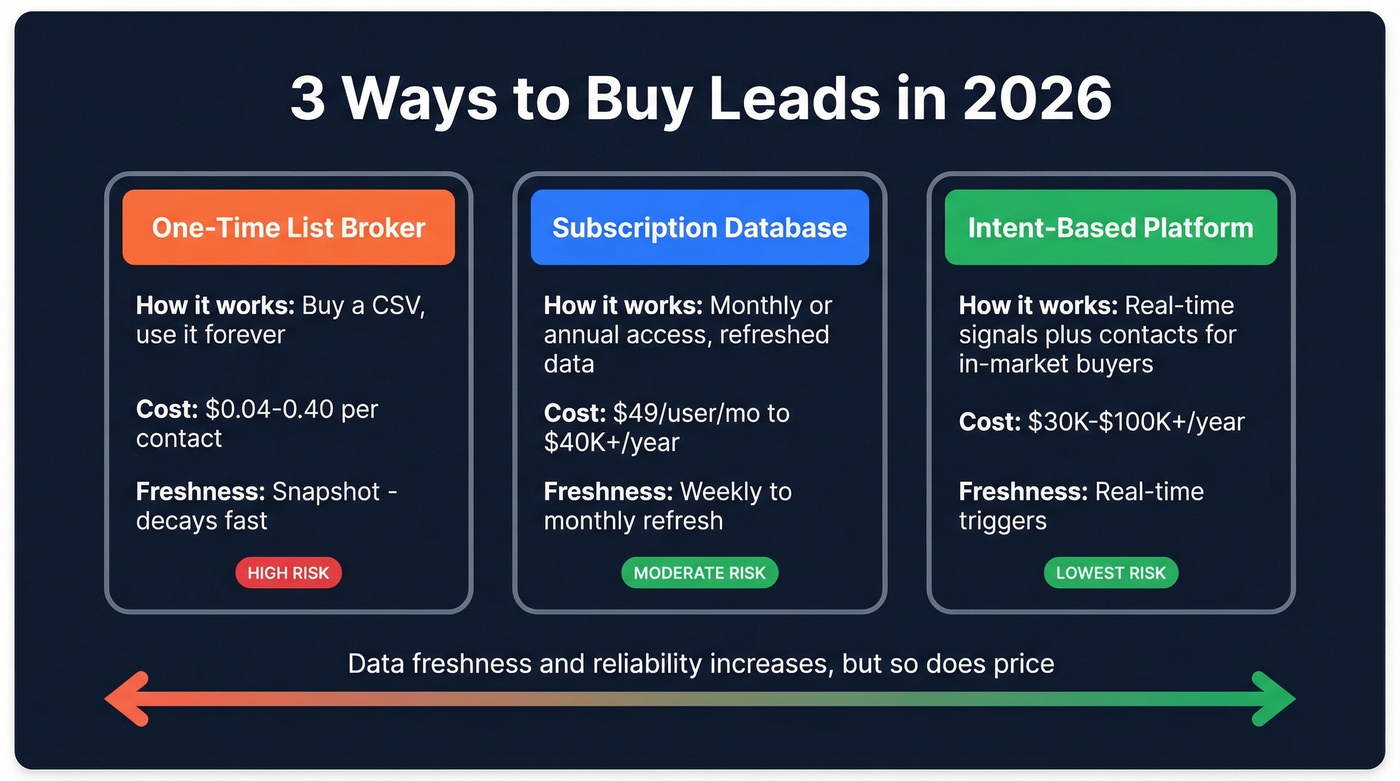
| Type | How It Works | Typical Cost | Data Freshness |
|---|---|---|---|
| One-time list broker | Buy a CSV, use it forever | $0.04-0.40/contact | Snapshot - decays fast |
| Subscription database | Monthly/annual access, refreshed data | $49/user/mo to $40K+/year | Weekly to monthly |
| Intent-based platform | Signals + contacts for in-market buyers | $30K-$100K+/year | Real-time triggers |
The old-school model - paying a broker for a static CSV - is the riskiest option. A one-time list of 10,000 contacts where up to 50% are already invalid is a fundamentally different product than a subscription database that refreshes weekly. Yet people compare them as if they're interchangeable.
Subscription and intent-based models have largely replaced brokers for serious outbound teams. The real question isn't whether to purchase contacts. It's which model matches your budget and workflow.
Should You Actually Purchase a Lead List?
The main reason teams still buy leads is speed. When you need to test a new market segment next week, building an organic pipeline from scratch isn't realistic. A purchased list gets reps dialing on day one.
But Reddit threads are brutal about the experience. Practitioners call out wrong industries, generic inboxes, contacts who left their roles months ago, and - the real killer - "overused" contacts who've already been hammered by every competitor using the same database. One user on r/SaaS put it bluntly: "I just paid to damage my own domain." In another widely shared thread, a B2B marketer said 70% of phone numbers from large databases were wrong, and the email contacts weren't much better.
The overuse problem is underrated. If you're buying from a broker who sells the same list to 50 other companies, your prospects are already numb to cold outreach before you even show up. The practitioners who've moved past list buying focus on intent signals - job changes, funding rounds, hiring surges - rather than static contact databases.
The Real Risks
Deliverability Damage
This is the risk that keeps experienced ops people up at night. Your bounce rate needs to stay under 2%, and spam complaints need to stay below 0.1%. Miss those thresholds and your sending domain takes a hit that affects every campaign you're running, not just the one using purchased contacts. If you want the full mechanics, start with our email deliverability guide and then tighten your email velocity before scaling.
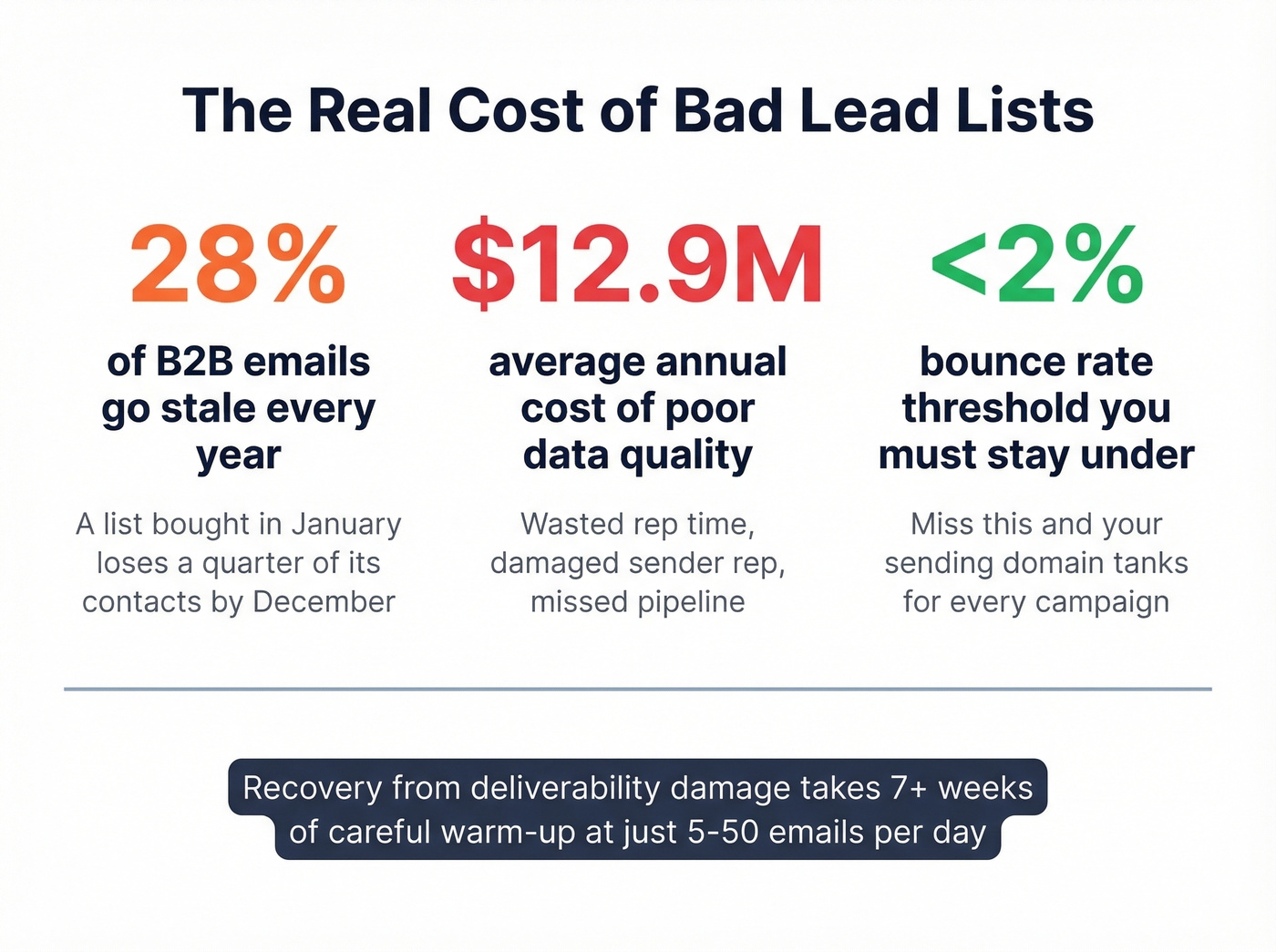
Recovery isn't quick. A proper warm-up schedule means weeks 1-2 at 5-10 emails/day, scaling to maybe 50/day per inbox by week 7+. That's nearly two months of reduced capacity because of one bad list.
Data Decay
B2B email addresses decay at 28% per year. A list purchased in January has lost roughly a quarter of its valid contacts by December. Poor data quality can cost organizations $12.9 million a year on average - a stat that sounds inflated until you factor in wasted rep time, damaged sender reputation, and missed pipeline. If you're trying to fix this systematically, pair list building with data enrichment services and a defined lead generation workflow.
A 7-day refresh cycle is the benchmark for freshness. Many competitors refresh every 4-6 weeks. One-time purchased CSVs never refresh. That's the real difference between buying a list and subscribing to a database: whether anyone's updating the data after you pay.
The Supply Chain Problem
Here's the thing most buyers never think about: where did the emails actually come from?
The lead list ecosystem runs on aggregators and resellers. Broker A buys data from Aggregator B, who scraped from Source C - and none of them verified the data along the way. By the time the list reaches you, nobody can tell you where the emails originated. Faceless bulk providers delivering cheap, low-quality contacts that get marked up and resold is endemic to this industry. If your provider can't tell you exactly how they sourced each contact, walk away. (If you're tempted to scrape, read our guide to web scraping lead generation first.)
Is It Legal to Buy Lead Lists?
Buying is legal almost everywhere. How you use the list is where you get into trouble. If you need a deeper breakdown by region, see our full guide on Is It Illegal to Buy Email Lists.
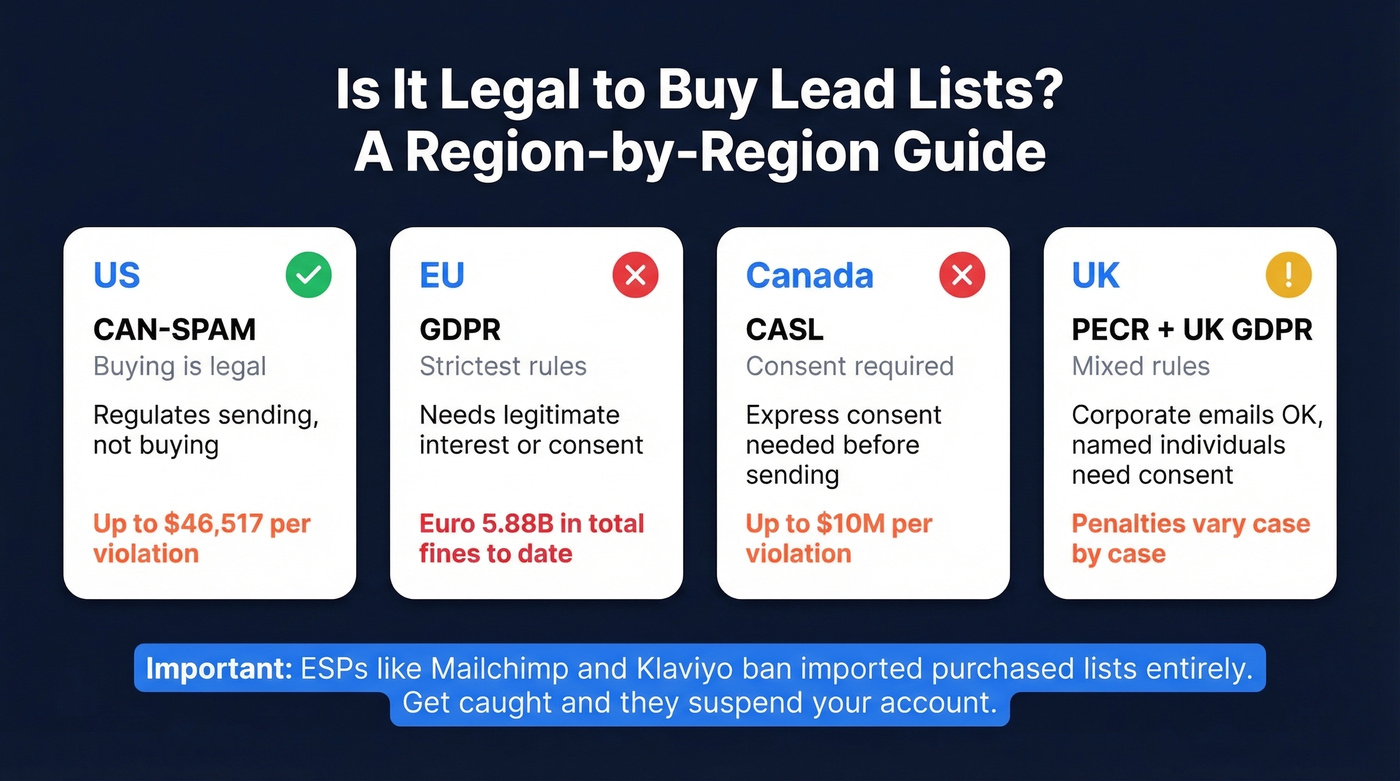
| Region | Law | Key Rule | Max Penalty |
|---|---|---|---|
| US | CAN-SPAM | Regulates sending, not buying | $46,517/violation |
| EU | GDPR | Needs legitimate interest or consent | Euro5.88B total fines to date |
| Canada | CASL | Requires express consent | $10M/violation |
| UK | PECR + UK GDPR | Corporate emails OK; named individuals need consent | Case-by-case |
The enforcement numbers are real. Vodafone Italia got hit with a Euro12.25M fine for using purchased lists affecting 4.5 million people. TIM paid Euro27.8M. In Canada, Hudson's Bay Company paid a $120K undertaking for unsubscribe failures, and the CRTC received 208,083 complaints in a single six-month period, with 48% citing lack of consent.
There's also a practical compliance layer most people miss: ESPs like Mailchimp and Klaviyo prohibit imported purchased lists entirely. Get caught and they'll suspend your account. GDPR-compliant emails achieve ~89.1% inbox placement versus 68% for non-compliant sends - compliance isn't just about avoiding fines, it's about deliverability.

Static lead lists decay at 28% per year and wreck your deliverability. Prospeo refreshes 300M+ profiles every 7 days - not 6 weeks - so every email you export is verified through a 5-step process before you pay. Teams like Meritt dropped their bounce rate from 35% to under 4%.
Stop buying dead data. Build a verified list in minutes for $0.01/email.
Best Places to Buy Lead Lists in 2026
Prospeo - Best for Verified Email Accuracy
Prospeo isn't a list broker - it's a self-serve database where every email runs through a 5-step verification process on proprietary infrastructure before you pay for it. The platform covers 300M+ professional profiles, includes 143M+ verified emails, hits 98% email accuracy, and refreshes data on a 7-day cycle.

The 30+ search filters include buyer intent powered by Bombora across 15,000 topics, technographics, job changes, headcount growth, and funding signals. You're not buying a static list - you're building a targeted one in real time and exporting only verified contacts. (If you're building lists in tools like Clay, our Clay list building breakdown will save you time.)
The results back this up. Meritt went from a 35% bounce rate to under 4% after switching. Stack Optimize maintains 94%+ deliverability across all clients, keeps bounce under 3%, and has zero domain flags. Pricing starts free with 75 emails and 100 Chrome extension credits per month, with paid plans running ~$0.01 per email. No contracts, no sales calls required.
Apollo.io - Best All-in-One Outbound Platform
Apollo combines a 275M+ contact database with built-in sequencing, a dialer, and 65+ search filters - all in one platform. For teams that want to find contacts and email them without stitching together three tools, it's where most teams start. If you're comparing options, use our roundup of sales prospecting databases and broader SDR tools to sanity-check fit.
The tradeoff is real, though. Email accuracy runs around 79%, which means roughly one in five emails won't land. We've seen teams pair Apollo with a dedicated email verification tool to close that gap - it's almost a requirement for high-volume sending. (If you need options, see our Bouncer alternatives.)
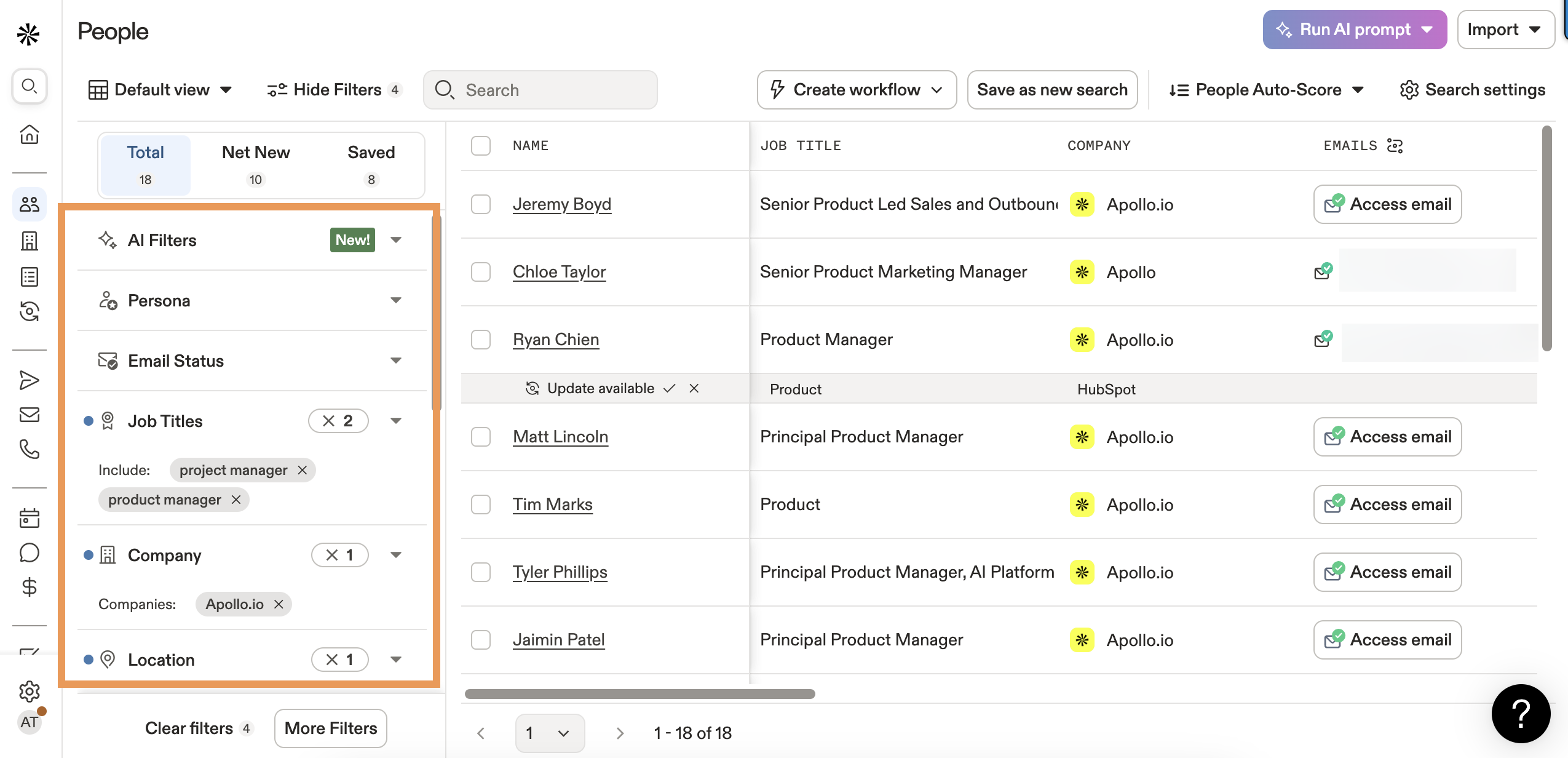
Pricing: Free tier available. Paid plans start at $49/user/mo (Basic), $79 (Professional), and $119 (Organization), all billed annually. Compared to ZoomInfo, Apollo wins on price and self-serve accessibility. Where ZoomInfo still wins: depth of company-level data and intent signals for enterprise ABM.
BookYourData - One-Time Purchases
Use this if you need a one-time batch of contacts without committing to a subscription. BookYourData's pay-as-you-go model starts at $99 for 250 contacts with a 97% accuracy guarantee backed by real-time verification and catch-all validation.
Skip this if you need ongoing prospecting, sequencing, or a full outbound platform. BookYourData is best treated as a one-time data purchase: buy a batch, download, and run your own outreach workflow. For teams testing a new market or running a one-off campaign, the no-subscription model makes sense. Just verify the list independently before sending.
ZoomInfo - Enterprise Data
ZoomInfo has the deepest company-level data in the market - firmographics, org charts, technographics, intent signals - and it's the default for enterprise sales orgs with budget to match. Pricing starts at ~$14,995/year for the Professional tier (5,000 credits, up to three users) and climbs to ~$39,995/year for Elite. Annual contracts only. The #1 complaint on Reddit? Paying for modules you don't use. If you're a 10-person team, this isn't your tool.
Cognism - European Compliance
Cognism screens data against 15 DNC lists and takes a GDPR-first approach that makes it a strong option for teams selling into Europe. Custom pricing typically runs ~$1,000-3,000/mo for small teams. Outside Europe, the database thins out considerably compared to Apollo or ZoomInfo.
Lusha - SMB Teams
Lusha keeps things simple - clean UI, quick setup, credit-based pricing starting with a free plan. Pro runs ~$22/user/mo and Premium ~$52/user/mo, both billed annually. It's a solid pick for small teams that need basic contact lookup without a complex platform. The tradeoff: a smaller database, so coverage gaps show up faster when you're prospecting outside major markets.
Also Worth Considering
UpLead ($99/mo, 170 credits) is a straightforward option for teams that want a lighter-weight database. Seamless.AI has a free trial with 50 credits and a large database, though accuracy reports are mixed on Reddit - expect pricing around $125-175/user/mo on annual plans. RocketReach (from $75/mo) focuses on contact lookup and works well as a supplementary tool. ListKit uses AI-driven prompts instead of traditional filters, which is an interesting approach, but it's too new to evaluate long-term accuracy.
Pricing Comparison
| Tool | Starting Price | Model | Free Tier? | Accuracy |
|---|---|---|---|---|
| Prospeo | ~$0.01/email | Credits | Yes | 98% |
| Apollo.io | $49/user/mo | Subscription | Yes | ~79% |
| BookYourData | $99/250 contacts | Pay-as-you-go | No | 97% |
| ZoomInfo | ~$14,995/yr | Annual contract | No | Not published |
| Cognism | ~$1,000/mo | Custom | No | Not published |
| Lusha | $22/user/mo | Credits | Yes | Not published |
| UpLead | $99/mo (170 credits) | Credits | Trial | Not published |
| Seamless.AI | ~$150/user/mo | Credits | Trial | Not published |
| RocketReach | $75/mo | Subscription | Trial | Not published |
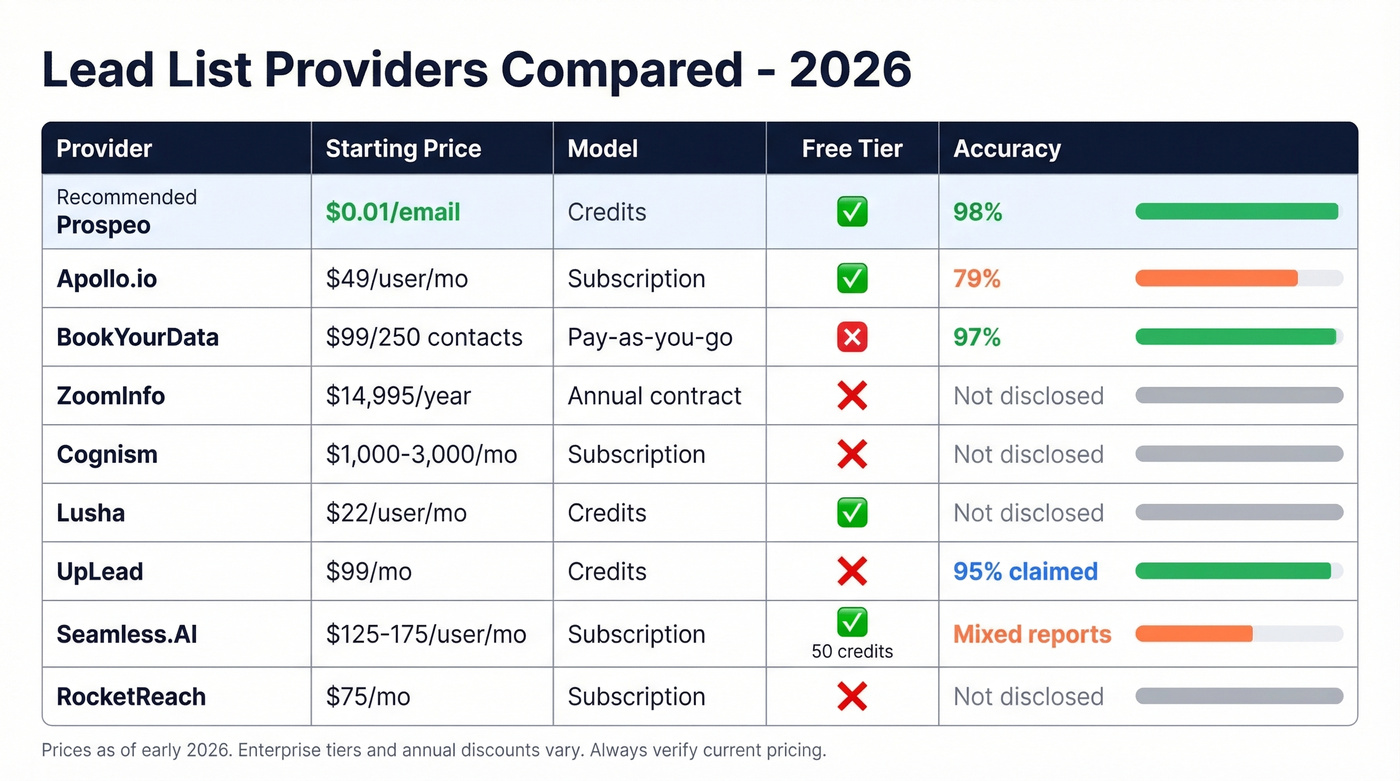
Most providers won't publish accuracy numbers. If a vendor can't tell you their verified email accuracy rate, ask why.
How to Evaluate a Provider Before You Buy
Before you commit, run through these eight questions:
- Source transparency - Are contacts first-party collected or aggregated from third parties?
- Exclusivity - Are you getting shared leads (sold to competitors) or exclusive data?
- Consent documentation - Can the vendor provide proof of how consent was obtained? Tools like TrustedForm capture timestamps and consent language.
- Data freshness - What's the refresh cycle? Weekly? Monthly? Never?
- Verification methodology - What does "verified" actually mean? A syntax check isn't verification.
- Compliance posture - Do they screen against DNC lists? Are they GDPR-ready?
- Refund/replacement policy - What happens when contacts bounce? Do you get credits back?
- Integration options - Can you push data directly into your CRM or sequencer?

If a provider can't answer questions 1, 3, and 5 clearly, walk away.
Build Your Own List Instead
Let's be honest: if your average deal size is under $50K, you almost certainly don't need a traditional list broker. Self-serve databases have made them unnecessary for any team with 30 minutes and a clear ICP.
The workflow is straightforward. Set your ICP filters - industry, headcount, job title, buyer intent signals, technographics - preview results, export verified contacts, and push them straight to Salesforce, HubSpot, Smartlead, or Instantly. Same-day outreach, every email pre-verified. If you need a scoring rubric before you export, use an ideal customer profile template and tighten your firmographic filters.
The cost math is stark. A purchased CSV runs $0.04-0.40 per contact with no accuracy guarantee. Self-serve platforms charge ~$0.01 per verified email. When B2B SaaS blended CPL averages $237, the per-contact cost difference seems small - but the difference between 98% deliverability and 60% deliverability is the difference between a pipeline and a burned domain.
The biggest risk of buying lead lists is the supply chain you can't see. Prospeo uses proprietary email-finding infrastructure - no third-party resellers, no recycled CSVs. 98% email accuracy, 30+ filters including buyer intent across 15,000 topics, and you only pay for verified contacts. No contracts, cancel anytime.
Replace your list broker with a database that actually verifies every contact.
FAQ
Is it legal to buy lead lists?
Yes, purchasing lead lists is legal in most jurisdictions. CAN-SPAM regulates sending behavior (not buying) in the US, GDPR requires legitimate interest or consent in the EU, and CASL requires express consent in Canada. Always verify compliance for your target region before sending a single email.
How much do lead lists cost?
One-time broker lists run $0.04-$0.40 per contact. Database subscriptions range from free tiers to $40K+/year. Self-serve platforms charge ~$0.01 per verified email, which is the most cost-efficient option for teams running ongoing outbound campaigns.
What's the difference between shared and exclusive leads?
Shared leads are sold to multiple buyers - cheaper, but they convert worse because prospects have already been contacted by competitors. Exclusive leads are sold once, cost more, and typically convert at higher rates. Always ask which type you're getting before you pay.
How do I verify a purchased list before sending?
Run every purchased list through a dedicated email verification tool before loading it into your ESP. Target a bounce rate under 2%. Never send to an unverified list - one bad send can damage your domain reputation for weeks and tank every active campaign.
What's the best alternative to buying lead lists?
Self-serve B2B databases where you build targeted lists using ICP filters and get verified data in real time. The static CSV model is a relic - building a fresher, more accurate list yourself takes minutes and costs less per usable contact.