

Email Lead Generation: The Inbound & Outbound Playbook for 2026
One in six legitimate emails never reaches the inbox. That 83.5% global inbox placement rate means your perfectly crafted outreach is worthless if your infrastructure is broken - and most teams don't realize theirs is until a campaign tanks. Email lead generation remains the highest-ROI channel in B2B, but only when data quality, deliverability, and compliance are locked down before you write a single subject line.
We're covering both disciplines here - inbound opt-in nurture and outbound cold prospecting - with the benchmarks, tools, and checklists that keep campaigns alive.
What Is Email Lead Generation?
It's the process of identifying and engaging potential buyers through email, either by attracting them to opt in or by reaching out cold to net-new prospects. In B2B, 61% of decision-makers prefer email over calls or social when the content is relevant, and the channel returns $36-$40 for every $1 spent - consistently outperforming paid social, display, and most content marketing.
In practice, it comes down to filling your pipeline with qualified contacts who match your ideal customer profile and moving them toward a buying decision.
The Numbers That Matter
Channel Economics
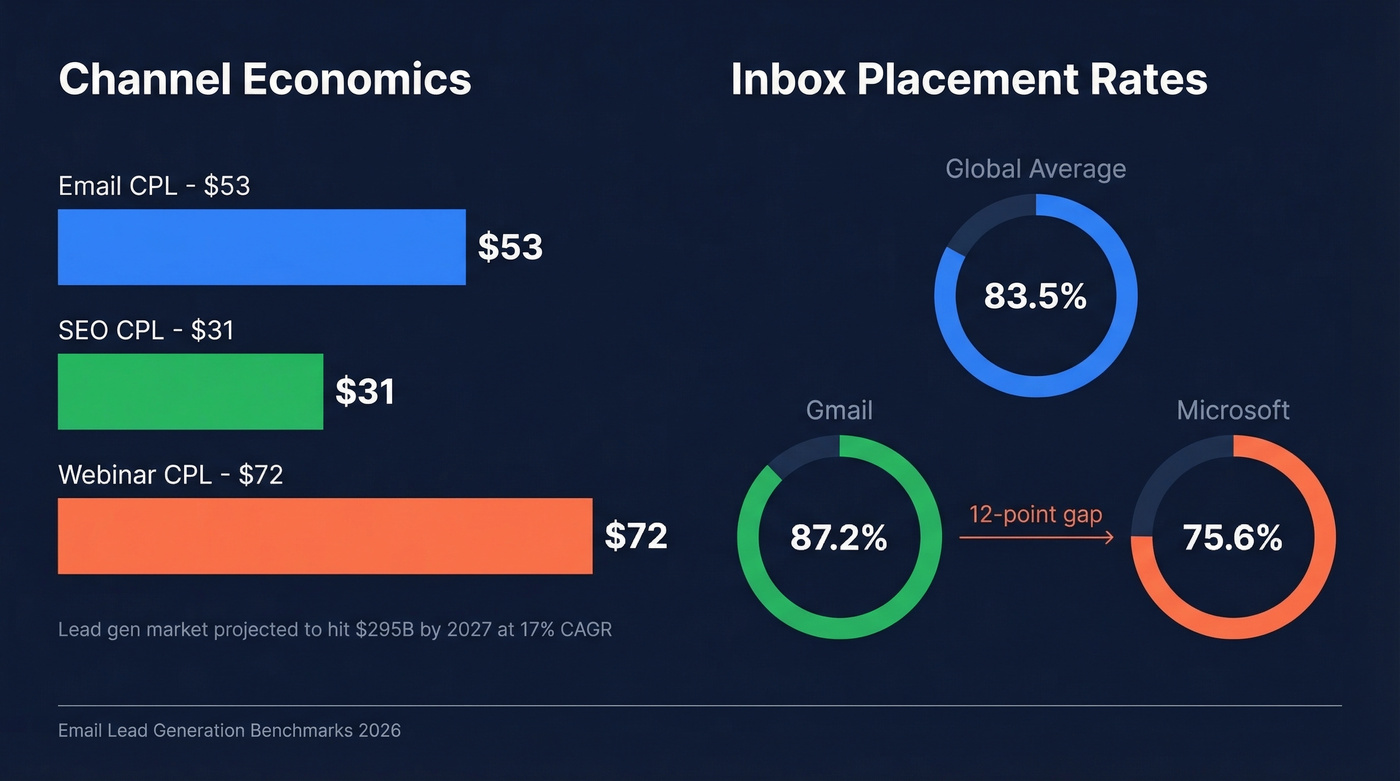
| Benchmark | Number |
|---|---|
| Email CPL | $53 |
| SEO CPL | $31 |
| Webinar CPL | $72 |
| [Lead gen market size (projected 2027)](https://www.businesswire.com/news/home/20210126005925/en/Global-Content-Marketing-Market-Trajectory-Analytics-Report-2020-2027-Lead-Generation-is-Projected-to-Account-for-US%24295.1-Billion-of-the-Total-%24829.6-Billion-Industry - ResearchAndMarkets.com) | $295B at ~17% CAGR |
Conversion & Deliverability
| Benchmark | Number |
|---|---|
| Leads that never convert | 79% |
| Generating quality leads cited as top challenge | 61% of marketers |
| Global inbox placement rate | 83.5% |
| Gmail inbox placement | 87.2% |
| Microsoft inbox placement | 75.6% |
That Gmail vs. Microsoft gap matters. It's a 12-point swing in inbox placement before you've even written copy.
Inbound: Lead Magnets and Automation
Lead Magnets That Convert
The long-form ebook is dead as a lead magnet. Templates, checklists, and calculators consistently outperform 30-page PDFs because they deliver an immediate win - over 50% of marketers report higher conversion rates from magnets that solve one specific problem fast.
What's working right now:
- Diagnostic quizzes - "Score your outbound readiness in 2 minutes"
- ROI calculators - let prospects plug in their own numbers
- Swipe files - proven email templates or sequences
- Micro-samples - free access to one module of a paid course
A 1-page checklist someone uses today converts better than a 40-page guide they bookmark and forget. The best inbound campaigns pair these magnets with segmented follow-up sequences rather than dumping every subscriber into the same nurture track.
Automated Flows vs. One-Off Campaigns
Klaviyo's benchmark data across 183,000+ customers reveals a massive performance gap. Flows generate roughly 41% of total email revenue from just 5.3% of sends, with revenue per recipient running 18x higher than campaigns. Click rates on flows hit 5.58% versus 1.69% for campaigns, and 48% of flow-driven revenue comes from new buyers compared to just 16% for campaigns.
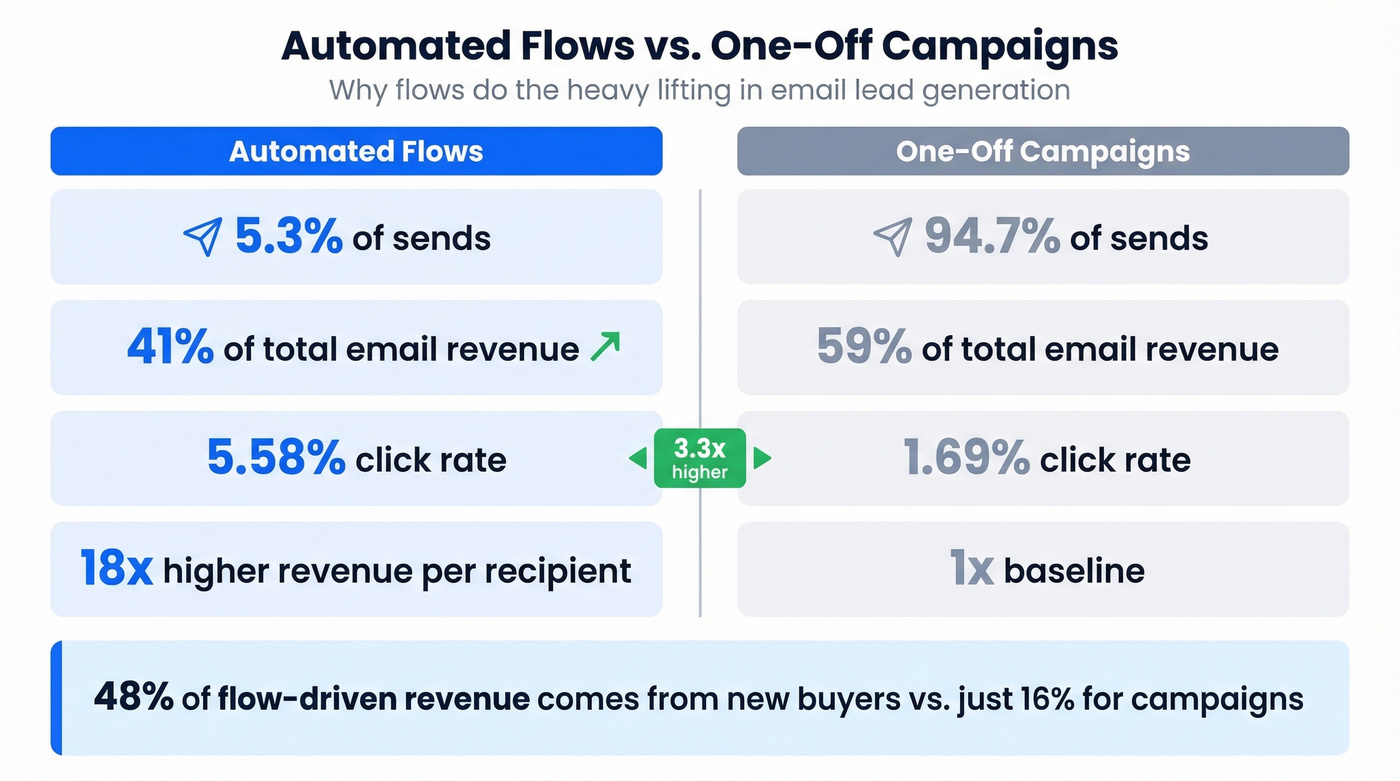
The takeaway isn't "stop sending campaigns." It's that your welcome sequence, demo-request follow-up, and re-engagement automation are doing the heavy lifting. If you're spending 80% of your time on newsletters and 20% on flows, flip that ratio.
With 30% of B2B sales cycles running 1-3 months and another 25% stretching longer, automated nurture isn't optional - it's how you stay in the conversation until a prospect is ready to buy. Track influenced pipeline and reactivation rate alongside standard engagement metrics. These tell you whether nurture is actually moving revenue, not just generating clicks.
Outbound: Infrastructure and Execution
Sending Infrastructure
Here's the thing about outbound deliverability: it's fragile. The consensus on r/coldemail and across every practitioner community is the same - infrastructure discipline matters more than copy.
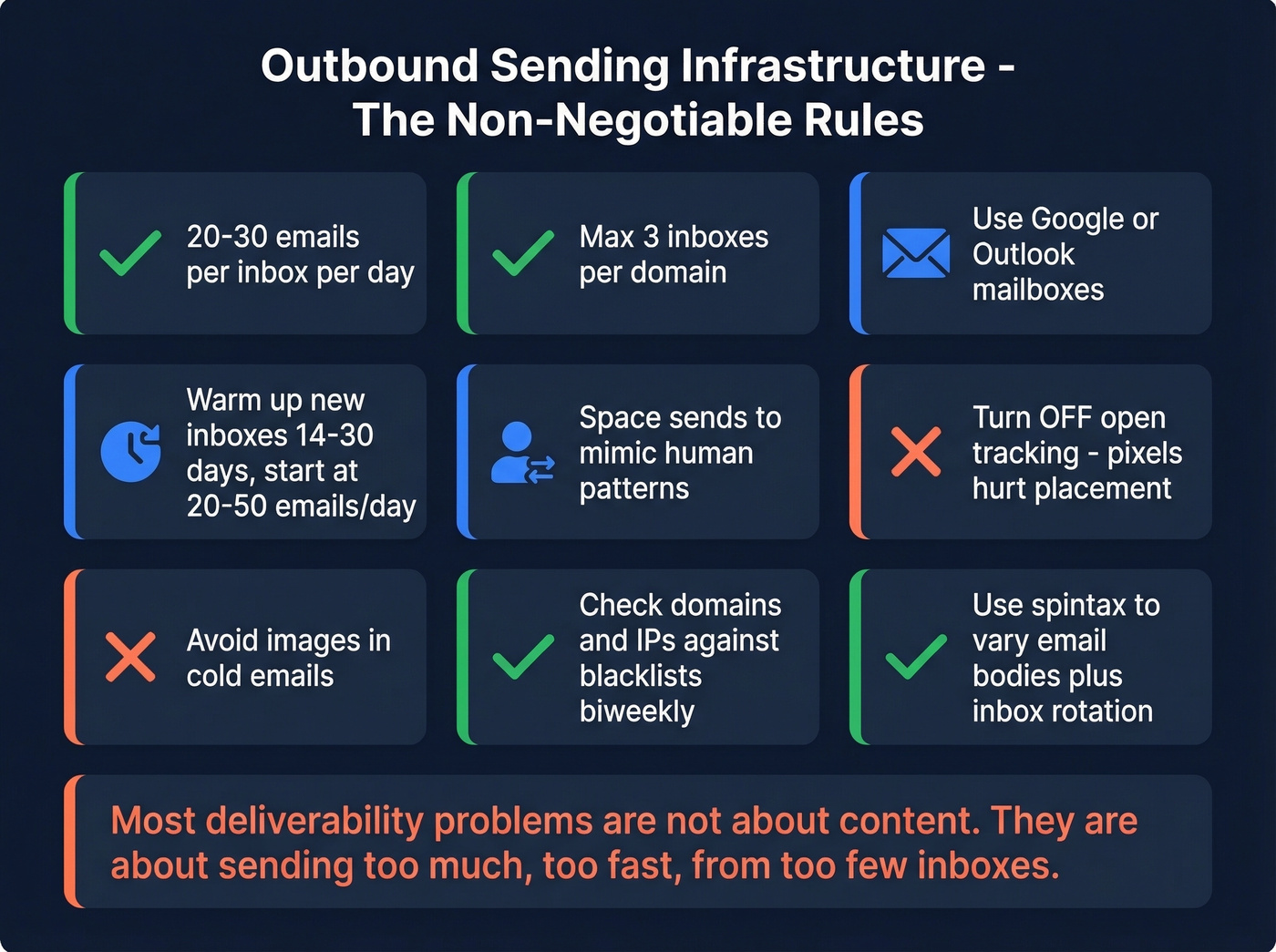
The non-negotiable rules:
- 20-30 emails per inbox per day
- Max 3 inboxes per domain
- Use Google or Outlook mailboxes
- Warm up new inboxes 14-30 days, starting around 20-50 emails/day
- Space sends to mimic human patterns
- Turn off open tracking - tracking pixels hurt placement
- Avoid images in cold emails
- Check domains and IPs against blacklists biweekly
- Use spintax to vary email bodies + inbox rotation
Most deliverability problems aren't about content. They're about sending too much, too fast, from too few inboxes.
Outbound KPIs
Stop measuring open rates for cold email. With tracking pixels hurting deliverability and Apple's Mail Privacy Protection inflating numbers, opens are a vanity metric.
| Metric | Average | Top Performer |
|---|---|---|
| Reply rate | 3-5% | 15-25% |
| Positive reply rate | 1-2% | 5-10% |
| Meetings per 1,000 delivered | 3-8 | 15-30 |
| Bounce rate | <5% | <2% |
| Spam complaint rate | <0.3% | <0.1% |
If your reply rate is under 3%, the problem is almost always targeting or data quality - not your subject line.
Cold Email Framework
Most cold emails fail because they lead with the sender instead of the prospect. Use intent signals - buyer intent topics, job changes, funding events, headcount growth - to find the right prospects, then structure the message around their situation:
- Subject line: One word or short phrase performs best. Name personalization lifts open rates from ~10% to 39%. (If you need ideas, start with proven subject line examples.)
- Opening line: Reference something specific - a recent hire, a funding round, a tech stack change. No "I hope this finds you well."
- Value prop: One sentence. What outcome you deliver, not what your product does.
- CTA: Low-friction ask. "Worth a 15-min call?" beats "Book a demo." (More email call to action patterns help here.)
Let's be honest: if your deals average under $10K, you probably don't need a 5-step sequence. A single well-targeted email with a strong CTA will outperform a bloated drip campaign that annoys people into unsubscribing.
Why Data Quality Decides Everything
We've audited dozens of outbound setups, and the failure pattern is always the same. A team launches a 500-email campaign with an unverified list. Bounce rate hits 12%. The ESP flags the domain. Deliverability tanks across all campaigns - including the ones going to verified contacts. One bad send poisons the well.
The fix is non-negotiable: verify every email before it enters a sequence. Bounce rates need to stay under 2%, and anything above 5% means you should stop sending immediately. (If you want the deeper benchmarks and error-code breakdown, see email bounce rate.)
Prospeo's 5-step verification process with catch-all handling, spam-trap removal, and honeypot filtering on a 7-day refresh cycle keeps domains clean at 98% email accuracy. Meritt, an outbound agency, dropped their bounce rate from 35% to under 4% after switching - and tripled their pipeline from $100K to $300K per week.

Every bounced email erodes your domain reputation - and one bad send can tank deliverability for weeks. Prospeo's 5-step verification with catch-all handling, spam-trap removal, and honeypot filtering delivers 98% email accuracy at $0.01 per lead. Meritt cut their bounce rate from 35% to under 4% and tripled pipeline to $300K/week.
Stop poisoning your domain with unverified lists.
The Deliverability Checklist
Gmail, Yahoo, and Microsoft have all tightened enforcement since early 2024. If you're sending more than 5,000 emails per day, these are requirements, not suggestions.
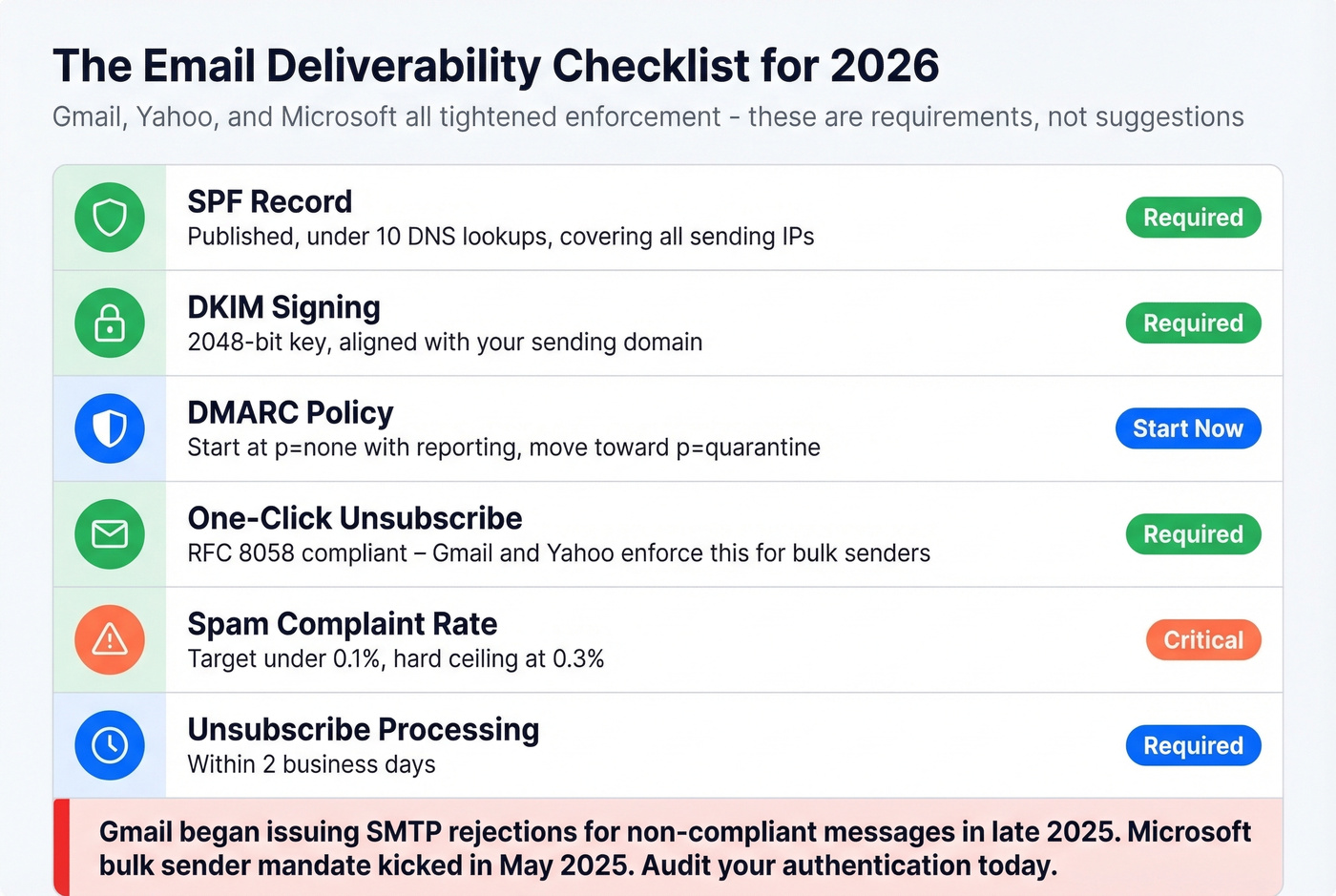
- SPF: Published, under 10 DNS lookups, covering all sending IPs (use these SPF record examples to sanity-check yours)
- DKIM: 2048-bit key, aligned with your sending domain (here’s how to verify DKIM is working)
- DMARC: At minimum
p=nonewith reporting - move towardp=quarantineas you gain confidence (make sure you understand DMARC alignment) - One-click unsubscribe: RFC 8058 compliant - Gmail and Yahoo enforce this for bulk senders
- Spam complaint rate: Target under 0.1%, hard ceiling at 0.3%
- Unsubscribe processing within 2 business days
Gmail began issuing SMTP 4xx/5xx rejections for non-compliant messages in late 2025. Microsoft's bulk sender mandate kicked in May 2025. If you haven't audited your authentication in six months, do it today.
Compliance: CAN-SPAM vs. GDPR
These two frameworks work on opposite principles. CAN-SPAM is opt-out by default; GDPR is opt-in. Getting this wrong isn't a slap on the wrist.
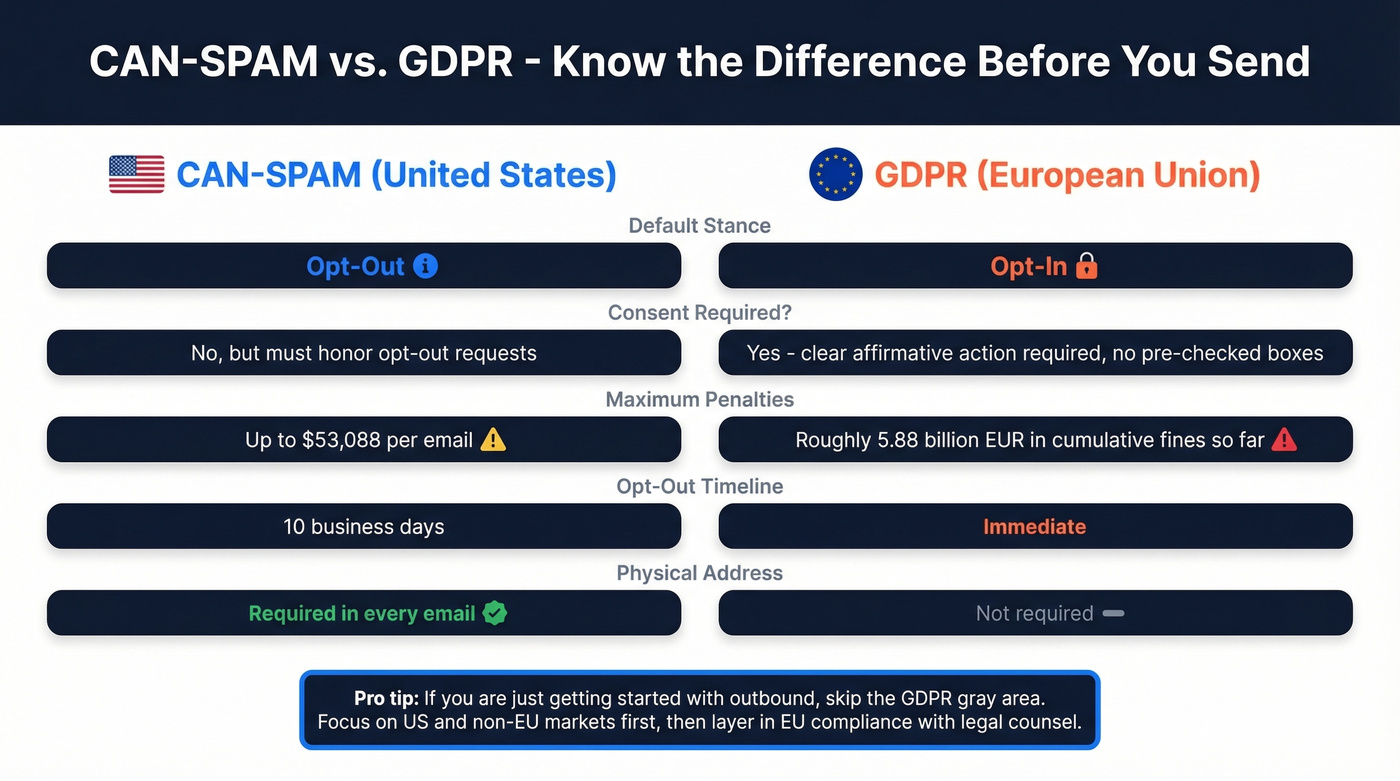
| Requirement | CAN-SPAM | GDPR |
|---|---|---|
| Default stance | Opt-out | Opt-in |
| Consent needed? | No, but must honor opt-out | Yes - affirmative action |
| Penalties | Up to $53,088/email | ~EUR 5.88B cumulative |
| Opt-out timeline | 10 business days | Immediate |
| Physical address | Required | Not required |
For US-focused outbound, CAN-SPAM is your baseline: include a physical address, don't use deceptive headers, and honor opt-outs within 10 business days. For EU prospects, GDPR requires consent as a clear affirmative action - no pre-checked boxes. The "legitimate interest" basis can apply to existing customers, but cold outreach to new EU contacts needs careful legal footing.
Skip the GDPR gray area entirely if you're just getting started. Focus on US and non-EU markets first, nail your process, then layer in EU compliance when you have legal counsel involved. (If you need the legal nuance, start with Is it illegal to buy email lists?.)
Essential Tools
Data & Verification
Prospeo is our top pick for a reason. The 7-day data refresh cycle is the key differentiator - the industry average sits at six weeks, which means most databases are serving you stale contacts. Layer in buyer intent signals across 15,000 topics to prioritize accounts showing active purchase behavior, and use 30+ search filters to build lists by technographics, job changes, headcount growth, funding, and revenue. Native integrations with Instantly, HubSpot, Salesforce, and Clay mean your data flows straight into whatever you're already using. Pricing runs about $0.01 per email with a free tier to start.

Apollo.io combines a B2B database with built-in sequencing, which makes it attractive for teams that want one platform. Free tier available, paid plans from $49/user/month. The tradeoff: email accuracy sits around 79% vs. 98% from Prospeo, so you'll burn through more credits on bad addresses. (If you’re comparing sources, see our breakdown of B2B company data providers.)
Cold Email Outreach
Instantly is the best sequencing tool for most outbound teams. Inbox rotation, built-in warmup, A/B testing, and clean UX - plans start around $30/month. But Instantly is only as good as the data you feed it. Pair it with verified contacts and it performs. Feed it an unverified list and you'll burn inboxes faster than you can warm them up. (For more on safe scaling, use an email velocity framework.)
Inbound & CRM
HubSpot is the default for inbound. The free CRM is genuinely useful, and paid Marketing Hub automation ranges from $15 to $3,600/month depending on features and contact volume. Mailchimp works for SMBs that need email marketing without the complexity - free plans available, paid starting around $13/month.
The Quick-Start Stack
| Category | Tool | Starting Price |
|---|---|---|
| Data & verification | Prospeo | Free tier, ~$0.01/email |
| Cold email outreach | Instantly | ~$30/mo |
| CRM & inbound | HubSpot | Free |
Total cost: under $200/month. That's enterprise-grade prospecting infrastructure at a fraction of what a ZoomInfo contract runs.
Intent signals, job changes, funding rounds, headcount growth - the article's cold email framework only works when you can actually find and reach the right people. Prospeo's 300M+ profiles with 30+ filters let you layer buyer intent across 15,000 topics, then export verified contacts that land in inboxes, not spam folders.
Target the signal. Skip the bounce. Book 26% more meetings.
Email Lead Generation FAQ
What's the difference between inbound and outbound?
Inbound targets contacts who've opted in through lead magnets, newsletters, or webinars - you nurture them with automated flows. Outbound targets net-new prospects using cold email sequences. They require different tools, metrics, and compliance approaches, though most mature teams run both in parallel.
How many cold emails can I send per day safely?
Cap at 20-30 emails per inbox per day, with a maximum of 3 inboxes per domain. Warm up new inboxes for 14-30 days before scaling. Exceeding these limits is the fastest way to land in spam - even with perfect copy and verified data.
What tools do I need to start?
Three tools cover the fundamentals: a data provider like Prospeo for verified contacts (98% accuracy, free tier with 75 credits), a sending tool like Instantly for sequences and warmup (~$30/mo), and HubSpot's free CRM for tracking pipeline. Total stack cost: under $200/month.
How do I start with zero pipeline?
Build a tightly targeted list of 200-500 prospects using firmographic and intent filters, verify every address, and send a simple two-step sequence from a properly warmed domain. Measure positive reply rate and meetings booked - not opens. Scale only after bounce rates stay under 2% and you've validated your messaging.
Which industries see the best results?
SaaS, professional services, financial services, and manufacturing see the highest ROI because they combine high contract values ($25K+) with long sales cycles. The economics easily support the $53 average CPL, and multi-threaded outreach to buying committees compounds the return per account.