

How to Calculate Cost Per Lead (And Why Your Formula Is Probably Wrong)
Your CMO asks for last quarter's cost per lead. You pull ad spend, divide by leads, and send over a number. It's wrong - probably by 2-3x.
Knowing how to calculate cost per lead correctly starts with getting the inputs right, and the inputs most teams use are incomplete. They miss labor, tools, creative costs, and worst of all, they count leads that aren't real people. We've watched teams report a $50 CPL that's actually $150 once you load in the costs they conveniently left off the slide deck.
The Quick Version
The basic cost per lead formula is Total Marketing Spend / Total Leads. Most teams undercount costs by 2-3x. Track two numbers: media CPL for campaign optimization, and fully-loaded CPL for real ROI decisions. Then go further and calculate your cost per qualified lead (CPQL), because a $50 CPL means nothing if only 5% of those leads are actual prospects.
What Cost Per Lead Actually Means
Cost per lead measures how much you spend to generate a single lead:
CPL = Total Spend / Total Leads
Spend $10,000 on a campaign that produces 200 leads, and your CPL is $50. Simple enough. But this metric isn't the same as customer acquisition cost (CAC), which includes sales costs and tracks all the way through to a closed deal. CPL stops at the top of the funnel - someone raised their hand, and you're measuring what that hand-raise cost you.
You'll also see related acronyms: CPMQL (cost per marketing qualified lead), CPSQL (cost per sales qualified lead), and LAC (lead acquisition cost). They're all variations on the same idea.
The Formula Everyone Gets Wrong
Here's the thing: that $50 number is probably your media CPL - ad spend only. Useful for optimizing campaigns. Not your real cost per lead.
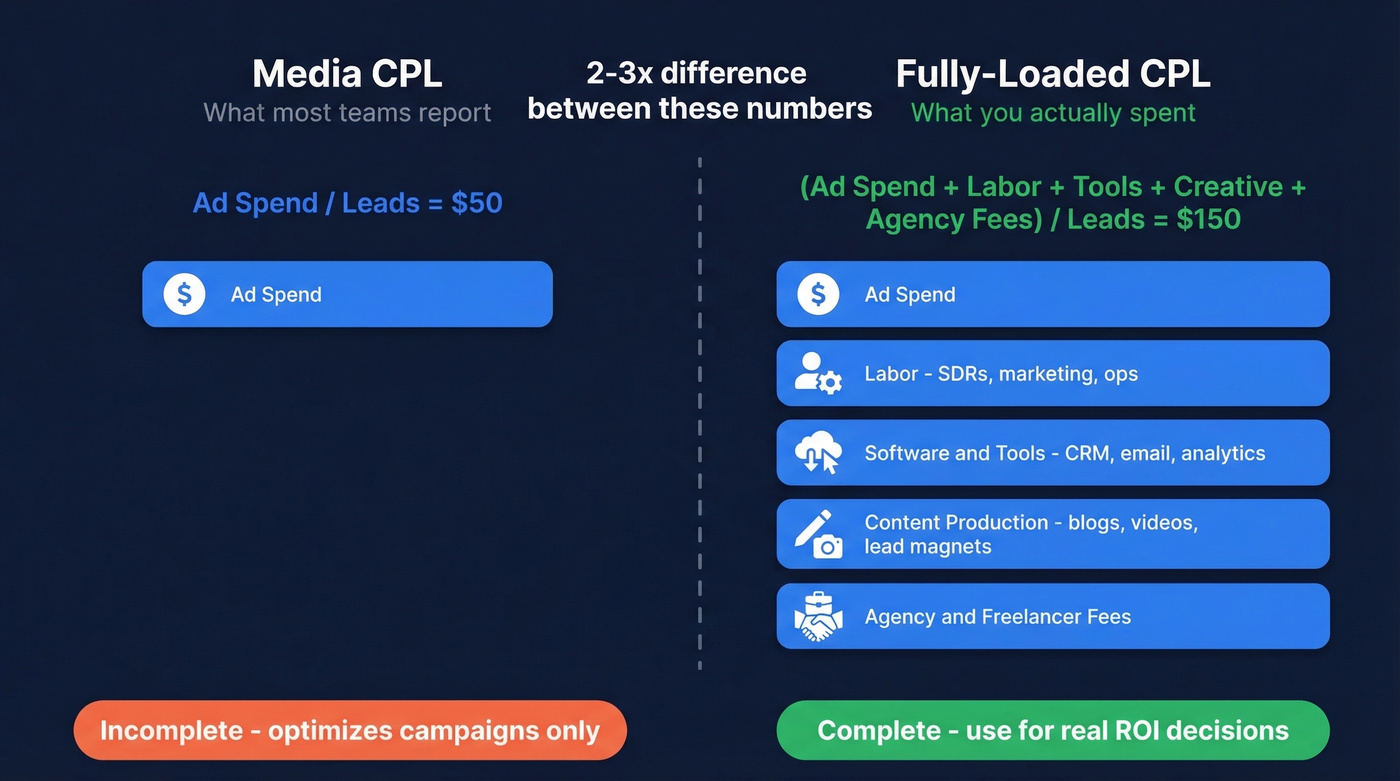
A fully-loaded CPL includes everything you actually spent to generate those leads:
Fully-Loaded CPL = (Ad Spend + Labor + Tools + Creative + Agency Fees) / Total Leads
Fully-loaded CPL runs 2-3x higher than media CPL. That $50 lead? Probably $100-150 when you count everything.
Most teams miss these cost categories:
- Labor - the portion of SDR, marketing, and ops salaries dedicated to lead gen
- Software and tools - CRM, email platform, analytics, landing page builders, SEO tools
- Content production - blog posts, videos, lead magnets, landing pages
- Agency and consultant fees - retainers, project fees, freelancers
- Events and sponsorships - booth costs, travel, swag (if lead-focused)
Track both numbers. Use media CPL to optimize individual campaigns. Use fully-loaded CPL when your CFO asks whether marketing is actually profitable.
Step-by-Step CPL Examples by Channel
Google Ads
Google Ads average CPC hit $5.26 across the Apr 2024-Mar 2025 period - up 12.88% year-over-year across a WordStream dataset of 16,446 campaigns. If your landing page converts at 20%, your media CPL is:
$5.26 / 0.20 = $26.30 per lead
Now add the SDR who qualifies those leads (2 hours/day, about 25% of a workday, on a $70k salary = ~$67/day), plus your $200/mo landing page tool, plus the freelancer who wrote the ad copy. Suddenly that $26 lead is $55+. That's your loaded CPL.
Facebook Ads
Facebook Lead Ads run cheaper on a per-click basis - CPC averages $1.92 versus Google's $5.26. But CPL rose 20.94% year-over-year to $27.66 across 1,000+ campaigns. On a $2,000 monthly spend, that's roughly 72 leads. Decent volume, but quality varies dramatically depending on your targeting and form friction.
SEO and Content
Content costs are distributed over time, and the payoff is nonlinear. Say you're spending $4,000/month - $2,500 for a writer, $500 for SEO tools, $1,000 in team time for editing and distribution. If that content generates 20 leads per month, your CPL is $200, which tracks with Sopro's benchmark of $206 average CPL for SEO.
But month 1 might produce 3 leads while month 12 produces 40 - from the same content. Snapshot CPL is misleading for content. Cohort it over 6-12 months.
Cold Email
Sopro's data puts cold emails at $225 CPL on average, with a range of $150-$300. Can you beat that? A lean program might cost $1,500/month - $500 for tools (sequencer, data provider, verification) plus $1,000 in SDR time for list building, writing, and follow-up. Eight qualified replies per month puts your CPL at $187.50, comfortably below the benchmark. The key variable is list quality: bad data means wasted sends and inflated CPL.
The bridge formula that trips people up on Reddit threads is simple: CPL = CPC / Conversion Rate. A $10 CPC with a 20% conversion rate gives you a $50 CPL. That's media CPL - add your loaded costs on top.
CPL vs CPA vs CAC vs CPC
These four metrics sit at different points in the funnel, and confusing them is one of the most common mistakes we see.
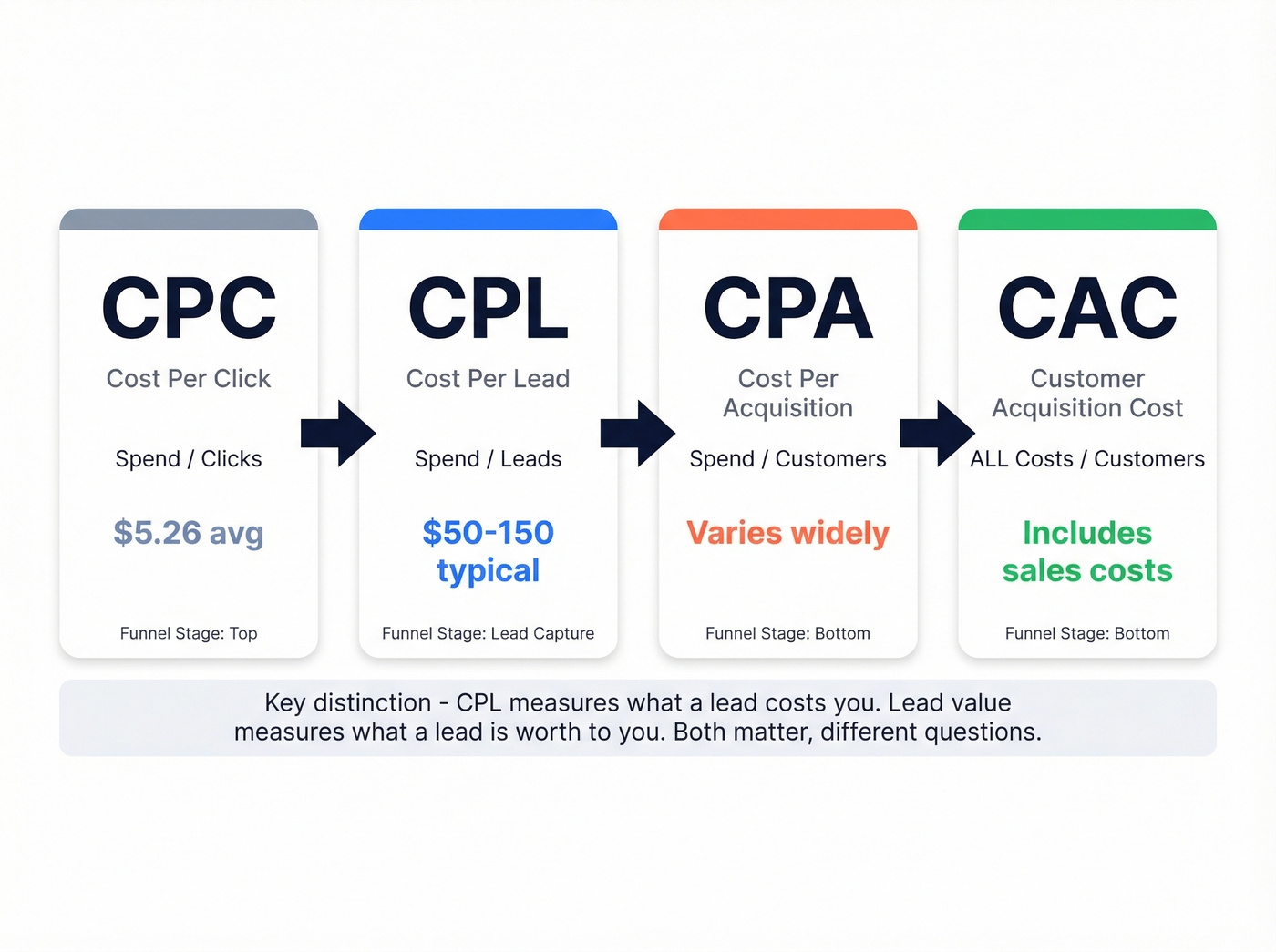
| Metric | What It Measures | Formula | Funnel Stage |
|---|---|---|---|
| CPC | Cost per click | Spend / Clicks | Top |
| CPL | Cost per lead | Spend / Leads | Lead capture |
| CPA | Cost per acquisition | Spend / Customers | Bottom |
| CAC | Full acquisition cost | All costs / Customers | Bottom |
One important distinction: CPL and "lead value" aren't the same thing. A common confusion on r/advertising is calculating $24,000 deal value x 3% close rate = $720 and calling that "CPL." That's expected value per lead - what a lead is worth to you. CPL is what the lead cost you. Both matter, but they answer different questions.
A lead who first clicked a blog post, then attended a webinar, then requested a demo illustrates another wrinkle: first-touch attribution credits the blog at $200 CPL, while last-touch credits the demo page at $50 CPL. Same lead, wildly different CPL by channel.

Bad contact data inflates your CPL by 43% or more. Prospeo's 98% email accuracy and 5-step verification mean you stop paying for leads that bounce. At $0.01 per verified email, your fully-loaded CPL drops fast.
Stop dividing spend by leads that don't exist.
Why CPL Alone Destroys Budgets
Let's say your dashboard shows a $50 CPL across 200 leads. Looks great. But your SDRs work those 200 leads and only 10 are actual prospects - the rest are students, competitors, wrong titles, or people who fat-fingered a form.
If you want a cleaner way to operationalize this, build a simple lead scoring model and enforce it in your lead generation workflow.
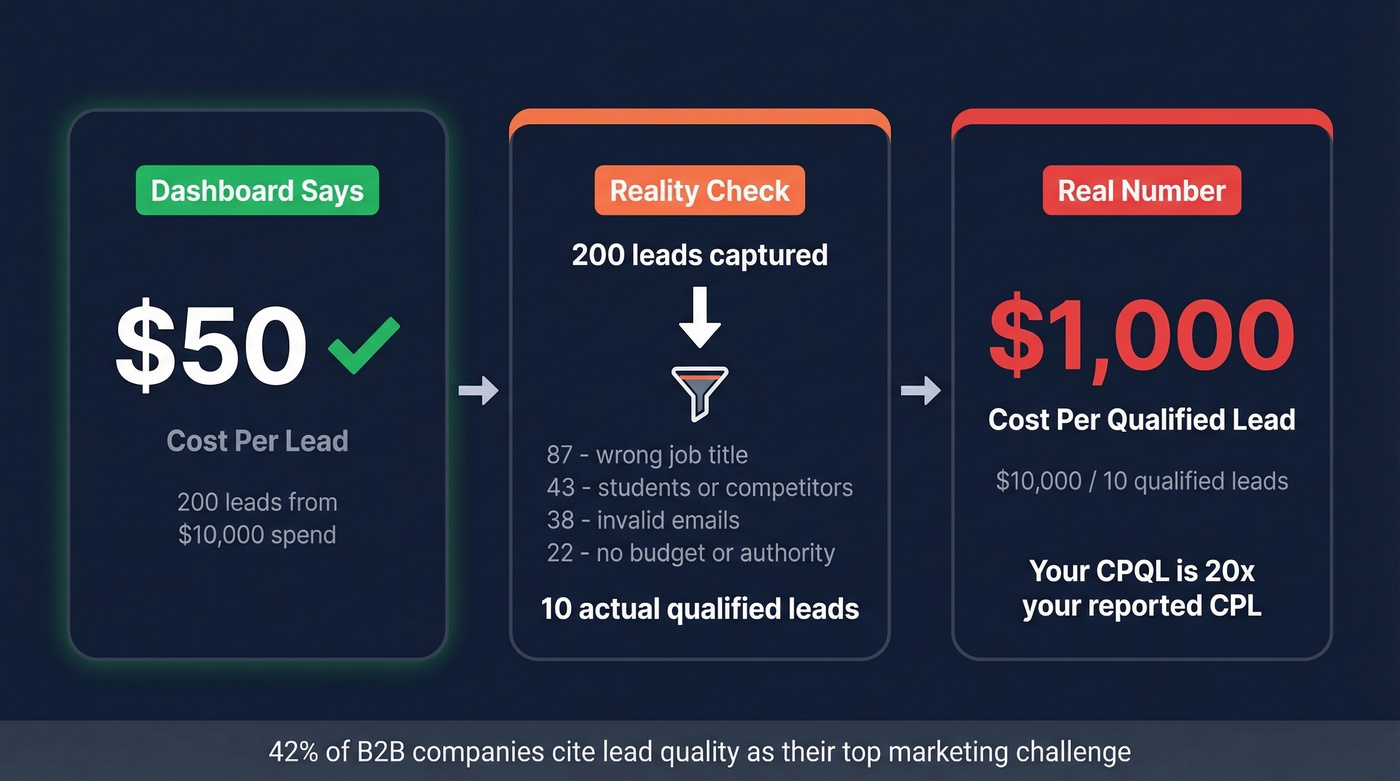
$10,000 / 10 qualified leads = $1,000 CPQL
That $50 CPL was a vanity metric. The number that matters is $1,000.
CPQL = Total Marketing Spend / Number of Qualified Leads
This isn't a niche problem. 42% of B2B companies cite lead quality as their top marketing challenge. Per 321 Web Marketing's framework, a qualified lead meets firmographic fit (right industry, size, title), hits engagement thresholds (multiple visits, content downloads), and shows intent signals like pricing page visits or demo requests.
Qualification is one problem. Data quality is another entirely. If 30% of your leads have invalid emails, your effective CPL is 43% higher than your dashboard shows. Bad contact data turns leads into phantom line items - you paid for them, but they don't exist in any meaningful way. Running lead lists through Prospeo's email verification before reporting CPL changes the math: at 98% email accuracy, you remove invalid contacts before counting leads, so your denominator reflects real people instead of dead data.

Remember that Reddit poster claiming $0.33 per lead through automated scraping? Perfect example. At $0.33, you're not buying leads - you're buying rows in a spreadsheet. Without qualification and verification, that number is meaningless. (If you're doing this at scale, read our guide to web scraping lead generation.)
2026 CPL Benchmarks by Industry and Channel
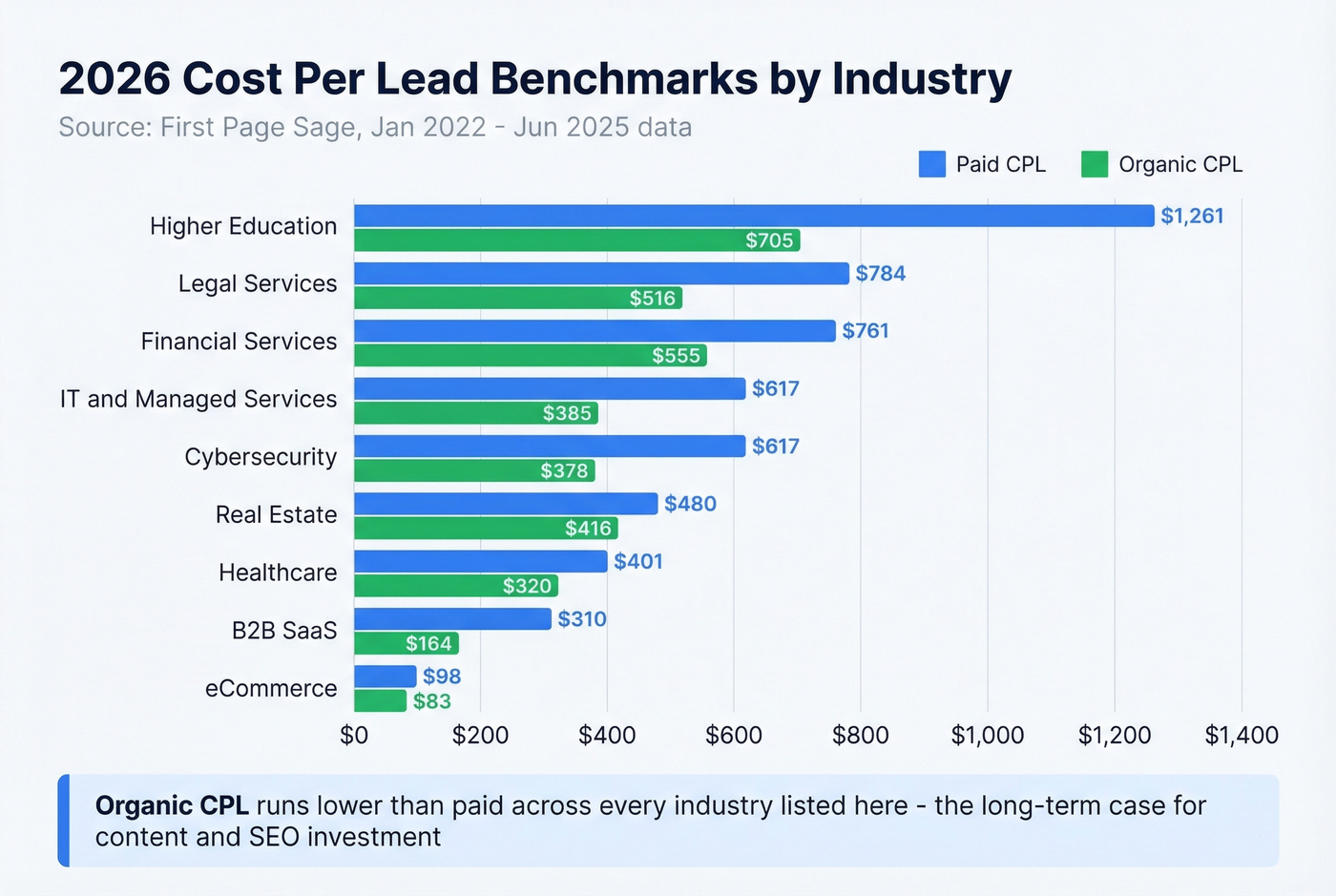
The most recent benchmark data comes from First Page Sage (Jan 2022-Jun 2025) and Sopro (updated Sep 2025). These are the numbers to plan against.
By Industry
First Page Sage data shows massive variation:
| Industry | Paid CPL | Organic CPL | Blended CPL |
|---|---|---|---|
| B2B SaaS | $310 | $164 | $237 |
| eCommerce | $98 | $83 | $91 |
| Financial Services | $761 | $555 | $653 |
| Healthcare | $401 | $320 | $361 |
| Higher Education | $1,261 | $705 | $982 |
| IT & Managed Services | $617 | $385 | $503 |
| Legal Services | $784 | $516 | $649 |
| Real Estate | $480 | $416 | $448 |
| Cybersecurity | $617 | $378 | $497 |
Organic CPL runs lower than paid CPL across every industry listed here. That's the long-term argument for content and SEO investment - though it takes 6-12 months to see returns.
By Channel
| Channel | Avg CPL | Low | High |
|---|---|---|---|
| Trade shows | $840 | $180 | $1,500+ |
| PPC (Google) | $463 | $175 | $751 |
| LinkedIn ads | $408 | $15 | $800+ |
| Cold email | $225 | $150 | $300 |
| SEO | $206 | $14 | $397 |
| Facebook ads | $142 | $102 | $182 |
| Affiliate | $73 | $54 | $92 |
| Referrals | $25 | - | - |
Referrals ($25) and affiliate ($73) crush paid search ($463) on cost - but you can't scale referrals the way you can scale Google Ads. LinkedIn CPC runs $3.94-$5.58, and Sopro's benchmark average CPL for paid LinkedIn ads is $408.
By Platform
Cross-platform averages from SimplyBeFound:
| Platform | Avg CPL |
|---|---|
| Google Ads | $53.52 |
| Bing Ads | $41.44 |
| Facebook Ads | $21.98 |
Company size matters too. Companies with fewer than 50 employees average $146 CPL; enterprise organizations ($500M+ revenue) average $429.
How to Set Your Maximum CPL
Break-Even Method
If your average customer is worth $500 and 10% of leads convert to customers, your break-even CPL is:
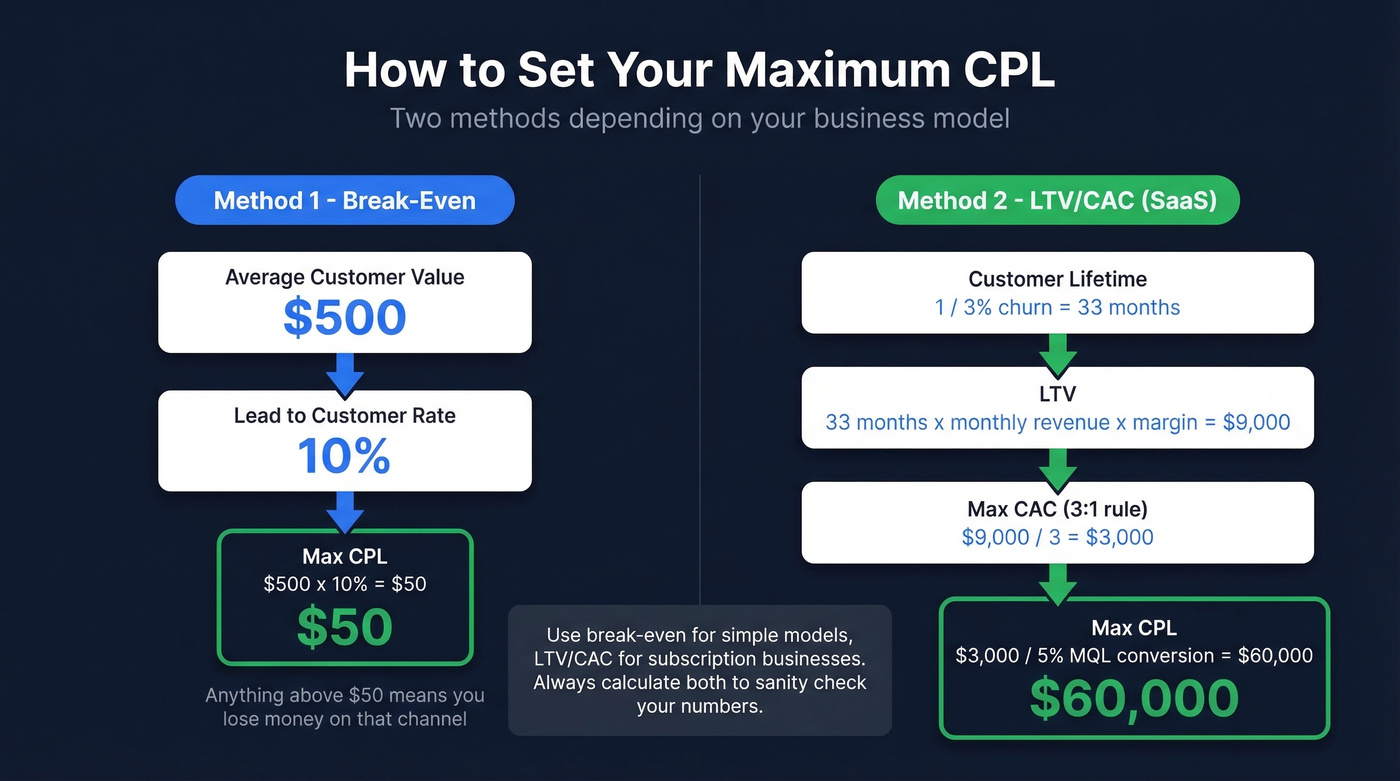
$500 x 10% = $50 max CPL
Anything above $50 and you're losing money on that channel before accounting for overhead.
LTV/CAC Method
For subscription businesses, the LTV-based approach is more accurate. Calculate customer lifetime as 1 / churn rate. If monthly churn is 3%, lifetime is ~33 months. Multiply by monthly payment x gross margin to get LTV.
Apply the 3:1 LTV:CAC rule - your max CAC is LTV / 3. Then divide max CAC by your MQL-to-customer conversion rate to get your max CPL. If LTV is $9,000, max CAC is $3,000, and 5% of MQLs become customers, your max CPL is $150.
Look, if you're going to track one CPL metric, make it CPQL. Most teams obsess over media CPL because it's easy to calculate and makes dashboards look good. But a $150 CPL ceiling means nothing if you're spending $1,000 per qualified lead. CPQL is the only number that connects marketing spend to pipeline reality.
If you need to connect this to the rest of your funnel, map CPL to funnel metrics and sanity-check it against your sales conversion rate.
Five CPL Mistakes That Inflate Your Numbers
1. Only counting ad spend. You report a $50 CPL but ignore the $3,000/month in SDR time, $500 in tools, and $1,500 in agency fees that made those leads possible. Your real CPL is 2-3x higher.
2. Counting unverifiable leads. Half your leads have bad emails, disconnected phones, or fake form fills. Your dashboard says 200 leads; reality says 120. Verify your list before you report - if 98% of emails check out, your denominator is real.
3. Confusing CPC with CPL. A $5 CPC doesn't mean a $5 lead. CPL = CPC / conversion rate. At a 10% conversion rate, that $5 click is a $50 lead. We've seen teams report CPC as CPL and wonder why their unit economics don't work.
4. Ignoring attribution model impact. First-touch attribution credits the blog post that started the journey. Last-touch credits the demo request page. Same lead, different CPL by channel depending on which model you use. Pick one and be consistent - or use multi-touch and accept the complexity.
5. Not accounting for time lag. Leads generated in Q1 don't always qualify until Q3. If you snapshot CPL monthly, you'll overcount costs in early months and undercount later. Look at cohorted CPL over 90-day windows for a more honest picture.
How to Reduce CPL Without Sacrificing Quality
Most CPL reduction comes from fixing fundamentals, not finding hacks.
Tighten audience targeting. Narrower audiences cost more per click but produce cheaper qualified leads. A $12 CPC that converts at 30% beats a $4 CPC that converts at 5% - every time.
Improve landing page conversion rates. Every percentage point of conversion improvement drops your CPL proportionally. Test headlines, form length, and social proof. In our experience, shortening forms from 7 fields to 4 has the single biggest impact on conversion rate for B2B landing pages.
A/B test ad creative. Stale creative drives up CPC over time. Refresh every 2-3 weeks on paid social, monthly on search. Higher quality scores on Google Ads directly reduce CPC, which compounds into lower CPL.
Shift budget toward high-efficiency channels. Referrals, SEO, and cold email consistently outperform paid search on CPL. Reallocate 10-20% of paid budget toward these channels and measure the impact over a quarter.
Clean your contact data. Bad contact data is the silent CPL killer. If 30% of your list bounces, you paid for leads that don't exist. Skip this step if you're running small campaigns under 50 leads/month - the math won't move much. For anything larger, verification pays for itself immediately. The free tier at Prospeo - 75 emails/month - is enough to test this on your next campaign list before committing.
If you're building outbound lists, start with a repeatable Clay list building workflow and keep a shortlist of free lead generation tools for quick experiments.
Cold email CPL benchmarks assume $500/month on data tools - but most of that spend is wasted on invalid contacts. Prospeo delivers 143M+ verified emails on a 7-day refresh cycle, so every dollar you spend actually reaches a real person.
Cut your cost per qualified lead - start with data that's actually accurate.
FAQ
What is a good cost per lead?
B2B SaaS averages $237 blended CPL; eCommerce averages $91; financial services runs $653. Don't compare your number to generic benchmarks - compare it to your break-even CPL (customer value x lead-to-customer conversion rate). A $500 CPL is perfectly healthy if your customers are worth $50,000.
What's the difference between CPL and CPA?
CPL measures the cost to generate a lead - someone who fills out a form, downloads content, or replies to outreach. CPA measures the cost to acquire a paying customer. CPL sits at the top of the funnel; CPA accounts for the full journey from first touch to closed deal, including sales costs.
Should I include salaries in my CPL calculation?
Yes - at least the portion of team time dedicated to lead generation. Excluding labor underestimates your true CPL by 2-3x. Track media CPL (ad spend only) for campaign optimization and fully-loaded CPL (all costs) for ROI decisions and budget planning.
How do I lower CPL without hurting lead quality?
Start with data hygiene - verify contacts before counting leads so you're not inflating numbers with phantom records. Beyond that, improve landing page conversion rates, tighten audience targeting, and shift budget toward high-efficiency channels like SEO and referrals. The consensus on r/LeadGeneration is that list quality drives more CPL improvement than any ad optimization trick.
Is there a free CPL calculator?
Several free CPL calculator tools exist online, but most only handle the basic formula - ad spend divided by leads. For a fully-loaded number, build a spreadsheet that includes labor, tools, creative, and agency costs. The formulas in this guide give you everything you need to create one that reflects your actual spend.