

How to Use ChatGPT for B2B Sales (Without Getting Garbage Outputs)
88% of organizations now use AI regularly in at least one business function. Nearly two-thirds haven't figured out how to scale it. That gap - between "we have ChatGPT" and using ChatGPT for B2B sales in a way that actually moves pipeline - is where most teams are stuck right now.
This isn't hypothetical. Vercel tracked ChatGPT-driven signups jumping from under 1% to 10% in about seven months, proof that AI channels already generate real revenue. Teams can see productivity gains of up to 40%, but the default experience for most reps is still mediocre outputs and wasted time.
Here's how to close that gap and save 2-5 hours per rep per week doing it.
The Quick Version
- Start with pre-call research prompts. Biggest ROI, lowest effort. You'll cut 30-45 minutes of digging down to 2-3 minutes per prospect.
- Never ask ChatGPT to "write a cold email" without a framework and examples. Generic input produces generic output. Every time.
3 Mistakes That Kill Your Outputs
Mistake 1: Treating it like Google. Reps type "tell me about Acme Corp's tech stack" and expect live, accurate results. ChatGPT isn't a search engine. Paste the prospect's About page, their latest press release, or their job postings into the prompt. Context in, insight out.
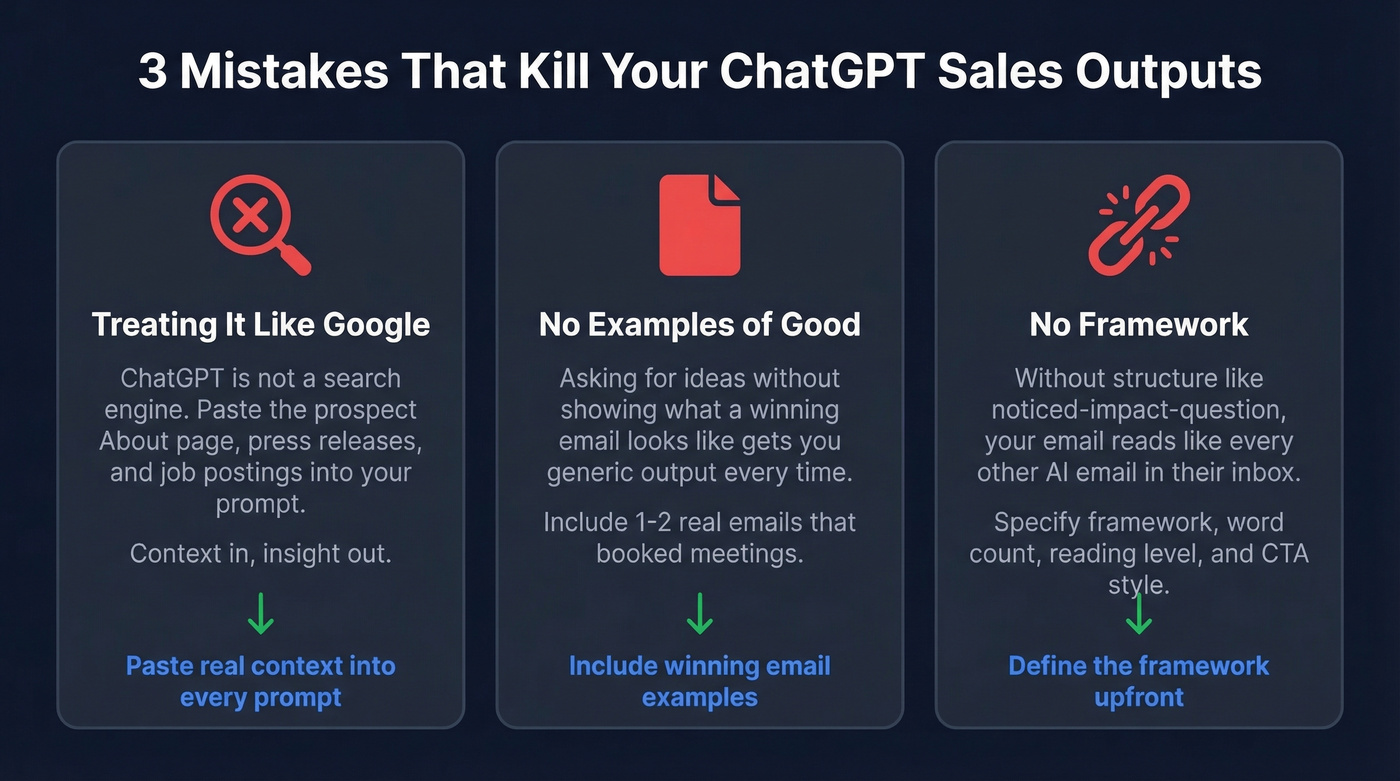
Mistake 2: Asking for "ideas" without showing what good looks like. "Give me some cold email ideas" produces the same bland output every time. ChatGPT mirrors the quality of what you feed it. If you don't show it a strong example, it defaults to generic. Include 1-2 examples of emails that actually booked meetings for your team.
Mistake 3: No framework. This is the most common sin we see. Without structure - a "noticed-impact-question" framework, a pattern interrupt, a social proof hook - you get something that reads like every other AI-generated email in your prospect's inbox. Specify the framework, word count, reading level, and CTA style in the prompt itself.
One-Time Setup That Improves Every Output
Before you write a single prompt, paste a company snapshot into ChatGPT's custom instructions. This runs in the background on every conversation, so you don't repeat yourself.
Company: [Your company name]

ICP: [Industry, company size, geography]

Buyer roles: [Titles you sell to]

Average deal size: [Range]

Sales motion: [Inbound/outbound/PLG/hybrid]

Current quarter goals: [Pipeline target, meetings target]

Tone: [Direct, consultative, casual - whatever matches your brand]
Five minutes of setup. Dramatically more relevant outputs on everything after. You can also connect ChatGPT to Zapier or Make to pull CRM data into prompts automatically, but the manual snapshot gets you 80% of the value with zero integration work.
Two power-user tips worth setting up on day one: Use Alt+Space (Windows) or Option+Space (Mac) to open ChatGPT's companion window alongside your CRM - no tab-switching. And get in the habit of pasting outputs directly into your sequencer without reformatting.
5 AI-Powered Sales Workflows (With Prompts)
Don't try all five at once. Pick the two that match your current bottleneck and run them for two weeks before adding more.
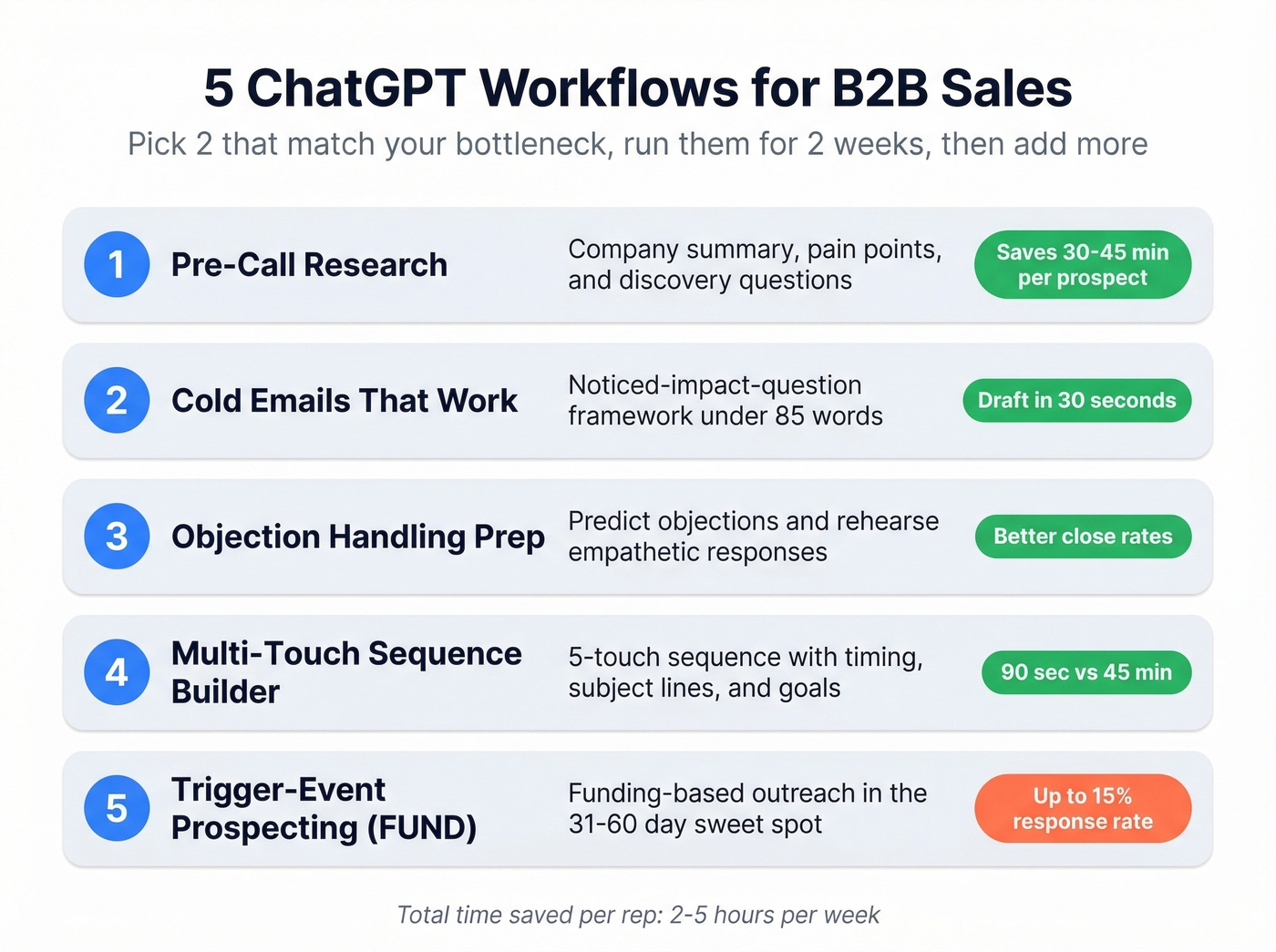
Pre-Call Research in 2 Minutes
This is where ChatGPT pays for itself fastest. What used to take 30-45 minutes of digging - scanning the prospect's website, reading their blog, checking recent news - collapses to 2-3 minutes with the right prompt.
I'm calling [Name], [Title] at [Company]. Here's their About page: [paste].

Here's their latest news: [paste].

Give me: (1) a 3-sentence company summary, (2) 3 role-specific pain points
for a [Title], (3) 2 discovery questions that show I've done my homework.
Cold Emails That Don't Sound Like AI
The "noticed-impact-question" framework is a strong alternative to generic templates:
Write a cold email using this framework:
- Line 1: Something specific I noticed about [Company] (use this context: [paste])
- Line 2: The business impact of the problem we solve
- Line 3: A question that opens a conversation
Keep it under 85 words, 6th-grade reading level. No buzzwords. No "I hope this
email finds you well."
Keeping cold emails under 85 words typically improves reply rates. Reading level targets are the other lever - they're the difference between AI-sounding drivel and something a human would actually reply to.
Before and after:
Without constraints: "I wanted to reach out because I noticed your company has been experiencing significant growth in the enterprise segment and I believe our solution could help streamline your operations and drive meaningful results across your sales organization..."
With the prompt above: "Saw you just opened a London office and posted 3 AE roles this month. Scaling outbound internationally usually means your existing data vendors start falling apart on EU contacts. Worth a 15-minute call to see if that's hitting your team yet?"
The second version takes seconds to write. The first is what you get when you type "write me a cold email."
If you want more structure, AI email personalization is the fastest way to make these prompts consistently sound human.
Objection Handling Prep
I'm selling [product] to [Title] at [Company type]. Common objections include
[list 2-3 you've heard before]. Predict 3 additional objections this buyer
might raise, and give me an empathetic response for each that acknowledges
their concern before redirecting.
This turns ChatGPT into a sparring partner. We've seen reps who run this before every discovery call handle objections noticeably faster - not because the AI responses are perfect, but because the rep has already mentally rehearsed the hard questions. The consensus on r/sales is similar: the prep matters more than the script.
If your team wants to standardize this, build a shared library of objection handling techniques and have ChatGPT adapt them per persona.
Multi-Touch Sequence Builder
Design a 5-touch cold email sequence for [ICP]. Include:
- Goal for each touch (open, reply, meeting, social proof, breakup)
- Suggested timing between touches
- Subject line and body for each
- Constraints: under 75 words per email, conversational tone, no jargon
The output gives you a solid first draft in 90 seconds instead of 45 minutes. Expect to rewrite 30-40% of it, but the structure and pacing save you the most time.
If you're building sequences at scale, pair this with drip campaign templates so reps aren't reinventing cadence every time.
Trigger-Event Prospecting (FUND Framework)
Timing is the difference between a 2% response rate and a 15% response rate. The FUND framework structures your outreach around funding events:
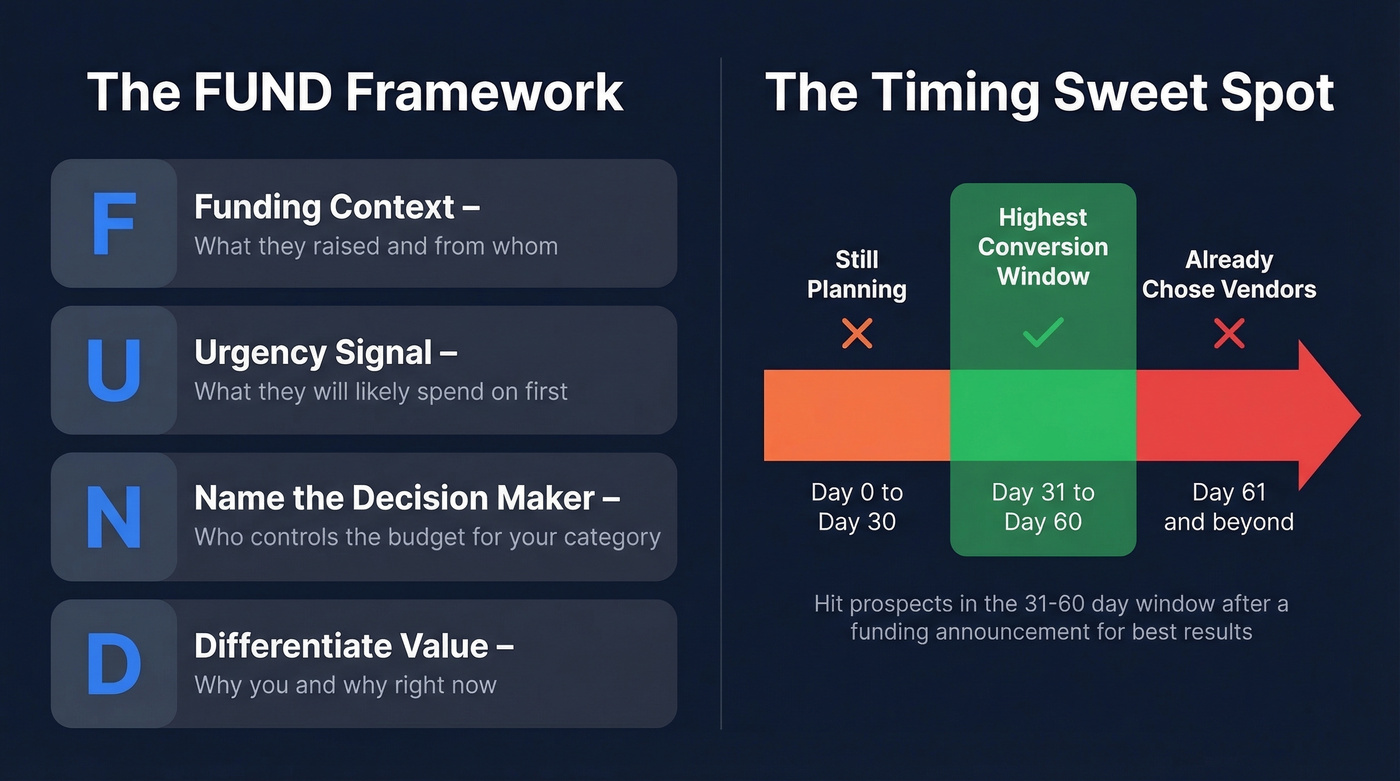
- Funding context - what they raised, from whom
- Urgency signal - what they'll likely spend on first
- Name the decision maker - who controls the budget
- Differentiate value - why you, why now
Days 31-60 after a funding announcement is the highest-conversion window. Before day 30, they're still planning. After day 60, they've already chosen vendors.
[Company] just raised [amount] from [investors]. Based on their product
and hiring patterns, what are they most likely to invest in first?
Who's the likely decision maker for [your category]? Draft a 60-word
outreach email using the FUND framework.
To make this work reliably, you need clean targeting and signals - start with B2B prospecting strategies and then automate the trigger list.
Beyond Outbound
This article focuses on outbound because that's where the ROI is most immediate. But ChatGPT handles plenty of other B2B sales tasks well: competitive battlecards updated from recent win/loss notes, deal summary briefs for handoffs, territory planning based on firmographic data, and weekly pipeline digests pulled from CRM exports. The OpenAI Academy guide covers several of these in depth if you want to go deeper.
If you're trying to systematize this across the org, start with B2B sales best practices and then layer AI on top.

Your ChatGPT prompts are only as good as the prospect data you feed them. Prospeo gives you 300M+ profiles with 98% verified emails, 30+ filters including buyer intent and funding signals, and a 7-day refresh cycle - so every "noticed" line in your AI-generated cold email is backed by data that's actually current.
Stop crafting perfect emails for stale contacts. Start with real data.
The Data Quality Bottleneck
Here's the thing: ChatGPT can write a perfect cold email. It can research the prospect, predict objections, and build a five-touch sequence. But it can't give you a verified email address to send it to.
It hallucinates contact data - job titles, company sizes, email addresses. Ask ChatGPT for someone's work email and you'll get something that looks plausible and bounces immediately. This is where the workflow breaks down for most teams.
For outbound teams running sequences, the difference between 98% verified emails and a list that bounces at 15%+ compounds fast - it's your domain reputation, your sender score, and ultimately your pipeline. A 7-day data refresh cycle means the contacts ChatGPT helps you target are actually reachable when your sequence fires, not stale records from six weeks ago.
If you're sourcing contacts, compare options in our guide to the best B2B database and prioritize accuracy over raw volume.

Running the FUND framework? Prospeo tracks 15,000 intent topics and funding signals so you can hit that 31-60 day sweet spot with verified decision-maker emails and direct dials. At $0.01 per email, scaling trigger-event sequences costs less than the coffee you drank writing them.
Find funded companies and their decision-makers in one search.
Which Plan and Which Model
Not every rep needs a $30/month plan. Here's how to think about it:
| Plan | Price | Best For |
|---|---|---|
| Free | $0 | Individual experimentation |
| Plus | $20/mo | Solo reps, daily use |
| Business | $30/user/mo (annual) | Teams needing admin + SSO |
Hot take: If your average deal size is under $15K, ChatGPT Plus at $20/month is probably all you need. The Business plan's admin controls and SOC 2 compliance matter for enterprise sales orgs, but a 5-person SDR team selling mid-market deals will get 95% of the value from Plus.
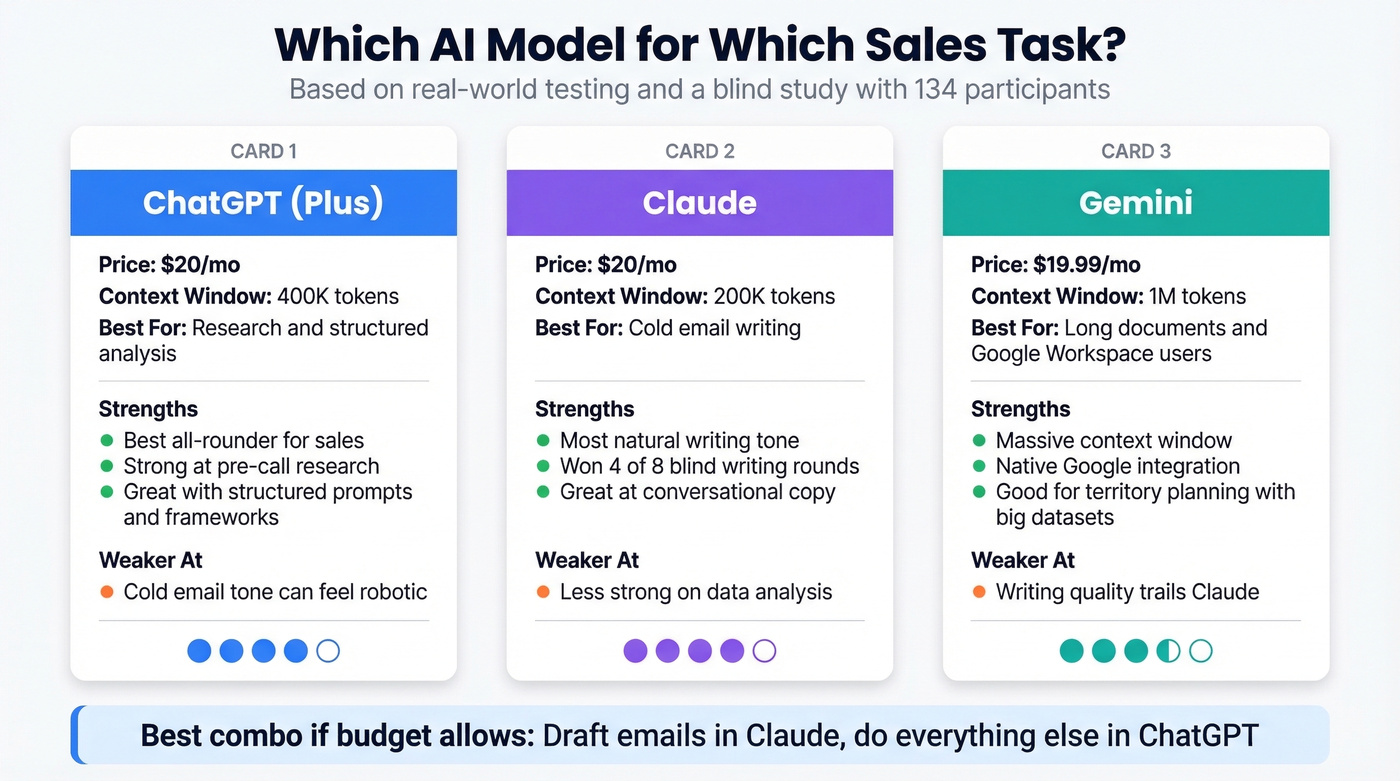
For model selection:
| Model | Context Window | Price | Best For |
|---|---|---|---|
| ChatGPT (Plus) | 400K tokens | $20/mo | Research + analysis |
| Claude | 200K tokens | $20/mo | Cold email writing |
| Gemini | 1M tokens | $19.99/mo | Long docs, Google users |
Claude often writes more natural cold emails. A blind test with 134 participants had Claude winning 4 of 8 writing rounds. ChatGPT is stronger for structured analysis and real-world examples - it's the better all-rounder. If budget allows, draft emails in Claude and do everything else in ChatGPT.
If you're choosing tools for the whole team, it helps to map this to your RevOps tech stack so AI doesn't become another silo.
What NOT to Paste Into ChatGPT
Sensitive data makes up 34.8% of employee ChatGPT inputs, and nearly 47% of organizations have no AI-specific security controls. That's a lawsuit waiting to happen.
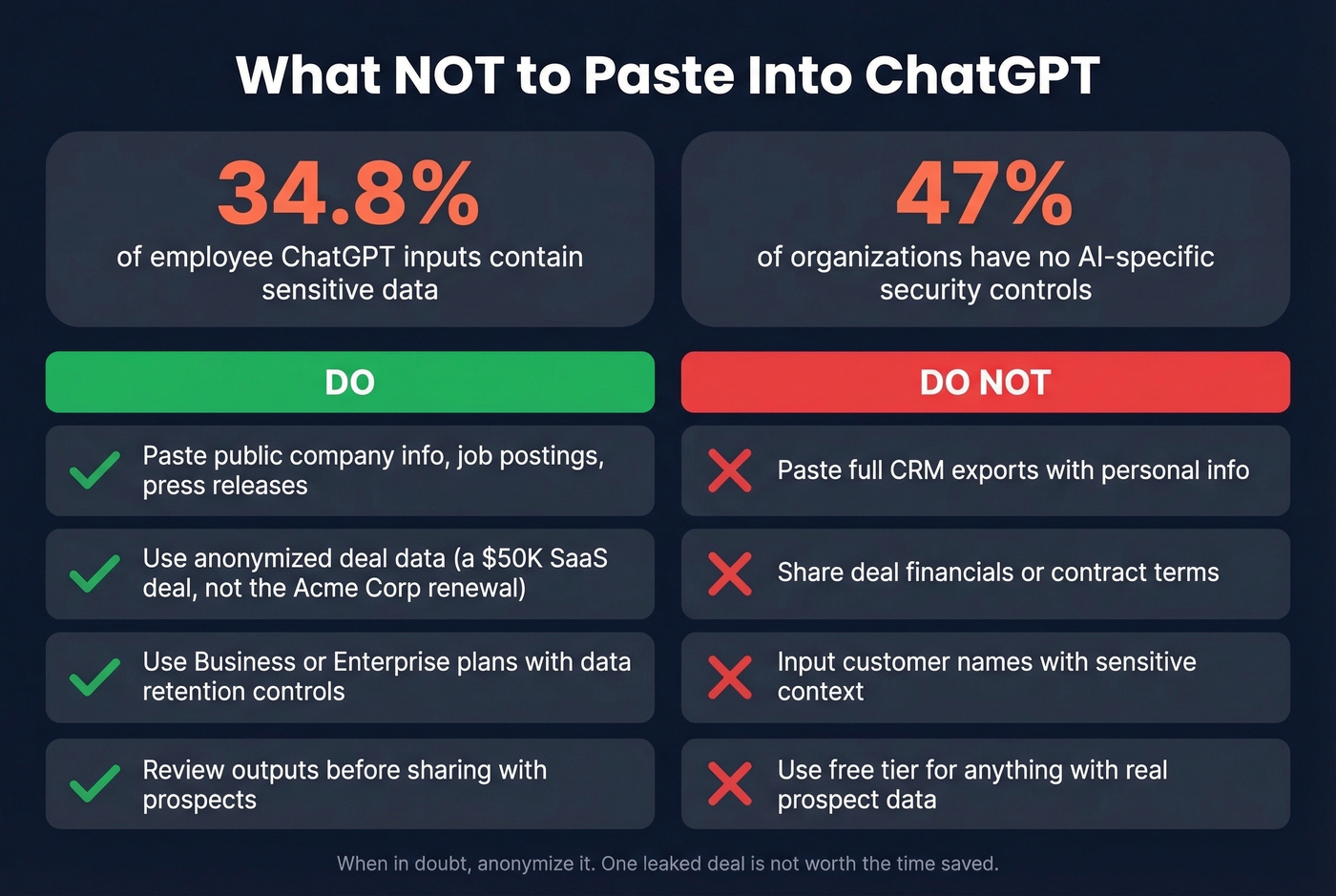
Do:
- Paste public company info, job postings, press releases
- Use anonymized deal data ("a $50K SaaS deal" instead of "the Acme Corp renewal")
- Use Business or Enterprise plans with data retention controls
Don't:
- Paste full CRM exports with PII
- Share deal financials, contract terms, or discount structures
- Input customer emails, phone numbers, or personal data
If your team is using ChatGPT daily, you need an AI usage policy. A one-page "never paste this" checklist covers 90% of the risk.
For teams doing outbound at volume, align this with B2B compliance so your AI workflow doesn't create legal exposure.
What's Coming: Agentic Sales Workflows
ChatGPT Agent - combining Operator, Deep Research, and o3 - can already run 30-40 minute autonomous tasks: monthly pipeline reports pulled from CRM data, persona updates based on closed-won patterns, competitive intel summaries refreshed weekly.
62% of organizations are experimenting with AI agents today. By the end of 2026, the sales teams that win won't just be using ChatGPT for B2B sales prompts - they'll have agents running entire research and enrichment workflows in the background while reps focus on selling.
Skip this if you're still figuring out basic prompt engineering. Agents are powerful but they're a "walk before you run" situation - nail the five workflows above first.
FAQ
Can ChatGPT replace my SDR team?
No. ChatGPT accelerates research and drafting but can't build relationships, read tone on live calls, or verify prospect data. Think of it as an assistant that makes your SDRs 2-3x faster, not a replacement for the human judgment that actually books meetings.
Is the free plan enough for sales?
For individual experimentation, yes. For daily team use, ChatGPT Business at $30/user/month is the practical baseline - you get admin controls, connector integrations, and SOC 2 compliance. The free plan's rate limits will frustrate any rep using it more than a few times per day.
What's the best AI model for writing cold emails?
Claude edges out ChatGPT for pure writing quality - it produces more natural, less "AI-sounding" copy. ChatGPT is the better all-rounder for research, analysis, and structured workflow tasks. If you can only pick one, start with ChatGPT. If budget allows, draft emails in Claude.
How do I get accurate prospect data to pair with AI-generated outreach?
Not from ChatGPT - it hallucinates contact details including emails, phone numbers, and job titles. Use a verified data platform like Prospeo to source contacts, then feed that data into ChatGPT for personalized messaging. That two-tool workflow is what actually converts.