

How to Check Emails for Validity in 2026
You uploaded 10,000 emails, hit send, and watched your bounce rate climb past 8%. Your sender reputation tanked. Your next campaign landed in spam. You spent the rest of the week explaining to your VP why half the pipeline isn't getting your messages.
That's what happens when you skip verification. This guide covers how email verification actually works, which tools do it best, and the catch-all problem that most verifiers still can't solve.
Quick Recommendations
- Find AND verify in one step - Prospeo. 98% accuracy, ~$0.01/email, catch-all handling built in.
- Already have a list, need standalone verification - ZeroBounce. ~$65 per 10K emails, strong accuracy, 49 native integrations.
- Low volume, tight budget - Hunter. 100 free verifications per month, paid plans from $34/mo.
- Cheapest bulk option - MillionVerifier. ~$6 per 10K emails. Decent accuracy, weak catch-all handling.
Why Verification Matters
Email validation reduces bounce rates by 90%. A 1% increase in unverified emails can cause deliverability to drop by 10%, and once ISPs like Gmail and Yahoo flag your domain, clawing back reputation takes weeks - sometimes months.
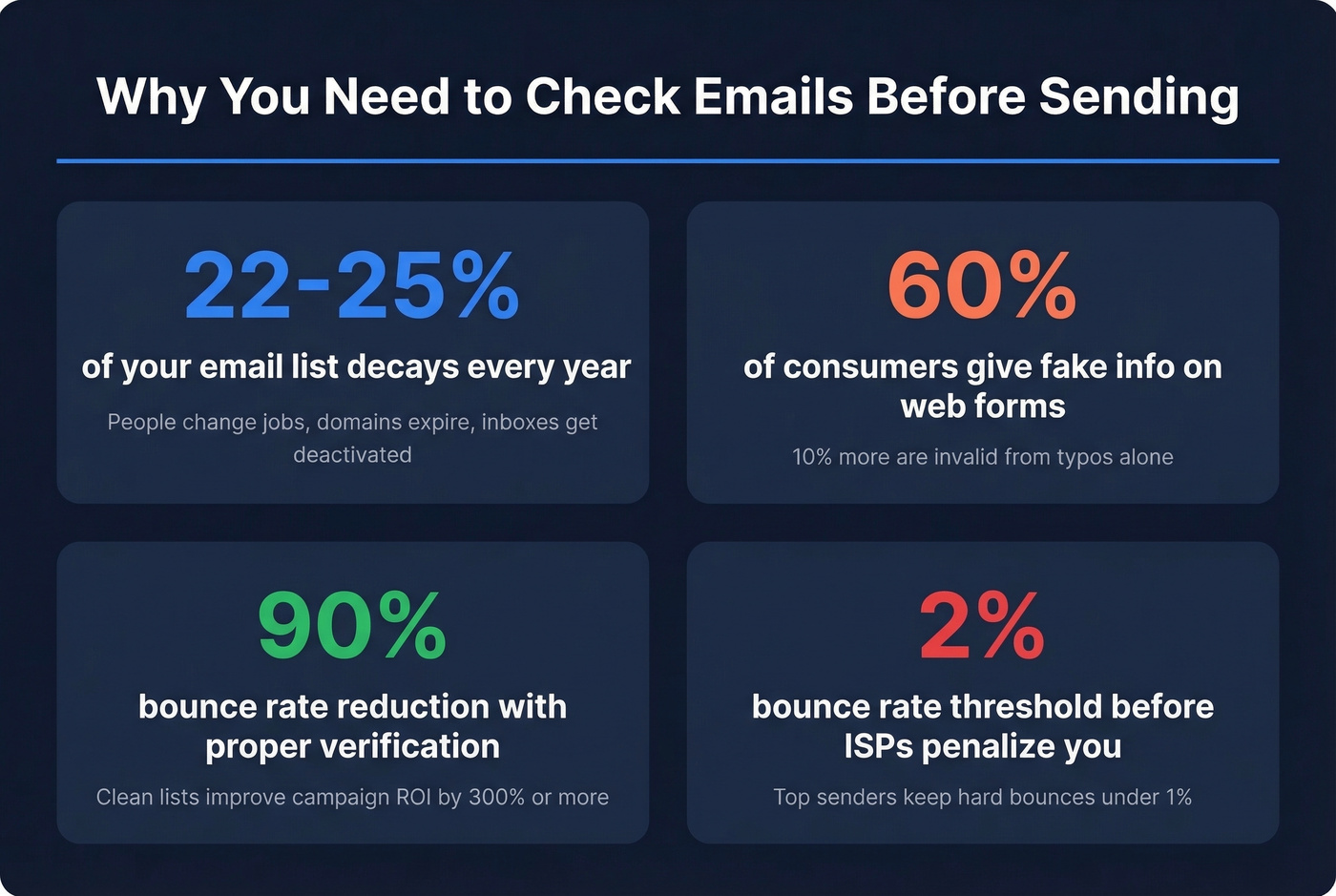
Clean, verified lists improve campaign ROI by 300% or more. Deliverability varies by industry too: mining companies average 98% deliverability, while software/IT hovers around 80.9%. If you're in tech, your margin for error is thinner than you think.
Your list is rotting right now. People change jobs, companies rebrand domains, inboxes get deactivated. Lists decay 22-25% per year. Roughly a quarter of last year's "verified" contacts are dead today.

It gets worse at the point of collection. 60% of consumers intentionally provide incorrect information on web forms, and another 10% of emails entered into systems are invalid from the start - typos, fake domains, disposable addresses. If you're running any kind of inbound form without real-time validation, you're collecting garbage.
Bounce rates above 2% trigger ISP penalties. Top-performing senders keep hard bounces under 1%. Bruce Herwig, Marketing Director at Image Source, saw his bounce rates drop to 1.6% and 0.85% after cleaning his lists through a verification service. That's the difference between landing in the inbox and landing in spam.
How Email Verification Works
Every verification tool runs the same basic pipeline, whether they charge $6 or $80 per 10,000 emails. The difference is how well they execute each step - and what they do with the ambiguous results.
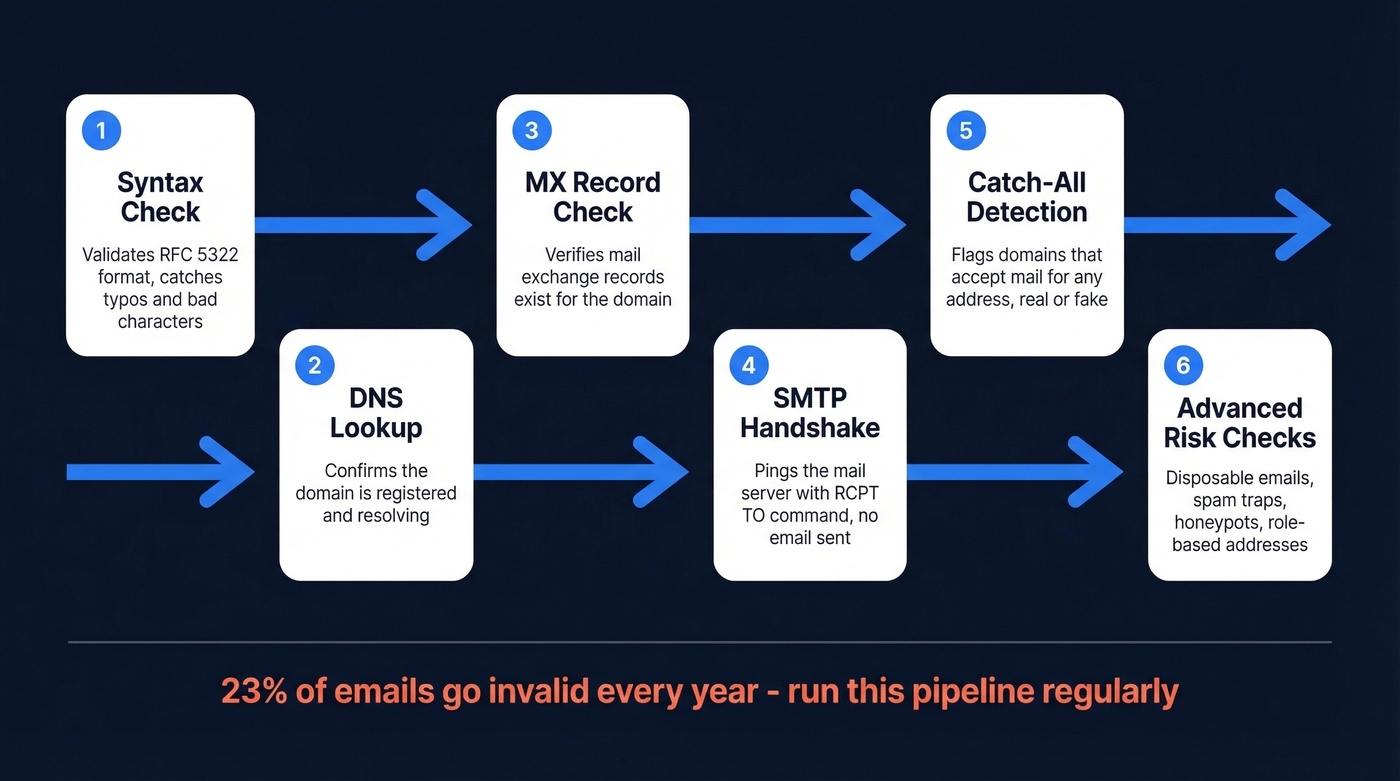
Syntax validation. The tool checks whether the email follows RFC 5322 formatting rules. Exactly one @ symbol, no spaces, local part under 64 characters, no consecutive periods. This catches obvious garbage like "john..doe@@company" before anything else runs.
DNS lookup. Does the domain actually exist? The tool queries DNS records to confirm the domain is registered and resolving. Expired or parked domains get flagged here.
MX record check. Even if a domain exists, it needs mail exchange records to receive email. No MX records means no mailbox - the address is undeliverable.
SMTP handshake. This is where the real verification happens. The tool opens a connection to the mail server and issues a RCPT TO command with the email address. The server responds with either "yes, that mailbox exists" or "no, unknown user." No actual email is sent - the connection closes before delivery.
Catch-all detection. Some domains accept mail for any address, real or fake. These "catch-all" servers say "yes" to everything, which means the SMTP check can't confirm individual mailboxes. Verifiers flag these as "unknown" or "risky." This is the biggest unsolved problem in email verification - more on that below.
Advanced risk checks. The best tools layer on additional signals: disposable email services like Mailinator and Guerrilla Mail, role-based addresses like info@ and support@, spam trap identification, honeypot filtering, and bounce history analysis. These checks separate a $6 verifier from a $65 one.
23% of email addresses become invalid within a single year. Running this pipeline once isn't enough.

Your list is decaying 25% per year. Prospeo's 5-step verification with catch-all handling, spam-trap removal, and honeypot filtering keeps bounce rates under 2% - without a separate verification tool. Every email found is already verified at 98% accuracy.
Find and verify emails in one step for about a penny each.
How to Check Emails for Validity
Manual Checks First
Before you pay for verification, catch the obvious problems yourself. The average B2B bounce rate sits at 2.33% - if you're anywhere near that number, even basic manual hygiene helps. Run through this syntax checklist on any list you've collected:
- Exactly one @ symbol
- No spaces anywhere in the address
- Local part (before the @) is 64 characters or fewer
- No consecutive periods
- Domain portion has at least one period
Next, confirm whether the domain exists. A quick WHOIS lookup tells you if the domain is registered, expired, or in a redemption period. Domains in redemption are effectively dead - any email sent there will bounce. You can also verify MX records from a terminal with dig MX domain.com or use a free online MX lookup tool. No MX records means the domain can't receive email, full stop.
These manual checks won't scale past a few dozen addresses, but they're useful for spot-checking high-value prospects before you add them to a sequence (and before you scale cold email marketing).
Tool-Based Verification
For lists of any meaningful size, automated verification is the only practical option. The workflow depends on whether you already have emails or need to find them first.
If you're starting from scratch - you have a target account list but no contact emails - Prospeo handles both steps in a single workflow. Upload a CSV or provide your prospecting inputs, and every email returned has already passed verification including catch-all handling and spam-trap removal. You skip the "find emails in one tool, verify in another" dance entirely.
If you already have a list from your CRM, a purchased database, or a scraping tool, standalone verifiers like ZeroBounce, NeverBounce, or Clearout let you upload a file and get results back with status codes for each address. Most return categories like valid, invalid, catch-all/unknown, disposable, and role-based.
Best Email Verification Tools
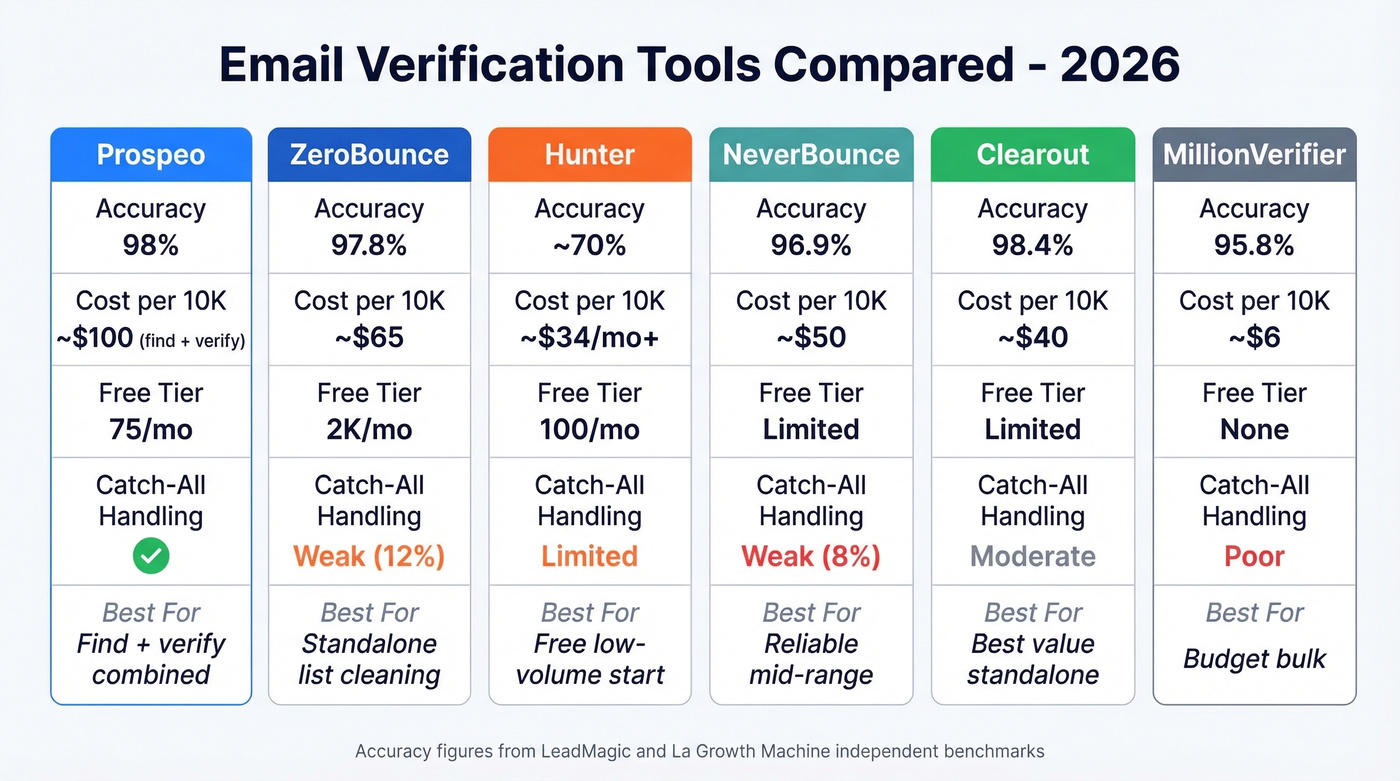
Our pick for most teams: Prospeo if you need to find and verify in one step, ZeroBounce if you already have lists that need standalone cleaning.
| Tool | Accuracy | Cost/10K | Pricing | Best For |
|---|---|---|---|---|
| Prospeo | 98% | ~$100 | 75 free/mo | Find + verify combined |
| ZeroBounce | ~97.8% | ~$65 | 2K free/mo | Standalone cleaning |
| Hunter | ~70%* | ~$34/mo+ | 100 free/mo | Low-volume free tier |
| NeverBounce | ~96.9% | ~$50 | Limited free | Reliable mid-range |
| Clearout | ~98.4% | ~$40 | Limited free | Best value standalone |
| MillionVerifier | ~95.8% | ~$6 | No free tier | Budget bulk |
Prospeo
Prospeo isn't just a verifier - it's a B2B data platform with 300M+ professional profiles and 143M+ verified emails. It uses a 5-step verification process with catch-all handling, spam-trap removal, and honeypot filtering. Every email in the database gets refreshed on a 7-day cycle, dramatically faster than the 6-week industry average.
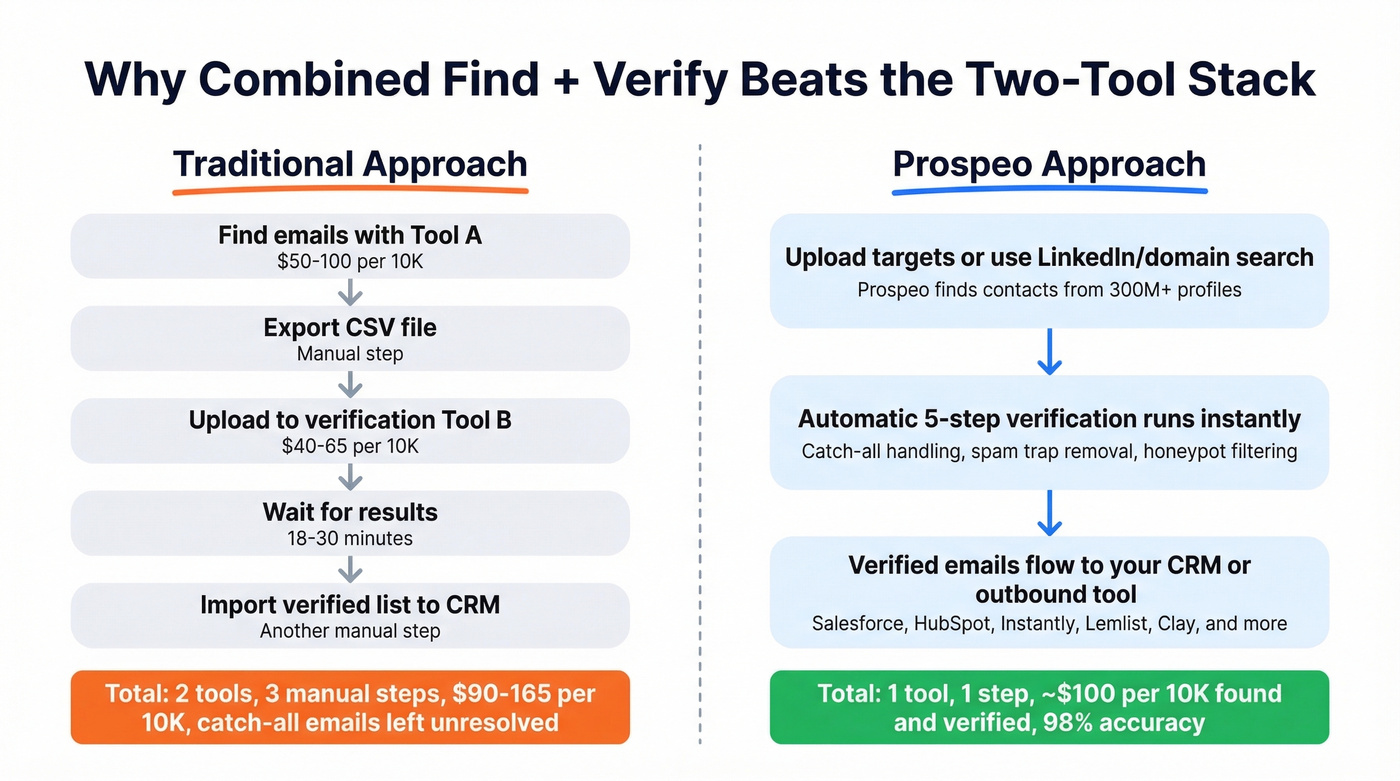
The real advantage is workflow compression. Instead of finding emails in one tool and verifying in another, Prospeo returns only verified contacts. That's roughly $1 for 100 verified emails - cheaper than any standalone verifier when you factor in the finding step. Native integrations with Salesforce, HubSpot, Smartlead, Instantly, Clay, Zapier, Lemlist, and Make mean verified contacts flow straight into your outbound stack. Meritt went from a 35% bounce rate to under 4% after switching. Snyk's 50-person AE team dropped from 35-40% bounces to under 5%, generating 200+ new opportunities per month.
If you're building lists from names/domains, pair this with a name to email workflow.
ZeroBounce
Use this if: You already have lists from other sources and need a reliable standalone cleaner with deep integrations.
Skip this if: You need email finding and verification in one tool, or you're dealing with heavy catch-all domains.
ZeroBounce hit 97.8% accuracy in the LeadMagic 10,000-email bake-off, processing the full batch in about 22 minutes. Pricing runs ~$65 per 10K emails, and $15/mo for 2,000 verifications.
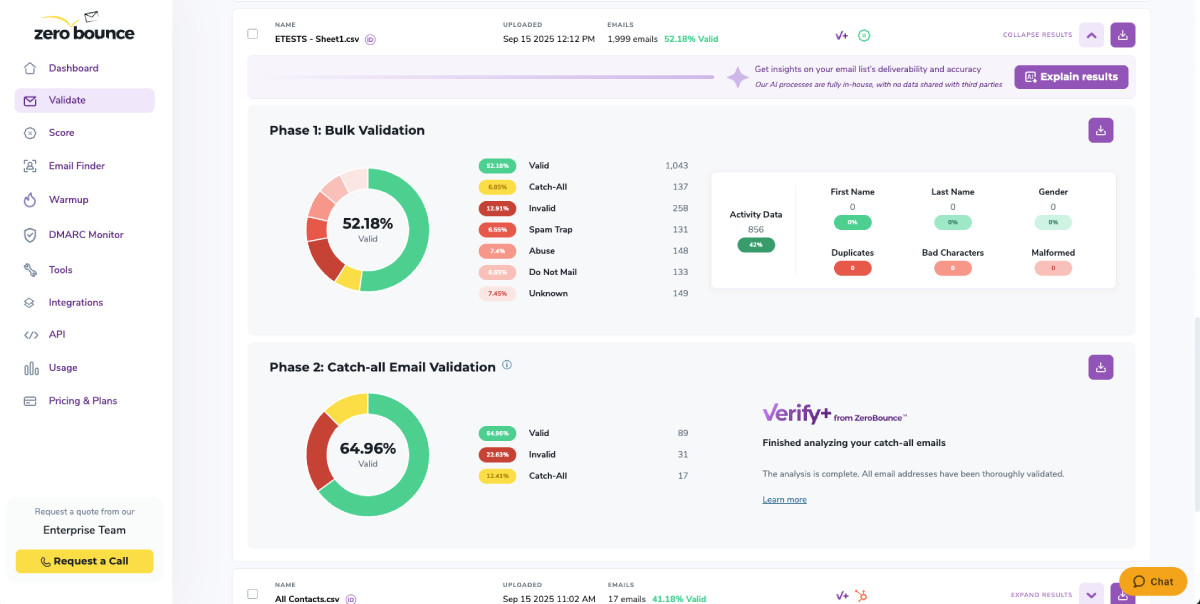
The 49 native integrations are genuinely useful - direct connections to most major ESPs and CRMs mean you can automate list cleaning without manual exports. The catch-all resolution rate of 12% is the weak spot. In B2B, roughly 28% of emails sit on catch-all domains, so you'll get a lot of "unknown" results back from ZeroBounce on enterprise-heavy lists.
If you're trying to diagnose list issues end-to-end, start with email bounce rate benchmarks and codes.
Hunter
We've seen more teams start with Hunter than probably any other verification tool, and the reason is simple: 100 free verifications per month with no credit card. For a founder sending 50 cold emails a week, that's enough to get started.
Hunter runs syntax checks, domain validation, server response analysis, and cross-references against its own B2B database. They've built a proprietary accept-all verification system that works with several major email providers. The tool has 6M+ users and solid review scores - 4.6 on Capterra, 4.4 on G2.

The caveat: Hunter's own benchmark of 15 verifiers across 3,000 emails showed their tool at 70% accuracy - the highest in their own test, but the dataset was built from Hunter's email activity patterns. That's a meaningful bias. Paid plans start at $34/mo. For low-volume verification, it's the obvious free starting point. For high-volume outbound, you'll want something with better catch-all handling.
If you're comparing options, see our breakdown of Hunter alternatives.
NeverBounce
NeverBounce scored 96.9% accuracy in the LeadMagic test at ~$50 per 10K emails, scaling up to ~$80 at lower volumes. Upload a CSV, get results in about 18 minutes. The catch-all resolution rate of 8% is the lowest among the major players, which means a significant chunk of "unknown" results on B2B lists.
If catch-all domains aren't a big part of your list, NeverBounce is solid and predictable. If they are, look elsewhere.
Clearout
Clearout posted 98.4% accuracy in the La Growth Machine 47,000-email test - the highest standalone accuracy score in that benchmark. At ~$40 per 10K emails, it's also one of the better values in the space.
Clearout is the quiet winner here. It doesn't get the Reddit buzz that ZeroBounce does, but the numbers are hard to ignore. If you want standalone verification at a fair price and don't need 49 integrations, give it a serious look.
MillionVerifier
At roughly $6 per 10K emails, MillionVerifier is 10x cheaper than most competitors. Accuracy came in at 95.8% in the LeadMagic test - respectable but not top-tier. On r/smallbusiness, users have complained about paying $15 for 6,000 verifications through Smartlead's add-on, which is still 4x more expensive than going direct with MillionVerifier.
If you're cleaning a massive purchased list and catch-all accuracy isn't critical, MillionVerifier saves real money. If deliverability is mission-critical, spend more.
The Catch-All Problem
Here's the dirty secret of email verification: roughly 28% of B2B emails sit on catch-all domains. These servers accept mail for any address - real, fake, or randomly generated. When your verifier hits a catch-all domain, it can't confirm whether the specific mailbox exists. The result comes back as "unknown" or "risky."
The math stings. You paid $80 to verify 10,000 emails. 2,800 came back as "unknown" because they're on catch-all domains. You just spent $22 on non-answers.
Catch-all resolution rates vary wildly across tools. Findymail, a catch-all specialist rather than a full verification suite, leads with 94.99% quality and 100% coverage. Kitt AI ranges from 76-91% quality depending on the domain. Hunter's proprietary system hits ~93-94% quality but only 30-44% coverage. ZeroBounce resolves just 12%. NeverBounce manages 8%.
Let's be honest: catch-all handling is the single biggest differentiator between verification tools in 2026. If your list is heavy on enterprise domains - which are disproportionately catch-all - this is the feature that matters most. Accuracy benchmarks get all the attention, but the real question is what happens to the 28% of your list that every tool struggles with.
If you're trying to validate a specific address (not just clean a list), use this guide on how to check if an email exists.
Most teams pay for an email finder, then pay again for a verifier, and still get catch-all unknowns. Prospeo runs proprietary verification on 300M+ profiles with a 7-day data refresh - so the emails you pull today are accurate today, not six weeks ago.
Kill the bounce rate before it kills your domain reputation.
Mistakes That Kill Deliverability
Never removing inactive subscribers. ISPs like Gmail and Yahoo track engagement signals. If you keep sending to addresses that never open, your sender score drops - even if the addresses are technically valid. Prune non-engagers every quarter.
Ignoring hard vs. soft bounces. Hard bounces mean the mailbox doesn't exist - remove immediately, one and done. Soft bounces from a full mailbox or temporary server issue get a second chance, but three consecutive soft bounces on the same address means it's effectively dead.
Relying on single opt-in. Without double opt-in, you're collecting typos, fake addresses, and spam traps. A single opt-in form is an open door for list pollution. Add real-time validation on your forms at minimum.
Purchasing or renting lists. This is the fastest way to destroy your domain reputation. Purchased lists routinely hit 25% bounce rates with 2% spam complaint rates - the industry standard for spam complaints is under 0.1%. That's a 20x penalty waiting to happen. (If you're considering it anyway, read is it illegal to buy email lists.)
Cleaning only once per year. Lists decay 22-25% annually, roughly 5-6% per quarter. If you're running weekly outbound, re-verify every 90 days minimum. Monthly is safer for high-volume senders. In our experience, teams that verify quarterly see bounce rates stay comfortably under 2%, while annual cleaners regularly spike above 5%. For the full playbook, see our email deliverability guide.
FAQ
Do email verifiers actually send emails?
No. Verification tools use an SMTP handshake to confirm whether a mailbox exists without delivering a message. The server responds to the RCPT TO command, confirming or denying the address, and the connection closes before any email is sent. Your prospects never know you checked.
What's a catch-all domain?
A catch-all domain accepts mail for any address, real or fake. Verifiers can't confirm individual mailboxes on these domains, so results come back as "unknown" or "risky." About 28% of B2B emails sit on catch-all domains, making this the biggest gap in standard verification.
How often should I re-verify my list?
Every 90 days minimum. Email lists decay 22-25% per year - roughly 5-6% per quarter. High-volume outbound teams should re-verify monthly. The cost of re-verifying is trivial compared to weeks spent recovering a damaged sender reputation.
Is email verification legal?
Yes. Verification checks publicly available DNS and MX records plus server responses. No personal data is accessed beyond what the email address itself reveals. GDPR compliance depends on how you obtained the email, not on verifying it. For a deeper look at GDPR and cold outreach, the ICO's direct marketing guidance is worth reading, and Mailtrap's deliverability blog covers the technical side well. Google's Postmaster Tools is also free and gives you direct visibility into how Gmail views your sending domain.