

How to Check If an Email ID Exists (2026 Guide)
You just uploaded 5,000 contacts into your sequencer, hit send, and watched 800 of them bounce. Your domain reputation tanks, your deliverability craters, and now you're spending the next two weeks warming a new inbox. That's entirely avoidable - if you check whether an email ID exists before you send to it.
Only 23.6% of B2B marketers verify their email lists before campaigns. The other 76.4% are gambling with their sender reputation every time they press send.
Why Verification Matters More Than You Think
Email addresses decay fast. Roughly 23% go invalid every year - people change jobs, companies rebrand, domains expire. A list you built six months ago is already ~11.5% dead weight.
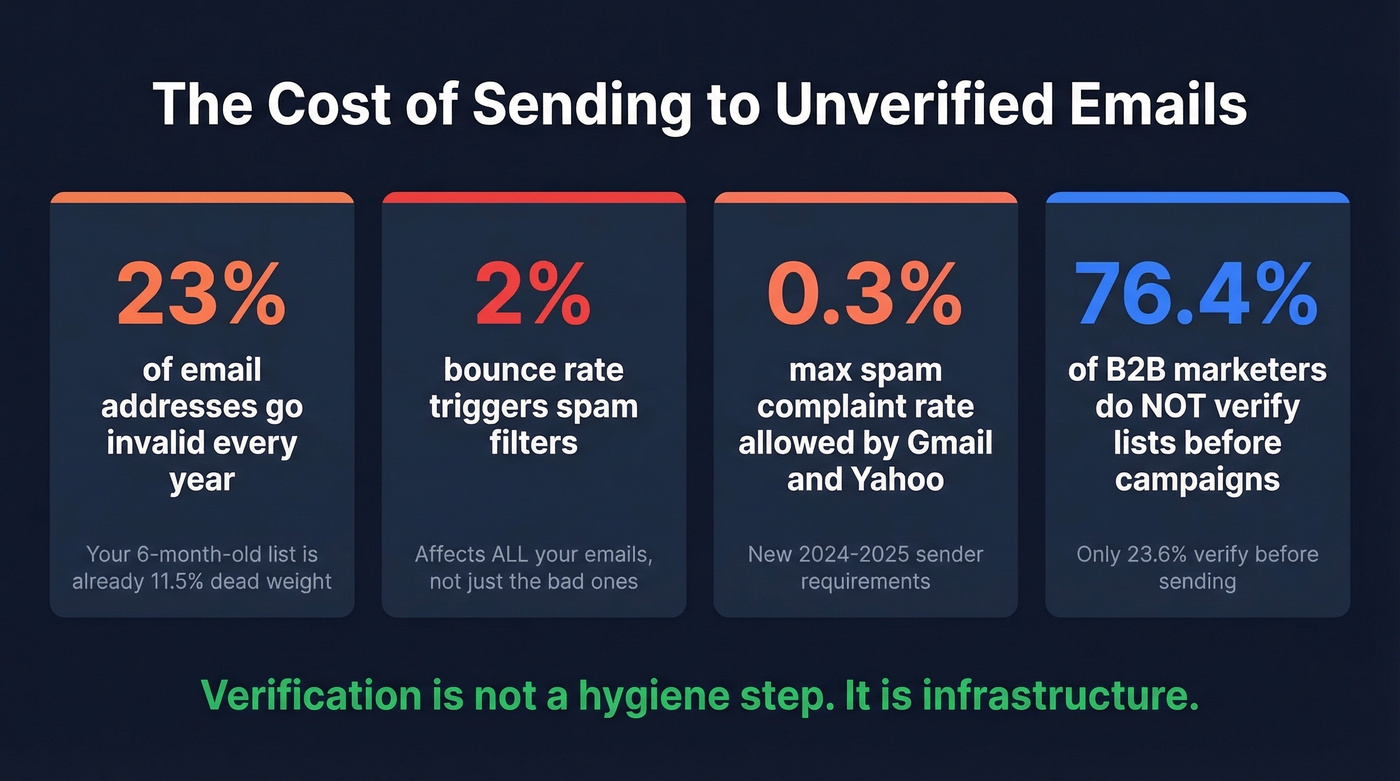
The consequences aren't just wasted sends. Most email providers treat a bounce rate above 2% as a red flag. Cross that threshold and you're triggering spam filters that affect every message you send, not just the ones to bad addresses. Gmail and Yahoo now require spam complaint rates below 0.3%. Microsoft's inbox placement dropped over 26 percentage points year-over-year for Office 365 senders. And only 7.6% of domains fully enforce DMARC authentication - meaning the infrastructure protecting inboxes is still immature, which makes your sender reputation even more fragile.
Verification isn't a hygiene step. It's infrastructure. Every bounced email erodes the domain reputation you've spent months building, and once that reputation is damaged, even your emails to valid addresses start landing in spam.
What You Need (Quick Version)
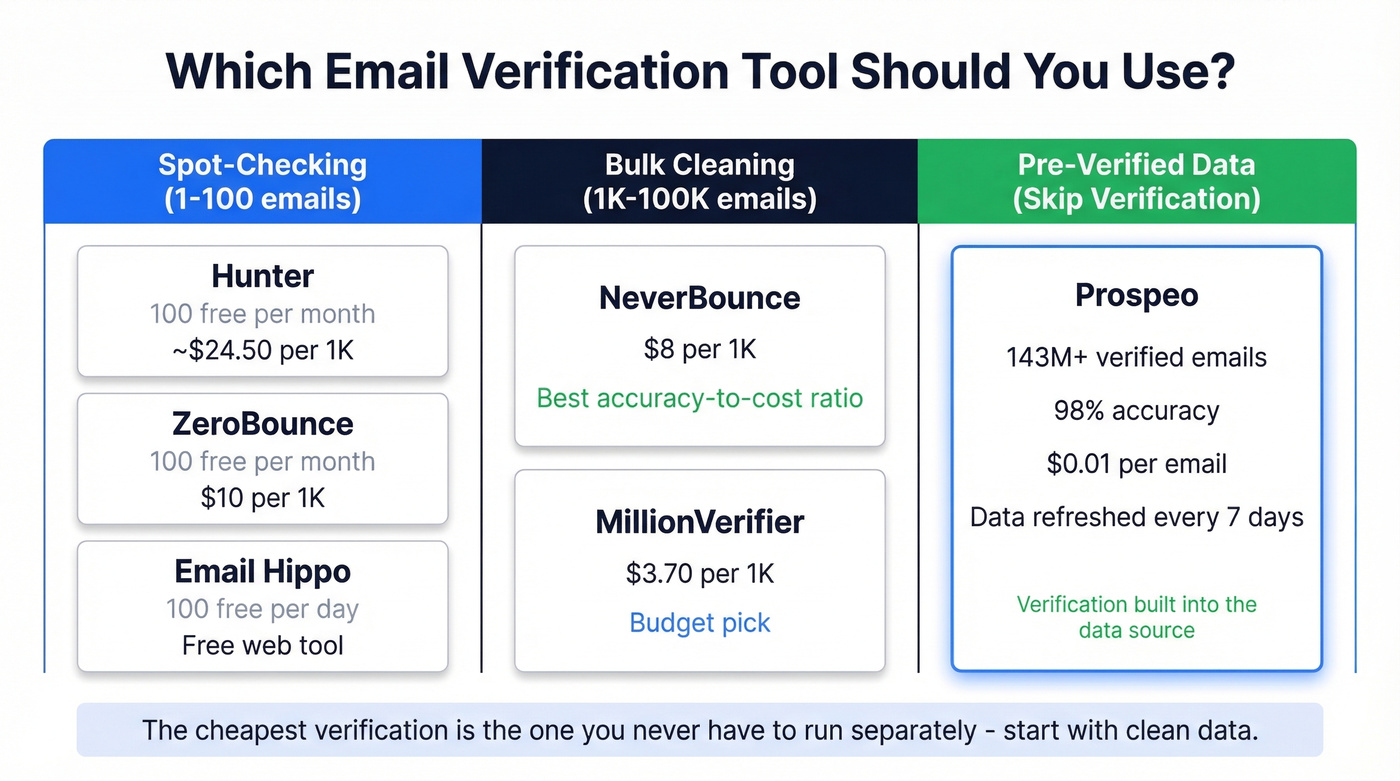
Spot-checking a single email? Use a free online verifier (or an AI email checker if you want extra signal). Hunter lets you run free single checks without signup, and its Free plan includes 100 verifications per month. ZeroBounce offers 100.
Cleaning a list before a campaign? You need a bulk verifier. MillionVerifier is the budget play at ~$3.70 per thousand. NeverBounce is more reliable at $8 per thousand.
How Email Verification Works
Every tool runs some version of these five stages. Some vendors market "30+ verification steps" - in practice, those are sub-steps within this same core pipeline.
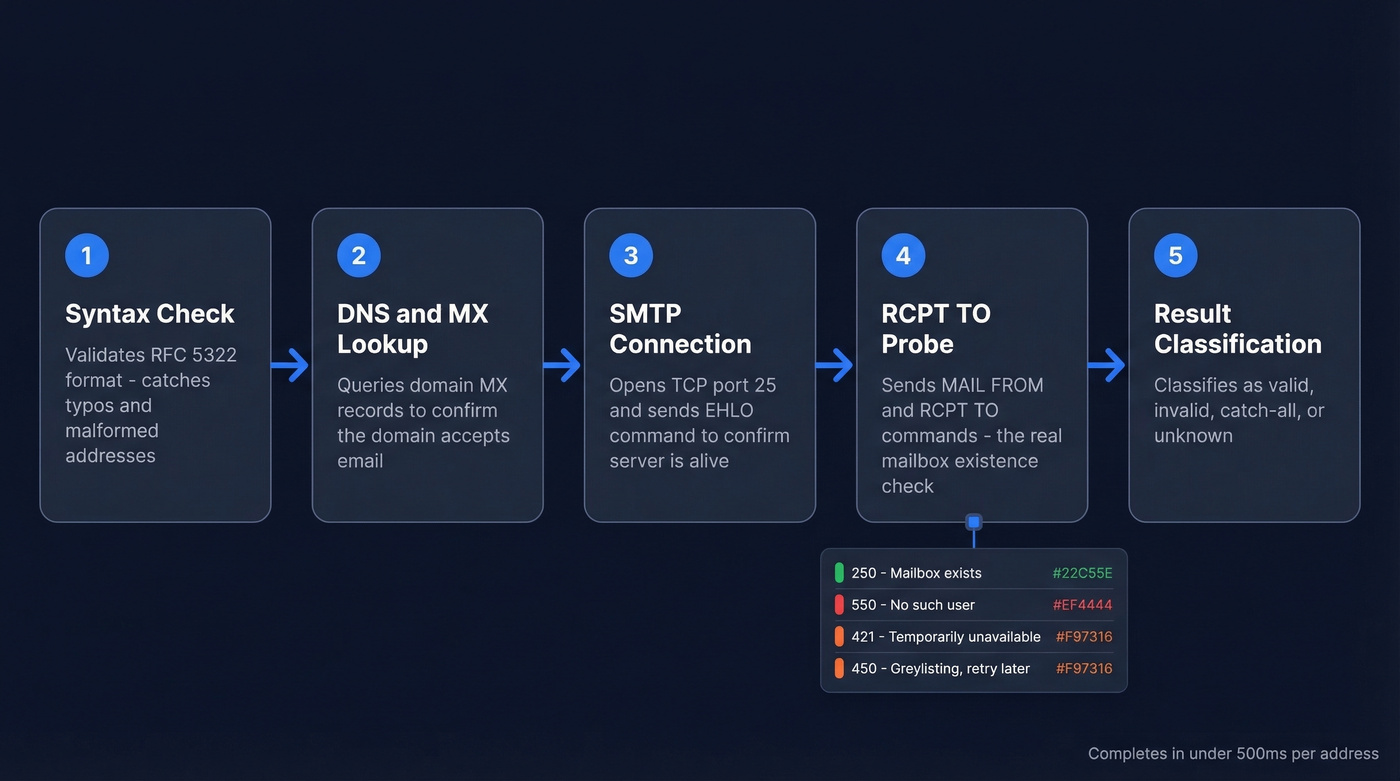
Step 1: Syntax validation. The system checks whether the address follows RFC 5322 formatting rules. Does it have an @ symbol? Is the domain portion valid? This catches typos and malformed addresses, roughly 5-10% of bad addresses in scraped lists.
Step 2: DNS and MX record lookup. The verifier queries DNS for the domain's MX (Mail Exchange) records to confirm the domain can actually receive email. Checking A or AAAA records isn't enough - a domain can have a website without accepting mail.
Step 3: SMTP connection. The tool opens a TCP connection to the mail server on port 25 and initiates an SMTP handshake with an EHLO command, confirming the server is alive and accepting connections.
Step 4: RCPT TO probe. Here's where the real check happens. The tool sends a MAIL FROM command followed by RCPT TO:<the-email-you're-checking>. The server's response reveals whether the mailbox exists:
- 250 - Mailbox accepted. The address exists.
- 550 5.1.1 - No such user. Invalid.
- 421 - Service temporarily unavailable.
- 450 - Temporary failure, often greylisting. Retry later.
Step 5: Result interpretation. The tool classifies the address as valid, invalid, catch-all, or unknown based on the response pattern. No actual email is sent - it's a partial handshake only.
The entire sequence often completes in under 500 milliseconds per address.

You just read how most verifiers top out at 70% accuracy on real B2B domains - and how catch-all servers fool every SMTP check. Prospeo skips the guesswork entirely. Our proprietary 5-step verification pipeline handles catch-all detection, spam-trap removal, and honeypot filtering before you ever see an email. 98% accuracy, 143M+ verified addresses, refreshed every 7 days.
Start with emails that already exist - verified at the source, not after the bounce.
Why "Verified" Doesn't Mean "Deliverable"
The Catch-All Problem
Between 30-40% of B2B email domains are configured as catch-all. The mail server accepts every RCPT TO command with a 250 OK regardless of whether the mailbox actually exists. You could send to totallyFakeAddress@bigcorp.com and the SMTP check would say "looks good."
Enterprise environments make this worse. Companies running Proofpoint, Mimecast, or Barracuda as Secure Email Gateways often block SMTP verification attempts entirely through greylisting, rate limiting, or outright rejection. The verifier can't even reach the RCPT TO step, so it returns "unknown." In our experience, catch-all domains account for the majority of "verified but bounced" complaints we see from outbound teams.
Accuracy Claims Are Misleading
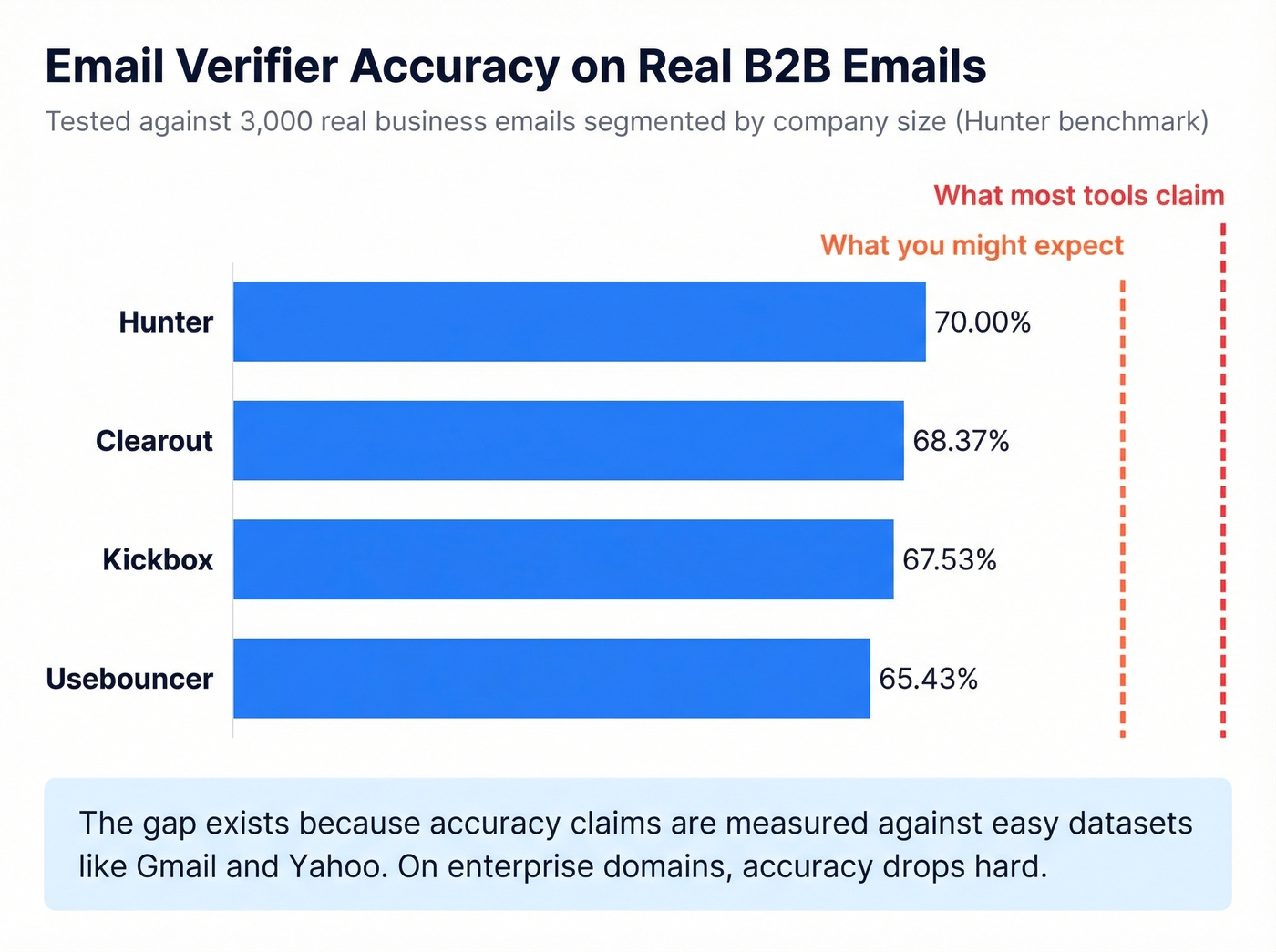
Every verification tool claims 99%+ accuracy. Hunter ran a benchmark testing 15 verifiers against 3,000 real business emails segmented by company size. The results: Hunter hit 70%, Clearout 68.37%, Kickbox 67.53%, Usebouncer 65.43%. Not 99%. Not even 90%.
The gap exists because accuracy claims are measured against easy datasets - consumer addresses at Gmail and Yahoo, where SMTP responses are straightforward. On enterprise domains with stricter configurations, accuracy drops hard.
Here's the thing: verification is a probability estimate, not a binary answer. If your entire email quality strategy is "run the list through a verifier and trust the results," you're building on sand. The best approach layers format checks, DNS validation, SMTP probing, and engagement feedback - and ideally starts with data that was verified at the source.
Three Ways to Verify an Email Address
Free Online Verifiers
For one-off checks, free tools work fine. Hunter's Free plan includes 100 verifications per month, ZeroBounce offers 100 free monthly checks, and Email Hippo allows 100 free daily lookups. Mailmeteor runs as a Google Sheets add-on with 50 free checks per month.
Use this for checking a handful of addresses before personal outreach. Skip this if you're cleaning more than a few hundred contacts - you'll burn through free tiers in minutes.
Manual SMTP Check (DIY Method)
If you want to understand what's happening under the hood - and learn how to check if an email ID exists at the protocol level - you can run the SMTP handshake yourself.
nslookup -q=mx example.com
telnet mx.example.com 25
EHLO yourdomain.com
MAIL FROM:<test@yourdomain.com>
RCPT TO:<target@example.com>
A 250 response to RCPT TO suggests the mailbox exists. A 550 means it doesn't.
Many ISPs block outbound port 25 entirely, and Gmail, Outlook, and most enterprise providers actively reject SMTP probes from unknown sources. We've tested this method extensively - it works against smaller domains but is essentially useless against the providers that matter most. Treat it as a learning exercise, not a production workflow.
Verification APIs
For developers building verification into signup flows or automation pipelines, ZeroBounce's real-time API endpoint handles single-address checks in seconds, while Verifalia's batch API lets you submit lists with configurable quality levels. Both return status codes and confidence scores.
If you're building this into a broader outbound stack, it also helps to understand email deliverability and how to improve sender reputation before you scale volume.
Best Tools to Check If an Email ID Exists
We've tested most of these tools across real B2B campaigns. Here's what actually matters.
| Tool | Free Tier | Cost per 1K | Best For |
|---|---|---|---|
| Prospeo | 75 emails/mo | ~$10 | Pre-verified B2B emails (skip verification) |
| ZeroBounce | 100/mo | $10 | Accuracy-focused API |
| NeverBounce | 10 credits | $8 | Reliable bulk cleaning |
| Hunter | 100/mo | ~$24.50 | Single spot-checks |
| MillionVerifier | - | ~$3.70 | Budget bulk lists |
| Verifalia | - | ~$4.76 (PAYG) | Enterprise dev API |
| Email Hippo | 100/day | Free web tool | Quick free checks |
| Mailmeteor | 50/mo | Free add-on | Google Sheets users |
Prospeo
Most verification tools fix bad data after you've already sourced it. Prospeo solves the problem before it starts. Its database of 143M+ verified emails runs through a 5-step verification process with catch-all handling, spam-trap removal, and honeypot filtering - the exact failure modes that trip up standalone verifiers.
The data refreshes every 7 days versus the 6-week industry average. At 98% email accuracy and roughly $0.01 per email, you're paying a fraction of standalone verification costs - and you're getting the contact data alongside the verification, not just a pass/fail result. One of our customers, Stack Optimize, built to $1M ARR while maintaining 94%+ deliverability and sub-3% bounce rates across all their clients - that's the kind of outcome you get when the data arrives clean.
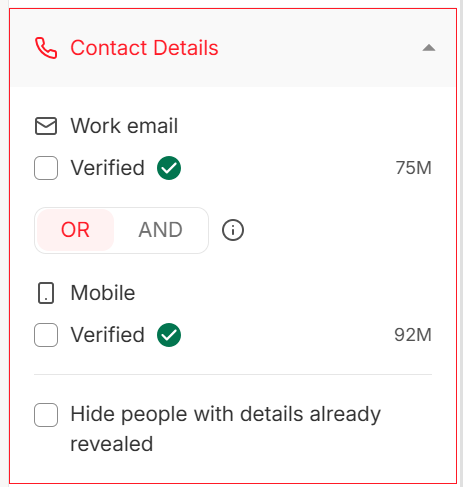
The free tier gives you 75 emails per month. Paid plans scale with no contracts and no sales calls required. Pair it with your sequencer and the list arrives clean.
Running SMTP handshakes manually or burning free-tier credits 100 at a time won't scale. Prospeo's Email Finder and Enrichment API return verified emails at 92% match rate and $0.01 per address - with catch-all handling built in. No bounced-email roulette, no domain reputation damage.
Replace your verification stack with data that never needed verifying twice.
ZeroBounce
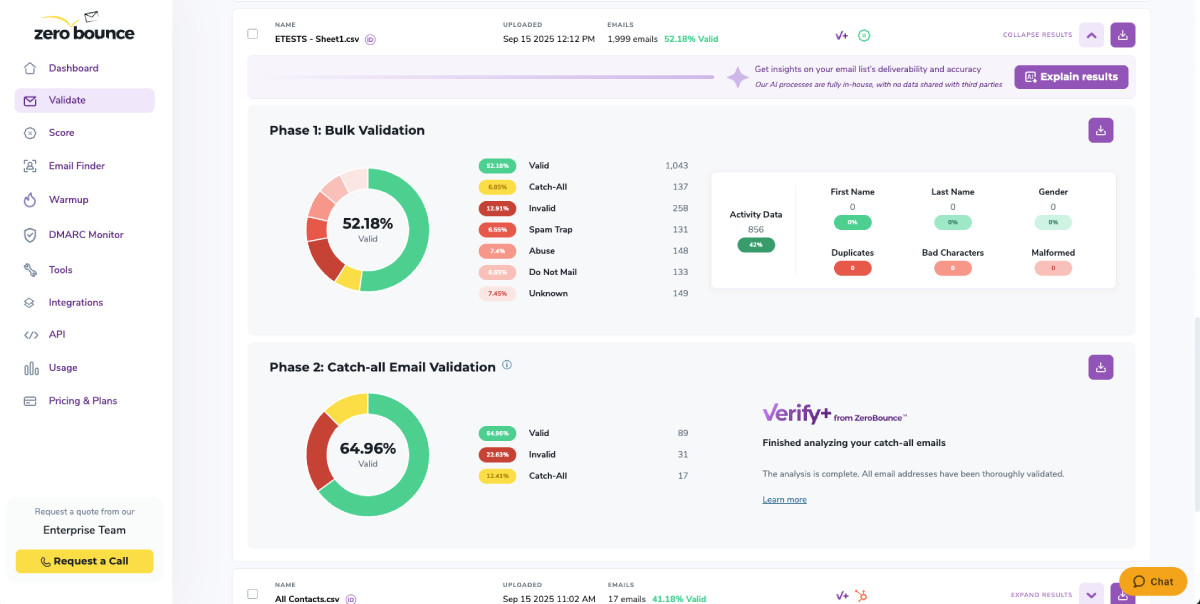
ZeroBounce is a well-regarded option with 100 free monthly verifications and a polished API. A standout feature: its Verify+ capability can identify disabled Yahoo and AOL accounts that other tools miss. Processing speed is solid - 100,000 emails in about 45 minutes.
At $99/month for 10,000 credits on their ONE plan, it isn't the cheapest for high-volume cleaning. But if accuracy matters more than cost-per-thousand, it's a strong pick. Skip this if you're verifying 100K+ emails monthly on a tight budget - MillionVerifier or NeverBounce will save you real money at scale.
NeverBounce
NeverBounce is the workhorse for teams cleaning lists before every campaign. At $8 per thousand, it hits the sweet spot between accuracy and affordability, with integrations into many ESPs and marketing platforms. If you're sending to lists of 10K-100K contacts regularly, this is the tool that keeps your bounce rate under 2%. The consensus on r/sales is that NeverBounce is the "boring but reliable" choice - and for list cleaning, boring is exactly what you want.
If you're troubleshooting bounces, it helps to understand bounce rate mechanics and suppression rules.
Hunter
Hunter's Free plan includes 100 monthly verifications, making it a go-to for occasional spot-checks. Fast results, clean interface, doubles as an email finder. But at ~$24.50 per thousand, it's one of the most expensive options for bulk work. Hunter's own benchmark showed it leading at 70% accuracy on real B2B data - worth reading for context on how verification actually performs in the wild. Use it for quick lookups, not list cleaning.
MillionVerifier
The budget king. At ~$3.70 per thousand emails, MillionVerifier costs less than half of most competitors. If you're sitting on a 500K-contact list and need to clean it without spending a fortune, start here. Accuracy is decent but not best-in-class - you're trading some precision for significant cost savings. For large, lower-stakes lists like newsletter audiences or event registrations, that tradeoff makes sense.
Verifalia, Email Hippo & Mailmeteor
Verifalia is built for developers who want granular control. Pay-as-you-go starts at $119 for 25,000 verifications. The subscription tier at $499/month is steep, and deeper verification modes can consume 2 or 4 credits per email. Solid API, enterprise pricing.
Email Hippo offers 100 free checks per day through a simple web interface. It's a fast way to confirm an address is real before you add it to a campaign list.
Mailmeteor runs as a Google Sheets add-on with 50 free verifications per month. If your workflow lives in spreadsheets, it's the path of least resistance.
Best Practices
Let's break this down into what actually moves the needle:
- Verify at capture, not after. Check the address before it enters your system. Cleaning downstream is always more expensive than filtering at the point of entry.
- Re-verify before every campaign. A list verified three months ago has already lost ~6% of its addresses. Don't trust stale data.
- Don't trust catch-all "valid" results. When a verifier returns "catch-all" or "accept-all," treat those addresses as risky. Segment them into a separate send with lower volume.
- Layer your methods. Format validation + DNS check + SMTP probe + engagement feedback gives you a far more reliable signal than any single method alone.
- Feed bounce data back into suppression. Every hard bounce should permanently suppress that address across all future campaigns. Automate this - we've seen teams cut their bounce rates in half just by closing this loop.
- Build verification into every entry point. Whether it's a signup form, a CRM import, or a cold outreach list, verify at each stage rather than treating it as a one-time cleanup task.
If you're scaling outbound, it also helps to align verification with your cold email marketing process and safe email velocity limits.
FAQ
Can you check if an email ID exists without sending a message?
Yes. SMTP verification performs a partial handshake using the RCPT TO command without delivering a message. Free tools like Hunter and ZeroBounce automate this - paste an address, get a result in seconds. No email is ever sent during the process.
How do I check if an email ID exists for free?
Hunter offers 100 free verifications per month, ZeroBounce provides 100 free monthly checks, and Email Hippo allows 100 free daily lookups. For a more technical route, run a manual SMTP handshake using telnet - though most major providers block these probes. Prospeo's free tier includes 75 pre-verified emails monthly, bypassing verification entirely.
Why does my verification tool say "unknown"?
Usually a catch-all domain. 30-40% of B2B domains accept all RCPT TO commands regardless of whether the mailbox exists. It can also mean the server blocked the probe via greylisting or rate limiting.
How accurate are email verification tools really?
Independent benchmarks show top tools hit 65-70% accuracy on real B2B data. Consumer email accuracy is higher because Gmail and Yahoo respond more predictably. Vendor claims of 99%+ are measured against cleaner datasets that don't reflect typical B2B conditions.
How often should I re-verify my email list?
Every 30-90 days minimum. With ~23% of addresses going invalid annually, a six-month-old list is already ~11.5% dead weight. Teams running weekly outbound should re-verify monthly. The alternative is sourcing contacts from providers with a 7-day refresh cycle so the data stays current without manual re-verification.