

How to Write a Check-In Email After No Response (Without Sounding Desperate)
You sent a proposal last Tuesday. Waited the "right" amount of time. Rewrote the follow-up twice, agonized over the subject line, hit send. Still nothing.
Here's the thing: 48% of reps never send a second message, and 17% of cold emails never even reach the inbox. A thoughtful follow-up boosts reply chances by 49%, so the stakes are real. But the problem might not be your words - it might be your data.
The Quick Version
- 75-100 words is the sweet spot. Emails in this range hit a 51% response rate across 40M messages analyzed by Boomerang.
- Two to three follow-ups is the practical max. Four or more triples spam complaints.
- Personalized, question-format subject lines drive a 46% open rate - versus 35% without personalization. (If you need ideas, borrow from these email subject line examples.)
- Verify the email address first. If 17% of cold emails never land, your brilliant follow-up might be shouting into a void.
The Follow-Up Email Framework
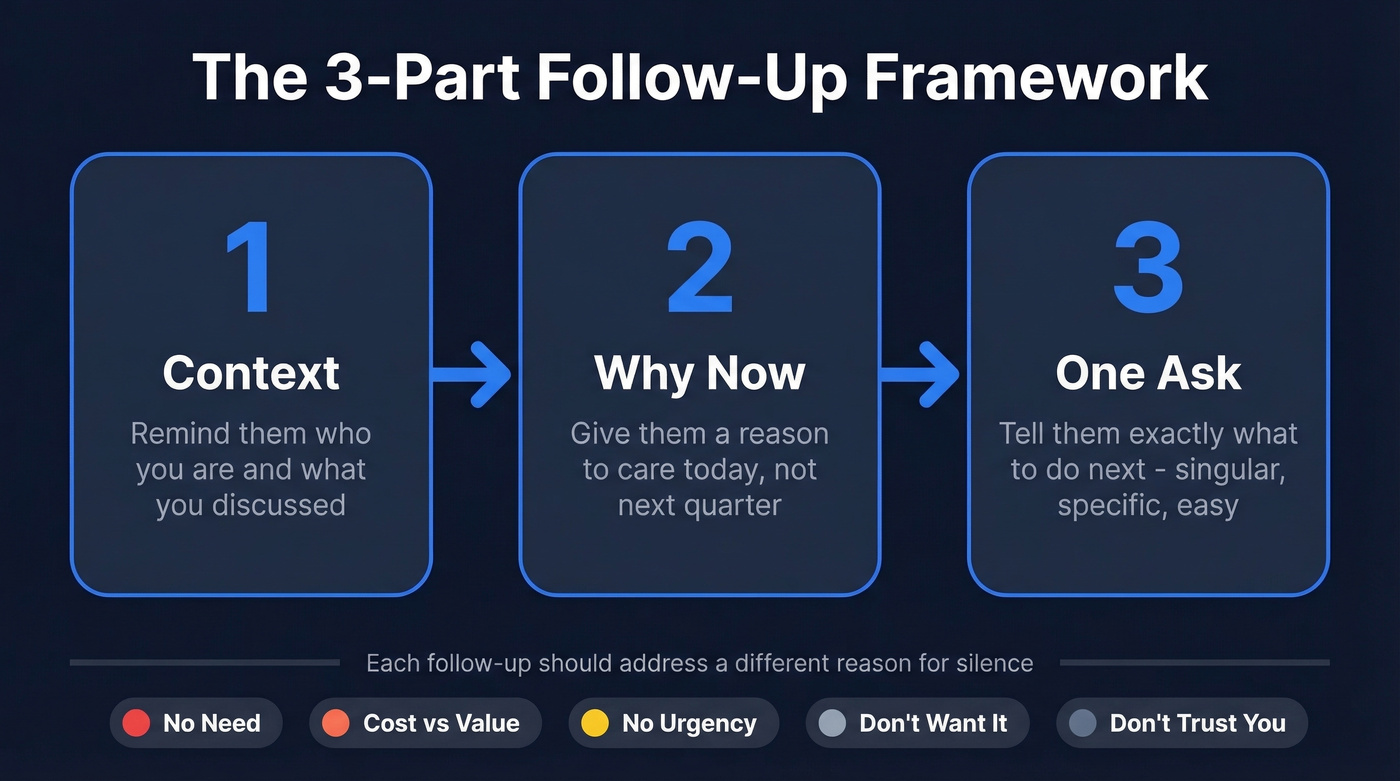
Every follow-up that works follows the same three-part structure: context, why now, one ask. Context reminds them who you are and what you discussed. "Why now" gives them a reason to care today, not next quarter. And one ask - singular - tells them exactly what to do next.
Executives receive around 120 emails a day. Your message didn't get rejected. It got buried.
Each follow-up must address a different reason they haven't replied. There are five common objections behind silence: no need, value vs. cost, no urgency, don't want it, or don't trust you. Your first follow-up might add a case study (trust). Your second might introduce a deadline (urgency). If you're sending the same "just bumping this up" message twice, you're not following up - you're nagging.
Don't over-apologize. Don't open with "Sorry to bother you again." You're offering something valuable. Act like it.
Timing, Cadence, and When to Stop
| Scenario | Wait Before Follow-Up |
|---|---|
| Cold outreach | 3-5 days |
| Client or vendor | 3-5 days |
| Internal (colleague) | 2-3 days |
| Post-interview (small co., fast-moving) | ~1 week |
| Post-interview (large co.) | Up to 1 month |
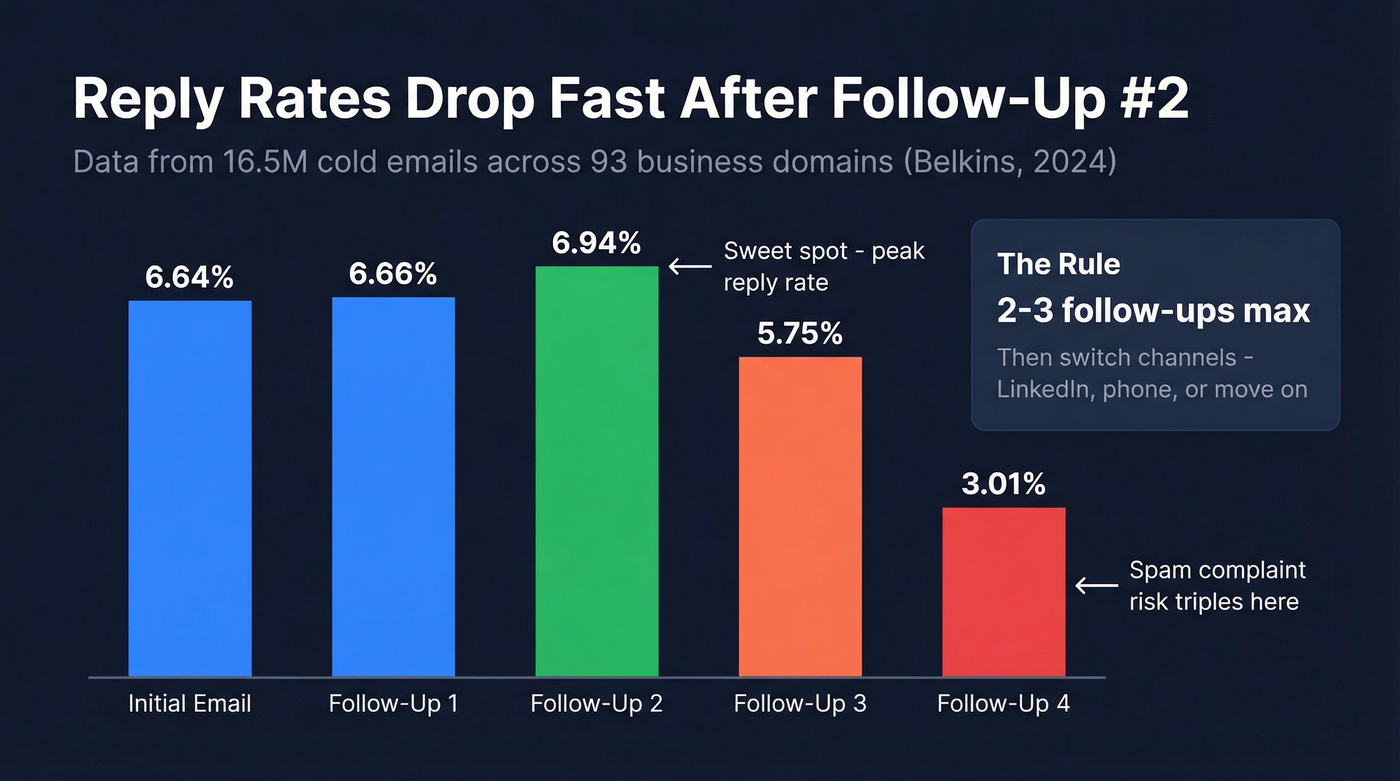
A 16.5M-email study from Belkins - 16.5M cold emails across 93 business domains, Jan-Dec 2024 - makes the decay curve painfully clear for founder-segment prospects: reply rates run 6.64% on the initial email, 6.66% after the first follow-up, and peak at 6.94% after the second. Then they drop to 5.75% on the third and crater to 3.01% on the fourth. Enterprise prospects ghost and punish persistence. SMBs are more forgiving, but even they have limits.
Two follow-ups. Three if you must. Four is spam. (For more copy options, see these sales follow-up templates.)
When two emails get silence, switch channels. A direct message on a professional network or a brief phone call resets the dynamic entirely - LinkedIn nurturing actions alone can push reply rates up to 11.87%.

Your follow-up copy isn't the problem - your data is. Teams using Prospeo cut bounce rates below 2% and see reply rates double before changing a single word of copy. 98% email accuracy, catch-all handling, and spam-trap removal built in.
Clean your list in minutes. 75 free verifications, no credit card.
Subject Lines That Get Opened
"Just checking in" is the email equivalent of a shrug. It's vague, it doesn't personalize, and it doesn't ask a question - three strikes against it based on the data. Worse, recipients often read it as passive-aggressive, a polite way of saying "why haven't you replied yet?" The same goes for "just checking in to see if there is any update" - it puts all the burden on the recipient without offering them a reason to engage. If you want alternatives, use this guide on how to say just checking in professionally.
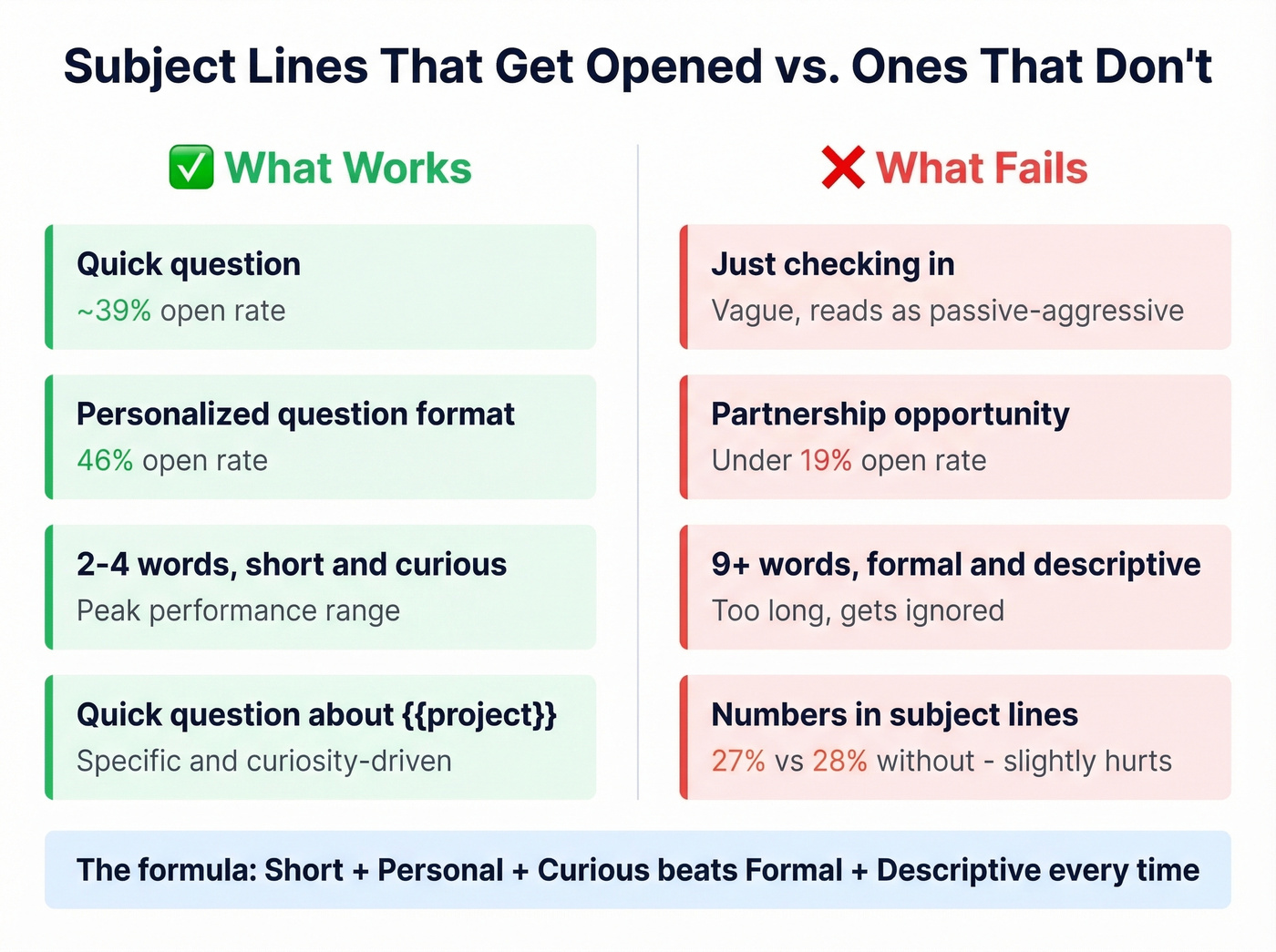
Personalized subject lines hit 46% open rates versus 35% without. Questions perform at 46%. Keep it to 2-4 words for peak performance. Numbers in subject lines actually hurt slightly (27% vs. 28% without).
Skip anything generic, anything over nine words, anything that sounds like a newsletter. One operator on r/Entrepreneur found "Quick question" pulling ~39% opens while "Partnership opportunity" limped in under 19%. Short, personal, and curious beats formal and descriptive every time.
Three Templates That Work
Cold Outreach Follow-Up
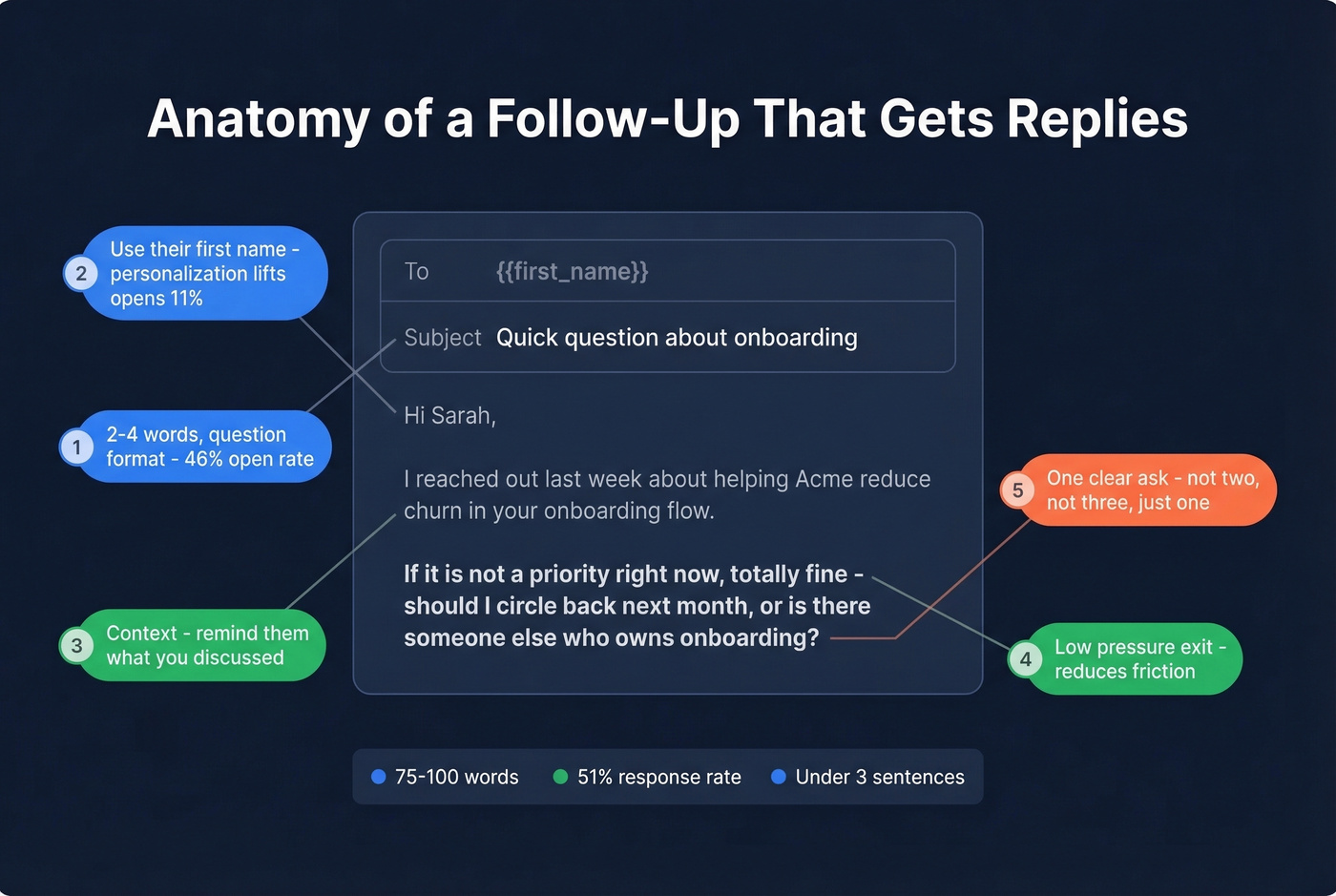
Hi {{first_name}},
I reached out last week about helping {{company}} reduce churn in your onboarding flow.
If it's not a priority right now, totally fine - should I circle back next month, or is there someone else who owns onboarding?
Client or Vendor Follow-Up
Hi {{first_name}},
Following up on the proposal I sent on {{date}} for the Q3 campaign. Our design team starts allocating bandwidth next Monday, so I wanted to confirm timing before we lock the schedule.
Could you let me know by Friday whether you'd like to move forward or adjust scope?
Post-Interview Follow-Up
Hi {{first_name}},
I've been thinking about the migration project you mentioned - especially the challenge of getting engineering buy-in. That's a problem I've tackled twice before and would love to dig into.
Do you have a sense of timing for next steps?
Notice what all three share: they're under 100 words, they reference something specific from the prior conversation, and they end with a single clear question. No "just wanted to touch base." No apologies.
Before You Follow Up, Verify Your Data
Let's be honest: most follow-up advice obsesses over what to write. The bigger question is whether your email arrived at all. That Reddit operator who doubled their reply rate? The first thing they fixed wasn't copy - it was list quality. Their bounce rate dropped from 11% to under 2% after manual verification.
We've seen the same pattern across dozens of outbound teams we work with. Before you send another check-in email after no response, check the basics: SPF, DKIM, and DMARC configured on your domain. Bounce rate under 2%. And verified addresses. (If you need a deeper checklist, start with this email deliverability guide and then improve sender reputation.)
Prospeo's email finder runs a 5-step verification process with 98% accuracy, including catch-all handling, spam-trap removal, and honeypot filtering. The free tier covers 75 verifications per month - enough to clean a prospect list before your next sequence goes out.
If your domain reputation has already taken a hit from bad data, no amount of clever copywriting will save your follow-ups. Fix the foundation first. (If you're troubleshooting bounces, this email bounce rate guide helps.)

Before you write follow-up #3, make sure follow-ups #1 and #2 actually landed. Prospeo's 5-step verification catches dead addresses, spam traps, and honeypots that silently destroy your sender reputation - at $0.01 per email.
Stop perfecting emails that bounce. Fix the foundation first.
FAQ
How many follow-ups should I send after no response?
Two to three. A 16.5M-email study shows reply rates peak after the second follow-up (6.94%) then crater to 3.01% by the fourth. Four or more triples spam complaints - stop before you damage your sender reputation.
Should I use the same subject line on a follow-up?
For reply-thread follow-ups, keep the original subject - it preserves context and inbox threading. For a fresh attempt after extended silence (10+ days), use a new personalized subject line in question format, which averages 46% open rates.
What if my follow-up emails aren't getting opened at all?
The problem is almost certainly deliverability, not copywriting. Confirm your domain has SPF/DKIM/DMARC configured, your bounce rate is under 2%, and you're sending to verified addresses. Skip this step and you're optimizing words nobody will ever read.
Is "just checking in" a good subject line?
No. It's vague, impersonal, and often reads as passive-aggressive. Personalized question-format subject lines hit 46% open rates versus 35% for generic ones. Try "Quick question about {{project}}" instead - short, specific, and curiosity-driven.