

Chief Revenue Officer: The Definitive CRO Guide (2026)
Your board just told you it's time to hire a CRO. Or maybe you're the one eyeing the title. Either way, the chief revenue officer role is the most misunderstood seat in the C-suite - and the most volatile. Average tenure is 25 months. One in three turns over every year. Here's everything you need to know before you hire one, become one, or report to one.
The Short Version
What's a CRO? The executive who owns the entire revenue cycle - acquisition, retention, and expansion - across sales, marketing, customer success, and RevOps. Not a VP of Sales with a fancier title.
What do they earn? $182K average base nationally. At venture-backed startups, base salaries run $400K-$600K, with equity packages often valued around $1M-$2M on top.
When should you hire one? Generally not before $50M ARR. The one exception: you're at ~$10M and growing 300%+ year-over-year.
Why do they keep leaving? That 25-month average tenure isn't a people problem - it's a role-design problem. Half of all CROs say they were hired for full revenue ownership but scoped as a glorified VP of Sales.
What Is a CRO?
A chief revenue officer is the C-suite executive responsible for the entire revenue engine - from the first marketing touch through closed-won, onboarding, retention, and expansion. The CRO aligns sales, marketing, customer success, partnerships, and revenue operations under a single strategic umbrella, reporting directly to the CEO.
The title traces back to 1999, when LaVon Koerner at Revenue Storm operationalized the concept. It entered documented public usage by 2002, but didn't gain real traction until the SaaS boom made cross-functional revenue alignment a survival requirement rather than an org-chart experiment.
That's the textbook version. The reality is messier.
70% of CROs describe their ideal scope as owning the full revenue cycle across all go-to-market functions. But in practice, many get handed the sales org and told to "figure out the rest." The gap between the title and the actual authority is where most CRO tenures go sideways. When the role works, it works exceptionally well - the Revenue Operations Alliance highlights research suggesting Fortune 100 companies with a CRO-like role show 1.8x higher revenue growth than peers. The key word is "CRO-like," meaning the authority and scope match the title, not just the org chart label.
What Does a CRO Do Day-to-Day?
The job is to make revenue predictable, scalable, and durable. The cross-functional scope is what separates a CRO from every other revenue leader. They're the connective tissue between teams that historically operate in silos. VP of Sales, VP of Marketing, Head of Customer Success, and the RevOps leader all report into the CRO. Partnerships often do too.
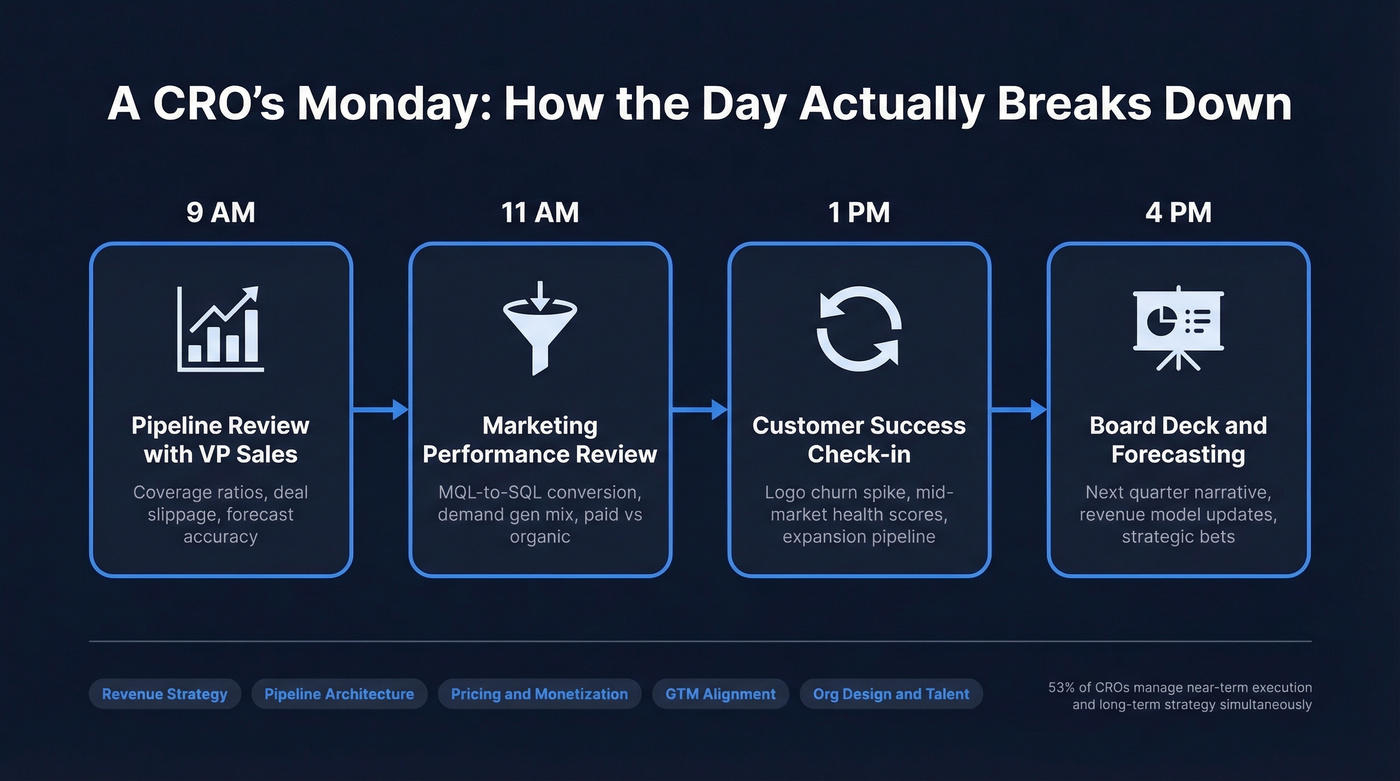
Here's what a Monday actually looks like. At 9 a.m., the CRO is reviewing pipeline coverage ratios and deal slippage with the VP of Sales. By 11, they're in a marketing review dissecting MQL-to-SQL conversion rates and debating whether the demand gen mix needs to shift from paid to organic. After lunch, they're on a call with the Head of CS about a spike in logo churn among mid-market accounts. By 4 p.m., they're building the board deck narrative for next quarter's revenue forecast. 53% of CROs say they manage near-term execution and long-term strategic bets simultaneously - that's not a scheduling preference, it's the job description.
CRO responsibilities break down into five buckets:
- Revenue strategy and forecasting - setting targets, building models, owning the board-level revenue narrative
- Pipeline architecture - ensuring marketing generates the right leads, sales converts them efficiently, and CS expands them
- Pricing and monetization - working with product and finance on packaging, pricing tiers, and expansion revenue levers
- GTM alignment - eliminating handoff friction between marketing, sales, and CS through shared definitions, SLAs, and data
- Org design and talent - building the leadership team, structuring comp plans, deciding when to hire specialists vs. generalists
The reporting structure is straightforward: CRO reports to the CEO, occasionally the COO. Everyone else in the revenue org reports up through the CRO. When that chain of command gets muddied - when the VP of Marketing reports to the CEO instead of the CRO, for instance - the role starts to break down.
CRO vs VP Sales vs CSO vs CCO
These titles get used interchangeably, and they shouldn't. The scope differences are real and consequential for how you design your org.
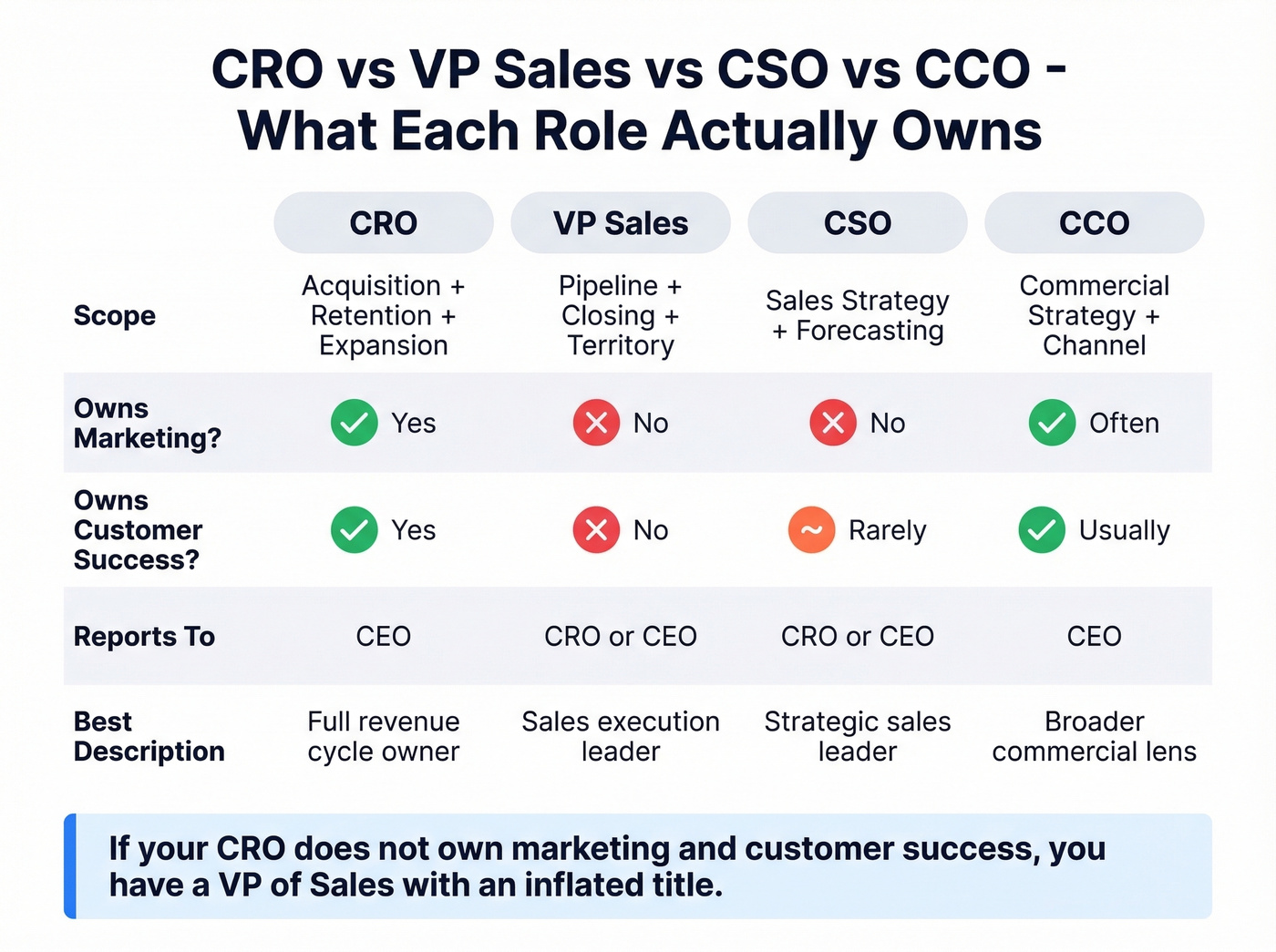
| Role | Scope | Owns Marketing? | Owns CS? | Reports To |
|---|---|---|---|---|
| CRO | Acquisition + retention + expansion | Yes | Yes | CEO |
| VP Sales | Pipeline + closing + territory | No | No | CRO or CEO |
| CSO | Sales strategy + forecasting | No | Rarely | CRO or CEO |
| CCO | Commercial strategy + channel | Often | Usually | CEO |
The VP of Sales is an execution-focused leader who owns quotas, pipeline, closing, and territory management. They're building and running the sales machine. A CSO carries more strategic weight - sales forecasting, territory design, competitive positioning - while still being confined to the sales function.
The CCO is the wildcard. More common in European companies, the CCO typically spans sales, marketing, and customer relationships with a broader commercial strategy lens that includes partnerships and channel. Think of it as a CRO with a slightly different philosophical emphasis.
Here's the thing: if your "CRO" doesn't own marketing and customer success, you have a VP of Sales with an inflated title. That's not a judgment - it's a structural observation. The Launch Collective framework puts it clearly: CRO means full revenue ownership. Anything less is a different role.
CRO Compensation in 2026
National Salary Ranges
PayScale's 2026 data puts the national average CRO base at $182K, with a range of $106K at the 10th percentile to $253K at the 90th. Total pay - including bonus, commission, and profit sharing - runs $122K to $309K.
Those numbers feel low if you're in the startup world. They are. PayScale captures a broad cross-section that includes smaller companies, non-tech industries, and regional markets. It's useful as a floor, not a ceiling.
For a geo-specific benchmark, NYC CROs average $426,507 in total comp - $241K base plus $185K in additional cash compensation. That's more representative of what a CRO at a growth-stage tech company actually takes home.
Startup CRO Pay by Stage
Venture-backed startup comp is a different universe entirely:
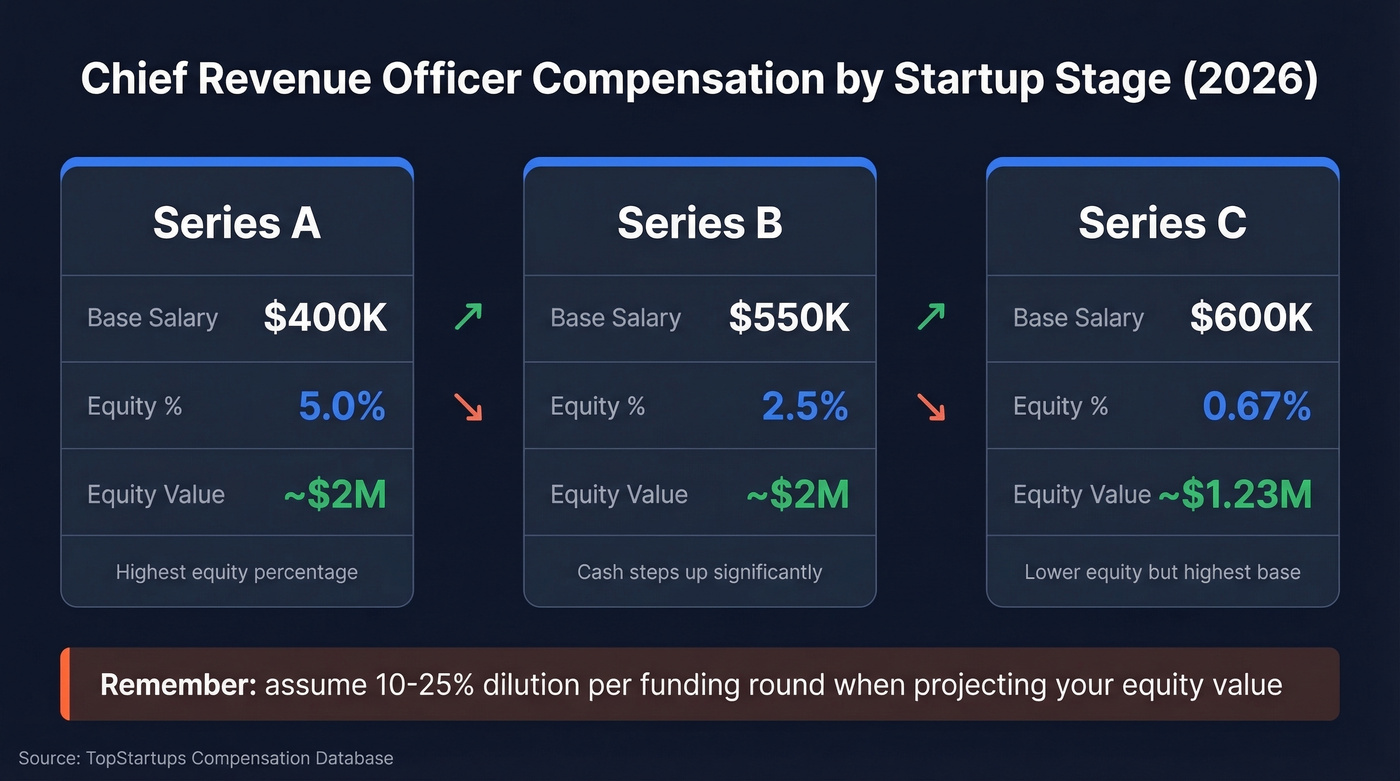
| Stage | Base Salary | Equity % | Equity Value | Notes |
|---|---|---|---|---|
| Series A | $400K | 5.0% | ~$2M | Highest equity % |
| Series B | $550K | 2.5% | ~$2M | Cash steps up |
| Series C | $600K | 0.67% | ~$1.23M | Lower % but higher base |
These come from TopStartups' compensation database, which aggregates vetted private submissions. Pre-seed CRO hires exist but are rare enough to be outliers. The pattern is consistent with what we see in the market: earlier stages offer more equity at lower bases, and the equity percentage drops as valuations climb.
One critical nuance: assume 10-25% dilution per funding round when projecting equity value. That Series A 5.0% stake won't be 5.0% by the time the company hits Series C. Factor dilution into your decision, especially if you're weighing a lower-base/higher-equity offer.
The gap between PayScale's $182K average and a Series B CRO pulling $550K base isn't a data error. These are genuinely different labor markets. A CRO at a $200M ARR SaaS company and a CRO at a $30M regional services firm are doing fundamentally different jobs at fundamentally different price points.
The CRO Tenure Crisis
Here's the stat that should make every board pause: the average CRO tenure is 25 months. A Pave dataset of 14,000 executives pegs it even lower at 1.8 years, with a 32% annual turnover rate. One in three CROs turns over every single year.
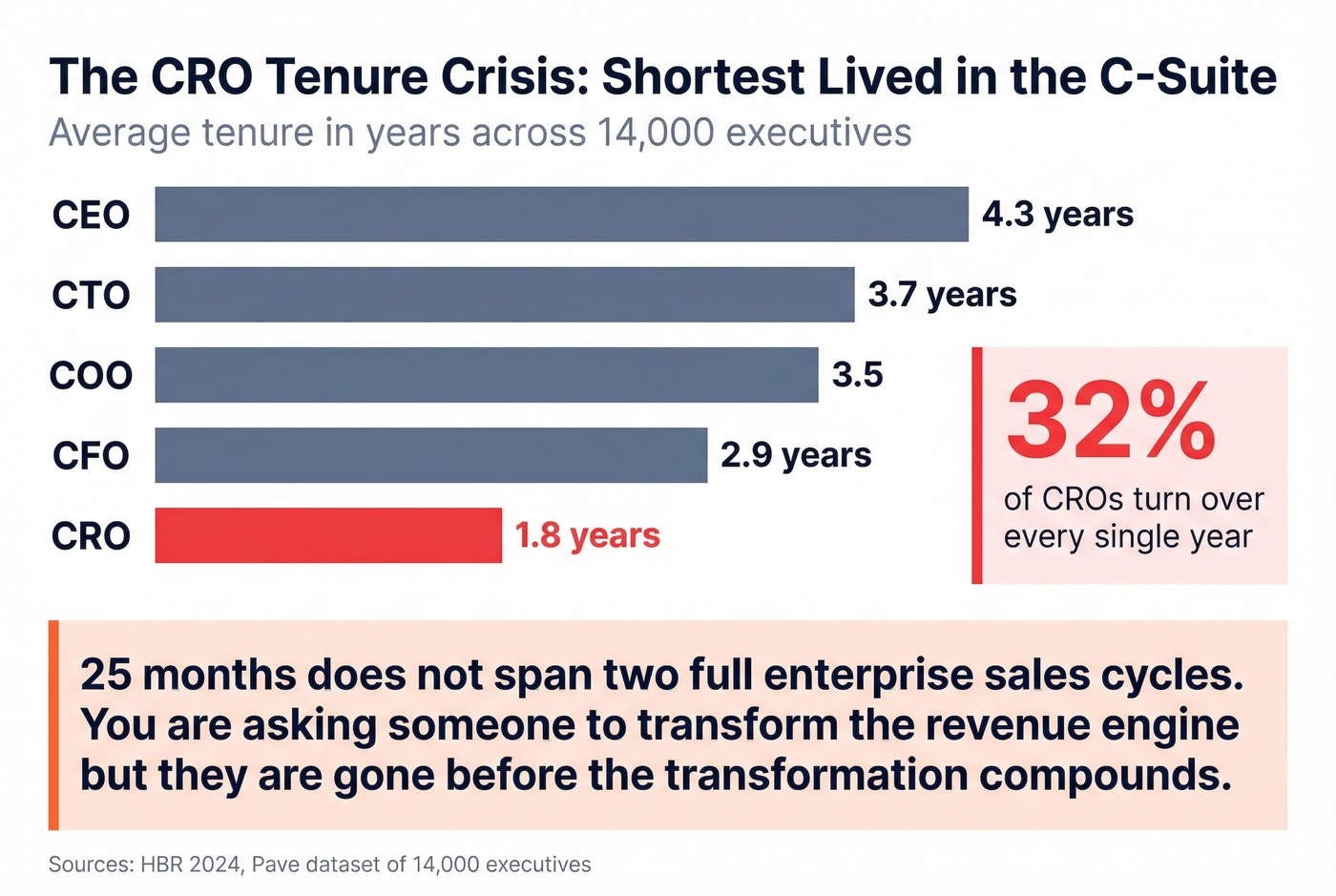
For context:
- CEO: 4.3 years
- CTO: 3.7 years
- COO: 3.5 years
- CFO: 2.9 years
- CRO: 1.8 years
It's not close. Twenty-five months doesn't span two full sales cycles at most enterprise companies. You're asking someone to transform the revenue engine, but they're gone before the transformation has time to compound.
The problem isn't that companies keep hiring the wrong people. The problem is that companies keep defining the role wrong, then blaming the person when it doesn't work. We've seen this pattern repeatedly: a board hires a "CRO," scopes them as a VP of Sales, gives them a revenue target without authority over marketing or CS, and then acts surprised when they leave after 14 months.

A CRO's #1 job is making revenue predictable. That starts with pipeline - and pipeline starts with data. Prospeo gives your revenue org 300M+ profiles, 98% verified emails, and 30+ filters including buyer intent and headcount growth, so every rep connects with real buyers.
Give your CRO the data infrastructure that actually scales.
Why CROs Fail
Your CRO just quit after 14 months. Again. Before you start the search for the next one, figure out whether the role was set up to succeed in the first place.
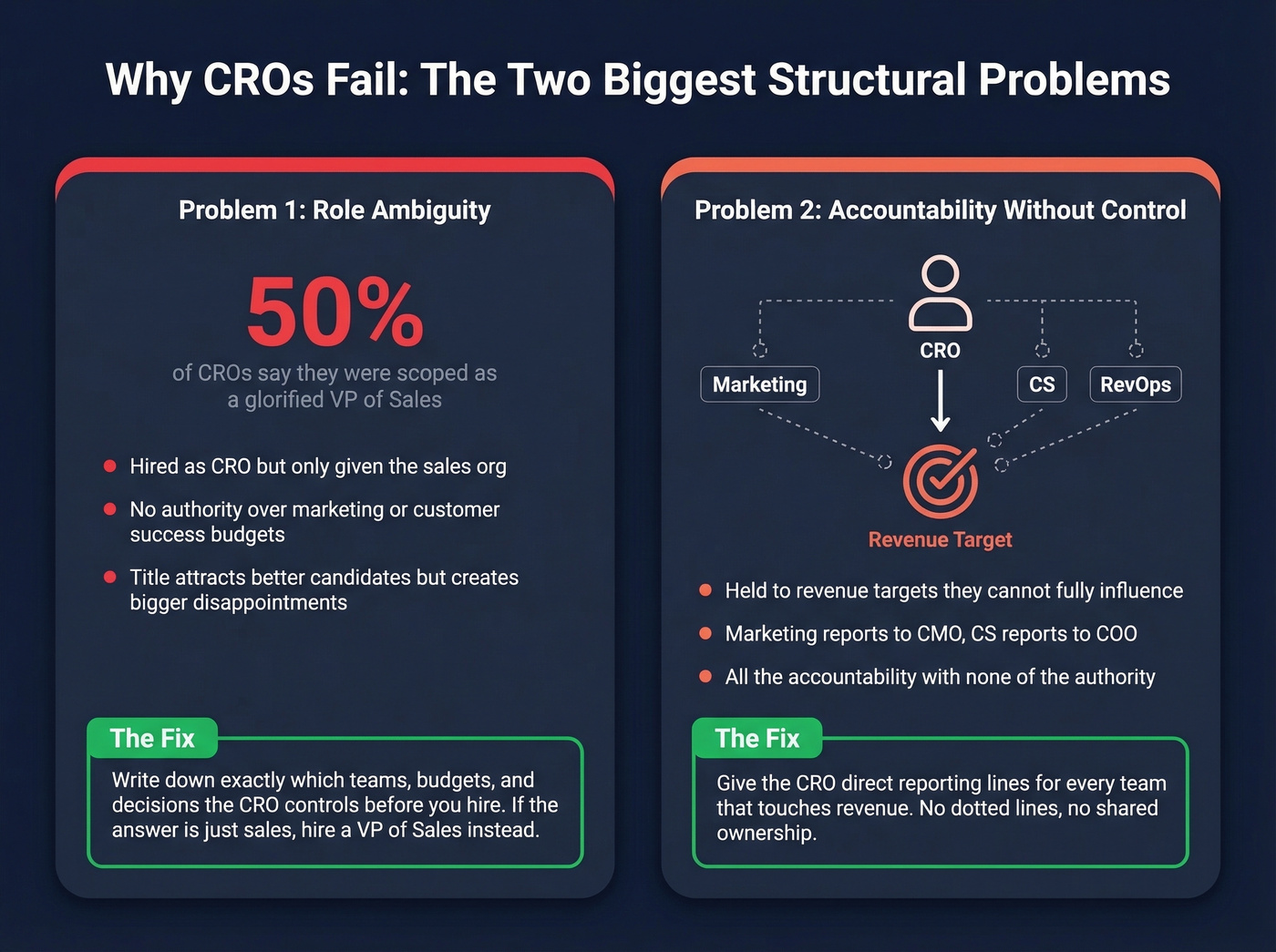
Role Ambiguity
50% of CROs cite unclear scope or being treated as a "glorified VP of Sales" as their primary challenge. This is the single biggest failure mode, and it's entirely preventable.
Let's be honest: most companies that hire a CRO before $50M ARR aren't hiring a CRO at all. They're hiring a VP of Sales with a title that'll attract better candidates and create bigger disappointments. Define the role before you fill it. Write down exactly which teams, budgets, and decisions the CRO controls. If the answer is "just sales," hire a VP of Sales and save everyone the confusion.
A post on r/ceo illustrates the problem perfectly. A CEO described their "CRO" who was also the company's top individual producer - carrying a personal quota because the comp plan incentivized personal production over team management. That's not a CRO. That's a senior AE with a C-suite title and a structural conflict of interest baked into their comp plan.
Accountability Without Control
CROs get held to revenue targets without authority over the teams and budgets that drive revenue. Marketing reports to the CMO. CS reports to the COO. But the CRO owns the number. This creates what practitioners describe as "all the accountability, none of the control" - a recipe for burnout that plays out on a predictable 18-to-25-month timeline.
The data backs up why this matters at the org level: companies with an aligned end-to-end revenue engine grow nearly 20% faster and are 15% more profitable than those without one. When the CRO can't actually align the engine because half the teams don't report to them, you lose that growth premium entirely.
Short-Term Pressure vs Long-Term Building
A third of CROs feel intense pressure to deliver immediate results while simultaneously building scalable systems. You can't do both in the same quarter. 37% emphasize that strong alignment with the CEO, CFO, and board is critical to managing this tension. Without that alignment, the CRO becomes a scapegoat for quarterly misses while trying to fix structural problems that took years to create.
When to Hire a CRO
Your board just told you it's time to hire a CRO. You're at $12M ARR. With respect, your board is probably wrong.
Madrona's framework lays out clean ARR thresholds that match what we've observed in practice:
- $0-$2M ARR: The CEO sells. You're still finding product-market fit. A CRO has nothing to optimize yet.
- $2-$10M ARR: Hire a scrappy head of sales or sales director. Someone who'll carry a bag and build the first playbook.
- $10-$50M ARR: Bring in an experienced VP of Sales to scale what's working. Build out the sales org, formalize processes, add sales ops.
- $50M+ ARR: Now you need a CRO. The complexity of coordinating marketing, sales, CS, and partnerships across multiple segments and motions justifies the role.
The one exception: if you're at ~$10M ARR but growing 300%+ year-over-year, an earlier CRO hire makes sense. At that growth rate, you're building infrastructure for a $50M company in real time, and you need someone thinking end-to-end about the revenue engine before it outgrows its plumbing.
Most companies hire a CRO too early. They do it because a board member suggests it, or because they think the title will attract a better candidate. Skip the CRO title at $15M ARR - a VP of Sales is almost always the right call. Save the CRO hire for when the cross-functional complexity genuinely demands it.
CRO KPIs That Matter
Fewer, shared KPIs beat a dashboard of 30 metrics nobody owns. The Mereo framework gets this right with four core metrics that a CRO should obsess over. KPI emphasis shifts by industry - telecom CROs fixate on ARPU, SaaS CROs on ARR and net retention, enterprise CROs on deal size and cycle length - but the underlying framework applies everywhere.
CAC + Payback Period
Formula: (sales + marketing spend) / new customers acquired. Track the payback period alongside it - how many months until a customer's gross margin covers the acquisition cost. If your CAC payback is stretching beyond 18 months, something in the funnel is broken.
LTV and LTV:CAC Ratio
Formula: (average revenue per period x gross margin %) x average customer lifetime. The LTV:CAC ratio is the efficiency test. Below 3:1, you're spending too much to acquire. Above 5:1, you're probably underinvesting in growth.
Deal Velocity + Conversion
Stage-by-stage conversion rates, win rates, and cycle length - all tracked via CRM timestamps. Run rolling 90-day and 12-month views. The 90-day view catches emerging problems. The 12-month view filters out noise.
Churn and Net Retention
Gross churn tells you how many customers you're losing. Net retention tells you whether expansion revenue offsets it. Cohort retention curves and health scoring give you the leading indicators before the lagging numbers go red.
Every one of these metrics degrades when your team is working with stale contacts and bouncing emails. Tools like Prospeo, which refresh contact data on a 7-day cycle with 98% email accuracy, are the kind of data hygiene that makes pipeline forecasting reliable instead of aspirational.
How to Become a CRO
There's no single path to the CRO seat, but there are four common ones - each with a distinct credibility gap you'll need to close.
Sales to CRO (The Fast Track)
AE, Manager, Director, VP Sales, CRO. This is the most common path and the fastest. The risk is that boards pigeonhole you as "head of sales plus" if you haven't demonstrated fluency in marketing strategy, customer success metrics, and RevOps systems.
If you're on this track, volunteer for cross-functional projects early. Own a joint marketing-sales initiative. Get your hands dirty in CS QBRs. The CROs who came up through sales and lasted beyond 25 months are the ones who deliberately broadened before they got the title.
Marketing to CRO
Can you carry a number? That's the question every board will ask, and "I influenced pipeline" isn't a good enough answer. The marketing-to-CRO path runs through demand gen or growth leadership, but the credibility gap is quota ownership. You'll need to prove you can forecast, manage a pipeline, and close - not just generate demand. Consider a rotation through sales leadership or a player-coach role that puts you directly on the hook for revenue. The VP Marketing to CRO jump is the hardest in the entire C-suite.
Customer Success to CRO
CSM/AM, Head of CS, CRO. The expansion revenue expertise is valuable, but you'll need to prove you can drive net-new acquisition, not just retain and grow existing accounts. The jump from "keeping customers" to "winning new ones" is bigger than it looks from the CS side.
RevOps to CRO
RevOps leaders have the systems thinking, the process rigor, and the forecasting chops. What they often lack is direct revenue ownership - you've built the infrastructure, but have you carried a number? The strongest candidates take an interim VP of Sales role to build that credibility before making the final jump.
The fastest path is Sales to CRO. The most durable path includes a rotation through marketing or CS. If you're serious about the CRO seat, plan your career moves to close the gaps your primary discipline leaves open.
The CRO's Tech Stack in 2026
A CRO's pipeline metrics are only as good as the data infrastructure feeding them. Bad data inflates CAC, extends sales cycles, and makes every forecast unreliable.
The core stack spans five categories:
- CRM - Salesforce or HubSpot as the system of record
- Revenue intelligence - Gong, Clari, or similar for deal inspection and forecasting
- B2B data and prospecting - verified contacts, enrichment, and intent signals
- Intent data - in-market buyer signals to prioritize accounts
- Sales engagement - sequence execution and multi-channel outreach
AI is reshaping every layer of this stack in 2026. AI-driven forecasting tools are replacing gut-feel pipeline calls, AI SDRs handle initial outreach sequencing, and revenue intelligence platforms use machine learning to flag at-risk deals before reps notice. The CRO who ignores AI isn't just behind - they're building on a foundation their competitors have already outgrown.

The data layer is where most stacks quietly fall apart. We've seen CROs inherit pipelines built on data that's six weeks stale - the industry average refresh cycle - with 20%+ email bounce rates baked into every sequence. That's not a sales execution problem. It's a data infrastructure problem. The CRO who fixes the data layer first will see every downstream metric improve.
If you're auditing the data layer, start with data enrichment and a clear view of email bounce rate drivers, then lock in email deliverability basics before you scale volume.
CROs align sales, marketing, and CS around one number: revenue. Bad contact data breaks that alignment fast - bounced emails burn domains, wrong numbers waste rep hours, and pipeline forecasts collapse. Prospeo delivers 98% email accuracy on a 7-day refresh cycle at $0.01/email, so your GTM engine runs clean.
Stop letting stale data sabotage your revenue org.
CRO FAQ
What is a chief revenue officer?
A chief revenue officer is the C-suite executive who owns the full revenue cycle - acquisition, retention, and expansion - across sales, marketing, and customer success. Unlike a VP of Sales, the CRO is a strategic, cross-functional leader responsible for aligning every go-to-market function under a unified revenue strategy, reporting directly to the CEO.
How much does a CRO make in 2026?
National average base is ~$182K per PayScale. In venture-backed startups, base salaries run $400K-$600K with equity often valued at $1M-$2M. NYC CROs average $426K total comp. The gap reflects different labor markets - industry, company stage, and geography all drive massive variation.
When should a startup hire a CRO?
At $50M+ ARR, when cross-functional complexity justifies the role. Before that, a VP of Sales is more appropriate and more likely to succeed. The exception: startups at ~$10M ARR growing 300%+ year-over-year benefit from an earlier hire to build revenue infrastructure ahead of scale.
Why is CRO turnover so high?
Average tenure is 25 months - the shortest in the C-suite. The top cause is role ambiguity: being hired as a CRO but scoped as a VP of Sales. Without clear authority over marketing, CS, and RevOps, CROs burn out from carrying accountability without control. It's a role-design problem, not a talent problem.
What data tools should a CRO prioritize?
Start with CRM hygiene and contact data accuracy - every downstream metric depends on it. A 7-day data refresh cycle and 98%+ email accuracy give CROs a reliable foundation, while intent data helps prioritize accounts showing active buying signals. Layer in revenue intelligence tools like Gong or Clari for deal-level visibility.