

8 Chief Revenue Officer Skills That Keep You Alive Past 18 Months
You just got the CRO title. Your CEO expects you to "align revenue." Your board wants a forecast by Friday. Welcome to the ejection seat - the average CRO lasts 17-25 months, shorter than two full enterprise sales cycles. CEOs average 7 years. CFOs get 5. CROs get pushed out fast, and 62% of companies stall or shrink after a CRO exits.
Here's the thing: most chief revenue officer skills lists read like a LinkedIn recruiter wrote them. "Strategic thinking." "Leadership." "Communication." That's not a skills list - that's a horoscope. Let's talk about what actually keeps you employed.
What a CRO Actually Is (And Isn't)
A VP of Sales owns deal execution - pipeline, quotas, rep performance. A CRO owns the entire revenue system: sales, marketing, CS, and RevOps alignment. A CCO owns commercial direction - markets, pricing, positioning.
The diagnostic is simple. Deals aren't closing? You need a VP of Sales. Deals close but revenue leaks across handoffs? You need a CRO. Selling the wrong thing to the wrong market? That's a CCO problem.
A CRO without authority over marketing and customer success is a VP of Sales with a bigger title. Fix the authority problem before you worry about competencies.
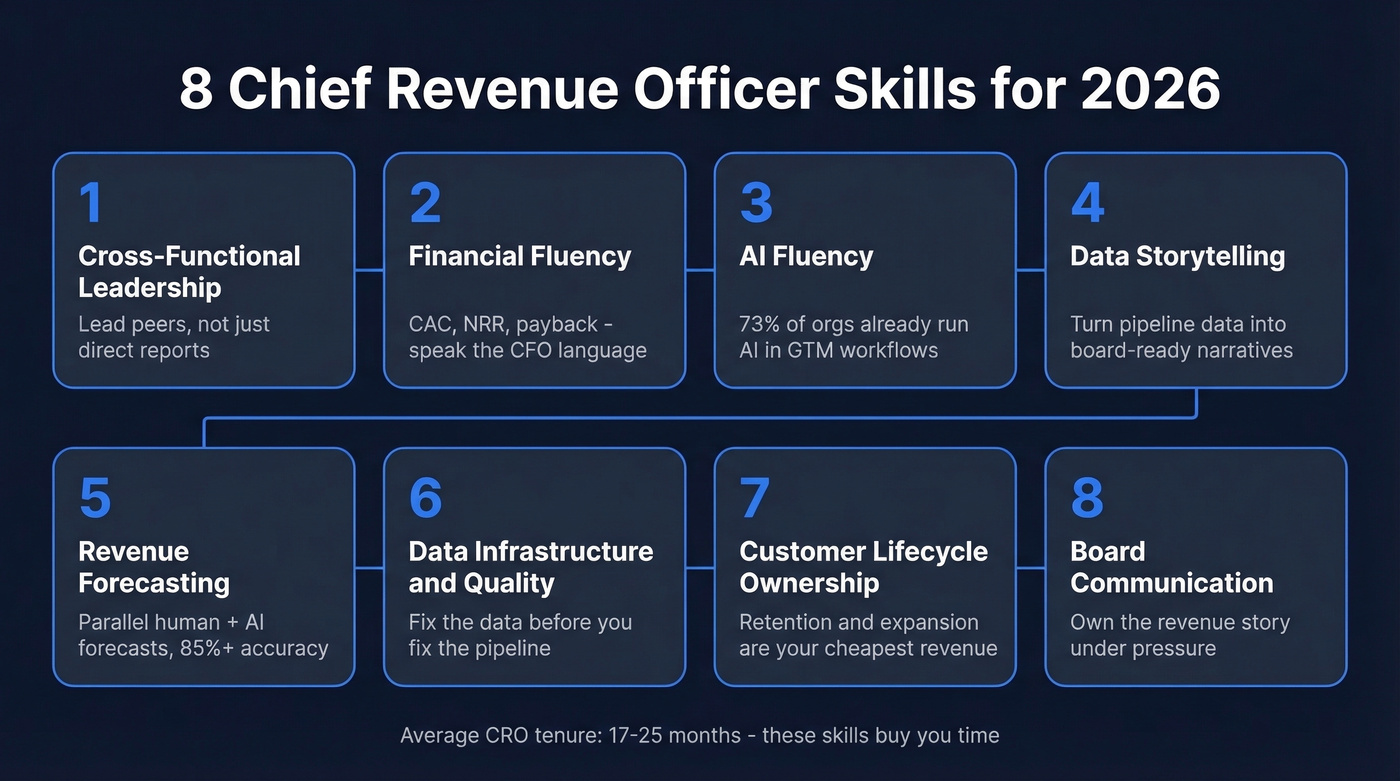
The 8 Skills Every CRO Needs in 2026
1. Cross-Functional Leadership
This is the top survival competency, and the SaaStr CRO panel from Notion, CircleCI, and Lattice hammered it home: your first team is the executive team, not the sales org. The ability to lead peers - not just direct reports - is the foundation of CRO leadership.
And here's what gets CROs fired: skipping the marketing foundation. Segmentation, value prop, and customer journey mapping aren't optional. They're one of the most common failure modes we've seen. Build execution on sand and you'll spend your entire tenure "fixing pipeline" instead of fixing the machine.
2. Financial Fluency
Boards don't want vision decks. They want ARR vs. plan and CAC payback period.
Every CRO skills article lists "strategic thinking" - that's useless. The actual skill is fluency in unit economics: CAC, payback, NRR, CLTV:CAC. If you can't explain why your CAC ratio moved from 1.2 to 0.8, the CFO will explain it for you, and you won't like their version.
3. AI Fluency
In a 2026 CRO survey, 73% of organizations reported running AI in core GTM workflows with measured revenue impact. Forecast accuracy is moving from the low-70s toward 85-90% with AI-assisted models. If your CRO is still "evaluating" AI, they're already behind.
But AI doesn't fix broken foundations. Inconsistent CRM data, messy routing logic, and undefined handoff SLAs will cause AI initiatives to fail before they hit production. The skill isn't "use AI." It's knowing where AI adds value and where it amplifies garbage.
4. Data Storytelling
Every CRO article lists "data-driven." That's like listing "breathing" for marathon runners.
The actual skill is translating pipeline data into a full-funnel narrative that gets the CFO to fund your plan and the board to extend your runway - blending CRM, product usage, marketing attribution, and finance data into a story non-revenue leaders can act on. We've watched CROs lose budget fights not because their numbers were wrong, but because they couldn't frame those numbers in terms the rest of the C-suite cared about.
5. Revenue Forecasting
This is operational discipline, not guesswork. The best CROs run parallel human and AI forecasts, compare the delta, and use the gap to find blind spots.
The targets worth chasing: forecast call time down 50%, deal slippage down 25%, accuracy consistently above 85%. In our experience, teams transform their board credibility just by getting forecast accuracy from "directionally right" to "within 5%." That single improvement buys you more trust than any strategy deck. (If you’re rebuilding the stack, start with sales forecasting tools that support both models.)
6. Data Infrastructure and Quality
Your outbound team burns 500 dials a day with single-digit connect rates because nobody verified the phone numbers. Your pipeline coverage looks healthy until you realize 30% of the contacts are stale. Sound familiar?

The average GTM team manages 23+ tools, and contact data goes stale in weeks - the industry average refresh cycle is about six weeks. We've watched pipeline forecasts collapse at companies where data decayed on exactly that timeline.
This is where the CRO's job intersects with tooling decisions. A platform like Prospeo, which refreshes 300M+ profiles every 7 days at 98% email accuracy, turns pipeline metrics from fiction into something you can actually defend in a board meeting. (If you’re evaluating vendors, compare data enrichment services and B2B company data providers side by side.)
7. Customer Lifecycle Ownership
This separates real CROs from VPs of Sales with inflated titles. Buyers complete up to 90% of their research before talking to sales, which means the revenue journey starts long before a rep picks up the phone.
Retention, expansion, and NRR aren't someone else's problem. They're the cheapest, most predictable revenue source you have. Gainsight's research makes the case clearly: CS isn't a cost center, it's a revenue engine. (If churn is the leak, run a proper churn analysis.)
8. Board Communication
You can't delegate the revenue story to a deck. The CRO must translate operational metrics - pipeline velocity, stage conversion, NRR trends - into a strategic narrative the board can use to make decisions. This isn't presentation skills. It's the ability to own the revenue narrative at the highest level and defend it under pressure when a board member pokes holes in your Q3 projection.
A word of caution: Most companies hiring a CRO don't actually need one. If your average deal size is under $25k and you have fewer than 50 reps, a strong VP of Sales and a RevOps lead will outperform a CRO who spends their first six months just mapping the org chart. The CRO role creates value when there's genuine cross-functional complexity to orchestrate. Without that complexity, it's an expensive title.

You just read that contact data goes stale in six weeks and pipeline forecasts collapse because of it. Prospeo refreshes 300M+ profiles every 7 days with 98% email accuracy - so the pipeline numbers you defend in your next board meeting are real, not fiction.
Stop forecasting on decayed data. Start with contacts you can trust.
CRO Leadership Gaps by Background
| Background | Strengths You Bring | Gaps to Close |
|---|---|---|
| Sales | Quota ownership, deal execution, forecasting instincts | Retention economics, demand gen, post-sale lifecycle |
| Marketing | Segmentation, positioning, analytics | Quota credibility, forecasting discipline, closing motions |
| CS | Retention, expansion, LTV optimization | Net-new acquisition, outbound pipeline building |
| RevOps | Systems thinking, data integrity, process design | Field credibility, closing motions, exec presence |
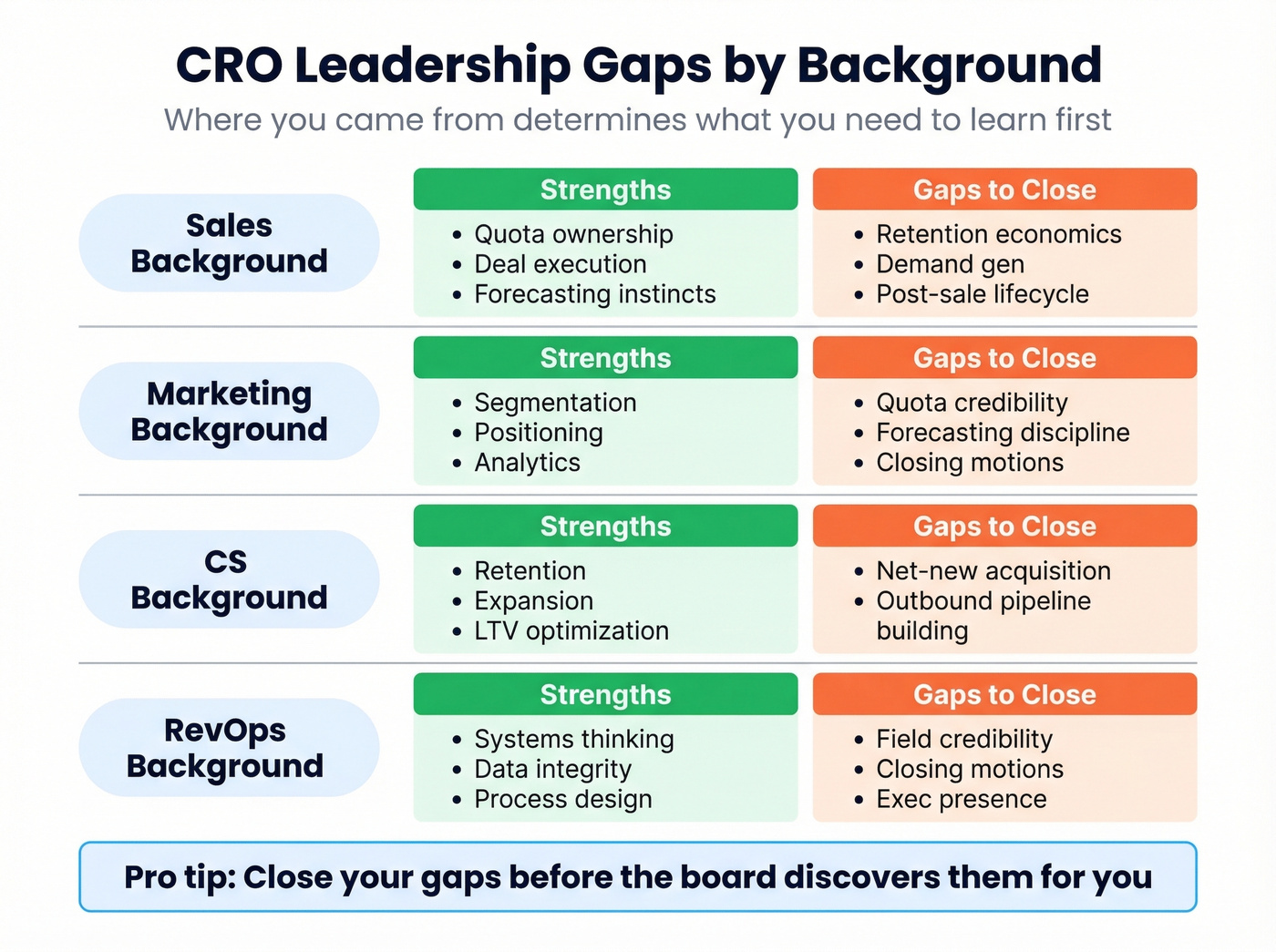
The sales-to-CRO path is the most common, but it's where the biggest blind spots hide. If you came up through sales leadership, your first 90 days should include a marketing audit and a deep dive into retention economics. The best CRO leadership advice I can give: close your gaps before the board discovers them for you. The consensus on r/sales threads about CRO transitions backs this up - the reps who got promoted fastest often struggled most with the cross-functional piece.
The 5 Metrics a CRO Owns
If you don't own all five, you're not a CRO - you're a VP of Sales with a fancier business card.
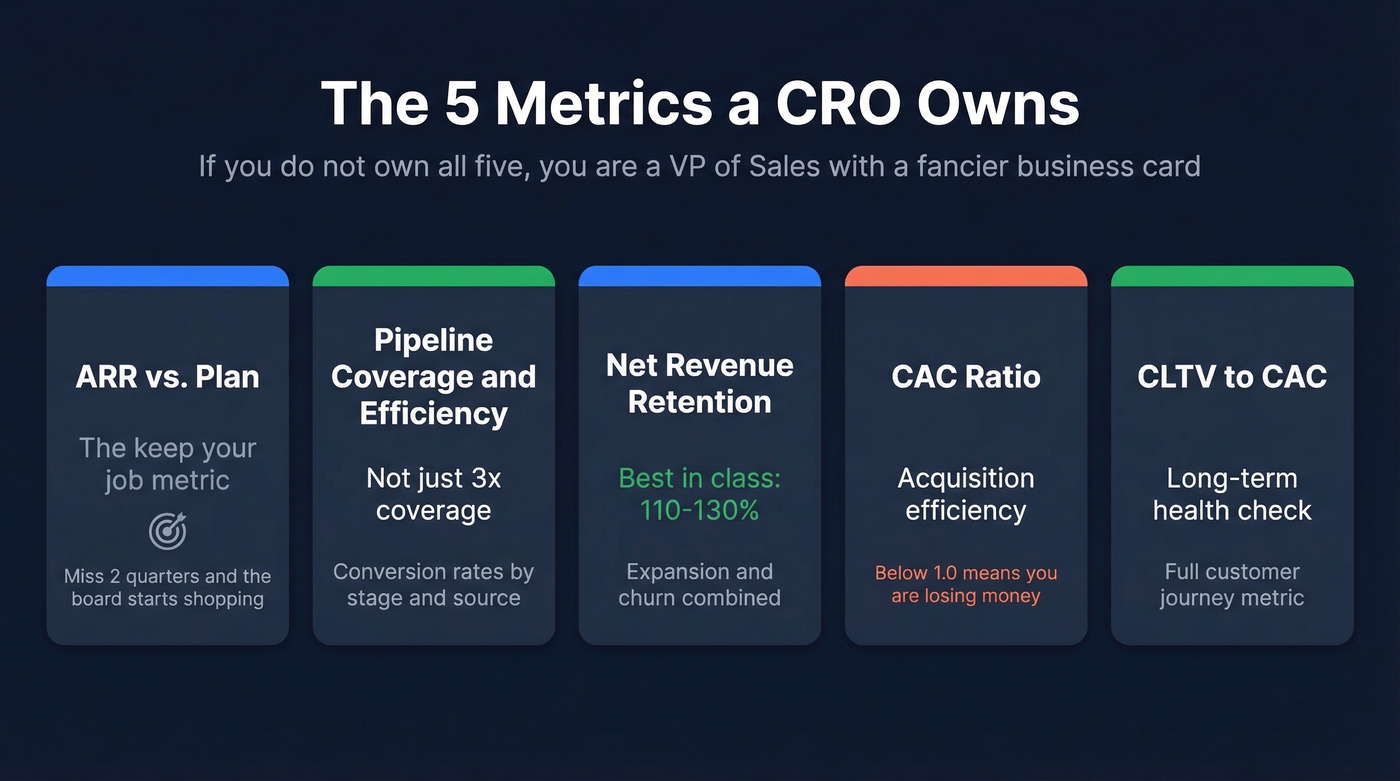
- ARR vs. plan - the "keep your job" metric. Miss this two quarters running and the board starts shopping.
- Pipeline coverage and efficiency - not just 3x coverage, but conversion rates by stage and source. (To pressure-test it, use pipeline health metrics.)
- Net revenue retention - expansion and churn combined. Best-in-class SaaS runs 110-130%.
- CAC ratio - how efficiently you're acquiring revenue. Below 1.0 means you're spending more than you earn back.
- CLTV:CAC - the long-term health check. Benchmarkit's analysis frames these as the metrics that define a "true CRO" who owns the full customer journey.
What CROs Earn in 2026
In the UK, CROs typically earn £220k-£260k base, with double OTE standard and £280k+ at high-growth or VC-backed companies.
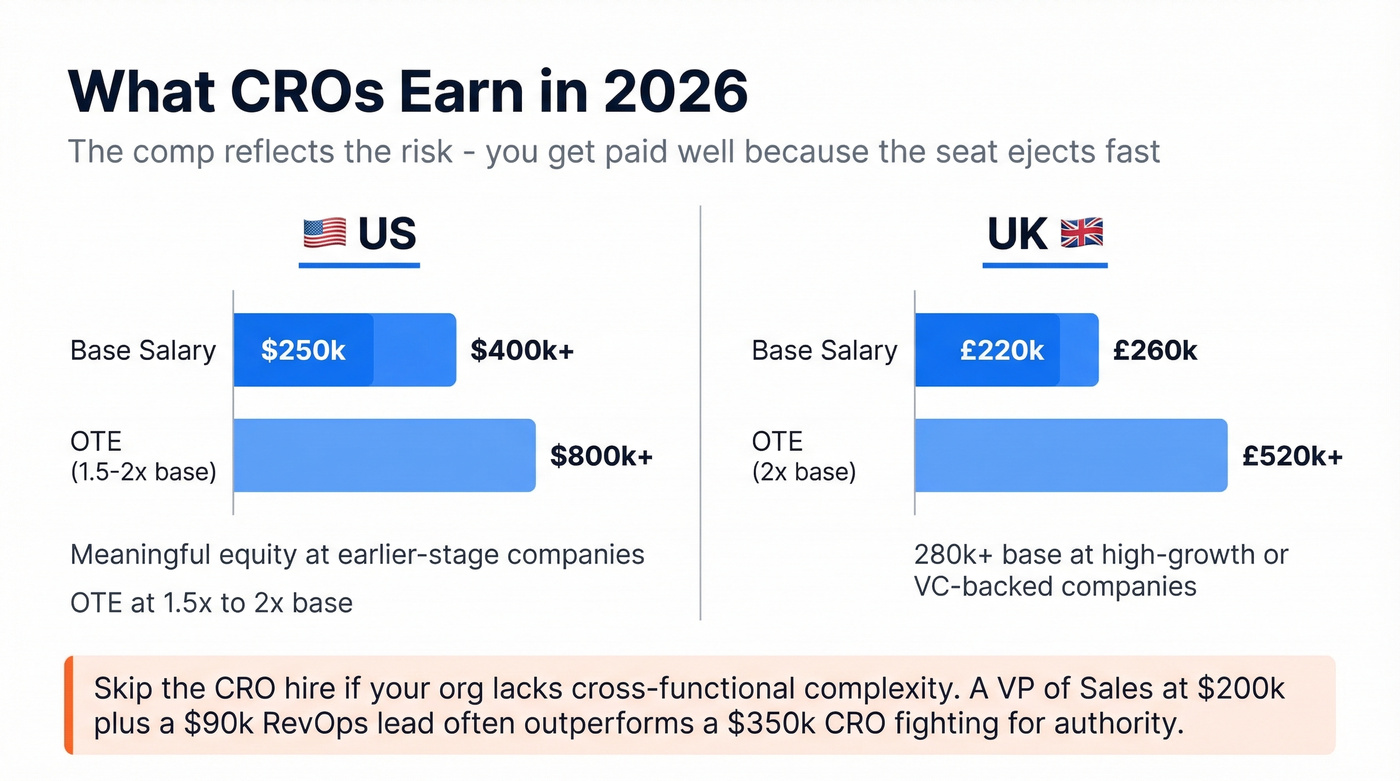
In the US, expect $250k-$400k+ base at growth-stage SaaS, with OTE at 1.5-2x and meaningful equity at earlier-stage companies. The comp reflects the risk - you're getting paid well because the seat ejects fast. Glassdoor's CRO salary data tracks within these ranges, though equity packages vary wildly by stage.
Skip the CRO hire entirely if your org doesn't have the cross-functional complexity to justify it. A VP of Sales at $200k with a $90k RevOps lead will outperform a $350k CRO who's fighting for authority they were never given.
Every CRO skill on this list depends on one thing: reliable data flowing through your revenue system. Prospeo gives you 98% accurate emails, 125M+ verified mobiles with 30% pickup rates, and 30+ filters to build pipeline your reps can actually convert - at $0.01 per email.
Your reps deserve contacts that pick up. Give them Prospeo.
FAQ
How long does the average CRO last?
Between 17 and 25 months - shorter than two full enterprise sales cycles. This is why chief revenue officer skills around board communication and cross-functional leadership matter so much. When 62% of companies stall or shrink after a CRO exits, the pressure to deliver fast is real.
What's the difference between a CRO and a VP of Sales?
A VP of Sales owns deal execution: pipeline, quotas, and rep performance. A CRO owns the entire revenue system - sales, marketing, CS, and RevOps alignment - and is accountable for metrics like NRR and CLTV:CAC that span the full customer lifecycle. If you only control the sales number, you're a VP of Sales regardless of what your title says.
What tools should a CRO prioritize for pipeline accuracy?
Start with a CRM like Salesforce or HubSpot, add AI-assisted forecasting, and layer in a verified B2B data platform with high accuracy and frequent refresh cycles. Stale data is the silent killer of pipeline credibility - look for providers that refresh weekly rather than monthly.
What's the most overlooked CRO competency?
Data infrastructure ownership. Most CROs inherit a 23+ tool stack with decaying contact data and no single source of truth. Fixing data quality before layering on AI or automation prevents the "garbage in, garbage out" cycle that kills forecasting credibility.