

Chief Sales Officer: What the Role Really Looks Like in 2026
CSO appointments jumped 58% year-over-year in 2024. That's not a rounding error - it's a signal that boards are betting on the chief sales officer role again, even as the CRO title grabs most of the headlines. If you're evaluating the role, building toward it, or deciding whether your company needs one, here's what actually matters right now.
The Short Version
- Role: A CSO owns the sales organization - strategy, team, pipeline, and quota attainment - typically reporting directly to the CEO.
- 2026 compensation: Cash comp ranges from $145K to $309K, with equity pushing total packages to $500K-$1M+ at public companies.
- CSO ≠ CRO: The CSO owns sales execution and team performance. The CRO owns the full revenue lifecycle across sales, marketing, CS, and partnerships. Different jobs.
- Surging demand: CSO appointments grew 58% YoY in 2024, outpacing CRO growth (+17%) by a wide margin.
What Does a CSO Actually Do?
The chief sales officer is the executive who owns the sales function. Not the full revenue engine - that's the CRO's territory - but the specific discipline of turning pipeline into closed revenue. Strategy, team performance, quota design, forecasting, and sales technology all roll up to this person.
Spencer Stuart's dedicated sales practice has conducted over 1,000 sales leadership searches in the past three years, with a global team of 25 consultants focused exclusively on this space. That volume tells you something about demand.
On the org chart, the CSO sits at the C-suite table and typically reports directly to the CEO. The VP of Sales reports to the CSO when both roles exist. Think of it as a hierarchy of scope: the VP runs a sales team, the CSO runs the sales organization, and the CRO runs the revenue organization.
The distinction matters because scope defines accountability. A CSO who's asked to own marketing alignment, customer success, and partnerships isn't a CSO - they're a CRO with the wrong title. That mismatch creates confusion in reporting, compensation, and board expectations. Getting the title right isn't semantics. It's organizational design.
A recurring debate in sales leadership communities is whether the CSO title signals a company that hasn't evolved to the CRO model - or one that's smartly keeping sales leadership focused. The appointment data suggests the latter.
CSO vs CRO vs VP of Sales
Most companies hire the wrong title. They want a CRO but need a CSO, or they promote a VP of Sales into a CSO seat without expanding the mandate.
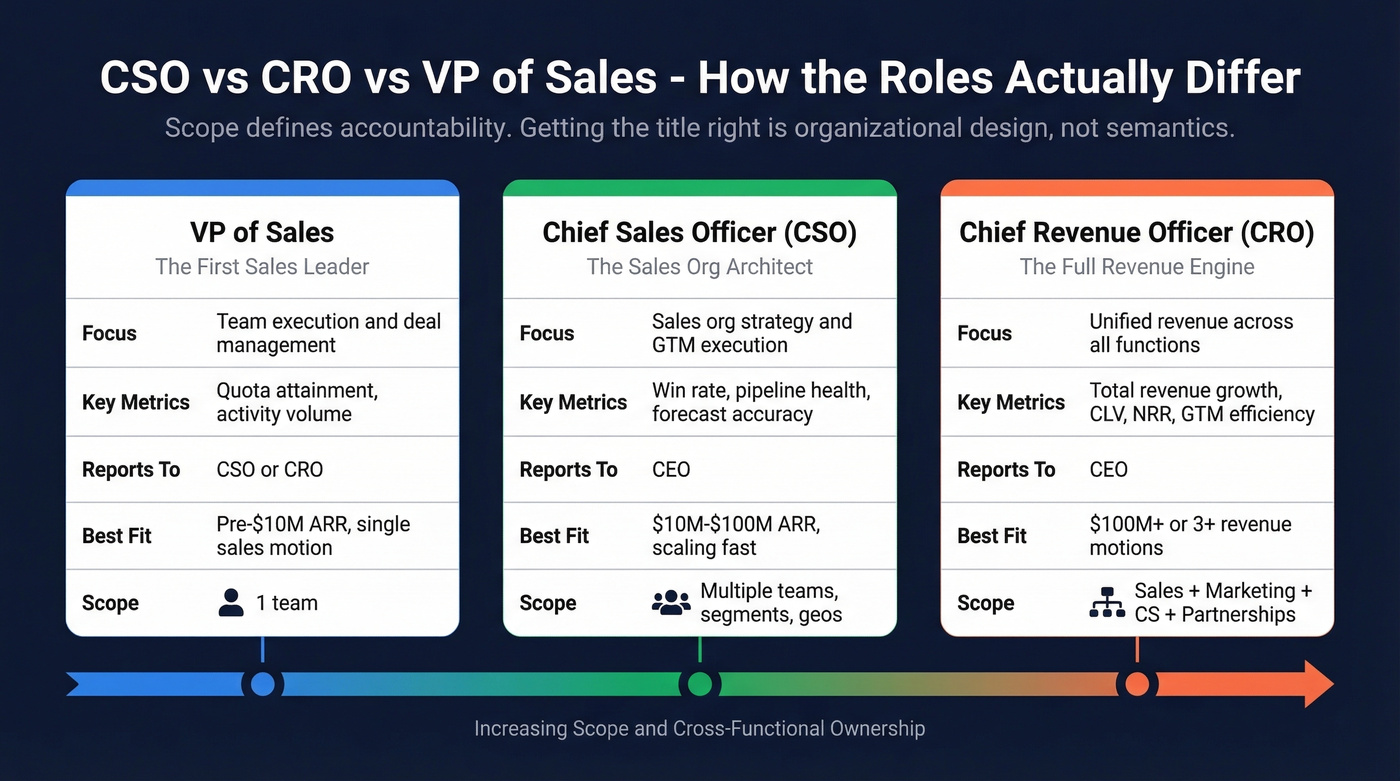
| Role | Primary Focus | Key Metrics | Reports To | Best Fit |
|---|---|---|---|---|
| VP of Sales | Team execution | Quota attainment, activity | CSO or CRO | Pre-$10M, single motion |
| CSO | Sales org strategy | Win rate, pipeline, forecast | CEO | $10M-$100M, scaling |
| CRO | Full revenue engine | Revenue growth, CLV, NRR | CEO | $100M+ or multi-motion |
The VP of Sales is your first sales leader. They're player-coaches who manage reps, run deals, and hit a number. That works until you have multiple teams, segments, or geographies - at which point you need someone thinking about the system, not just the scoreboard.
The CSO builds that system. They own sales strategy, GTM execution, hiring frameworks, and forecasting discipline. Their metrics are pipeline coverage, win rates, and forecast accuracy - the operational health of the sales organization.
The CRO sits above all revenue-generating functions. Sales, marketing, customer success, and partnerships all report up. Their metrics are broader: total revenue growth, customer lifetime value, GTM efficiency across motions. It's a fundamentally different job.
Here's the decision framework we'd recommend: if you're a $10M-$50M company debating CSO vs CRO, hire the CSO first. Revenue operations alignment can be solved with a strong RevOps hire underneath them. The CRO title makes sense above $100M or when you have three or more revenue-generating motions that need unified orchestration. Jumping straight to CRO at $20M usually means you're paying for a title and getting a CSO anyway.
Core Responsibilities
The CSO's job breaks into six areas. Some they own outright; others they influence but don't control. Knowing the difference separates effective leaders from ones who burn out trying to own everything.
What the CSO owns directly:
- Sales strategy and GTM execution. Market segmentation, territory design, quota methodology, and the playbooks reps actually follow. If the CSO isn't setting the strategic direction for how deals get won, nobody is.
- Team leadership, hiring, and enablement. Building the org chart, defining the hiring bar, and ensuring reps have the skills and tools to execute.
- Pipeline management and forecasting. Owning the forecast isn't about calling a number on Monday morning. It's about building the inspection cadence, deal scoring methodology, and pipeline hygiene that make the number predictable.
- Technology adoption and AI integration. This is increasingly central to the job. Industry data summarized by Rocket Talent shows 84% of reps missed quota the prior year - the CSO's job isn't just strategy, it's fixing execution through better systems and tooling.
What the CSO influences but delegates:
Cross-functional alignment with marketing, product, and CS sits in this bucket. So does customer advocacy and retention influence - Forrester's research suggests more than half of seven-figure B2B transactions will soon involve a digital or self-serve component. The CSO needs to understand how customers buy, not just how reps sell. But retention metrics belong to CS; the CSO's role is ensuring the handoff doesn't leak revenue.
Salary and Compensation in 2026
A lot of salary pages for this role are outdated or don't break out variable comp. This data is from PayScale's January 2026 update, based on 62 reported profiles.
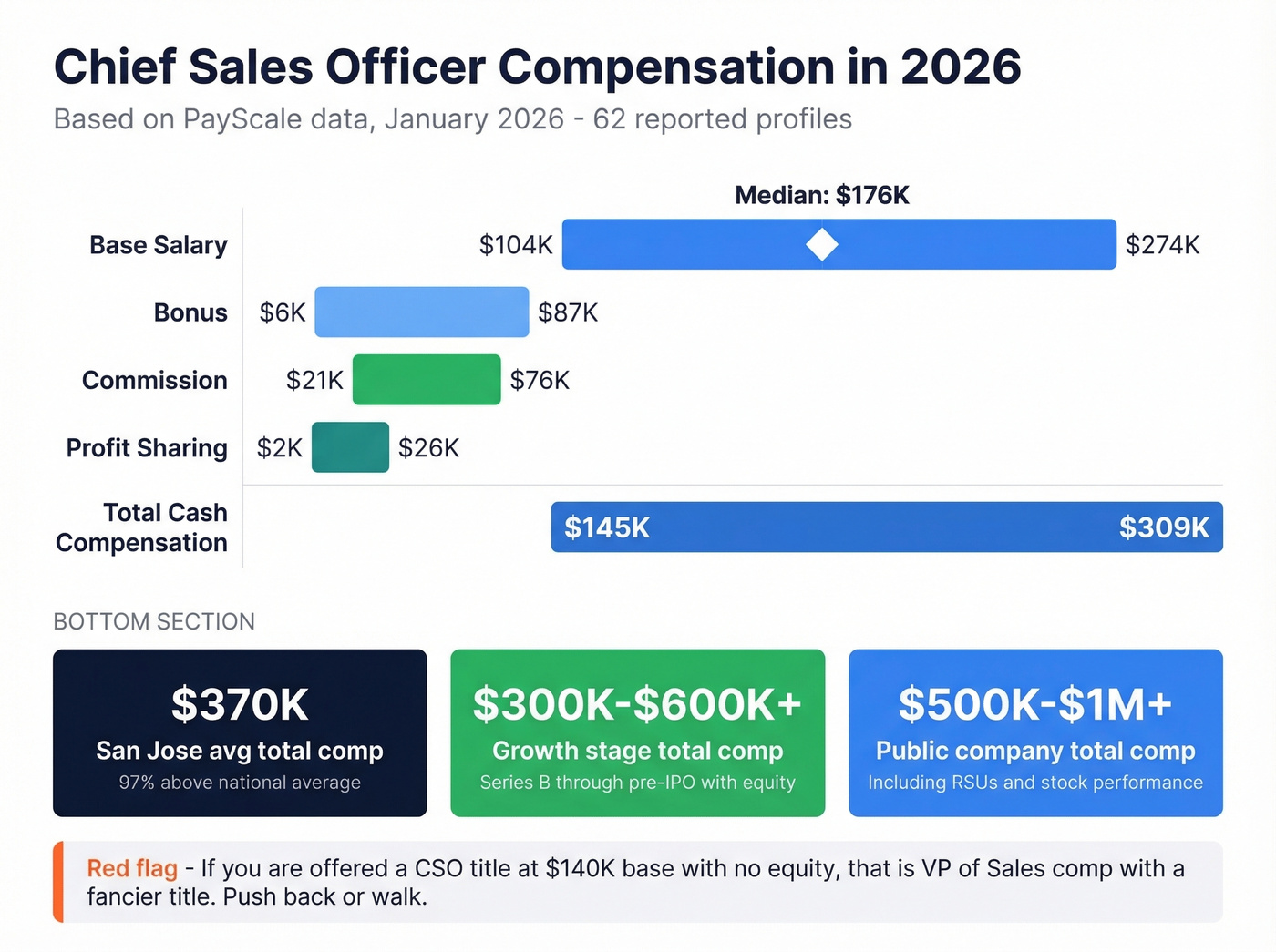
| Component | Range | Average |
|---|---|---|
| Base | $104K-$274K | $176K |
| Bonus | $6K-$87K | - |
| Commission | $21K-$76K | - |
| Profit Sharing | $2K-$26K | - |
| Total Cash | $145K-$309K | - |
The $176K figure is the median base, but geography swings this dramatically. Comparably pegs San Jose CSO total comp at roughly $370K - 97% above the national average. New York, Boston, and the Bay Area cluster in similar territory.
The table above covers cash compensation only. Equity changes the picture entirely. At growth-stage companies from Series B through pre-IPO, total comp packages typically run $300K-$600K+ when you factor in stock options or RSUs. At public companies, the number can push $500K-$1M+ depending on grant size and stock performance.
CROs often earn more than CSOs at equivalent company stages, reflecting the broader scope. But the gap narrows at companies where the CSO is the de facto top revenue leader and there's no CRO above them.
Here's the thing: if you're being offered a CSO title at $140K base with no equity, that's a VP of Sales comp package with a fancier title. Push back or walk.

84% of reps missed quota last year. CSOs fixing that problem start with better data - 98% verified emails, 125M+ direct dials, and intent signals across 15,000 topics. Prospeo gives your sales org the pipeline accuracy that makes forecasts predictable.
Stop forecasting on bad data. Start closing on verified contacts.
KPIs That Define Success
The best framework we've seen for CSO metrics comes from Revenue Room Connect's "control panel" concept: fewer, sharper KPIs with clear owners and decision paths. A CSO doesn't need 30 dashboards. They need eight metrics they actually act on.
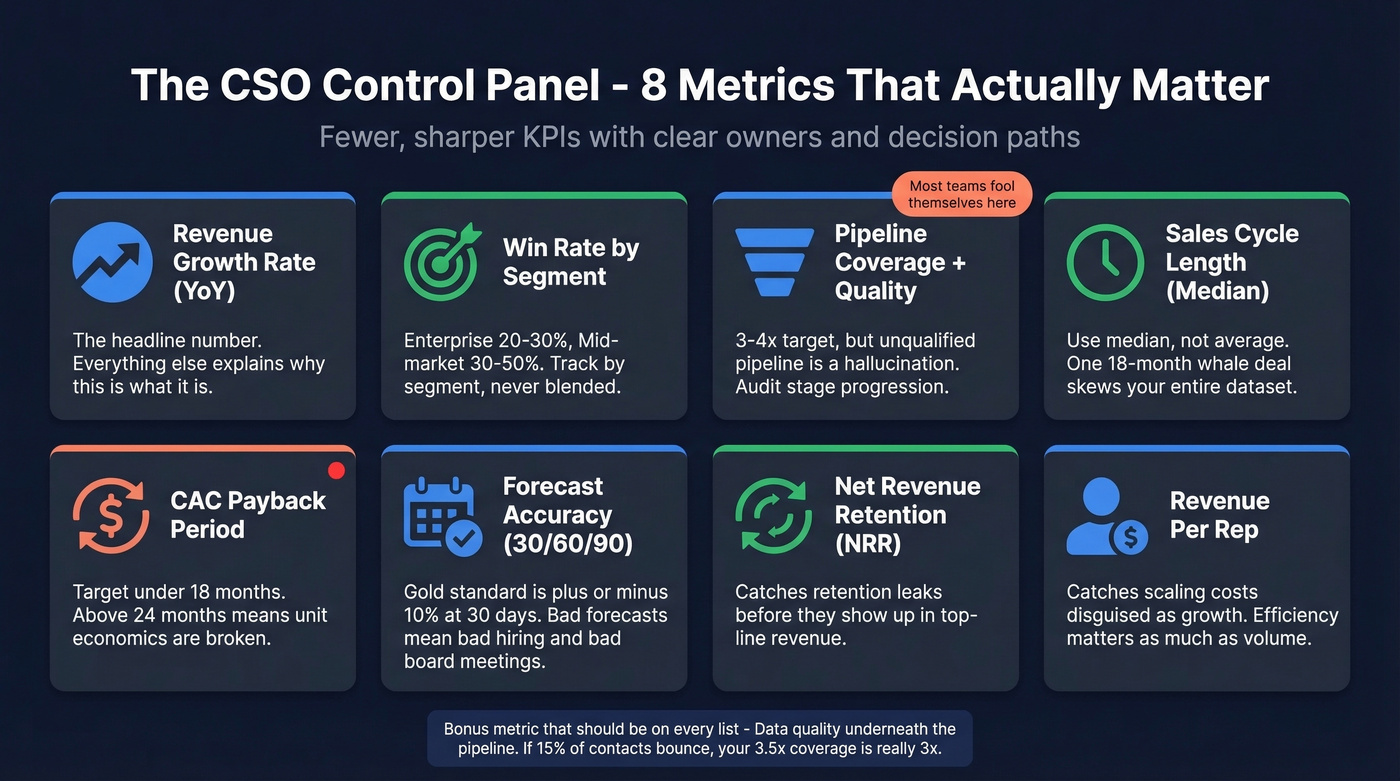
Revenue growth rate (YoY) is the headline number. Everything else exists to explain why this number is what it is.
Win rate by segment tells you where the machine is working - enterprise B2B typically runs 20-30%, mid-market 30-50%. Track by segment, not blended, because a blended win rate hides problems. Pipeline coverage ratio + quality score is where most teams fool themselves. The standard target is 3-4x coverage, but Revenue Room Connect calls unqualified pipeline "a hallucination" - and they're right. If 40% of your pipeline is stuck in stage 1 with no next step, your 4x coverage is really 2.4x.
Sales cycle length (median) matters more than average. Average lies to your face - one 18-month whale deal skews your entire dataset. CAC payback period should land under 18 months. Above 24 months, you've got a unit economics problem that no amount of pipeline will fix.
Forecast accuracy at 30/60/90 days is decision infrastructure, not a vanity metric. The gold standard is ±10% at 30 days out. Bad forecasts mean bad hiring plans, bad cash management, and bad board conversations. NRR and revenue per rep round out the picture - the first catches retention leaks, the second catches scaling costs disguised as growth.
One thing that doesn't show up on most KPI lists but should: data quality underneath the pipeline. If 15% of your pipeline is built on unverified emails that'll bounce when reps actually reach out, your 3.5x coverage is really 3x. We've seen this firsthand - teams running outbound on stale data inflate their pipeline numbers without realizing the foundation is rotten. The CSO who doesn't audit data quality is flying with a broken altimeter.
The Modern CSO Tech Stack
The CSO doesn't configure tools - but they decide what the team runs on, and that decision shapes every metric downstream.
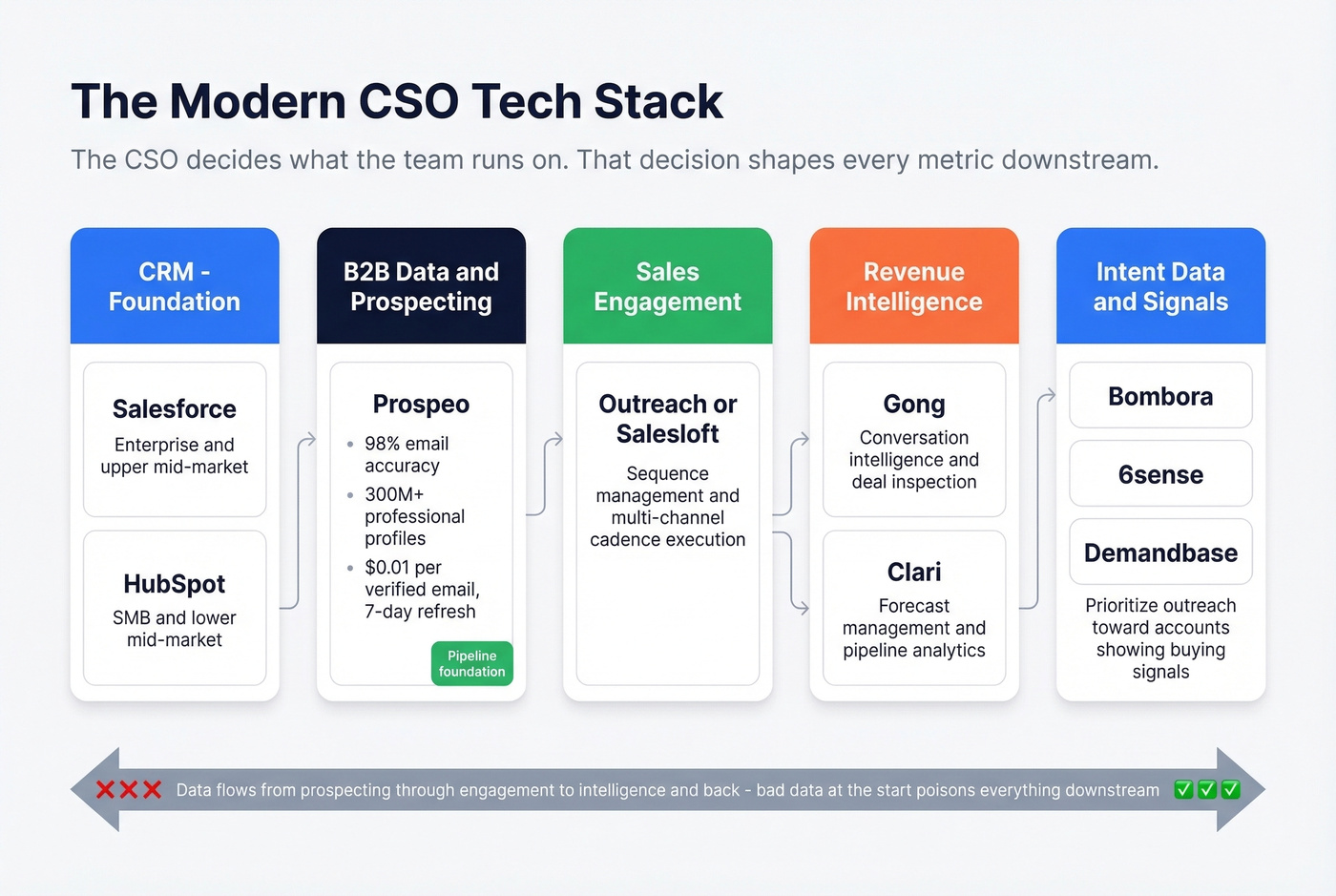
CRM comes down to size and existing infrastructure. Salesforce dominates enterprise; HubSpot wins at SMB and lower mid-market.
Sales engagement means Outreach or Salesloft for sequence management and multi-channel cadence execution. Table stakes for any team running outbound at scale.
Revenue intelligence splits into two jobs. Gong handles conversation intelligence and deal inspection - what's actually happening in calls. Clari handles forecast management and pipeline analytics - whether the number is real. Together, they give the CSO visibility into deals, not just what reps report in the CRM.

B2B data and prospecting is where most stacks quietly fall apart. Reps can't sell to people they can't reach, and bad data poisons everything downstream - sequences bounce, pipeline metrics inflate, and forecast accuracy crumbles. Prospeo delivers 98% email accuracy across 300M+ professional profiles on a 7-day refresh cycle, at roughly $0.01 per verified email. That weekly refresh means your team isn't working stale records that looked good in the CRM but bounce on first touch.
Intent data and buyer signals from Bombora, 6sense, or Demandbase help the CSO's team prioritize outreach toward accounts showing actual buying signals rather than spraying across the entire TAM.
If you're pressure-testing your data layer, start with data enrichment and a clear lead scoring model so intent doesn't turn into noise.
How the Role Is Evolving
The CSO isn't being replaced by the CRO - it's surging. Russell Reynolds data cited by Adweek shows CSO appointments jumped 58% in 2024, compared to 17% growth for CRO appointments. Boards are investing in dedicated sales leadership, not consolidating it away.
Three forces are driving this evolution.
First, digital buying has fundamentally changed the sales motion. The CSO has to understand and enable hybrid buying journeys, not just manage a team of phone-first reps. Second, automation is compressing the tactical layer. Gartner projects 70% of routine sales tasks will be automated by the end of the decade, which means the CSO's value shifts from managing activity volume to designing the strategy and systems that make automation effective. Third, the AI adoption gap is becoming a competitive moat - 83% of sales teams using AI reported year-over-year profit growth, but only about half have fully implemented it.
Let's be honest about what this means: the CSO title is actually more valuable than the CRO title for most companies right now. The CRO model works when you have mature, cross-functional revenue operations that genuinely need unified leadership. Most companies don't have that. They have a sales team that needs to get dramatically better at execution, forecasting, and technology adoption. That's a CSO's job. Hiring a CRO to fix a sales problem is like hiring an architect when you need a general contractor.
The chief sales officer who thrives in this environment looks different from the one who thrived in 2018. They're as comfortable discussing LLM-powered lead scoring as they are running a QBR. They think in systems, not just deals.
Fractional CSO - Pricing and Fit
Not every company needs a full-time executive leading sales. If you're between $5M and $50M in revenue, a fractional CSO is genuinely underrated - and we've seen it work well for companies that need strategic sales leadership but can't justify a $400K annual commitment.
| Model | Cost Range | Best For |
|---|---|---|
| Monthly retainer | $4K-$15K/mo | Ongoing strategic guidance |
| Hourly | $200-$500/hr | Specific projects or audits |
| Hybrid | $3K-$5K/mo + % growth | Aligned incentives, growth stage |
| Full-time (comparison) | ~$400K/yr total cash outflow (year 1) | $50M+ or complex sales orgs |
The retainer model is most common - typically one to two days per week at $4,000-$15,000 per month. That gets you someone who sets the strategy, builds the playbook, coaches your VP of Sales, and joins your leadership meetings. They won't manage your reps day-to-day, but that's the point.
The hybrid model (base retainer plus a percentage of revenue growth) aligns incentives, but set clear guardrails on what "growth" means before signing. A fractional leader with performance upside can push for short-term wins over sustainable systems.
For context, a full-time CSO's first-year cash outflow - base, bonus, benefits, taxes, and recruiting fees - runs roughly $400K. A fractional engagement at $8K/month costs under $100K annually. For a $15M company that needs someone to professionalize the sales org before hiring a full-time leader, that math is compelling. Skip this route if you already have 30+ reps and complex multi-segment motions - you need someone full-time in the seat.
How to Become a CSO
The typical path runs 10+ years and follows a predictable ladder: Account Executive, Sales Manager, Director of Sales, VP of Sales, CSO. Each step roughly doubles the scope of responsibility and halves the amount of time spent selling directly.
Education matters but isn't a gate. Most CSOs have a bachelor's degree, and an MBA is common at larger companies - but plenty of sales executives at growth-stage companies climbed through performance alone. What boards actually look for is a track record of building and scaling sales organizations, not a credential.
Three skills separate the CSO from the VP of Sales who plateaus. First, cross-functional influence - the ability to drive alignment with marketing, product, and CS without direct authority. Second, data-driven forecasting - not just calling a number, but building the systems that make the number predictable. Third, tech stack fluency - understanding how CRM, engagement, intelligence, and data tools connect into a system that scales. I've watched VPs stall their careers because they treated technology decisions as someone else's problem; the best CSOs treat the stack as a strategic asset.
The fastest accelerant? Take a VP of Sales role at a company going through a growth inflection from $10M to $50M. That's where you'll learn to build systems, not just manage teams. If you can navigate that transition successfully, the CSO title follows naturally. For structured learning, Pavilion's CRO School and Winning by Design's Revenue Architecture course are two solid options.
If you're building the outbound muscle that gets you there, start with modern sales prospecting techniques and tighten your sales follow-up process so pipeline doesn't decay between touches.
FAQ
What's the difference between a CSO and a CRO?
The CSO owns sales execution, team performance, pipeline, and quota attainment. The CRO owns the full revenue engine - sales, marketing, customer success, and partnerships. Most companies under $100M in revenue need a CSO, not a CRO. The CRO model adds value when three or more revenue-generating motions require unified orchestration.
How much does a chief sales officer make in 2026?
Average base salary is $176K, with total cash compensation ranging from $145K to $309K per PayScale's January 2026 data. Add equity at growth-stage companies and total comp reaches $300K-$600K+. At public companies, packages can push $500K-$1M+ depending on grant size and stock performance.
When should a company hire a CSO instead of a VP of Sales?
Hire a CSO when you've outgrown a single sales team and need someone who can build the org, own strategy, and sit at the executive table. That inflection typically hits around $10M-$20M in revenue, when you're adding segments, geographies, or motions that a player-coach VP can't orchestrate alone.
Is the CSO role growing or being replaced?
Growing - and fast. CSO appointments jumped 58% year-over-year in 2024, per Russell Reynolds data cited by Adweek. CRO appointments grew 17% in the same period. The role is evolving toward growth architecture and AI adoption, but demand is accelerating, not declining.
What tools should a CSO prioritize for prospecting data?
A CRM (Salesforce or HubSpot), engagement platforms (Outreach or Salesloft), and a verified data source for clean emails and direct dials. Bad data is the fastest way to destroy pipeline accuracy and forecast reliability - our team has seen bounce rates drop from 35%+ to under 4% just by switching to a provider with proper verification infrastructure.
A CSO's tech stack defines execution quality. Prospeo delivers 300M+ profiles with 30+ filters - buyer intent, technographics, headcount growth, funding - refreshed every 7 days. At $0.01 per email, it's 90% cheaper than ZoomInfo with higher accuracy.
Equip your sales org with enterprise data at startup pricing.