

Clodura.AI vs Salutary Data: They're Not Actually Competitors
Comparing Clodura.AI and Salutary Data is like comparing a car to the steel mill that makes its chassis. One's a GTM execution platform where reps prospect, sequence, and call with a built-in dialer. The other supplies raw B2B datasets to the platforms those reps use. They're not rivals - they're different layers of the same stack.
Think data supplier -> enrichment layer -> GTM execution platform -> outreach. Salutary lives at the first step. Clodura lives at the third and fourth.
What makes this comparison even stranger: Intentsify announced the acquisition of Salutary Data in February 2026, folding it into an intent-data ecosystem. Salutary is now part of Intentsify, so packaging and activation options will likely shift as integration progresses.
30-Second Verdict
If you need reps prospecting and dialing this week, pick Clodura.AI. It's an all-in-one GTM platform - data, sequences, calling, and buyer intent - with self-serve pricing starting at $0.
If you need bulk data feeds for internal systems, pick Salutary Data. It's for data ops or RevOps teams that license raw B2B datasets via API or flat files, with custom contracts starting around $5K.
What Each Tool Actually Does
Clodura.AI is a GenAI-powered GTM platform that bundles prospecting data (600M+ leads), waterfall enrichment across 50+ email and 20+ phone providers, automated sequences, an AI email writer, and an integrated dialer called CallPilot, plus buyer intent signals. An SDR can go from search to call without leaving the platform. It's the all-in-one play for teams consolidating their stack.
If you're evaluating broader SDR tools or modern sales prospecting techniques, Clodura fits the “do it all in one place” category.
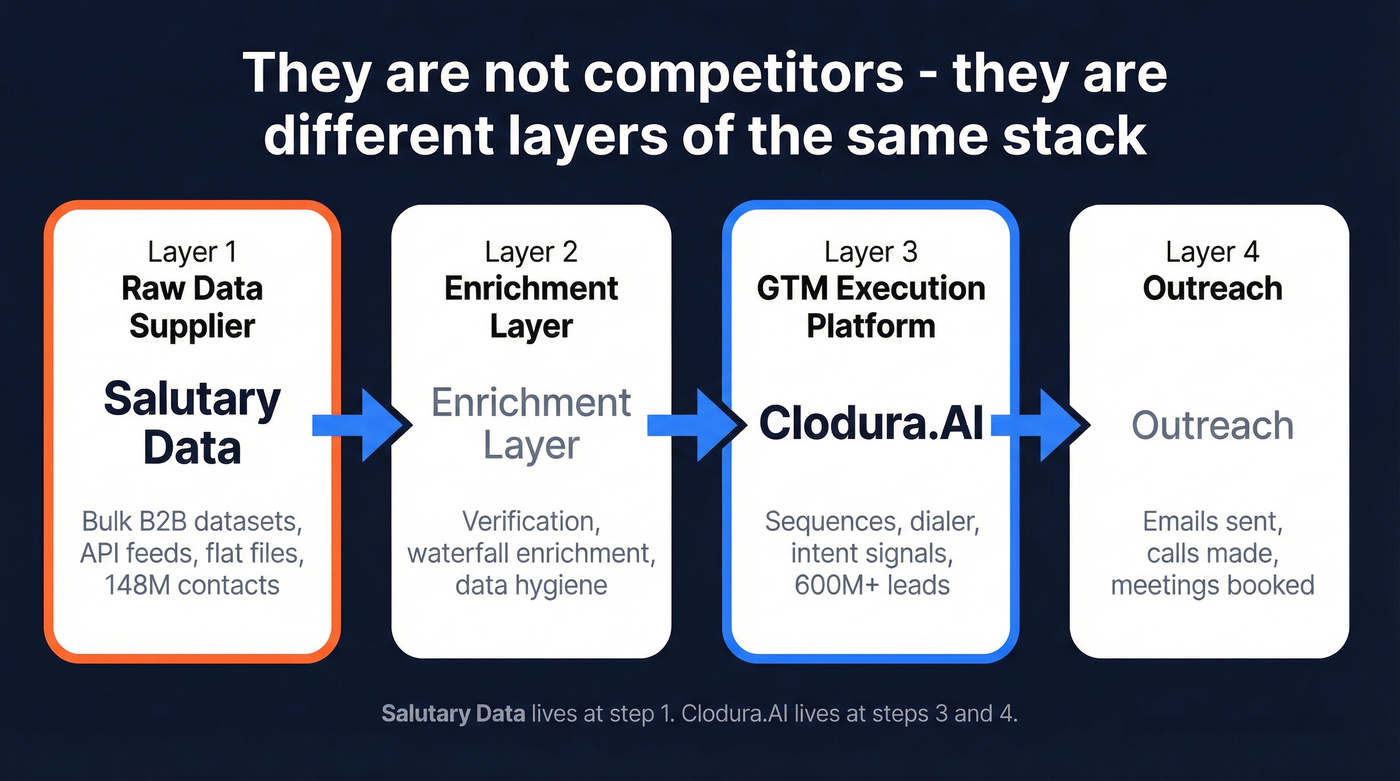
Salutary Data isn't a tool you log into and start prospecting. It's a foundational data supplier - a company that curates, verifies, and sells raw B2B datasets to martech platforms, data aggregators, and enterprise buyers. US-focused, 148M unique contact profiles, delivered via API feeds or flat files.
If you're comparing vendors at the “raw data + enrichment” layer, see our roundup of B2B company data and data enrichment services.
Head-to-Head Feature Breakdown
| Dimension | Clodura.AI | Salutary Data |
|---|---|---|
| Database size | 600M+ leads/emails | 148M unique contact profiles |
| Pricing model | Self-serve, credits | Custom contracts |
| Starting price | $0/mo (free tier) | ~$5K+ per dataset |
| Accuracy claim | 95% email accuracy | 71M validated work emails |
| Verification | Waterfall enrichment (50+ email, 20+ phone providers) | Quarterly audits; 45M records third-party validated; 48M emails deliverability-tested |
| Key features | Sequences, dialer, intent | Raw data feeds, API |
| G2 Rating | 4.5/5 | 5.0/5 |
| G2 Reviews | 301 | 1 |
| Ideal buyer | Sales/SDR teams | Data ops / RevOps |
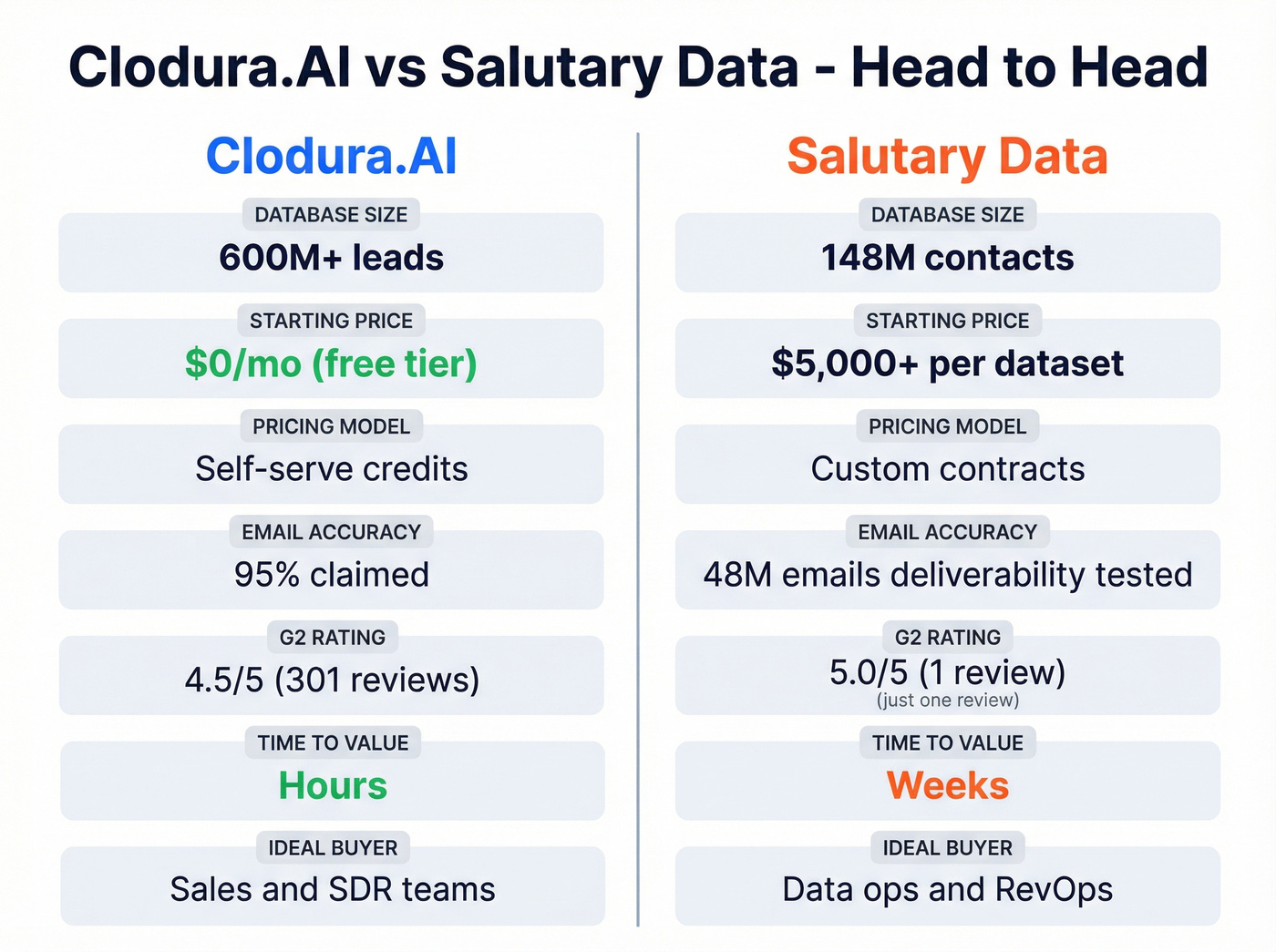
Ratings from G2's Clodura.AI page and G2's Salutary Data page. The review count contrast tells the story: 301 vs. one. That tracks with how these products are bought - self-serve sales tooling generates public reviews; negotiated data licensing doesn't. We couldn't find meaningful community threads about Salutary either, and most public sentiment is limited to that single G2 review and a few marketplace blurbs.
Operational Fit
- Buying motion: Clodura is self-serve. Salutary is sales-led.
- Implementation: Reps start on Clodura today. Salutary is a data integration project.
- Who owns it: SDR leader vs. RevOps or data engineering (see what a RevOps Manager typically owns).
- Time-to-value: Hours vs. weeks.

Clodura aggregates 50+ third-party providers. Salutary sells raw feeds. Prospeo built its own email-finding infrastructure from scratch - no middlemen, no data decay. 98% email accuracy, 7-day refresh cycle, and 300M+ profiles. That's why teams using Prospeo book 26% more meetings than ZoomInfo users.
Stop stitching together tools. Start sending emails that actually land.
Pricing Compared
Clodura.AI runs on a credit system with unlimited users on every plan. Free Forever gives you 100 credits at $0/mo, no credit card required. The Max tier is 5,000 credits for $99/mo billed monthly or $90/mo billed annually.
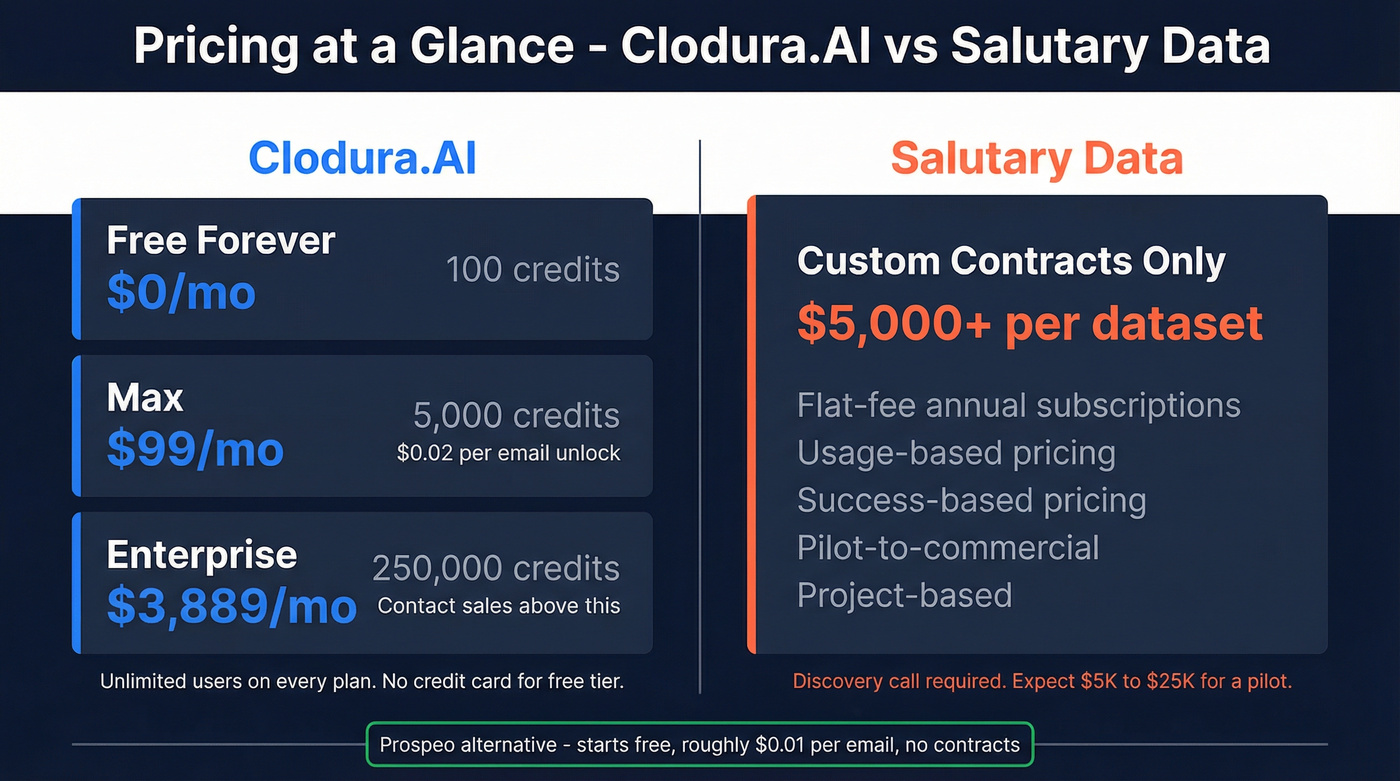
On that $99 tier, Clodura's published credit math works out to about $0.0198 per email unlock (1 credit) and $0.198 per phone unlock (10 credits), with a full lead unlock at ~$0.22 (11 credits). Higher tiers run up to 250,000 credits for $3,889/mo billed monthly ($3,500/mo annually), and above that you'll need to contact sales.
Salutary Data requires a discovery call. Their pricing page describes five models - flat-fee annual subscriptions, usage-based, success-based, pilot-to-commercial, and project-based - but lists no dollar figures. On Datarade, datasets start at $5,000 per purchase. Expect pilot engagements in the $5K-$25K range, with full-file enterprise licensing going significantly higher.
If you're trying to benchmark list costs across vendors, our guide to sales prospecting databases breaks down typical pricing models.
Here's the thing: if your average deal size is under $15K, you almost certainly don't need Salutary-level data infrastructure. You need a tool that gives you verified contacts you can email today.
Data Quality and Coverage
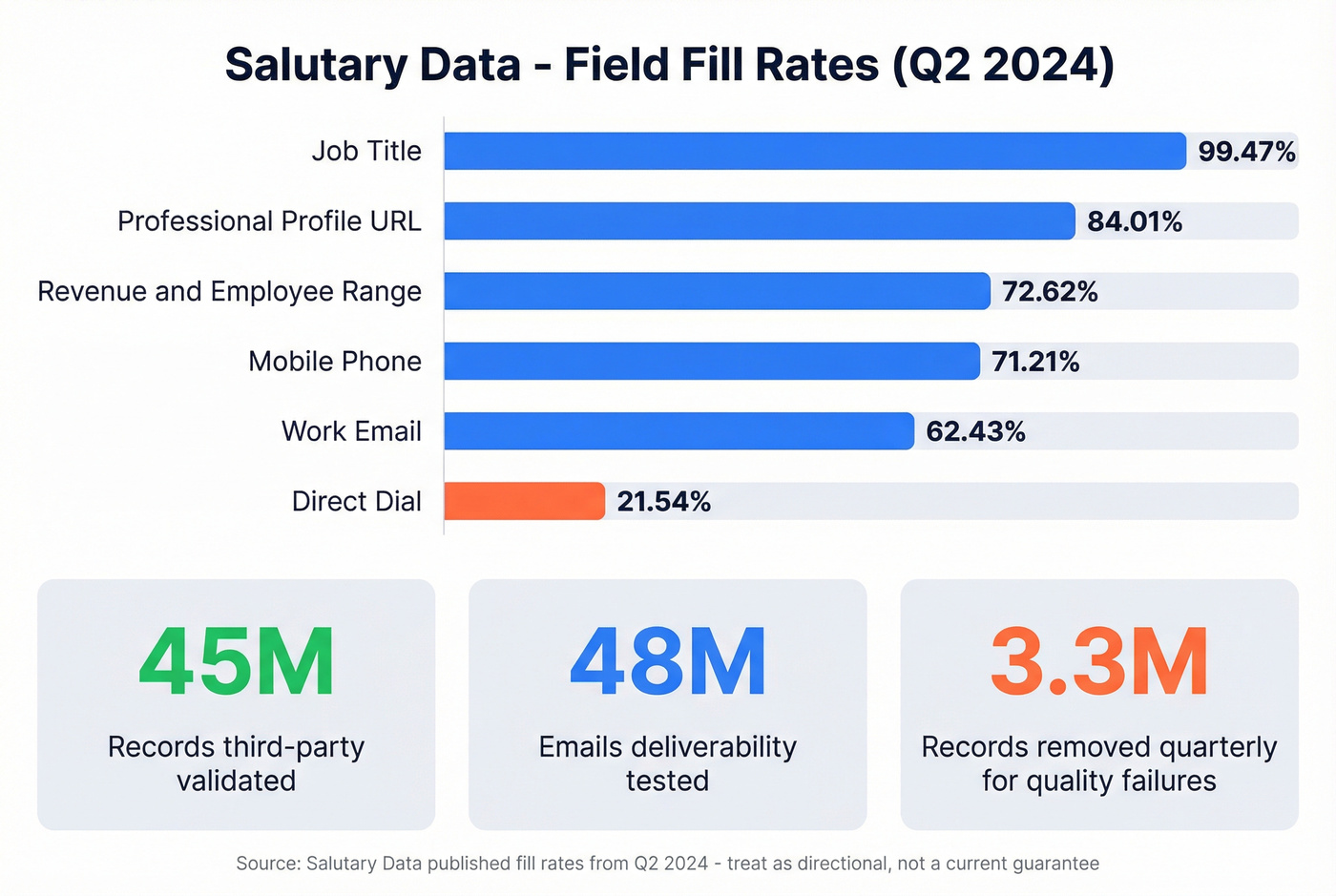
Salutary publishes unusually specific fill rates from Q2 2024 - the latest public field-level coverage table they offer, so treat it as directional rather than a current guarantee. The highlights: Mobile Phone at 71.21%, Work Email at 62.43%, Direct Dial at 21.54%, and Job Title at 99.47%. Coverage is also strong for firmographics like revenue and employee ranges (~72.62%) and professional profile URLs (~84.01%). On the verification side, they validate 45M records through third-party vendors, run deliverability tests on 48M emails, and remove 3.3M records quarterly that fail quality checks. That's serious hygiene for a wholesale data operation.
Clodura claims 95% email accuracy, and many of its 301 G2 reviewers praise ease of use and lead generation effectiveness. There's a recurring theme in the cons, though: 15 mentions of inaccurate data and 15 mentions of outdated information in G2's aggregated feedback. That's not unusual for a platform pulling from 50+ enrichment providers - waterfall enrichment trades some consistency for coverage. If you're using Clodura for volume outbound, the workflow speed can outweigh occasional misses. Just add a verification step on export for high-stakes lists (or use dedicated email reputation tools to protect deliverability).
In our experience, the accuracy gap between platforms that run proprietary email infrastructure and those that aggregate third-party sources is real and measurable. It's the difference between a 2% bounce rate and a 10% one - and that gap compounds fast when you're sending thousands of emails per week. If you want benchmarks and fixes, see email bounce rate and our email deliverability guide.
Who Should Use Which
Use Clodura.AI if you're a sales team that wants data, sequences, a dialer, and buyer intent in one platform - and you want to start for free. It's built for reps who need to move from prospect identification to outreach without stitching together five tools.
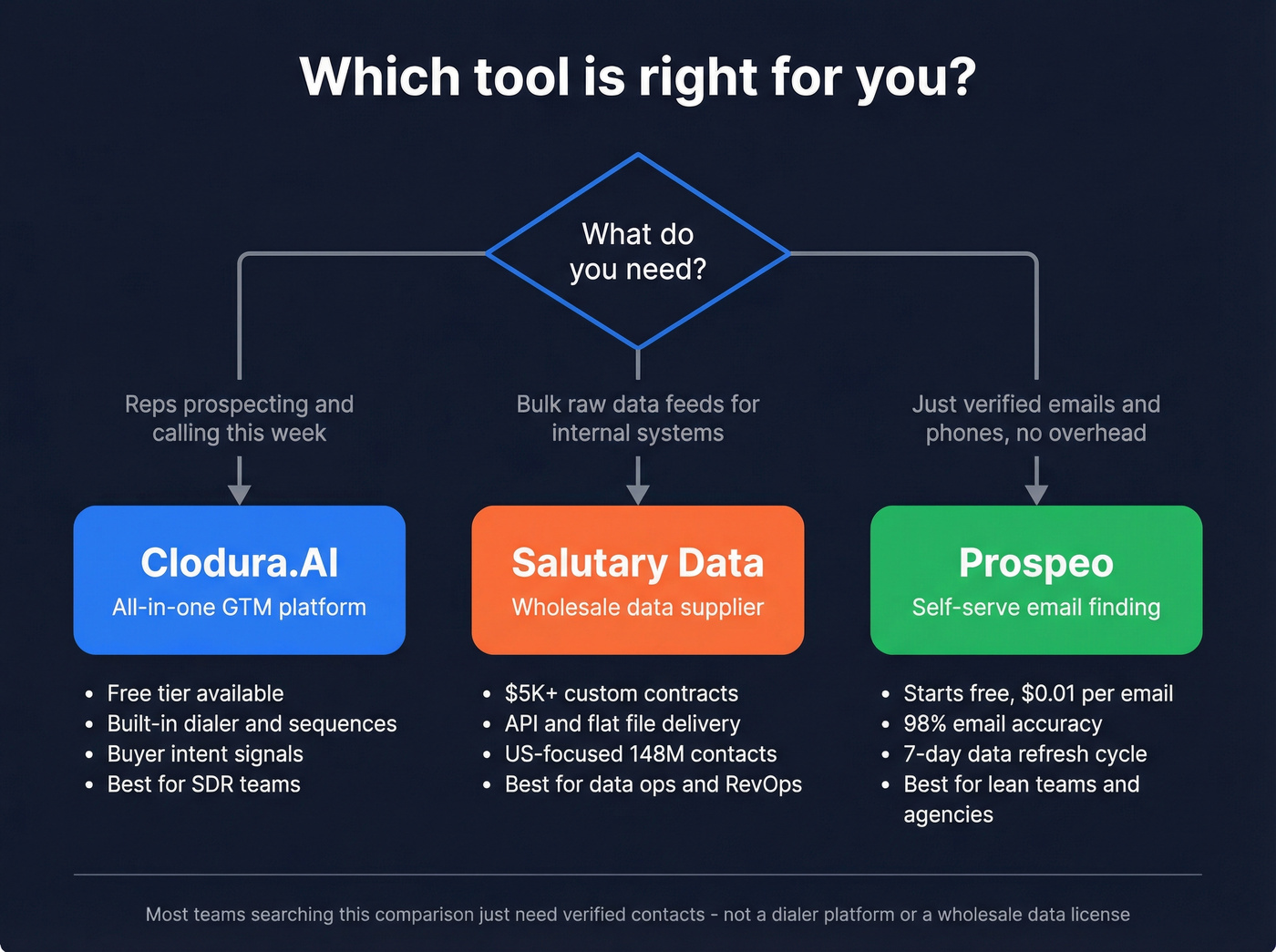
Use Salutary Data if you're a data ops or RevOps team powering your own systems with raw B2B feeds. You need API access, bulk datasets, and you have budget for a $5K+ custom contract. You're buying ingredients, not a finished meal.
Skip both if you're a lean team or agency that just needs verified emails and phone numbers without the overhead. You don't need a dialer platform or a wholesale data license - you need accurate contacts, fast.
When Neither Fits
Let's be honest - most people searching this comparison aren't data engineers licensing wholesale feeds or SDR managers evaluating full GTM suites. They just want verified emails and mobiles they can use right now.
Prospeo covers 300M+ profiles with 143M+ verified emails and 125M+ verified mobiles, all refreshed on a 7-day cycle versus the 6-week industry average. We've seen teams cut bounce rates from 35%+ down to under 4% after switching, and the math on accuracy alone - 98% versus Clodura's 95% claim - adds up to thousands of fewer bounced emails per quarter at scale. It starts free with 75 emails and 100 Chrome extension credits per month, paid plans work out to about $0.01 per email, and there are no contracts or discovery calls.

You don't need a $5K data contract or a platform with a built-in dialer you'll never use. Prospeo gives you 143M+ verified emails and 125M+ mobile numbers at $0.01 per email - self-serve, no contracts, cancel anytime. Bounce rates under 2% from day one.
Verified contacts in minutes, not weeks of integration work.
FAQ
Are Clodura.AI and Salutary Data competitors?
No. Salutary supplies raw B2B datasets to platforms and enterprises via API or flat files. Clodura is a GTM execution platform with its own UI, sequences, and dialer. They serve different layers of the data stack and different buyers - RevOps vs. SDR teams.
How much does Salutary Data cost?
Expect $5,000+ per dataset based on Datarade listings. Contract models include flat-fee, usage-based, success-based, pilot-to-commercial, and project-based pricing - all requiring a discovery call. Budget $5K-$25K for a pilot engagement.
What's a self-serve alternative to both?
Prospeo offers 300M+ profiles with 98% email accuracy starting free - 75 emails and 100 Chrome extension credits per month. At roughly $0.01 per email on paid plans, it's the fastest path to verified B2B contact data without contracts or sales calls.
Did Salutary Data get acquired?
Yes. Intentsify acquired Salutary Data in February 2026. The deal folds Salutary's 148M-contact database into Intentsify's intent-data ecosystem. Expect packaging and activation options to evolve as integration progresses throughout 2026.