How to Recover Closed Lost Deals: The 2026 Playbook
It's Q3. You're 40% behind target. Your VP just asked the team to "get creative" about pipeline - code for "we don't have enough new logos coming in." Meanwhile, your CRM holds 400+ closed lost deals from the past 18 months, sitting there like a graveyard nobody visits.
A disciplined closed lost deal recovery program can turn that graveyard into your fastest pipeline source.
Recent research shows 61% of those losses weren't because a competitor won. They were buyer indecision. The deal just... stalled. And with roughly 84% of reps missing quota last year, that graveyard isn't just neglected pipeline - it's the fastest path back to target.
Here's the thing: most teams don't need more top-of-funnel. They need to stop ignoring the pipeline they already paid to generate. A solid closed lost accounts strategy can produce more revenue than another SDR hire.
The 30-Second Version
- Fix your CRM. Replace free-text "reason lost" with a 7-category dropdown. You can't recover what you can't segment.
- Fix your data. Verify contacts before re-engaging - contact data decays at around 30% per year. Bounced emails kill campaigns and sender reputation.
- Fix your timing. Use buying signals, not calendar reminders, to trigger outreach. Former prospects who already evaluated you convert roughly 5x better than cold outbound, but only when you reach them at the right moment.
Why Deals Go Closed-Lost
HubSpot's State of Sales Report puts the top deal-killers at no product fit (37%) and poor value for money (35%). But those are the reasons reps type into a free-text field. The real reasons are messier - budget freezes, champion departures, committee paralysis, a competitor who undercut on price.
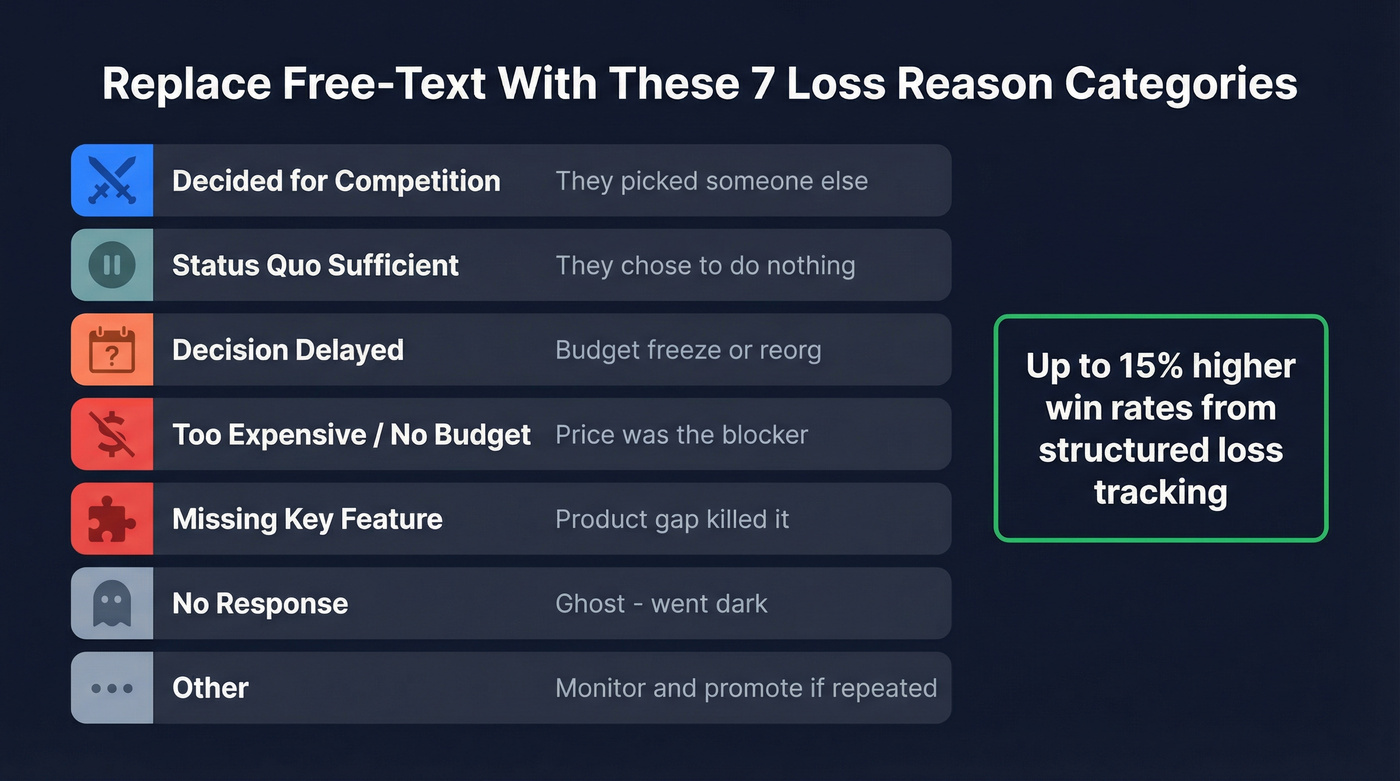
If your CRM has a free-text reason-lost field, you've already failed. Replace it with a structured dropdown:
| Loss Reason | What It Actually Means |
|---|---|
| Decided for Competition | They picked someone else |
| Status Quo Sufficient | They chose to do nothing |
| Decision Delayed | Budget freeze or reorg |
| Too Expensive / No Budget | Price was the blocker |
| Missing Key Feature | Product gap killed it |
| No Response | Ghost - went dark |
| Other | Monitor; promote if repeated |
One analysis of B2B win/loss programs found that systematic closed-lost tracking can drive up to a 15% increase in win rates over time. That's not a tool purchase - it's a dropdown field and some discipline.
The 5-Step Recovery Framework
1. Score and Segment Your Backlog
Not every closed lost deal deserves a second chance. Score your backlog across four dimensions: loss reason, ICP fit, original deal size, and recency. An $80k deal lost to "decision delayed" six months ago with a strong champion still in-seat? Top priority. This scoring step is the foundation of any effort to build pipeline from lost deals rather than chasing net-new from scratch.
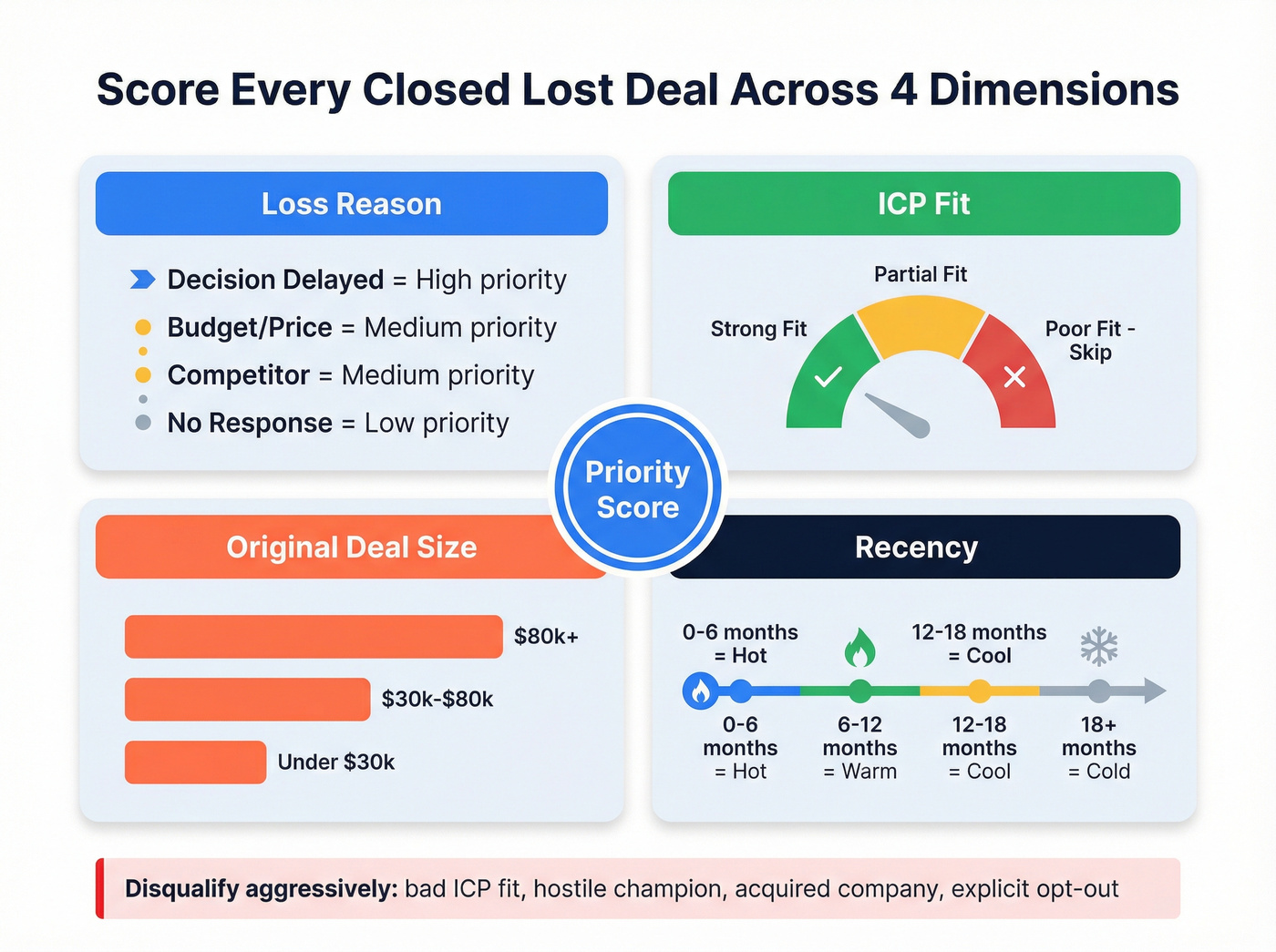
Disqualify aggressively. Bad ICP fit, hostile champion, acquired company, or deals where the contact explicitly asked not to be re-engaged - skip them. We've seen teams waste entire quarters chasing deals that were never going to close the first time, let alone the second.
2. Fix Your Data First
A rep pulls 200 closed lost contacts from the CRM, loads them into a sequence, and a chunk of emails bounce on day one. Sender reputation tanks. The whole domain gets throttled. Campaign over before it started.
We see this constantly.
Contact data decays at around 30% per year. The email addresses in your CRM from deals that closed lost a year ago? A third of them are dead. If you want to re-engage closed lost deals effectively, clean data isn't optional - it's the prerequisite.

Run your list through Prospeo's enrichment tool before touching a single sequence. With 98% email accuracy and a 7-day data refresh cycle, you'll know which contacts are still reachable, and the native Salesforce and HubSpot integrations let you enrich directly inside your CRM without exporting a CSV. Teams like Snyk cut bounce rates from 35-40% to under 5% after switching to verified data - exactly the kind of hygiene that makes or breaks a recovery campaign.
3. Set Up Signal Monitoring
Time-based follow-up is lazy. "Ping them again in 90 days" treats every deal the same regardless of what's actually happening at the account.
Watch for these signals instead:
- Pricing page revisits - they're shopping again
- New stakeholders researching your integration docs
- Funding events that evaporate budget objections
- Leadership changes that reset priorities
- Competitor contract end dates approaching renewal season
On a budget, Google Alerts covers funding and leadership changes for free. For more sophisticated signal detection, intent data platforms tracking thousands of topics can surface when a lost account starts researching your category again. The consensus on r/sales is pretty clear: timing outreach to buying signals - rather than arbitrary calendar dates - is the single biggest factor in whether recovery outreach gets a response or gets ignored.
4. Deploy Loss-Reason Sequences
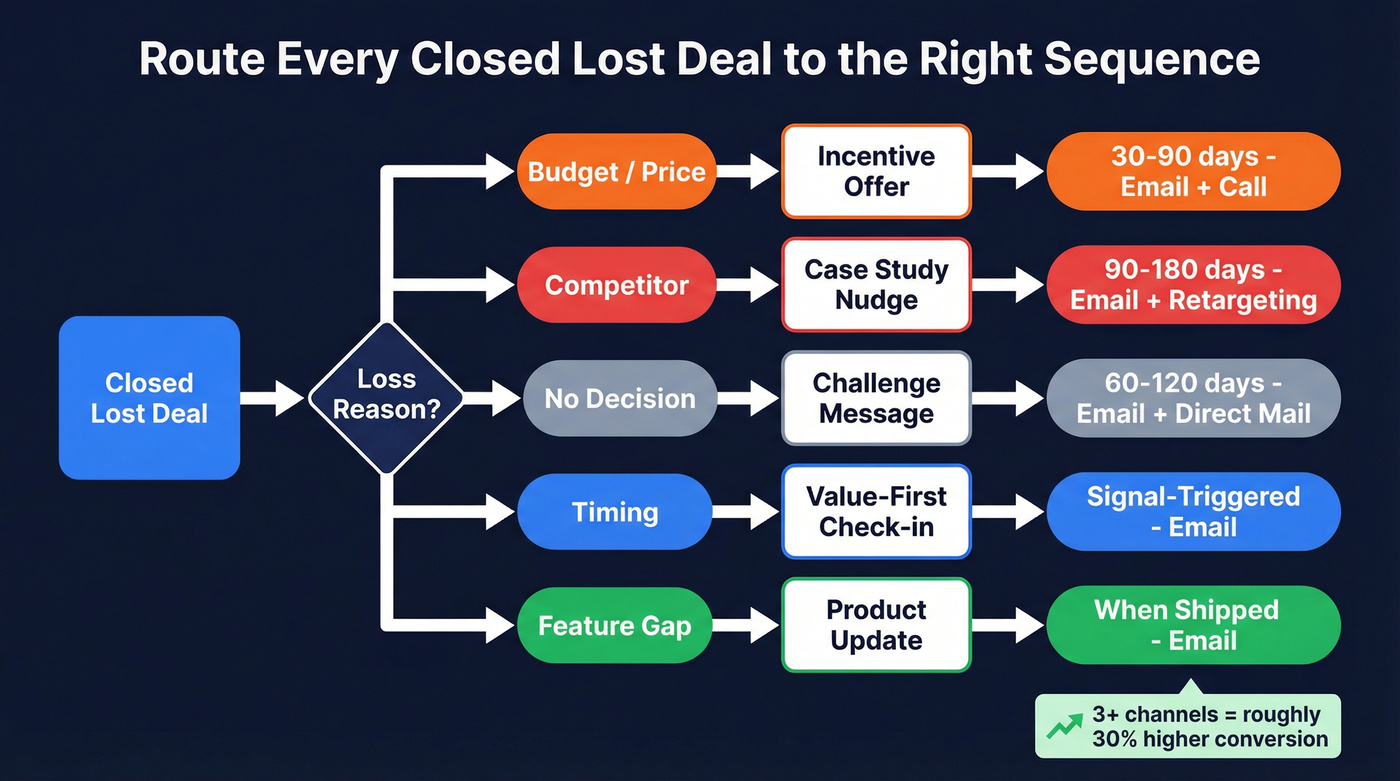
Different loss reasons need different messages, timing, and channels:
| Loss Reason | Message Type | Timing | Channel |
|---|---|---|---|
| Budget/Price | Incentive offer | 30-90 days | Email + call |
| Competitor | Case study nudge | 90-180 days | Email + retargeting |
| No Decision | Challenge message | 60-120 days | Email + direct mail |
| Timing | Value-first check-in | Signal-triggered | |
| Feature Gap | Product update | When shipped |
Don't send the same generic "just checking in" to every segment. That's how you get unsubscribes instead of re-opens. Using 3+ channels yields roughly 30% higher conversion rates than email alone, so pair sequences with retargeting ads and the occasional direct mail piece for your highest-value accounts.
5. Measure and Build the Culture
Recovery won't stick without metrics and incentives. Track these KPIs monthly:
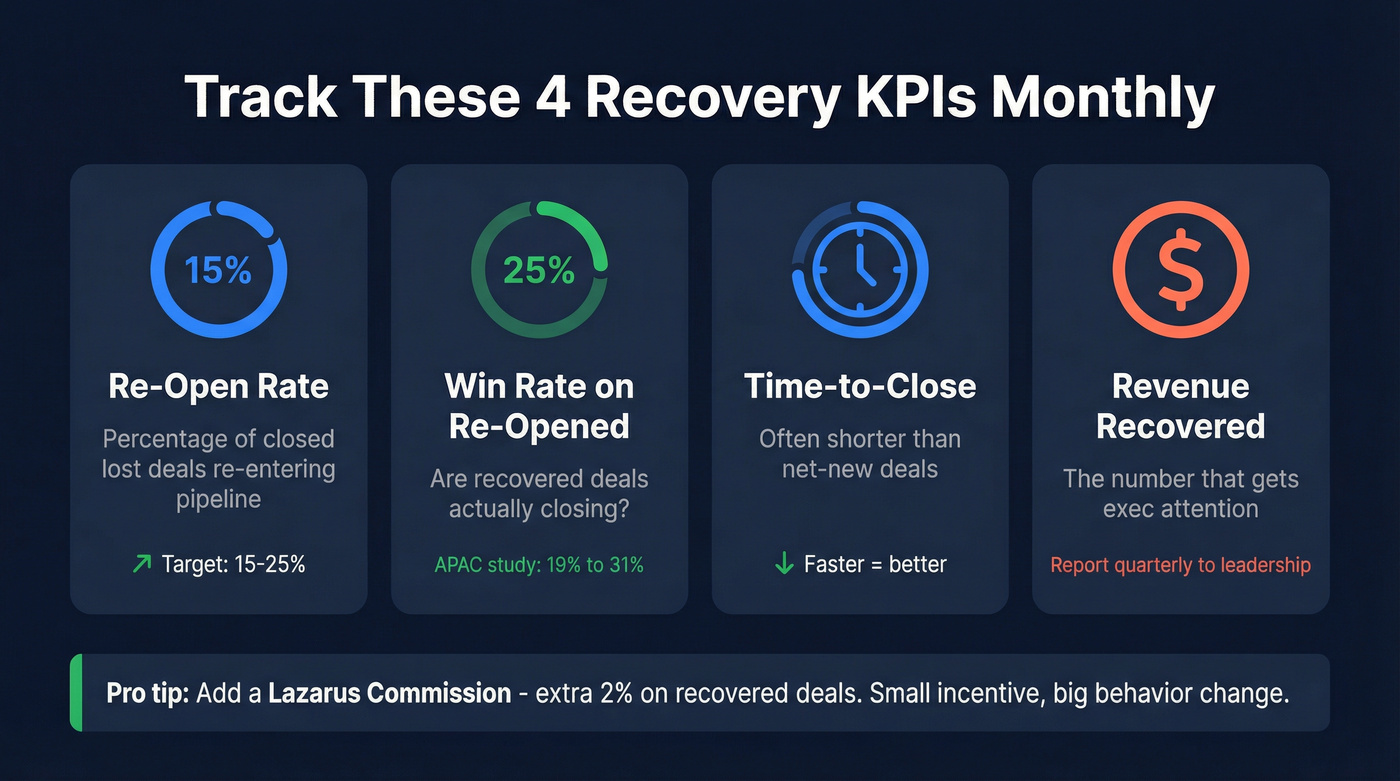
- Re-open rate - percentage of closed lost deals re-entering pipeline
- Win rate on re-opened - are recovered deals actually closing?
- Time-to-close on recovered deals, which is often shorter than net-new
- Revenue recovered per quarter - the number that gets exec attention
One tactic we love: the "Lazarus Commission" - an extra 2% on recovered deals. Small incentive, big behavior change. Run a monthly resurrection review where the team surfaces their best recovery candidates and shares what's working. Over time, this review becomes the engine that helps you revive closed lost deals consistently rather than in one-off bursts.
An APAC study across SaaS and fintech companies saw win rates jump from 19% to 31% and no-decision rates drop from 38% to 22% - all within four months of implementing structured recovery. That's a meaningful lift from a pipeline source most teams completely ignore.

Your closed lost deals are only recoverable if the contact data is still valid. Prospeo's CRM enrichment verifies emails at 98% accuracy on a 7-day refresh cycle - so you know exactly which contacts are reachable before you launch a single recovery sequence. Snyk cut bounce rates from 35% to under 5%.
Stop burning sender reputation on dead emails from your CRM graveyard.
Recovery Email Templates
Template 1: Permission to Close (Week 1)
Subject: Closing your file - unless I shouldn't?
Hi [Name], I'm doing some housekeeping and about to close out your file from our conversation in [month]. Before I do - has anything changed on your end? If the timing's better now, I'd love to reconnect. If not, no hard feelings.
This works because people hate losing access to options. It gives them an easy way to respond without feeling sold to.
Template 2: Case Study Nudge - for Competitor Losses (Week 3)
Subject: [Competitor] to us: how [Similar Company] made the switch
Hi [Name], I know you went with [Competitor] back in [month]. Wanted to share a quick case study - [Similar Company] made the same choice, then switched to us after [specific trigger]. They saw [specific result]. Worth a 15-minute conversation if your renewal's coming up?
Template 3: Product Update - for Feature Gap Losses (Week 5)
Subject: We built the thing you asked for
Hi [Name], you mentioned [missing feature] was a dealbreaker when we last spoke. We shipped it [last month/last quarter]. Here's a 2-minute demo: [link]. Would it change the conversation?
Skip Template 3 if the feature gap was actually a fundamental architecture mismatch. Shipping one feature doesn't fix a platform-level objection, and sending this email in that scenario makes you look like you weren't listening.
Calculate Your Recovery Revenue
Even conservative assumptions produce numbers that get CFO attention. The formula:
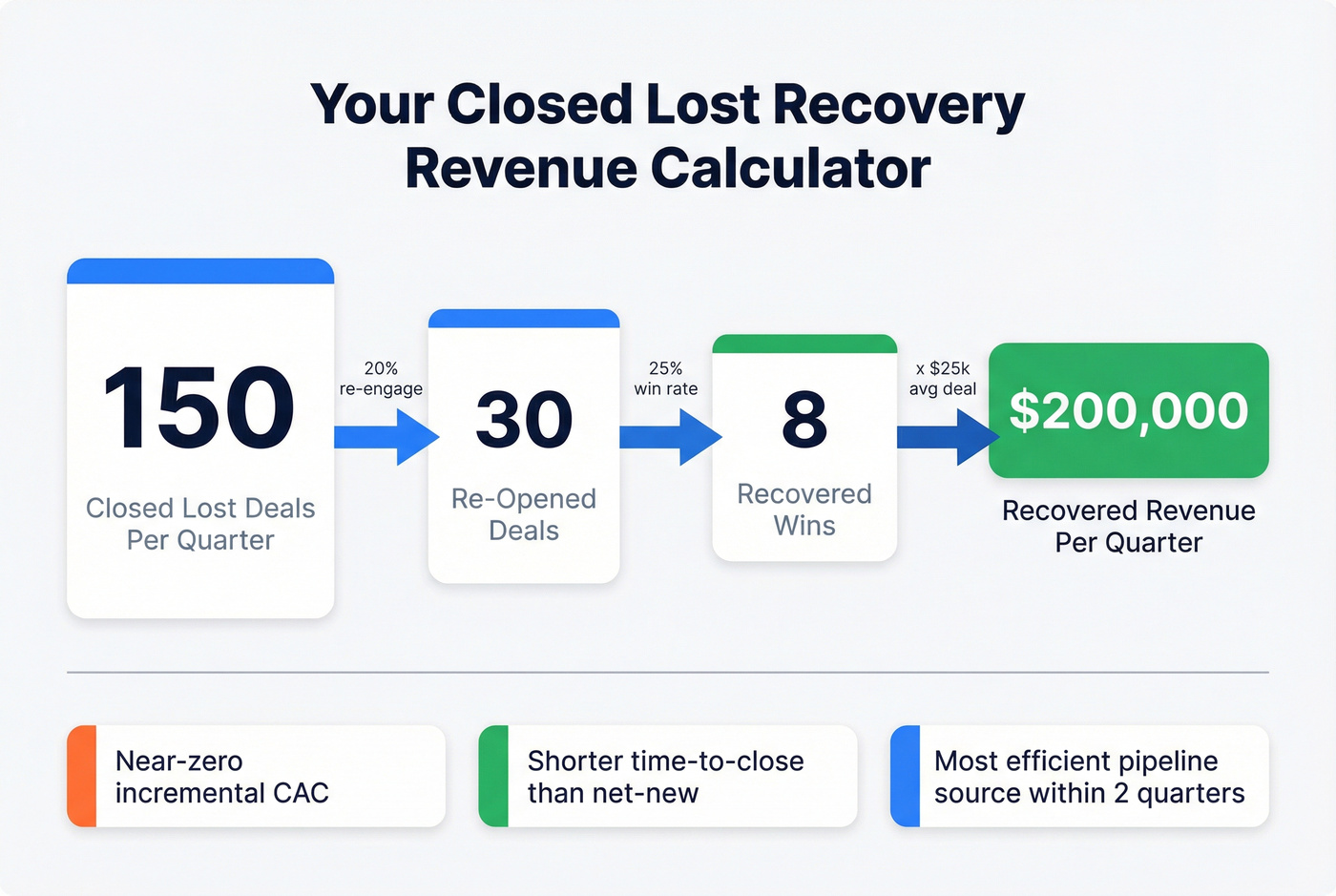
Closed-lost deals per quarter x re-engagement rate x win rate x average deal size = recovered revenue
Let's break this down with real numbers. Say you have 150 closed lost deals per quarter, a 20% re-engagement rate giving you 30 re-opened deals, and a 25% win rate on those producing about 8 wins at $25,000 average deal size. That's $200,000 in recovered revenue per quarter - from pipeline you already paid to generate.
Teams that reactivate lost opportunities systematically often find this becomes their most efficient pipeline source within two quarters, because the cost of running recovery sequences is trivially low compared to the CAC of generating equivalent net-new pipeline.
Recovery campaigns live or die on timing and data quality. Prospeo layers intent data across 15,000 topics with verified contact details - so you re-engage closed lost accounts exactly when they're back in-market, with emails that actually land. All at $0.01 per email, no contracts.
Turn your closed lost graveyard into your fastest pipeline source this quarter.
CRM Setup Checklist
Whether you're on HubSpot or Salesforce, add these fields to every closed lost deal:
- Loss reason - dropdown, 7 categories from the table above
- Recovery status - picklist: Not Started, Monitoring, Re-Engaged, Recovered, Disqualified
- Next review date - auto-populated based on loss reason
In HubSpot, create a workflow triggered when deal stage hits Closed Lost that auto-populates the review date and enrolls the contact in the appropriate recovery sequence. In Salesforce, use Flow Builder to auto-reopen the opportunity when a signal fires - website revisit, intent spike, or champion job change.
Look, the automation isn't complicated. The discipline to actually set it up is the hard part. I've watched teams nod along through the entire setup discussion, then never build the workflow because "we'll get to it next sprint." Don't be that team.
FAQ
How long should I wait before following up on closed lost opportunities?
For deals lost to timing or budget, reach out within 2-4 weeks. Competitor or feature-gap losses need 1-3 months of breathing room. No-decision ghosts warrant 3-6 months. Signal-based triggers - a funding event, a champion job change, a pricing page revisit - override all timelines and should prompt immediate outreach.
What's a realistic win rate on recovered deals?
Expect 15-25% of closed lost deals to re-open with structured outreach, and 20-30% of those to convert. The APAC study referenced above saw win rates jump from 19% to 31% after implementing a structured recovery framework - a meaningful lift from a pipeline source most teams ignore entirely.
How do I prevent stale data from killing my recovery campaign?
Verify every contact before any outreach. A 7-day data refresh cycle catches role changes and dead addresses that a static CRM export misses - teams like Meritt cut bounce rates from 35% to under 4% after switching to verified data. Bouncing 30% of your emails on day one doesn't just kill the campaign; it damages your sender domain for every future campaign too.
Should I reopen the original opportunity or create a new one?
Create a new opportunity linked to the original. This preserves your historical win/loss data while giving the recovered deal its own pipeline stage, close date, and attribution. Your reporting stays clean and you can measure recovery performance separately from net-new pipeline.
What if the champion left the company?
That's a signal, not a dead end. Your former champion is a warm lead at their new company - they already know your product and had enough interest to evaluate it. Track role changes and reach out within 30 days of a move. Meanwhile, use the departure as a reason to contact the original company: a new decision-maker often means a fresh evaluation cycle, and you've got institutional knowledge about the account that a competitor doesn't.