

Closed Won Revenue: Definition, Formula, and How to Increase It
Your VP of Sales says the quarter closed at $2.4M. Your CFO says $800K. Your CMO wants campaign attribution on all of it. Everyone's looking at the same CRM - nobody agrees on the number.
That gap between closed won revenue and recognized revenue causes more cross-functional arguments than any other metric in B2B. Let's clear it up.
Quick version:
- Closed won revenue = sum of deal amounts where stage = Closed Won, filtered by close date. It's a bookings metric, not recognized revenue.
- Track it in Salesforce or HubSpot with the filters below.
- The fastest lever to increase it: improve win rate by 5 points - worth ~$20M on a $100M revenue base - starting with pipeline data quality.
What Is Closed Won Revenue?
Closed Won Revenue = SUM(Amount) where Stage = Closed Won AND Close Date = [period]
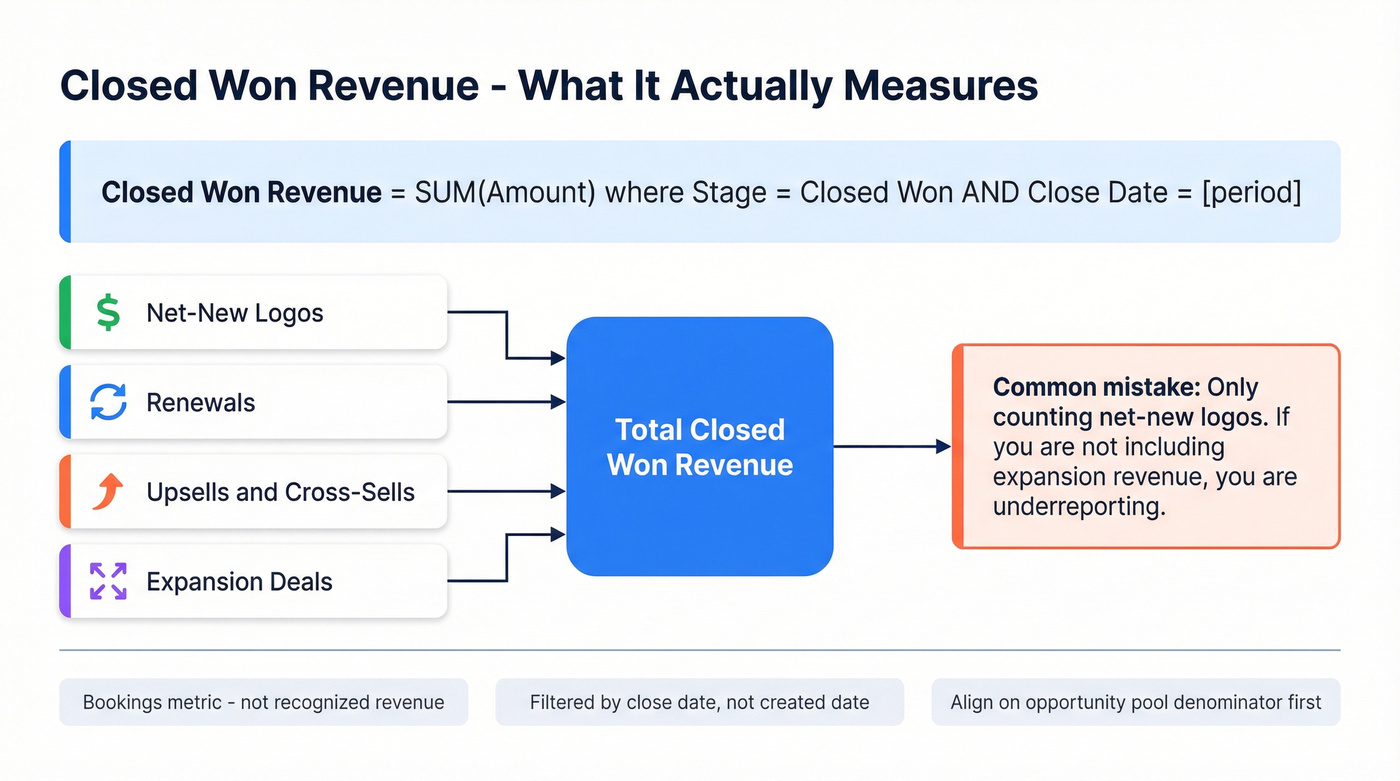
This measures bookings committed during a given timeframe - contracts signed, deals done, handshakes made. It doesn't measure revenue earned. That distinction is the root of the VP-vs-CFO argument above.
One thing most teams get wrong: they assume this metric only counts net-new logos. It doesn't. Any deal that reaches Closed Won counts - renewals, upsells, cross-sells, and expansion deals all contribute. If you're not including expansion revenue, you're underreporting, full stop. (If you need the definitions straight, see cross-sells and upsells.)
The "denominator debate" matters here too. What counts as the opportunity pool directly affects related metrics like win rate vs. close rate. Count from MQL and you get one number. Count from SQL or qualified opportunity and you get another. Align on the denominator before you argue about the numerator.
Why It's Not Recognized Revenue
A $120K annual deal closes in March. The CRM says $120K. Finance recognizes $10K/month under ASC 606 because the service is delivered ratably over 12 months - revenue follows delivery, not signing. Meanwhile, the board deck says ARR is up $120K. Three numbers, one deal, three different audiences who each think their number is "revenue."
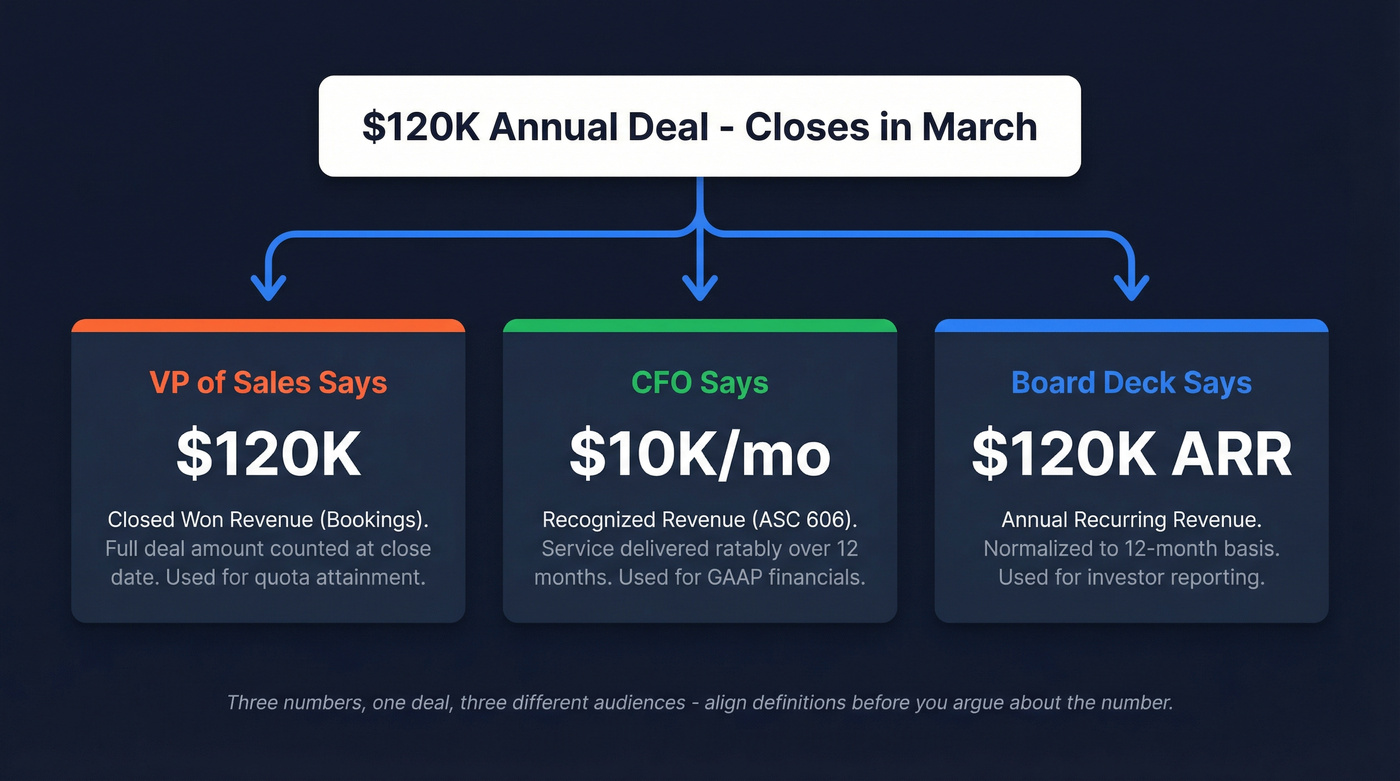
This isn't theoretical. 95% of SaaS finance leaders say technology gaps block order-to-cash effectiveness, and 54% call those gaps "severe." Reporting bookings as revenue destroys investor credibility - and it happens more often than anyone admits.

The gap between bookings and recognized revenue starts with reporting. The gap between your pipeline and closed won revenue starts with data quality. Snyk's 50 AEs dropped bounce rates from 35% to under 5% with Prospeo - and AE-sourced pipeline jumped 180%.
Stop leaking pipeline to bad data at $0.01 per verified email.
How to Track It in Your CRM
Salesforce
Building a closed won revenue report takes five minutes:
- Navigate to Reports, click New Report, and select the Opportunities report type.
- Add a filter: Stage = Closed Won.
- Add a second filter: Close Date = [your period].
- Group by Close Date, then add SUM(Amount) as your summary metric.
- Save and click Add Chart to visualize the trend.
From there, slice by territory, campaign, or rep. The most useful patterns we've found are average deal size trending, stage velocity on won deals, and win rate by source - those three cover what leadership actually asks for. For teams tracking against quota, add a goal field to compare bookings vs. target in the same report.
One workflow tip: create a rule that auto-updates the Account record from "Prospect" to "Customer" the first time an opportunity hits Closed Won. Small thing, but it keeps segmentation clean downstream.
HubSpot
Here's the thing about HubSpot: "closed won" isn't about the stage name. It's any deal stage where the probability is set to "won." If your custom pipeline uses a stage called "Signed" but the probability isn't configured correctly, it won't show up in revenue analytics. We've seen this trip up more mid-market teams than we can count.
The bigger gotcha is that HubSpot's revenue analytics doesn't pull from products or quotes - it uses recurring revenue properties that must be updated manually. And if you're adding line items after a deal closes, pipeline revenue is driven by the overall deal stage, not individual line items. This is the single biggest source of HubSpot reporting discrepancies for teams tracking commissions at the line-item level. If that's you, skip the native reports and build in a BI tool instead.
Win Rate Benchmarks by Deal Size
Knowing your bookings total is useful. Knowing whether your win rate is competitive is actionable. Benchmarks from an Optif.ai analysis of 939 B2B SaaS companies:
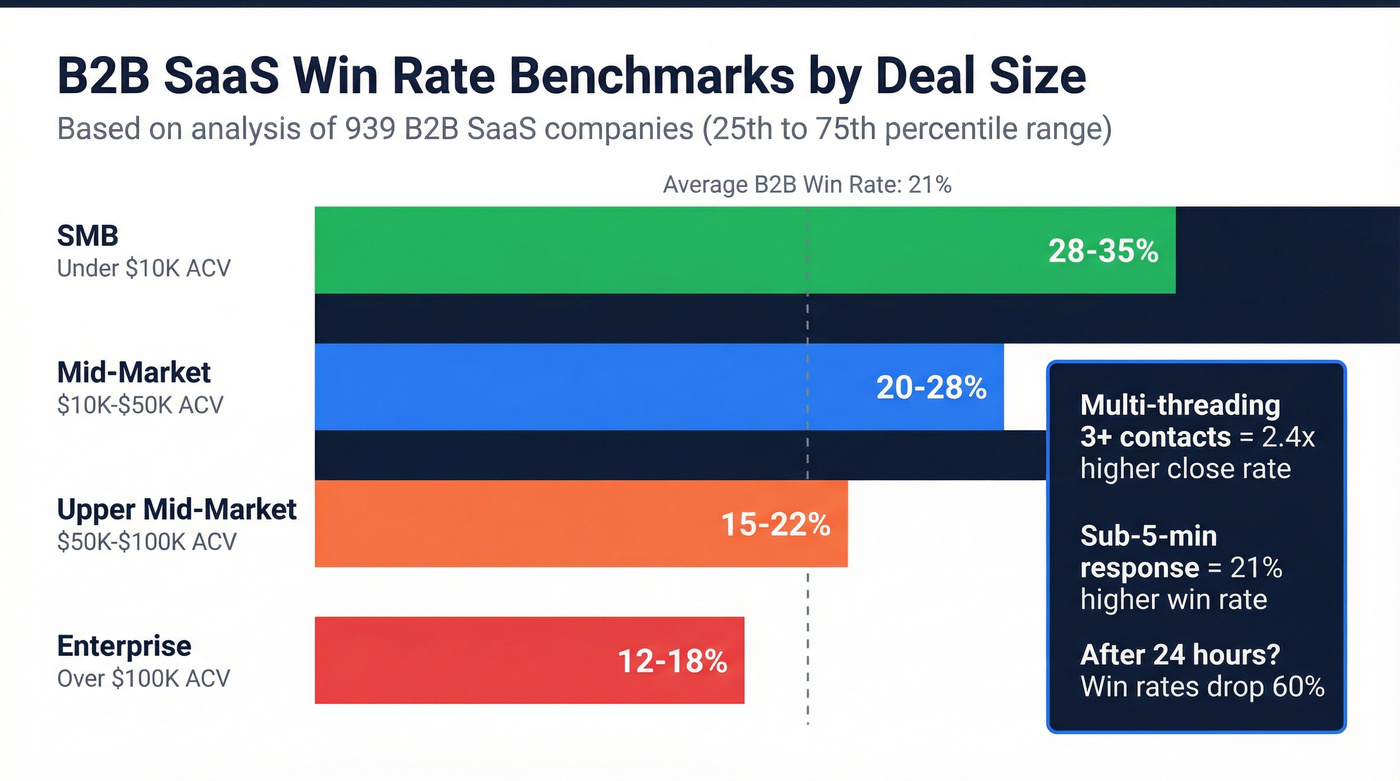
| Segment | ACV Range | Win Rate (25th-75th) |
|---|---|---|
| SMB | Under $10K | 28-35% |
| Mid-Market | $10K-$50K | 20-28% |
| Upper Mid | $50K-$100K | 15-22% |
| Enterprise | Over $100K | 12-18% |
The average B2B win rate sits around 21% according to HubSpot's 2024 Sales Trends data. Multi-threading across 3+ contacts closes deals 2.4x more often - 3.1x for enterprise. Responding to inbound in under 5 minutes correlates with 21% higher win rates. After 24 hours? Win rates drop 60%.
How to Increase Closed Won Revenue
You don't need more leads. A RAIN Group analysis showed that a $100M organization improving win rate from 25% to 30% generates ~$20M in additional revenue without a single new lead. With $50M in fixed costs, that translates to 8+ points of margin improvement.
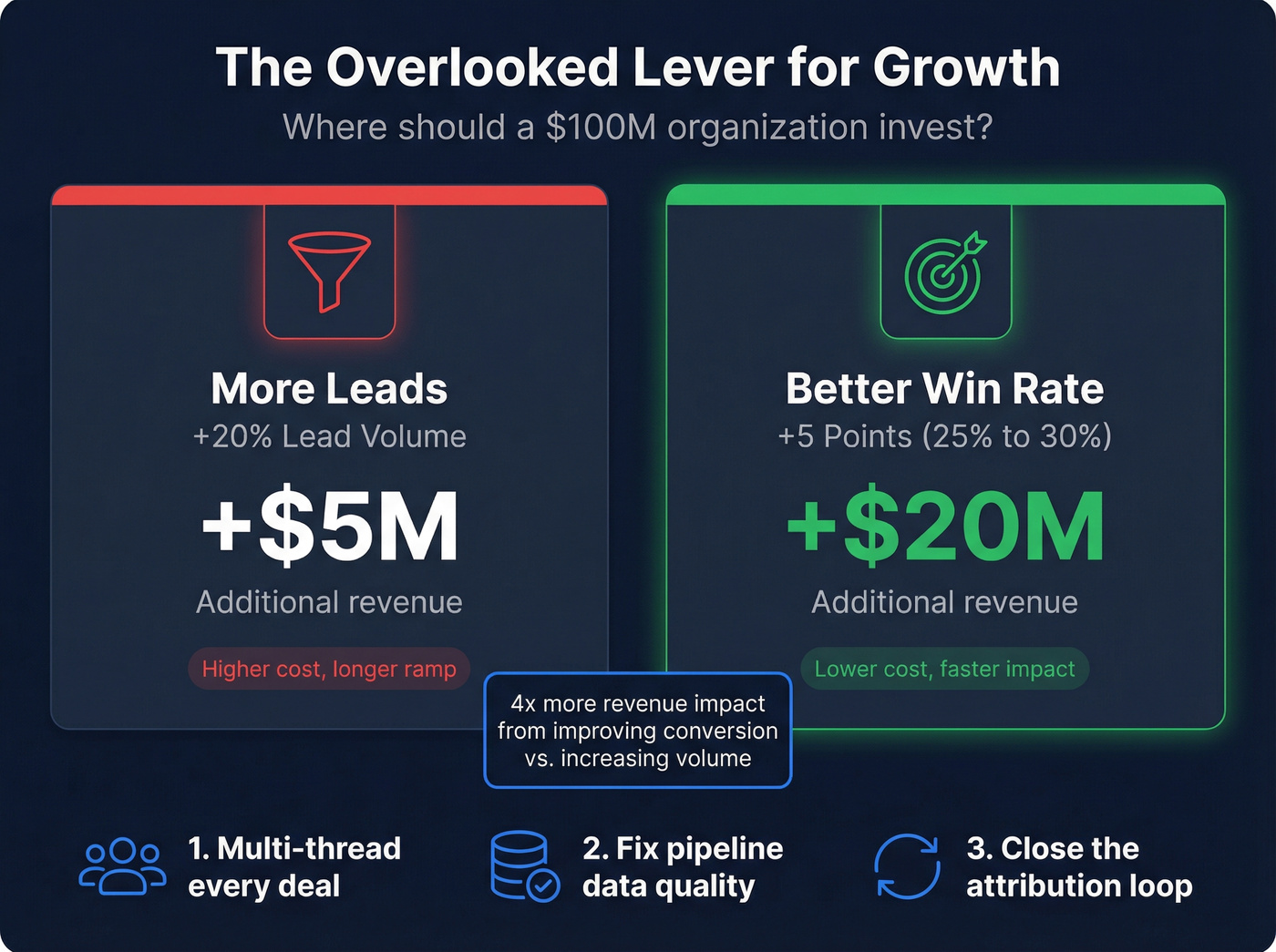
Most teams pour budget into top-of-funnel when the real money is sitting in deals already in their pipeline. A 5-point win rate improvement is worth more than a 20% increase in lead volume - and it's cheaper to execute.
Three levers move the needle:
1. Improve Win Rate Through Sales Execution
Multi-thread every deal. Respond faster. We've seen teams obsess over lead volume while ignoring the fact that their reps are single-threading $80K deals to one champion who goes dark. The consensus on r/sales is pretty clear: if you're not talking to at least three stakeholders on an enterprise deal, you're gambling. (If you want a tighter process, use a sales execution checklist.)
2. Fix Pipeline Quality Upstream
If your email bounce rate is above 5%, you're leaking pipeline before it ever reaches a proposal stage. Fewer delivered emails means fewer conversations, fewer opportunities, and less closed won revenue at quarter-end. Prospeo's 98% email accuracy and 7-day data refresh cycle fix this at the source - Snyk dropped their bounce rate from 35-40% to under 5%, and AE-sourced pipeline jumped 180%. (More on benchmarks and fixes: email bounce rate.)

3. Close the Attribution Loop
If you can't trace won deals back to the campaign that sourced them, you're flying blind on marketing ROI. Enrich every closed record with decision drivers, competitive intel, and originating channel. That data compounds into your best ICP refinement tool over time, and it's what separates teams that scale from teams that just spend more. (If you need a system for this, start with data enrichment.)
A 5-point win rate improvement on a $100M base is worth $20M - but only if your reps are reaching real buyers. Prospeo's 7-day data refresh and 98% email accuracy mean more conversations, more pipeline, and more closed won revenue at quarter-end.
Teams using Prospeo book 35% more meetings than Apollo users.
FAQ
What's the difference between closed won revenue and ARR?
Closed won revenue is the total deal amount booked at close; ARR normalizes that to a 12-month recurring basis. A $36K three-year deal counts as $36K in bookings but only $12K ARR. Use bookings for quota attainment and ARR for investor reporting.
Can closed won revenue decrease after a deal closes?
Yes. If a deal is reopened, downgraded, or reclassified post-close, the amount for that period should be adjusted. Most CRMs don't handle this automatically, so RevOps needs clear policies on post-close modifications to keep historical reports accurate.
How do I grow closed won revenue without more leads?
Improve win rate. A 5-point increase on a $100M revenue base adds ~$20M. Start with sub-5-minute response times, multi-threading across 3+ contacts, and ensuring reps work verified contact data so emails actually land and conversations happen.