

Closed Won vs Closed Lost: Definitions, Benchmarks, and What to Do Next
The median B2B SaaS win rate sits around 21%. That means roughly four out of five decided opportunities end in Closed Lost. The distinction between closed won and closed lost is straightforward - one means revenue booked, the other means the deal's dead. But the real value is in tracking why deals die and recycling the best ones back into pipeline.
Closed Won vs Closed Lost Explained
Both are terminal CRM stages. Once a deal lands in either bucket, it drops out of your active pipeline and forecast.
| Attribute | Closed Won | Closed Lost |
|---|---|---|
| CRM probability | 100% | 0% |
| Forecast category | Closed / Won | Closed / Lost |
| Revenue impact | Recognized | $0 |
| Next action | Onboarding / handoff | Loss reason capture |
| Can reopen? | Technically yes, but usually restricted by process | Technically yes, but usually restricted by process |
Best practice: don't resurrect closed records. Create a new opportunity and link it to the original. That keeps your historical data clean and your win-rate math honest.
Where They Sit in the Pipeline
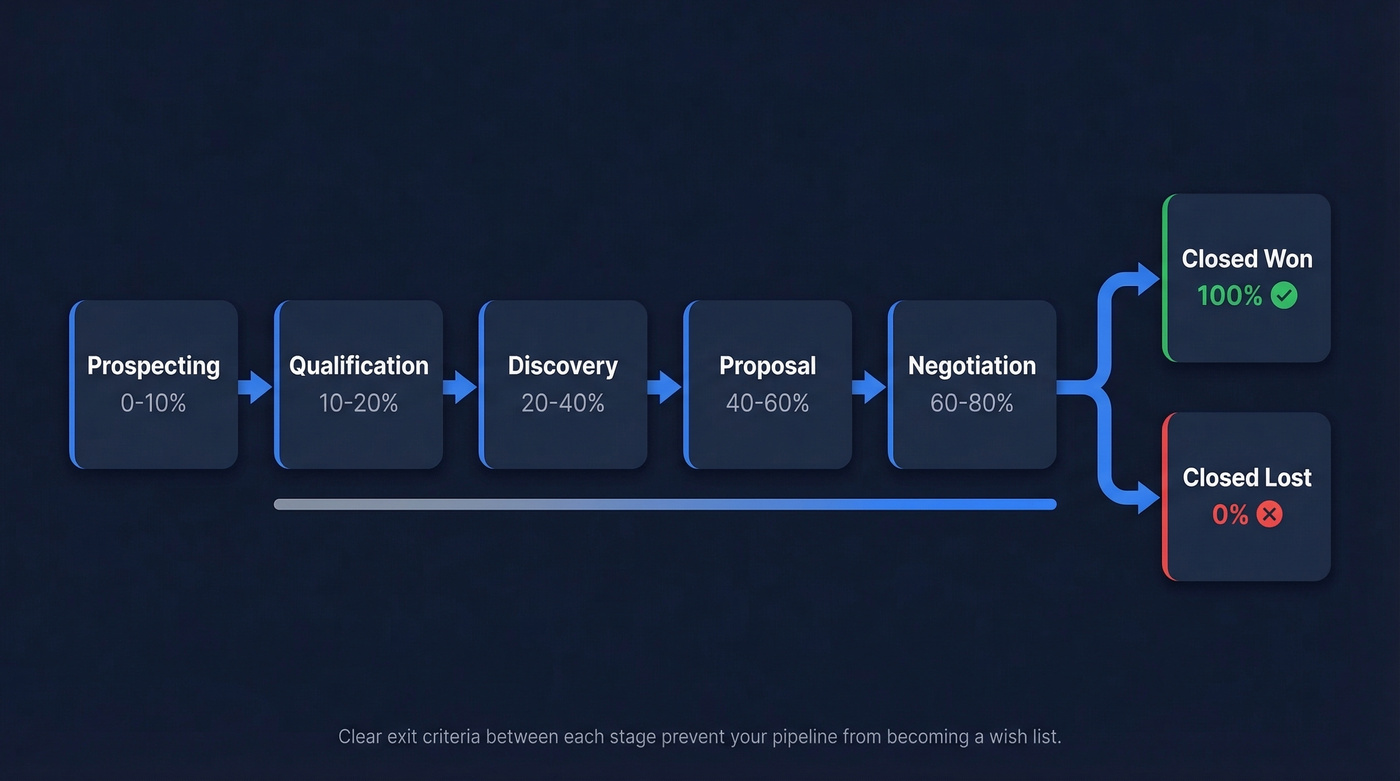
Closed Won and Closed Lost are the bookends. Everything between them is probability, based on a standard model adapted from Fullcast's pipeline framework:
| Stage | Probability |
|---|---|
| Prospecting | 0-10% |
| Qualification | 10-20% |
| Discovery | 20-40% |
| Proposal | 40-60% |
| Negotiation | 60-80% |
| Closed Won | 100% |
| Closed Lost | 0% |
The specific stages matter less than having clear exit criteria between them. If your reps can't articulate what moves a deal from Discovery to Proposal, your pipeline is a wish list.
Win Rate Benchmarks in 2026
Win rate = wins / decided opportunities. Close rate sometimes includes open deals in the denominator, which makes your numbers look worse. Know which one you're reporting before you walk into a board meeting with it.
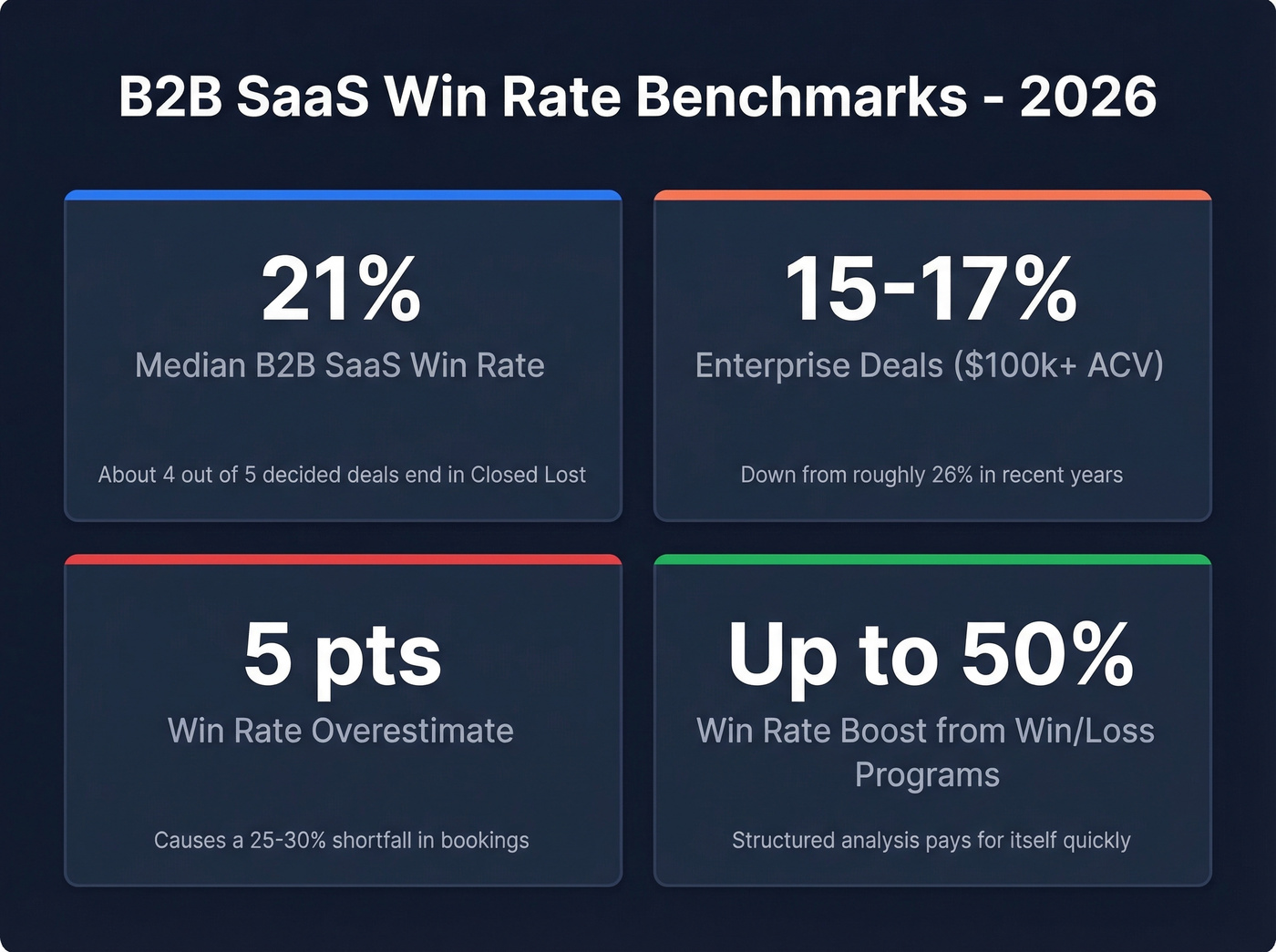
Enterprise deals above $100k ACV trend lower - Winning by Design's analysis showed those dropping from ~26% to ~17%. If you're consistently above 25%, your qualification is either excellent or your pipeline definition is too narrow. Worth auditing either way.
Here's the number that should keep you up at night: overestimating your win rate by just 5 points causes a 25-30% shortfall in bookings. That's the difference between hitting plan and a painful conversation with your board. Rigorous win/loss programs can boost win rates by up to 50%, so the effort pays for itself quickly.

If 61% of lost deals come from prospect indecision, the last thing you need is stale contact data adding to the pile. Prospeo's 300M+ profiles refresh every 7 days with 98% email accuracy - so your closed-lost bucket reflects real sales gaps, not ghost accounts.
Stop inflating your loss rate with bad data.
The "No Decision" Problem
No decision stalls 22% of all deals. Per Ebsta's analysis of 4.2M opportunities, 61% of lost deals stem from prospect indecision - not a competitor win.
Let's be honest: whether "no decision" deserves its own pipeline stage is a trap question. Track it as a closed-lost sub-reason. Parking-lot stages like "On Hold" clutter your pipeline and wreck forecasts. Close the deal, tag the reason, set a re-engagement trigger. If you're using MEDDPICC, map the gap - missing Economic Buyer means exec-level outreach next time around.
Reason Codes to Track
Free-text fields are where closed-lost data goes to die. HubSpot's native Closed-Lost Reason property defaults to text, which means you'll get "price," "pricing," and "$$" all describing the same thing. Switch it to a required dropdown via conditional stage properties. Keep your taxonomy to 8-12 reasons max, adapted from TheSalesBlog's framework:
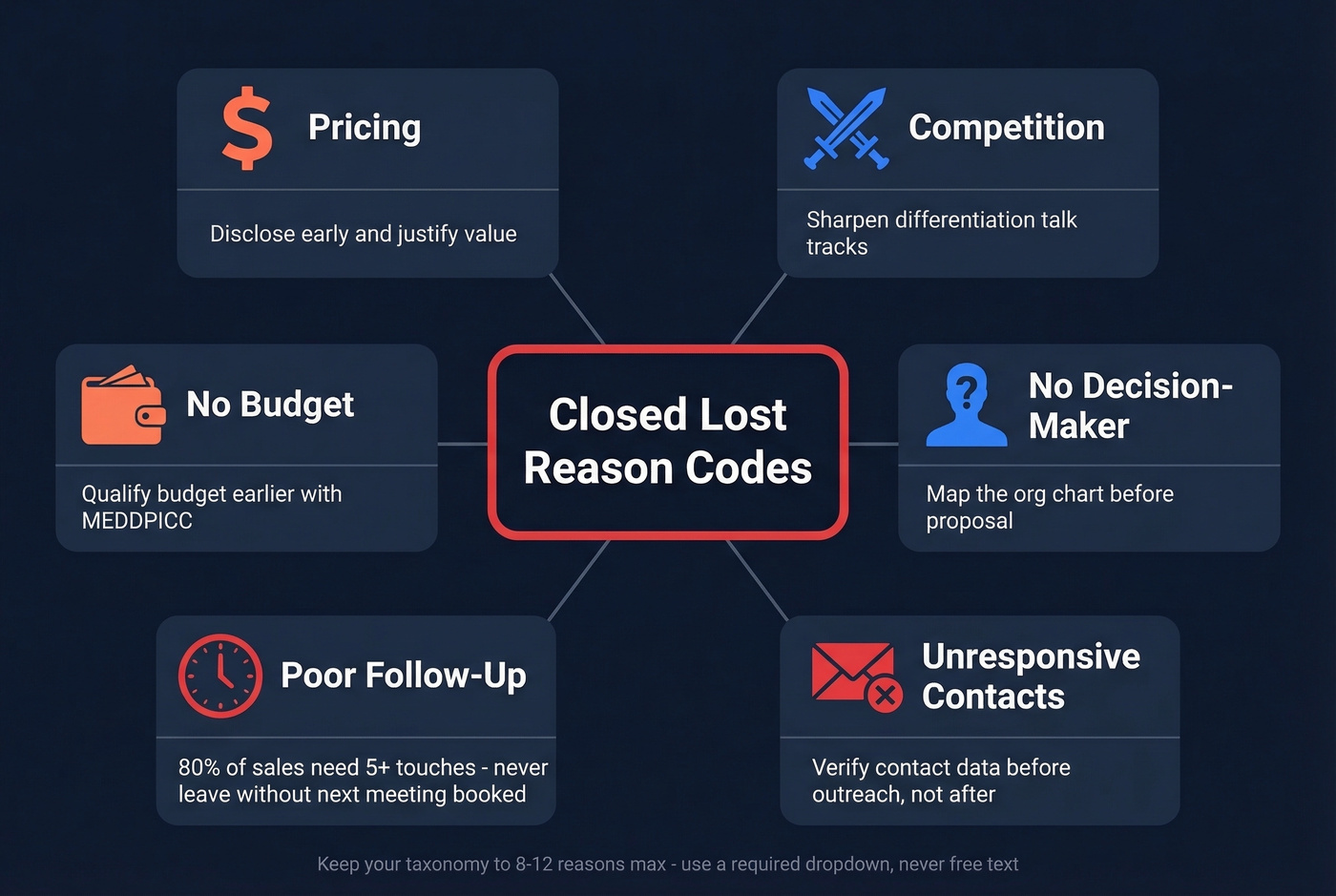
Pricing - disclose early, justify value. Competition - sharpen differentiation talk tracks. No budget - qualify budget earlier with MEDDPICC. No decision-maker - map the org chart before proposal. Poor follow-up - 80% of sales require 5+ follow-ups, but 44% of reps stop after one. Never leave a meeting without the next one booked. Unresponsive contacts - verify contact data before outreach, not after the deal stalls.
Analyze by rep, persona, and deal size quarterly. Patterns emerge fast, and they're almost always different from what your team assumes.
Here's the uncomfortable truth: sales and buyer explanations for why deals die only align 30-50% of the time. Your reps think it was pricing. The buyer chose a competitor. That gap is exactly why structured win/loss analysis matters more than gut feel.
Recycling Closed-Lost Deals
Closed-lost is paused demand, not dead demand. These buyers already recognized the problem and evaluated solutions, which makes them warmer than any net-new lead sitting in your BDR's outreach list.
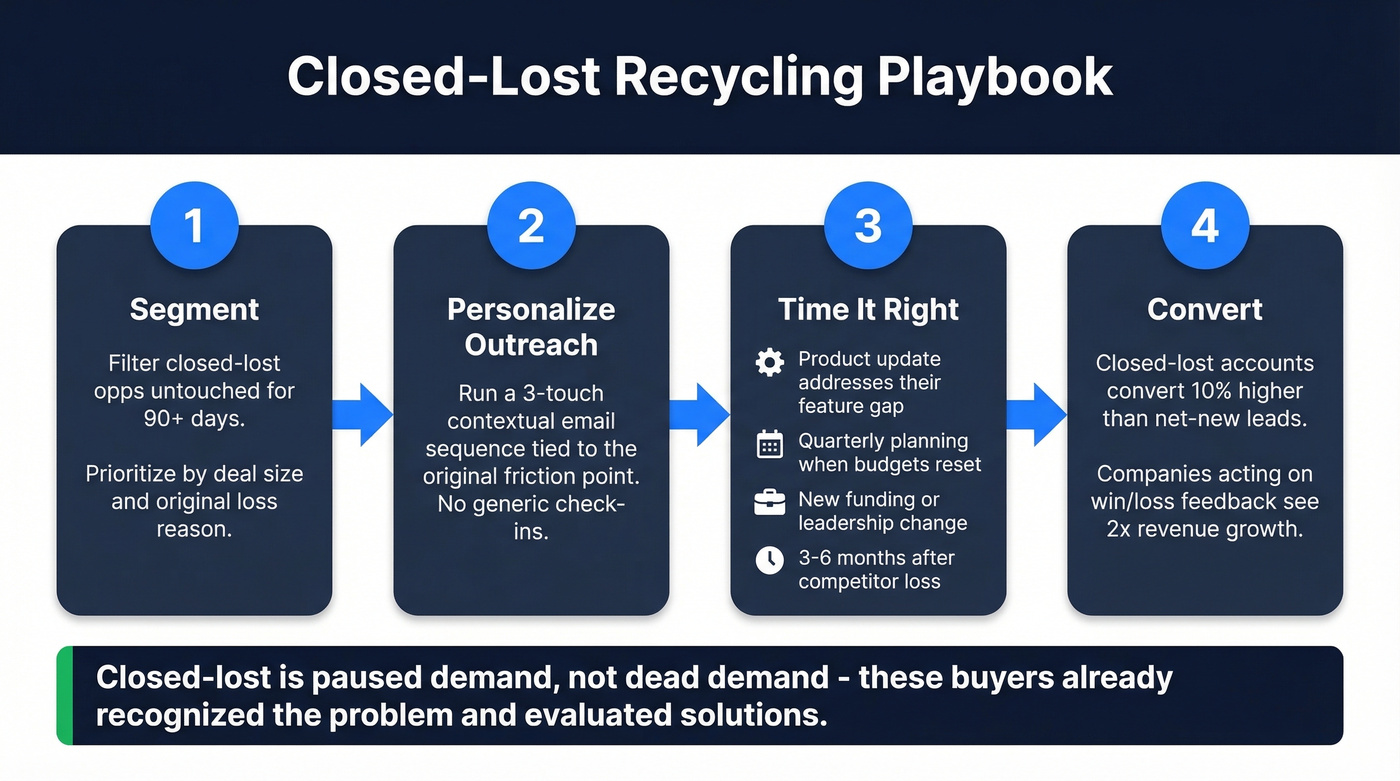
Start by segmenting closed-lost opps untouched for 90+ days. Run a 3-touch contextual email sequence tied to the original friction point - not a generic "just checking in." One case study showed closed-lost accounts converting 10% higher than newly generated leads, and companies that consistently collect and act on win/loss feedback see 2x revenue growth.
Look, most teams over-invest in net-new pipeline and completely ignore the closed-lost goldmine sitting in their CRM. If your average deal size is north of $25k, re-engaging last quarter's lost deals will almost certainly outperform cold outbound on a cost-per-meeting basis. We've seen this play out across dozens of sales orgs - the math just works.
Timing triggers worth watching: product updates that address the feature gap they cited, quarterly planning windows when budgets reset, prospect business changes like new funding or leadership turnover, and 3-6 months after a competitor loss when the honeymoon phase fades.
Bad Data Inflates Your Loss Rate
Take a hard look at your "Unresponsive contacts" bucket. How many of those deals died because the prospect genuinely went dark - and how many died because your rep was emailing a bounced address?
91% of CRM data is incomplete, and 70% decays annually. That's not a sales execution problem. It's a data hygiene problem masquerading as one, and it poisons every downstream metric including your closed won vs closed lost ratio.
In our experience, teams cut their "unresponsive contacts" bucket in half just by verifying emails before outreach. Prospeo's 300M+ profile database runs a 7-day refresh cycle and delivers 98% email accuracy, so reps chase real opportunities instead of ghost accounts - and your closed-lost analysis reflects actual execution gaps, not stale data. Skip this step if you're confident your CRM data is clean, but the consensus on r/sales is that almost nobody's CRM data is as clean as they think.
If you want a tighter process around this, start with an email verification step before sequences, and consider using an email verification tool or bulk email checkers when you're cleaning lists at scale.
Recycling closed-lost deals only works if you can actually reach the buyer. 70% of CRM data decays annually - meaning half your re-engagement sequences hit dead inboxes. Prospeo enriches your CRM with 50+ verified data points per contact at $0.01/email, so your closed-lost recycling campaigns land every time.
Re-engage lost deals with verified contacts, not bounced emails.
What's a good win rate for B2B SaaS?
The median B2B SaaS win rate is roughly 21%, with enterprise deals above $100k ACV trending closer to 15-20%. Consistently above 25% signals strong qualification or a narrow pipeline definition worth auditing.
Can you reopen a closed opportunity?
Most CRMs allow it technically, but best practice is to create a new opportunity linked to the original. This preserves clean historical data and keeps your win-rate calculations accurate.
Should "no decision" be its own pipeline stage?
No. Track it as a closed-lost sub-reason instead. Parking-lot stages like "On Hold" clutter your pipeline and wreck forecast accuracy. Tag the reason, set a re-engagement trigger based on the MEDDPICC gap, and move on.
How do won and lost deals behave differently by deal size?
Won deals tend to show multi-threaded engagement, faster stage progression, and consistent executive involvement. Lost deals often stall mid-pipeline, rely on a single champion, and show declining activity before going dark. Tracking these behavioral signals helps you intervene before it's too late.
How can bad contact data skew closed-lost reporting?
If reps email bounced addresses or dial disconnected numbers, those deals get tagged "unresponsive" - inflating your loss rate with data problems, not sales problems. Verifying contacts before outreach ensures your closed-lost analysis reflects real execution gaps rather than stale records.