

The 8 Best Bulk Email Checkers in 2026: Pricing, Accuracy, and Honest Picks
Your last campaign bounced at 8%. The "verified" list you bought three months ago just torched your sender reputation, and now even your good contacts aren't seeing your emails. A bulk email checker would have caught this before you hit send - but which one actually works?
Here's the thing: a benchmark of 15 email verification tools found the top scorer hit just 70% overall accuracy (using a methodology where unknown results count against the score). That's a long way from the 99% plastered across every landing page. We've spent weeks testing eight of these tools, and the gap between marketing claims and real-world performance is staggering.
Our Top 3 Picks
Best overall accuracy: Prospeo. 98% email accuracy from a pre-verified database of 143M+ emails, refreshed every 7 days. Instead of uploading a stale CSV and hoping, you pull contacts that already passed a 5-step verification process. Starts free (75 emails/month), scales at ~$0.01/email.
Best deliverability suite: ZeroBounce. More than verification - you get inbox placement testing, email scoring, and server monitoring bundled in. ZeroBounce ONE runs $99/mo for 10K credits plus the full deliverability toolkit. Overkill for simple list cleaning, perfect if email deliverability is your full-time job.
Best budget option: MillionVerifier. $37 for 10,000 verifications, and they don't charge credits for catch-all and unknown results. If your hard bounce rate exceeds 4% after verification, they refund your last payment. No other bulk email verifier puts its money where its mouth is like that.
What These Tools Actually Do
Every bulk email checker runs the same basic pipeline, though the quality of each step varies wildly between tools.
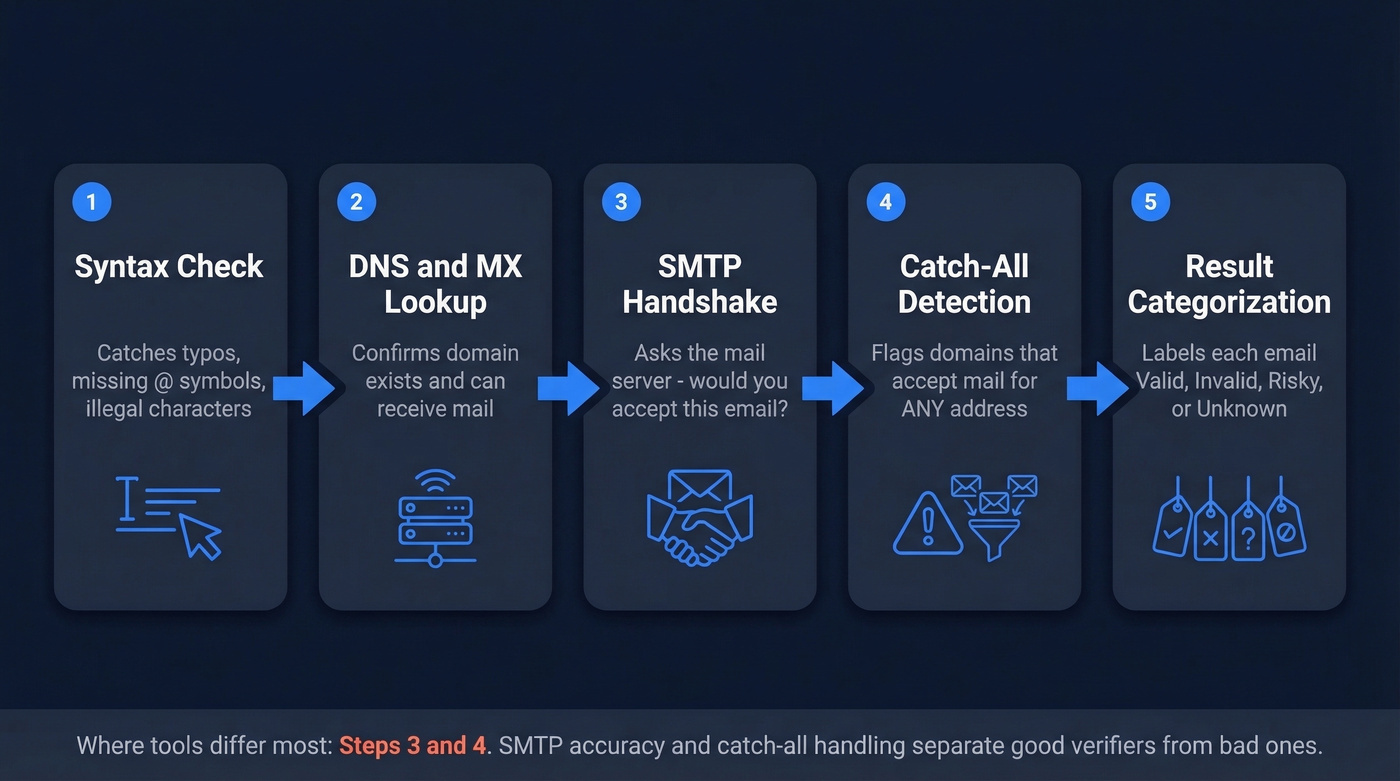
Syntax check. The tool confirms the email follows a valid format - no missing @ symbols, no illegal characters, no double dots. This catches the obvious typos.
DNS and MX lookup. It checks whether the domain exists and has mail exchange records configured. No MX record means the domain can't receive email. Dead end.
SMTP handshake. The tool connects to the mail server and asks, "Would you accept a message for this address?" without actually sending one. This is where most of the real verification happens - and where accuracy diverges between tools.
Catch-all detection. Some domains accept mail for any address, whether the specific mailbox exists or not. These are the accuracy killers. More on this later.
Result categorization. You get back labels like Valid, Invalid, Risky, or Unknown. What each tool does with "Risky" and "Unknown" - and whether they charge you for them - is where the pricing games begin.
For context on why email list cleaning matters: the average hard bounce rate across industries is 0.21%, with soft bounces averaging 0.70%. Anything above 2% signals a list hygiene problem. Google's guidance is blunt - if messages start bouncing, reduce sending volume until error rates drop. Bulk email validation prevents that spiral before it starts. For deeper bounce benchmarks and fixes, see our guide on hard bounce rate.
The Accuracy Problem Nobody Talks About
Every email verification service claims 97-99% accuracy. The actual numbers tell a different story.
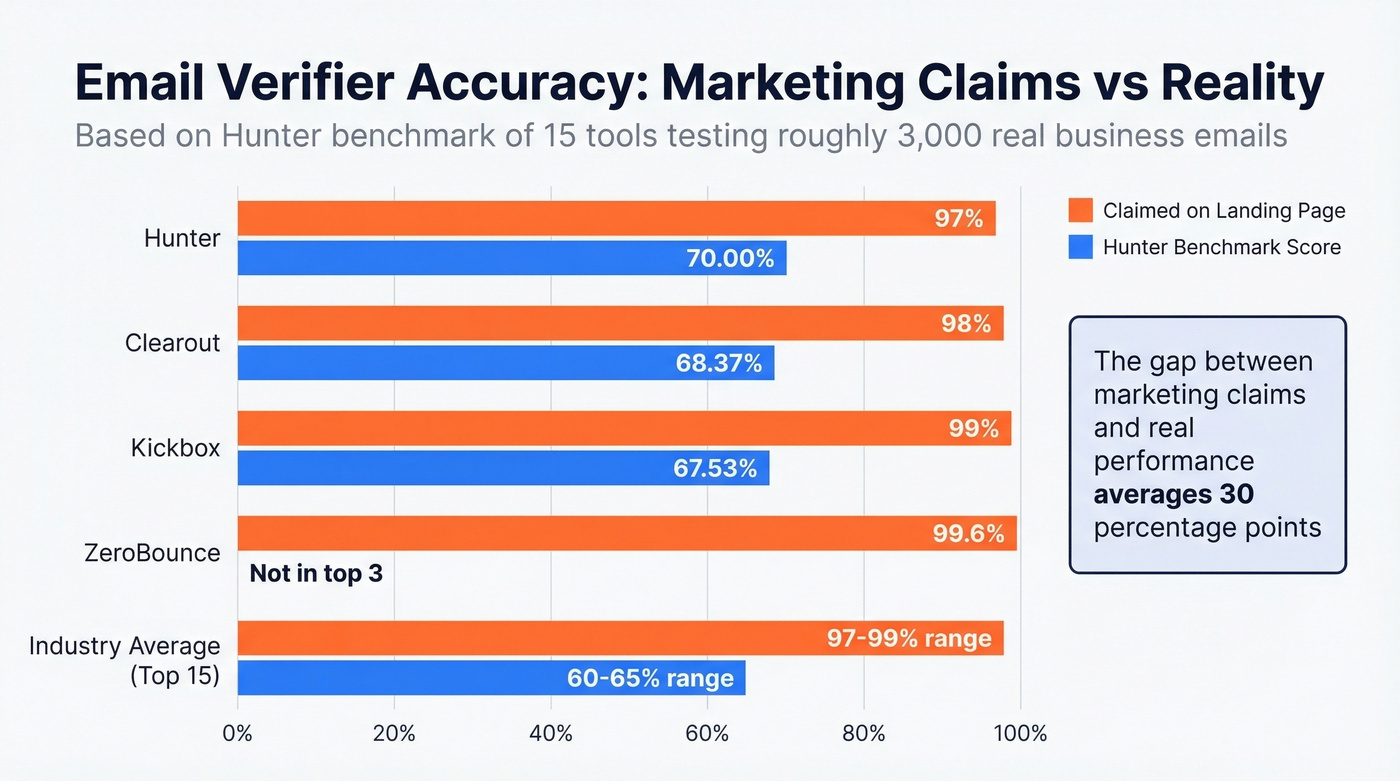
Hunter ran the most transparent benchmark we've seen - 15 tools, roughly 3,000 real business emails segmented by company size, plus 300 known-invalid addresses. Hunter itself scored highest at 70.00%. Clearout hit 68.37%. Kickbox landed at 67.53%. Hunter acknowledges methodology bias: the test dataset came from email activity on their own platform, which may have given them an edge. But even accounting for that, the gap between marketing claims and real-world performance is enormous.
Most teams don't need 99% accuracy from their verifier. They need a tool that's honest about what it can and can't verify - especially on catch-all domains - and doesn't charge them for guesses. The tools that admit uncertainty and refund accordingly outperform the ones that slap "Valid" on everything and hope you don't check. If you're building a full outreach stack, pair verification with a broader email deliverability plan.
Accuracy drops further on mid-market and enterprise domains because stricter mail server configurations make SMTP handshakes less reliable. The tool says "valid," the server says "nope." ZeroBounce claims 99.6% accuracy on its landing page but didn't crack the top three in the Hunter benchmark. Clearout advertises a 3% bounce rate guarantee, which sounds impressive until you realize the industry average hard bounce rate is 0.21%.
The 8 Best Bulk Email Checkers Compared
Prospeo
Prospeo isn't just a mass email verifier - it's a B2B data platform where verification is baked into the foundation. The database covers 300M+ professional profiles with 143M+ verified emails, all running through a multi-step verification pipeline that includes catch-all handling, spam-trap removal, and honeypot filtering. Every record refreshes on a 7-day cycle, compared to the 6-week industry average. If you're comparing data sources, start with our roundup of B2B data providers.
Think about the typical workflow: build a prospect list in one tool, export a CSV, upload it to a verifier, wait, download the cleaned file, re-import. With Prospeo, you pull already-verified contacts and push them straight to Salesforce, HubSpot, Lemlist, Instantly, Smartlead, or Clay. Two steps become one. If you're doing this inside Clay, our Clay list building workflow breaks down the real costs and steps.
Email accuracy sits at 98%, backed by proprietary email-finding infrastructure that doesn't rely on third-party providers. The free tier gives you 75 emails/month. Paid plans run about $0.01/email with no contracts and no annual commitments. One of our test clients, Stack Optimize, built to $1M ARR using Prospeo's data with deliverability consistently above 94% and bounce rates under 3% - zero domain flags across all their clients.
Use this if: You're running cold outreach and want verified emails from the start, not a cleanup tool for bad data. Outbound agencies scaling client campaigns without burning domains will get the most value here. If you need a full system, see our AI cold email outreach playbook.

The top bulk email checker in Hunter's benchmark scored 70% accuracy. Prospeo's pre-verified database delivers 98% - because every email passes a 5-step verification pipeline refreshed every 7 days, not after you upload a stale CSV.
Skip the cleanup step entirely. Start with emails that already work.
ZeroBounce
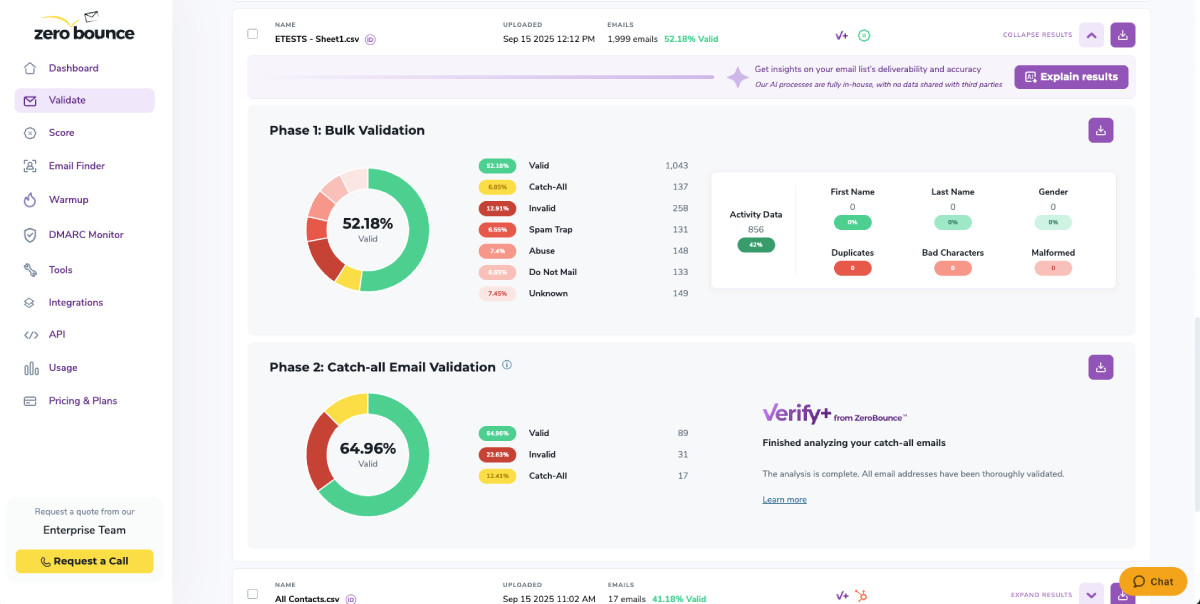
ZeroBounce is the most feature-complete deliverability platform in this list. Beyond standard verification, you get inbox placement testing (will your email land in the primary tab or spam?), email scoring, blacklist monitoring, and server health checks. It's a deliverability command center. If you're troubleshooting placement, add an email spam checker to your process.
Pricing starts at $39 for 2,000 credits ($0.0195/email), $129 for 10K credits, and drops to $0.003199/email at the million-credit tier. The ZeroBounce ONE subscription bundles 10K credits/month with all deliverability tools for $99/mo ($79/mo annually). You get 100 free monthly verifications when you sign up with a business domain, credits never expire, and unknowns aren't charged.
Why it wins: If your deliverability team needs more than a clean/dirty binary - if you need to know where emails land, which servers are flagged, and how your sender score trends over time - ZeroBounce is the only tool here that covers all of it.
Key tradeoff: You're paying a premium. At 10K emails, ZeroBounce costs $129 versus MillionVerifier's $37. That premium buys deliverability intelligence, but if you just need a list cleaner, you're overpaying.
MillionVerifier
MillionVerifier is the budget champion, and it's not even close. $37 for 10,000 verifications. At scale, 1M emails costs $389. You get 500 free credits to start.
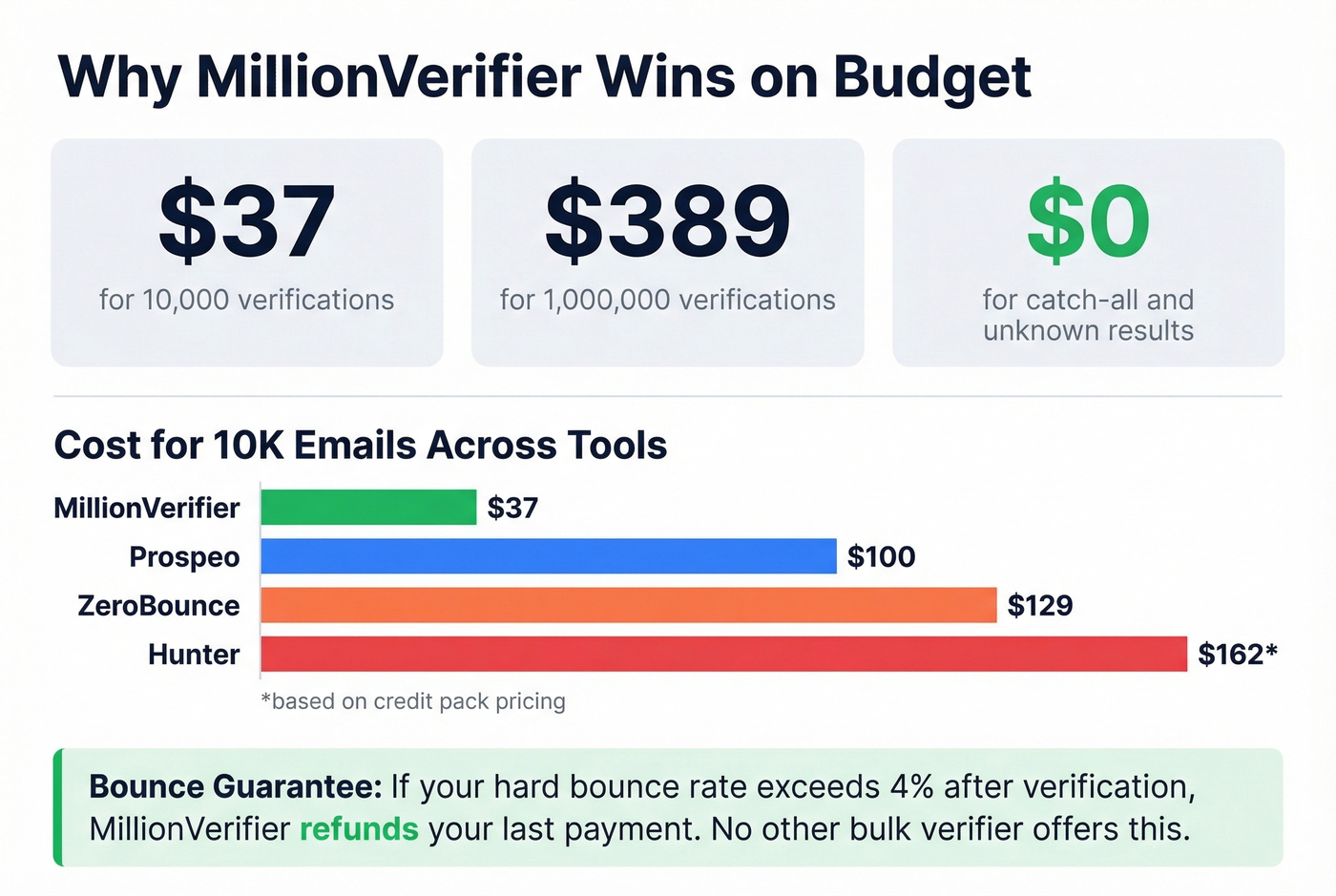
The pricing story gets better: you only pay for good and bad emails, not for risky results like unknowns and catch-alls. Bulk buyers get 1M bonus credits for every 5M purchased, plus 10% extra on auto-top-up payments. Then there's the bounce guarantee - if your hard bounce rate exceeds 4% after verification, they refund your last payment. Most "accuracy guarantees" in this space are marketing fluff. This one has teeth.
A third-party review tested 2,000 emails and got 1,609 good, 80 bad, and 69 risky (mostly catch-all). Three bounces from the "good" pile - about a 0.19% bounce rate on that subset.
Use this if: You're cleaning large marketing lists on a budget and need every dollar to stretch. The catch-all/unknown credit policy alone saves meaningful money at scale. If you're also enriching records, compare options in our data enrichment services guide.
Skip this if: You need deliverability tools beyond verification, or you're running high-stakes outbound where a single bounce can damage a warming domain.
Clearout
Clearout targets marketing teams running regular list hygiene. Its integrations are the strongest selling point - it plugs into major ESPs and CRMs, so you can automate validation workflows within your existing stack rather than exporting CSVs back and forth. You get 100 free credits to start, and unused credits roll over.
Pricing typically lands around $0.004-$0.01/email depending on volume. In the Hunter benchmark, Clearout scored 68.37% overall accuracy - second place, but still far from the 98%+ you'll see on marketing pages across this category. User feedback often praises the accuracy and API but flags the UI as dated and the learning curve as steeper than expected for advanced features.
EmailListVerify
Speed is EmailListVerify's calling card. The platform verifies more than 100K emails per hour per customer, making it a strong option for massive list cleans. You get 100 free verifications to test, and the service is pay-as-you-go with no monthly payments.
Pricing is aggressive - roughly $27 for 10K emails and $186 for 100K. In our experience, expect results closer to what independent benchmarks show across the category (high-60s overall accuracy for top performers). For marketing list hygiene where a few extra bounces won't crater your domain reputation, that's acceptable. For cold outbound to fresh prospects, pair it with a more rigorous verification step.
Hunter
Hunter is a prospecting tool that happens to include verification, not a dedicated verifier. Each verification costs 0.5 credits, which means the free plan's 50 credits get you 100 verifications per month. The Starter plan ($49/mo) includes 2,000 credits - that's 4,000 verifications.
Hunter topped its own benchmark at 70% accuracy, which is genuinely the best score in that dataset. But the per-email cost is steep compared to dedicated verifiers. A bulk pack of 200,000 verification credits runs $6,500. Compare that to MillionVerifier's pricing at the same volume and it's not even the same universe. If you're already using Hunter for email finding, the built-in verification is convenient. Subscribing just for list validation? The math doesn't work. If you're evaluating alternatives, see our Hunter alternatives breakdown.
Emailable
Fast processing - 10K emails in 2-3 minutes, 250K in about 10 minutes. You get 250 free credits, unknown results are free, and the minimum purchase is 5,000 credits. A solid middle-of-the-road option if you want speed and clean credit rules.
BulkEmailChecker
The cheapest entry point in this list: $9.95 for 10K verifications, $74.95 for 100K. You get 10 free daily verifications to test. The feature set is basic with limited integrations, but for one-off list cleans where budget is the primary constraint, it does the job.
Stack Optimize built to $1M ARR with zero domain flags across all clients - bounce rates under 3%, deliverability above 94%. That's what happens when verification is built into the data, not bolted on after the fact. At ~$0.01/email, Prospeo costs less than most bulk checkers and eliminates the upload-wait-download cycle.
Stop paying to verify emails that should have been accurate from the start.
Pricing at a Glance
We dug up pricing that most of these tools hide behind broken calculators and "Loading..." spinners.
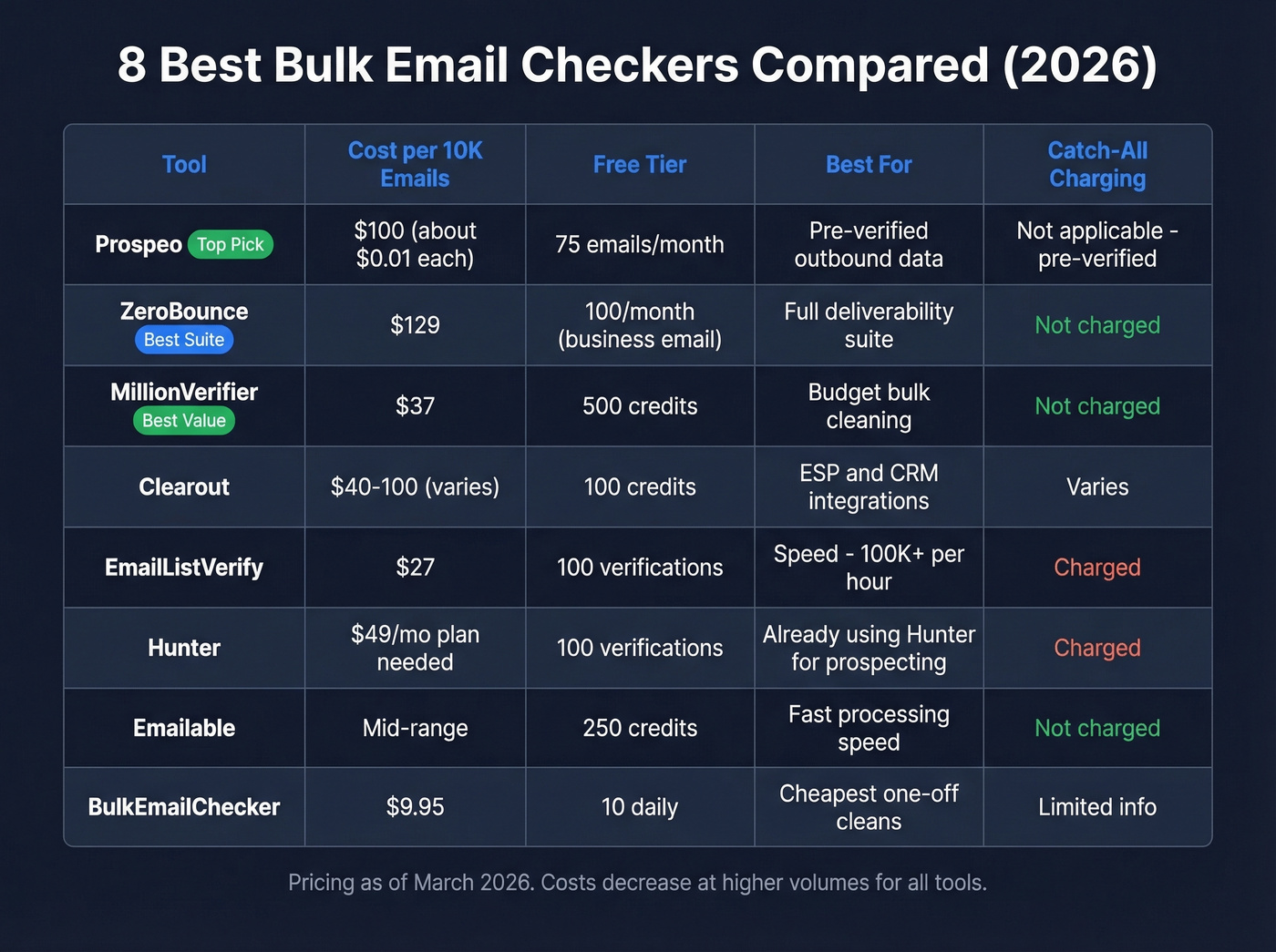
| Tool | Free Tier | 10K Price | 100K Price |
|---|---|---|---|
| ZeroBounce | 100/mo | $129 | $649 |
| MillionVerifier | 500 | $37 | ~$200 |
| Clearout | 100 | ~$40-$100 | ~$400-$1,000 |
| EmailListVerify | 100 | ~$27 | ~$186 |
| Hunter | 100 verifs/mo | $49/mo plan | $6,500 (bulk) |
| Emailable | 250 | ~$30-$80 | ~$300-$800 |
| BulkEmailChecker | 10/day | $9.95 | $74.95 |
Three takeaways. MillionVerifier is the cheapest at scale by a wide margin - and they don't charge credits for catch-all and unknown results on top of it. Prospeo offers the best value when you factor in that you're getting email finding and verification combined, not just a list cleaner. ZeroBounce is the most expensive per-email, but you're buying an entire deliverability platform.
How to Choose the Right Tool
The "best" tool depends entirely on what you're doing with the emails afterward.
Cold outreach and sales prospecting. Your domain reputation is on the line with every send. You need the highest possible accuracy and fresh data. Prospeo is the clear pick - pre-verified contacts on a 7-day refresh cycle mean you're starting clean. ZeroBounce is the runner-up if you also need inbox placement testing. If you're scaling sequences, use a B2B cold email sequence that matches your sending limits.
Marketing list hygiene. You've got an existing database that needs regular cleaning. Clearout's ESP/CRM integrations make this painless, and Emailable's speed handles large lists quickly. Marketing sends are more forgiving than cold outbound, so mid-tier accuracy is acceptable here.
High-volume budget cleaning. You're processing hundreds of thousands of emails and every penny matters. MillionVerifier at $37/10K with catch-all/unknown credit rules, or EmailListVerify at ~$27/10K for raw speed.
One-off list clean on a shoestring. BulkEmailChecker at $9.95/10K. Basic, no frills, gets the job done.
Catch-All Domains: The Hidden Killer
You uploaded 50,000 contacts, ran them through verification, got back 98% valid. You launched the campaign. Bounce rate: 5%.
What happened? Catch-all domains. These are mail servers configured to accept messages sent to any address at that domain, whether the specific mailbox exists or not. Your verifier pings the server, the server says "sure, send it over," and the tool marks it valid. But the actual person behind that address left the company two years ago.
This is the single biggest gap in email verification, and the consensus on r/coldemail is that catch-all handling separates the serious tools from the pretenders. The standard approach is to label catch-all results as "Risky" or "Accept-All" and leave you to decide. That's not helpful. If you suspect traps, follow a dedicated spam trap removal process.
MillionVerifier takes the fairest approach for budget-conscious teams - they don't charge credits for catch-all results, so you're not paying for data the tool can't verify. Prospeo's 5-step pipeline handles catch-alls upstream by combining SMTP checks with spam-trap removal and honeypot filtering before a record ever enters the database.
How Often Should You Verify?
Nearly 21% of emails in an unverified list are invalid. Job changes, company closures, domain migrations - the reasons pile up fast. Leave a list untouched for six months and you're looking at a deliverability crisis.
The minimum cadence is quarterly. Before every major campaign is better. If you're running ongoing outbound sequences, continuous verification - either through a tool with a refresh cycle or by re-verifying before each send - is the only way to keep bounce rates under control. If you're also managing sending limits, see our guide to email velocity.
There's a cost angle too. Klaviyo shifted billing to active profiles, which means every invalid email in your database costs you money even when you're not sending to it. Email list cleaning can reduce ESP costs by up to 25% while improving open rates by around 20%. The verification fee pays for itself in lower platform bills alone.
Bulk Email Checker FAQ
What's the difference between email verification and validation?
Same process, different names. Both check whether an email address exists and can receive mail. "Verification" is more common in B2B sales, "validation" in marketing. The technical pipeline - syntax, DNS, and SMTP checks - is identical regardless of the label.
Are free tiers accurate enough for real campaigns?
For small lists under 500 emails, free tiers work fine. Prospeo's free plan (75 emails/month) includes full 5-step verification. For production-scale campaigns above 1,000 contacts, pay for a dedicated tool - the cost of a bounced campaign far exceeds a few dollars in verification fees.
How long does bulk verification take?
Most tools process 10,000 emails in 2-10 minutes. EmailListVerify handles 100K+ per hour. Emailable processes 250K in about 10 minutes. No modern tool should take more than an hour for a 100K list.
What's a good email bounce rate?
The average hard bounce rate is 0.21% across industries. Anything above 2% signals a list hygiene problem. Software companies average 1.04% - the highest of any industry. Verify before every major send.
Can I verify catch-all emails?
Not reliably. Catch-all domains accept all incoming mail regardless of whether the specific address exists. No tool can guarantee a specific mailbox exists behind a catch-all server, but tools with multi-step pipelines that include spam-trap and honeypot filtering catch more of the bad ones before they reach your list.