

The Practitioner's Guide to MEDDPICC Sales: Beyond the Acronym
The average SaaS win rate sits around 19%. Four out of five deals die. The biggest killer isn't a competitor - it's the buyer doing nothing. Ebsta and Pavilion's research found that 61% of lost deals come from buyer indecision, not a lost bake-off.
That's the gap the MEDDPICC sales framework exists to close. Not by giving reps a script, but by giving them a system for figuring out whether a deal is real - and what's missing before it stalls. Top-performing reps are 588% more likely to follow a structured qualification methodology, and teams that enforce structured qualification with coaching and CRM stage gates typically improve win rates by 10-25% while shortening sales cycles by around 26%. The framework works. The problem is how most teams implement it.
The Quick Decision Tree
Before you read further:
- Use MEDDPICC if you're selling $50K+ ACV deals with 4+ stakeholders and 3+ month cycles. That's where the framework earns its overhead.
- Use BANT for transactional deals with short cycles and a single decision-maker. Don't overcomplicate a $5K deal.
- Use SPICED for consultative, change-heavy sales where the buyer's situation matters more than their budget line.
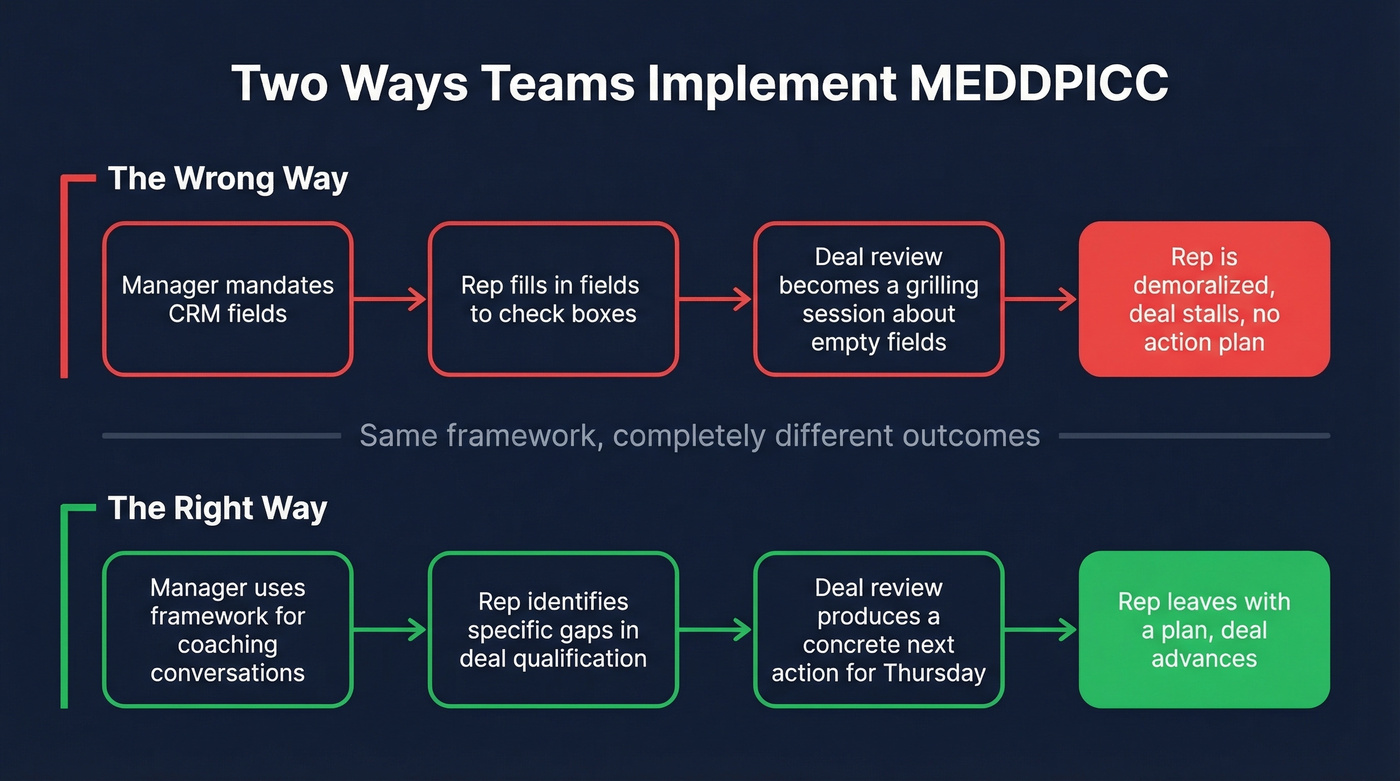
MEDDPICC works when managers use it for coaching, not compliance. It fails when it becomes a CRM checkbox exercise. If your deal reviews end with "fill in the Champion field" instead of "here's what we're doing Thursday to advance this deal," you're doing it wrong.
What Is the MEDDPICC Framework?
MEDDPICC stands for Metrics, Economic Buyer, Decision Criteria, Decision Process, Paper Process, Implicate Pain, Champion, and Competition. It's a deal qualification and inspection framework - not a sales methodology. That distinction matters: MEDDPICC tells you what's missing from a deal, not how to sell. You'll sometimes see the acronym spelled as MEDPICC or MEDDPPICC in various sales communities, but they all refer to the same core framework with minor variations in emphasis.
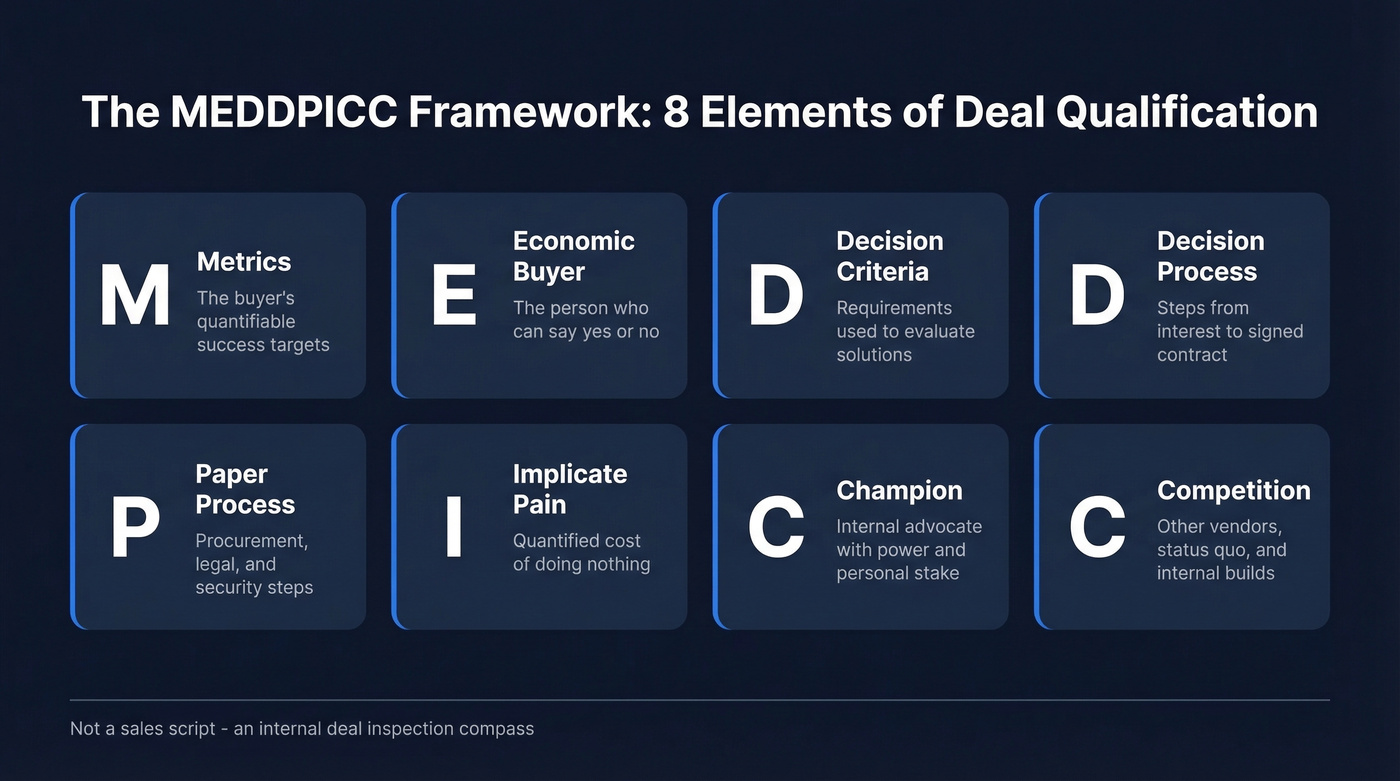
Dick Dunkel created the framework in 1996 at PTC, with John McMahon supporting it and Jack Napoli driving adoption. The original MEDDIC had six elements. It helped PTC grow from $300M to $1B in revenue over four years - a figure repeated across the industry, though it's more lore than audited fact. Over time, practitioners added Paper Process to catch procurement and legal stalls, and Competition, evolving it into MEDDPICC. Some teams have even extended it further to MEDDPICCR, appending "Risks" as a ninth element to flag deal-specific threats during late-stage reviews.
73% of SaaS companies selling above $100K ARR use some version of it today. The question isn't whether to adopt it - it's whether you're using it well.
The Eight Elements Explained
Your buyer should never hear the word "MEDDPICC." It's an internal compass - a way to assess deal health and figure out what's missing. The best reps run the framework while having completely natural conversations. The buyer thinks they're talking to someone who deeply understands their business. The rep knows they're systematically filling gaps.
Metrics
Your ROI calculator isn't Metrics. Their KPIs are. Metrics are the quantifiable outcomes your buyer needs to achieve - their MBOs, their board-level targets. Personal success measures can be even more powerful than business metrics.
Ask: "What does success look like 12 months after implementation - in numbers your CFO would care about?" and "What KPIs on your personal review would this project impact?"
You're in good shape when you can articulate the buyer's target metrics better than they can, tied to specific dollar amounts. (If you want to go deeper on quantifying outcomes, see MEDDPICC Metrics.)
Economic Buyer
The Economic Buyer can say yes when everyone else says no - and no when everyone else says yes. They control the budget and they're often absent from your day-to-day conversations, which is exactly the problem.
Ask: "Who ultimately signs off on a purchase of this size?" and "If your team recommends us, who else needs to approve?"
You're in good shape when you've had direct communication with the EB and know their priorities.
Decision Criteria
Decision Criteria are the specific requirements the buyer will use to evaluate solutions - technical requirements, business outcomes, integration needs, compliance boxes. You need to know these, and ideally you've helped shape them.
Ask: "What are the three non-negotiable requirements for any solution you'd consider?" and "How are you weighting technical fit versus business impact?"
You're in good shape when you have a written list of their criteria and your solution maps to the top priorities.
Decision Process
Decision Process maps the steps between "we like this" and "signed contract." Who's involved at each stage? What are the approval gates?
Ask: "Walk me through what happened the last time your team bought software at this price point" and "Between a verbal yes and a signed contract, what needs to happen internally?"
You're in good shape when you have a documented timeline with named stakeholders at each stage.
Paper Process
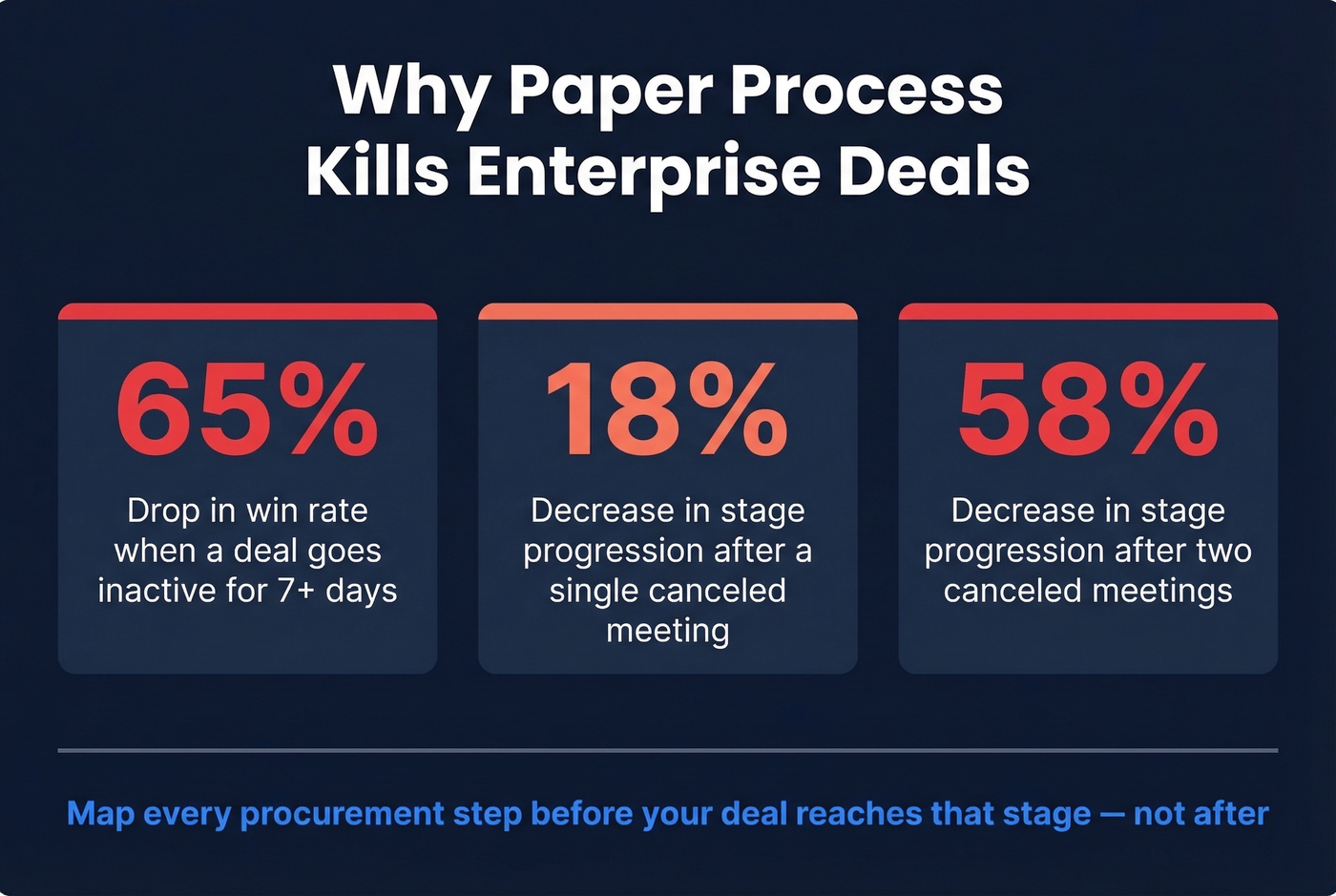
Here's a stat that should scare you: deals with more than 7 days of inactivity see win rates drop 65%. A single canceled meeting reduces stage progression by 18%. Two cancellations? That's -58%. Paper Process - procurement, legal review, security questionnaires, vendor onboarding - is where enterprise deals go to die.
Ask: "What does your procurement process look like, and how long did it take on your last purchase of this size?"
You're in good shape when you've mapped every procurement step before the deal reaches that stage. Don't scramble for a SOC 2 report at the finish line.
Implicate Pain
Picture this: your champion tells you the problem is "important." But when you ask what happens if they don't solve it by Q3, they shrug. That deal is dead - they just don't know it yet.
Implicate Pain goes beyond identifying the problem. You identify it, quantify it, then elevate the urgency - what happens if they don't act? (For more examples you can adapt, see pain point examples.)
Ask: "What's the cost of doing nothing for another quarter - in revenue, headcount, or competitive position?" and "How does this problem affect you personally?"
You're in good shape when the buyer can articulate why this needs to happen now, not next quarter.
Champion
A Champion isn't someone who likes you. A Champion has power inside the organization, is actively selling on your behalf, and has a personal stake in your success.
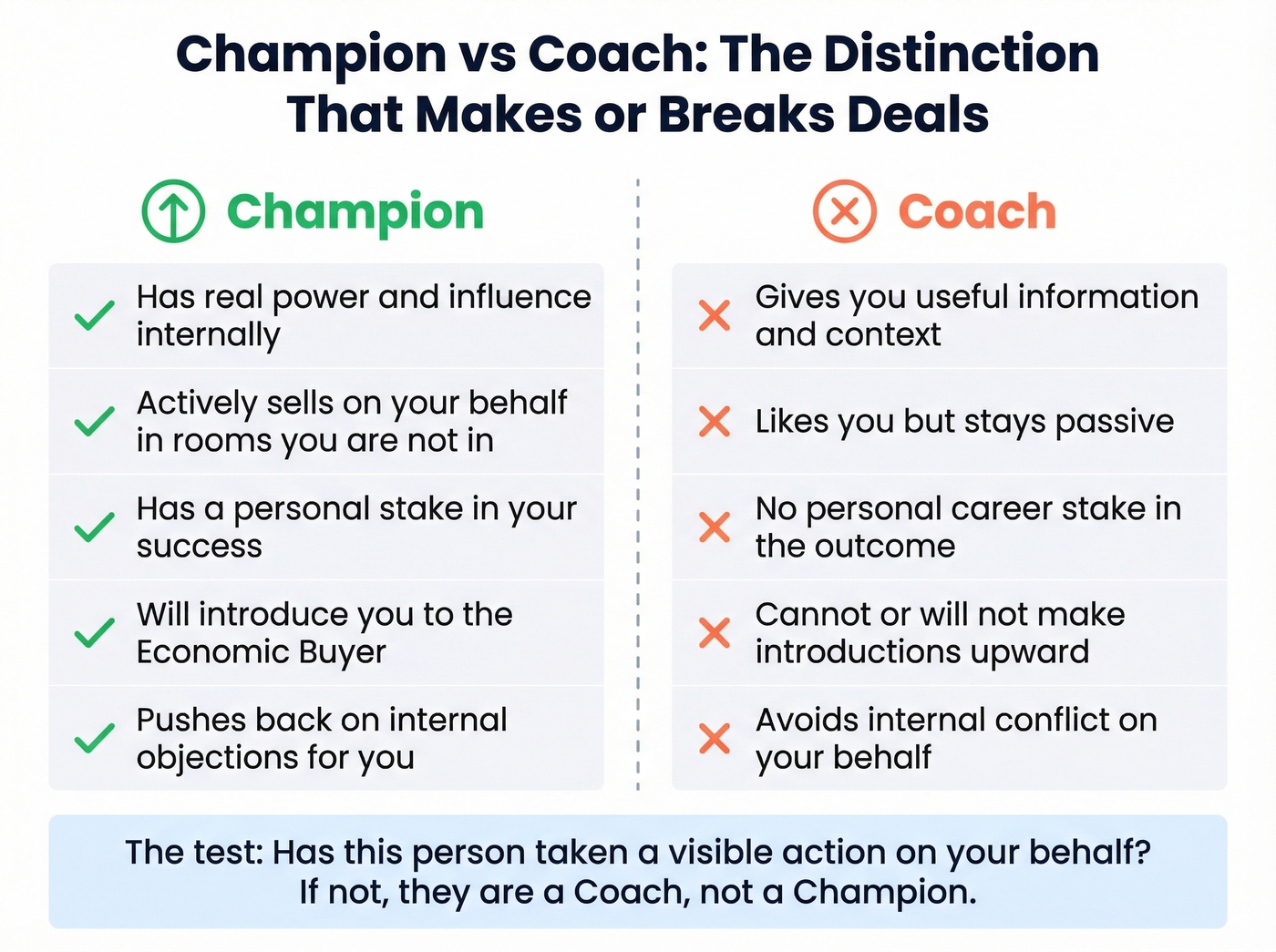
Here's the thing: the distinction between a Champion and a Coach is where most reps get it wrong. A Coach gives you information. A Champion puts their reputation on the line. If your "Champion" won't introduce you to the Economic Buyer or push back on internal objections, they're a Coach. We've seen reps ride a "Champion" relationship for months only to discover the person had zero internal influence - just enthusiasm and a calendar invite.
Ask: "If this decision came down to an internal debate, who would advocate for us - and why would they stick their neck out?"
You're in good shape when your Champion has taken a visible action on your behalf - scheduled a meeting with the EB, circulated your proposal, or pushed back on a competing option. Multi-threading across a buying committee means reaching stakeholders directly, not waiting on your Champion to make every introduction. (More on identifying and enabling one: sales champion.)
Competition
Competition isn't just other vendors - it's the status quo, internal builds, and doing nothing. Most deals lost to "no decision" are really lost to the status quo, which makes it the most dangerous competitor you'll face.
Rather than asking generic questions, get specific: "Who else are you evaluating, and what do you like about their approach?" and "Is there an internal option on the table - building this yourselves or extending an existing tool?" You're in good shape when you've armed your Champion with differentiation talking points against each alternative.
MEDDPICC vs Other Frameworks
There's a popular take on Reddit that all sales methodologies are basically the same - they all boil down to need, budget, stakeholders, and timeline. There's truth in that. But it's like saying all programming languages are the same because they all compile to machine code. The abstraction layer matters.
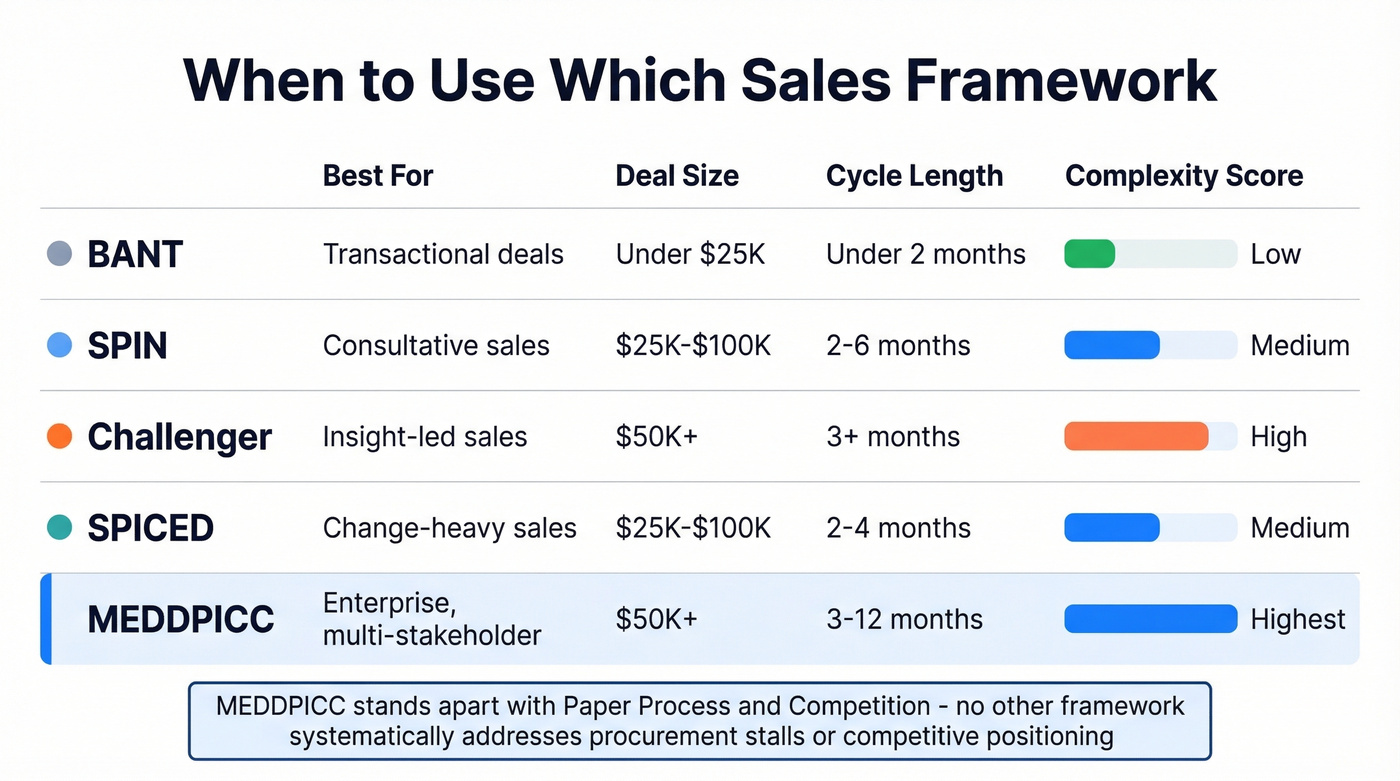
| Framework | Best For | Deal Size | Key Strength | Key Weakness |
|---|---|---|---|---|
| BANT | Transactional, <2mo | <$25K | Speed, simplicity | Misses complexity |
| SPIN | Consultative, 2-6mo | $25K-$100K | Pain discovery | Weak on process |
| Challenger | Insight-led, 3mo+ | $50K+ | Teaching buyers | Hard to coach |
| SPICED | Change-heavy, 2-4mo | $25K-$100K | Situation depth | Less structured |
| MEDDPICC | Enterprise, 3-12mo | $50K+ | Full deal map | Overhead |
Where MEDDPICC genuinely separates itself: Paper Process and Competition. No other framework systematically addresses procurement stalls or competitive positioning as core qualification elements. For a $200K deal with 7 stakeholders and a 6-month cycle, that's not overhead - it's survival.
A practical hybrid: Use BANT as a quick screen on inbound, then shift to MEDDPICC depth once a deal qualifies as enterprise. Don't force an 8-element framework on a deal that'll close in two calls.

MEDDPICC only works when you're talking to the right Economic Buyers. Prospeo's 300M+ profiles with 30+ filters - including buyer intent, job changes, and department headcount - let you find and verify decision-makers before your first call. 98% email accuracy means your outreach actually lands.
Stop qualifying dead deals. Start with verified decision-makers.
Why Reps Hate It (and How to Fix It)
The #1 complaint about MEDDPICC on r/sales is that it's a CRM exercise disguised as a sales methodology. Reps fill out fields to make managers happy. Managers check boxes to survive pipeline reviews. Nobody actually uses it to decide the state of a deal.
That's not a framework problem - it's an implementation problem.
The CRM Checkbox Problem
When MEDDPICC becomes mandatory CRM fields with no coaching attached, reps treat it like busywork. They write "VP of Engineering" in the Champion field and move on. The field is filled. The box is checked. The deal is no closer to closing. (If this sounds familiar, use this as a rollout reference: How to Implement MEDDIC Without Turning It Into Paperwork.)
Diagnostic Without Developmental
SBI's research nails the core issue: MEDDPICC is diagnostic, not developmental. It tells you what's missing but doesn't tell you what to do about it. When deal reviews become grilling sessions about gaps and empty CRM fields, sellers leave demoralized with no plan to advance the deal. That's compliance theater, not coaching.
Let's be honest - definitions won't teach you this. The hard part isn't knowing what a Champion is. It's figuring out that the person you thought was your Champion is actually a Coach who'll never go to bat for you internally. That realization only comes from experience and good coaching.
How to Fix It
Every deal review must end with a documented action plan: specific seller actions, specific customer commitments, and specific dates. Not "follow up with the EB" - "Send the ROI summary to Sarah Chen by Thursday; she'll circulate to the CFO before the Monday budget meeting." That's the difference between inspection and coaching. (If you need a template, start with a sales action plan.)
How to Implement MEDDPICC in Your Org
Rolling out this framework isn't a training event - it's an operating system change.
CRM Setup (HubSpot)
If you're on HubSpot, here's the operational setup that enforces the framework without turning it into a data-entry nightmare:
- Create association labels for buyer roles like Economic Buyer, Champion, Coach, and Technical Evaluator on contact-to-deal associations.
- Create corresponding deal checkbox properties such as "Economic Buyer Identified" and "Champion Confirmed," then set them to view-only.
- Build a deal workflow that checks associated contact roles and automatically sets the deal property.
- Make those deal properties mandatory for stage movement - reps can't advance a deal to "Proposal" without a confirmed Economic Buyer.
One caveat: making deal properties view-only requires at least one Enterprise subscription in HubSpot. On Professional, you'll need a workaround. (Related: HubSpot pipeline management.)
Tracking with Conversation Intelligence
Beyond CRM fields, teams increasingly use conversation intelligence platforms like Gong to automate MEDDPICC tracking. These tools analyze call recordings and flag which framework elements were discussed - and which were missed - so managers can coach from real conversations instead of self-reported CRM data. In our experience, this is where the framework starts to actually change behavior: when reps can hear themselves skipping Implicate Pain on three consecutive calls, the gap becomes undeniable. (If you want to tighten coaching, see discovery call coaching.)
Deal Scorecard Template
Translate generic checks into specific inspection points for your business. The Brevet Group's approach is the right one:
- Instead of "identify metrics," require a 3-year TCO comparison showing your solution vs. status quo.
- Instead of "have a champion," name a specific role and document what they've done on your behalf.
- Instead of "map paper process," confirm InfoSec requirements and legal review timelines before engaging procurement.
Score each element 0-3: unknown, identified, validated, confirmed with evidence. Any deal with a 0 on Economic Buyer or Champion shouldn't be in your commit forecast. Period. (To align this with your stages, use CRM deal stages.)
The Data Foundation
MEDDPICC tells you who to reach. But the framework falls apart if you can't actually contact the stakeholders you've identified. CRM data decays fast as people change roles and companies.
When you've mapped a 7-person buying committee, you need verified contact data for every stakeholder - not just the one person who took your first call. Multi-threading into a buying committee isn't optional in enterprise sales, and it requires accurate data for every person on the org chart. Prospeo finds verified emails at 98% accuracy across 300M+ professional profiles, plus direct dials from 125M+ verified mobile numbers, with a 7-day refresh cycle that keeps data current between deal reviews. (More on sourcing and QA: verified mobile numbers.)
Your Champion field is empty because you never reached the right person. Prospeo gives you 125M+ verified mobile numbers with a 30% pickup rate - so you can get direct access to the stakeholders MEDDPICC demands. At $0.01 per email, pipeline coverage costs less than a single lost deal.
Reach Champions and Economic Buyers directly - not their gatekeepers.
Deal Review Questions for Managers
It's Thursday afternoon. Your rep says the deal is "looking good." You ask about Paper Process. Silence. Turns out legal hasn't seen the contract, procurement needs a vendor onboarding form nobody mentioned, and the deal that was "closing this month" just slipped to next quarter.
Here's what to ask so that doesn't happen:
Metrics: "Show me the buyer's target numbers - not ours, theirs."
Economic Buyer: "Have you spoken directly with the EB? What's their top priority this quarter?"
Decision Criteria: "What are their top three requirements, ranked? Where are we weak?"
Decision Process: "Map the steps from today to signed contract."
Paper Process: "When's the last time something moved on procurement? If it's been more than 7 days, what's the blocker?"
Champion: "What has your Champion done for us this week - not said, done?"
Competition: "Who else is in the deal? What's their strongest argument against us?"
If a rep can't answer three or more of these, the deal isn't at the stage they think it is. End every review with the next three actions, who owns them, and when they'll happen.
Is MEDDPICC Certification Worth It?
The MEDDIC Academy is the registered trademark holder and the only provider of official MEDDPICC certification.
| Course | Price | Best For |
|---|---|---|
| Intro to MEDDPICC | Free | Everyone - start here |
| Full MEDDPICC | $297 | Individual reps |
| Advanced MEDDPICC | $597 | Experienced sellers |
| MEDDPICC for Managers | $1,173 | Front-line leaders |
| MEDDPICC for Trainers | $3,970 | Enablement teams |
| Infinite Sales Leadership | $1,970 | Sales leaders |
The free intro is a no-brainer starting point. We'd recommend the $297 Full MEDDPICC course as the best value for individual reps who want structured learning beyond blog posts. The $1,173 Managers course is solid if your org is serious about coaching cadence.
The $3,970 Trainers certification? Skip it unless you're a large enablement team that needs the official branding. This is a framework invented in 1996 and shared freely for decades across thousands of blog posts, books, and conference talks. Paying nearly $4K for the right to teach it internally feels like a tax on formality. For most teams, the $297 course plus internal coaching will get you 90% of the way there.
Hot take: MEDDPICC is the best enterprise qualification framework available. But if your average deal is under $30K and closes in six weeks, you're paying a complexity tax for zero return. The framework's value scales with deal complexity. Below a certain threshold, it's just bureaucracy with an acronym.
FAQ
What does MEDDPICC stand for?
Metrics, Economic Buyer, Decision Criteria, Decision Process, Paper Process, Implicate Pain, Champion, and Competition. It's a deal qualification framework for complex B2B sales - it tells you what's missing from a deal, not how to sell.
What's the difference between MEDDIC, MEDPICC, and MEDDPICC?
MEDDPICC adds Paper Process and Competition to the original six MEDDIC elements. MEDPICC drops one D as shorthand. Some organizations append a third C for "Close Plan." These additions address the most common ways enterprise deals die late - procurement stalls and competitive displacement.
Is MEDDPICC a sales methodology?
No - it's a qualification and inspection framework that diagnoses deal gaps. Pair it with an execution methodology like Challenger, SPIN, or Sandler to actually advance opportunities through those gaps.
When is MEDDPICC overkill?
For deals under $50K ACV with fewer than 4 stakeholders and cycles under 3 months, the overhead outweighs the benefit. Use BANT for transactional deals or SPICED for consultative mid-market sales instead.
How do you find contact data for a mapped buying committee?
Use a B2B data platform with verified emails and direct dials for every stakeholder. A 7-day data refresh cycle keeps contact info current so the buying committee you mapped last week is still reachable this week.