

30+ Pain Point Examples That Actually Help (With Data and Frameworks)
A SaaS founder on Reddit put it bluntly: it's "really hard to find" real customer problems, especially when "you don't know who the customer is." Over on r/sales, reps complain that the scripts they get are "way too generic" to understand a prospect's world. Both are right. Most pain point lists recycle the same vague categories - "financial," "productivity" - without giving you anything specific enough to use in a pitch, a product brief, or a strategy deck.
Every example below comes with context. The frameworks at the end show you how to find and prioritize the problems that actually move revenue.
What Is a Pain Point?
A pain point is a specific, recurring problem that costs a customer time, money, trust, or sanity. The real value isn't in defining the term. It's in getting specific enough that someone reads your example and thinks, "that's exactly my problem."
Why Unresolved Pain Points Cost Real Money
Unresolved customer frustrations aren't just annoying - they're a direct line item on your P&L.
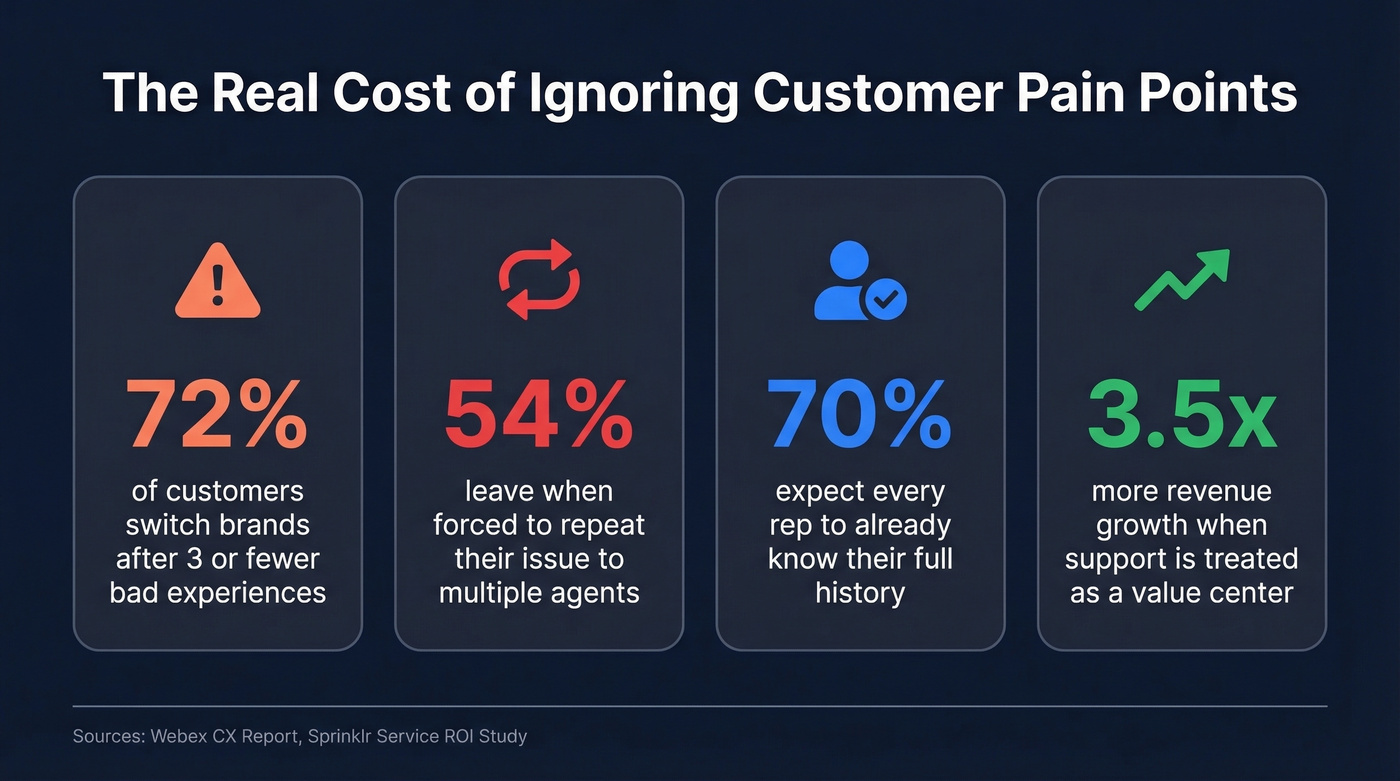
72% of customers switch brands after three or fewer poor experiences. 54% leave when they have to repeat their issue to multiple agents - a problem that's entirely solvable with better tooling. And 70% expect every company rep to already have the same information about them, which almost never happens.
On the revenue side, companies that treat customer service as a value center achieve 3.5x more revenue growth while increasing service spending by just 50 basis points of revenue. In ecommerce, 70% of shopping carts are abandoned before checkout. Every hidden fee, every forced account creation, every surprise shipping cost at the final step converts directly into lost revenue.
Types of Pain Points
The standard framework breaks customer frustrations into four buckets:
| Category | Core Question | Example | Fix Difficulty |
|---|---|---|---|
| Financial | "Am I overpaying?" | Hidden fees, unclear ROI | Low-Medium |
| Productivity | "Why is this so slow?" | Manual data entry, tool sprawl | Medium |
| Process | "Why is this so hard?" | Complex checkout, approval chains | Medium-High |
| Support | "Why can't I get help?" | Hold times, repeating issues | High |
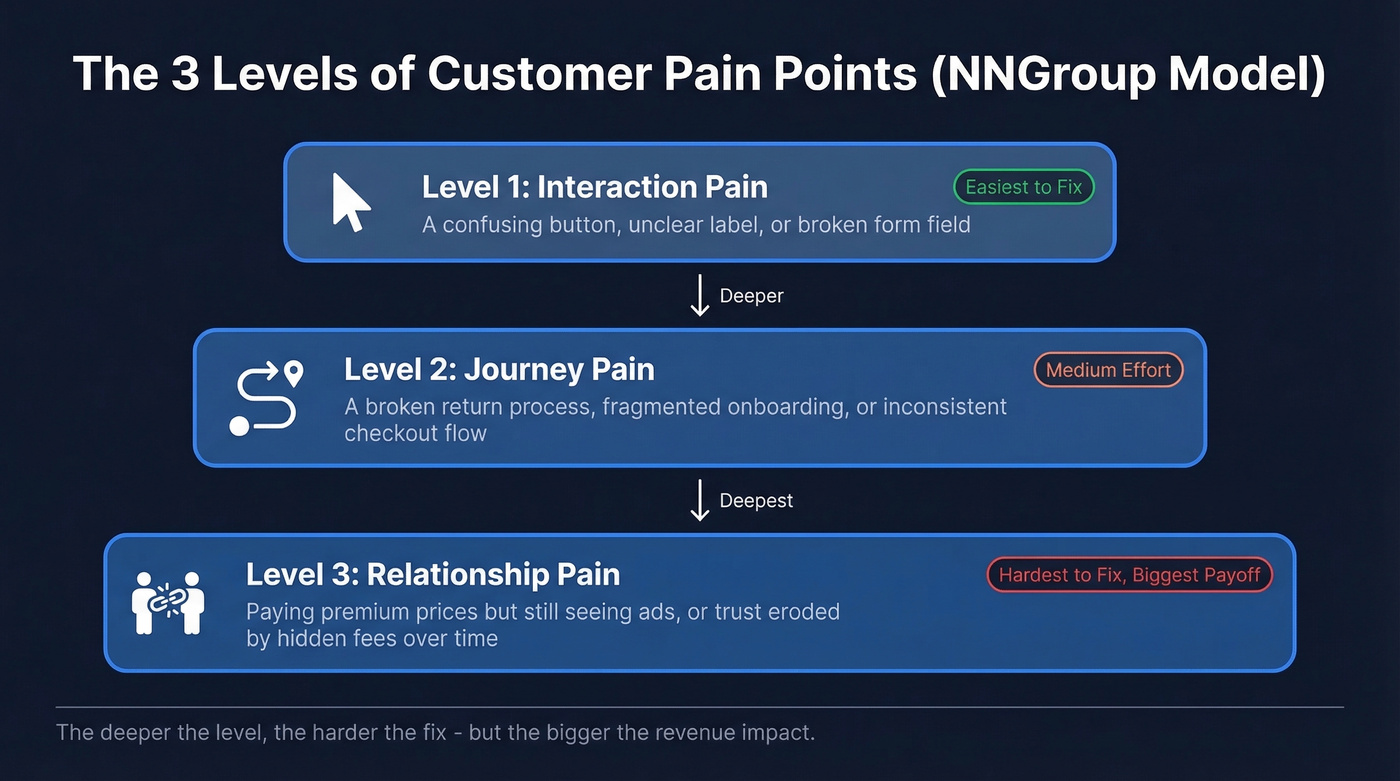
That's useful for organizing a brainstorm. But NNGroup's three-level model is more actionable for actually fixing things - and it's the framework we'd recommend over the standard four-category approach every time. They distinguish between interaction-level pain like a confusing button, journey-level pain like a broken return process, and relationship-level pain like paying for premium service while still seeing ads. The deeper the level, the harder the fix, but the bigger the payoff.
One more distinction worth internalizing: not all friction is bad. Fraud verification steps are helpful friction. Hiding shipping costs until the final checkout step is harmful friction. The difference matters when you're deciding what to fix.
30+ Examples by Category
Financial Pain Points
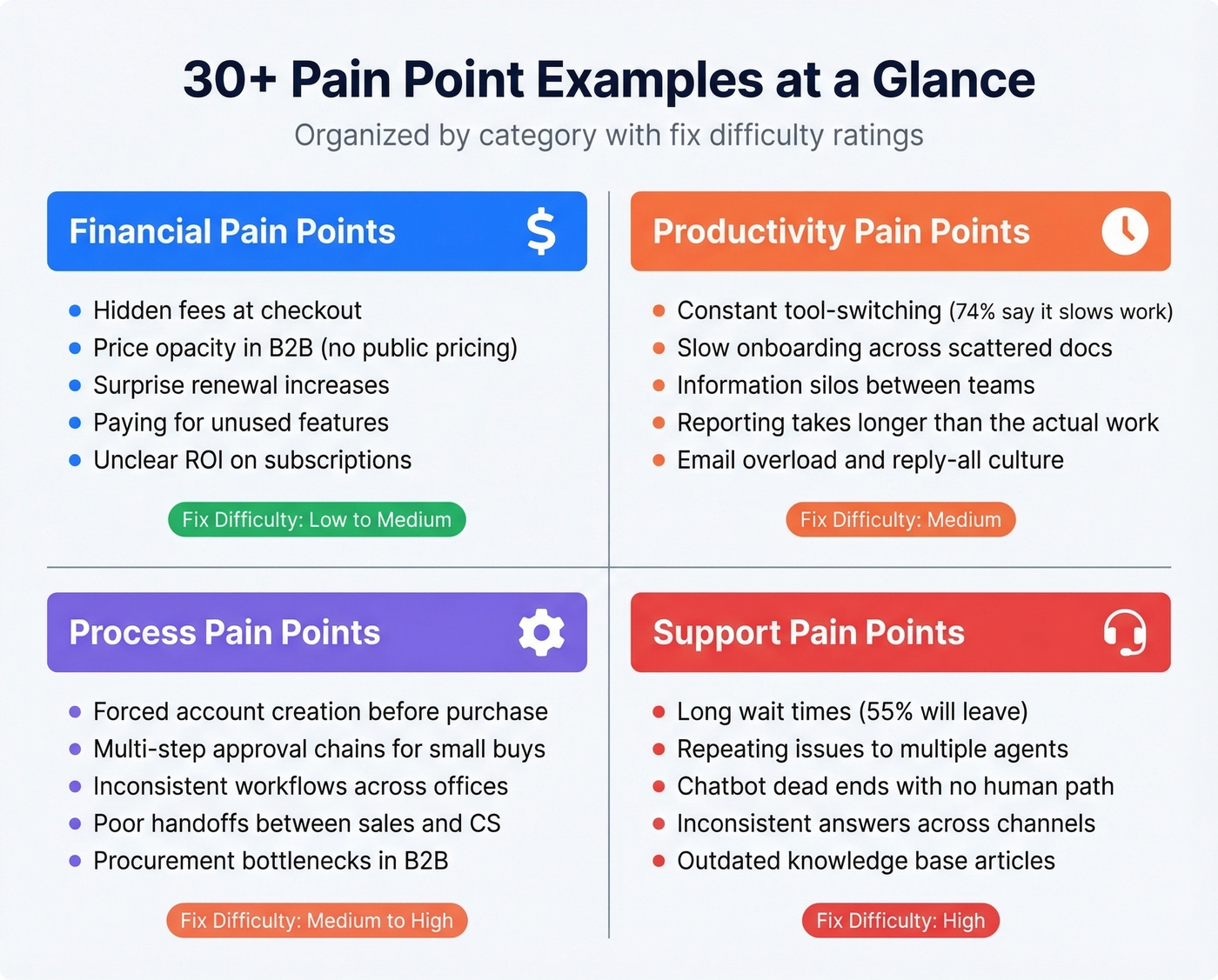
The most common financial pain points cluster around transparency and value perception. Hidden fees revealed at checkout - that surprise $4.99 "service fee" - are the most universal. Price opacity in B2B is nearly as bad: buyers can't get a quote without sitting through a demo call, which is why publishing pricing tiers (or at least ranges) is a competitive advantage. Unexpected renewal increases, where an annual contract jumps significantly with no warning, destroy trust faster than almost anything else.
Then there are the quieter financial drains that bleed money slowly:
- Unclear ROI on software subscriptions - team pays $2,000/mo for a tool nobody can prove is generating pipeline
- Paying for unused features - most sales teams pay for capabilities they never activate; modular pricing fixes this
- Currency conversion surprises - international buyers get charged more than the listed price without warning
- Chargeback costs from poor CX - returns and disputes eat margin because root causes like wrong items and late delivery aren't addressed upstream
Productivity Pain Points
Here's a useful test: if you can describe a productivity pain point and someone immediately says "yes, that's my Tuesday," you've nailed it.
The tool-switching tax is real. 74% of CRM leaders say constant tool-switching slows ticket resolution. Reps toggle between their CRM, email, Slack, a dialer, and a note-taking app - and every switch costs seconds of context recovery that compound across a full team into hours of lost productivity daily.
Other productivity frustrations that show up in almost every organization:
- Slow onboarding - new reps take weeks to ramp because documentation is scattered across five platforms (a common issue in sales onboarding)
- Information silos - marketing doesn't know what sales promised, and sales doesn't know what support escalated
- Reporting that takes longer than the work - building a weekly dashboard takes hours when it should take minutes
- Searching for the right document - employees waste a significant chunk of their week hunting for internal information
- Email overload - async tools with clear escalation paths beat the "reply-all" culture every time
Process Pain Points
Before: A customer wants to return a product. They email support, wait days for a response, get a PDF form to fill out, print a shipping label, mail the item, then wait weeks for a refund.
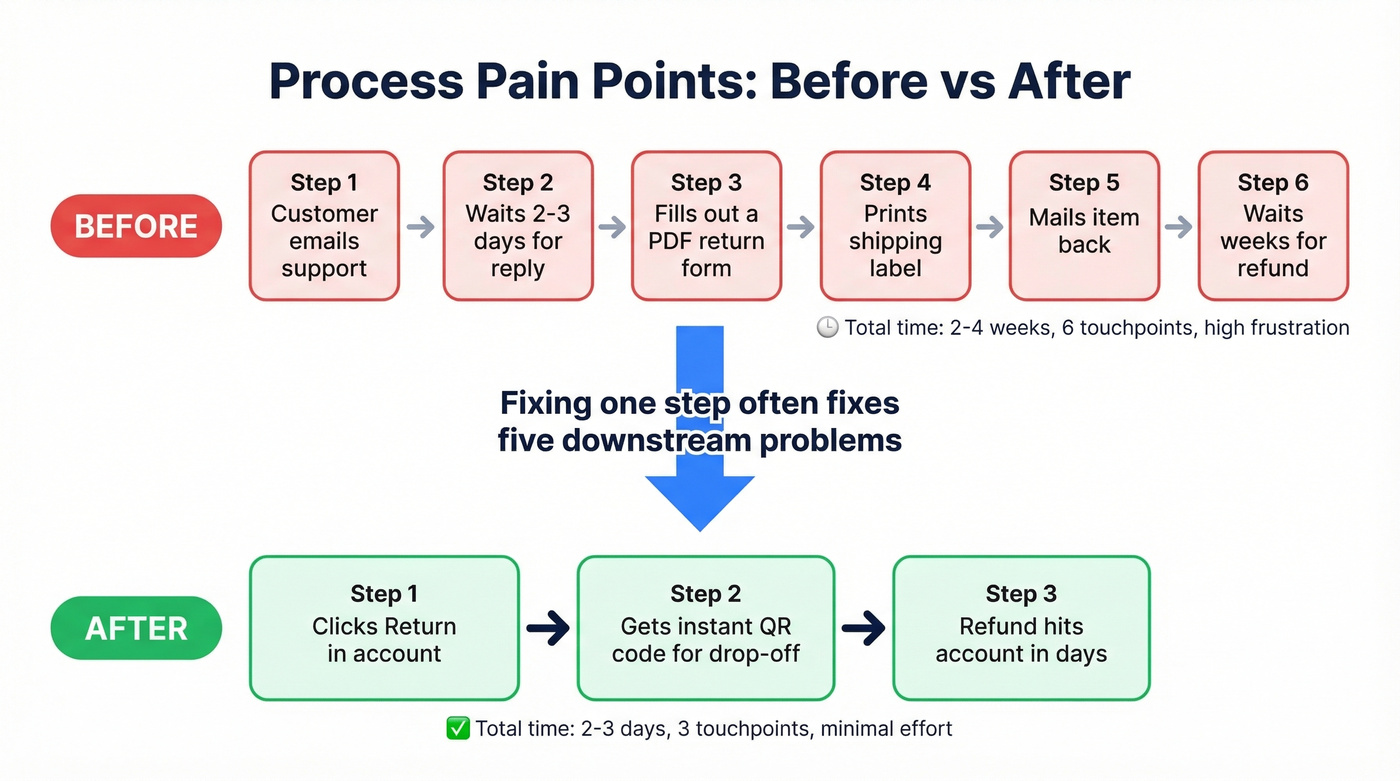
After: Customer clicks "Return" in their account, selects a reason, gets an instant QR code for drop-off, and sees the refund hit their account in a few days.
That gap between before and after is a process pain point - and it's the category where fixing one thing often fixes five downstream problems.
- Forced account creation before purchase - guest checkout should be the default
- Multi-step approval chains - a $500 purchase requiring three signatures is organizational theater
- Inconsistent workflows across offices - London handles renewals differently than New York
- Poor handoffs between sales and CS - the customer repeats their entire story post-close (often solved with better sales process optimization)
- Rigid scheduling systems - customers can't reschedule a delivery without calling
- Procurement bottlenecks in B2B - multiple stakeholders, legal review, and IT security checks for every vendor
Support Pain Points
55% of customers will leave if wait times are too long on any channel. That stat alone should justify every investment in support infrastructure. But hold times are just the most visible support pain point. The deeper ones do more damage:
- Repeating issues to multiple agents - customer explains the problem three times because there's no unified ticket history
- Generic, scripted replies - "We apologize for the inconvenience" doesn't solve anything; empower agents to go off-script
- Inconsistent service across channels - the app says one thing, the phone agent says another
- Chatbot dead ends - bot can't handle the question and there's no path to a human
- No proactive communication - customer discovers a delay by checking tracking, not from the company
- After-hours support gaps - customers in different timezones can't get help; follow-the-sun support or AI-first triage fixes this
- Outdated knowledge bases - help articles reference a UI that changed six months ago
Let's be honest: if your average deal size is under five figures, your biggest support problem probably isn't technology. It's that you're treating support as a cost center instead of a retention engine. The companies pulling 3.5x revenue growth aren't spending dramatically more on support. They're spending smarter.

Bad contact data is the pain point behind every other pain point on this list. Reps waste hours on bounced emails, wrong numbers, and stale records - that's a productivity, process, and financial drain rolled into one. Prospeo's 7-day data refresh and 98% email accuracy eliminate the root cause.
Stop solving symptoms. Fix the data that feeds your entire pipeline.
Industry-Specific Examples
B2B Ecommerce
A Sana/Sapio Research survey of 750 global B2B buyers found that 85% have frustrations when ordering online. A third of online B2B orders contained errors. 81% of buyers experienced pain from wrong stock levels or inaccurate shipping estimates, and 75% said they'd look elsewhere because of it.
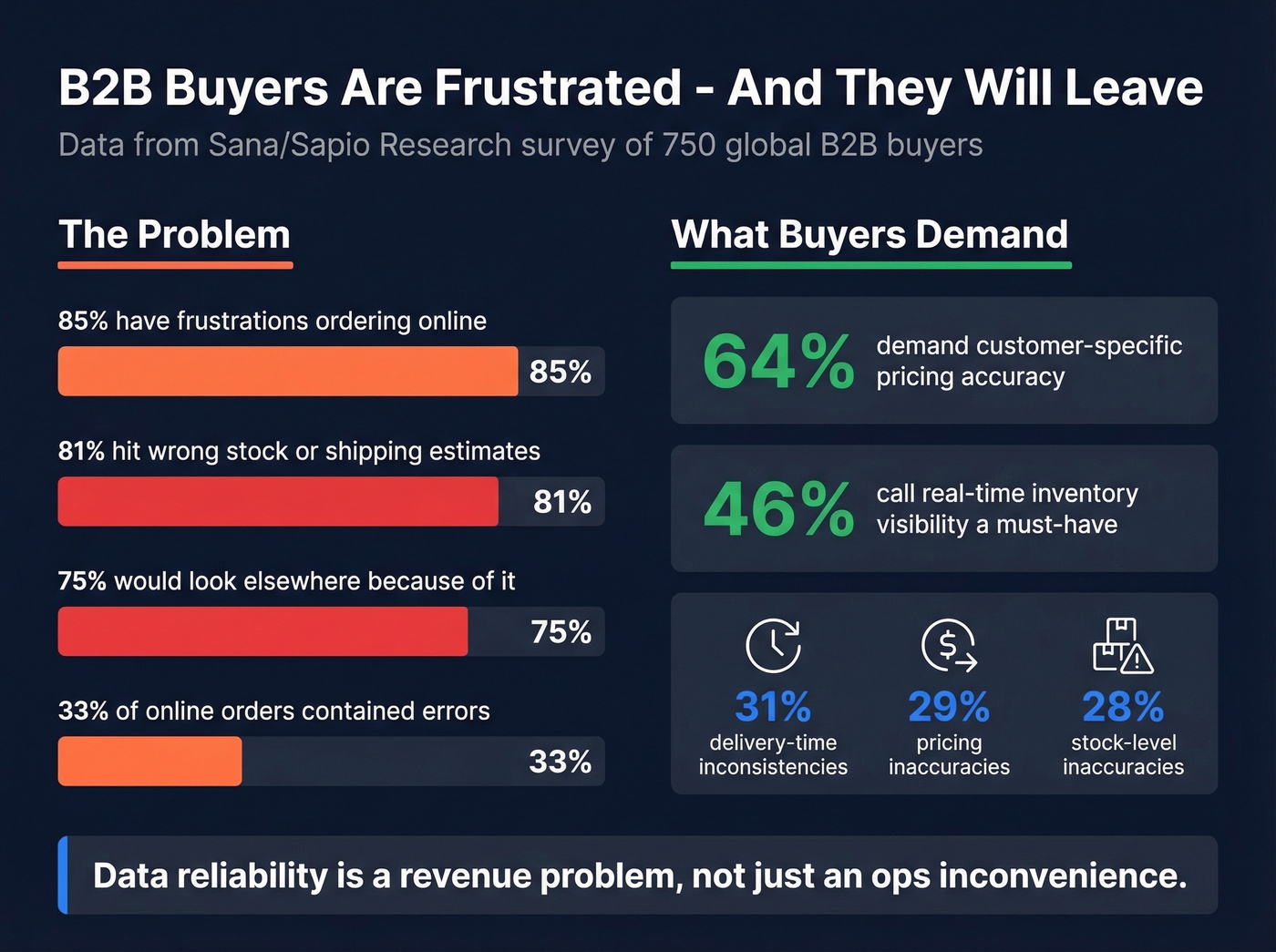
The root causes: 31% report delivery-time inconsistencies, 29% pricing inaccuracies, 28% stock-level inaccuracies. Buyers now expect real-time inventory visibility (46% call it a must-have) and customer-specific pricing accuracy (64%). Data reliability issues don't stop at inventory - sales teams face the same problem when outdated emails bounce, phone numbers are disconnected, and reps waste hours on leads that go nowhere. In our experience, data accuracy is a revenue problem, not just an ops inconvenience (especially in lead enrichment).

Healthcare
Healthcare is where customer pain points become genuinely dangerous. There were 180+ confirmed ransomware attacks against healthcare providers in 2024, with an average ransom of about $900,000. 80% of those attacks disrupted patient care, typically for two weeks.
Beyond cybersecurity, operational issues include legacy EHR systems that don't talk to each other and staffing shortages that create burnout cascades. US healthcare expenditures are approaching $5T - over 18% of GDP - and a meaningful chunk of that is spent managing problems that better systems could prevent.
SaaS
SaaS pain points are persona-specific, which is why generic lists fail. A sustainability lead - often a team of one - struggles with manual data sourcing for carbon accounting and persuading the CFO that compliance isn't optional. They're not just short on time; they're anxious about greenwashing accusations with no peers to gut-check their work.
An HR leader is trying to keep up with employment law changes like the EU Pay Transparency Directive while losing candidates because salary ranges are inflexible. As one practitioner put it, you need to push past "time and money" to find the emotional weight underneath - the career risk, the daily frustration that makes someone finally open their wallet.
Employee Pain Points That Cause Customer Pain Points
Most customer problems start as employee problems. When 74% of CRM leaders say tool-switching slows ticket resolution, that's not just an internal efficiency issue - it's why your customer waited too long for an answer.
Employees spend over 3 hours per day on tasks that could be automated: data entry, monitoring email, filing digital items. That's time not spent solving customer problems. And 73% say they'll leave if their employer doesn't address these issues, which creates turnover, knowledge gaps, and worse customer experiences. Skip this section if you're only focused on external-facing pain points, but we've found that the fastest path to better CX is often fixing the internal workflow first.
How to Uncover Pain Points
Research Methods
The table-stakes methods - customer surveys, support ticket analysis, session recordings, social listening, NPS follow-ups - are necessary but insufficient. The methods that surface non-obvious problems are journey mapping and direct observation.
Journey mapping means tracing the full experience, not just individual touchpoints. When you map a B2B buyer's journey from first search to signed contract, you'll find friction at transitions: the handoff from marketing to sales, the gap between demo and procurement approval, the silence between contract sent and contract signed. These transition-level issues are invisible if you only measure individual touchpoints.
Direct observation - watching someone use your product without coaching them - reveals problems customers have normalized. They won't mention the workaround they've been using for six months because they've forgotten it's a workaround.
Reddit and community forums are underrated. The r/customerexperience and r/sales subreddits surface frustrations in language your customers actually use, not the sanitized version they give in surveys. The consensus on r/sales is that most discovery frameworks are too rigid - reps need real examples, not acronyms.
Sales Discovery Questions
Step zero: make sure you can actually reach the prospect. If too many of your emails bounce, discovery calls never happen. Verify your contact data first - tools like Prospeo exist for exactly this problem, with 98% email accuracy and a 7-day refresh cycle that keeps your list clean (and helps reduce email bounce rate).
Once you're on the call, Gong's analysis of 519,000 B2B sales calls found that 11-14 targeted questions is the sweet spot. Top performers' discovery calls run 76% longer than average - they're not rushing through a checklist (more in our guide to discovery questions).
Sequence your questions deliberately: context first, then diagnostic, then impact, then emotional, then vision.
- "Walk me through your current process for [problem area]."
- "What happens if this isn't resolved by next quarter?"
- "What have you tried so far, and why didn't it stick?"
- "Who else feels this pain, and who controls the budget to fix it?"
The goal isn't to check boxes. It's to get the prospect talking about consequences. That's where urgency lives.
How to Prioritize and Fix Them
You don't need to fix every pain point. Fix the three that cost the most money. We've seen teams build elaborate scoring matrices and never use them. Start with three, not thirty.
Step 1: List every issue from your research - surveys, tickets, calls, observation.
Step 2: Score each one. Severity (1-5) x frequency (1-5) x revenue impact (1-5). Multiply for a composite score.
Step 3: Root cause analysis. Use the 5 Whys method. "Customers complain about slow support" - why? - "Agents switch between 4 tools" - why? - "Systems aren't integrated" - that's your real fix. Most teams skip this step and jump straight to solutions. That's how you end up building features that address symptoms while the root cause keeps generating new complaints (this is also where churn analysis becomes actionable).
Step 4: Map solutions to each root cause, not each symptom.
Step 5: Set KPIs before you start - response time, churn rate, NPS, ticket volume - whatever moves when the problem is resolved (tie it back to pipeline health so fixes show up in revenue).
Here's how to think about timelines using NNGroup's levels: interaction-level issues get fixed with UX changes in days to weeks. Journey-level issues need process redesign over weeks to months. Relationship-level issues require a strategy shift that takes months to quarters. Weight your prioritization accordingly - interaction-level fixes are quick wins, but relationship-level fixes drive the biggest long-term impact.
Tool-switching, information silos, slow onboarding - every productivity pain point above gets worse when your CRM is full of outdated contacts. Prospeo enriches your CRM with 50+ data points per record at a 92% match rate, so reps spend time selling instead of searching.
Enrich your CRM in minutes for $0.01 per verified email.
FAQ
What are the four types of pain points?
Financial (cost concerns like hidden fees), productivity (inefficient tools or workflows), process (overly complex procedures), and support (poor service experiences like long hold times or repeating issues across channels).
How do you identify customer pain points without a large customer base?
Start with Reddit, industry forums, and competitor reviews - then run 5-10 direct interviews with prospects or early users. Social listening on niche communities surfaces problems that surveys miss entirely. Even a handful of real-world examples gathered this way can reshape your messaging and product roadmap.
What's the difference between B2B and B2C pain points?
B2B pain points involve multiple stakeholders, longer decision cycles, and operational complexity - B2C frustrations are more immediate and emotional. B2B buyers increasingly expect B2C-level experiences, which is why 85% report frustrations ordering online.
How many discovery questions should you ask on a sales call?
Gong's analysis of 519,000 B2B sales calls found 11-14 targeted questions is the ideal range. Top performers' calls run 76% longer than average. Sequence context questions first, then diagnostic, then impact and urgency.