

Closing Sales: 10 Techniques, Real Scripts, and the System Most Guides Ignore
It's Thursday afternoon. You've got 12 deals that were supposed to close this month. Eight have gone dark, two are "checking with legal," and the other two want "one more call with the team." You nailed every demo. Your deck was tight. And yet here you are, staring at a pipeline about to slip into next quarter.
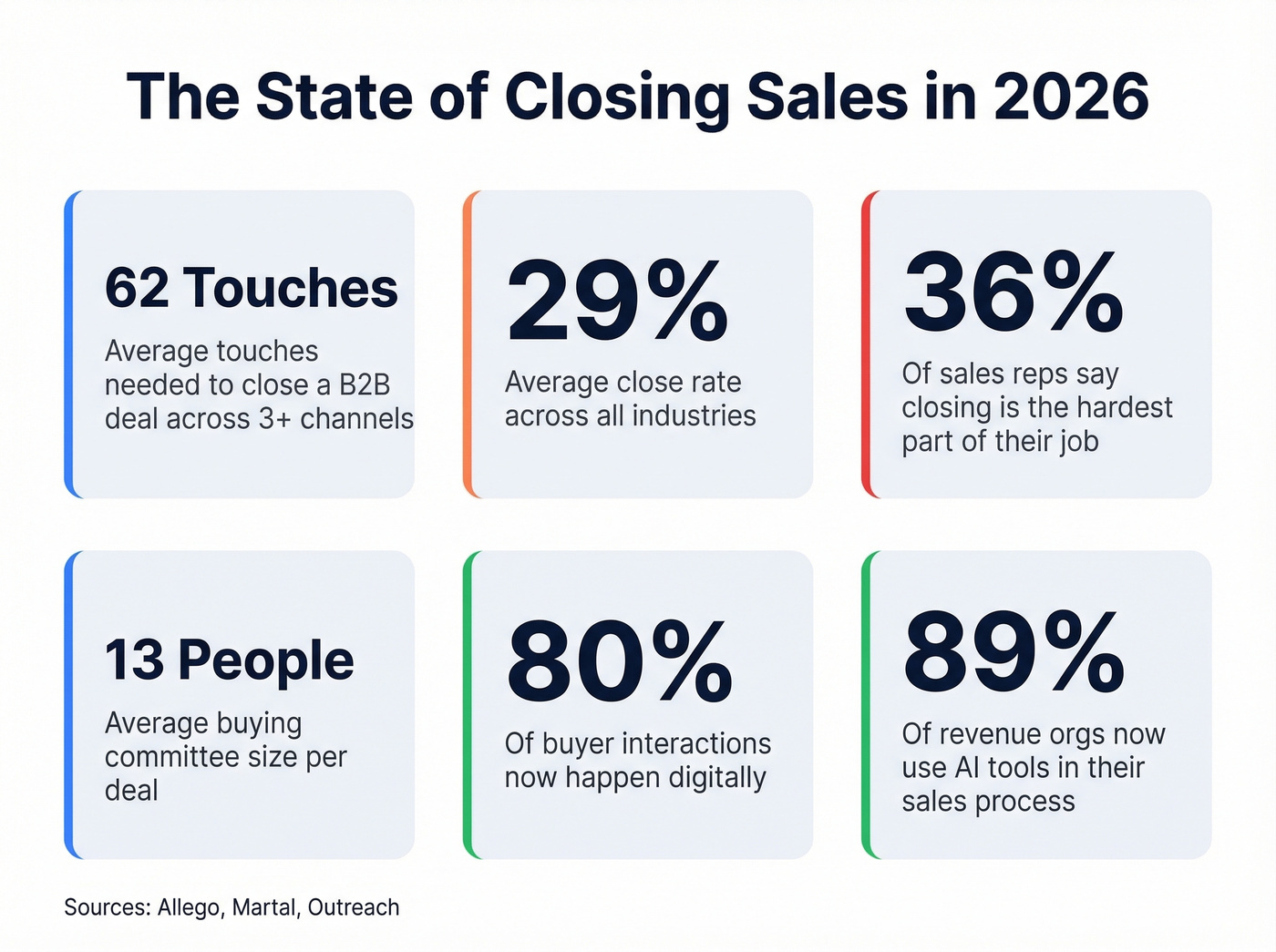
You're not alone. Modern B2B deals require an average of 62 touches across at least three channels before they close, the average close rate across industries hovers around 29%, and 36% of sales professionals say closing is the hardest part of their job - second only to prospecting. Meanwhile, buying committees have ballooned to 13 decision-makers per deal, and 80% of buyer interactions now happen digitally. You're not convincing one person anymore. You're building consensus across a small committee who may never be in the same room together.
Most guides hand you a list of techniques and wish you luck. That's like giving someone a tennis racket and calling them ready for Wimbledon. None of them tell you what to do when your "decision-maker" turns out to be an influencer with no budget authority, or when the VP of Finance's email bounces and the phone number goes to a fax machine.
The close is a system - and the system starts long before you ever ask for the sale.
The Short Version
- If your close rate is below your industry benchmark, the problem is upstream. Fix qualification and data quality before you memorize another script.
- If you only learn three techniques: Mutual Action Plan for enterprise, Summary Close for mid-market, Alternative Choice for SMB.
- If you're closing over video (and you probably are), you need a different playbook. Jump to the virtual selling section below.
Here's the thesis: stop memorizing scripts and start fixing your pipeline. If 30% of your emails bounce and you're single-threaded into one champion, no technique saves you.
Close Rate Benchmarks for 2026
Before you can fix your close rate, you need to know what "good" looks like. It varies wildly.
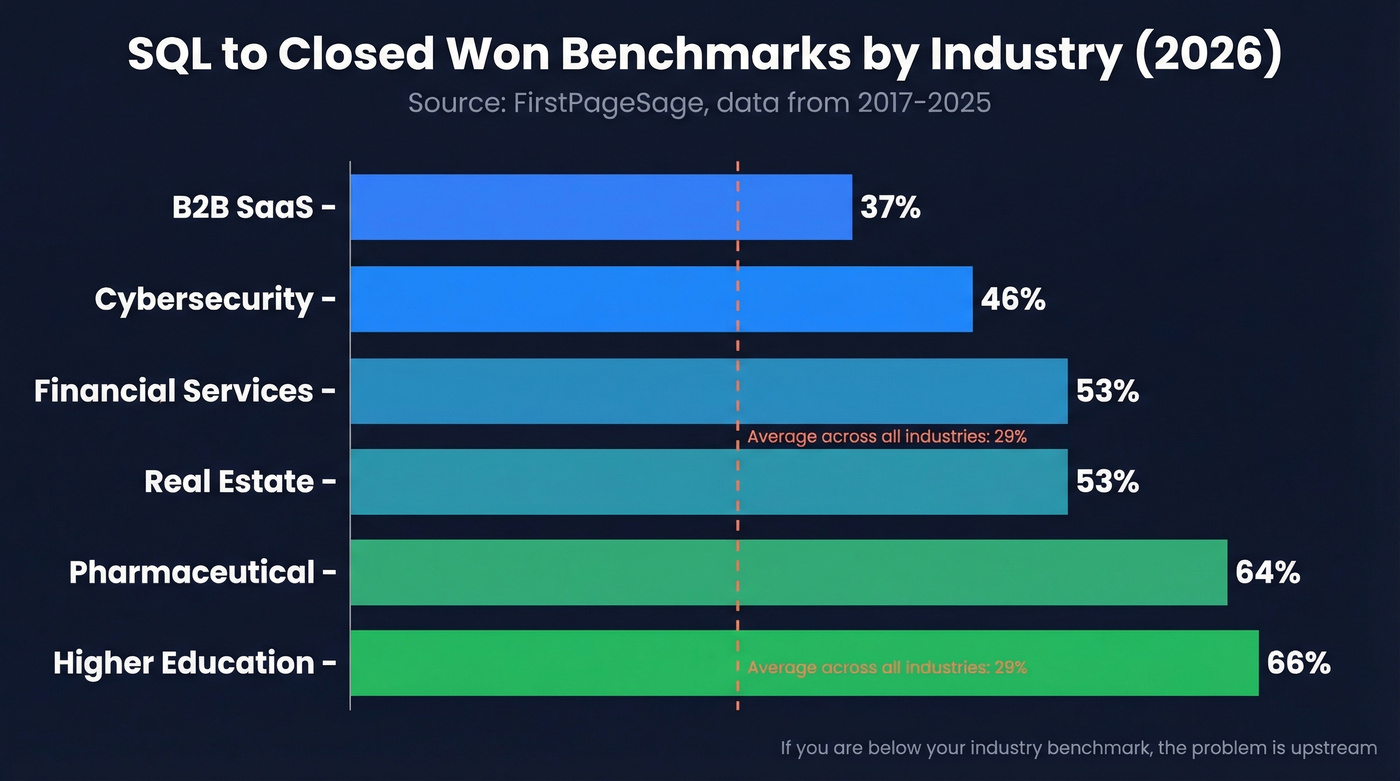
FirstPageSage published SQL-to-Closed-Won benchmarks drawn from data gathered between 2017 and 2025:
| Industry | SQL to Closed Won |
|---|---|
| B2B SaaS | 37% |
| Cybersecurity | 46% |
| Financial Services | 53% |
| Real Estate | 53% |
| Pharmaceutical | 64% |
| Higher Education | 66% |
The spread from 37% to 66% is enormous. A B2B SaaS account executive at 37% is performing at average. That same number in Higher Education would be a fireable offense.
If you're in B2B SaaS and converting at 25%, the problem isn't your technique - it's what's happening before deals reach the close stage. Bad qualification, weak discovery, or SDRs chasing prospects who were never going to buy. The diagnostic framework is simple: if you're significantly below your industry benchmark, look upstream. If you're at or above benchmark but want to improve, that's where technique refinement and deal-stage execution matter. In our experience, most teams find the biggest gains come from fixing the top of the funnel, not polishing the bottom.
What Must Be True Before You Close
Let's be honest about something most guides skip entirely: you can't close a deal with a dead phone number.
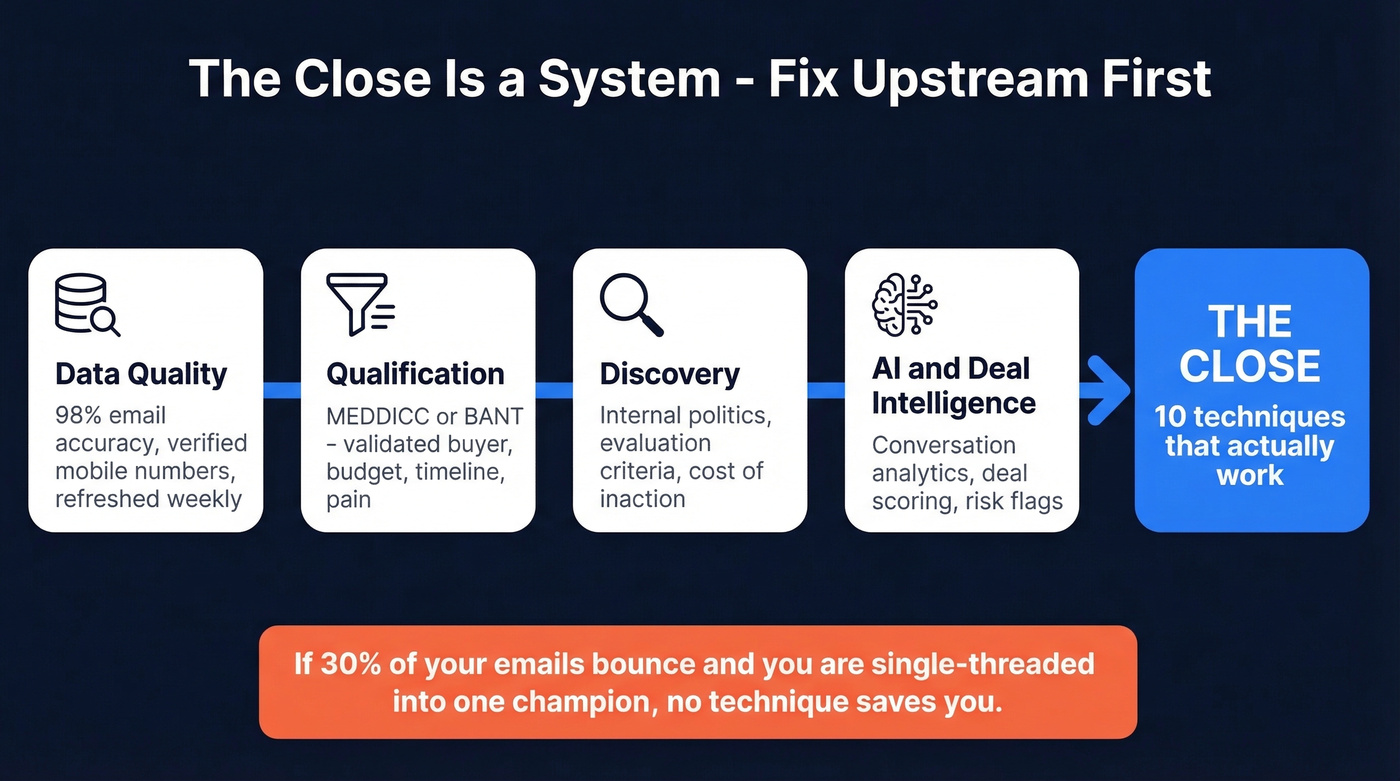
If your contact data is stale, your emails bounce, and you're single-threaded into one champion who goes on PTO, no amount of assumptive language saves that deal. The foundation isn't technique - it's infrastructure.
Qualification comes first. Whether you use MEDDICC, BANT, SPICED, or your own framework, the point is the same: every deal in your pipeline should have a validated economic buyer, a clear pain, a timeline, and a budget conversation. Deals without these elements aren't "opportunities" - they're hopes. Hopes don't hit quota.
Discovery determines your ceiling. The quality of your close is directly proportional to the quality of your discovery. If you don't understand the buyer's internal politics, their evaluation criteria, and what happens if they do nothing, you're guessing. Reps who rush past discovery to get to the demo are the same reps who wonder why deals stall at the proposal stage. (If you want a tighter structure, use a set of proven discovery questions.)
Data quality is the invisible killer. When you're trying to multi-thread into a buying committee of 13 people and half your contact info is wrong, you're dead before you start. Buyers are 23% more likely to spend with brands they trust, and trust starts with reaching the right person at the right time. This is where tools like Prospeo change the math - 98% email accuracy and 125M+ verified mobile numbers refreshed every 7 days mean your outreach actually connects instead of bouncing into the void. (If you're auditing your stack, start with data enrichment services.)
AI is accelerating everything around the close. With 89% of revenue organizations now adopting AI tools, conversation intelligence platforms can flag deal risk, score engagement, and run AI role-plays so reps practice before the real call. If you're not using deal scoring or conversation analytics in 2026, you're leaving money on the table.

10 Techniques That Actually Work
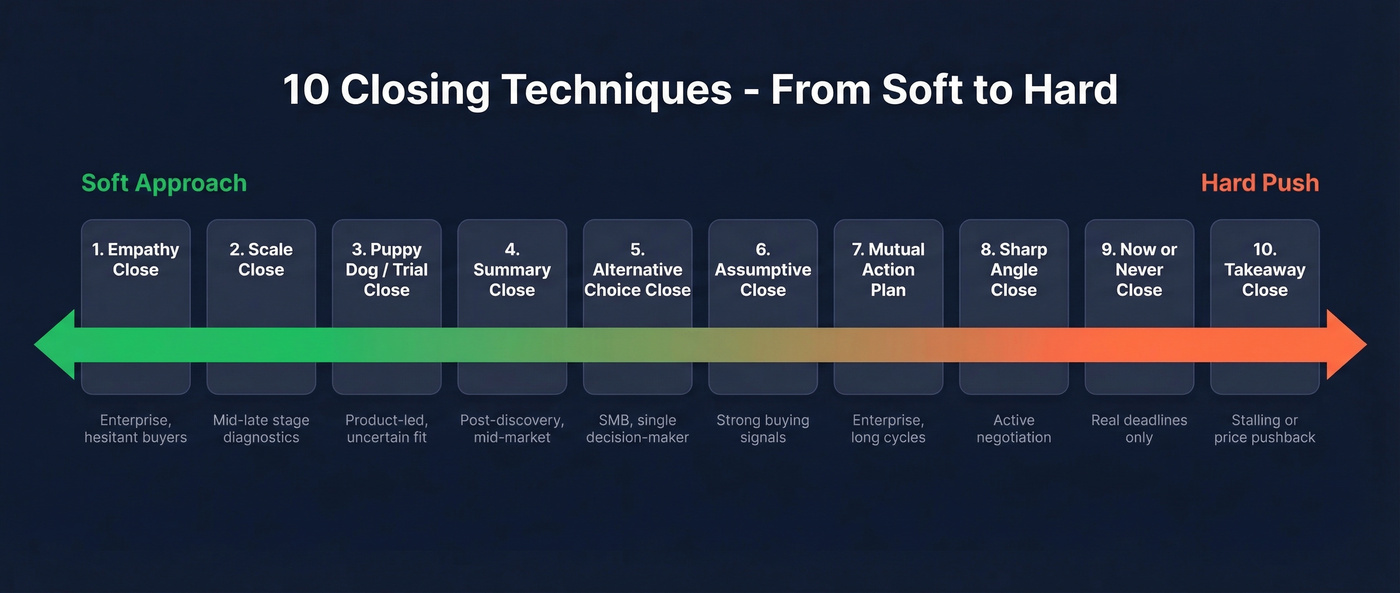
Every technique below includes when to use it, when to skip it, and an exact script. These range from soft approaches that ease prospects into a decision to hard tactics that push for commitment.
1. The Assumptive Close
Act as if the prospect has already decided to buy. Skip the "so, what do you think?" moment and move straight to logistics. This works because it removes the psychological weight of making a "big decision" - you're just sorting out details.
When to use: Strong buying signals - nodding along, asking implementation questions, discussing timelines. Skip it when: The prospect hasn't confirmed budget or authority. Assuming the sale too early feels pushy. Script: "Great - should we kick off implementation on Tuesday, or does Thursday work better for your team?"
2. The Summary Close
Restate everything the prospect said they need, map it to what you deliver, then ask for the decision. People trust their own words more than yours - that's commitment and consistency at work.
When to use: After thorough discovery where the prospect articulated specific pain points. Skip it when: Discovery was shallow. You'll just be summarizing your own pitch, and they'll notice. Script: "So you need to cut onboarding time from 6 weeks to 2, integrate with Salesforce, and stay under $40K annually. We've covered how we handle all three. Ready to move forward with the agreement?"
3. The Now-or-Never Close
Create urgency tied to a real deadline - end-of-quarter pricing, limited implementation slots, a price increase taking effect. Loss aversion is the driver: prospects are more motivated to avoid missing out than to gain something new.
When to use: When there's a genuine constraint on the buyer's side or yours. Skip it when: The scarcity is fake. HubSpot found that teams replacing urgency-based CTAs with data-backed proposals increased win rates by 20%. Fake scarcity triggers suspicion, and buyers talk to each other. Script: "Our Q2 pricing locks in at this rate through Friday. After that, the new structure adds about 15%. I'd hate for that to hit your budget."
4. The Sharp Angle Close
When a prospect asks for a concession - a discount, an extra feature, faster delivery - you agree, but only if they commit now. It turns their leverage into yours.
When to use: The prospect is negotiating from genuine interest, not just fishing. Skip it when: You don't have authority to grant the concession. Nothing kills credibility faster than "let me check with my manager" after you just made a conditional offer. Script: "I can get you that additional seat at no charge - if we can get the contract signed by end of week. Fair?"
5. The Takeaway Close
Remove something from the offer. Counterintuitive, but loss aversion is powerful - prospects want something more once it's no longer available. It also reframes you as a consultant, not a desperate seller.
When to use: When a prospect is stalling or pushing hard on price. Skip it when: The prospect is already enthusiastic. You'll kill momentum for no reason. Script: "Based on what you've described, you might not need the enterprise tier. Let's drop that and go with the standard plan - it covers your core use case."
6. The Empathy Close
Here's the scenario: you're 45 minutes into a call with a VP of Operations. She's been engaged the whole time, but when you move toward next steps, she hesitates. Something's off, but she won't name it.
This is where most reps push harder. Do the opposite.
Script: "Look, this is a big decision and I don't want you to feel rushed. What would need to be true for you to feel confident moving forward?"
That question does two things. It validates the hesitation instead of fighting it, and it forces the prospect to articulate the real objection - which is almost never what they said first. We've found this is one of the most underrated approaches in complex enterprise deals where internal politics create invisible resistance. Skip it when the deal is moving fast; don't slow down momentum with unnecessary empathy.
7. The Scale Close
You: "On a scale of 1 to 10, where are you on moving forward with this?" Prospect: "I'd say a 7." You: "A 7 - that's solid. What would get you to a 9?" Prospect: "Honestly, if I could see a case study from someone in our industry..."
Now you know exactly what to do next. The Scale Close is a diagnostic tool disguised as a closing technique. Use it mid-to-late stage when you're genuinely unsure where the prospect stands. Too early, and it feels like a sales trick.
8. The Alternative Choice Close
Give the prospect two options, both of which result in a yes. You're not asking "do you want to buy?" - you're asking "which way do you want to buy?" This reduces decision fatigue and keeps the conversation moving forward.
When to use: SMB and mid-market deals with one decision-maker and a straightforward evaluation. Skip it when: Enterprise deals with multiple stakeholders. You can't shortcut a committee decision with a binary choice. Script: "Would you prefer the annual plan with the discount, or the monthly plan for more flexibility?"
9. The Puppy Dog / Trial Close
Let the prospect experience the product before committing. The name comes from pet stores - once someone takes the puppy home, they're not bringing it back. Free trials, pilot programs, and proof-of-concept engagements all fall here.
When to use: When the product sells itself through usage and the objection is uncertainty about fit. Skip it when: Implementation is heavy and a "trial" requires significant resources from both sides. A 14-day pilot that takes 6 weeks to set up isn't a trial - it's a project. Script: "Why don't we set you up with a 14-day pilot? Your team uses it on real deals, and we'll review the results together. If it doesn't deliver, no hard feelings."
10. The Mutual Action Plan Close
This isn't a single moment - it's a shared document outlining every step from now to signed contract, with owners and dates for both sides. It's the gold standard for enterprise contract negotiation because it makes the close collaborative, not confrontational.
When to use: Any deal with multiple stakeholders, a procurement process, or a sales cycle longer than 30 days. Skip it when: Quick transactional sales where a MAP would feel like overkill.
Picture this: you share a Google Doc with your champion listing legal review by the 15th, security questionnaire delivered by the 12th, and go-live targeted for March 1st. Every stakeholder sees their name next to a task. Nobody can claim they didn't know the timeline. That's the power of a MAP - it turns an abstract "we'll get back to you" into a concrete, shared commitment with accountability baked in.

You just read it: 13 decision-makers per deal, and half your contact data is wrong. Prospeo gives you 98% email accuracy and 125M+ verified mobiles refreshed every 7 days - so you actually reach the buying committee instead of bouncing into the void.
Stop losing closeable deals to bad data.
Closing by Deal Size
The technique that wins a $500/month SMB deal will actively hurt you in a $200K enterprise negotiation. Here's how the motion changes:
| Dimension | SMB | Mid-Market | Enterprise |
|---|---|---|---|
| Decision-makers | 1-2 | 5-8 | 5-16 |
| Touches to close | 2-3 | 8-15 | 20-60+ |
| Best technique | Alternative Choice | Summary Close | Mutual Action Plan |
| Key risk | Speed - they drop you | Champion leaves | Internal conflict |
SMB: Speed Is Everything
SaaStr's analysis nails this: SMB reps get 2-3 touches, maybe. At low price points, SDRs and AEs are making around 50 calls a day and dropping any deal that shows friction. The Alternative Choice close works here because it collapses the decision into a simple A-or-B. Don't over-complicate it.
Mid-Market: Protect the Champion
Mid-market deals live and die by your internal champion. The Summary Close works because it arms your champion with the language they need to sell internally - your job is to make their job easy. If the champion leaves mid-deal, you're starting over, which is why multi-threading matters even at this level.
Enterprise: Build Consensus or Lose
Gartner's 2024 buyer survey found that 74% of B2B buyer teams demonstrate unhealthy conflict during the decision process, spanning five to 16 people across up to four functions. But here's the upside: buying groups that reach consensus are 2.5x more likely to report a high-quality deal, and tailoring content for buying-group relevance improves consensus by 20%.
The Mutual Action Plan works for enterprise because it makes the complexity visible and manageable. Everyone knows their role, their deadline, and what happens next. Multi-threading is non-negotiable - you need verified contact info for every stakeholder, not just the champion.
Here's the thing: the number of reps running enterprise playbooks on SMB deals - and wondering why their quota attainment is in the gutter - is staggering. If your average deal is a few thousand dollars a year, you don't need a 60-touch motion. Match your closing complexity to your deal size. (For longer cycles, see our guide to enterprise B2B sales.)
Virtual Selling: How to Close Remotely
70-80% of B2B buyers prefer virtual sales interactions over in-person. Only 15-25% want to interact with reps face-to-face to make a purchase decision. Virtual selling isn't a pandemic holdover. It's the default.
But only 26% of buyers think the average sales professional is actually skilled at selling virtually, and 91% of virtual sellers struggle to keep buyers engaged. More than half of attendees check email during virtual meetings. That's the reality.
The virtual playbook requires different tactics:
- Camera on, always. You lose 90% of body language cues over video. Show your face and read theirs.
- Shorter meetings. A 25-minute call with a clear agenda beats a 60-minute ramble. Attention spans over video are brutal.
- Async video follow-ups. After the call, send a 90-second video summarizing next steps. It's personal, memorable, and cuts through inbox noise. (If you want a repeatable process, borrow these sales follow-up templates.)
- Digital proposals with tracking. Know when your prospect opens the proposal, how long they spend on the pricing page, and when they forward it to their boss. This intel tells you when to follow up and what to address.
- Name the elephant. If engagement drops, call it out: "I want to make sure this is landing - what questions are coming up for you?" Silence on video is deadly. Fill it with questions, not more slides.
- Use digital sales rooms. Centralize every asset - proposals, case studies, security docs - in a shared space the entire buying committee can access. It replaces the 14-email thread and gives you visibility into who's engaging with what. (If you're implementing this, start with a digital sales room.)
7 Mistakes That Kill Deals
1. Faking scarcity. "This price expires Friday" when it doesn't. Buyers talk to each other. They'll find out. And you'll lose the deal and the relationship.
2. Single-threading. Relying on one champion in a deal with 8 stakeholders is a recipe for a stalled pipeline. If your champion gets reassigned, goes on leave, or loses internal influence, you're done. The consensus on r/sales is that this is the most common and most preventable mistake in B2B - and we'd agree.
3. Not asking for the sale. Sounds obvious, but a surprising number of calls end without a close attempt. Reps get comfortable in the conversation and forget to actually make the ask.
4. Rushing past discovery. Sending a pitch deck two minutes into a call tells the prospect you don't care about their problem - you care about your quota.
5. Poor follow-up cadence. The average B2B deal takes 62 touches across three channels. Most reps give up after a handful. Build a standard late-stage cadence of 5-12 touches over two to four weeks. Persistence isn't pestering - it's professionalism. (If you need a system, use a sales meeting follow-up email framework.)
6. Working with bad data. You can't close someone you can't reach. If your contact database is stale, you're wasting touches on bounced emails and disconnected numbers. This is the most fixable problem on this list - and tools like Prospeo exist specifically to solve it. (Start by checking your email bounce rate.)
7. Ignoring procurement. In enterprise deals, the economic buyer saying "yes" is the halfway point, not the finish line. Legal review, security questionnaires, procurement approvals - if you haven't mapped these steps in your Mutual Action Plan, you'll miss your close date every time.
The Objection-Handling Framework
Objections aren't roadblocks - they're buying signals wrapped in hesitation. The prospect who says "it's too expensive" is telling you they're interested but need help justifying the spend. The one who ghosts you was never a real opportunity.
The pattern: acknowledge the concern, reframe it, move forward. Never argue. Never dismiss.
| Objection | What They Really Mean | Response |
|---|---|---|
| "Too expensive" | "I don't see enough value" | Revisit ROI - ask which outcome matters most |
| "Not the right time" | "This isn't a priority" | Ask when, and map what needs to change |
| "Need to check with my boss" | "I'm not the decision-maker" | Offer to loop them in for a 15-min call |
| "We're looking at [competitor]" | "Convince me you're better" | Ask their evaluation criteria, then differentiate |
| "Let me think about it" | "Something's unresolved" | Ask: what's the one thing that would make this a clear yes? |
| Goes dark | "You're not a priority" | Multi-channel nudge: email + voicemail + async video over 7 days |
Every response ends with a question or action that moves the conversation forward. You're not closing the objection - you're opening the next stage.
Let's break down the most common one. When a prospect says "it's too expensive," respond: "Totally fair. Let's revisit the ROI - which outcome matters most to your team? If we can show a 3x return on the investment, does the price still feel like the blocker?" That reframe shifts the conversation from cost to value, which is where you want to be.
Multi-threading into a buying committee requires real contact data for every stakeholder - CFO, VP, legal, procurement. Prospeo's 30+ search filters let you find every decision-maker by department, seniority, and company, with emails at $0.01 each and a 30% mobile pickup rate.
Reach the entire buying committee, not just your single-threaded champion.
FAQ
What does "closing" mean in sales?
Closing is the final stage where a prospect commits to purchase - from the formal ask through contract negotiation and signature. It typically involves overcoming last objections, aligning on terms, and getting the deal signed.
What's the most effective closing technique?
It depends on deal size. Mutual Action Plan for enterprise with 5+ stakeholders, Summary Close for mid-market, and Alternative Choice for SMB. A one-size approach leaves revenue on the table.
What's a good close rate in B2B?
The average is about 29%. B2B SaaS averages 37%, Financial Services 53%, Higher Education 66%. If you're significantly below your industry benchmark, fix qualification and data quality before optimizing technique.
How do I reach the full buying committee?
Multi-thread with verified contact data so you're never relying on one champion. Use search filters to map stakeholders by department and seniority, and make sure your email accuracy is high enough that outreach actually lands.
How do I close a deal over email?
Summarize value discussed, include a specific next-step date, and end with a direct ask: "Can you confirm by Thursday?" Keep the email under 150 words - brevity signals confidence and respects the buyer's time.
Closing sales isn't a single skill you sharpen - it's a system you build. Fix the data, nail discovery, match your technique to the deal, and the close becomes the easiest part of the conversation. Apply these consistently, and you'll stop watching deals slip into next quarter.