

How to Write a Closing Sales Email That Gets Replies
You don't need 50 closing lines. You need three.
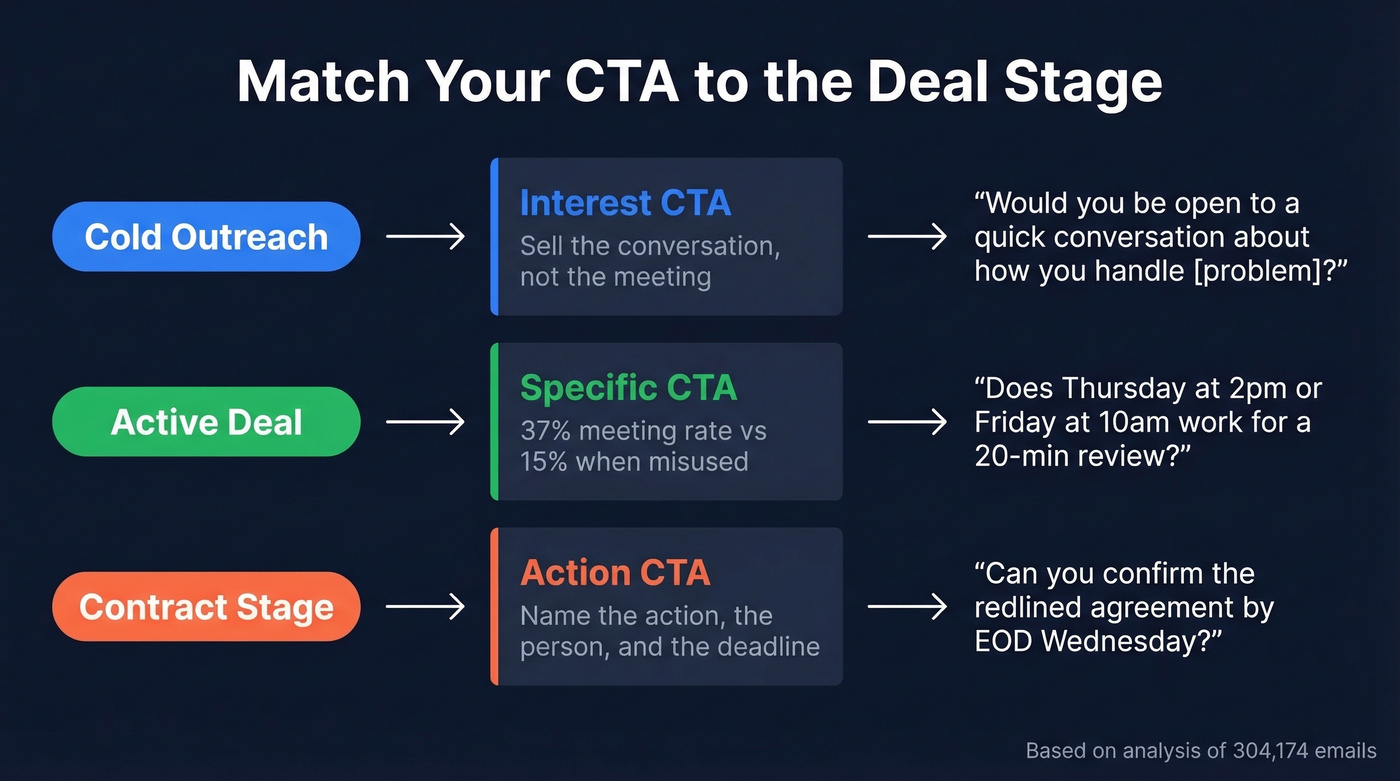
Your closing sales email should match your deal stage, and the data on this is surprisingly clear. An analysis of 304,174 emails grouped CTAs into three types - and the winner changes based on where the deal stands.
Here's the thing most reps get wrong: they agonize over subject lines and openers. But your opener gets the email read. Your close gets the reply. And most closes fail because they ask for too much too soon, or too little too late.
The Quick Version
- Cold outreach: Interest CTA ("Would you be open to...")
- Active deal: Specific CTA ("Does Thursday at 2pm work?")
- Contract stage: Action CTA ("Can you confirm by EOD Wednesday?")
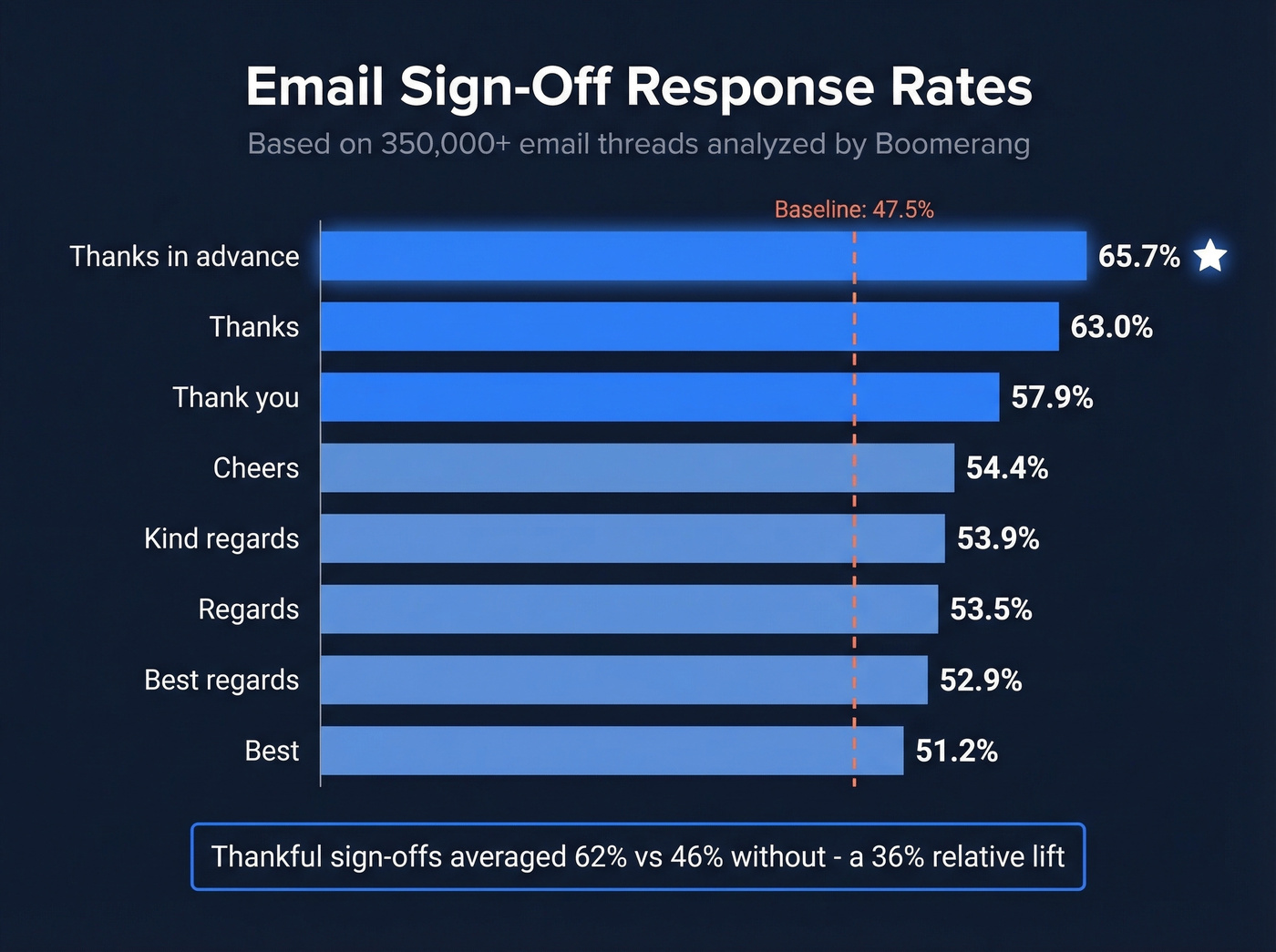
One more data point worth knowing: "Thanks in advance" hit a 65.7% response rate in a 350K-thread study. Thankful sign-offs overall averaged 62% vs. 46% without - a 36% relative lift.
Why Your Close Outweighs Your Opener
An analysis of 28M+ cold emails found the average rep sends 344 cold emails to land one meeting. That's a brutal ratio. Pitching in the body drops reply rates by up to 57%. The close is where the action happens - it's the sentence that converts attention into a calendar invite.
Match Your CTA to the Deal Stage
That 304,174-email study sorted CTAs into Interest (asks if they're interested), Specific (asks for a day/time), and Open-ended (asks for a meeting without specifics). Here's how to deploy each one.
Cold Outreach: Interest CTAs
The data is unambiguous: Interest CTAs outperform every other type in cold emails. You're asking a stranger to engage, not to block 30 minutes. Sell the conversation, not the meeting.
"Would you be open to a quick conversation about how [company] handles [specific problem]?"
"Is [problem area] on your radar for Q3, or is the team focused elsewhere?"
"Curious if this resonates - worth a 10-minute call?"
Keep the full email under 100 words. Three-to-four-sentence emails earn the highest reply rates, and your close is one of those sentences.
Active Deals: Specific CTAs
Picture this: a prospect replied to your cold email, you had a solid discovery call, and now you're trying to schedule a demo. You send "Would you be open to meeting next week?" and hear nothing for five days. The problem isn't timing - it's that you used a cold-stage CTA in a warm-stage deal.
Specific CTAs in active deals book meetings at a 37% rate, compared to just 15% when used in cold outreach. The deal context unlocks the performance.
"Does Thursday at 2pm or Friday at 10am work for a 20-minute review?"
"I've blocked Tuesday at 3pm for us - does that hold on your end?"
The specificity removes friction. Instead of "let me check my calendar," the prospect just says yes or suggests an alternative. We've tested both approaches across dozens of campaigns, and the difference is night and day.
Contract Stage: Action CTAs
At this point, you're not selling - you're project-managing. Your close should give the champion something to forward internally. Name the action, the person, and the deadline.
"I've attached the redlined agreement - can you confirm by EOD Wednesday?"
"Security review is complete on our side. What's the next step to get this to procurement?"
We've seen deals stall for weeks at this stage simply because the email said "Let me know your thoughts" instead of naming a specific next step and owner. Don't be that rep.

You just learned the three CTA types that book meetings. But none of them work if your email bounces. Prospeo's 5-step verification delivers 98% email accuracy with catch-all handling and spam-trap removal - refreshed every 7 days, not 6 weeks. One team dropped their bounce rate from 35% to under 4% and tripled pipeline.
Verify your prospect list before you send that closing email.
Best Sign-Offs Ranked by Data
Boomerang analyzed 350,000+ email threads from online communities - not pure sales data, but the pattern holds across contexts. The baseline response rate was 47.5%.
| Sign-Off | Response Rate |
|---|---|
| Thanks in advance | 65.7% |
| Thanks | 63.0% |
| Thank you | 57.9% |
| Cheers | 54.4% |
| Kind regards | 53.9% |
| Regards | 53.5% |
| Best regards | 52.9% |
| Best | 51.2% |
"Thanks in advance" works because it presupposes action. Subtle, but the numbers don't lie.
SMB vs. Enterprise: Different Closes
SMB deals close in 1-3 months. A Specific CTA in your second email is perfectly appropriate - the buyer often is the signer.
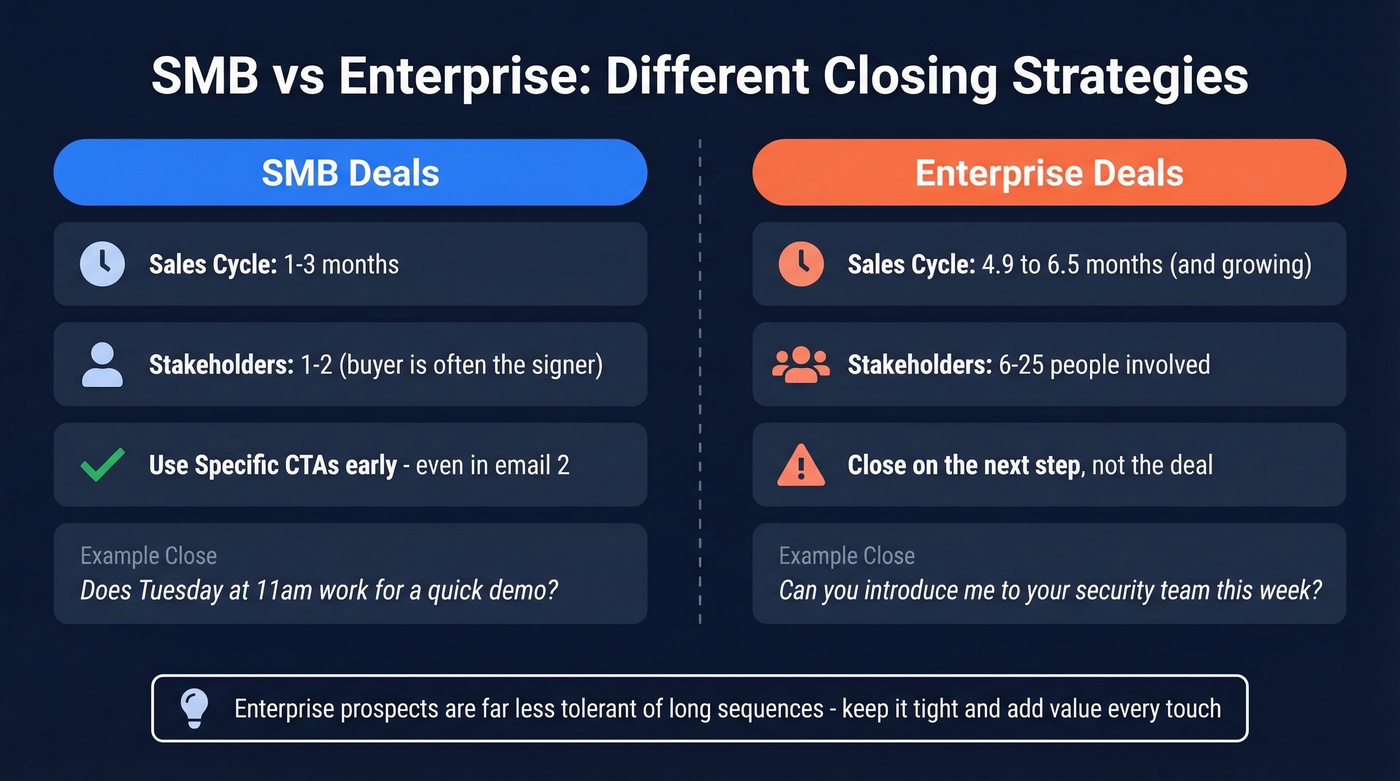
Enterprise deals don't close. They get committee'd to death. B2B tech sales cycles have stretched from 4.9 months in 2019 to 6.5 months in 2026, with 6-25 stakeholders involved. Your closing line needs to account for the fact that your contact probably can't say yes alone. An analysis of 16.5M cold emails shows enterprise prospects are far less tolerant of long sequences and persistence. Close on the next step, not the deal - "Can you introduce me to your security team?" beats "Ready to move forward?" every time.
One cadence that gets traction on r/salestechniques: Day 1 send, Day 3 follow-up with new value, Day 7 case study, Day 14 direct ask to schedule. Each touch adds something. Never "just checking in." If you need examples, use these sales follow-up templates as a starting point.
5 Mistakes That Kill Your Close
Multiple CTAs in one email. One email, one ask. Options paralyze.
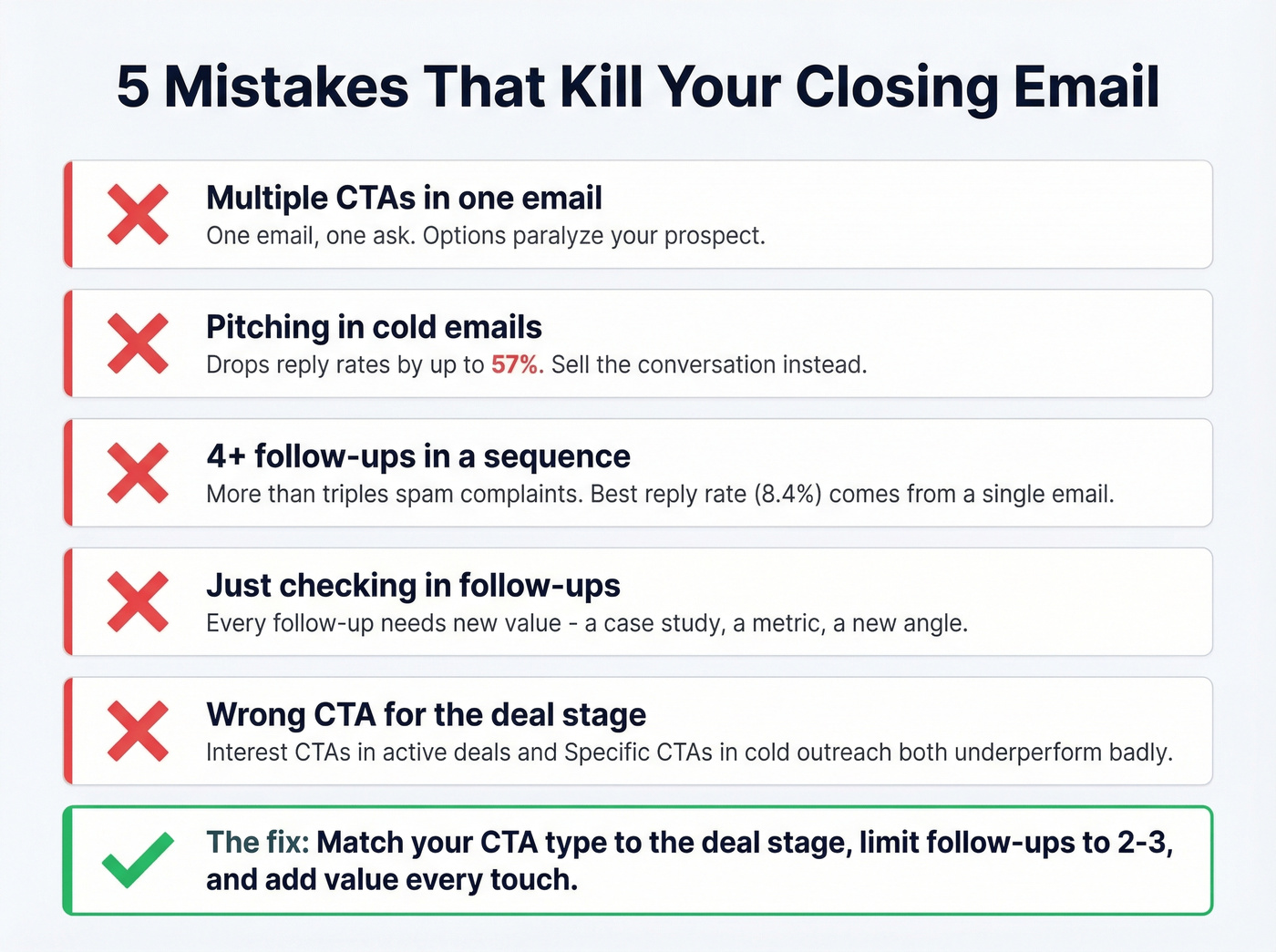
Pitching in cold emails. Pitching drops reply rates by up to 57%. Your cold close sells a conversation, not a product. If you're building a full sequence, start with a B2B cold email sequence structure.
4+ follow-ups in a sequence. Four or more emails more than triple spam complaints. The highest reply rate - 8.4% - actually comes from a single email. Two to three follow-ups is the ceiling.
"Just checking in" follow-ups. Every follow-up needs new value. If three follow-ups get silence, send a clear "closing the loop" email - it often triggers a response because it creates urgency around the conversation ending. Here are better ways to say just checking in professionally.
Make Sure Your Email Arrives
None of this matters if your email bounces. A high bounce rate doesn't just waste that send - it damages your domain reputation, which means your next 500 emails land in spam too. If you want benchmarks and fixes, start with email bounce rate and then work on improve sender reputation.

Prospeo's 5-step verification catches bad addresses before they do damage - 98% email accuracy, catch-all domain handling, spam-trap removal, and a 7-day data refresh cycle. One customer, Meritt, dropped their bounce rate from 35% to under 4% after switching and tripled their pipeline. If you're running any closing sequence, verify first. It's fast, and it prevents deliverability damage that can take weeks to recover from. For the full framework, see our email deliverability guide.
Matching your CTA to the deal stage only matters if you're emailing the right person at a verified address. Prospeo gives you 300M+ profiles with 30+ filters - buyer intent, job changes, technographics - so your closing email hits the decision-maker who can actually say yes. 98% accuracy. $0.01 per email. No contracts.
Find verified decision-makers and close them with confidence.
FAQ
How long should a closing sales email be?
Under 100 words - three to four sentences total. The 28M-email analysis found shorter emails earn significantly higher reply rates. Your close is one sentence; the rest sets it up.
Do I need different templates for each deal stage?
Yes. Interest, Specific, and Action CTAs serve as your three core templates. Swap in your prospect's name, problem, and timeline, but keep the structure matched to the stage. A cold-stage Interest CTA reused at the contract stage will stall momentum.
How many follow-ups should I send after my close?
Two to three maximum. Four or more follow-ups more than triple spam complaint rates. Each follow-up should add new value - a case study, a relevant metric, or a different angle on the problem. Skip this advice if you're in a true enterprise deal with an engaged champion; there, persistence on next steps is expected.
Does email verification actually affect reply rates?
It does, and the effect is indirect but massive. If 10% of your list bounces, your sender reputation drops and future emails land in spam - even the ones going to real, interested prospects. Cleaning your list before you send keeps deliverability high across your entire sequence, so your carefully crafted closing line actually reaches the inbox.