

Cognism vs ZoomInfo: The Honest 2026 Comparison Nobody Else Will Give You
Your VP just forwarded a ZoomInfo renewal quote that's 20% higher than last year. Or maybe you're evaluating Cognism for the first time and wondering if the "Diamond Data" branding justifies the price tag. Either way, every Cognism vs ZoomInfo comparison you've found so far was written by one of the two vendors.
Let's fix that.
30-Second Verdict
Choose Cognism if you're cold calling into EMEA. Diamond Data phone verification and coverage across 13 European DNC lists make it the strongest option for UK and EU outbound teams.
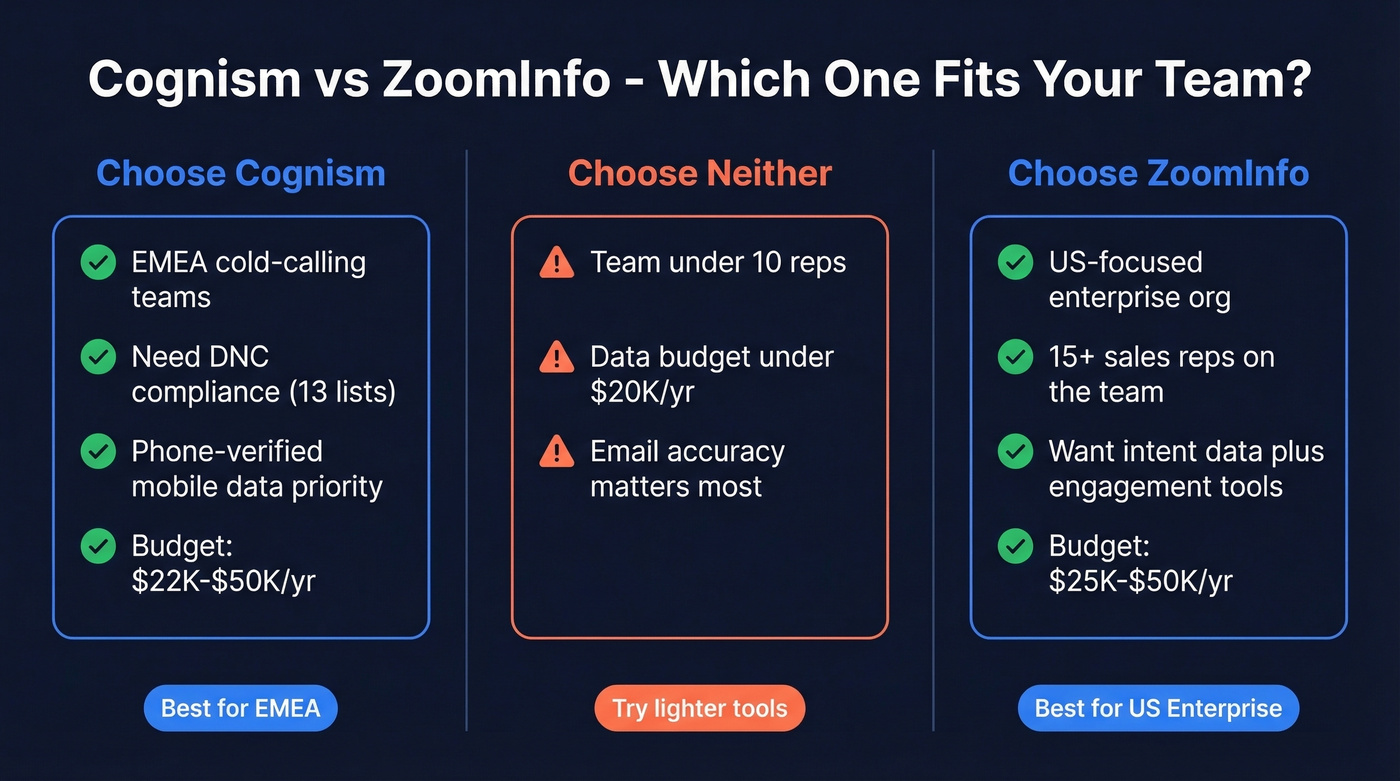
Choose ZoomInfo if you're a US-focused enterprise org with $25K+ to spend. Its massive North America coverage and bundled engagement tools create a single-platform GTM stack nobody else matches stateside.
Skip both if your team is under 10 reps or your data budget is under $20K/year. You don't need a six-figure platform to build pipeline - you need accurate data.
What Each Tool Actually Does
ZoomInfo is the incumbent enterprise sales intelligence platform. Its site advertises 500M+ contacts globally, 105M+ US mobile phone numbers, 110M+ companies, and 400M verified profiles, with the deepest coverage in North America. Beyond raw data, ZoomInfo bundles intent signals, conversation intelligence via Chorus, web forms, and workflow automation into a single platform. It's trying to run your entire revenue stack from one dashboard - and for large orgs, it often succeeds.
Cognism takes a narrower, sharper approach. It's built around phone-verified mobile data - branded as Diamond Data - and European compliance. Where ZoomInfo goes wide, Cognism goes deep on the things EMEA cold-calling teams care about: accurate direct dials, GDPR alignment, and DNC list coverage across Europe. The database is smaller, but the verification layer on mobiles is genuinely differentiated.
Data Quality and Coverage
Here's where vendor marketing diverges most from reality.
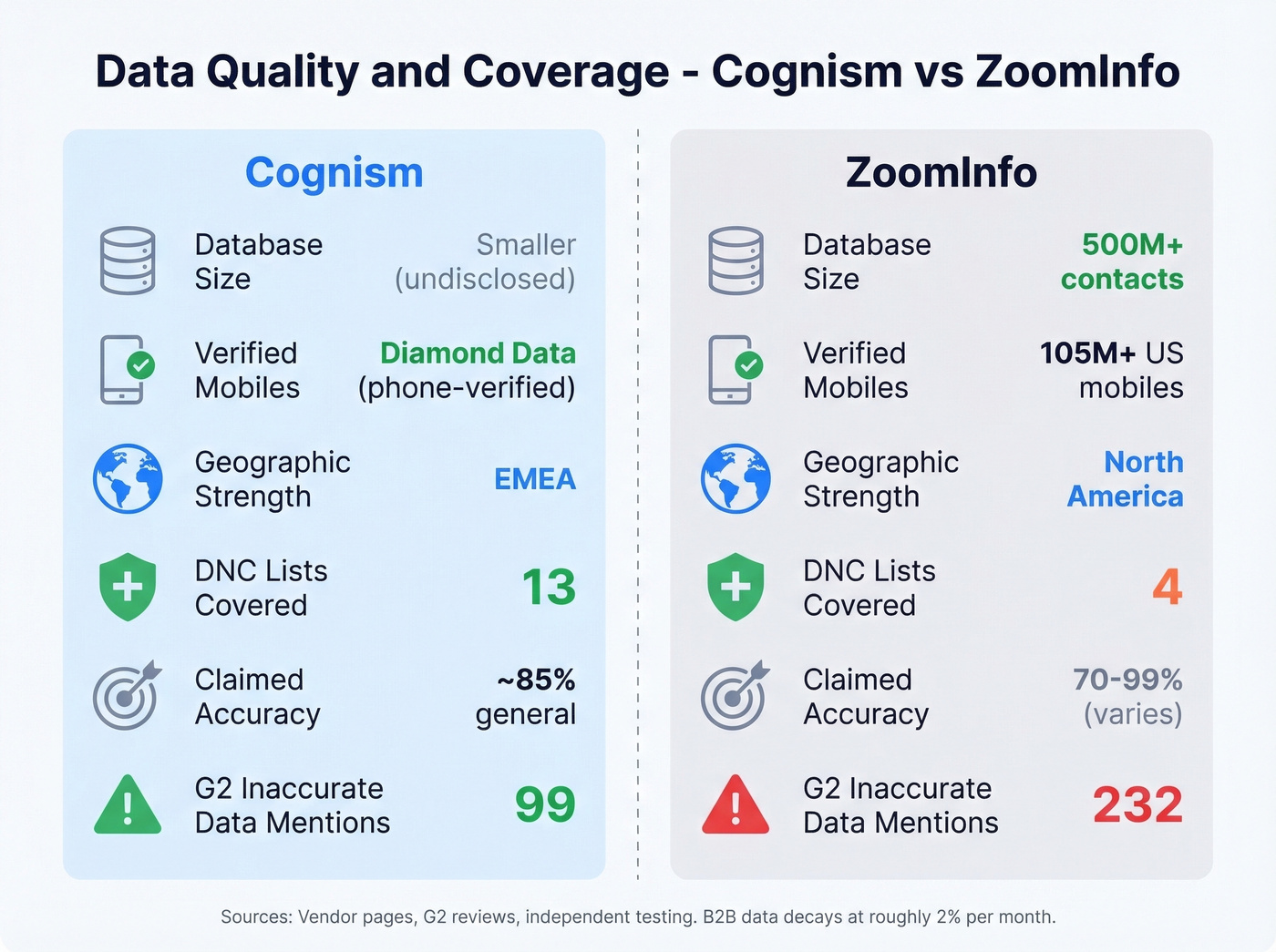
| Feature | Cognism | ZoomInfo |
|---|---|---|
| Database size | Smaller (undisclosed) | 500M+ contacts |
| Verified mobiles | Diamond Data (phone-verified) | 105M+ US mobile numbers |
| Geographic strength | EMEA | North America |
| DNC lists covered | 13 | 4 |
| Claimed accuracy | ~85% general; Diamond Data higher | 70-99% (varies by type) |
| G2 "Inaccurate Data" mentions | 99 | 232 |

The geographic split is the single most important factor in this decision. ZoomInfo's North American data is unmatched - no other provider comes close on US company and contact coverage. Outside NA, the quality drops noticeably. Multiple reviewers flag international data as thinner and more likely to be stale.
Cognism flips that equation. Its Diamond Data phone verification process produces better connect rates for UK and European prospects, and the 13 DNC list coverage matters: if you're cold calling into Europe without checking local do-not-call registries, you're risking fines, not just bounces.
We've tested both platforms side by side. The honest truth is that neither publishes independent accuracy benchmarks with real methodology. ZoomInfo's "70-99%" range is so wide it's almost meaningless. Cognism's ~85% general claim is more specific but still self-reported. ZoomInfo's own comparison page claims up to 9% higher email and mobile accuracy across EU markets versus Cognism, but doesn't publish methodology alongside that table.
B2B contact data decays at around 2% per month, so any database without aggressive refresh cycles degrades fast. The G2 complaint ratios tell the story directionally: ZoomInfo's "Inaccurate Data" and "Outdated Data" are each cited 232 times - more than double Cognism's "Inaccurate Data" count of 99, even accounting for ZoomInfo's larger review base.
Features and AI Tools
Worth evaluating:
- Intent data: Cognism's intent is Bombora-powered. ZoomInfo layers proprietary intent signals like WebSights, Scoops, and Champion Tracking, which can be a real edge for US-focused ABM plays.
- Chrome extension: Both offer one. Both work. Cognism's is slightly easier to get started with; ZoomInfo's has more depth once configured.
- CRM integrations: Salesforce and HubSpot work well with both. No meaningful difference here.
Skip these:
- ZoomInfo Copilot: Sounds impressive in demos. In practice, it's a paid add-on - expect a 10-20% uplift on your contract - and most teams don't activate it after the first month.
- Cognism's Sales Companion covers similar ground with AI-powered summaries, recommended contacts, and prospecting strategy, but it's included in the base package. That's a real difference worth noting.
- ZoomInfo's engagement suite: Chorus, webforms, and workflow tools are bundled to justify the price. If you're already running Outreach or Salesloft, you don't need ZoomInfo's versions. You're paying for overlap.

Neither Cognism nor ZoomInfo publishes independent accuracy benchmarks. Prospeo does: 98% verified email accuracy, 125M+ verified mobiles with 30% pickup rates, and a 7-day data refresh cycle - not the 4-6 weeks you get elsewhere. All at ~$0.01/email with no annual contract.
Stop paying $25K+ for self-reported accuracy numbers.
Pricing - What You'll Actually Pay
Both vendors make it deliberately hard to compare. Here's what we've pieced together from vendor pages, Vendr benchmarks, and real user reports.
ZoomInfo
ZoomInfo's list prices run across three tiers: Professional+ at $14,995/year, Advanced+ at $29,995/year, and Elite+ at $35,995/year. Professional+ includes 3 seats and 5,000 bulk credits. That sounds reasonable until you start adding what you actually need.
Extra credits run ~$3,000 per 5,000, which works out to $0.60/credit and drops to $0.20/credit at high volume. Additional users cost $2,500 each at list price. Global Data - which you'll need if you sell outside the US - adds $9,995. NeverBounce email verification is another ~$3,000. Copilot adds 10-20% to your total contract. One Reddit user reported paying $17,500 for 12 months on Advanced+, and that's before add-ons.
All-in, teams regularly spend $25K-$50K/year once the real configuration is done. ZoomInfo runs on a credit-based system where every search, export, and enrichment action costs credits, so your actual spend depends heavily on usage patterns.
Good news: discounts of 30-65% off list price are common. Push for single-year terms and Net-90 payment. Avoid multi-year commitments unless the discount exceeds 40%.
Cognism
Cognism uses a different commercial model: unrestricted views with exports controlled by fair-use limits, plus a platform fee and per-seat pricing.
The Grow tier runs ~$15,000 platform fee plus $1,500/user/year. Elevate, which includes Diamond Data, costs ~$25,000 platform plus $2,500/user/year.
Vendr benchmarks put a 5-user Grow contract at $22,513/year and a 5-user Elevate at $37,498 - a 67% premium for the phone-verified mobile data. A 10-user Elevate team hits roughly $50,000/year. Hidden costs to watch: onboarding runs $2,000-$5,000, API access adds $5,000-$15,000/year depending on volume, and intent topic add-ons cost $200-$400 per topic, though bundling can drop that to $75-$150/topic. Enrichment credits are sold in 1,000-credit increments at $0.45/credit for 5,000 and $0.35/credit for 10,000+. The "unlimited" access comes with fair-use limits - including up to 25 records per export action and roughly 2,000 records/user/month based on user reports.
Negotiation room exists: up to 29% off is achievable. Bundle intent topics for better per-topic rates.
Side-by-Side Pricing
| Scenario | Cognism | ZoomInfo |
|---|---|---|
| 3-person team | ~$19,500/yr (Grow) | ~$15,000/yr (Pro+) |
| 5-person team | ~$22,500/yr (Grow) | ~$25,000/yr (w/ add-ons) |
| 10-person team | ~$50,000/yr (Elevate) | ~$40,000-50,000/yr |
| Per-lead cost | ~$0.50-$1.00 | ~$0.60-$1.00 |
| Contract required | Yes (annual) | Yes (annual) |
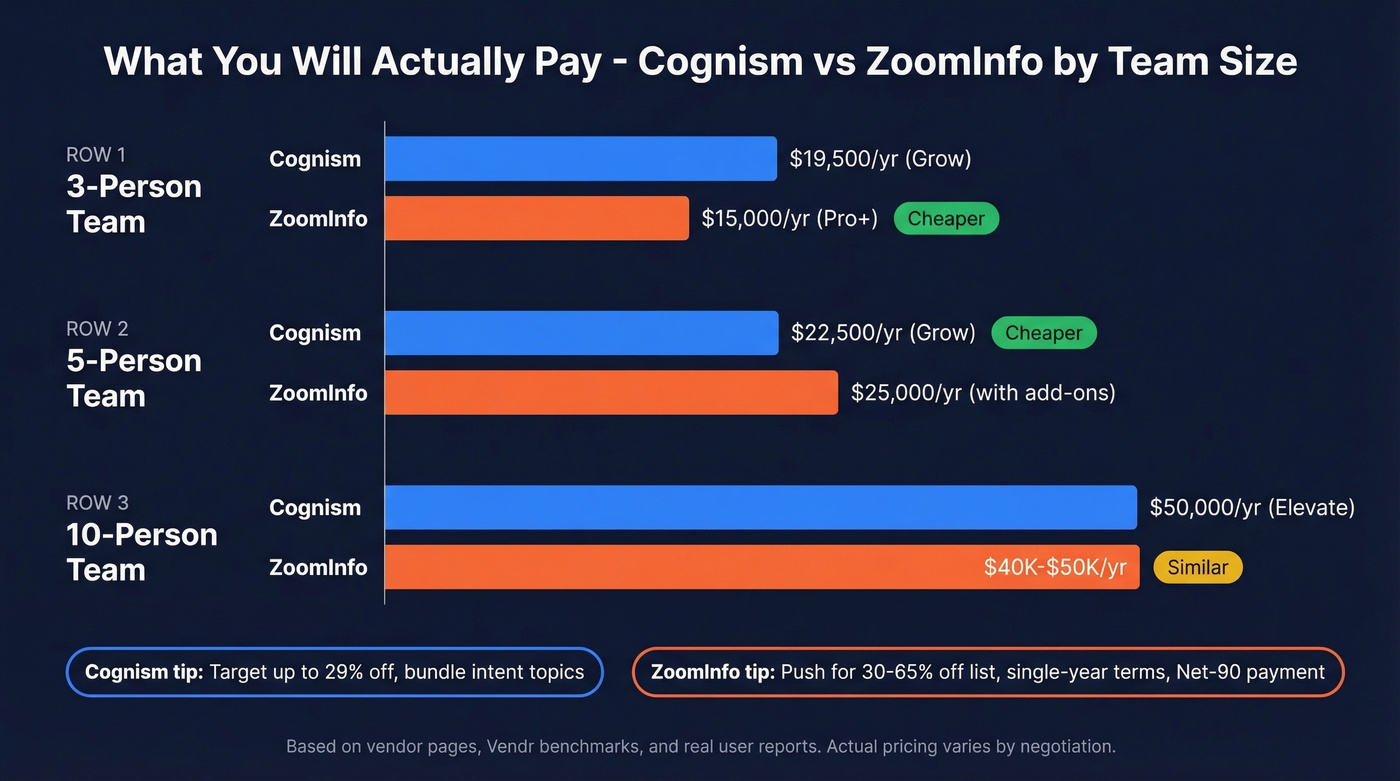
Negotiation tips: For ZoomInfo, push for 30-65% off list, single-year terms, and Net-90 payment. For Cognism, target up to 29% off and bundle intent topics for volume discounts. If you need a framework for discounting conversations, use an anchor early and define your walk away point before procurement starts.
Contract Terms and Hidden Traps
Before you sign either contract, know what you're agreeing to:
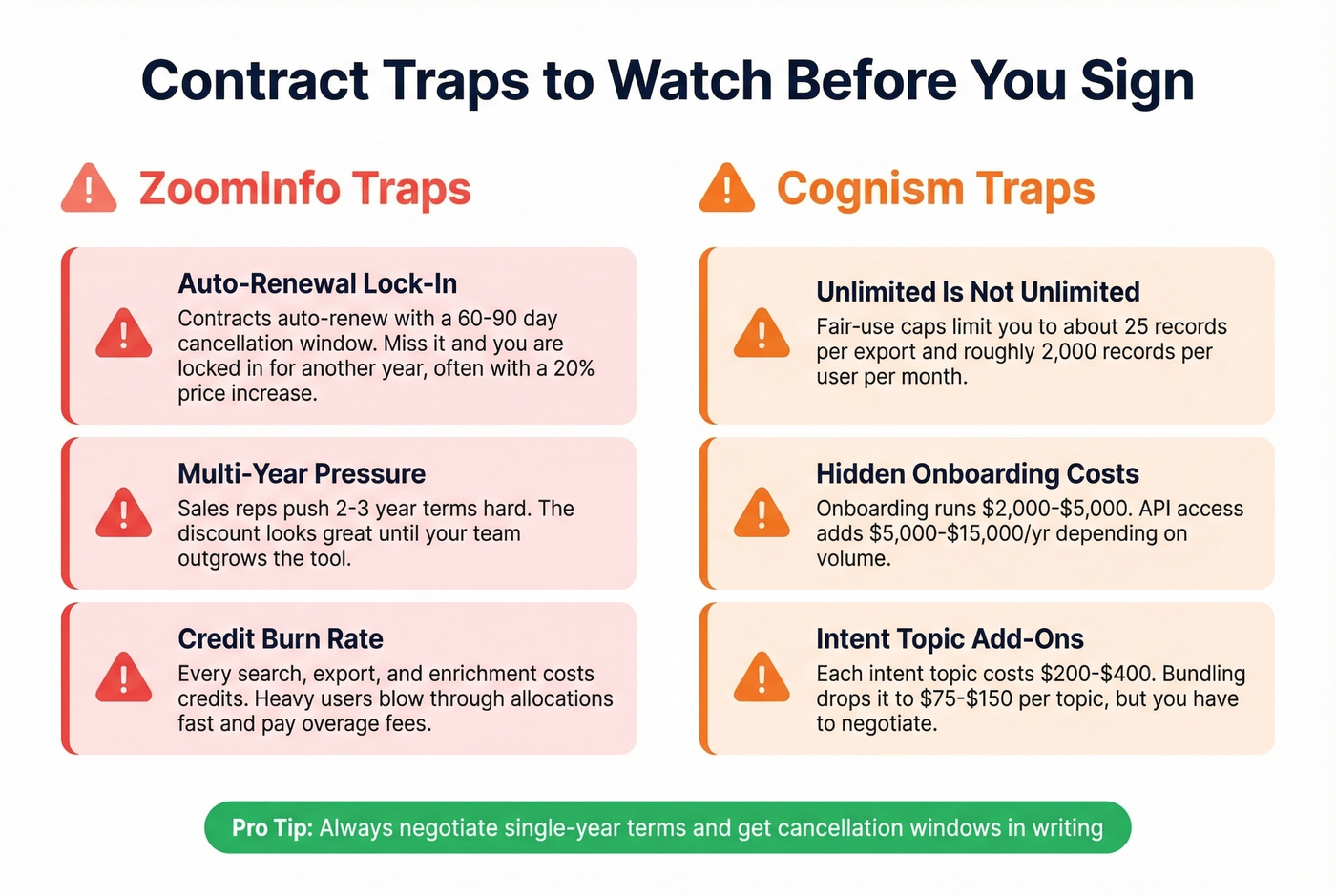
- ZoomInfo auto-renewal: Contracts auto-renew with a 60-90 day cancellation window. Miss it, and you're locked in for another year - often with a ~20% uplift at renewal.
- ZoomInfo multi-year push: Sales reps will push 2-3 year terms hard. The discount looks attractive until you realize you're locked into a tool your team might outgrow.
- Cognism export limits: "Unlimited" access comes with fair-use caps. Expect ~25 records per export action and roughly 2,000 records/user/month. Heavy prospecting teams hit these walls fast.
- Both require "talk to sales": Neither tool offers self-serve purchasing. Plan for a few weeks of procurement on either side.
- Switching costs: When you leave either platform, enrichment workflows and historical exports don't carry over cleanly. Factor that into your decision timeline.
What Real Users Say
Both tools carry a 4.5/5 on G2, but the review volumes tell different stories. ZoomInfo has 9,035 reviews to Cognism's 1,318 - ZoomInfo's been around longer and has a much larger install base.
Cognism edges ahead on ease of use (9.0 vs 8.8) and quality of support (9.1 vs 8.7). Cognism users consistently praise the onboarding experience and the responsiveness of their CS team. ZoomInfo's support is fine, but at enterprise scale, you're often navigating layers of account management before you reach someone who can actually help.
Where ZoomInfo takes hits: "Inaccurate Data" and "Outdated Data" are each cited 232 times in G2 cons - the two most prominent complaint categories. Cognism's "Inaccurate Data" count sits at 99, with "Incorrect Numbers" at 62.
Here's the thing: Cognism's phone numbers aren't as reliable as the Diamond Data branding suggests. The verification is real, but numbers still go stale. And ZoomInfo's data decays faster than their marketing implies - especially outside North America. Set expectations accordingly for both.
Our take? ZoomInfo is still the best all-in-one platform for US enterprise sales. But most teams don't need all-in-one. They need accurate emails and working phone numbers. If your deal sizes sit below $15K, you're probably overpaying for platform features your reps will never touch.
If you're building a modern outbound motion, it also helps to pressure-test your sales prospecting techniques and make sure your stack includes the right SDR tools before you commit to a six-figure data contract.
When to Choose Which
Choose Cognism if you're building an EMEA cold-calling motion, need DNC compliance across 13 European lists, and value phone-verified mobiles over database breadth. Budget: $22K-$50K/year.
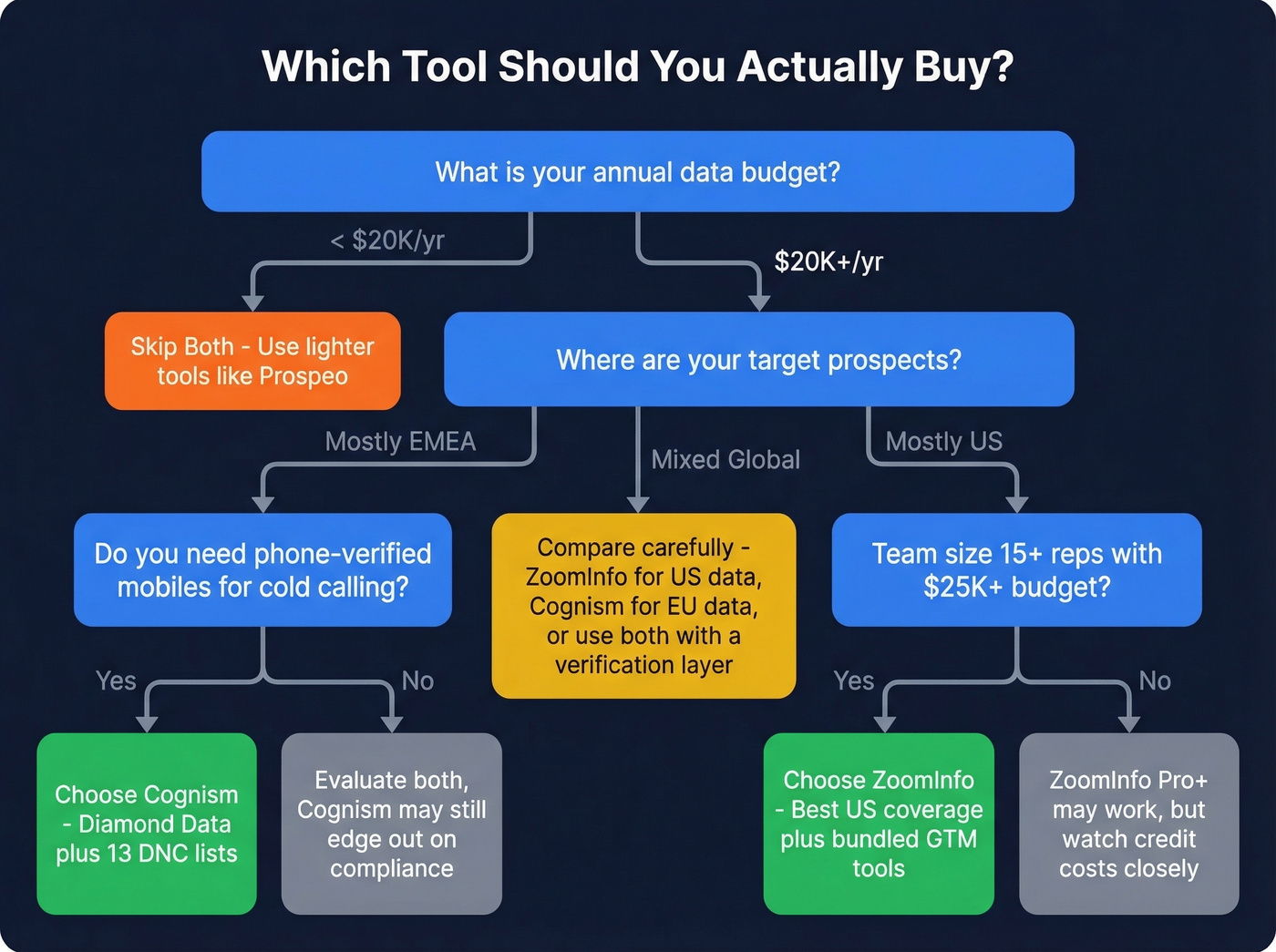
Choose ZoomInfo if you're a US-focused enterprise with 15+ reps, want intent data and engagement tools in one platform, and have $25K-$50K/year plus the procurement bandwidth to manage the contract.
Choose neither if your team is under 10 reps, your data budget is under $20K/year, or you care more about email accuracy and direct dials than platform features you'll never configure. In our experience, most teams in this bracket get better results from lighter, self-serve tools.
For teams exploring alternatives, Apollo.io starts at ~$49/month for individuals and Lusha offers a free tier with paid plans from ~$36/month per user. Apollo is usually the "cheap and broad" option, while Lusha is simpler but smaller in database depth. Neither matches the enterprise packaging of the two main contenders here.
If you're comparing vendors beyond these two, start with a broader list of sales prospecting databases and shortlist based on your data enrichment services needs (CRM sync, refresh cadence, and field coverage).
A Third Option Worth Testing
If you're spending $25K+ per year and still cleaning bad data out of your CRM every quarter, the problem isn't which enterprise platform you picked. It's the data model itself.
Prospeo covers 300M+ professional profiles with 98% email accuracy, 143M+ verified emails, and 125M+ verified mobiles that hit a 30% pickup rate. Data refreshes every 7 days - not the 4-6 week cycle most platforms run. You get 30+ search filters including buyer intent, technographics, and job change signals.
The pricing difference is stark: roughly $0.01/lead versus $0.60-$1.00 at either Cognism or ZoomInfo. A 5-person team pays ~$200/month with no annual contract. There's a free tier so you can test before committing anything. Meritt tripled their pipeline from $100K to $300K/week after switching, while dropping their bounce rate from 35% to under 4%. If you're trying to keep deliverability stable while scaling, track your email bounce rate and follow a real email deliverability guide before you ramp volume.

ZoomInfo charges $15K-$50K/year. Cognism's Elevate runs $37K+ for 5 users. Prospeo gives you 300M+ profiles, 30+ search filters, intent data, and verified direct dials - starting free. Teams using Prospeo book 26% more meetings than ZoomInfo and 35% more than Apollo.
Get enterprise-grade B2B data without the enterprise invoice.
FAQ
Is Cognism or ZoomInfo better for European prospecting?
Cognism wins for EMEA. Its Diamond Data phone verification and coverage across 13 European DNC lists make it the stronger choice for cold calling into the UK and EU. ZoomInfo's international data is thinner, with reviewers consistently flagging stale records outside North America.
Can you negotiate ZoomInfo pricing?
Yes - discounts of 30-65% off list price are common. Push for single-year terms instead of multi-year lockups, avoid bundled add-ons you won't use, and request Net-90 payment terms. The first offer is never the final offer.
What's the real cost difference between Cognism and ZoomInfo?
For a 5-person team, Cognism Grow runs ~$22,500/year while ZoomInfo Professional+ starts at ~$15,000/year but typically reaches $25,000+ with add-ons and extra credits. Both require annual contracts and sales conversations to purchase.
Is there a cheaper alternative to both?
Prospeo delivers 98% email accuracy and 125M+ verified mobiles at roughly $0.01/lead - 90% cheaper than either platform. It's self-serve with no annual contract, and its 7-day data refresh cycle keeps records fresher than the industry average.
How accurate is ZoomInfo's data in 2026?
ZoomInfo positions accuracy as varying by data type, often framed as a wide 70-99% range. G2 reviews show "Inaccurate Data" and "Outdated Data" as the two most-cited complaints with 232 mentions each. Expect strong results on fresh North America records and more cleanup work internationally.