

Cold Call Email Templates: Before, During, and After the Call
Every template list you'll find organizes by copywriting framework - PAS, BAB, AIDA - as if you're sitting down to craft a masterpiece. That's not how cold calling works. You hang up the phone, you've got 10 minutes before the prospect forgets your name, and you need the right cold call email template now.
Threads on r/salestechniques are full of reps asking for exactly this: a follow-up email after a cold call. What they get instead is generic outreach templates with no connection to the phone. This article organizes by what actually happens during your workday - you pick up the phone, and then you need the right email to pair with it.
We've built these templates around the actual cold-calling workflow, plus the benchmarks and deliverability basics that make them land. One prerequisite before any of this matters: your emails need to actually arrive. Verify your list first, then worry about copy.
The Four Templates That Cover 90% of Scenarios
- Post-cold-call follow-up - they picked up, you talked, now cement it
- Voicemail follow-up - they didn't pick up, you left a message
- Pre-call warm-up - send before you dial to boost pickup rates
- Breakup email - final touch after multiple attempts
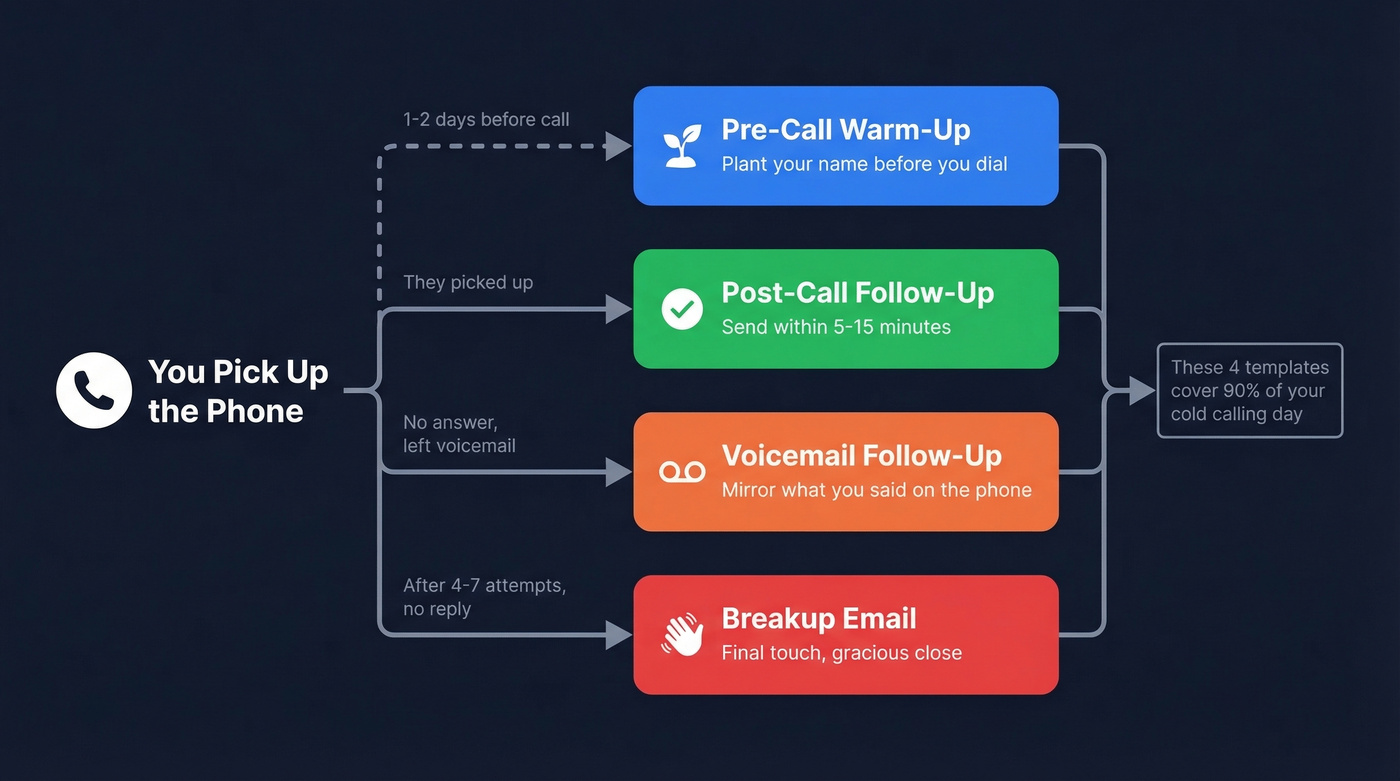
That's it. Everything else is a variation.
2026 Cold Email Benchmarks
Here are the numbers you need before you start writing. Instantly's 2026 benchmark report analyzed billions of cold email interactions:
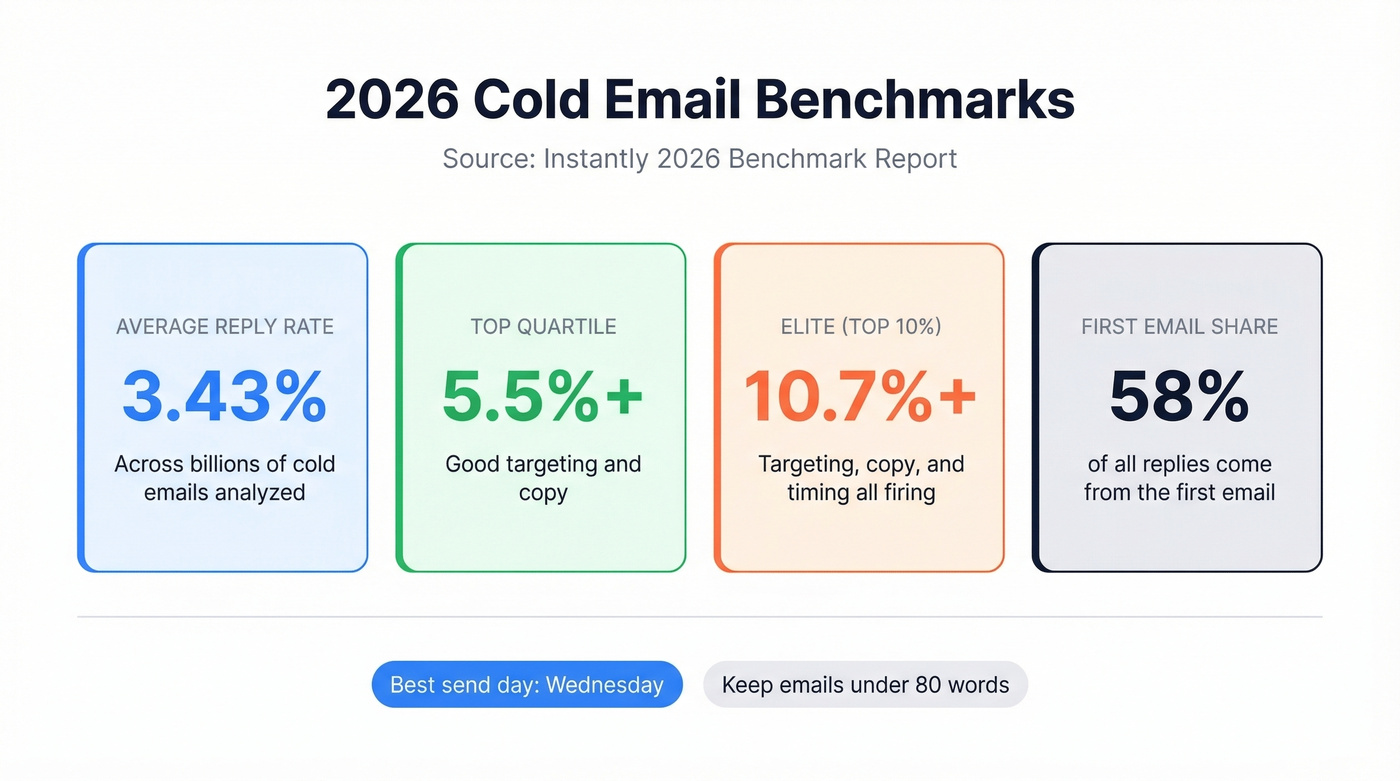
- Average reply rate: 3.43%
- Top quartile: 5.5%+
- Top 10% (elite): 10.7%+
The stat that should shape your entire strategy: 58% of all replies come from the first email in a sequence. Follow-ups capture the remaining 42%, but that first touch does the heavy lifting. Wednesday is the highest-performing send day, with Tuesday close behind.
For context, ActiveCampaign's most recent dataset shows opted-in marketing emails averaging a 39.26% open rate. Cold outreach lives in a completely different universe. You're interrupting strangers, not emailing subscribers. A 3.43% reply rate isn't bad - a 10%+ reply rate means your targeting, copy, and timing are all firing together.
Best performers keep emails under 80 words and A/B test subject lines weekly. That brevity matters even more when you're pairing emails with phone calls.
Templates for Every Stage
These five templates map to the stages of a cold-calling workflow. Each one has a specific trigger and timing window.
Pre-Call Warm-Up Email
Send this 1-2 days before you plan to call. The goal isn't to get a reply - it's to make your name familiar so they're more likely to pick up the phone.
Subject: Quick question about [specific initiative/challenge]
Hi [First Name],
I noticed [company] is [specific observation - hiring for X role, expanding into Y market, using Z tool]. We help teams like yours [one-sentence value prop].
I'll try you later this week for a quick 2-minute conversation. If email's easier, just hit reply.
[Your name]
Keep it around 40-60 words in the body. You're planting a seed, not pitching.
Post-Cold-Call Follow-Up
This is the template most people actually need - and the one that separates good reps from great ones. Send it within 5-15 minutes of hanging up, while your name is still fresh. Same-day at the absolute latest.
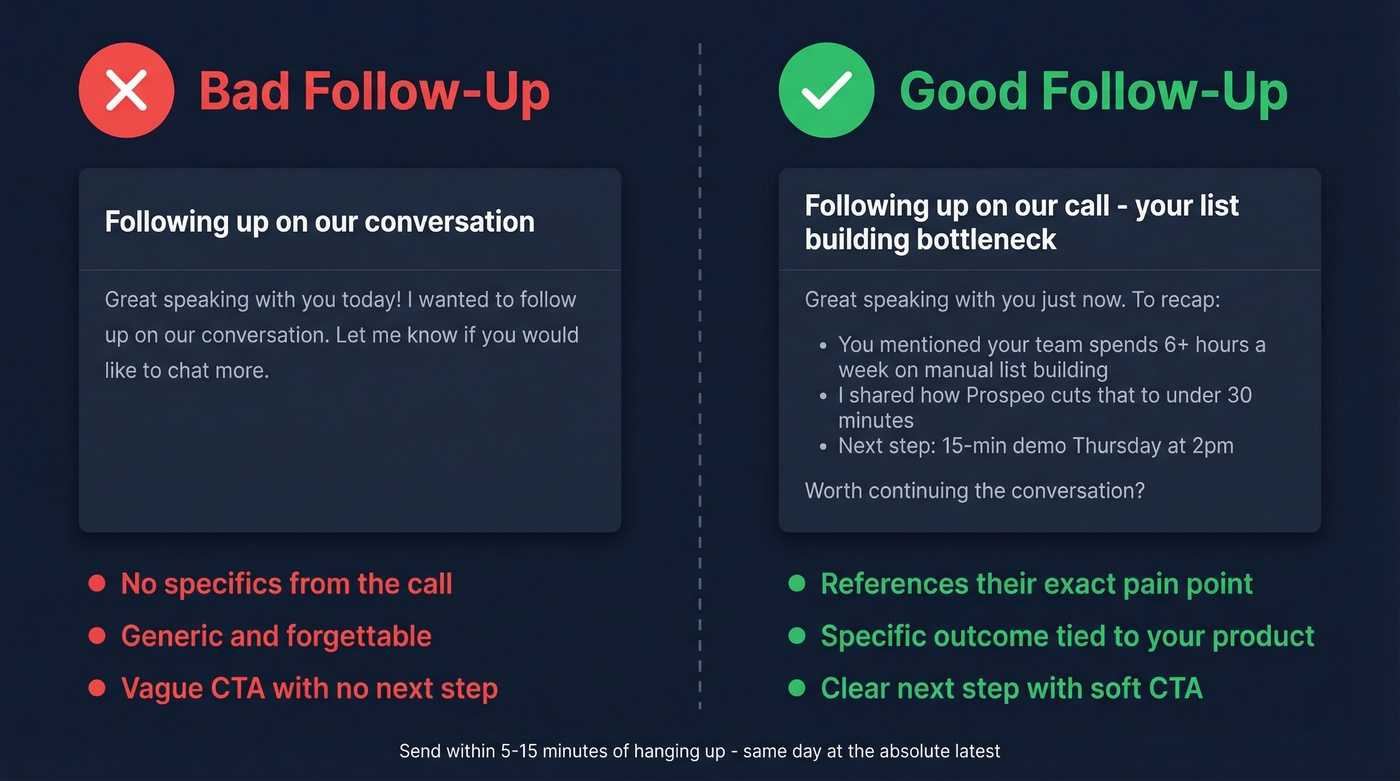
Here's what a bad version looks like versus a good one:
Bad: "Great speaking with you today! I wanted to follow up on our conversation. Let me know if you'd like to chat more."
Good:
Subject: Following up on our call - [one key topic]
Hi [First Name],
Great speaking with you just now. To recap:
- You mentioned [their specific pain point or goal]
- I shared how [your solution] helps with [specific outcome]
- Next step: [whatever you agreed on - demo, intro to another stakeholder, sending a resource]
[Attached resource / link to calendar / relevant case study]
Worth continuing the conversation?
[Your name]
The difference is specificity. "You mentioned your team's spending 6 hours a week on manual list building" is memorable. "Great speaking with you" alone is forgettable. The single soft CTA - "Worth continuing the conversation?" - keeps friction low. In our experience, this is the highest-ROI email a rep can send all day, and most reps skip it because they're already dialing the next number.
Voicemail Follow-Up Email
Mirror what you said on the phone so the two touches reinforce each other. Send within 5-15 minutes of leaving the voicemail.
Subject: Just left you a voicemail
Hi [First Name],
I just tried calling and left a quick message. The short version: I work with [similar companies/titles] who [specific result you deliver].
I'd love 10 minutes to see if this is relevant for [their company]. Would [day] or [day] work?
[Your name]
"Just left you a voicemail" works as a subject line because it's honest and creates continuity. They heard your voice, now they see your name in their inbox. That one-two punch is what makes the cold call + email combination far more effective than either channel alone.
Post-Meeting Recap
After a discovery call or demo, send a recap the same day. Ambiguity after a meeting kills deals - this email eliminates it.
Subject: Recap + next steps from today
Hi [First Name],
Thanks for the time today. Here's what we covered:
- [Key pain point discussed]
- [Solution/approach you proposed]
- Next step: [specific action - send proposal by Friday, intro to VP of Ops, schedule pilot]
I'll [your next action] by [date]. Let me know if anything shifts on your end.
[Your name]
Breakup Email
The final touch after 4-7 attempts with no response. Breakup emails often pull a spike in replies. Something about "I'll stop emailing you" triggers a response.
Subject: Should I close the loop?
Hi [First Name],
I've reached out a few times and haven't heard back - totally understand if the timing isn't right.
I'll assume this isn't a priority right now and won't follow up again. If things change, I'm here.
[Your name]
Short and gracious. No guilt trips, no passive aggression.
Classic Cold Email Frameworks
These are for pure cold outreach - no prior call, no voicemail, no existing relationship. Think of them as standalone cold call email examples you can adapt when you haven't yet spoken to the prospect. They're included for completeness, but the real edge in this article is the cold-call-specific templates above. If you're only going to use one section, use that one.
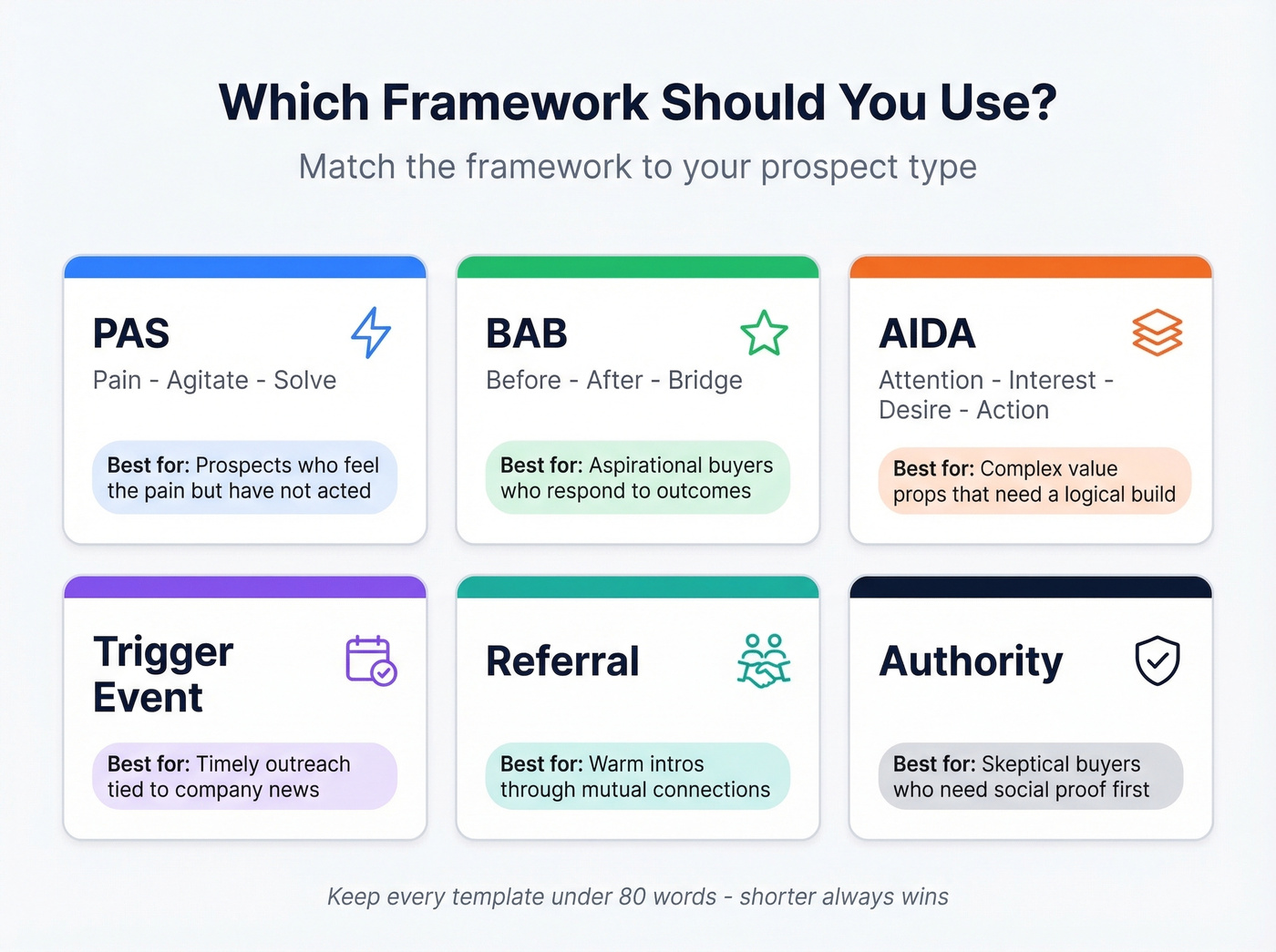
Keep every template under 80 words. Here's when to reach for which:
| Framework | Best For |
|---|---|
| PAS | Prospects who feel the pain but haven't acted |
| BAB | Aspirational buyers who respond to outcomes |
| AIDA | Complex value props that need a logical build |
| Trigger Event | Timely outreach tied to company news |
| Referral | Warm introductions through mutual connections |
| Authority | Skeptical buyers who need social proof first |
Pain-Agitate-Solve (PAS)
Subject: [Pain point] at [Company]
Hi [First Name],
Most [title]s at [industry] companies tell us [pain point] is eating 5+ hours a week. The worst part? It gets worse as you scale - more reps, more bad data, more wasted dials.
We built [product] to fix that. [One-sentence proof point]. Worth a quick look?
Before-After-Bridge (BAB)
Subject: What if [desired outcome]?
Hi [First Name],
Right now, your team is probably [current frustrating state]. Imagine instead: [desired future state with specific metric].
[Product] bridges that gap. [Customer name] made the switch and saw [result]. Can I show you how in 15 minutes?
AIDA
Subject: [Surprising stat] about [their industry]
Hi [First Name],
[Industry] teams lose an average of [stat] per quarter to [problem]. Your team at [Company] is likely no exception - especially with [specific observation about their situation].
[Product] cuts that number by [metric]. [Customer name] saw results in [timeframe].
Worth 10 minutes to see if it fits?
Trigger Event
Subject: Congrats on [trigger - funding round, new hire, expansion]
Hi [First Name],
Saw that [Company] just [trigger event]. When teams hit this stage, [common challenge] usually follows.
We help [similar companies] navigate that by [specific value]. Relevant for you right now?
Referral / Mutual Connection
Subject: [Mutual connection] suggested I reach out
Hi [First Name],
[Name] mentioned you're the right person to talk to about [topic]. We recently helped [their company/similar company] with [result].
Would a 10-minute call make sense this week?
Authority / Social Proof
Subject: How [known company] solved [problem]
Hi [First Name],
[Known company] was dealing with [problem you solve]. After switching to [your solution], they [specific metric improvement].
Your team at [Company] looks like a strong fit for the same approach. Open to a quick conversation?

Every template above is worthless if it lands in a bounce folder. Prospeo's 98% email accuracy and 7-day data refresh mean your post-call follow-ups actually reach the inbox - not a dead address your last provider gave you six weeks ago.
Verify your list before you pick up the phone.
Writing Tips That Boost Reply Rates
Templates are starting points. Here's what separates emails that work from the ones that get archived.
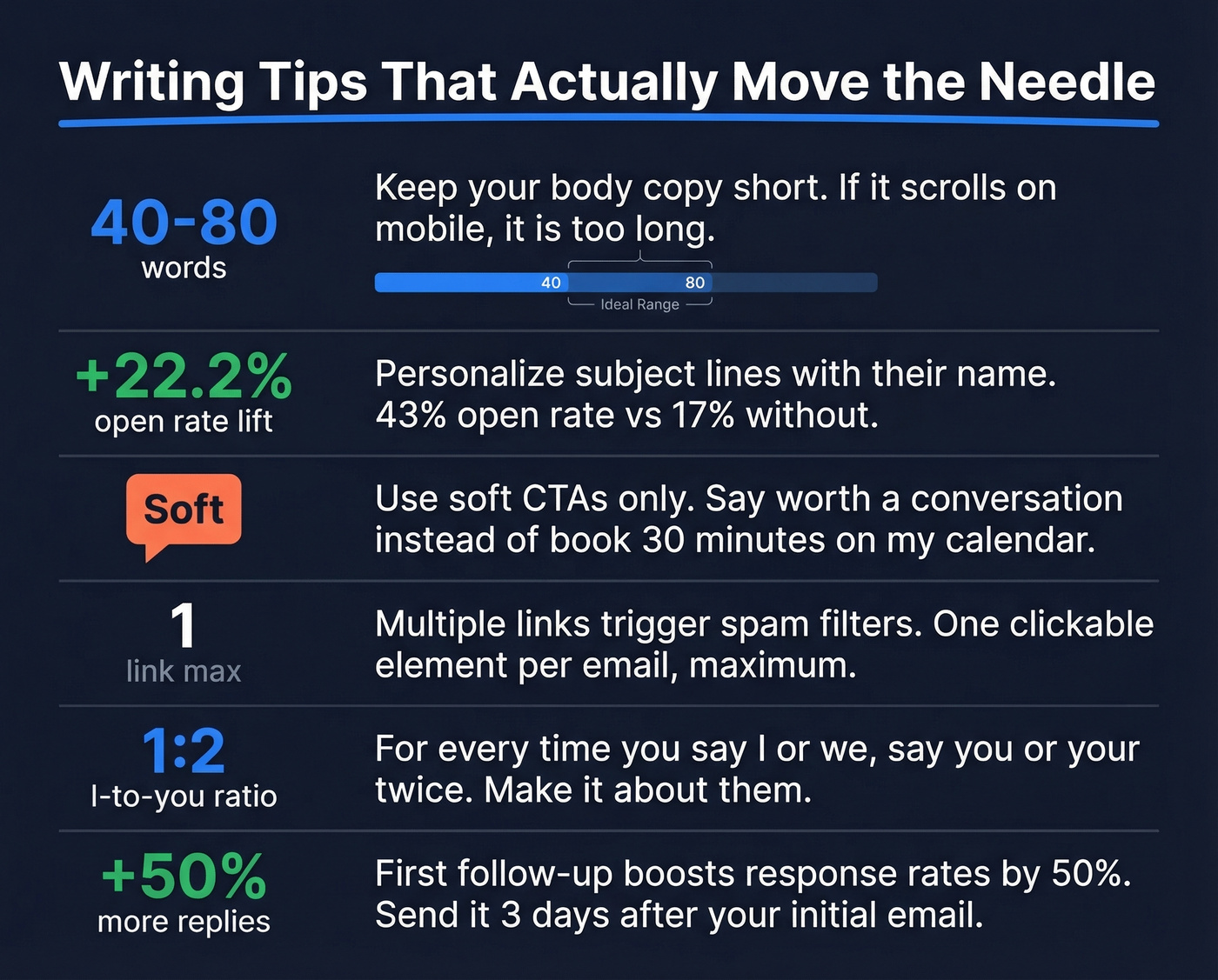
Body length: 40-80 words. The practitioner consensus on Reddit and Instantly's data both point the same direction - shorter wins. If your email scrolls on mobile, it's too long.
Personalized subject lines boost opens by 22.2%. Subject lines with the recipient's name hit 43.41% open rates vs 16.67% without personalization. That's not a marginal difference - it's the single easiest win you can implement today. If you need ideas, borrow from these subject lines.
Soft CTAs only. "Worth a conversation?" beats "Book 30 minutes on my calendar." Lower friction, higher response. (More examples: email call to action.)
One link maximum. Multiple links increase spam risk. If you need to share a resource, make it the only clickable element.
Plain text over HTML. Logos, images, and fancy formatting trigger spam filters. Write like you're emailing a colleague.
1:2 I/you ratio. For every time you say "I" or "we," say "you" or "your" twice. The email is about them, not you.
Follow up. The first follow-up increases B2B response rates by 50%, with optimal timing at three days after the initial email. We've seen reps who skip follow-ups entirely and then wonder why their pipeline is dry. If you want more options, use these sales follow-up templates.
The best outreach emails share one trait: they reference something specific about the prospect's situation. A script that relies on generic filler - "I help companies like yours" - will always underperform one that names a real pain point. If you want a deeper playbook, start with email copywriting.
The 2-Week Multi-Channel Cadence
Cold emails don't work in isolation. Combining email, phone, and social touchpoints can increase response rates by 287% compared to single-channel outreach. Here's a concrete 14-day framework:
| Day | Channel | Action |
|---|---|---|
| 1 | First cold email | |
| 2 | Social | Profile visit |
| 3 | Social | Connection request |
| 5 | Follow-up (new angle) | |
| 6 | Phone | First cold call |
| 8 | Social | Direct message |
| 10 | Phone | Second cold call |
| 14 | Breakup email |
The phone calls land on days 6 and 10 intentionally - by then, the prospect has seen your name in their inbox and on social. You're not a stranger anymore. Space follow-ups 2-3 days apart and aim for midweek mornings (Tuesday through Thursday) for initial touches. The 4-7 touchpoint sweet spot balances persistence with professionalism. Beyond 7 touches, returns drop off unless each one adds genuinely new value.
Here's the thing: if your average deal size is under $5k, you probably don't need a 14-day multi-channel cadence. A 3-touch email sequence with one call will get you 80% of the results at 20% of the effort. Save the full cadence for deals worth the time investment.
Most reps skip the phone calls because they're uncomfortable. That's exactly why calls work - your competitors aren't making them either. If you're building a repeatable process, use a cold calling system.
Deliverability Checklist
None of these templates matter if your emails land in spam. Run through this before you send a single message:
- SPF, DKIM, DMARC - all three configured and passing. (If you need a deeper walkthrough, use this email deliverability guide.)
- Warm-up ramp - start new domains at 5-10 emails/day. Increase gradually over 4-6 weeks until you're at 40-50/day. Rushing this is the fastest way to burn a domain. If you're shopping tools, start with unlimited email warmup.
- Custom tracking domain - set up a CNAME so you're not sharing reputation with every other user on your email tool's default tracking domain. (More detail: tracking domain.)
- Inbox placement 80%+ - run seed tests. If you're below 80%, stop sending and fix the issue before scaling.
- Spam complaints under 0.3% - above this threshold, mailbox providers start throttling you.
- Bounce rate under 2% - anything higher signals to ISPs that you're sending to bad lists. (Benchmarks + fixes: email bounce rate.)
- One-click unsubscribe header - RFC 8058 compliance via List-Unsubscribe and List-Unsubscribe-Post headers. Required for bulk senders.
- Plain text, one link max - already on the writing checklist, but it's a deliverability issue too.
- Verify every email before it enters your sequence. Tools like Prospeo run multi-step verification with catch-all handling and spam-trap removal, catching bad addresses before they damage your domain. The free tier covers 75 verifications per month - enough to test before committing.
Mistakes That Kill Response Rates
Sending from an unwarmed domain. New domains have zero reputation. Warm up for 4-6 weeks minimum. I've watched teams burn through three domains in a quarter because they refused to wait.
Skipping SPF/DKIM/DMARC. Table stakes with Google, Yahoo, and Microsoft bulk-sender rules now enforced. Without authentication, your emails go straight to spam.
Using generic, unresearched templates. "I help companies like yours grow revenue" tells the prospect nothing. Even the best template falls flat without personalization.
Loading up HTML, images, and multiple links. Every extra element increases spam risk. Plain text, one link.
Using a shared tracking domain. Your sender reputation gets tangled with everyone else on the platform. Set up a custom CNAME.
Multiple CTAs. "Book a call, download our whitepaper, and check out our case study" gives three reasons to do nothing.
Sending to unverified lists. Bad data is one of the fastest ways to damage domain reputation. If your bounce rate exceeds 2%, clean your list before sending another email.
Pre-call warm-ups only work when you have the prospect's real email and direct dial. Prospeo gives you both - 143M+ verified emails and 125M+ mobile numbers with a 30% pickup rate, all at $0.01 per email.
Stop dialing switchboards and emailing dead addresses.
CAN-SPAM in 30 Seconds
CAN-SPAM applies to all commercial email - including B2B. No exception. Penalties run up to $53,088 per email in violation:
- Accurate "From," "To," and "Reply-To" headers
- Non-deceptive subject lines
- Clear disclosure that the message is an ad
- Valid physical postal address included
- Clear opt-out mechanism in every email
- Honor opt-outs within 10 business days
- Never sell or transfer opted-out email addresses
Build it into your templates from day one. Skip this if you enjoy writing checks to the FTC.
FAQ
How quickly should I email after a cold call?
Within 5-15 minutes - while your name is still fresh. This window makes your email feel like a natural continuation of the conversation, not a random follow-up. Same-day is the absolute latest, but sooner always wins.
What's a good reply rate for cold emails?
The average cold email reply rate is 3.43%. Top performers hit 10.7%+. Above 5.5% puts you in the top quartile. Below 1% means your targeting, copy, or deliverability needs work - probably all three.
How many follow-ups should I send?
Aim for 4-7 touchpoints across your sequence. 58% of replies come from the first email, but follow-ups capture the other 42%. Beyond 7 touches, returns drop sharply unless each message introduces genuinely new value.
Should I use HTML or plain text?
Plain text. HTML templates with images, logos, and multiple links trigger spam filters and signal "marketing blast" rather than personal outreach. One link maximum - write like you're emailing a colleague, not designing a newsletter.
How do I keep my cold emails from bouncing?
Verify every address before sending and keep your bounce rate under 2%. Multi-step verification with catch-all handling and spam-trap removal catches bad addresses before they damage your domain. Let's be honest - if you're still sending to unverified lists in 2026, you're burning money and domains simultaneously.