

Cold Call Research: How to Prep Smarter Without Killing Your Dial Count
It's 9:15 AM. You've been staring at a prospect's profile for twelve minutes, reading about their volunteer work and scanning a podcast appearance from 2023. You haven't dialed once. Meanwhile, the rep two desks over just booked a meeting on her fourteenth call - with about ninety seconds of prep.
That gap is what smart cold call research looks like in practice. A thread on r/sales nails the dilemma: with a 5-7% pickup rate across 100 dials, researching all 100 feels like a waste. The poster's right - and wrong. 82% of B2B decision-makers think sales reps show up unprepared, and 76% of top performers research prospects before every call. The fix isn't more research. It's smarter research on fewer prospects.
The Quick Version
- Tier your prospects. Tier 3 gets 2 minutes. Tier 2 gets 5. Tier 1 gets 15.
- Research triggers, not trivia. Funding rounds, hiring surges, and leadership changes beat company history every time.
- Verify your data before you research anything. A wrong phone number makes all that prep worthless.
Why Pre-Call Research Matters
The gap between average reps and top performers isn't talent - it's preparation quality. [Gong's dataset of 300M+ cold calls] tells the story: average reps connect on 5.4% of dials while top-quartile reps hit 13.3%. Once connected, top reps book meetings on 16.7% of conversations versus 4.6% for average reps. At 800 dials per month, that's roughly 2 meetings for the average rep versus 18 for the top performer. Read that again. Nine times the output from the same dial volume.
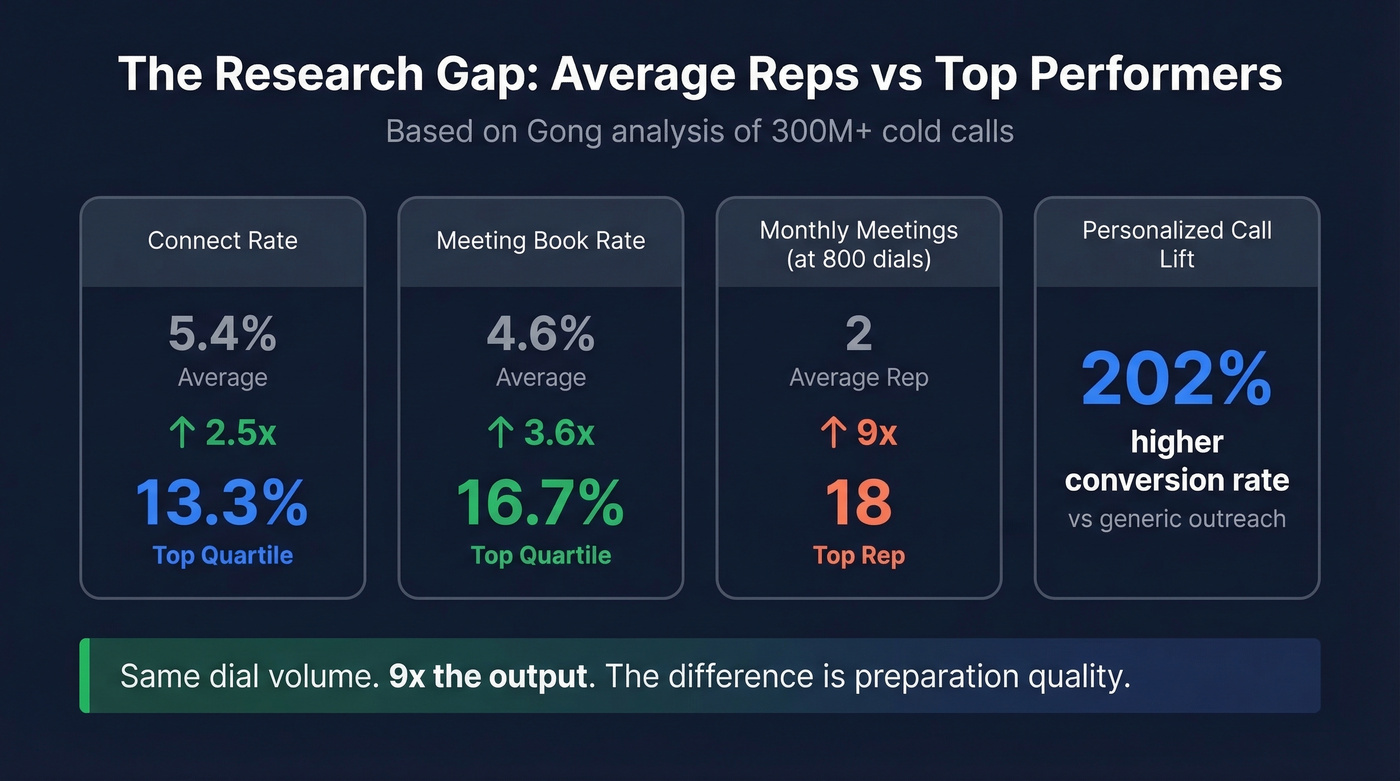
Personalized, research-backed calls drive up to 202% higher conversion rates than generic outreach. And buyers contact sellers around 61% into their journey - the pre-contact favorite wins roughly 80% of the time. Your prospect research determines whether you're on that shortlist.
The math is simple. Preparation works. The question is how much.
The Tiered Pre-Call Research System
Not every prospect deserves the same prep time. A $5K deal and a $150K enterprise opportunity shouldn't get identical research investment. We've found this tiered framework is the most practical way to balance quality and volume.
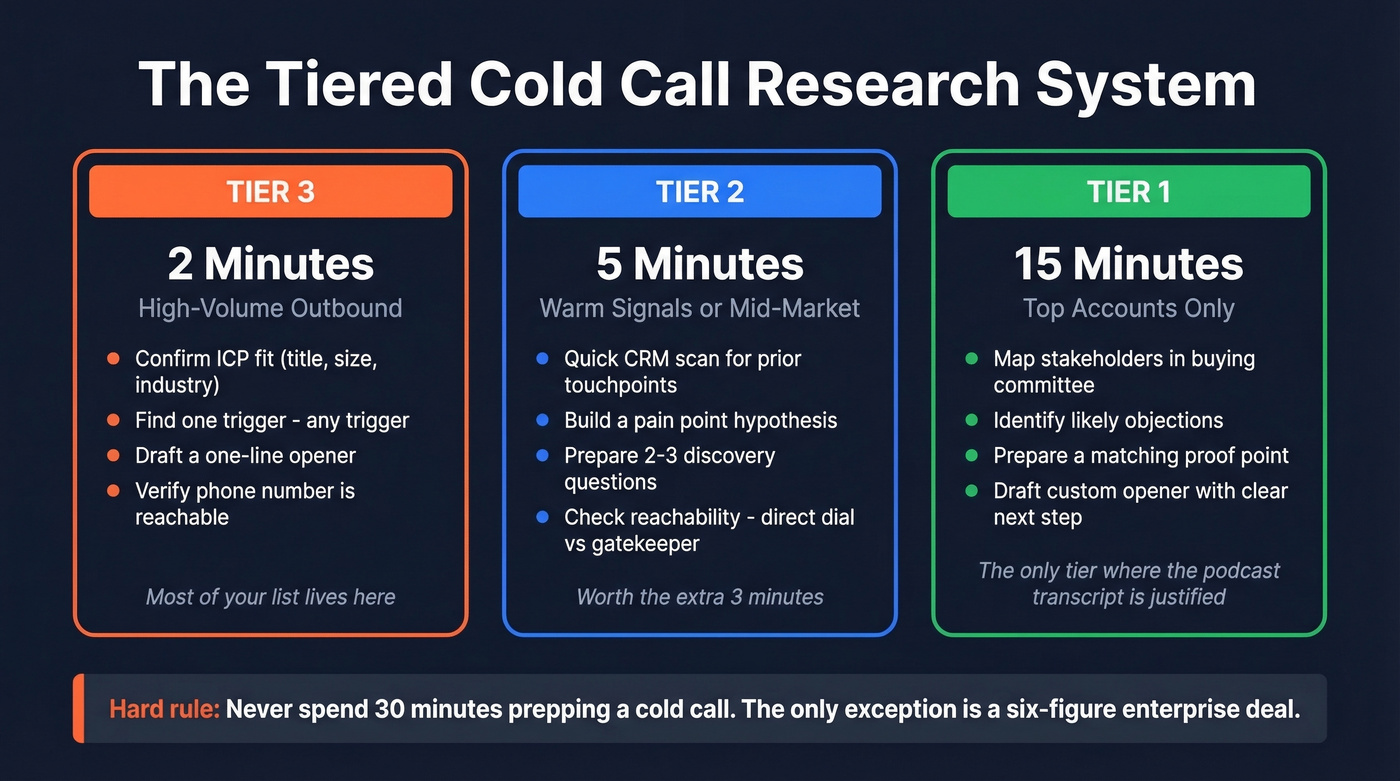
Tier 3: 2 Minutes (High-Volume Outbound)
Confirm ICP fit - right title, right company size, right industry. Find one trigger, any trigger. Draft a one-line opener referencing it. Verify the phone number is reachable. This is your bread and butter for SDR prospecting, and most of your list lives here.
Tier 2: 5 Minutes (Warm Signals or Mid-Market)
Quick CRM scan for prior touchpoints. Build a hypothesis about their likely pain point. Prepare 2-3 discovery questions and check reachability - direct dial versus gatekeeper.
Tier 1: 15 Minutes (Top Accounts Only)
Map stakeholders, identify likely objections, prepare a proof point that matches their situation, and draft a custom opener with a clear next-step ask. This is the only tier where reading that podcast transcript is justified.
The hard rule: never spend 30 minutes prepping a cold call. The only exception is a six-figure enterprise deal where you're multi-threading into a buying committee.
Trigger Events That Actually Matter
Firmographics tell you who to contact. Triggers tell you when. A VP of Engineering at a 200-person SaaS company is a decent prospect. That same VP, three weeks after closing a Series B? That's a conversation waiting to happen.
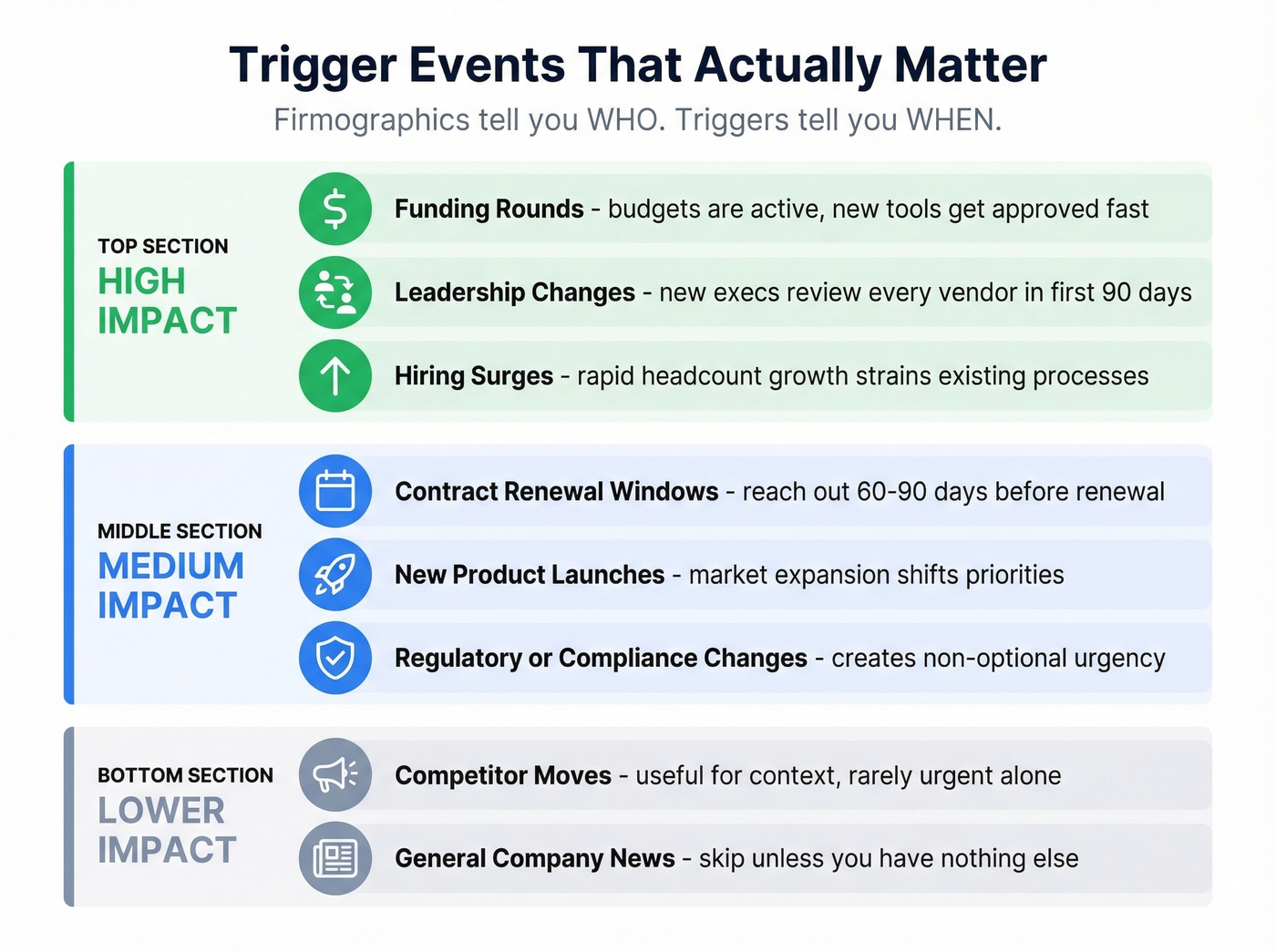
High impact: Funding rounds where budgets are active and new tools get approved fast, leadership changes where new execs in their first 90 days review every vendor, and hiring surges where rapid headcount growth strains existing processes.
Medium impact: Contract renewal windows - reach out 60-90 days before renewal when buyers evaluate alternatives. New product launches or market expansion. Regulatory or compliance changes that create non-optional urgency.
Lower impact: Competitor moves and general company news. Useful for context, rarely urgent enough to drive action alone. Skip these unless you've got nothing else.
Social listening can also surface real-time triggers that databases miss. A prospect complaining about their current vendor online or celebrating a team milestone gives you a natural conversation starter that feels human, not scripted.
If you want a repeatable way to operationalize this, build a simple process for tracking sales triggers across your target accounts.

Trigger events only matter if you can actually reach the prospect. Prospeo's 125M+ verified mobile numbers with a 30% pickup rate and 7-day refresh cycle mean your research converts to conversations - not voicemails at disconnected numbers.
Verify the number first. Research second. Book meetings faster.
Turning Research Into Your Opening Line
Research is useless if it stays in your head. The opener's job is to sell the next 30 seconds, not the product. Let's be honest: knowing how to investigate prospects before calling is only half the battle. Translating that insight into a natural first sentence is what separates booked meetings from hang-ups.
If you need a few frameworks to steal, keep a swipe file of talk track examples and adapt them to each trigger.
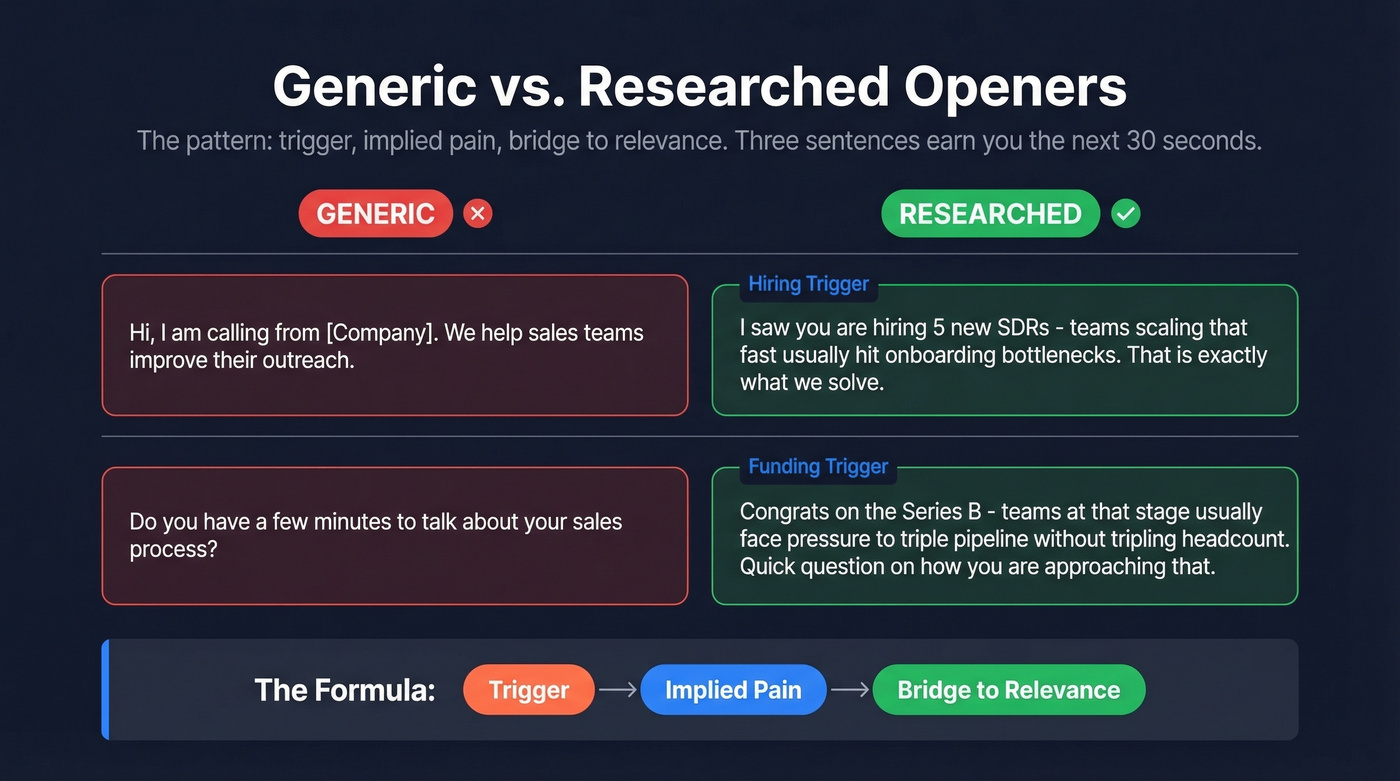
Generic: "Hi, I'm calling from [Company]. We help sales teams improve their outreach."
Researched (hiring trigger): "I saw you're hiring 5 new SDRs - teams scaling that fast usually hit onboarding bottlenecks. That's exactly what we solve."
Generic: "Do you have a few minutes to talk about your sales process?"
Researched (funding trigger): "Congrats on the Series B - teams at that stage usually face pressure to triple pipeline without tripling headcount. Quick question on how you're approaching that."
The pattern: trigger, implied pain, bridge to relevance. Three sentences earn you the next 30 seconds.
Once you've earned those seconds, rapport-building questions keep the conversation moving:
- "I noticed your team just expanded into EMEA - how's the ramp going so far?"
- "You've been in the role about six months now - what's been the biggest surprise?"
- "I saw your company just launched [product] - is that shifting priorities for your team?"
These questions work because they're grounded in something real, not small talk about the weather.
When Research Becomes Procrastination
Here's the thing: if you've been "researching" for 20 minutes and haven't dialed, that's not preparation. It's avoidance. SalesBuzz calls this the "Two-Minute Warning" - past two minutes on a standard prospect, you're stalling. Newer reps feel this pressure most acutely. Reddit threads are full of SDRs who spend their first hour "getting ready" and wonder why their numbers lag.
Call reluctance disguised as diligence kills pipeline faster than bad data. If you're seeing this pattern, it helps to build a full cold calling system that forces time-boxing and consistent reps.
If your average deal size is under $15K, you probably don't need more than two minutes of prep per prospect. The marginal return on that extra time is almost zero at lower deal sizes. Set a timer. Dial.
Prospect Research Tools That Speed Up Prep
We've tested a lot of stacks over the years, and the pattern that works best is simple: verify first, enrich second, research last. Most reps do it backwards - they spend 8 minutes researching a VP of Sales, dial, and discover the number is disconnected. All that prep, wasted.
Prospeo delivers 125M+ verified mobile numbers with a 30% pickup rate and 98% email accuracy across 143M+ verified addresses, all on a 7-day data refresh cycle. You're not burning research time on unreachable prospects.
Beyond verification, AI enrichment tools like Clay automate the firmographic and trigger-event gathering that eats up Tier 2 and Tier 3 prep time. Gartner projects that B2B sales orgs using AI will reduce prospecting and meeting prep time by 50%+. The goal isn't to eliminate research - it's to automate the commodity parts so your brain focuses on the hypothesis and the opener.
If you're evaluating vendors for that "enrich second" layer, start with a shortlist of data enrichment services and compare coverage, refresh rates, and verification methodology.
Two-minute prep only works when your contact data is accurate. Prospeo delivers 98% email accuracy and verified mobiles at $0.01/lead - so you spend those 2 minutes on triggers, not hunting for working phone numbers.
Kill call reluctance with data you trust on every single dial.
Actionable Cold Calling Research Tips
These are the highest-leverage moves distilled from everything above:
- Verify contact data first. Bad numbers waste more pipeline than bad openers. Always confirm reachability before investing any research time.
- Time-box ruthlessly. Set a literal timer for each tier so pre-call prep doesn't bleed into procrastination. Two minutes means two minutes.
- Lead with triggers, not titles. A recent event gives you a reason to call today, not just a reason to call.
- Use social listening for signals databases miss. Posts, job changes, and public comments reveal intent in real time.
- Script your opener template in advance so research slots directly into a proven structure instead of requiring a fresh creative effort every dial.
FAQ
How long should I spend on cold call research?
Two minutes for most prospects, five for mid-tier, and fifteen for top accounts. Never thirty unless it's a six-figure, multi-stakeholder deal. Match prep depth to deal size - anything else is procrastination with extra steps.
What if I can't find any triggers?
Default to role-based pain points for their title and industry. A relevant problem hypothesis beats zero personalization every time. Even basic rapport-building questions tied to their role can open the door when trigger data is thin.
Does pre-call research work at high volume?
Yes - but only if your contact data is verified first. Pair verified numbers with the 2-minute Tier 3 framework to maintain 80+ dials per day without sacrificing relevance. Our team has seen teams using verified mobiles with a 30% pickup rate cut wasted dials dramatically compared to unverified lists.
What are the best prospect research tools in 2026?
Start with a verified data provider for accurate phone numbers and emails, then layer in enrichment tools like Clay for automated firmographic and trigger-event data. The best stack handles repetitive gathering so you focus on crafting the opener.