

Cold Calling After iOS 26: The Data, the Panic, and Your New Playbook
It's Monday morning, your SDR team's Slack is on fire, and someone just posted a screenshot of Apple's new call screening feature with the caption "RIP cold calling." Connect rates dipped last week. Everyone's blaming iOS 26.
Here's the thing: cold calling after iOS 26 isn't dead. Bad data and lazy dialing were already killing it. The screening feature just gave people a new thing to panic about.
What You Need (Quick Version)
- The default setting is off. Your prospect has to manually enable screening. Panic is premature.
- Cold calling success rates dropped from 4.82% to 2.3% before iOS 26 shipped. Your data quality problem is bigger than your screening problem.
- If screening does kick in, write for the transcript - eight to fourteen words, benefit-first - and fire a multi-channel follow-up within five minutes.
What Apple's Call Screening Actually Does
There's a lot of misinformation floating around Reddit and sales Twitter. Let's go straight to Apple's support docs.
The Three Settings
Navigate to Settings > Apps > Phone > Screen Unknown Callers and you'll find three options:
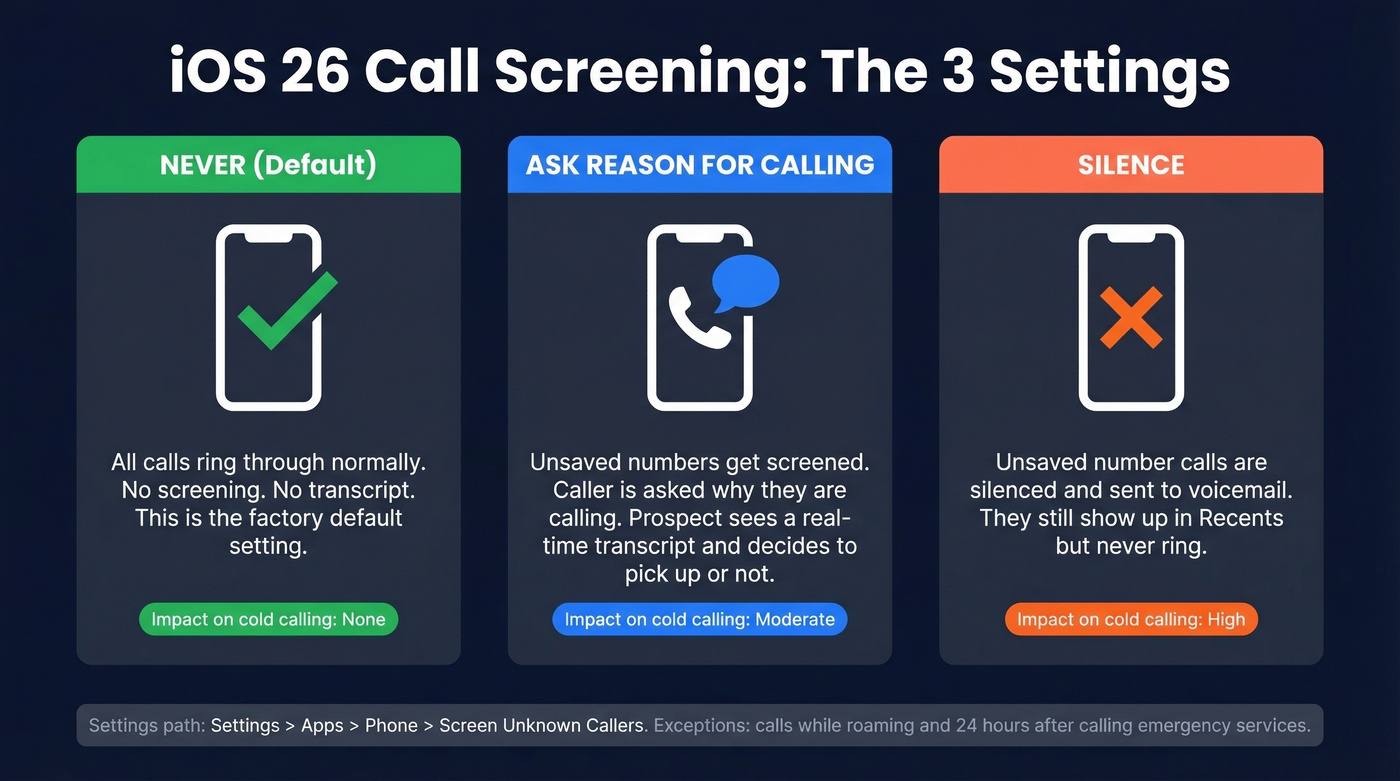
- Never - All calls ring through normally. This is the default.
- Ask Reason for Calling - Unsaved-number calls get screened. The caller is asked why they're calling before the phone rings. The prospect sees a real-time transcript and decides whether to pick up.
- Silence - Unsaved-number calls are silenced and sent to voicemail. They still show up in Recents.
Two exceptions worth knowing: calls aren't screened while roaming, and screening turns off for 24 hours after you call emergency services. Carrier spam/fraud identification also plays a role - calls flagged as spam or fraud by your carrier can be silenced and moved to a Spam list.
The feature is available on any iPhone that supports iOS 26. It doesn't require Apple Intelligence.
What the Caller Hears
Per ZDNET's testing, the automated voice says something like: "Hi, if you record your name and reason for calling, I'll see if this person is available."
Here's where it gets tricky. One r/ios thread notes that the screening voice sounds like a default answering machine - no clear "at the beep" cue, so callers don't know when to start speaking. The voice also uses a local accent that varies by region. For a rep making 80 dials a day, this ambiguity is a real problem. Many will just hang up, thinking they hit voicemail.
How Big Is the Impact, Really?
There are roughly 143 million iPhone users in the US, about 58.66% of the smartphone market. Massive installed base. But the default setting is off - every prospect has to actively navigate to Settings, find the screening option, and turn it on.
If 20% enable it (and that's generous), that's around 28.6 million prospects with an AI gatekeeper. Meaningful, but not the apocalypse.
We have a useful precedent. Google launched call screening on Pixel phones in 2018. Opt-in features like this usually follow predictable adoption curves, and screening adoption on Android is commonly estimated around 1-5%.
| Feature | iOS 26 | Android/Pixel |
|---|---|---|
| Launched | 2026 | 2018 |
| Default | Off (Never) | Off |
| Screening levels | 3 (Never / Ask / Silence) | 3 (Basic / Medium / Maximum) |
| Adoption est. | TBD | ~1-5% |
| AI transcription | Yes | Yes |
If you're losing sleep over Apple's screening update, you're worrying about the wrong variable.

You just read it: cold calling success rates dropped from 4.82% to 2.3% before iOS 26 even shipped. The real killer isn't call screening - it's dialing wrong numbers. Prospeo's 125M+ verified mobile numbers hit a 30% pickup rate, and every record refreshes every 7 days so you're never calling a number that's gone stale.
Stop blaming iOS 26. Fix your data and watch connect rates climb.
Cold Calling Was Already Harder
The Cognism/WHAM dataset tells a stark story. Cold calling success rates - conversations that result in a booked meeting - dropped from 4.82% in 2024 to 2.3% in 2025. That happened before iOS 26 was even announced. Average cold call length sits at about 93 seconds, and the same dataset shows 93% of total conversations happen by the third call. Push to five attempts and you hit 98.6%.
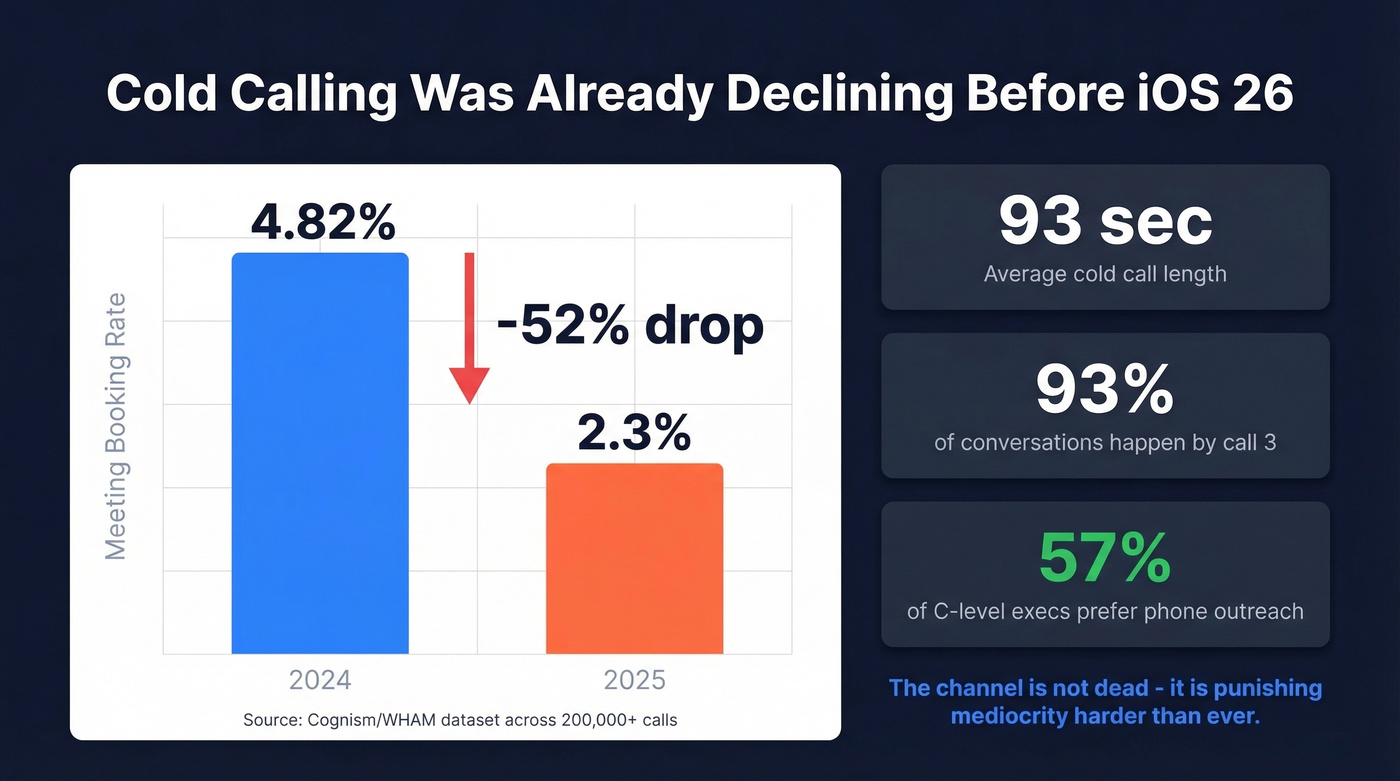
But here's the counterpoint that keeps cold calling alive: 57% of C-level executives prefer hearing from sales reps via phone over any other channel, and 49% of buyers actually prefer cold calls to other outreach. The channel isn't dead. It's punishing mediocrity harder than ever.
Our take: If your average deal size is above $25k, phone outreach is still the highest-ROI outbound channel post-iOS 26. Nothing else gets you a live conversation with a decision-maker in under two minutes. The teams panicking are the ones who were already running a 2% connect rate on garbage data - screening just made their problem visible.
In our experience, the gap between average and great comes down to three things: data quality, targeting, and disciplined multi-touch sequences. One widely cited benchmark puts Cognism SDR performance at an 11.3% success rate across 200,000+ calls - nearly five times the industry average. No magic, just execution.
Your New Playbook for iOS 26
If a prospect does have screening enabled, you've got roughly eight to fourteen words to earn a callback.
Write for the Transcript
Your prospect isn't listening to you - they're reading a real-time transcript on their lock screen. Aloware's research suggests prospects decide within the first 40 characters of that transcript. Think of it like a push notification headline. If the first line doesn't hook them, they're swiping away. Kixie recommends keeping your screening response to eight to fourteen plain words: short, literal, benefit-forward, zero fluff.
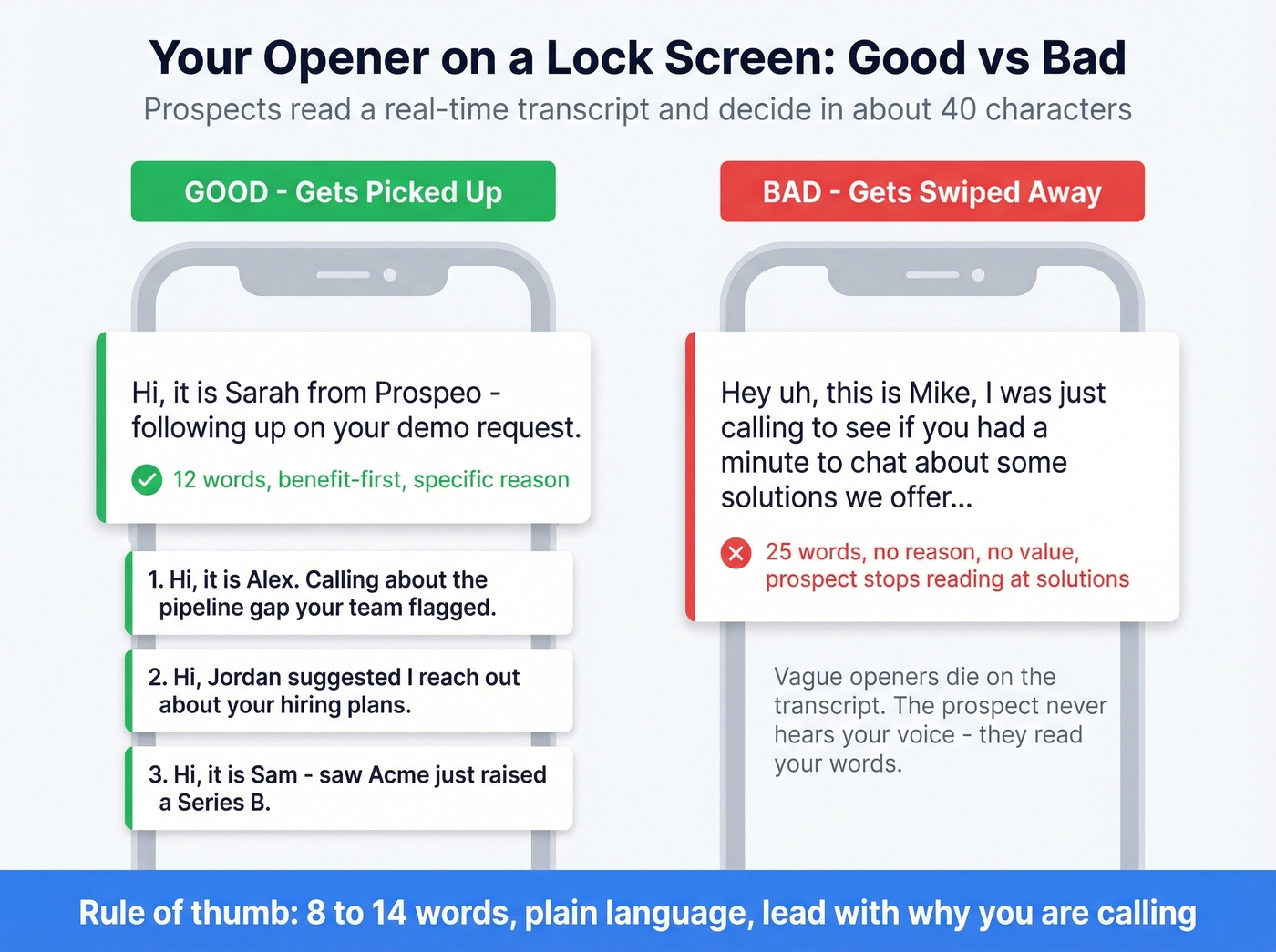
Copy-paste openers that work:
- Request-based: "Hi, it's [Name] from [Company] - following up on your demo request."
- Pain-point: "Hi, it's [Name]. Calling about the [specific problem] your team flagged."
- Referral: "Hi, [Mutual Contact] suggested I reach out about [topic]."
- Event-based: "Hi, it's [Name] - saw [Company] just raised a Series B."
- Hiring trigger: "Hi, it's [Name] - noticed [Company] just posted a [role], calling about [related solution]."
Now compare that to what most reps actually say: "Hey uh, this is Mike, I was just calling to see if you had a minute to chat about some solutions we offer..." The prospect stops reading before "solutions." Dead on arrival in a transcript world.
The Multi-Channel Recovery Sequence
When a call gets screened, don't just move to the next dial. A screened call means the prospect saw your name and reason - they're aware of you now. That awareness decays fast, so execute a recovery sequence immediately:
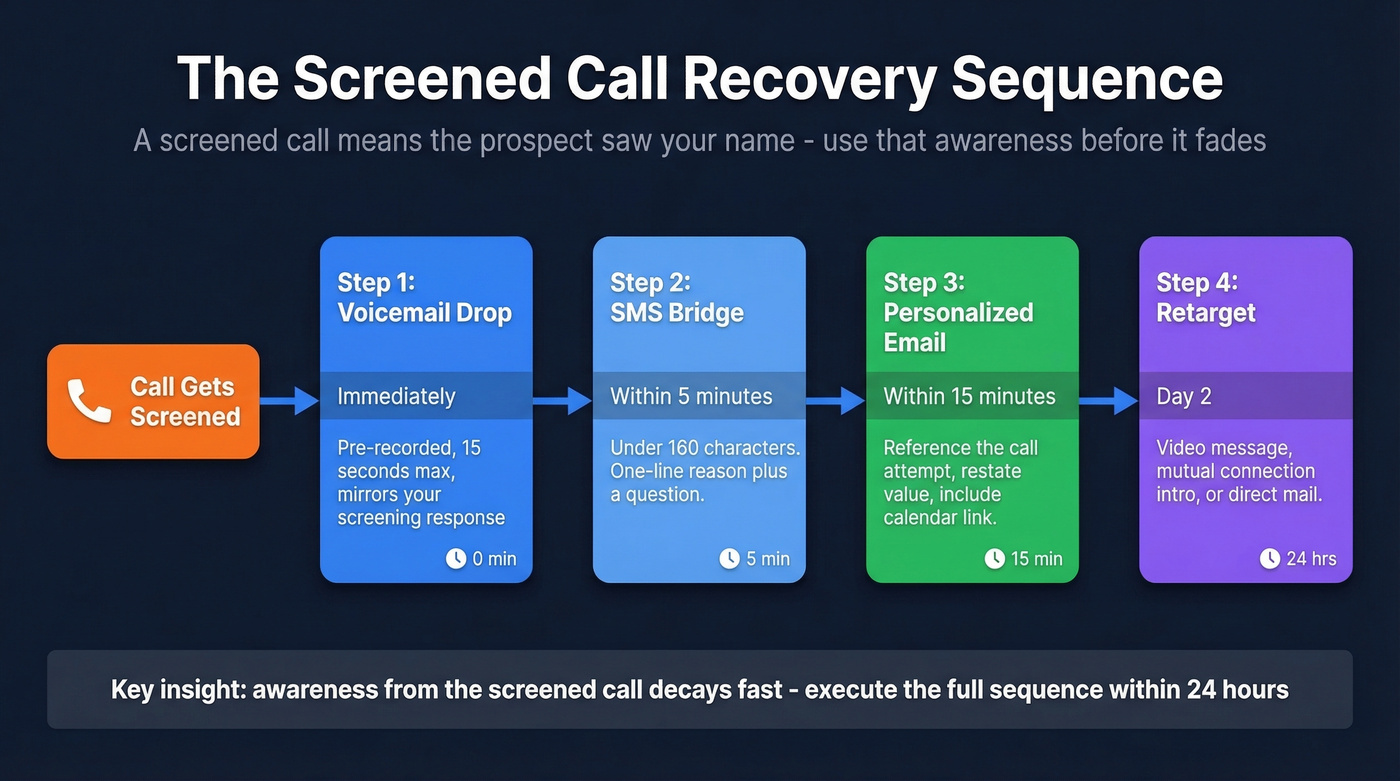
- Voicemail drop - pre-recorded, 15 seconds max, mirrors your screening response.
- Within 5 min: SMS bridge - "Hey [Name], just tried calling - [one-line reason]. Worth a quick chat?" Under 160 characters.
- Within 15 min: personalized email - reference the call attempt, restate the value prop, include a calendar link. (If you need copy, steal from these sales follow-up templates.)
- Day 2: retarget via another channel - video message, mutual connection intro, or direct mail.
Rethink Your Dialer Setup
Parallel and predictive dialers - Orum, Koncert, Nooks - connect reps after detecting a live answer. With screening, there's no live answer. There's a prompt that needs an immediate, coherent human response. If no rep is on the line when the prompt plays, you've wasted a dial and damaged your number reputation.
The consensus on r/sales is that connection rates were already plummeting with parallel dialers well before iOS 26 shipped.
One-to-one power dialers like PhoneBurner and Kixie handle this better - the rep is already on the line when the prompt plays. If your parallel dialer's screened-call rate climbs above 15%, switch to a 1:1 model. Pricing is comparable: parallel dialers typically run $100-300/user/month, while 1:1 power dialers are often $100-200/user/month. (If you're evaluating tools, start with these SDR tools and Dialpad alternatives.)
Fix Your Data First
Before you rewrite a single opener, audit your phone numbers. If 30-40% of the mobiles in your CRM are wrong, disconnected, or landlines, call screening is the least of your worries. Every wasted dial burns your number reputation, eats rep time, and now triggers screening transcripts that make your brand look sloppy when you do reach a real prospect.
This is where fixing your data upstream matters more than any script optimization. Prospeo's Mobile Finder covers 125M+ verified numbers with a 30% pickup rate, and the data refreshes every 7 days versus the 6-week industry norm - so you're not dialing numbers that went stale last month. Meritt cut bounce rates from 35% down to under 4% and tripled their connect rate to 20-25% by switching to a cleaner data source. (For a broader stack view, compare data enrichment services and sales prospecting databases.)
Putting It All Together
Three priorities for your team this week:
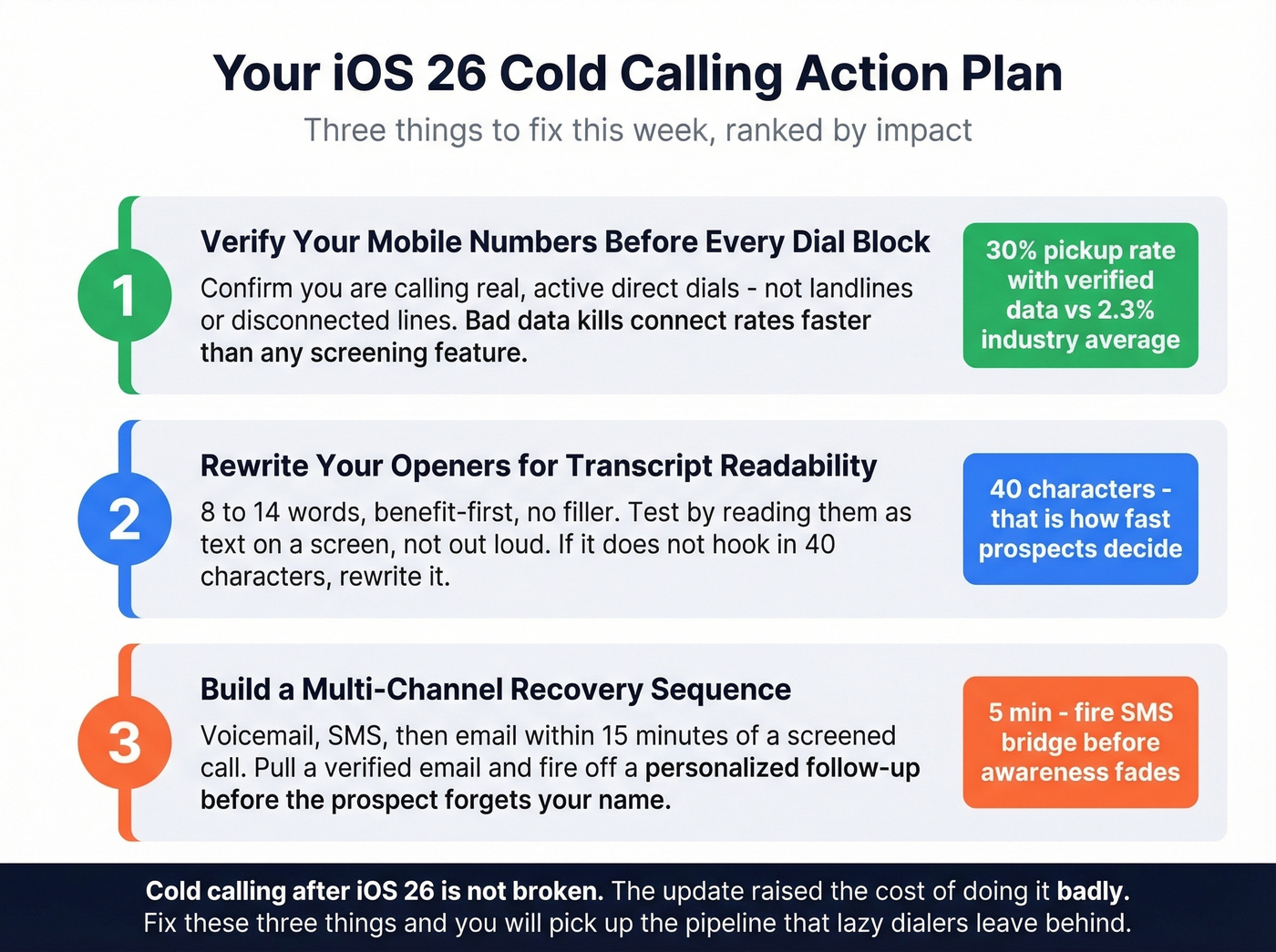
- Verify your mobile numbers before every dial block. Confirm you're calling real, active numbers - not landlines or disconnected lines.
- Rewrite your openers for transcript readability. Eight to fourteen words, benefit-first, no filler. Test them by reading them as text, not out loud. (If your team needs frameworks, pull from these sales prospecting techniques.)
- Build a multi-channel recovery sequence. Voicemail, SMS, then email within 15 minutes of a screened call. Pull a verified email with Prospeo and fire off a personalized follow-up before the prospect forgets your name. (For the email side, these email subject lines examples help.)
Cold calling after iOS 26 isn't broken. The update raised the cost of doing it badly. Teams with clean data, tight openers, and multi-channel sequences won't just survive - they'll pick up the pipeline that lazy dialers leave behind.
Your screening-optimized opener only works if you're calling the right person's direct line. Prospeo gives you verified direct dials for decision-makers across 300M+ profiles - with 30+ filters including job changes, hiring triggers, and buyer intent signals so every call is relevant enough to survive a transcript.
Reach the direct dial. Nail the transcript. Book the meeting.
FAQ
Is iOS 26 call screening on by default?
No. The default is "Never" - all calls ring through normally. Your prospect has to manually enable "Ask Reason for Calling" or "Silence" in Settings. Based on Android's precedent with Pixel call screening since 2018, adoption for opt-in features like this typically stays in the single digits.
Does call screening work on all iPhones?
It's available on any iPhone that supports iOS 26 and doesn't require Apple Intelligence. Older devices that can't run iOS 26 won't have the feature, which limits the real-world impact on your total addressable dial list.
How do I know if my call was screened?
There's no definitive indicator on the caller's end. Track a proxy metric: calls with no ring plus immediate voicemail, divided by total calls initiated. If this rate spikes after iOS 26 rollout, screening is the likely cause. Verifying your mobile numbers before dialing reduces noise so you're measuring actual screening, not wrong numbers.
Will Apple's call screening kill cold calling for good?
No. The feature is opt-in, and Android's similar feature shows single-digit adoption after eight years. The bigger threat to connect rates is bad data and generic openers. Teams that adapt scripts for transcript readability and maintain verified phone lists will keep booking meetings at strong rates.
What's the best way to maintain clean phone data for cold calling?
Use a provider with frequent data refreshes - stale numbers waste dials and trigger screening transcripts that hurt your brand. Look for weekly refresh cycles rather than the 6-week industry average, and verify numbers are active mobiles before they hit your dialer. At around $0.10 per verified mobile, modern data tools are significantly cheaper than enterprise alternatives.