

How to Cold Call for Digital Marketing Services (And Actually Book Meetings)
You're 40 dials into the afternoon. Thirty-three went to voicemail. Four people hung up before you finished your name. The rest said "send me an email" - polite for "never contact me again."
If you're cold calling digital marketing prospects - selling SEO, PPC, or social media services by phone - you already know the Reddit consensus: it's brutal. But it works when you fix the one thing most agency owners ignore: the quality of the numbers you're dialing.
What You Need Before Dialing
Skip the scripts for now. Get these three things right first:
- A verified prospect list. This is the single biggest lever. Teams using quality-verified data and precise ICP targeting hit an 11.3% success rate vs. the 2.7% industry average. That's not a marginal improvement - it's a completely different business.
- One good opener that explains why you're calling. Not a pitch. A reason. Gong's research shows stating your reason for calling makes you 2.1x more likely to book a meeting.
- A follow-up sequence. 80% of calls go to voicemail. Without emails and a multi-touch plan, you're leaving meetings on the table. (If you need a starting point, use these follow-up templates.)
Benchmarks That Actually Matter
Here's a realistic cold calling funnel for B2B outbound, based on 10 million+ analyzed calls:
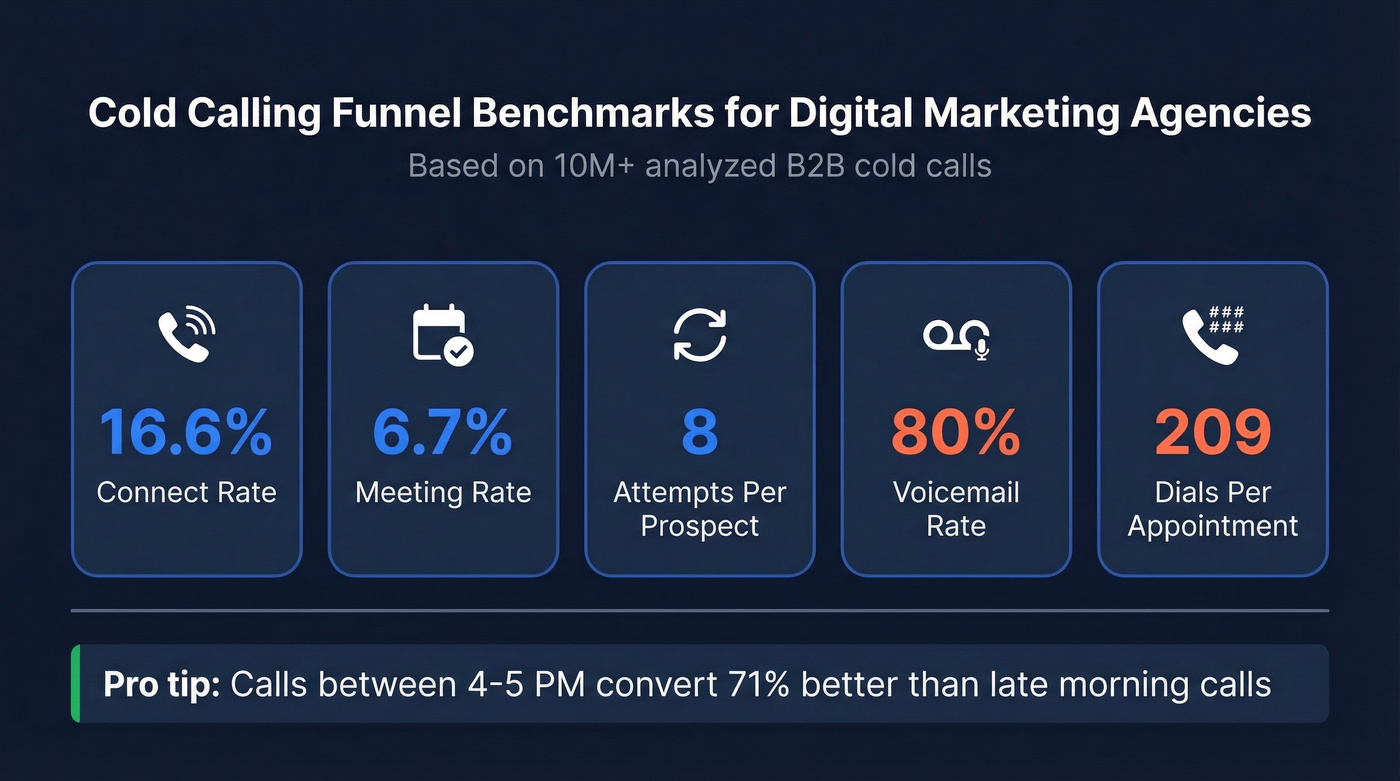
Connect rate: 16.6% · Meeting rate: 6.7% · Attempts per prospect: 8 · Voicemail rate: 80% · Dials per appointment: 209
That 209 number stings, but it's the math. At 60 calls per day, you're booking roughly one meeting every three to four days. The way to improve that ratio isn't more calls - it's better numbers. Calling verified mobiles instead of office lines changes the connect rate dramatically.
One more stat worth pinning to your monitor: calls between 4-5 PM convert 71% better than late-morning calls. Time your dials accordingly. (More dialing fundamentals here: cold calling for beginners.)
A Script That Books Meetings
This script works for selling SEO or PPC services. The structure follows what converts: intro, personalization, proof, CTA. If you're figuring out how to phone-prospect for an agency, this framework is the fastest way to get started.
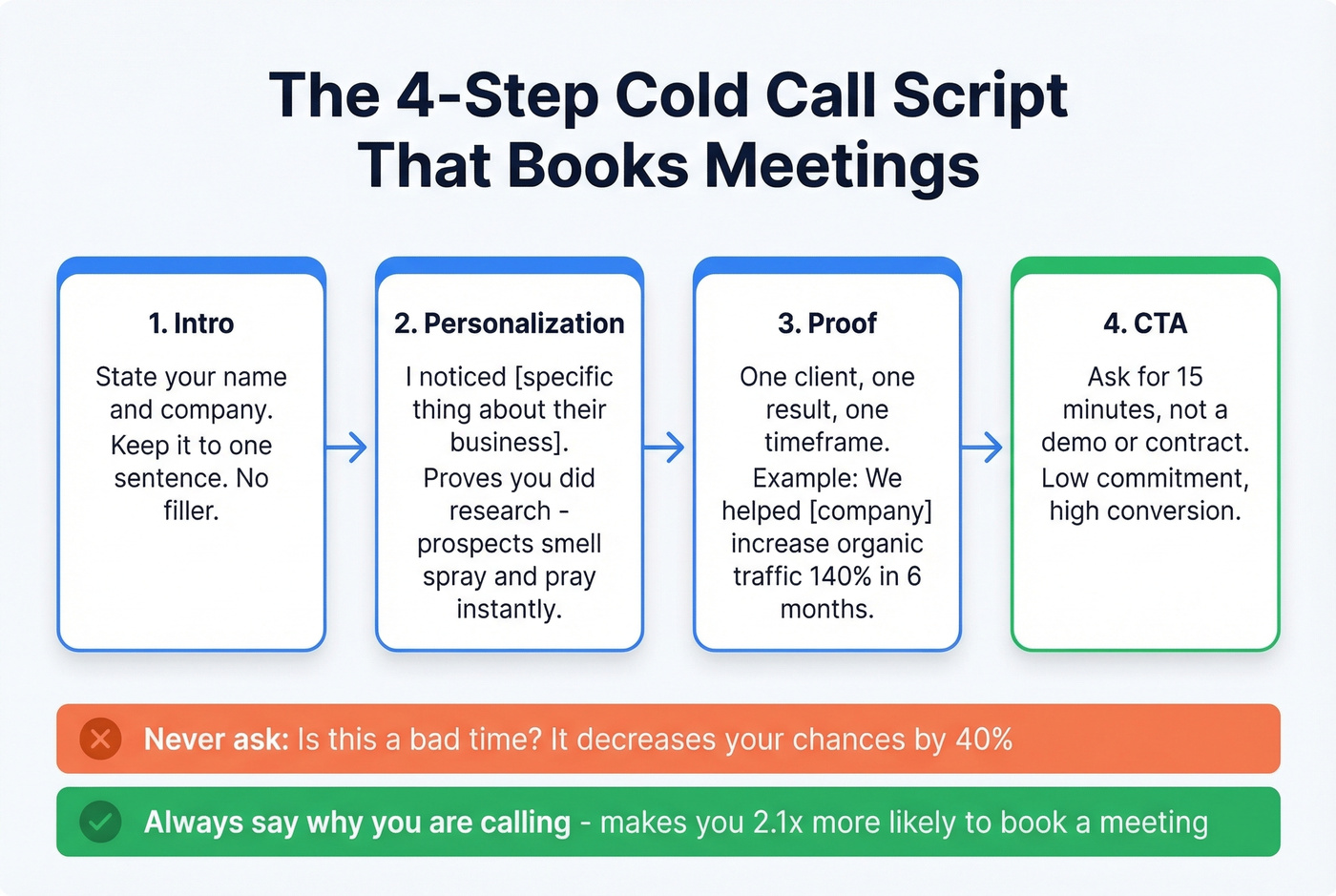
"Hi [Name], this is [Your Name] from [Agency]. I'm calling because I noticed [Company] is running Google Ads for [specific keyword] - and your landing page isn't showing up organically for that same term. We helped [similar company] increase organic traffic by 140% in six months, which cut their ad spend by a third. Would you be open to a 15-minute call this week to see if there's a similar opportunity?"
Why this works: "I noticed [specific thing]" proves you did research - prospects smell spray-and-pray instantly. The proof line is brief and concrete: one client, one result, one timeframe. And the CTA asks for 15 minutes, not a demo or a contract.
Drop this forever: asking "is this a bad time?" decreases your chances by 40%, according to Gong's call analysis. (If you want more talk tracks, steal these talk track examples.)
Alternative for fixed-price services: On Reddit, agency owners selling web design use a pricing-first opener - leading with "$0 down, $150-350/month" - to qualify budget immediately. Worth testing if you sell packaged services rather than custom retainers.
Objection Rebuttals
| Objection | Response |
|---|---|
| "We already have an agency" | "Most of our clients came from another agency. Quick question: are you hitting your lead gen targets this quarter?" |
| "Send me some info" | "Happy to. What's most useful - case studies in your industry, or a quick audit of your current campaigns?" |
| "No budget right now" | "Totally fair. When does your next planning cycle start? I can send benchmarks so you have numbers ready." |
| "Not interested" | "Understood. Before I go - are you generating enough inbound leads from your website, or is that a gap?" |
The goal with every rebuttal isn't to overcome the objection. It's to ask one more question that keeps the conversation alive. (For more ways to keep momentum, use these sales prospecting techniques.)

You just read the math: 209 dials per appointment with average data. Teams using verified mobiles cut that number dramatically. Prospeo gives you 125M+ verified mobile numbers refreshed every 7 days - so every dial reaches a real decision-maker, not a dead line or a front desk.
Stop wasting 27% of your calling time on bad numbers.
Build Your Prospect List
Bad contact data wastes 27.3% of a rep's calling time. B2B data decays at roughly 2.1% per month - so that list you bought six months ago? A quarter of it is dead.
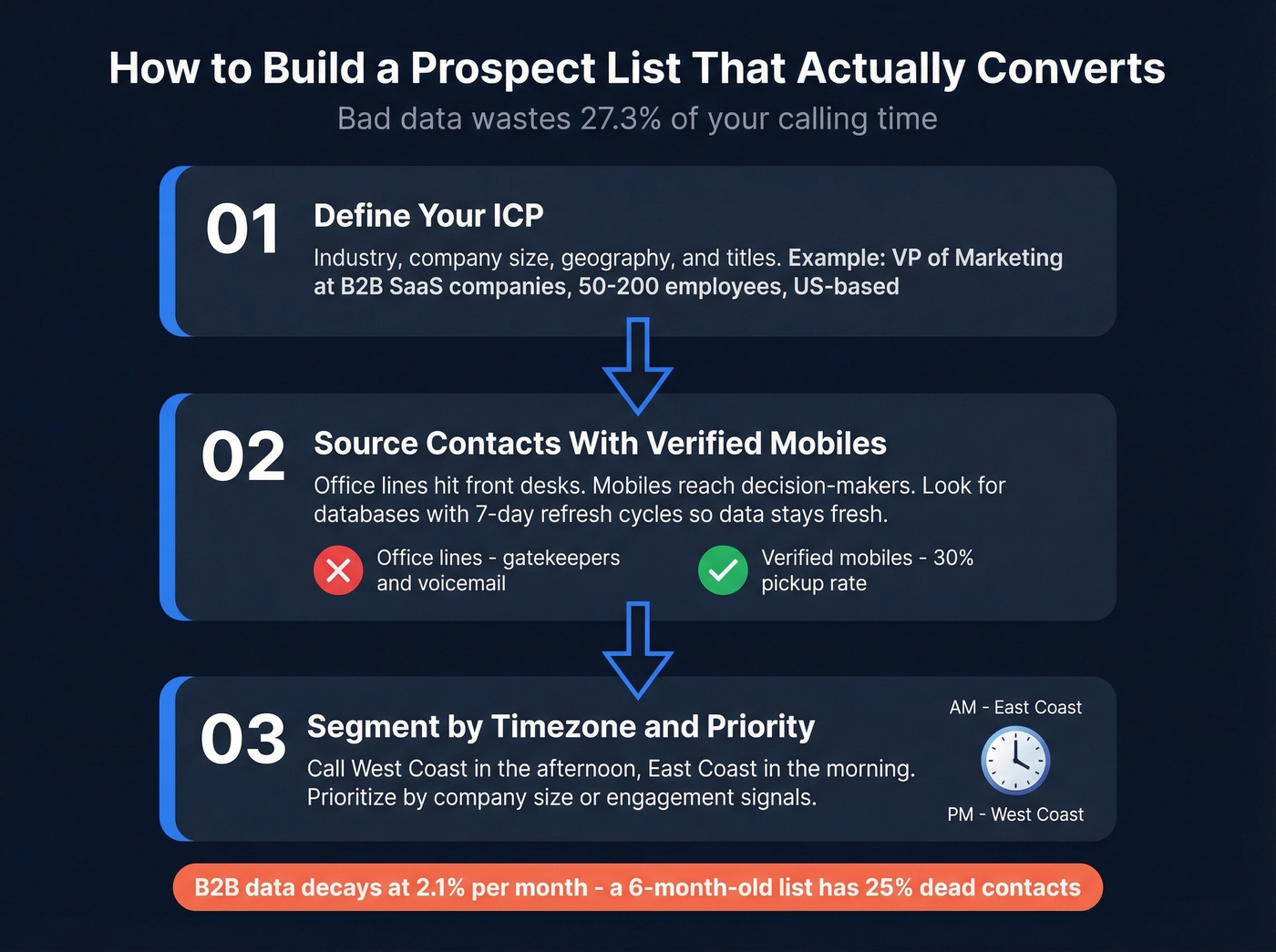
Step 1: Define your ICP. Industry, company size, geography, and titles. For a digital marketing agency, that might be "VP of Marketing or business owners at B2B SaaS companies, 50-200 employees, US-based." (If you want a scoring rubric, use this ideal customer profile template.)
Step 2: Source contacts with verified mobiles. We've found that the single biggest difference between agencies that book meetings and agencies that burn out on cold calling is mobile verification. Office lines hit front desks; mobiles reach decision-makers. Prospeo's database has 125M+ verified mobile numbers with a 30% pickup rate, refreshed every 7 days - which matters because B2B data goes stale fast. (If you're also cleaning/enriching records, compare data enrichment services.)

Step 3: Segment by timezone and priority. Call West Coast prospects in the afternoon, East Coast in the morning. Prioritize by company size or engagement signals so your best prospects get called first. (This is easier with solid firmographic filters.)
Tips That Save Wasted Dials
Don't pitch too early. Opening with "We do SEO and PPC" is a fast way to get hung up on. Ask about their current lead generation first. The prospect needs to feel heard before they'll listen.
Don't give up after one attempt. It takes 8 attempts to reach a prospect. Most reps quit after 2-3. Persistence isn't annoying - it's expected in B2B sales. (If you need a repeatable process, build a cold calling system.)
Talk less. Successful cold calls average 5:50 in duration vs. 3:14 for failed ones. The difference is the prospect talking, not you. Use open-ended questions and mirror what they say.
Research before dialing. Spend 30 seconds looking at their website and ad presence before you pick up the phone. One specific observation beats ten minutes of generic pitch.
Verify your data. Every bad number is a wasted dial and a hit to your momentum. If you're loading hundreds of contacts into a dialer without verification, you're burning time you can't get back.
Check compliance. State DNC lists and TCPA calling hour restrictions aren't optional. Getting flagged isn't just a fine - it kills your number's reputation.
Your Tool Stack
You don't need a $40k tech stack. Four tools cover everything a small agency needs:
| Tool | Category | Starting Price | Best For |
|---|---|---|---|
| Prospeo | Data provider | Free tier; ~$0.01/email | Verified mobiles + emails |
| Close | Dialer + CRM | $49/mo | Small agency teams |
| CloudTalk | Dialer | $27/mo | Budget-friendly calling |
| HubSpot Sales Hub | CRM | $90/mo | Pipeline management |
Close is the best all-in-one for small teams - built-in power dialer plus CRM means fewer tabs. CloudTalk works if you just need a phone system and already have a CRM. Skip it if you want everything in one place. (If you're evaluating options, start with these SDR tools.)
Your cold calling script is only as good as the number it reaches. Prospeo's database lets you filter by industry, title, and company size - then delivers verified direct dials with a 30% pickup rate. At ~$0.01 per email and 7-day data refresh, your agency gets enterprise-grade contacts without enterprise pricing.
Dial decision-makers directly - not gatekeepers, not voicemail boxes.
Pairing Cold Calls With Inbound
Here's the thing: cold calling digital marketing prospects is harder than cold calling for almost any other B2B product - because the prospect knows you could just be running ads to reach them instead. That's exactly why the phone works. It signals conviction.
The HBR stat that cold calling is "ineffective 90% of the time" gets thrown around constantly, usually by inbound-first teams looking for ammunition to dismiss outbound entirely. But when you combine precise ICP targeting with verified contact data, success rates jump to 11.3%. That's a completely different activity than random, unresearched dialing.
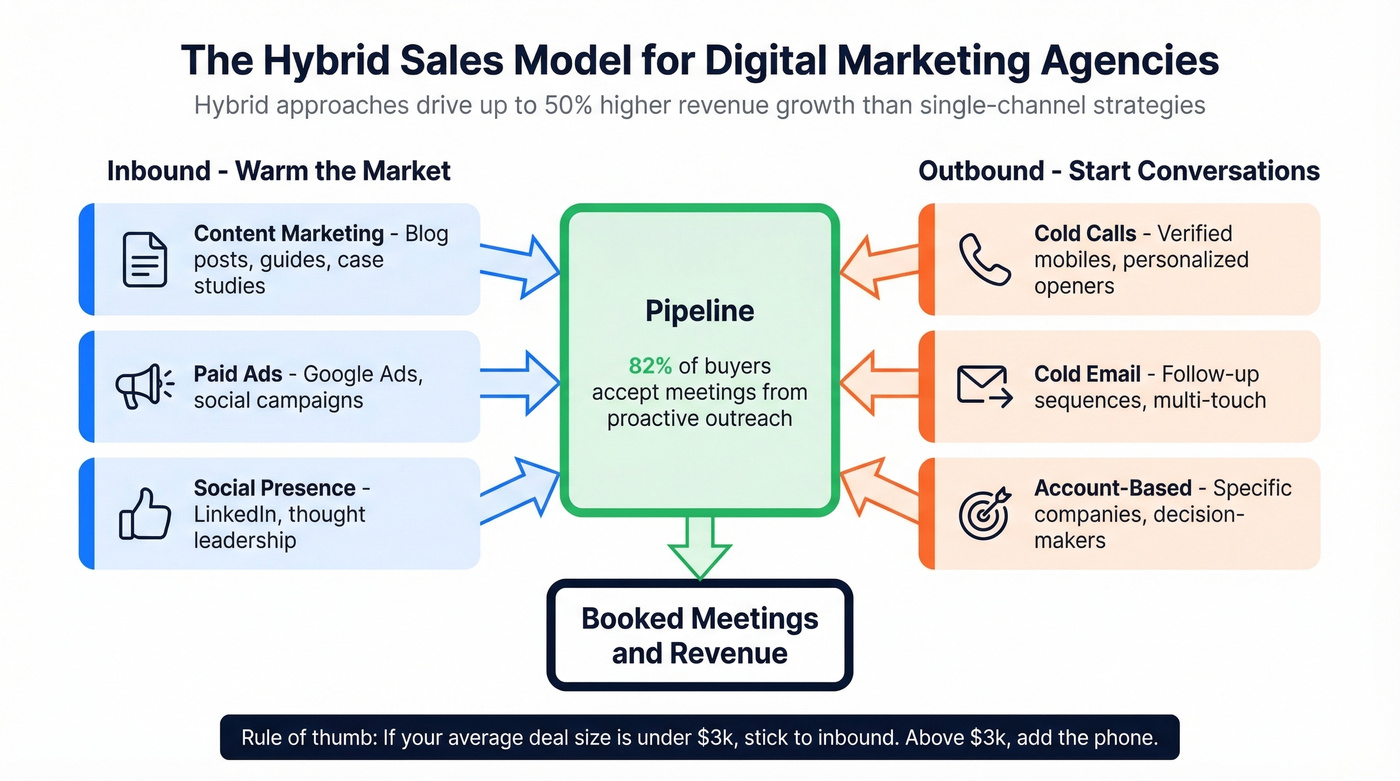
80% of B2B sales interactions are now digital, and buyers use roughly 10 channels before making a decision. Yet 82% of buyers still accept meetings from proactive outreach. The winning play for agencies in 2026: use content, ads, and social to warm the market, then use cold calls to start conversations with specific accounts. Hybrid sales models drive up to 50% higher revenue growth than single-channel approaches.
If your agency's average deal size is under $3k, phone outreach is usually a bad trade. Stick to inbound. But above that threshold, the phone is one of the fastest paths to pipeline.
FAQ
What's a good success rate for agency cold calls?
The B2B average is 6.7% of calls converting to a booked meeting. Teams using verified mobile data and tight ICP targeting hit up to 11.3%. If you're below 3%, fix your list quality before changing your script - bad numbers are the most common bottleneck.
How many dials per day should an agency rep make?
Plan for 209 dials per booked appointment. At 50-80 calls per day, that's roughly one to two meetings per week. Fifty calls to verified mobiles consistently outperform 200 calls to generic office lines.
Is cold calling still worth it for marketing agencies in 2026?
Yes - if your average deal size exceeds $3k. 82% of B2B buyers still accept meetings from proactive outreach, and hybrid models combining phone outreach with digital channels drive up to 50% higher revenue growth than single-channel strategies.