

How to Cold Call for Web Design Sales (Without Sounding Desperate)
Cold calling for web design sales isn't dead - 69% of buyers accept cold calls from new providers. That stat surprises every freelance web designer who's convinced the phone stopped working in 2015. It didn't. Most designers just dial random numbers from Google Maps, stumble through a pitch, and quit after three days.
Here's how to actually land web design clients on the phone.
Why Cold Calling Still Works for Web Design
The web design market has a structural advantage most B2B niches don't: your prospects are small business owners who answer their own phones. No gatekeeper, no "let me transfer you to procurement," no six-month buying committee. You call, the decision-maker picks up, and you're in a live conversation within seconds.
The skepticism is real. Browse r/freelance or r/web_design and you'll find plenty of threads asking "does cold calling even work for web design?" But the doubt almost always comes from designers who made 15 half-hearted calls and gave up. A $500-$3,000 website isn't a committee-driven enterprise purchase - it's one person saying yes or no on a Tuesday afternoon.
The real barrier isn't whether the phone works. It's whether you can stomach doing it consistently for two weeks straight.
What You Need Before You Dial
- A researched prospect list. Verified owner contacts pulled from a database - direct lines, not front-desk numbers.
- One of the two scripts below, memorized cold. Not read from a screen. You'll sound robotic otherwise.
- 30-50 calls per day for two weeks before you judge results. Anything less and you're dabbling, not experimenting.
- Best calling windows: Tuesday-Thursday, 10am-12pm and 2pm-4pm local time. Avoid Monday mornings and Friday afternoons - owners are either buried or checked out.
Once you've validated the process and want to scale, look into parallel dialers like PhoneBurner or Orum that let you dial 3-5 numbers simultaneously.
Build Your Prospect List First
Finding businesses that need websites is the easy part. Google Maps, Yelp, Chamber of Commerce directories, BBB listings - they're all free and full of local businesses with outdated or nonexistent web presences. The hard part is finding the owner's direct phone number, not the main line where a receptionist sends you to voicemail.
Here's the speed difference: manually searching Google Maps for 15 minutes gets you roughly 11 leads with maybe 9 phone numbers, mostly main lines. A database tool can pull 200+ businesses in minutes using filters like industry, location, and whether a listing has contact info on file.
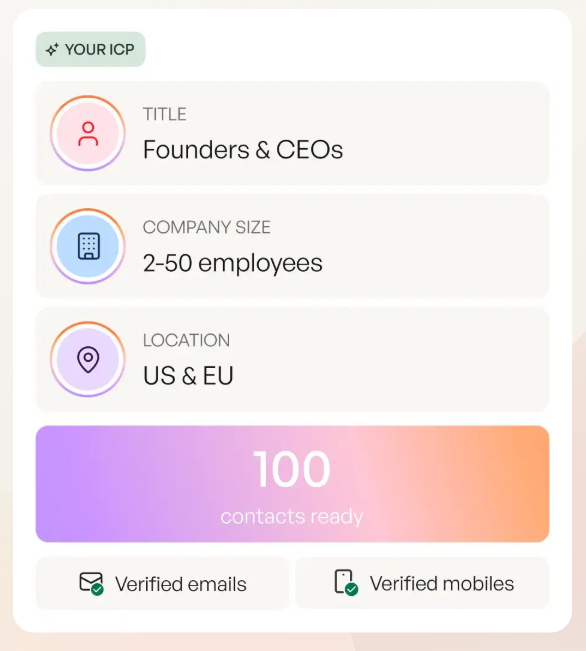
The best niches to target are businesses with money and bad websites. Contractors, landscapers, dentists, home services, auto shops, and real estate agents. These owners are busy running their business, not optimizing their online presence - which is exactly why they need you. Contractors and landscapers are ideal because the owner answers the phone directly. Skip businesses with front-desk gatekeepers like law firms or medical groups unless you already have a direct number.
One move we've seen work well: call "network nodes" - accountants, photographers, or business coaches who serve dozens of small businesses. One relationship can unlock an entire pipeline of referrals.
Prospeo's Mobile Finder covers 125M+ verified mobile numbers, so you're calling the owner's cell - not a receptionist. Search by industry and location using 30+ filters, export the list, and start dialing. The free tier gives you 75 emails plus 100 Chrome extension credits per month, enough to test the approach before spending anything.
If you want a tighter target list before you export, use an ideal customer profile and basic lead scoring so you’re calling the highest-likelihood buyers first.
Two Scripts for Selling Websites by Phone
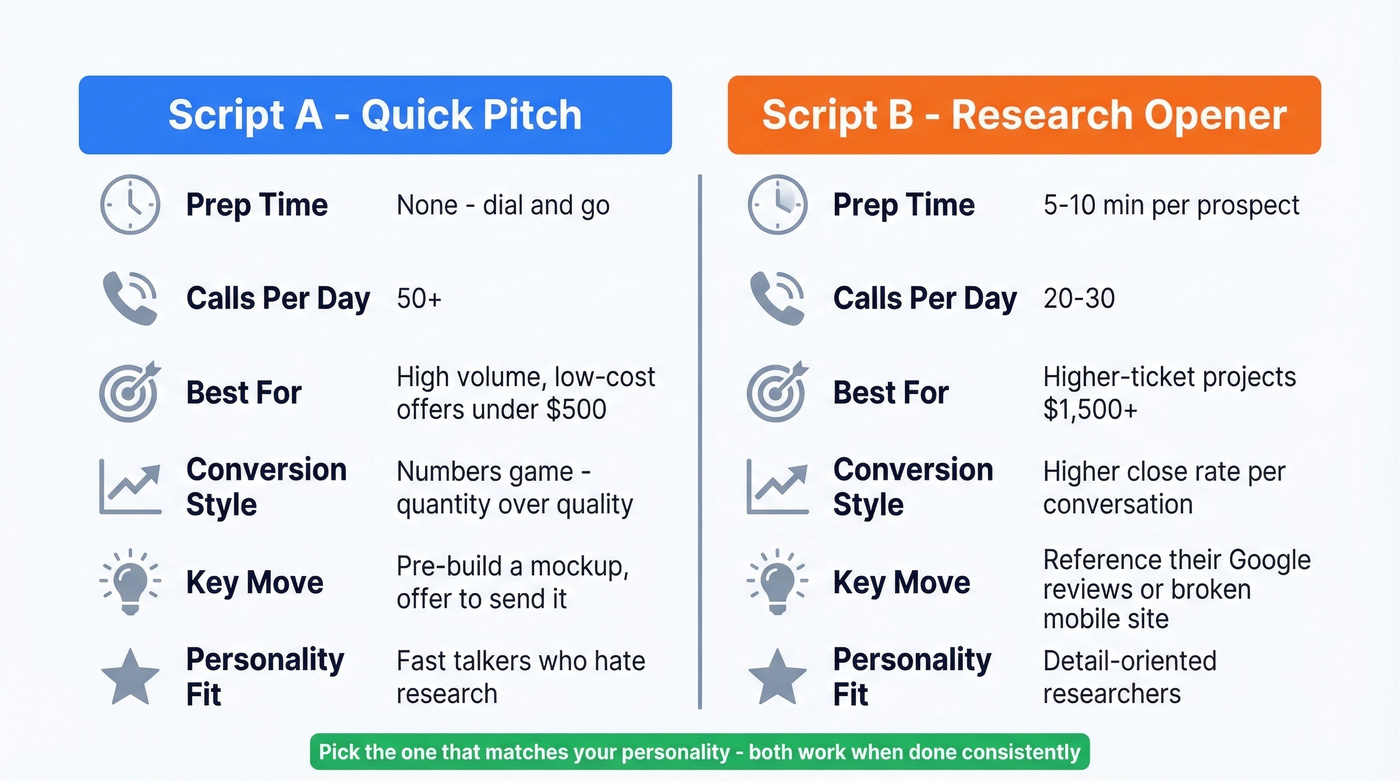
Script A - The Quick Pitch (Volume Play)
Built for speed. You're making 50 calls a day and need to get to the point in 30 seconds:
"I'm not sure if you're the right person to talk to about this, but... my name is [your name] and I run a local marketing agency. We specialize in building beautiful websites for businesses like yours for less than $500. I have some ideas for a new website for [business name] that I'd like to show you. Are you the right person to speak to about this?"
If they say they're not interested:
"I was afraid you were going to say that. I actually already built it for you. Can I send it to you anyway? I can email or text the link."
That rebuttal flips the conversation from "do you want to buy?" to "can I show you something I already made?" It's based on the SiteSwan framework and works best at high volume with a low-cost anchor price.
Script B - The Research Opener (Quality Play)
Takes more prep but books better meetings:
"Hi [name], this is [your name] from [company]. I noticed you have really good reviews on Google but no website - do you by any chance have one? I'm a web designer, and I'd love to talk about getting you a site that ranks higher on Google and brings in more clients. Is that something you'd be interested in discussing?"
If yes: "Awesome - does tomorrow at [time] work for you?"
Soft close: "If there's a good fit, I'd love to continue the conversation. If not, we can part ways - no pressure."
Bonus move: Before calling, check their site on your phone. If it's broken on mobile, open with that specific issue. "I noticed your site doesn't load properly on phones" beats any generic opener because it proves you did your homework. Concrete observations create pattern interrupts that generic pitches can't.
Pick the script that matches your personality. Script A is faster and works at volume. Script B converts at a higher rate per call but requires researching each prospect beforehand.
If you want more options beyond these two openers, pull ideas from sample elevator pitches and adapt them into a phone-first talk track.

Scraping Google Maps for phone numbers gets you 11 leads in 15 minutes - mostly front-desk lines. Prospeo's 125M+ verified mobile numbers let you skip the receptionist and call the business owner directly. Filter by industry and location, export your list, and start dialing.
Build a 200-prospect web design call list in under 5 minutes.
Handling the 5 Biggest Objections
Use the Embrace, Inform, Question framework: acknowledge the objection, provide a prepared response, then pull the conversation back with an open-ended question.
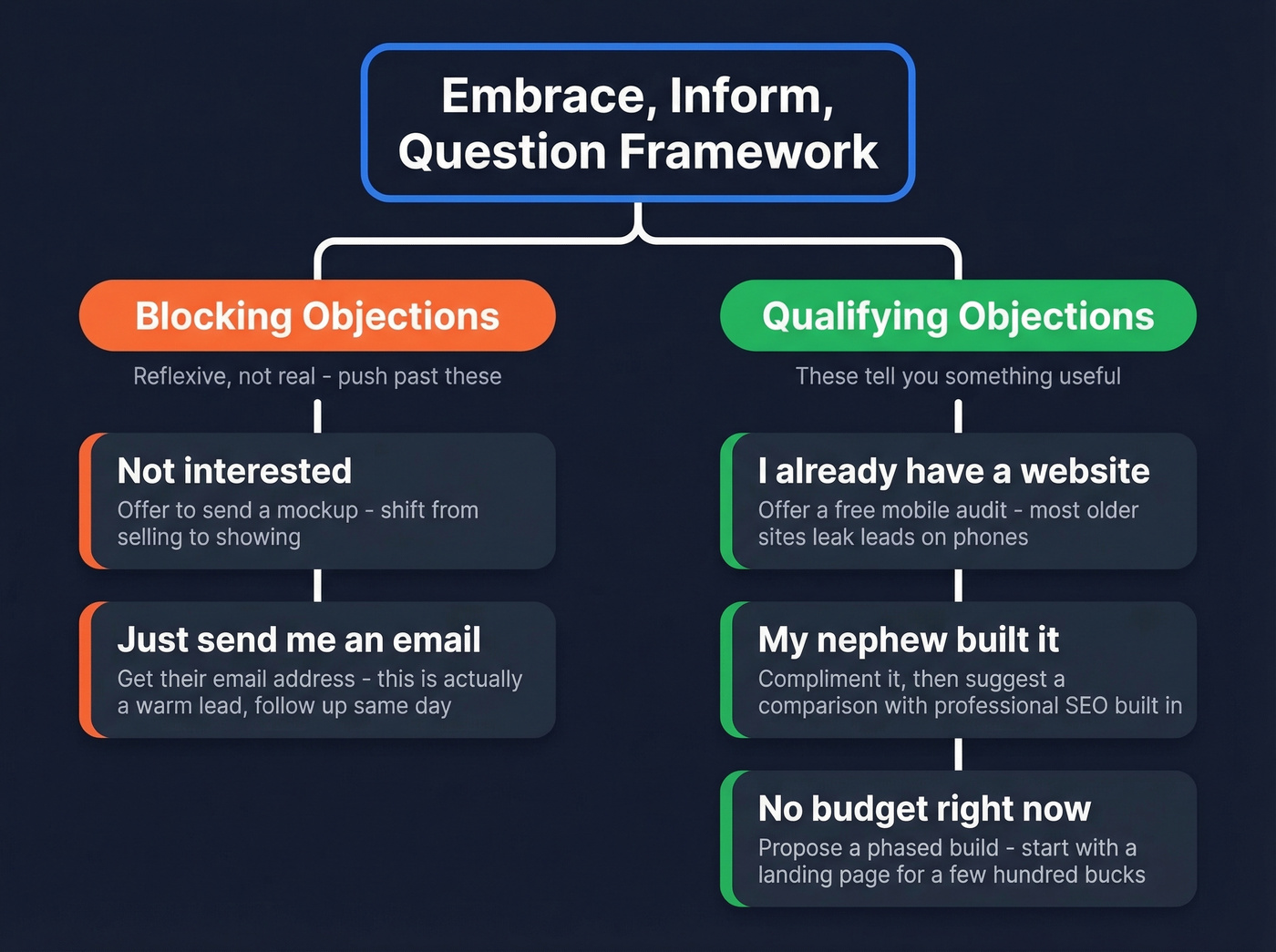
Quick distinction worth memorizing: "Not interested" and "send me an email" are blocking objections - they're reflexive, not real. "No budget" and "already have a website" are qualifying objections - they tell you something useful about what the prospect actually needs to hear.
| Objection | Response |
|---|---|
| "Not interested" | "Totally fair - most people aren't until they see what's possible. Mind if I send a quick mockup? Takes 10 seconds to look at." |
| "I already have a website" | "Great - when's the last time you checked it on a phone? A lot of older sites leak leads on mobile. I can run a free audit." |
| "My nephew built it" | "He probably did a solid job! But a professional site with SEO built in pays for itself when it brings in consistent leads. Worth a comparison?" |
| "No budget right now" | "Totally get it. We do phased builds - start with a landing page for a few hundred bucks, expand later when revenue picks up." |
| "Just send me an email" | "Absolutely - what's the best address?" (This isn't a rejection. It's a warm lead. Follow up the same day.) |
Objections aren't rejections. They're the prospect telling you what they need to hear before saying yes. If you want more reps-ready language, keep a swipe file of talk track examples and a dedicated guide on cold call rejection.
Your Conversion Math
Let's run the numbers on 50 calls per day. At a 15-30% connect rate (expect the lower end when starting out), that's roughly 8-15 live conversations. A 1-5% meeting booking rate means you're scheduling 1-2 meetings per day, or 5-10 per week.
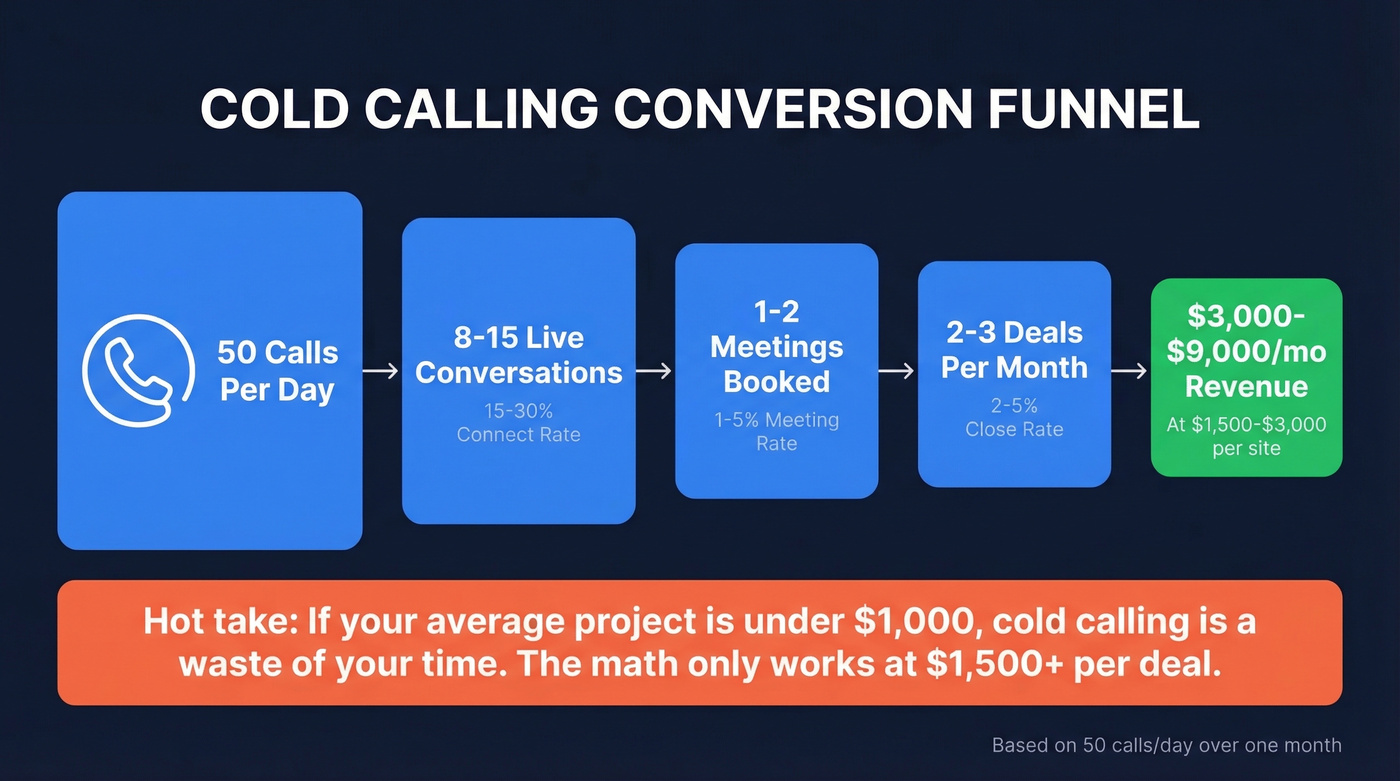
With a 2-5% call-to-deal conversion rate, 50 daily calls over a month produces 2-3 closed website projects. At $1,500-$3,000 per site, that's $3,000-$9,000 in new revenue from phone calls alone. In our experience, the 2-5% conversion rate holds up even for solo freelancers - the key variable is whether you're calling verified direct numbers or wasting time on front desks.
Here's my hot take: if your average web design project is under $1,000, cold calling is a waste of your time. The math only works when each closed deal is worth $1,500+. Below that, you're better off with cold email or content marketing. But above that threshold, the phone is the single fastest channel to landing clients.
The kicker: teams that combine calls with email follow-up see a 70% lift in conversion. One agency reported booking 200+ meetings and closing $300K+ in 16 months by combining both channels.
If you want to benchmark your funnel against broader outbound norms, compare your numbers to the average B2B lead conversion rate.
Pair Calls with Email Follow-Up
Every call - whether they picked up or not - should trigger an email the same day. Second touch two days later. Here's a template that works:
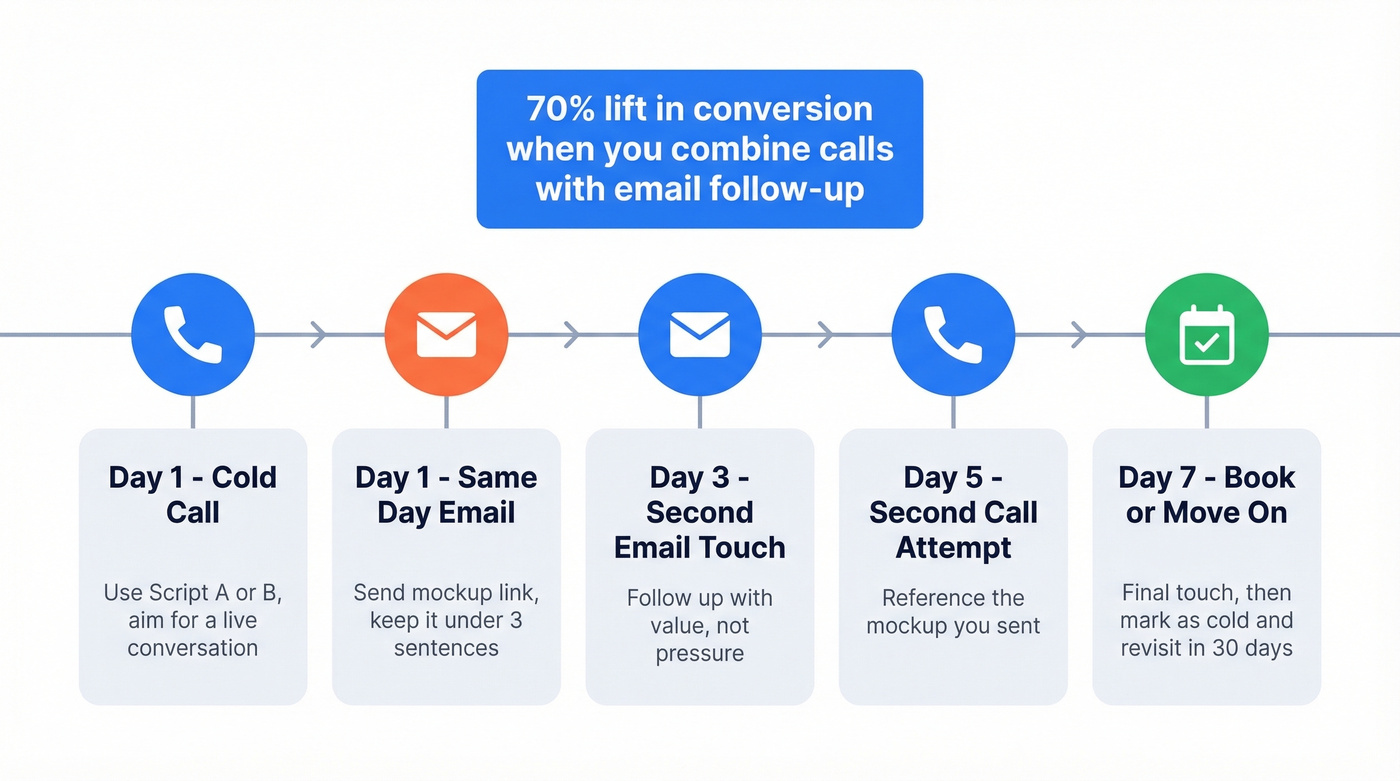
Subject: Quick mockup for [Business Name]
Hi [Name], I called earlier about building a website for [Business Name]. I put together a quick concept - here's the link: [URL]. Takes 30 seconds to look at. Worth a conversation?
Short, specific, low-commitment. That's all it needs to be.
If you need more variations, keep a few sales follow-up templates ready so you’re not rewriting emails every day.
For compliance, scrub your call list against the Do Not Call registry, and include an unsubscribe link plus your physical address in every email. Neither is complicated - just don't skip it.
Your cold calling math depends on connect rate - and connect rate depends on calling the right number. Prospeo's verified mobiles hit a 30% pickup rate, turning your 50 daily dials into 15 live conversations with actual decision-makers instead of voicemail boxes.
Triple your connect rate by calling verified owner mobiles, not main lines.
When to Outsource Your Calls
Most web designers who try cold calling quit not because it doesn't work, but because they hate doing it. That's fine. If you'd rather design than dial, outsource.
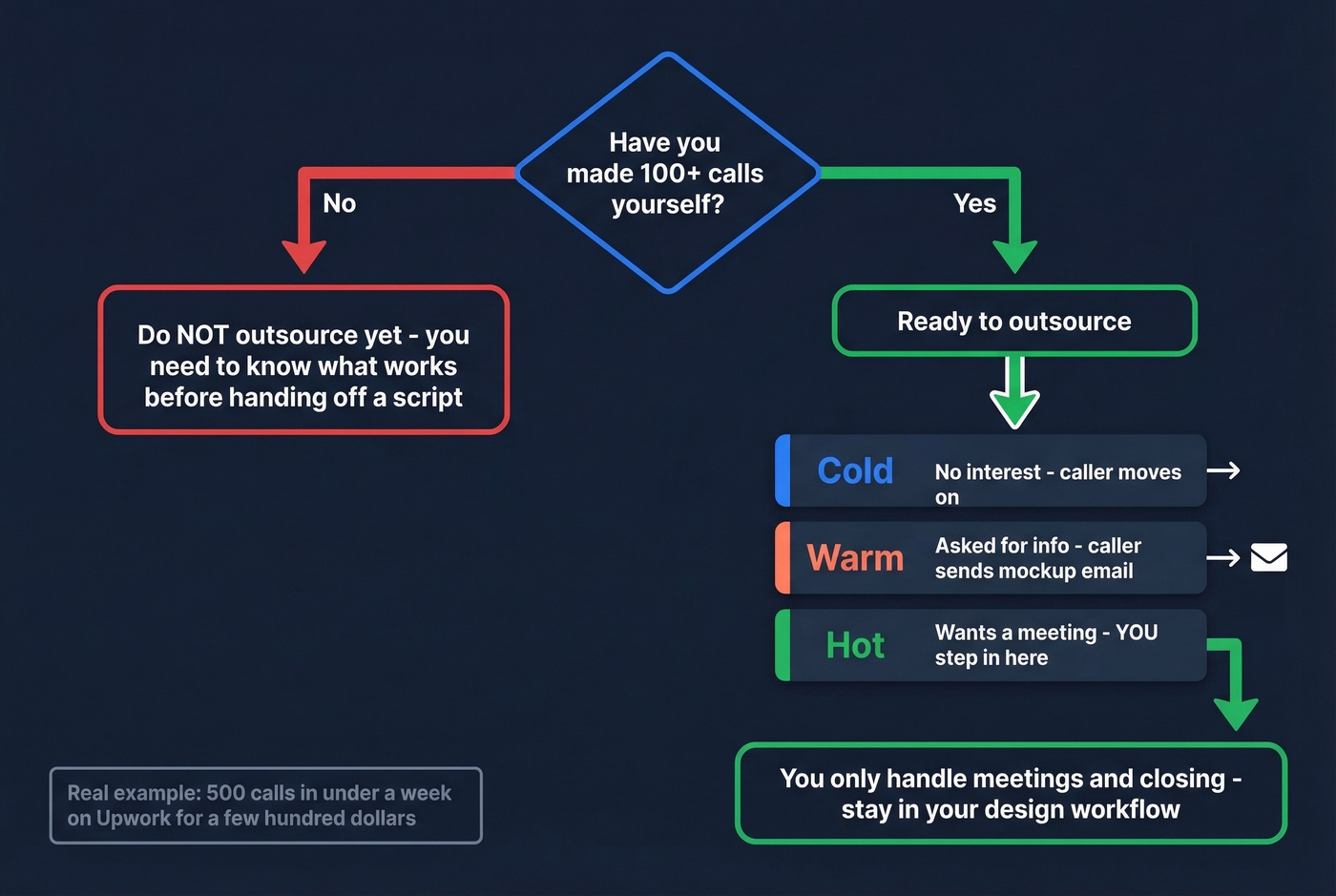
One designer we spoke with hired a cold caller on Upwork who completed 500 calls in under a week using a Google Voice number and a simple script. Total cost was a few hundred dollars. The key is a dead-simple lead scoring system: Cold (no interest), Warm (asked for info), Hot (wants a meeting). You only step in at the Hot stage. This lets you stay in your design workflow while someone else fills the top of your funnel.
Skip this route if you haven't personally made at least 100 calls first. You need to know what works before you can hand off a script to someone else - otherwise you're paying someone to fail on your behalf. If you decide to systematize it, build a repeatable cold calling system before you hire.
The Bottom Line
Cold calling for web design sales comes down to three things: a verified list, a memorized script, and the discipline to dial 50 times a day for two weeks. The designers who commit to that process consistently close 2-3 new projects per month. The ones who don't were never going to succeed with any outbound channel.
FAQ
How many cold calls should a web designer make per day?
Aim for 30-50 targeted calls daily. Fifty calls to business owners in your niche outperform 200 random dials. Commit to two weeks minimum before evaluating results - anything less isn't a real test.
What's a realistic close rate for selling websites by phone?
Expect 2-5% of total calls to convert into paying clients. At 50 calls per day over a month, that's roughly 2-3 new website projects worth $1,500-$3,000 each.
What's the best time to cold call small business owners?
Tuesday through Thursday, 10am-12pm and 2pm-4pm local time. Monday mornings and Friday afternoons are dead zones - owners are either buried in weekly planning or mentally checked out.
How do I find direct phone numbers for local business owners?
Skip Google Maps main lines. Use a B2B database to pull verified mobile numbers filtered by industry and location - a 30% pickup rate on verified mobiles far exceeds the 5-8% you'll get calling front desks.