

Cold Email Copywriting: What 5.5 Million Emails Reveal About Getting Replies
A RevOps lead we work with sent a few hundred cold emails last quarter. A painful chunk bounced - a big slice of his pipeline dead before a single human read a word. His copy was sharp: personalized openers, tight CTAs, a genuine offer. Didn't matter. Bad data killed the campaign before copywriting had a chance.
That's the tension most cold email copywriting guides ignore. They obsess over subject lines and frameworks while skipping the step that determines whether your email reaches an inbox at all. A Copyhackers case study proved what's possible when everything clicks: 328 cold emails, 56% open rate, 9% positive reply rate, and nearly $20K from a single email. Great outbound copy works - but only when the foundation is solid.
What You Need (Quick Version)
Three things separate campaigns that get replies from campaigns that get ignored:
- Keep emails to 50-75 words. This range hits a 12% response rate across 10,000+ campaigns. At 200+ words, you're down to 2%.
- Use 2-4 word personalized subject lines. A Belkins study of 5.5M emails found this combination delivers a 46% open rate.
Everything below expands on these three principles with data, frameworks, and templates.
2026 Cold Email Benchmarks
The average B2B cold email open rate sits around 39%. Response rates are harsher - most campaigns land between 1-3%, while top performers consistently hit 8-12%. The gap between average and elite almost always comes down to copy length, personalization, and list quality.
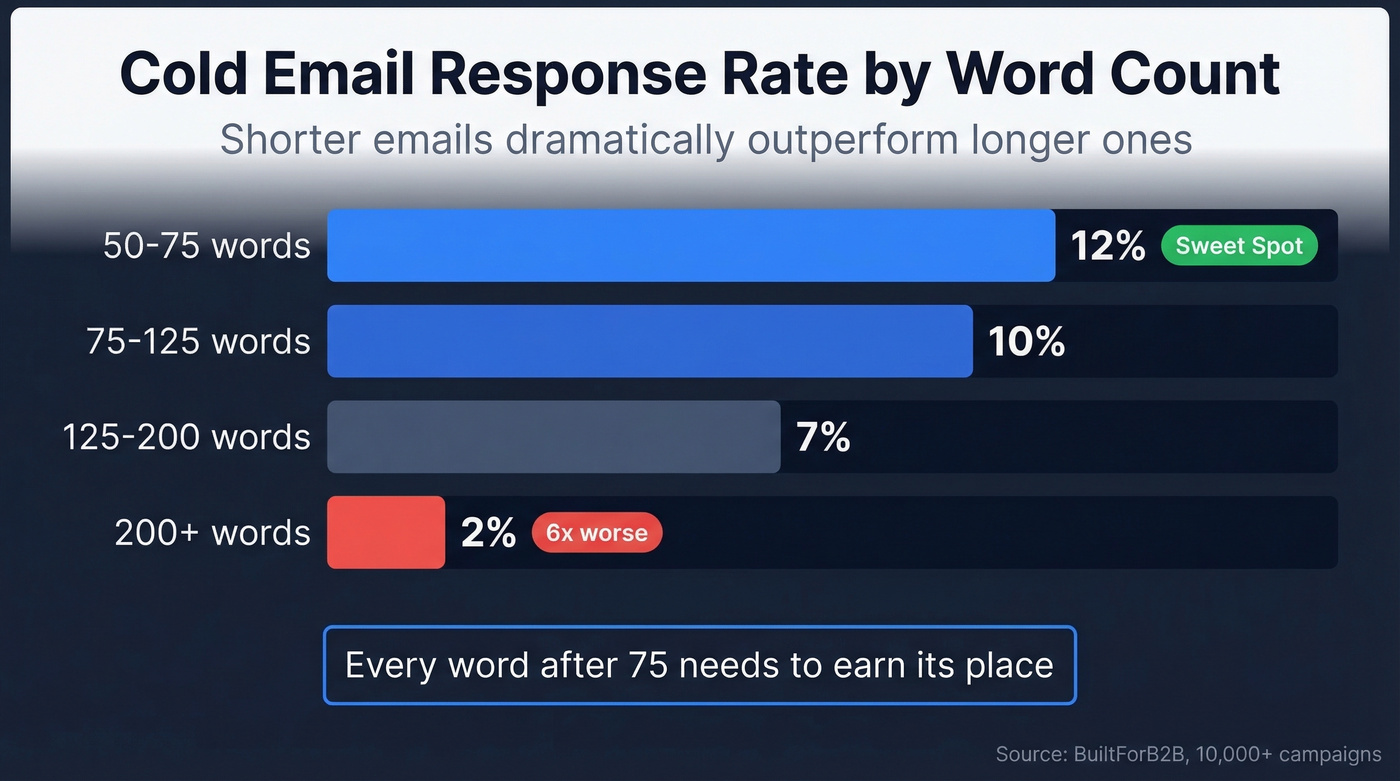
The word count data below should shape every email you write:
| Word Count | Response Rate |
|---|---|
| 50-75 words | 12% |
| 75-125 words | 10% |
| 125-200 words | 7% |
| 200+ words | 2% |
Industry matters too. SaaS cold emails average a 25.7% open rate. Investment firms hit 45.5%. If you're in a crowded vertical, your copy needs to work harder just to match baseline.
One timing detail: Thursday between 9-11 AM hits a 44% open rate, the highest of any time slot. Schedule accordingly.
Subject Lines That Get Opens
The Belkins study across 5.5 million emails is the most complete subject line dataset available. Personalized subject lines hit a 46% open rate versus 35% without personalization - a 31% lift from adding a first name or company reference. Reply rates jump even more: 7% with personalization versus 3% without.
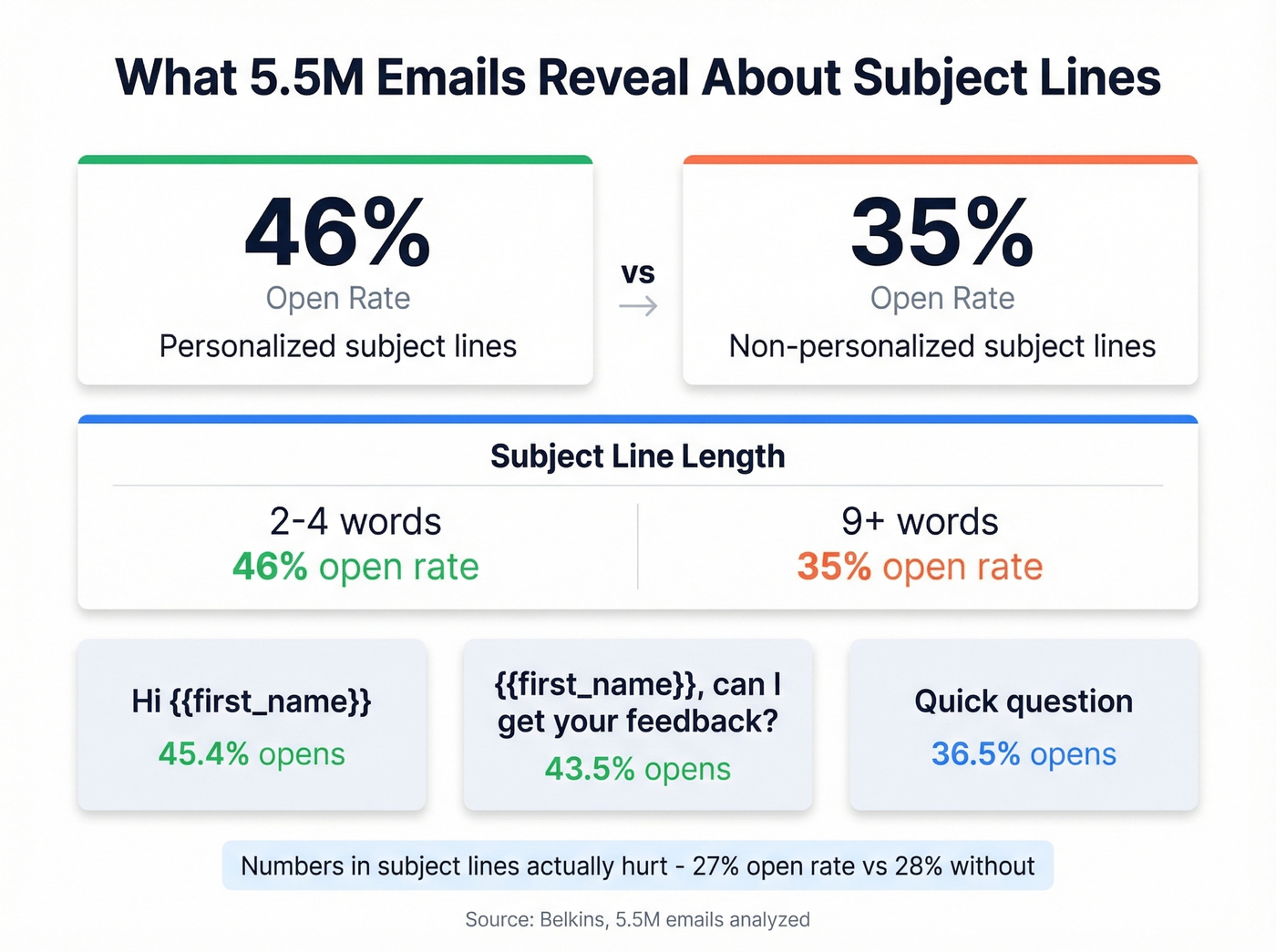
Length matters as much as content. Two to four words is the sweet spot at 46% open rate. Once you cross nine words, opens drop to 35%. The reason is partly mechanical - mobile clients truncate subject lines around 35-50 characters, so your carefully crafted 12-word subject line gets cut to "Hey {{first_name}}, I noticed your company recently..." which reads like every other SDR email in the inbox.
Question-format subject lines also hit 46%, matching personalized lines at the top. The best-performing examples: "Hi {{first_name}}" at 45.36%, "{{first_name}}, can I get your feedback here?" at 43.45%, and "Quick question" at 36.45%.
Numbers in subject lines actually hurt slightly - 27% open rate versus 28% without. Skip the "3 ways to..." format for cold outreach.
Here's the thing: hyper-personalized openers that reference someone's latest social post feel increasingly fake. Practitioners on r/copywriting are finding that specificity about a real business problem outperforms surface-level personalization every time. Mentioning someone's recent funding round is table stakes. Naming the specific hiring bottleneck that funding creates is what gets replies.
How to Write Cold Emails That Get Replies
Every cold email needs a structure. Freestyling produces rambling emails that bury the ask. But before we get to frameworks, here's the insight that matters more than any template: personalization isn't dead, but it's useless if the offer is weak. A practitioner on Reddit put it well - your offer needs to be specific, low-friction, and immediately valuable. "I'll audit your top 3 landing pages and send you a Loom with fixes" beats "Let's hop on a call to discuss how we can help" every single time. Nail the offer first, then pick your framework.
If you want the bigger system around this, start with a B2B cold email sequence instead of one-off sends.
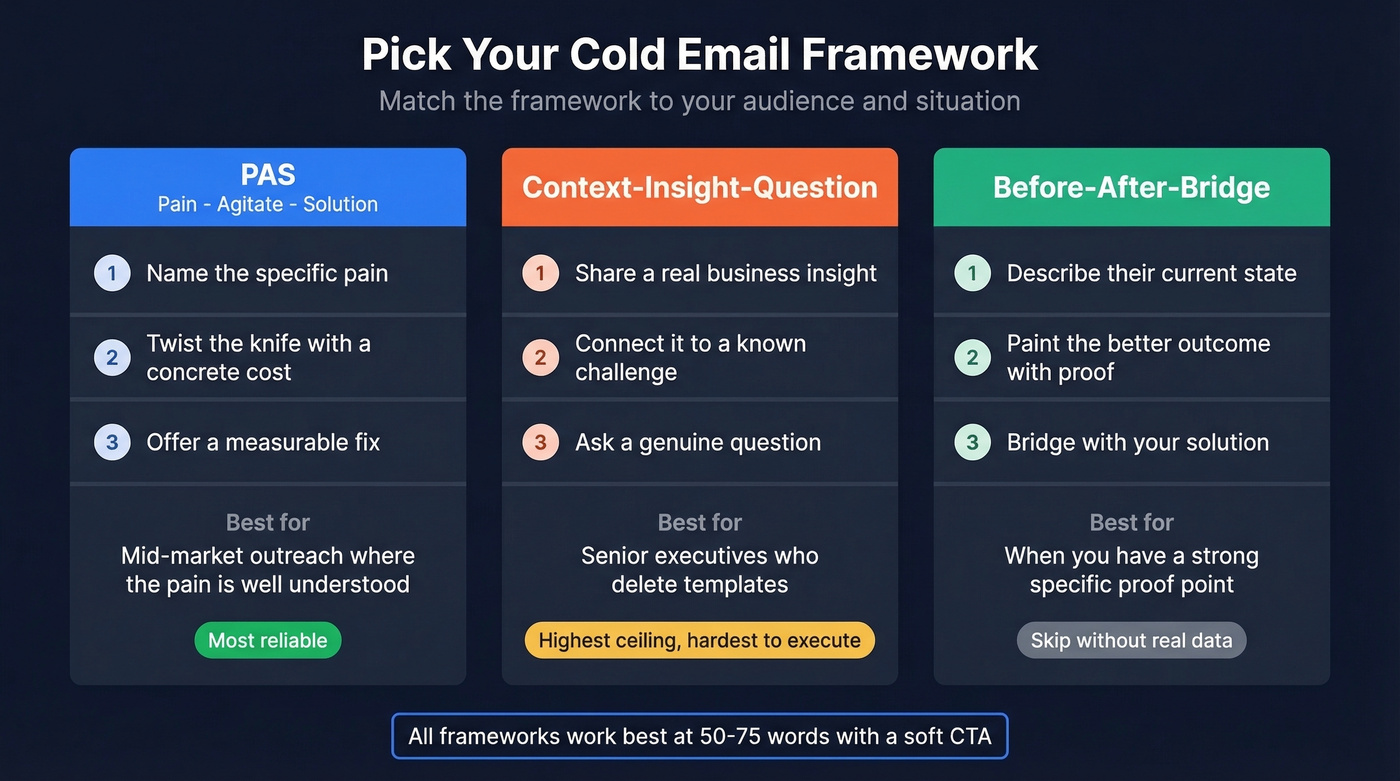
PAS (Pain-Agitate-Solution)
The workhorse. Name the pain, twist it, offer the fix.
{{first_name}}, most B2B teams lose 15-20 hours/week on manual list building. That's a full-time hire spent on copy-paste work instead of closing deals. We built a workflow that cuts that to 2 hours. Worth a conversation?
That's 42 words. The pain is specific, the agitate is concrete - a full-time hire doing grunt work - and the solution is measurable. We've used this structure more than any other, and it consistently outperforms the alternatives for mid-market outreach where the pain is well-understood.
Context-Insight-Question
Best for senior executives who delete anything that smells like a template. Lead with something you actually know about their business.
{{first_name}}, saw your team opened a Munich office last quarter. Most US SaaS companies expanding into DACH underestimate localization costs by 40-60%. We helped {{similar_company}} avoid that. How are you handling it?
When this falls apart: if your insight is generic or easily Googleable, this framework actively hurts you. "I saw your company is growing" isn't an insight. "Your engineering team posted 14 roles in the last 30 days, all backend - that usually means a platform migration" is an insight. If you can't find something that specific, use PAS instead.
Before-After-Bridge
Skip this framework unless you have a strong, specific proof point. Without one, it reads like every other "we helped Company X" email.
{{first_name}}, {{company}} is probably spending 3-4 hours per rep on prospecting daily. Our clients cut that to 45 minutes and tripled qualified pipeline. Happy to show you the exact workflow - interested?
The r/coldemail community keeps pushing word count even lower - 40-60 words max. In our testing, the sweet spot is right around 50. Every word beyond that needs to earn its place.
Notice every example uses a soft CTA. That's not an accident. As Clay's cold email guide puts it: your job is to sell the next line, not the meeting.
CTAs That Book Meetings
A Gong Labs study of 304,174 emails found that "Interest CTAs" outperform both specific-time asks and open-ended asks for cold outreach. You're selling the conversation, not the meeting. Asking someone to commit 30 minutes to a stranger is a big ask. Asking if they're interested is almost frictionless.
If you want more options, pull from these sales follow-up templates and adapt the CTA language to your offer.
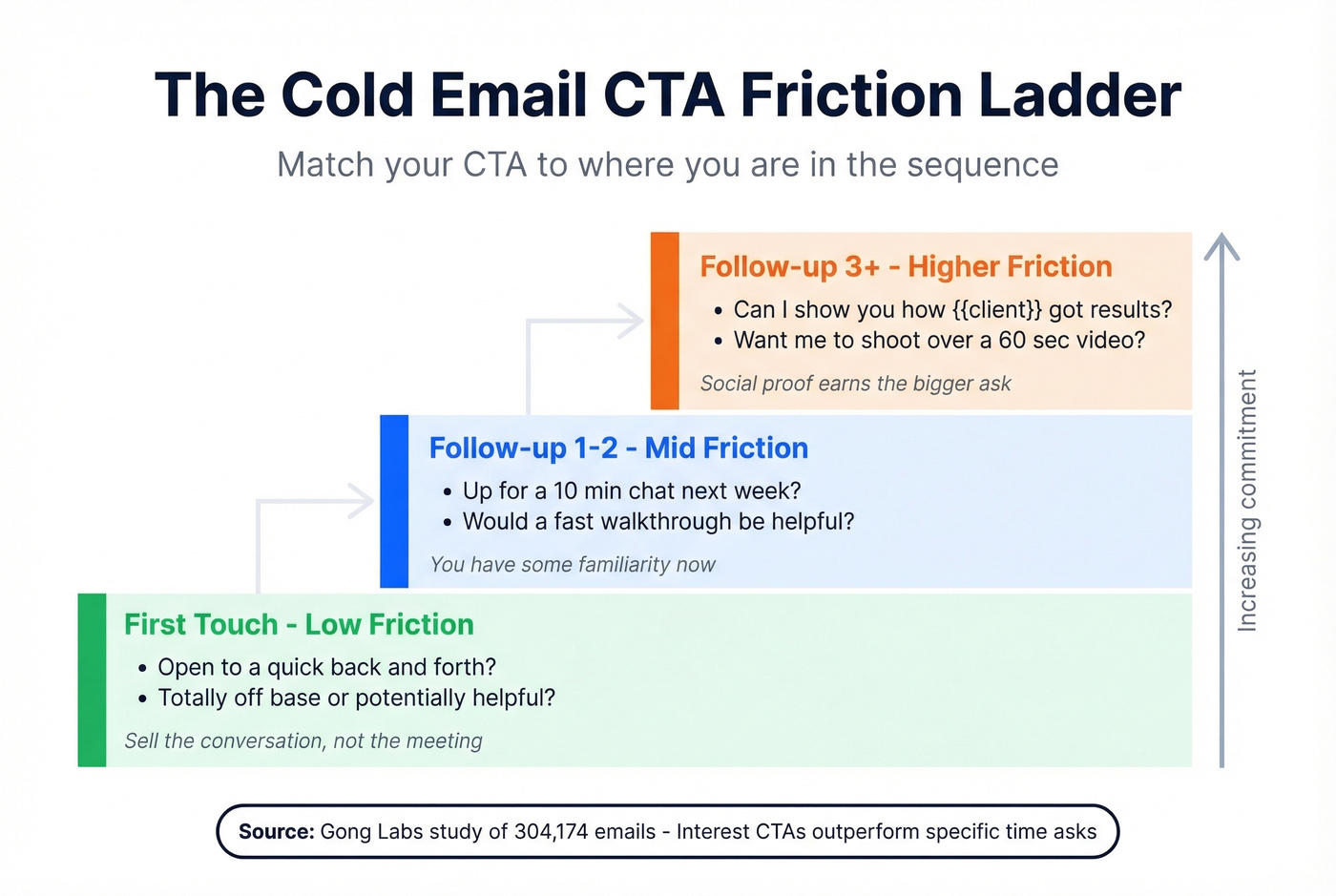
The community on r/coldemail has been testing CTAs across industries and the pattern holds:
| Category | CTA Example |
|---|---|
| Low Friction | "Open to a quick back and forth?" |
| Low Friction | "Totally off base or potentially helpful?" |
| Mid Friction | "Up for a 10 min chat next week?" |
| Mid Friction | "Would a fast walkthrough be helpful?" |
| Social Proof | "Can I show you how {{client}} got results?" |
| Video | "Want me to shoot over a 60 sec video?" |
Low friction CTAs work best for first touches. Save mid-friction and social proof CTAs for follow-ups when you've established some familiarity.
Using AI Without Sounding Like AI
The paradox: 67% of decision-makers say they don't mind if an email was written with AI. But 47% of B2B professionals say they're less likely to reply if it reads like AI. Recipients don't care about the tool. They care about the output.
The telltale signs people flag: repetitive phrasing, overly formal tone, and formulaic structure. "I hope this email finds you well. I wanted to reach out because..." is the template everyone's inbox recognizes instantly. Generic AI-written emails see 90% lower response rates compared to personalized ones.
Use AI to generate first drafts and variations. Then edit aggressively. We've tested AI-generated first drafts against hand-written ones - the gap closes to near-zero after 60 seconds of editing. Read it out loud. If it sounds like something a human would never say at a conference, rewrite it.
For more on tooling and workflows, see our guide to AI cold email outreach.
Deliverability Starts With Copy
45% of emails land in spam folders. Modern filters don't just scan for keywords - they evaluate patterns, tone, and context. A single "100% free" won't tank your campaign, but stack three spam-trigger phrases in one email and you're flagged.
A swap table for the most common offenders:
| Spam Trigger | Safer Alternative |
|---|---|
| 100% free | Complimentary |
| Act now | Get started today |
| Guaranteed success | Proven results |
| No obligation | No commitment needed |
| Click here | See how it works |
| Buy now | Explore options |
| Limited time offer | Available this month |
| Double your revenue | Grow your pipeline |
| Dear friend | {{first_name}} |
| Congratulations! | Quick note |
Let's be honest about what actually kills campaigns, though: bad data destroys good copy faster than any spam trigger. Every bounced email damages your sender reputation. Stack enough bounces and your domain gets flagged, meaning even your perfectly written emails to valid addresses start landing in spam. One bad campaign can poison deliverability for months.
If you're troubleshooting bounces, start with email bounce rate benchmarks and fixes, then work through a full email deliverability guide.
Step zero isn't writing - it's data hygiene. Prospeo runs every address through a 5-step verification process that includes catch-all domain handling, spam-trap removal, and honeypot filtering, delivering 98% email accuracy on 143M+ verified addresses refreshed every 7 days. Stack Optimize built their agency to $1M ARR on this data - 94%+ client deliverability, bounce rates under 3%, zero domain flags across all clients.
The Multi-Channel Multiplier
Cold email copy is one channel in a system, not the whole system. The data on multi-channel outreach is stark:
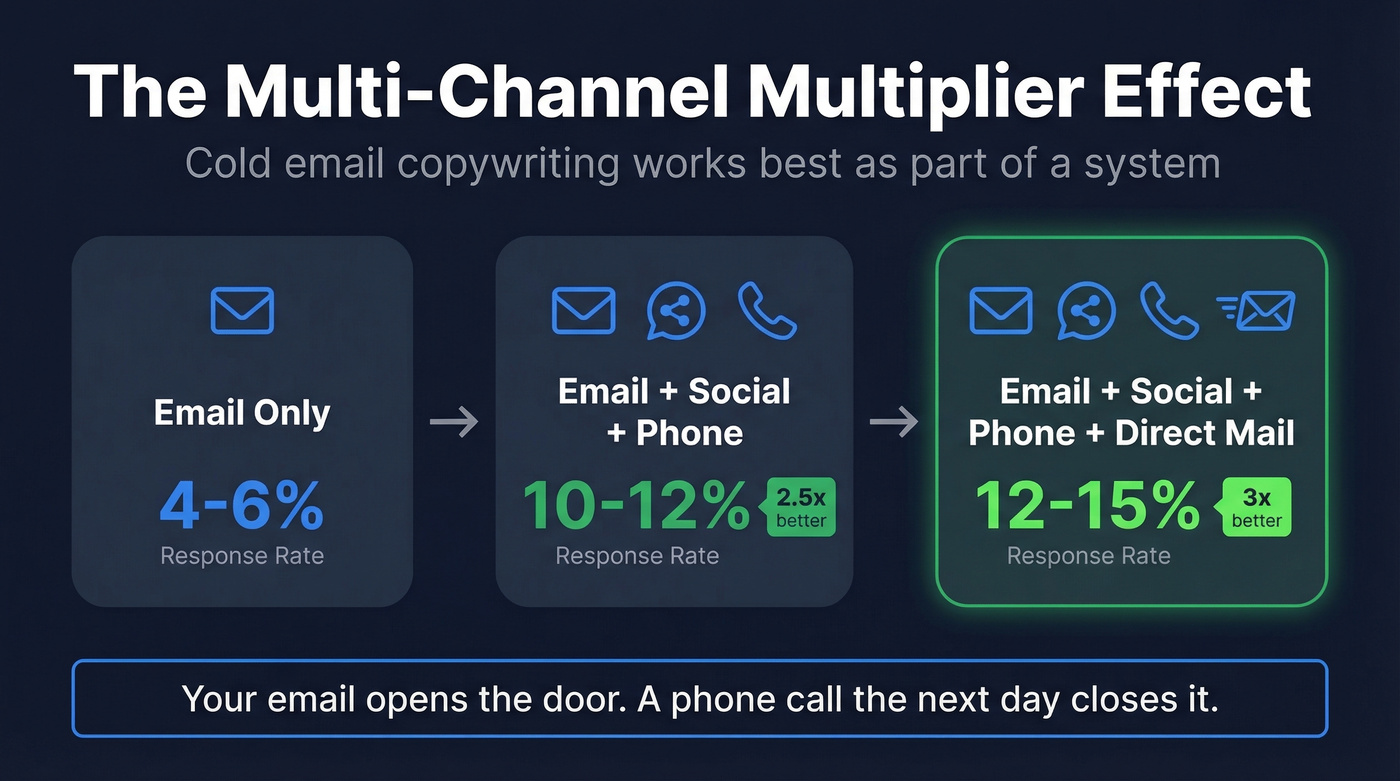
- Email only: 4-6% response rate
- Email + social + phone: 10-12%
- Email + social + phone + direct mail: 12-15%
Your email opens the door. A phone call the next day closes it. Community-led outbound through Slack and Discord groups is emerging as another complement - particularly effective in developer and founder-led sales motions where cold email alone faces skepticism.
For teams that want phone and email data in one place, Prospeo's 125M+ verified mobile numbers with a 30% pickup rate give you both channels without juggling separate tools. If you're building the broader motion, these sales prospecting techniques help you coordinate touches across channels.

The data is clear: 50-75 words get a 12% response rate. But none of that matters if your emails bounce. Prospeo's 98% verified email accuracy means your carefully crafted copy actually reaches inboxes - not spam folders. 300M+ profiles, 7-day data refresh, $0.01 per email.
Stop letting bad data kill great copy. Build a clean list in minutes.
Every framework above assumes one thing: your email lands in a real inbox. Teams using Prospeo cut bounce rates from 35%+ to under 4% and tripled qualified pipeline. 30+ filters let you target the exact buyers your cold emails are written for - by intent, tech stack, funding, headcount growth, and more.
Great cold email copywriting deserves a list that won't waste it.
FAQ
How long should a cold email be?
Fifty to seventy-five words hits a 12% response rate across 10,000+ B2B campaigns. At 200+ words, response drops to 2%. Write your email, then cut it in half - if you can say it in fewer words, you should.
What's a good cold email open rate?
The B2B average is roughly 39%. Top-performing campaigns with personalized, 2-4 word subject lines reach 46% based on Belkins' 5.5M-email study. Below 30% means your subject lines or sender reputation need work.
Should I use AI to write cold emails?
Yes, but edit aggressively. 67% of decision-makers don't mind AI-written emails, yet 47% won't reply if it reads like AI. Use AI for drafts, then rewrite anything formulaic - 60 seconds of editing closes the quality gap almost entirely.
How do I keep cold emails out of spam?
Verify every email address before sending, avoid stacking spam-trigger phrases, and keep your bounce rate under 2%. Catch invalid addresses and spam traps before you hit send - Stack Optimize holds 94%+ deliverability across all clients using this approach.
How many follow-ups should I send?
Three to five. Response rates on follow-up #4 and beyond drop below 1% in most datasets. Space them 3-5 days apart and change the angle each time - don't just bump the thread.