

Best Cold Email Marketing Services in 2026 (Ranked)
You send 400 emails on day one. By day three, 35% have bounced, your domain reputation is cratering, and the warmup you spent three weeks on is worthless. That's not a hypothetical - it's the most common cold email failure mode, and it has nothing to do with your sending tool. It has everything to do with data.
Cold email marketing services break into three layers: the data you send to, the tool that sends it, and the deliverability infrastructure that keeps you out of spam. Most guides only cover the middle layer. Belkins analyzed 16.5 million cold emails and found a 5.8% average reply rate - which means the difference between a campaign that books meetings and one that burns your domain comes down to how well you've stacked all three layers together.
Our Picks (TL;DR)
| Category | Pick | Why |
|---|---|---|
| Best data layer | Prospeo | 98% accuracy, 7-day refresh, native integrations |
| Best for scale (DIY) | Instantly | Built for high-volume sending with built-in warmup |
| Best value (DIY) | Saleshandy | Unlimited email accounts on flat-rate plans from $25/mo |
| Best agency | Belkins | 4.8/5 on G2, strongest track record at scale |
| Best for beginners | GMass + Prospeo | Gmail-based sending paired with verified data |
Prospeo sits at the top because every other tool on this list performs better when the emails you're sending to actually exist. At ~$0.01/email with a free tier of 75 emails/month, it's the cheapest insurance policy in your stack. Instantly and Saleshandy are the two sending tools worth evaluating first - Instantly for scale, Saleshandy for value. If you'd rather hand the whole thing off, Belkins has the deepest track record.
Agency vs. DIY
Before picking a tool, decide whether you're building or buying. The cost difference is massive.
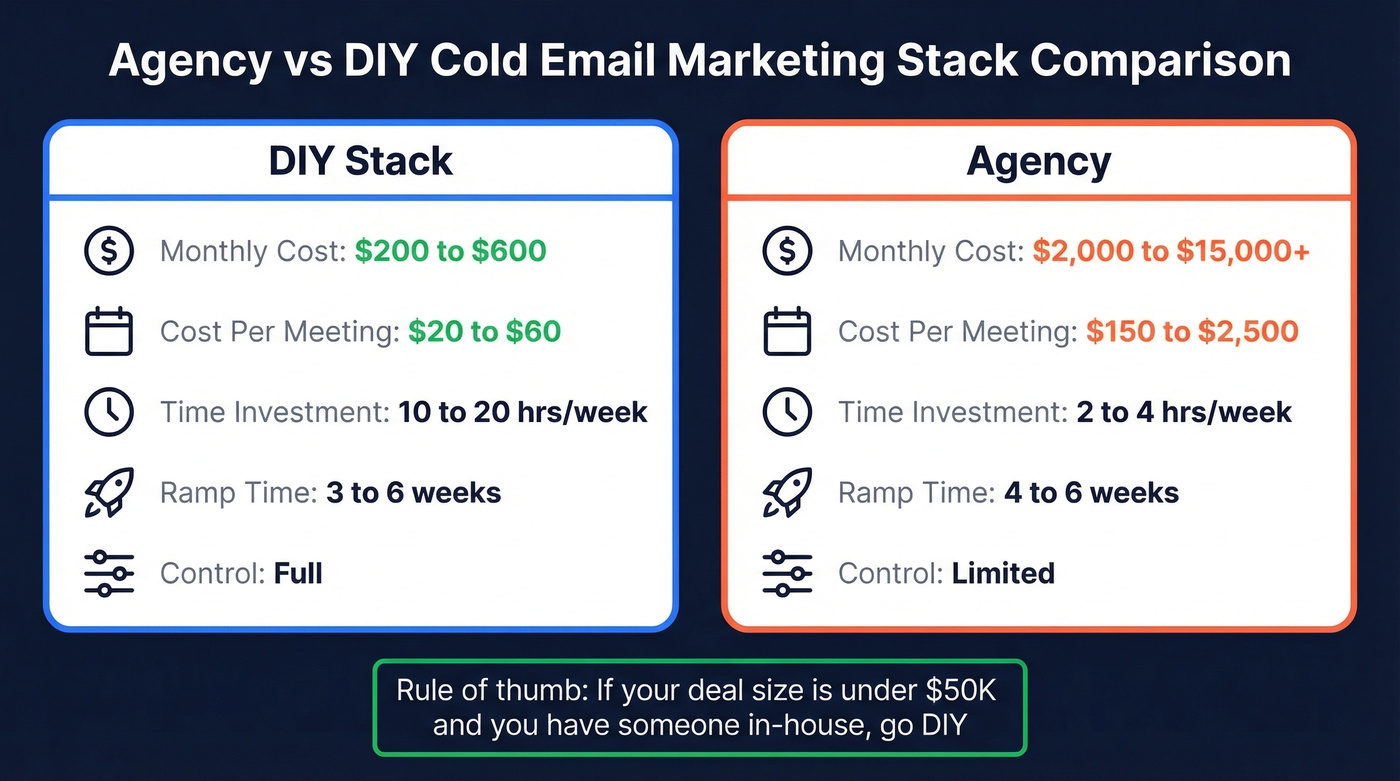
| DIY Stack | Agency | |
|---|---|---|
| Monthly cost | $200-$600 | $2,000-$15,000+ |
| Cost per meeting | $20-$60 | $150-$2,500 |
| Time investment | 10-20 hrs/week | 2-4 hrs/week |
| Ramp time | 3-6 weeks | 4-6 weeks |
| Control | Full | Limited |
The math is straightforward. If your average deal size is $50K+ and you don't have someone in-house who can manage domains, warmup, and copy, an agency makes sense - you're paying for speed and expertise. If you're closing deals in the four-figure range, the per-meeting cost of an agency will eat your margins alive. Build the stack yourself.
Here's the thing: most teams under 50 employees don't need an agency. They need one person who understands deliverability and a $300/month tool stack. The agency model is built for companies that value speed over cost efficiency, and that's a smaller group than the agency world wants you to believe.
Even agencies need clean data. The best ones bring their own data layer. The mediocre ones use whatever list you hand them and blame your ICP when campaigns underperform. Ask any agency prospect what their bounce rate threshold is before signing. If they can't answer immediately, keep looking.
Best Cold Email Software Tools
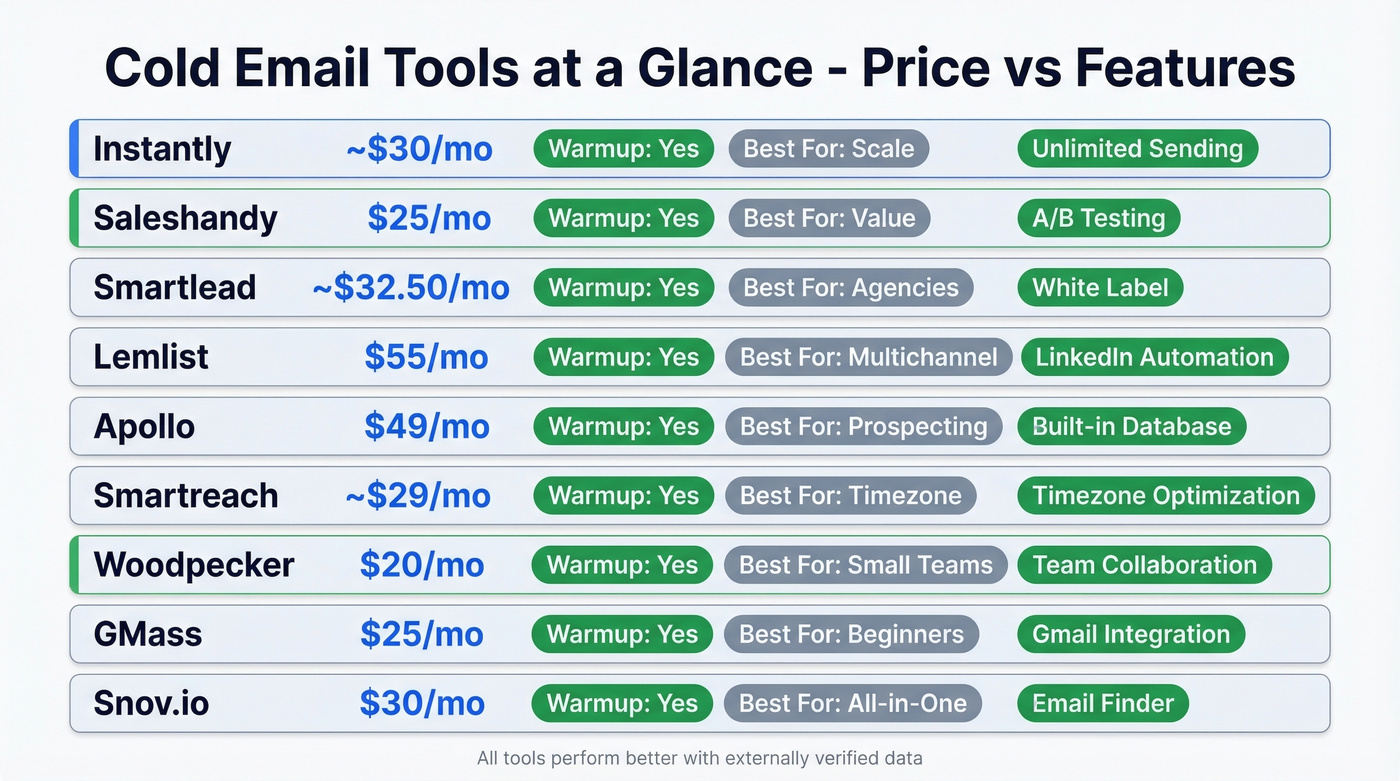
| Tool | Starting Price | Emails/mo (Entry) | Built-in Warmup | Best For |
|---|---|---|---|---|
| Instantly | ~$30/mo | Varies by plan | Yes | High-volume scale |
| Saleshandy | $25/mo | 6,000 | Yes | Value / unlimited accounts |
| Smartlead | ~$32.50/mo | Varies by plan | Yes | Agency multi-client |
| Lemlist | $55/mo | Varies by plan | Yes | Multichannel |
| Apollo | $49-$79/user/mo | Varies by plan | No | Prospecting + sending |
| Smartreach | ~$29/mo | Varies by plan | Yes | Time-zone sending |
| Woodpecker | $20/mo | Varies by plan | Add-on ($5/inbox) | Small teams |
| GMass | $25/mo | Gmail limits | No | Beginners / Gmail |
| Snov.io | $30/mo | Varies by plan | Yes | Email finder + sending |
Instantly
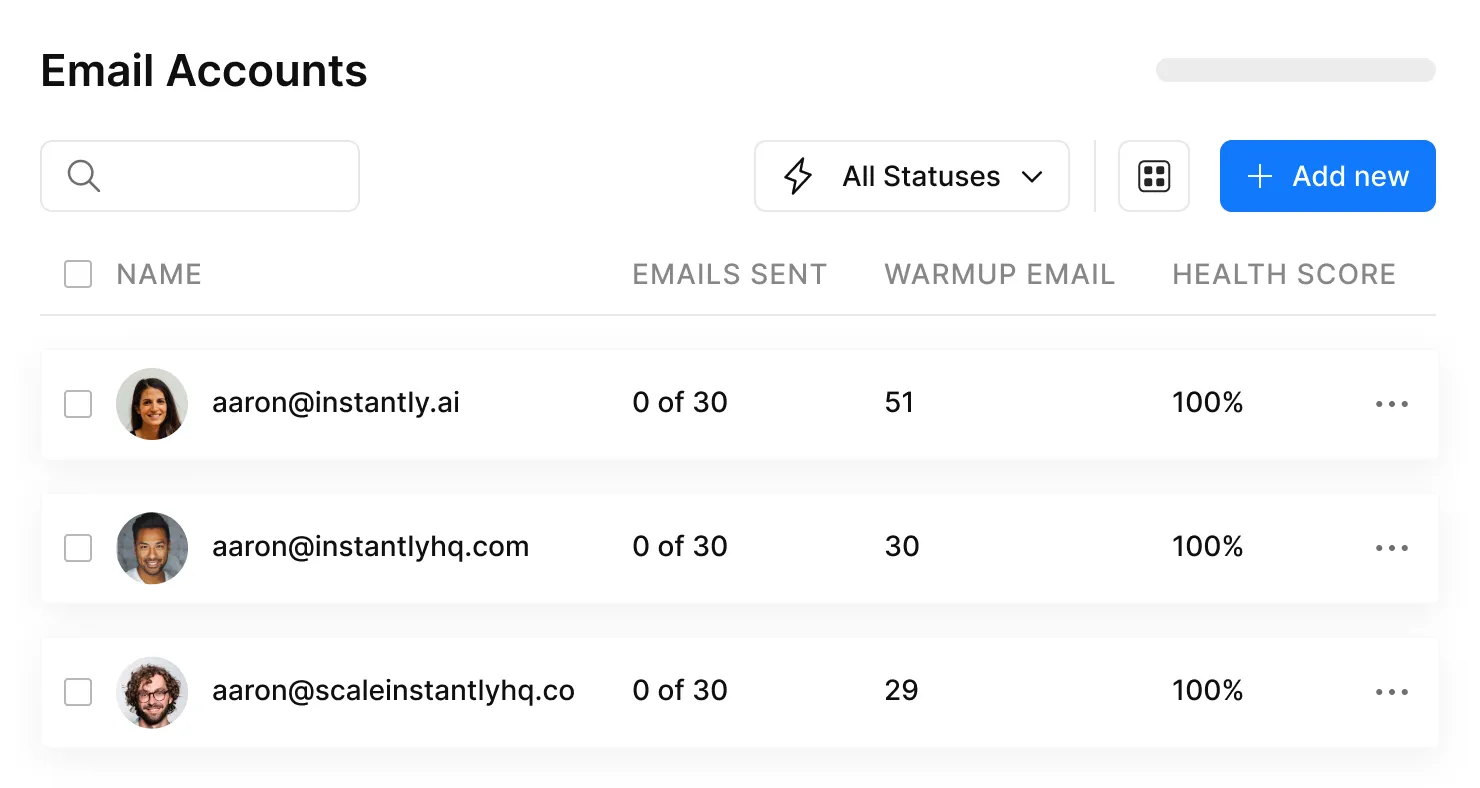
Use this if you're sending 500+ emails per day and want warmup, inbox rotation, and campaign management without switching tabs. Instantly is built for scale - the ~$30/mo entry price gets you started, and the platform handles the complexity of rotating across multiple inboxes without much manual work.
Skip this if you need a CRM or deep analytics without paying extra. Instantly's CRM and lead management features cost additional, and many operators still prefer to run their own domains plus a separate data provider. We've found it works best as a pure sending engine paired with external data.
Saleshandy
Saleshandy wins the value war, and it's not close. The $25/mo Starter plan gives you 6,000 emails/month and 2,000 active prospects with unlimited email accounts on a flat rate. Jump to the $69/mo Pro tier and you're at 150,000 emails/month with 100 email accounts per sequence.
The catch: don't trust their built-in database without external verification. We've seen bounce rates of 8-12% on Saleshandy-sourced contacts that weren't externally verified. Pair it with a dedicated data provider and use Saleshandy purely as a sending engine - that's where it shines.
Smartlead
The real draw here is the multi-client workspace architecture. If you're running campaigns for 5+ clients, the $29/client add-on keeps everything separated - domains, warmup, reporting. Entry price sits at ~$32.50/mo with verification credits from $15/mo. Single-sender teams will find the interface cluttered and overbuilt for their needs.
Lemlist
Use this if you want true multichannel sequences combining email with social touches. The $55/mo Email Pro plan covers the basics; $79/mo Multichannel Expert adds the full stack. Extra sending emails run $9/mo each.
Skip this if you're purely email-focused. You're paying a premium for multichannel features you won't use, and Saleshandy or Instantly will outperform it on raw email volume per dollar.
Apollo
Apollo puts prospecting and sending under one roof. The free plan with 100 credits/month is genuinely useful for testing, and the database is strong for US contacts.
But deliverability is weaker than dedicated sending tools. The consensus on r/coldemail consistently flags Apollo's sending setup as less reliable, and free/basic plans limit you to a single inbox. Paid plans start at $49/user/month on annual billing and commonly land around $59+/user/month depending on plan.
Apollo is the right pick if you're a solo founder who wants one tool and accepts the deliverability tradeoff. It's the wrong pick if you're scaling past 200 emails/day.
Smartreach, Woodpecker, GMass, and Snov.io
Smartreach starts at ~$29/mo and stands out for time-zone-optimized sending, multichannel sequences including calls and WhatsApp, plus the ability to buy domains and inboxes inside the ecosystem. Solid mid-tier pick.
Woodpecker is the cheapest on this list at $20/mo, though warmup costs an extra $5/inbox. Agency teams pay $27/client/month. It's the simplest tool here - ideal for small teams running straightforward sequences without multichannel complexity.
GMass runs inside Gmail at $25/mo basic or $55/mo Professional. Free trial lets you send 50 emails/day. No built-in warmup, no fancy infrastructure - just mail merge on steroids. Best for beginners who don't want to learn a new platform.
Snov.io combines an email finder with sending starting at $30/mo, with a free plan available. Decent all-in-one for solo operators, though the database depth doesn't match dedicated data providers like Prospeo.
Notable Omissions
Hunter.io is primarily an email finder, not a sending tool, so it doesn't fit this list. Mailshake ($25-$85/user/mo) is a capable sender but doesn't differentiate enough from Instantly or Saleshandy to warrant a full review.
Why Data Quality Decides Everything
Your sending tool matters less than your data. Full stop.
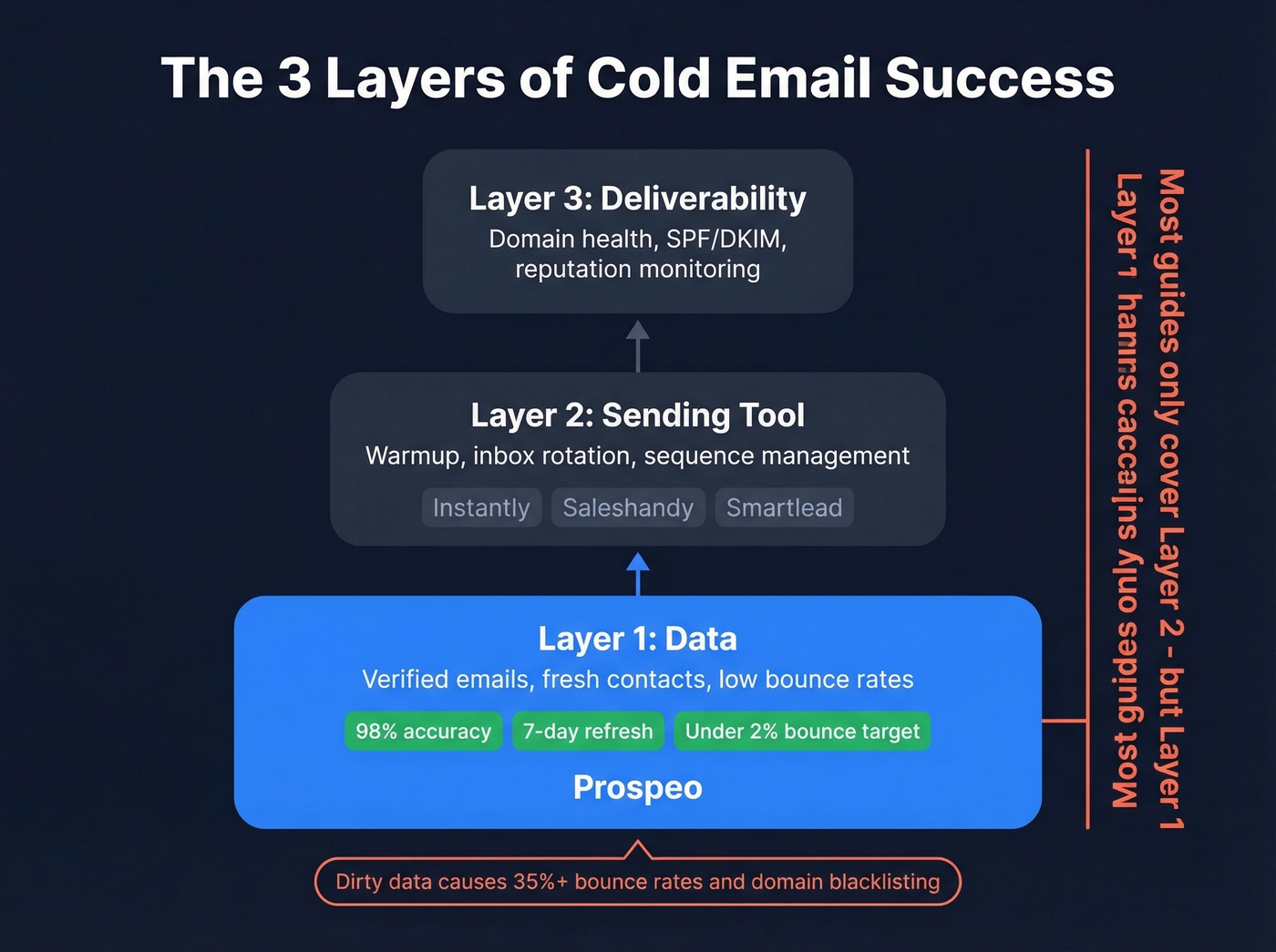
You can run the most sophisticated Instantly campaign with perfect warmup, flawless copy, and optimized send times - and it'll still fail if your list is dirty. Bounces above 2% are a deliverability problem that compounds fast, because every bounce teaches inbox providers your domain sends to bad addresses.
Prospeo's database covers 300M+ professional profiles with 143M+ verified emails, and the numbers that matter most are 98% email accuracy and a 7-day data refresh cycle. The industry average refresh is six weeks, which means most databases are serving you contacts who've changed jobs, companies that've been acquired, and emails that bounced last month. The 5-step verification process handles catch-all domains, removes spam traps, and filters honeypots before you ever hit send.
The proof is in production results. Stack Optimize built from $0 to $1M ARR running cold email with Prospeo data - 94%+ deliverability, under 3% bounce, zero domain flags across all clients. Snyk's 50-person AE team dropped bounce rates from 35-40% to under 5% after switching. Those aren't marginal improvements. That's the difference between a campaign that works and one that gets your domain blacklisted.
Native integrations with Instantly, Smartlead, Lemlist, HubSpot, and Salesforce mean it slots into whatever sending tool you picked above. Pricing runs ~$0.01/email with a free tier at 75 emails/month. No contracts, no sales calls required.
Best Cold Email Agencies
| Agency | Monthly Retainer | Per Meeting | Min Commitment | Best For |
|---|---|---|---|---|
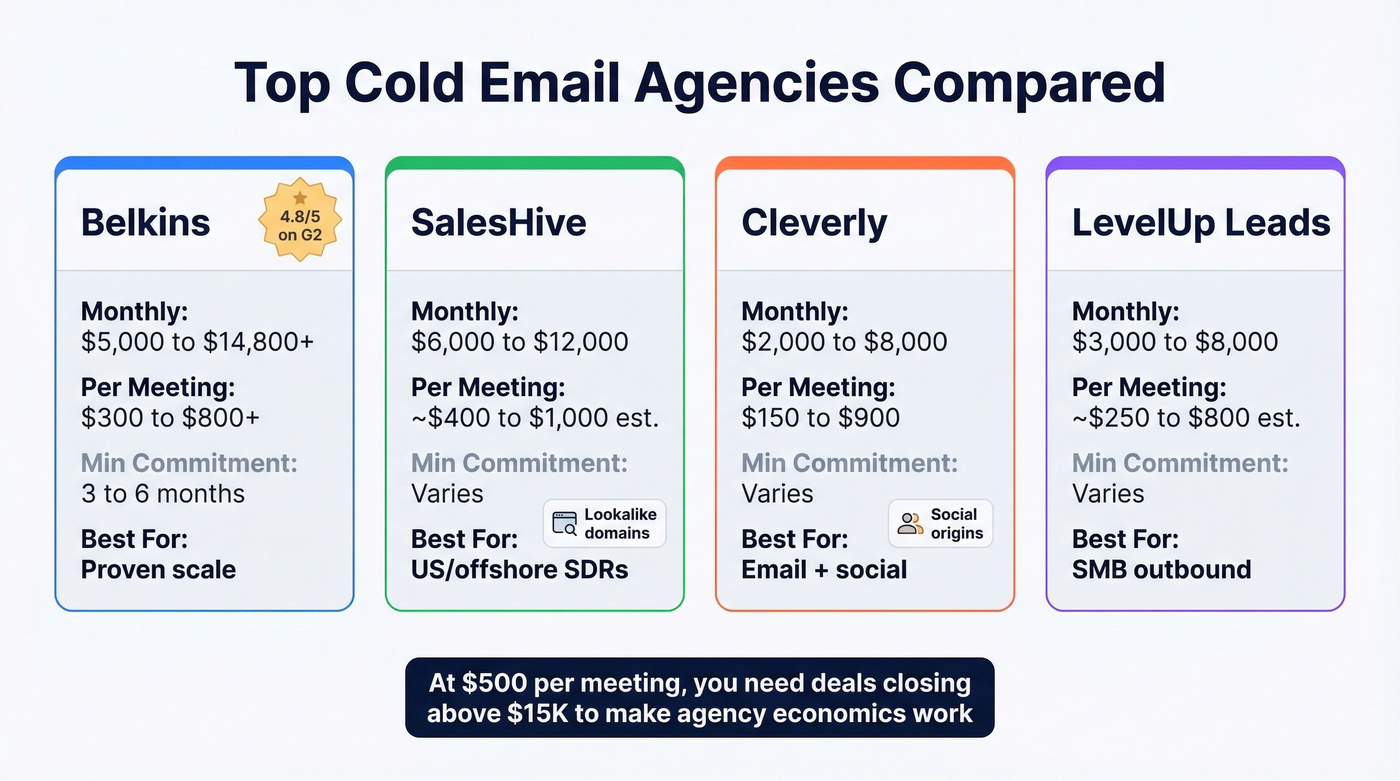
| Belkins | $5,000-$14,800+ | $300-$800+ | 3-6 months | Proven scale |
| SalesHive | $6,000-$12,000 | ~$400-$1,000 est. | Varies | US/offshore SDRs |
| Cleverly | $2,000-$8,000 | $150-$900 | Varies | Email + social |
| LevelUp Leads | $3,000-$8,000 | ~$250-$800 est. | Varies | SMB outbound |
Belkins
Belkins is the agency with the most verifiable track record in cold email. A 4.8/5 rating on G2 across 93 reviews puts them at the top of the category, and their own benchmark study of 16.5M emails gives them credibility most agencies can't match.
Retainers run $5,000-$14,800+/month depending on scope, with a pay-per-appointment model at $300-$800+ per meeting. Minimum project size is $10,000, and you should expect a 4-6 week onboarding period before campaigns go live. Typical commitments run 3-6 months. At $500/meeting, you need deals closing above $15K to make the unit economics work. For enterprise sales cycles, that's a no-brainer. For SMB plays, build the stack yourself.
SalesHive
SalesHive runs $6,000-$12,000/month and offers both US-based and Philippines-based SDR teams. Offshore SDRs can cut costs 40-50%, but you're trading some quality control and timezone alignment. One differentiator: SalesHive uses lookalike domains as a deliverability tactic, keeping your primary domain completely insulated from outbound risk. They run multi-channel outreach across email, phone, and social. Best for teams that want dedicated SDR capacity without hiring.
Cleverly and LevelUp Leads
Cleverly started as a social outreach agency and expanded into cold email. Their email packages run an estimated $2,000-$8,000/month, with social-specific plans starting at $297/month. In one published case study, they describe an Azure-hosted setup with 2 USA-based IPs, 100 Outlook inboxes, and multi-source verification. If you want coordinated email and social outreach from one agency, Cleverly is worth evaluating.
LevelUp Leads focuses on SMB outbound at an estimated $3,000-$8,000/month. Solid option for smaller companies that want agency support without enterprise-tier pricing, though their track record is thinner than Belkins or SalesHive.

You just read that 35% bounce rates destroy domains. Prospeo's 5-step verification delivers 98% email accuracy on a 7-day refresh cycle - so every cold email you send reaches a real inbox. At ~$0.01/email, it's the cheapest deliverability insurance in your stack.
Stop burning domains. Start with data that actually connects.
2026 Benchmarks
These are the most recent large-scale benchmarks available. Belkins' 16.5M-email study remains the most thorough cold email benchmark, and the numbers are sobering.
Average reply rate: 5.8%, down from 6.8% the year before. Practitioners on r/coldemail report 2-4% as a realistic baseline at scale. Anything above 5% is a strong campaign.
Copy length matters more than most people think. Emails with 6-8 sentences performed best at 6.9% reply rate. Keep it under 200 words. The diminishing returns on follow-ups are steep: a third email drops reply rates by up to 20%, and by the fourth, response rates fall 55% while spam complaints climb from 0.5% to 1.6%.
Targeting precision beats volume every time. Emailing 1-2 contacts per company produced a 7.8% reply rate. Blasting 10+ contacts at the same company drops that to 3.8% - and you've annoyed an entire buying committee in the process.
Best send day is Thursday at 6.87% reply rate. Best send window is 8-11 PM (6.52%). Monday is the worst day at 5.29%.
Deliverability Checklist
None of the tools or agencies above matter if your emails land in spam. Here's the non-negotiable setup:
- DNS authentication: SPF, DKIM, and DMARC configured on every sending domain. No exceptions. (If you need a quick reference, start with SPF and DMARC.)
- One-click unsubscribe: RFC 8058 compliance is enforced for bulk senders. Add the header.
- Threshold targets: Spam complaints under 0.3%. Bounces under 2%. Monitor both weekly.
- Domain math: For 400 emails/day, plan on 10-12 domains with 2-3 inboxes each. Send 10-15 emails per inbox per day. That's ~30-45 emails per domain daily.
- Warmup ramp: Week 1: 5-10 emails/day. Week 2: 20-40/day. Week 3+: 40-50/day once inbox health is stable. Keep warmup running after launch - never turn it off.
- Custom tracking domain: Set up a branded CNAME subdomain. Generic tracking domains are spam signals. (More detail: tracking domain.)
- Provider split: Run a 60/40 Google/Outlook mix across your inboxes. Don't put all your eggs in one provider's basket.
- Recipient provider segmentation: Some agency operators segment lists by recipient email provider to optimize deliverability per provider. It's an advanced tactic, but it works.
Verify your list before sending. A 35% bounce rate destroys domain reputation faster than any warmup tool can save it. Real-time verification that catches spam traps and honeypots is the cheapest step in this checklist and the one with the highest ROI.
Hidden Costs of DIY
The $25-$30/month price tag on sending tools is misleading. Here's what a real DIY cold email stack actually costs:
| Line Item | Monthly Cost |
|---|---|
| Domains (10-12) | $8-$15/mo (amortized) |
| Inboxes (20-30 at ~$6 each) | $120-$180 |
| Sending tool | $25-$150 |
| Data / verification | $50-$200 |
| Warmup (if separate) | $0-$50 |
| Total | $200-$600/mo |
Add 10-20 hours per week of your time managing domains, monitoring deliverability, writing copy, and cleaning lists. That's the real "stack tax" - the invisible cost that makes agencies look more reasonable than they first appear.
A dedicated verification provider at $50-$200/month pays for itself by preventing the domain damage that forces you to buy new domains and restart warmup from scratch. We've watched teams burn through $500+ in new domains because they skipped the $50/month verification step. That math only works in one direction.
Every sending tool on this list - Instantly, Saleshandy, Smartlead - performs better with externally verified contacts. Prospeo plugs into all of them natively and returns 98% accurate emails from 300M+ profiles, refreshed every 7 days. The free tier gives you 75 verified emails to prove it.
Pair your sending tool with the data layer that books 26% more meetings.
Mistakes That Kill Campaigns
Don't include links in your first email. Agency operators running millions of emails report that links in email one correlate heavily with spam flags. Save the link for follow-up two or three.
Keep emails under 150 words. Shorter emails perform 83% better, and 85% of cold emails are read on mobile first.
Personalize beyond {first_name}. Personalized cold emails perform 5x better than generic templates. Reference a specific company initiative, tech stack detail, or recent hire - something that proves you spent 30 seconds researching them. (If you want a system, use an ideal customer profile scorecard.)
Never send from your primary domain. One spam complaint on your main domain affects every email your company sends - marketing, transactional, everything.
Don't skip list cleaning. This is the #1 campaign killer. Period. (Related: spam trap removal.)
Write at a 6th-grade reading level. This correlates with 67% better performance. Short sentences, simple words, no jargon. One clear CTA per email - "Would a 15-minute call make sense?" beats a paragraph with three different options.
Don't blast 10+ contacts at the same company. Reply rates drop from 7.8% to 3.8% when you carpet-bomb an org chart.
Compliance Quick Reference
| Regulation | Key Requirements | Penalties |
|---|---|---|
| CAN-SPAM (US) | Physical address, opt-out within 10 days, honest subject lines | Up to $50,120/violation |
| GDPR (EU) | Consent or legitimate interest, document LIA, DPA required | Up to EUR 20M or 4% global turnover |
| CASL (Canada) | Express/implied consent, opt-out within 10 days, maintain records 3 years | Up to $10M/violation |
Let's be honest: cold email is legal in every major jurisdiction if you do it right. CAN-SPAM is the most permissive - you can email anyone as long as you include a physical address, an opt-out mechanism, and honest subject lines. GDPR requires documenting a Legitimate Interest Assessment, which sounds intimidating but takes about 30 minutes to set up properly. CASL is the strictest, requiring some form of prior consent. If you're selling into Canada, get legal advice before launching.
FAQ
How much do cold email marketing services cost?
DIY stacks run $200-$600/month all-in (domains, inboxes, sending tool, data). Agencies charge $2,000-$15,000/month with per-meeting costs of $150-$2,500. Choose DIY if your average deal closes under $15K; choose an agency if deals exceed $50K and you lack in-house bandwidth.
Is cold email legal in 2026?
Yes. Cold email is legal under CAN-SPAM (US), GDPR (EU, via legitimate interest), and CASL (Canada, with consent requirements). Every email needs a physical address, a working opt-out, and honest subject lines. GDPR requires a documented Legitimate Interest Assessment. Penalties range from $50,120/violation (CAN-SPAM) to EUR 20M (GDPR).
What reply rate should I expect?
Belkins' 16.5M-email study found a 5.8% average reply rate. Practitioners consistently report 2-4% as realistic at scale. Anything above 5% is a strong campaign. If you're below 1%, the problem is almost always data quality or targeting - not copy.
How many domains do I need?
For 400 emails per day, plan on 10-12 domains with 2-3 inboxes each, sending 10-15 emails per inbox daily. That's roughly 30-45 emails per domain. Fewer domains means higher per-domain volume, which triggers spam filters faster.