

Cold Email No Response? Here's What's Actually Wrong (And How to Fix It)
You sent 84 cold emails. Nearly every one got opened. Zero replies. That's not a hypothetical - it's a real scenario from r/copywriting that captures the frustration perfectly.
The average cold email reply rate in 2026 is 3.43%. If you're getting nothing back, you're not alone - but you can usually trace it to one fixable bottleneck.
Diagnose Why Prospects Aren't Replying
Before you rewrite a single subject line, figure out which of three problems you actually have:
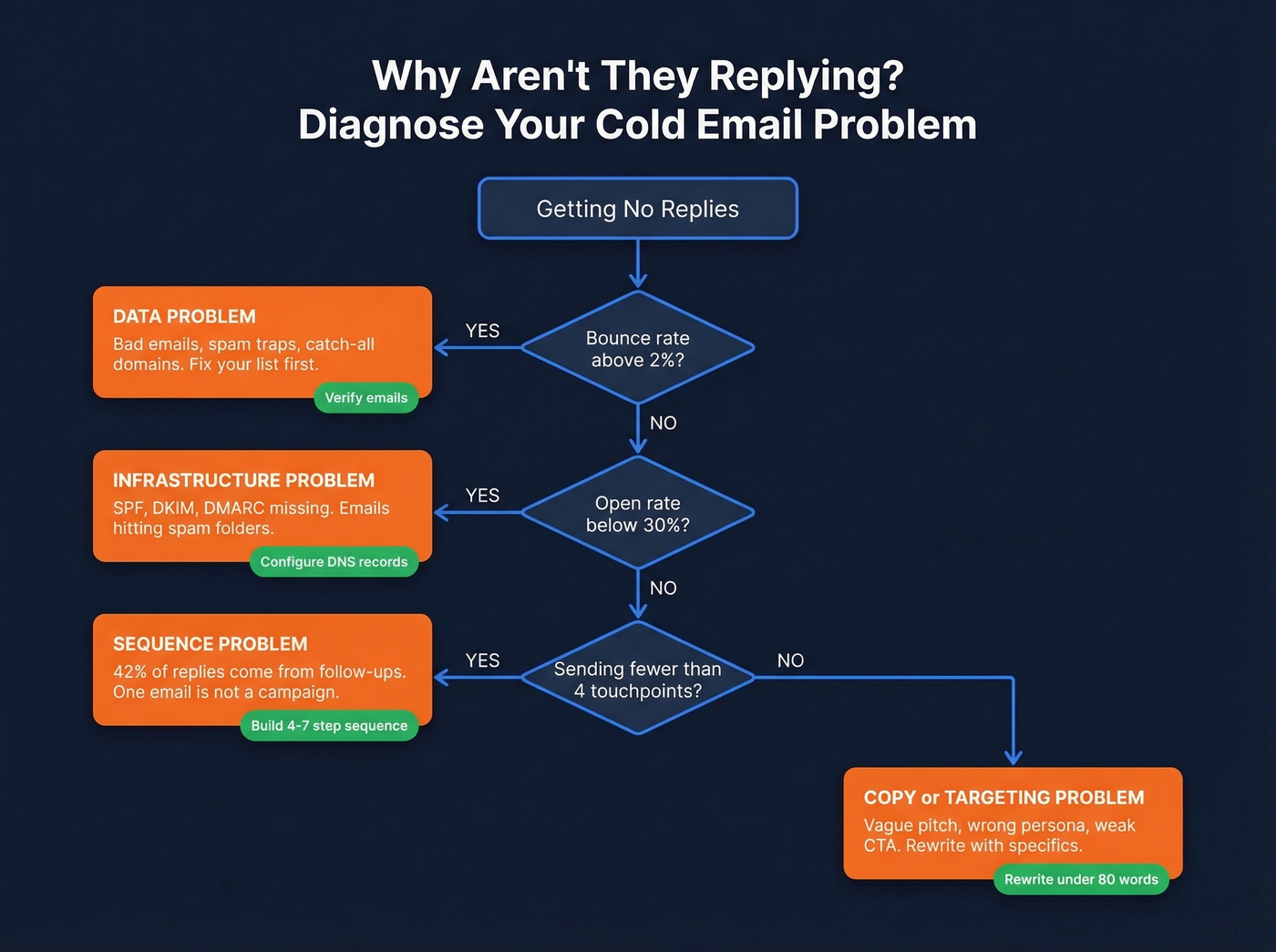
- Emails aren't reaching inboxes. Bad data, shot domain reputation, or broken authentication. Fix the data first. (If you’re not sure what “bad” looks like, start with bounce rate.)
- Emails are opened but ignored. Vague copy, weak CTA, or you're emailing the wrong person entirely - the CEO when the ops manager owns the budget. Tighten your targeting before you touch copy.
- You sent one email and stopped. 42% of replies come from follow-ups. One email isn't a campaign. It's a coin flip.
These look identical from the outside but require completely different fixes. And they compound: bad data causes bounces, which hurts sender reputation, which pushes future emails to spam, which makes even perfect copy invisible.
Start with your bounce rate. Above ~2% is a strong sign your list quality is hurting deliverability. Bounces clean but open rates suspiciously high (50%+)? Those "opens" are likely bot-triggered - one sender on r/coldemail reported a 56% open rate that was almost certainly inflated by spam filter pre-fetching. If opens look legitimate and bounces are low, the problem is your copy, your targeting, or both.
Here's the thing: we've seen teams spend weeks A/B testing subject lines when their bounce rate was 9%. Reply rates doubled from fixing data alone - no copy changes at all. Most "no response" problems are data problems wearing a copywriting disguise.
Your Data Is the Problem
Most guides jump straight to copywriting tips. They skip the upstream cause that makes everything else irrelevant.
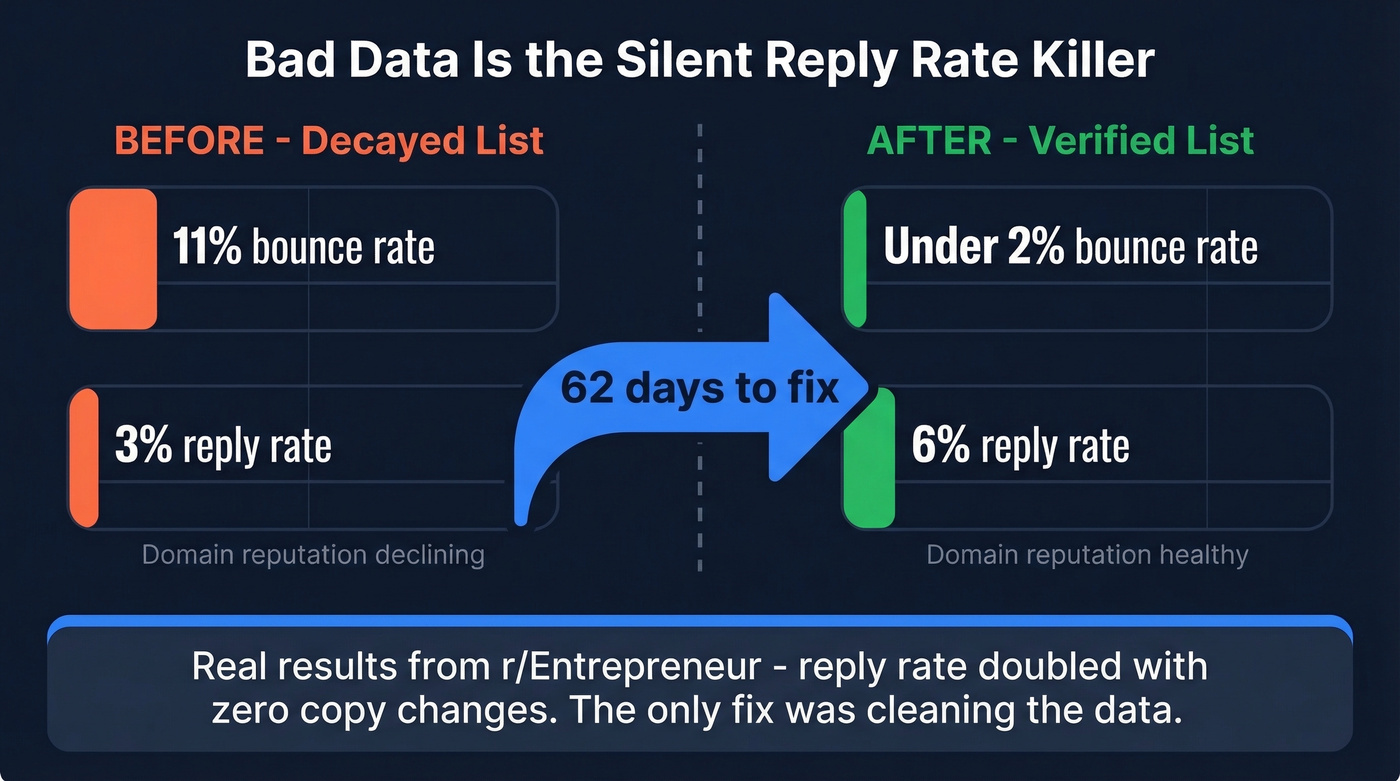
If your contact data is bad, your outreach gets ignored before anyone reads it. One team on r/Entrepreneur documented this spiral in detail. Their reply rate had decayed from 8% to 3% over 18 months, and the fix wasn't better subject lines - they dropped their bounce rate from 11% to under 2% through manual verification, and reply rates climbed to 6% in 62 days. Nearly half of senders don't even track bounce rates, according to a survey of 508 outbound professionals.
That's where verification matters. Prospeo catches spam traps, honeypots, and catch-all domains before they damage your sender reputation - 98% email accuracy, refreshed every 7 days versus the 6-week industry average. If you’re comparing options, see email verification tools side-by-side.
Your Infrastructure Is Broken
Even with perfect data, broken infrastructure kills deliverability. If your emails aren't getting replies, these technical gaps are likely the reason:
SPF, DKIM, and DMARC are non-negotiable. Gmail has enforced bulk sender requirements since February 2024. Outlook followed with high-volume requirements in May 2025. Without them, bulk mail gets rejected or routed to spam. (If you want a deeper walkthrough, use this email deliverability guide.)
Stay around 20-26 emails per inbox per day. Going higher than that is how domains get burned. One rebuild case study capped sending at 26 emails/day per domain as part of their recovery, and that restraint was a key factor. If you’re scaling, track email velocity explicitly.
Warmup is continuous, not a two-week project. Run it alongside campaigns indefinitely. And keep spam complaints under 0.3% - one flag-happy recipient can poison a domain that took weeks to warm. If you need options, compare email warmup tools.

Bad data causes bounces. Bounces kill sender reputation. Dead reputation means even perfect copy lands in spam. Prospeo's 98% email accuracy and 7-day refresh cycle stop that spiral before it starts - Stack Optimize built to $1M ARR with under 3% bounce rates across every client.
Stop rewriting subject lines when the real problem is your data.
Your Email Copy Needs Surgery
Back to those 84 opened, zero-replied emails. The copy read: "I noticed some issues with your site... brainstorming strategies... want me to send it over?" Three fatal mistakes: vague problem, no proof, and a CTA that asks for nothing specific. (For more examples, see email copywriting.)
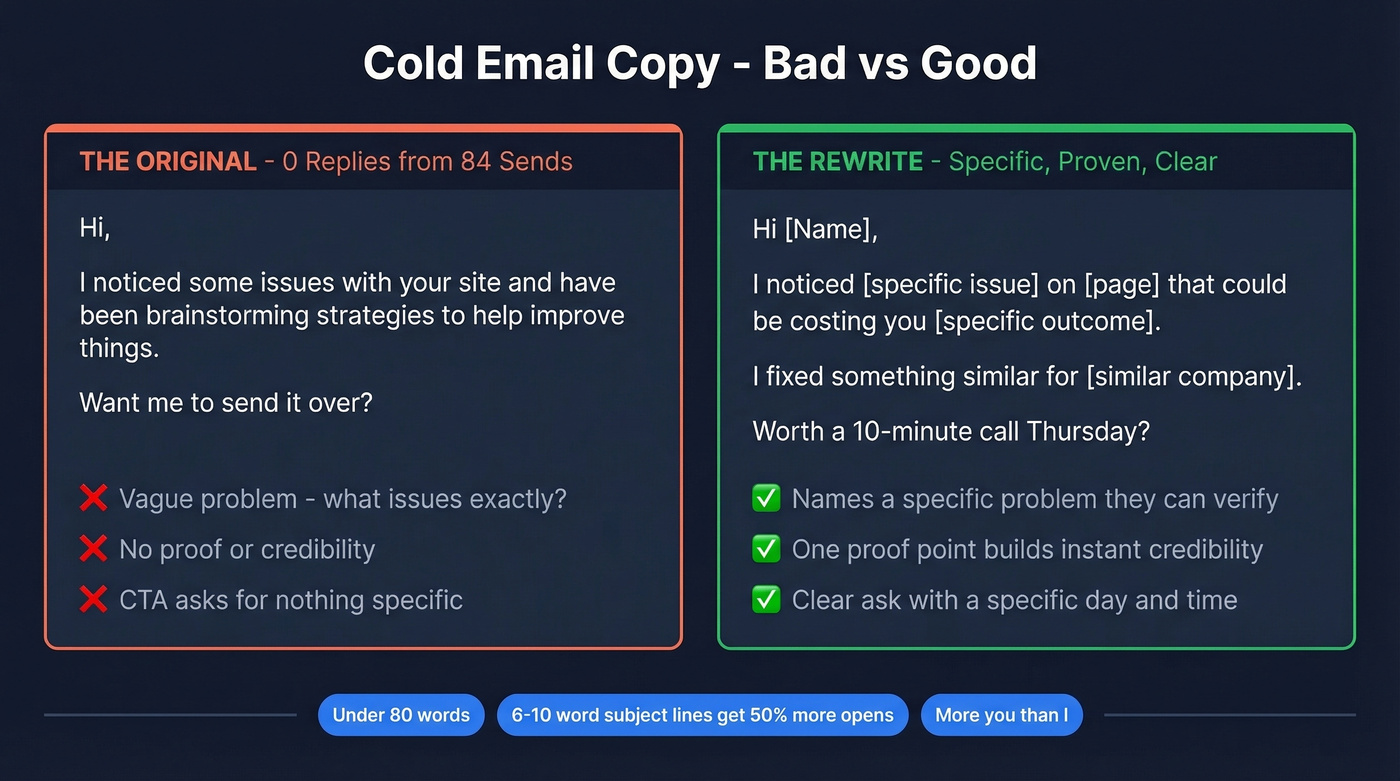
Here's that bad email rewritten:
"Hi [Name], I noticed [specific issue] on [page/flow] that could be costing you [specific outcome]. I fixed something similar for [similar company]. Worth a 10-minute call Thursday?"
The framework: name a specific problem, show one piece of proof, ask for one clear thing. Keep emails under 80 words - the team that rebuilt to 6% reply rates went as low as 56. Personalized subject lines get 50% higher opens, and the sweet spot is 6-10 words. You don't need AI-generated icebreakers. You need to signal you understand their specific situation in one line. If you want a swipe file, use these cold email subject line examples.
Let's be honest about a mistake we see constantly: sending a technical pitch to the CEO when the engineering manager owns the decision. That's a guaranteed path to silence. r/coldemail threads regularly flag wrong-persona targeting as the most overlooked reason outreach falls flat, and in our experience, they're right.
How to Handle Unresponsive Prospects
70% of cold emailers send one email and give up. That's wild.
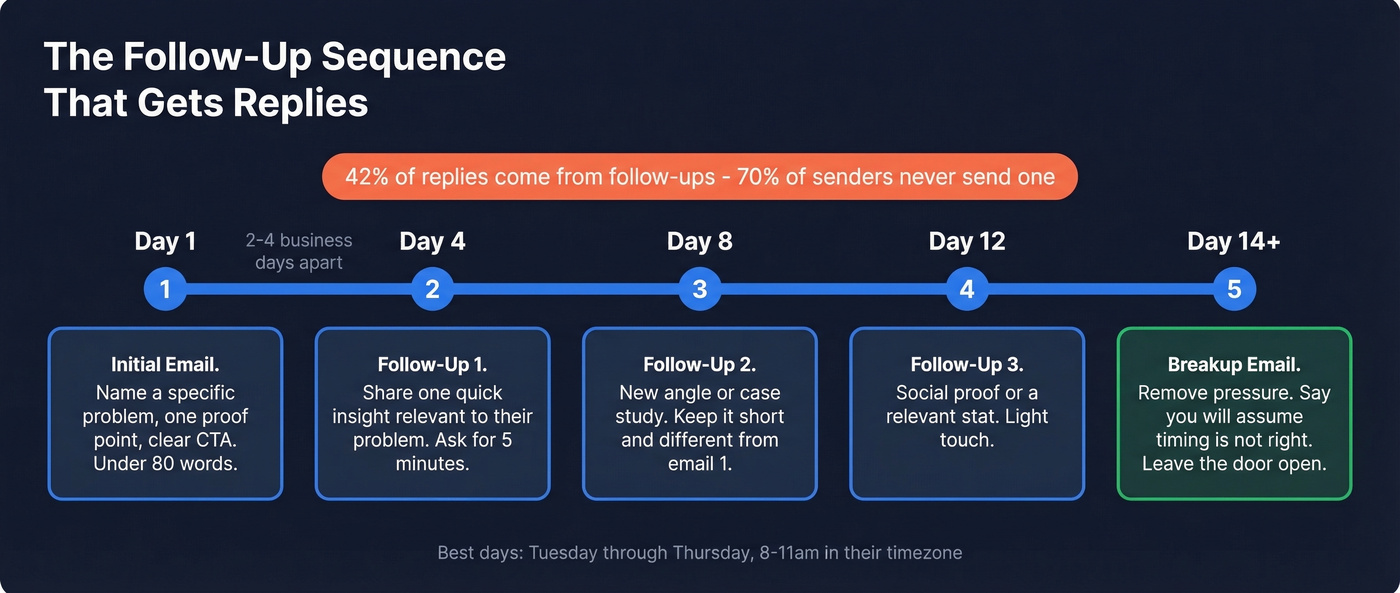
Especially given that 42% of replies come from follow-ups. Even replies don't guarantee pipeline - one sender got 3 replies from 30 emails but 2 ghosted before a call. You need volume and persistence.
The sweet spot is 4-7 touchpoints, spaced 2-4 business days apart, Tuesday through Thursday between 8-11am in the recipient's timezone. If you need copy you can paste, grab these follow-up templates.
Follow-up #1 (3 days later): "Hi [Name], wanted to share one quick thing - [specific insight relevant to their problem]. Worth 5 minutes Thursday?"
Breakup email (2 weeks later): "Hi [Name], I'll assume the timing isn't right. If [problem] becomes a priority, happy to pick this back up."
Some sellers skip breakup emails entirely, but in our experience they consistently outperform because they remove pressure. People reply when they don't feel cornered. If you're still getting silence after a full sequence, revisit your targeting and data quality before assuming the messaging is the issue.
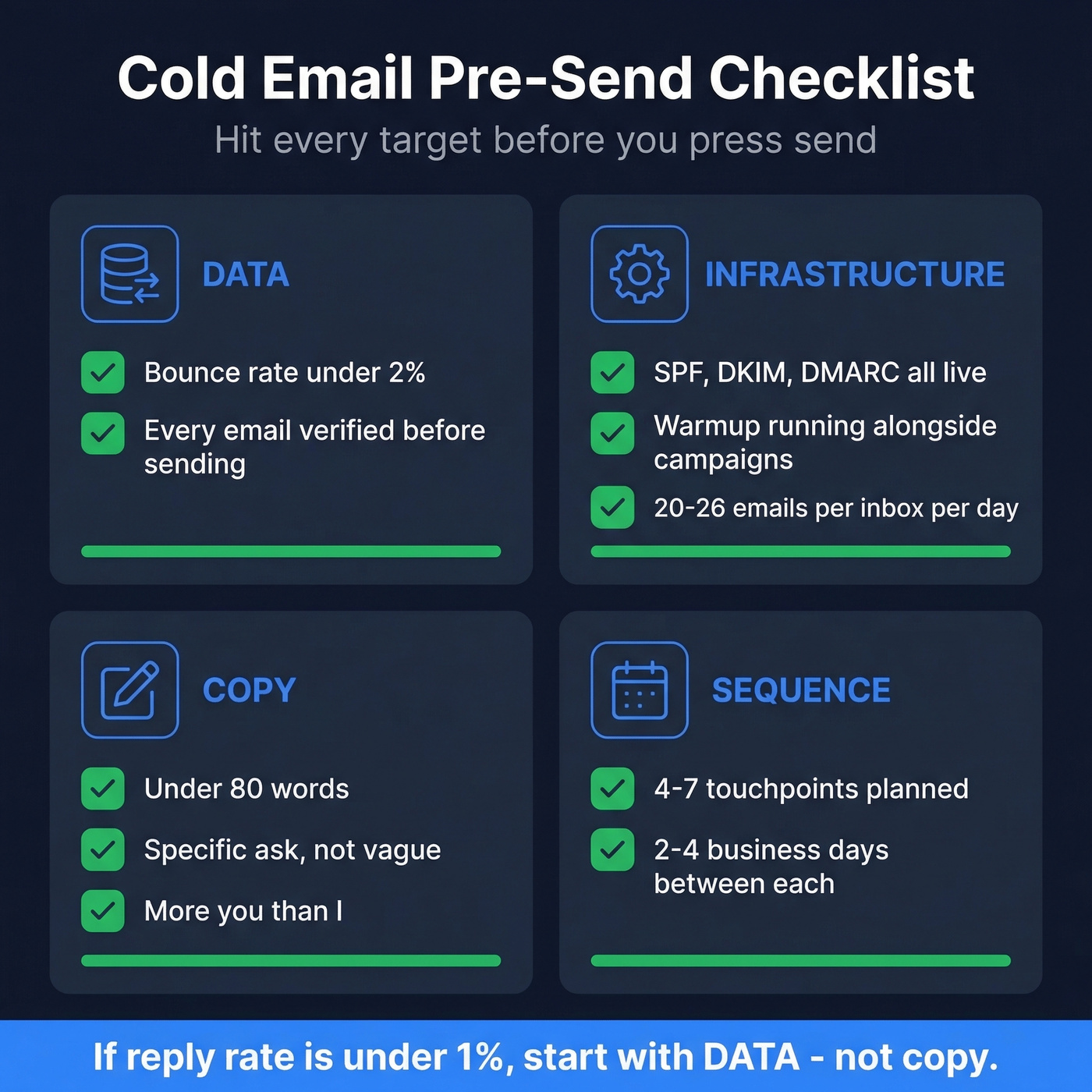
Pre-Send Checklist
| Category | Target |
|---|---|
| Data | Bounce rate <2%, every email verified |
| Infrastructure | SPF/DKIM/DMARC live, warmup running, ~20-26/inbox/day |
| Copy | <80 words, specific ask, more "you" than "I" |
| Sequence | 4-7 touchpoints, 2-4 days apart |
Verify every email before it enters your sequence. Prospeo's free tier covers 75 emails per month - enough to test whether your list is the real problem. (If you’re building lists upstream, start with lead generation tools.)
75 free verified emails per month. That's enough to test whether bad data is why prospects aren't replying. Every address runs through 5-step verification with spam-trap removal and catch-all handling - at $0.01/email when you scale.
Find out if your list is the bottleneck in 10 minutes.
FAQ
What's a good cold email reply rate in 2026?
The overall average is 3.43%. Top-quartile campaigns hit 5.5%+, and elite campaigns exceed 10%. Below 1% usually signals a data or infrastructure problem, not a copy problem.
How many follow-ups should I send after no response?
Four to seven touchpoints is the sweet spot. 42% of replies come from follow-ups, so stopping after one email cuts your potential responses nearly in half. Beyond seven, returns drop off sharply.
How do I know if my emails are landing in spam?
Check your bounce rate - above ~2% means bad data is hurting deliverability. Verify SPF, DKIM, and DMARC are configured. Then use a verification tool to clean invalid addresses before they damage your domain. Prospeo's 5-step verification catches spam traps and honeypots that other tools miss.
Why are my cold emails opened but getting no replies?
The most common causes are generic copy, wrong-persona targeting, or a weak CTA. Name a specific problem, show one proof point, and ask for one clear action in under 80 words. Also confirm you're reaching the actual decision-maker - not just the most senior person you could find.