Cold Email Outreach Alternatives: What Actually Works in 2026
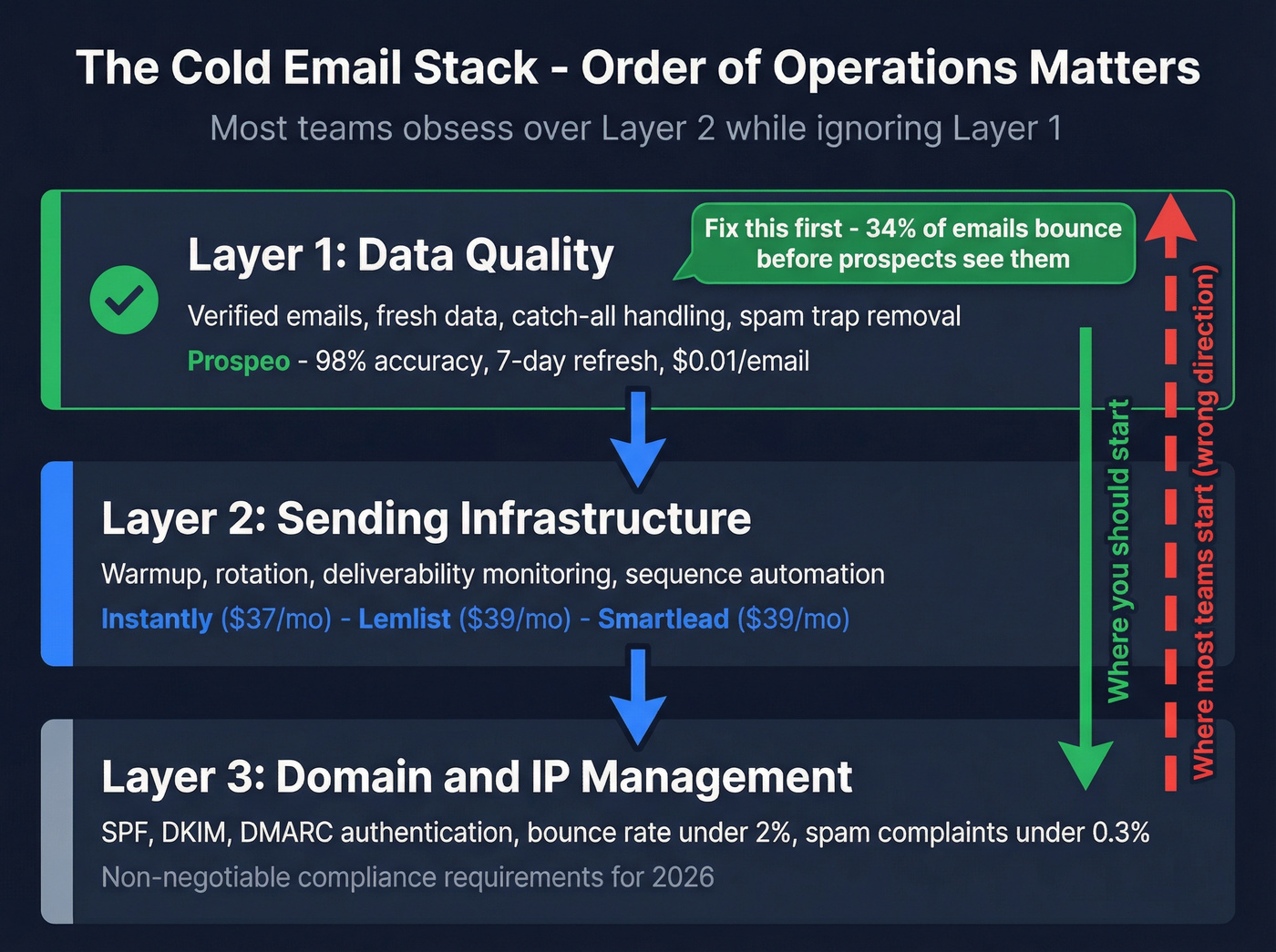
A RevOps lead we know ran a three-tool bake-off last quarter. The "best" sending platform didn't matter - 34% of the emails bounced before a single prospect saw the subject line. The team that won didn't switch senders. They fixed their data.
Here's the timeline that changed everything: Google and Yahoo started enforcing bulk-sender rules in February 2024. Microsoft followed in May 2025. By late 2025, Gmail began actively rejecting non-compliant bulk emails instead of just filtering them to spam. Meanwhile, 64% of sales reps report falling short of quota, and the average B2B deal now involves 6.3 stakeholders. Cold email isn't dead, but the version most teams are running - bulk lists, generic templates, fingers crossed on deliverability - that version is absolutely dead. The average cold email reply rate sits at 3.43% according to Instantly's 2026 benchmark report. That's not a channel problem. It's an execution problem.
What You Need (Quick Version)
Before you read 2,700 words, here's the decision in three paths:
Your sending tool is the problem. If you're on an outdated platform with no warmup, no rotation, and no deliverability monitoring, switch to Instantly ($37/mo) or Lemlist ($39/mo). Both handle the infrastructure side so you can focus on copy.
Cold email itself is the problem. Some audiences don't respond to cold email regardless of how good your data or tool is. Add LinkedIn outreach (2x the response rate of cold email), layer in intent data, or try conversational marketing. The answer might be channel diversification, not tool switching.
Why Cold Email Is Harder in 2026
The compliance bar is now non-negotiable: SPF, DKIM, and DMARC authentication. One-click unsubscribe headers (RFC 8058). Spam complaints under 0.3%. Bounce rates under 2%. Miss any of these, and your emails simply don't arrive.
Deliverability is where most teams get stuck. After a few weeks of sending, inbox placement drops and nothing seems to "work" anymore. Some teams try inbox bumps - re-sending to non-openers or nudging threads back to the top - but without clean data and proper authentication, bumps just accelerate domain damage.
Deliverability is only half the story, though. The other half is relevance. A Belkins study found that campaigns blasted to 500+ recipients averaged a 2.1% response rate, while campaigns targeting 50 or fewer recipients hit 5.8%. Smaller, sharper lists win every time.
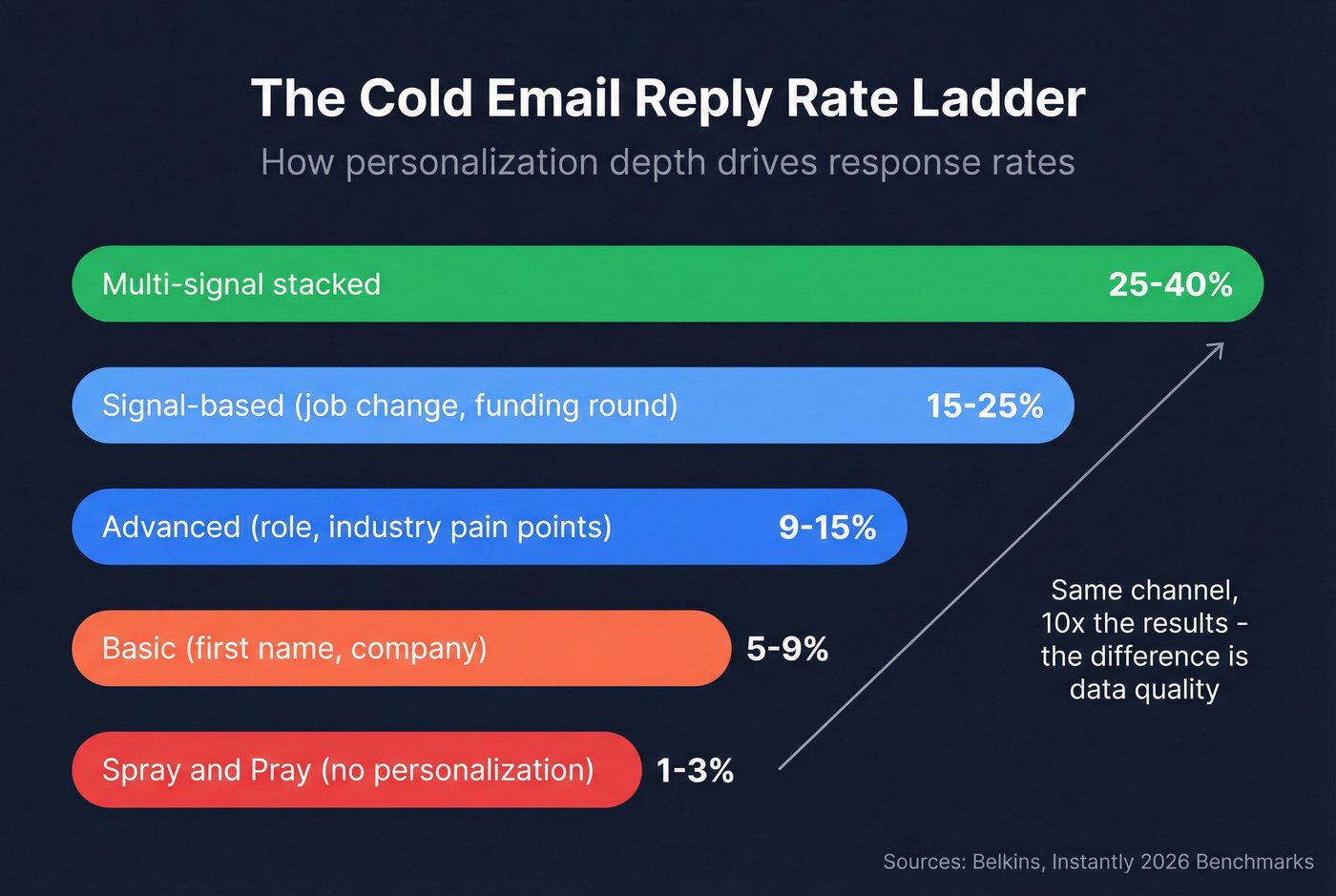
Here's what the reply-rate ladder looks like when you stack personalization depth against response rates:
| Personalization Level | Typical Reply Rate |
|---|---|
| None (spray-and-pray) | 1-3% |
| Basic (first name, company) | 5-9% |
| Advanced (role, industry pain) | 9-15% |
| Signal-based (job change, funding) | 15-25% |
| Multi-signal stacked | 25-40% |
The gap between 2% and 30% isn't the sending tool. It's the quality of your data and the specificity of your targeting. Teams still treating cold email like a volume game are burning domains and budget simultaneously.
Alternatives That Actually Drive Results
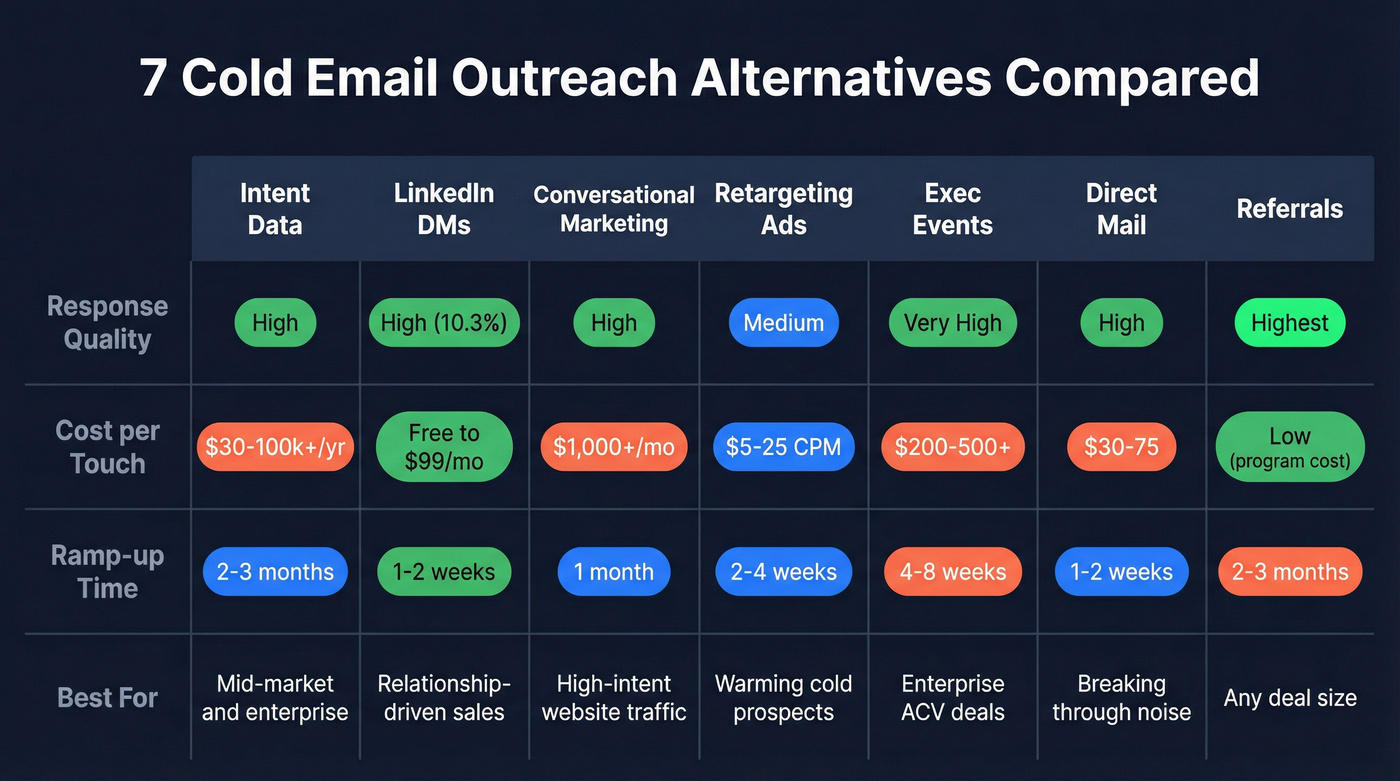
Sometimes the right move isn't fixing your cold email - it's adding channels that meet buyers where they already are. These seven approaches are producing measurable results for B2B teams right now.
Intent Data Platforms
Tools like 6sense and Demandbase track buying signals across the web - content consumption, competitor research, review site visits - and surface accounts that are actively in-market. Instead of cold-emailing 5,000 contacts and hoping 50 are interested, you start with the 50 who already are. Enterprise pricing typically runs $30-100k+/year, so this is a mid-market-and-up play.
Social Selling and Direct Messaging
LinkedIn DMs pull a 10.3% response rate versus 5.1% for cold email, with a connection request approval rate of 29.61%. The key is engaging with a prospect's content before sliding into their inbox. It's slower than email, but the conversion quality is noticeably higher. The consensus on r/sales is that LinkedIn works best as a complement to email, not a replacement - warm up the relationship socially, then follow up in the inbox.
Conversational Marketing
Drift and Qualified turn your website into a real-time sales channel. When a target account lands on your pricing page, a chatbot or live rep engages them immediately. Pair this with a de-anonymization tool like RB2B to identify visitors who never fill out a form.
Retargeting Warm Visitors
Someone visited your site, read a case study, and left. Retargeting ads on LinkedIn and Google keep you visible without another cold touchpoint. It's not outreach - it's staying top of mind with people who already showed interest.
Exclusive Events and Roundtables
Invite-only exec dinners, virtual roundtables, and small-group webinars create a context that cold email never can. The conversion rates are dramatically higher because the format itself signals exclusivity and value.
Direct Mail
Physical mail has made a comeback precisely because inboxes are overcrowded. Sendoso and Alyce let you trigger personalized packages - a book, a handwritten note, a gift card - tied to CRM events. Expect to spend $30-75 per touch, but for enterprise deals, the ROI math works.
Customer and Partner Referrals
The warmest intro is one that comes from someone the buyer already trusts. Building a structured referral program - with incentives, tracking, and enablement - consistently outperforms any cold channel. Most teams underinvest here, and it's the single biggest missed opportunity in B2B sales.

You just saw the data: campaigns under 50 recipients hit 5.8% reply rates. Signal-based targeting pushes that to 25%+. Prospeo gives you 30+ filters - buyer intent, job changes, funding, technographics - across 300M+ profiles so you can build those razor-sharp lists. At $0.01/email with 98% accuracy, you stop burning domains and start booking meetings.
Stop blaming your sending tool. Start with data that actually connects.
Best Cold Email Tools for 2026
If you're sticking with cold email (and you should - it still works when done right), the tool stack matters. But the order of operations matters more. Think of it as three distinct layers: data quality, sending infrastructure, and domain/IP management. Most teams obsess over the second layer while ignoring the first, which is like tuning a race car engine and filling it with bad gas.
Let's be honest: if your average deal size is under $5k, you probably don't need a $50+/user/month all-in-one platform. A $37/mo sender paired with accurate data will outperform an expensive suite with mediocre contact information every single time.
Prospeo - The Data Layer
Every sending tool on this list is only as good as the data you feed it. Prospeo sits upstream of your sequencer and solves the problem most teams misdiagnose as a "deliverability issue" when it's actually a data quality issue.
The database covers 300M+ professional profiles with 143M+ verified emails at 98% accuracy. That number comes from a 5-step verification process with catch-all handling, spam-trap removal, and honeypot filtering. For comparison, ZoomInfo's email accuracy runs around 87%, and Apollo's sits closer to 79%.
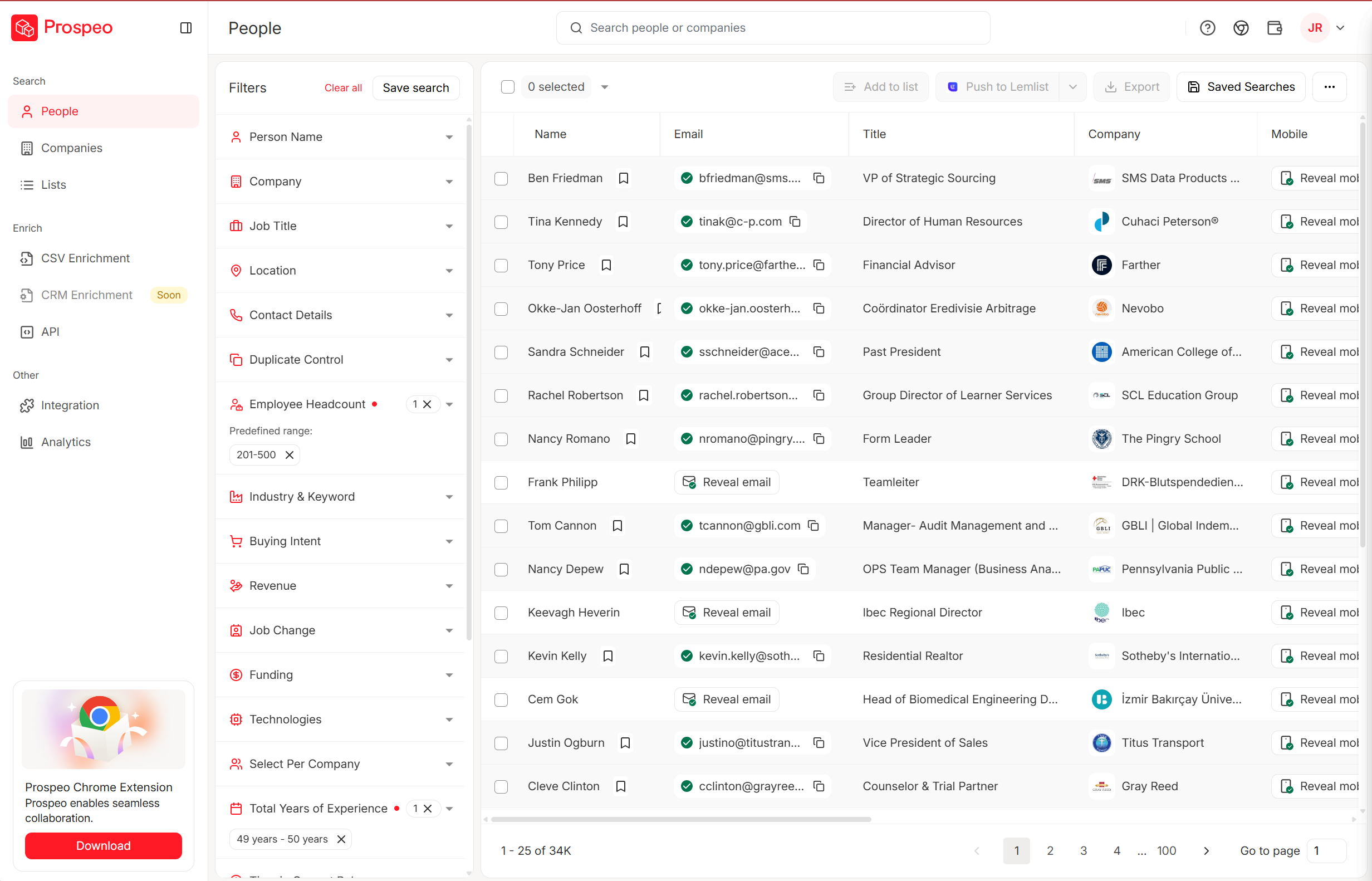
What makes the platform particularly useful for cold email teams is the 7-day data refresh cycle. The industry average is six weeks. In cold email, stale data means bounces, and bounces mean domain damage. That refresh cadence keeps your lists clean without manual re-verification.
Native integrations with Instantly, Lemlist, Smartlead, and Salesforce mean verified contacts flow directly into your sequences. Pricing starts free with 75 emails/month and scales at ~$0.01/email with no contracts.
Instantly - Best for Scale
Instantly is one of the most popular tools for high-volume cold email. At $37/mo, you get built-in warmup and a sending workflow designed for outbound teams. The UI is clean, the onboarding is fast, and the deliverability monitoring is actually useful.
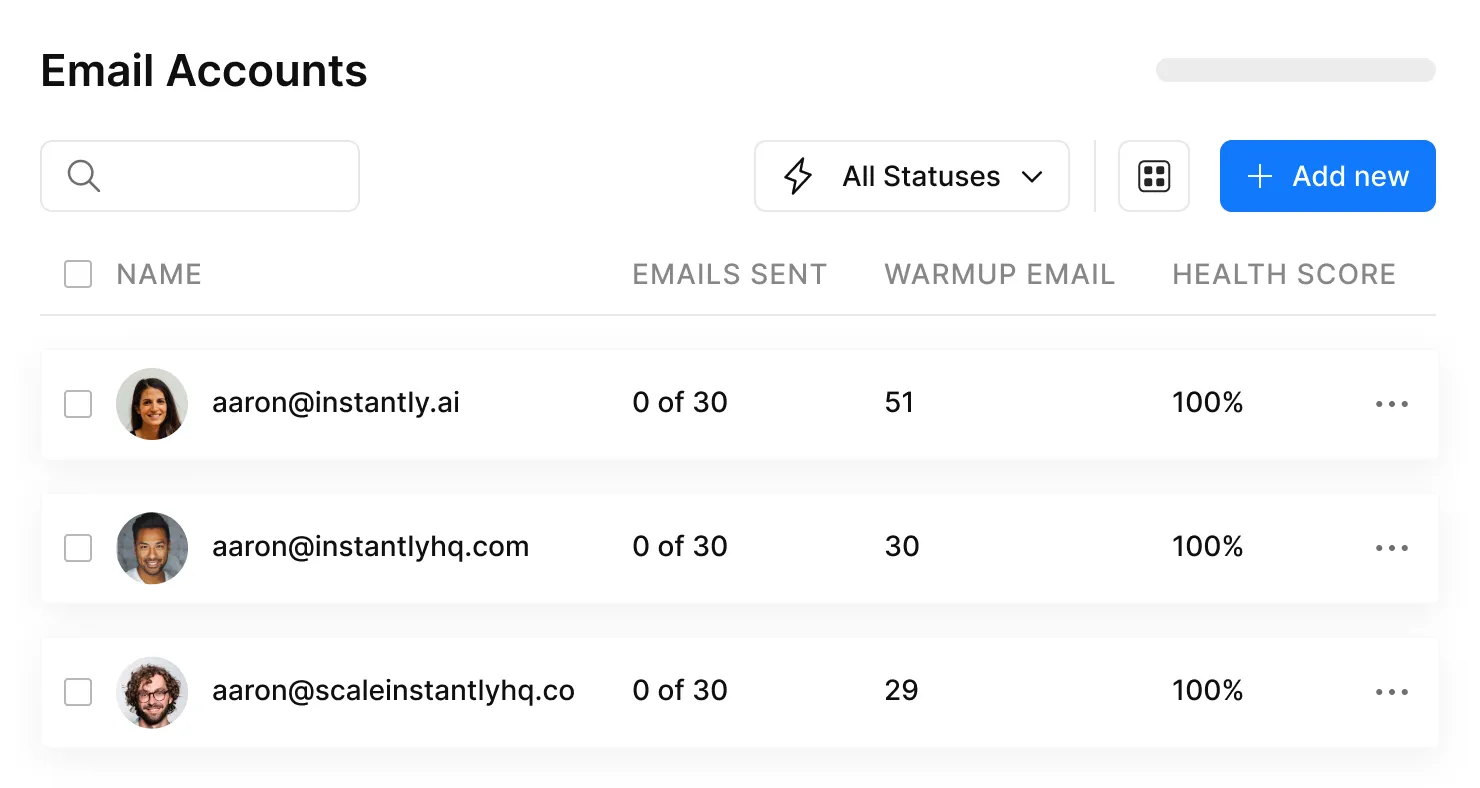
Where Instantly falls short is data. It's a sending tool, not a data platform. You'll need to bring your own verified contacts. We've found the combination of verified upstream data and Instantly's sending infrastructure to be one of the most cost-effective cold email stacks available right now.
Apollo - All-in-One With Caveats
Apollo looks like a bargain at $49/user/month on an annual plan. It's got a database, a sequencer, a dialer, and intent signals in one platform. For a solo founder or a two-person sales team, it's hard to beat on paper.
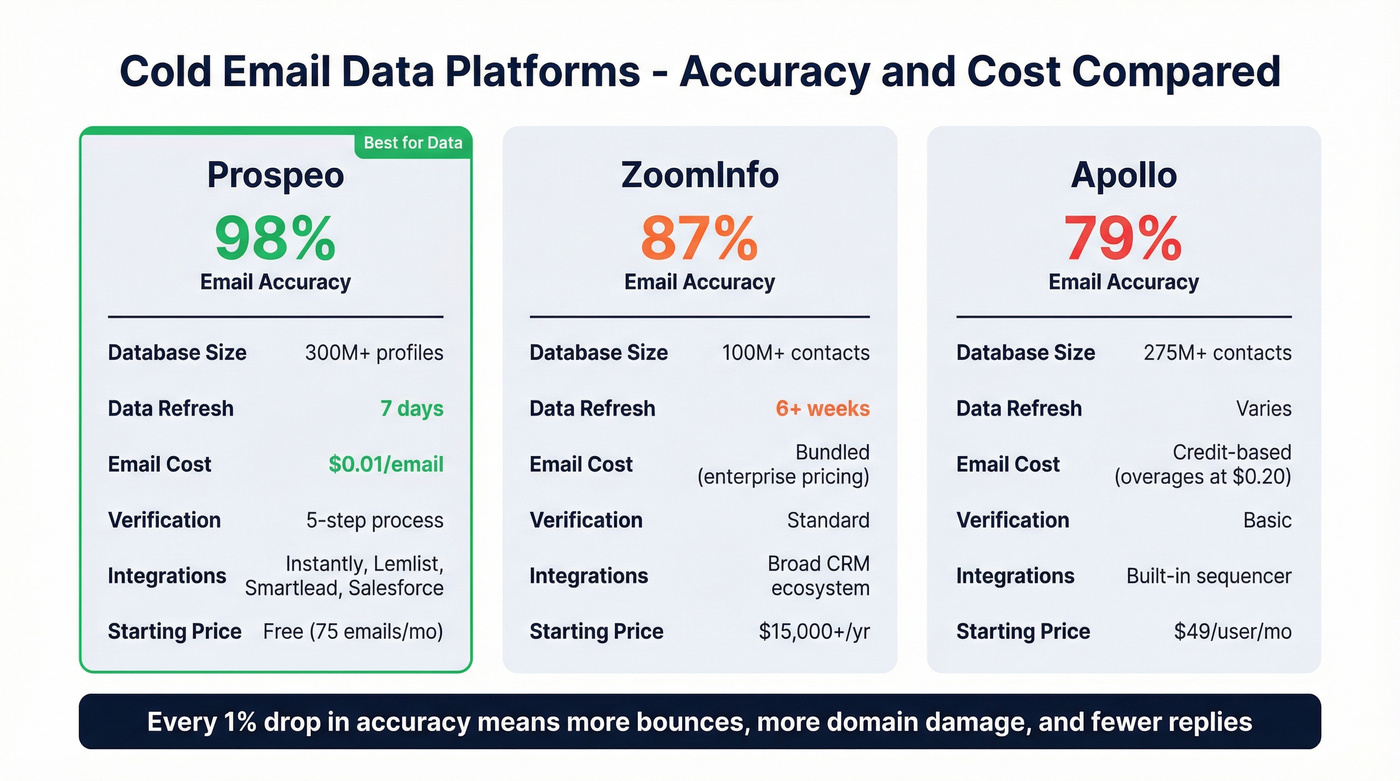
Here's the thing: Apollo's real cost is buried in the credit system. Mobile number reveals cost 8 credits each. Credit overages run $0.20/credit. Credits don't roll over - they expire every billing cycle. We've seen teams blow through their monthly allocation in the first two weeks, then face a choice between paying overages or going dark until the cycle resets. A 5-seat team running heavy outbound can easily end up in the $79-99/user/month range once you factor in Professional-tier features and credit overages.
The dialer requires the Professional plan. Calling is US/Canada only at Professional, and international calling is available on the Organization plan ($119/user/month annual) with a minimum of 3 users.
Skip Apollo if your primary need is verified data accuracy. Its email accuracy trails the top verification platforms, and the credit mechanics make mobile numbers surprisingly expensive at scale.
Lemlist - Best for Personalization
Use this if you're running highly personalized sequences with custom images, dynamic landing pages, and multichannel steps across email, LinkedIn, and calls. Lemlist's personalization engine is best in class for visual customization, and the multichannel workflow builder is intuitive.
Skip this if you're sending high-volume campaigns where personalization is template-based. At $39/mo, it's priced similarly to Instantly but optimized for a different playbook - quality over quantity.
Reply.io - Multichannel Workhorse
Reply.io starts at $59/mo and bundles email, LinkedIn, calls, SMS, and WhatsApp into a single sequence builder. It's the strongest option for teams that want true multichannel orchestration without stitching together three different tools. The AI assistant for email writing is decent, though not a replacement for a good copywriter.
Smartlead - Built for Agencies
If you're an in-house team running one brand, Instantly is simpler. For agencies, Smartlead is purpose-built. At $39/mo, the infrastructure - unlimited mailboxes, centralized inbox rotation, white-label reporting - is designed for the "running 15 campaigns across 8 clients" use case. The most common praise in agency circles is how well it handles domain rotation at scale without the manual overhead that plagues other tools.
Saleshandy, Woodpecker, and Mailshake
These three occupy different niches on the budget spectrum. Saleshandy at $36/mo is the budget pick - solid sending, basic analytics, gets the job done without frills. Woodpecker at $29/mo is even simpler, built for SMBs who want to send follow-up sequences without a learning curve.
Mailshake is the odd one out. Pricing starts at $58/mo with an annual commitment, and it has no free trial. It used to be a category leader but hasn't kept pace on features or pricing.
Tool Comparison at a Glance
| Tool | Starting Price | Best For | Free Plan? | Our Pick For... |
|---|---|---|---|---|
| Prospeo | ~$0.01/email | Verified data + email finding | Yes (75 emails/mo) | Best data accuracy |
| Instantly | $37/mo | High-volume sending | Free trial | Best sender for most teams |
| Apollo | $49/user/mo (annual) | All-in-one prospecting | Yes (limited) | Solo founders only |
| Lemlist | $39/mo | Personalized sequences | Yes (limited) | Best personalization |
| Reply.io | $59/mo | Multichannel sequences | Free trial | Best multichannel |
| Smartlead | $39/mo | Agency infrastructure | Free trial | Best for agencies |
| Saleshandy | $36/mo | Budget-friendly sending | 7-day trial | Tightest budget |
| Woodpecker | $29/mo | Simple SMB outreach | Free trial | Simplest setup |
| Mailshake | $58/mo (annual) | Teams committed to email | No | Hard to recommend |
Data Quality Beats Tool Switching
Most teams troubleshoot cold email in the wrong order. They switch from Lemlist to Instantly, rewrite subject lines, add a fourth follow-up step - and nothing changes. The reply rate stays flat because the root cause is upstream: the contact data is bad.
Look at what happens when teams fix the data layer first. Snyk's sales team was running 50 AEs prospecting 4-6 hours per week with bounce rates between 35-40%. After switching their data source, bounces dropped under 5%. AE-sourced pipeline jumped 180%, generating 200+ new opportunities per month. The sending tool didn't change. The sequences didn't change. The data changed.
Stack Optimize built an agency from $0 to $1M ARR running client campaigns on verified data. Client deliverability consistently hits 94%+, bounce rates stay under 3%, and they've had zero domain flags across all clients. For an agency where domain reputation is literally the business, that's the metric that matters.
If your bounce rate is above 5%, don't buy another sending tool. Fix your data first (and run a proper email deliverability checklist before you scale).
Every alternative on this list - LinkedIn, intent-based outreach, multi-channel sequences - still needs verified contact data to close the loop. Prospeo's 7-day refresh cycle means you're never working with stale records, and 143M+ verified emails with 5-step verification keep your bounce rate under 2% where compliance demands it.
The best channel strategy in the world fails on bad data. Yours won't.
The Decision Framework
If we were building a cold email stack from scratch in 2026, here's the order of operations:
Step 1: Fix your data. Build targeted lists using 30+ filters - buyer intent, technographics, job changes, funding events, headcount growth. Verify everything before it touches your sequencer (use an email checker tool or a dedicated email ID validator). This step alone eliminates the most common reason cold email fails.
Step 2: Choose your channels. Cold email should be one channel, not the only channel. Layer in LinkedIn outreach for high-value prospects. Add intent data if your deal sizes justify the spend. Use retargeting to stay visible to warm visitors. The best-performing teams run three or more channels in parallel (see AI multi-channel prospecting for a modern stack).
Step 3: Pick your sending tool. For most teams, Instantly at $37/mo paired with verified data is the highest-ROI combination. For heavy personalization, go Lemlist. For agencies, go Smartlead. For everything in one platform, Apollo works - just budget realistically, not based on the sticker price.
The teams getting 15-25% reply rates aren't using magic tools. They're running smaller lists of verified contacts, targeting accounts showing buying signals, and personalizing based on real triggers. Whether you're evaluating a cold email outreach alternative or optimizing the channel you already have, the stack matters less than the strategy - but bad data will sabotage even the best strategy (especially if you ignore B2B contact data decay).
FAQ
Is cold email dead in 2026?
No. But undisciplined cold email is. Teams running verified data, proper authentication, and signal-based personalization still see reply rates of 15-25%. The compliance bar is higher than ever, which actually benefits teams willing to do it right.
What's the average cold email reply rate?
It's 3.43% according to Instantly's 2026 benchmark report. A Backlinko analysis of 12 million outreach emails found 8.5% receive any reply. Top performers using signal-based personalization and verified data consistently exceed 15%.
Is LinkedIn outreach better than cold email?
LinkedIn DMs average a 10.3% response rate versus 5.1% for cold email, based on an analysis of 70,000+ campaigns. LinkedIn is slower and harder to scale, but conversion quality is higher. The best approach is running both - email for volume, LinkedIn for high-value targets.
How many cold emails can I send daily without getting flagged?
New domains should start at 5-10 emails per day and ramp over 4-6 weeks. Established domains with good reputation can safely send 50-100 per mailbox per day. Keep spam complaints under 0.3% and bounces under 2% - exceed either threshold and inbox providers will throttle you.