Bloom vs HoneyBook: Which CRM Actually Deserves Your Money in 2026?
You just opened the email from HoneyBook. Your Starter plan - the one you've been paying $19/month for - is jumping to $36. That's not a modest increase. That's nearly double. Reddit threads lit up with photographers, wedding planners, and freelancers all asking the same question: "Is this still worth it?" If you're weighing Bloom vs HoneyBook right now, you're not alone.
The answer depends on what you actually use. But here's what nobody else will tell you: the subscription price isn't even the most expensive part of this decision. The processing fees are. At $50K in annual payments, the difference between these two platforms is nearly $900/year. Let's break it all down.
30-Second Verdict
Bloom wins if: You're budget-conscious, need built-in galleries (photographers, this is you), want to choose your own payment processor (Stripe, Square, PayPal, Venmo), or you're based outside the US and Canada.
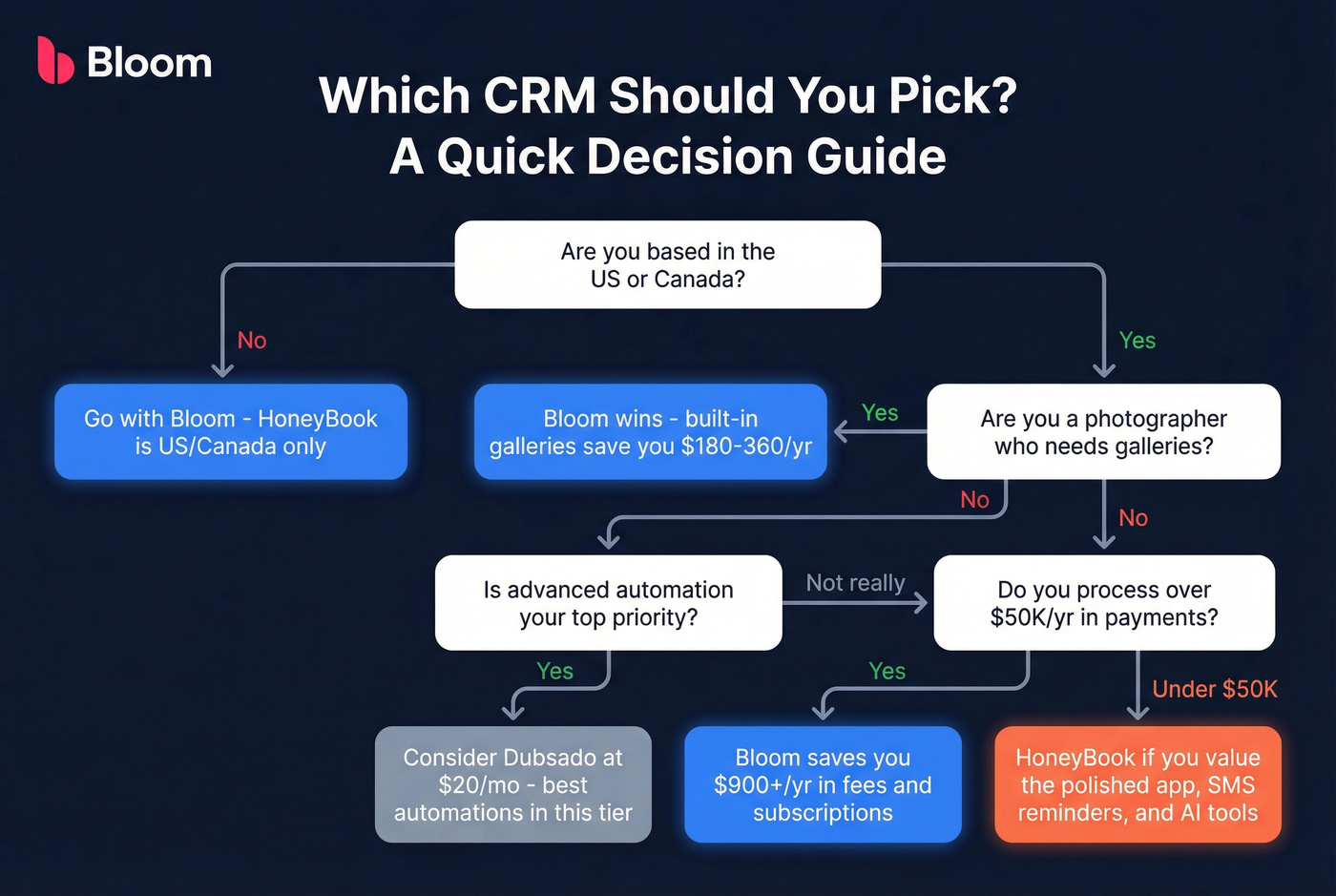
HoneyBook wins if: You're US/Canada-based, need mature automations and SMS reminders, value a polished mobile app, and your revenue justifies the post-increase pricing.
Skip both if: Advanced automation is your #1 priority - go Dubsado at $20/mo. Or if you need enterprise-grade integrations, HubSpot's free CRM tier is the move.
Pricing Breakdown - What You're Actually Paying
Pricing is the reason most people are reading this article. So let's get specific.

HoneyBook's Price Increase: Before and After
HoneyBook raised prices across all three plans on February 4, 2025 - the first increase for existing members in the platform's history. Existing users got a 20% loyalty discount for one year, but after that grace period, everyone pays full freight.
| Plan | Old Monthly to New | Old Annual/mo to New | % Increase |
|---|---|---|---|
| Starter | $19 to $36 | $16 to $29 | ~81-89% |
| Essentials | $39 to $59 | $32 to $49 | ~51-53% |
| Premium | $79 to $129 | $66 to $109 | ~63-65% |
The Starter plan got hit hardest. If you were paying $16/mo annually, you're now looking at $29/mo - an 81% jump. HoneyBook justified it as investment in "automation tools, AI-powered workflows, enhanced integrations, and comprehensive financial features." Whether those features justify the price depends on whether you actually use them.
Bloom's Pricing Tiers
| Plan | Monthly | Annual/mo | Processing Fee | Key Limits |
|---|---|---|---|---|
| Starter | $14/mo | $7/mo | 1.5% + processor | 3 projects, 1 workflow |
| Standard | $34/mo | $17/mo | Processor only | Unlimited everything |
| Plus | $66/mo | $33/mo | Processor only | Teams, 1TB storage |
Bloom's Standard plan at $17/mo annual is the sweet spot. You get unlimited projects, workflows, automations, galleries, and booking forms - with zero Bloom processing fees. You're only paying Stripe or Square's standard rates (typically 2.9% + 30 cents for cards).
Here's the kicker: Bloom's Standard plan at $17/mo annual costs less than HoneyBook's new Starter plan at $29/mo annual. That's a $144/year difference before you even factor in processing fees.
The Hidden Cost: Processing Fees
This is where the comparison gets really interesting.
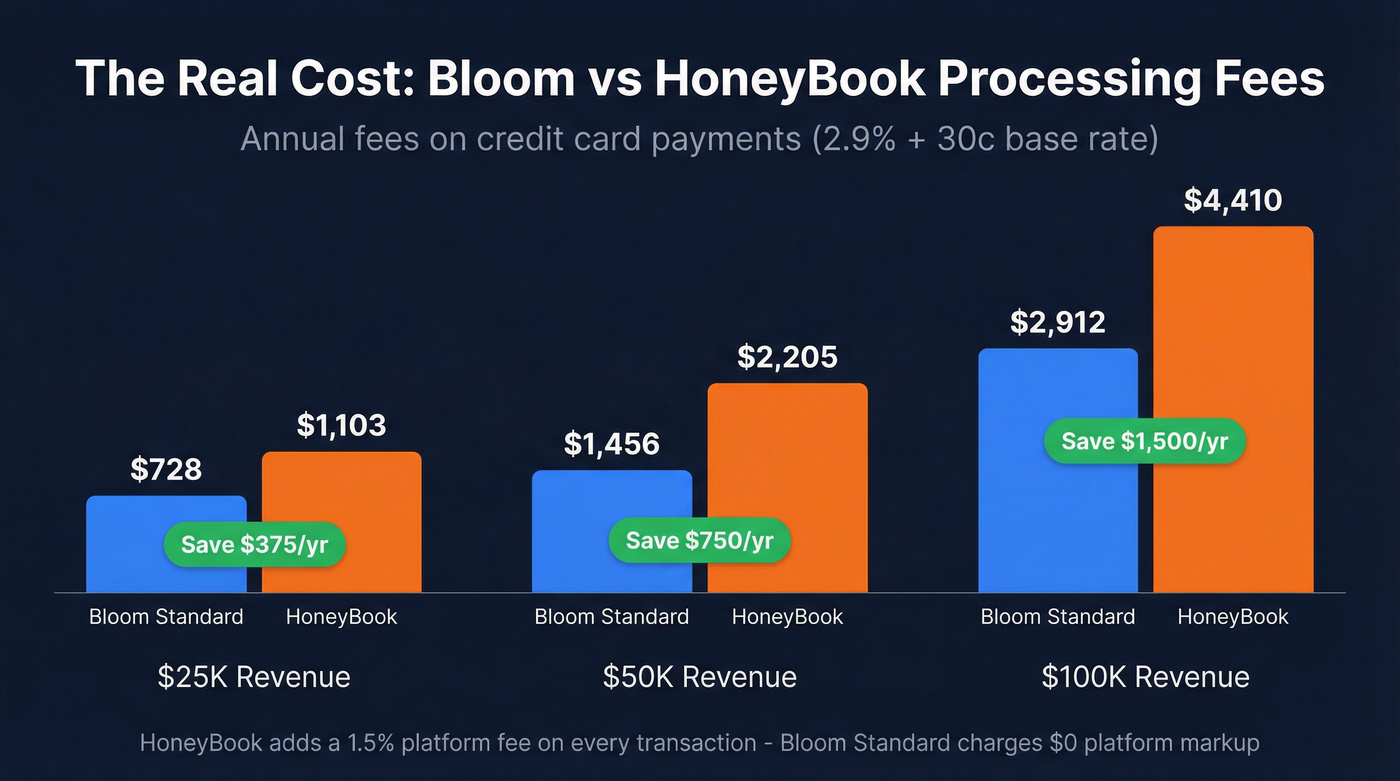
HoneyBook charges 2.9% + 25 cents on cards plus a 1.5% HoneyBook processing fee on every transaction, across all plans. Bloom Standard and Plus plans charge zero Bloom markup - you only pay your processor's standard rate.
Here's the math on card payments (assuming ~$2,500 average transaction):
| Annual Volume | Bloom Standard Fees | HoneyBook Fees | You Save w/ Bloom |
|---|---|---|---|
| $25,000 | ~$728 | ~$1,103 | ~$375/yr |
| $50,000 | ~$1,456 | ~$2,205 | ~$750/yr |
| $100,000 | ~$2,912 | ~$4,410 | ~$1,500/yr |
At $50K in annual payments, Bloom saves you roughly $750/year in processing fees alone. Add the subscription price difference ($17/mo vs $29/mo = $144/year), and you're looking at nearly $900/year in total savings. For a solopreneur, that's a new lens or a conference ticket.
HoneyBook locking you into their payment processor is the single most expensive decision in this comparison. It's not about the monthly subscription - it never was.

You're optimizing your CRM costs down to the penny - but what about the contacts inside it? Bad data costs more than any processing fee. Prospeo delivers 98% verified emails at $0.01 each, so every lead in your Bloom or HoneyBook pipeline is real.
Fill your new CRM with contacts that actually convert.
Feature-by-Feature Comparison
| Category | Bloom | HoneyBook | Winner |
|---|---|---|---|
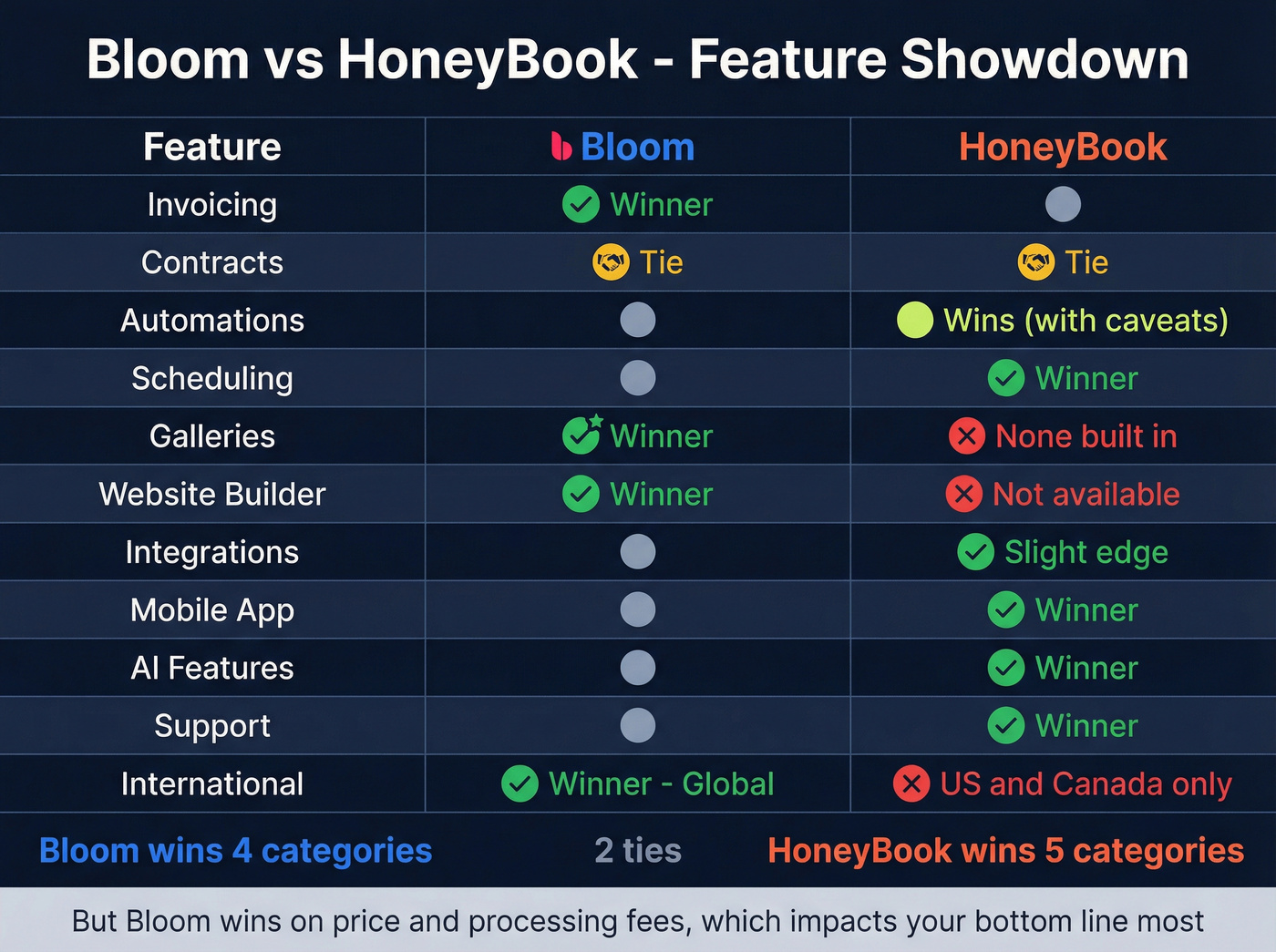
| Invoicing | Stripe/Square/PayPal | HoneyBook processing | Bloom |
| Contracts | Built-in e-sign | Built-in e-sign | Tie |
| Automations | Basic workflows | Moderate (w/ issues) | HoneyBook (barely) |
| Scheduling | Self-booking forms | Scheduler + SMS | HoneyBook |
| Galleries | Built-in, up to 1TB | Requires Pic-Time | Bloom |
| Website Builder | Yes, w/ portfolios | No | Bloom |
| Integrations | ~11 native + Zapier | ~11 native + deep Zapier | HoneyBook (slight edge) |
| Mobile App | Functional | Full-featured | HoneyBook |
| AI Features | Limited | Extensive (w/ limits) | HoneyBook |
| Support | Mixed reviews | Strong (G2: 9.1) | HoneyBook |
| International | Global | US/Canada only | Bloom |
Invoicing and Payments
Bloom wins this one outright, and it isn't subtle.
Bloom gives you choice: Stripe, Square, PayPal, Venmo, CashApp, Zelle, and bank transfers. You can even let clients cover credit card fees. Bloom also offers a free invoice generator that doesn't require an account - useful for testing before you commit. HoneyBook locks you into their own payment processing. No Stripe, no Square, no PayPal. That 1.5% HoneyBook fee on every transaction adds up fast.
HoneyBook's automatic payment reminders are genuinely useful, and they report 90% of invoices are paid on time or early. But the processing fee lock-in is a dealbreaker for anyone doing real volume.
Contracts, Proposals, and Scheduling
Contracts are a wash. Both platforms offer built-in e-signatures, contract templates, and the ability to bundle proposals with contracts and invoices. HoneyBook's template-sharing feature is a nice touch for teams. Bloom's approach is clean and functional but less mature.
Scheduling is where HoneyBook pulls ahead. SMS text reminders for meetings genuinely reduce no-shows. Bloom offers self-booking forms, but the scheduling experience is thinner - Shannon Towell documented a bug where selecting a date in Bloom's scheduler picked the wrong date, which isn't great for a scheduling tool.
Automations and Workflows
This is where HoneyBook should dominate. On paper, it does - more triggers, conditions, and actions than Bloom. But there's a problem.
HoneyBook's Automations 2.0 update removed the ability to trigger actions based on project dates. If you're a wedding photographer who wants to send a questionnaire 32 days before the wedding, you can't do that anymore. The "wait" trigger only works based on when the automation started, not relative to project dates. A community forum post about this has 15+ likes and multiple users calling the workarounds "very messy."
The other limitations stack up:
- Can't edit email templates within active automations
- Can't skip steps or start from a specific step
- Can't rearrange step order
- Must duplicate entire automations to make small edits
One user put it bluntly: "Constantly having to duplicate an automation to make small edits is not ideal when you're trying to make things as efficient as possible."
Bloom's automations are simpler - basic compared to HoneyBook's moderate - but they use a category-based workflow model that keeps things organized and predictable. At least they work as advertised.
HoneyBook wins, but with a significant asterisk. If project-date triggers matter to your workflow, this advantage evaporates.

Galleries and Deliverables
| Feature | Bloom | HoneyBook |
|---|---|---|
| Built-in galleries | Yes | No |
| Storage (Starter) | 50GB | N/A |
| Storage (Mid-tier) | 500GB | N/A |
| Storage (Top-tier) | 1TB | N/A |
| Separate tool needed | No | Pic-Time ($15-30/mo) |
| Annual cost saved | $0 | $180-360 extra |
This is Bloom's killer feature. Built-in client galleries with 50GB on Starter, 500GB on Standard, and 1TB on Plus. No separate subscription needed.
HoneyBook has no gallery delivery at all. Joy Michelle, a photographer who's used HoneyBook for 7+ years, lists "no gallery delivery/storage" as a top con and recommends integrating Pic-Time.
For photographers, this single feature saves $180-360/year on a separate gallery tool. Combined with Bloom's lower subscription cost, the savings compound fast.
Website Builder, Mobile App, and AI
Bloom includes a website builder with portfolio templates - $17/each for custom website add-ons. HoneyBook doesn't offer anything comparable. For creatives who want a simple portfolio site without paying for Squarespace, that's a genuine differentiator.
HoneyBook's mobile app is consistently praised as full-featured. You can manage projects, send invoices, and respond to leads from your phone without feeling like you're using a stripped-down version. Bloom has a mobile app, but it's less polished.
HoneyBook's AI features include chat, email drafts, meeting notetaker, meeting prep, priority lead notifications, follow-up suggestions, and project recaps. Impressive list - though the AI doesn't generate replies when automations are attached, which limits its usefulness in automated workflows. Bloom's AI features are more limited.
On integrations, both platforms offer roughly 11 native integrations plus Zapier. HoneyBook connects to QuickBooks, Meta ads, Zoom, Canva, Flodesk, Calendly, and Pic-Time - and its broader Zapier ecosystem gives it a slight edge. Bloom connects to QuickBooks, Google Calendar, Zoom, and the major payment processors.
What Users Actually Say
HoneyBook: Mature but Losing Momentum
HoneyBook scores 4.4/5 on G2 with 188 reviews. The praise centers on its all-in-one nature - replacing Calendly, separate contract tools, and invoicing software with a single platform. Support quality scores a 9.1/10, which is genuinely strong.

| Dimension | Bloom | HoneyBook |
|---|---|---|
| Overall | 4.5/5 (83) | 4.4/5 (188) |
| Meets Requirements | 8.4 | 8.8 |
| Ease of Use | 8.9 | 8.8 |
| Ease of Setup | 8.5 | 8.6 |
| Quality of Support | 8.9 | 9.1 |
| Product Direction | 8.9 | 8.6 |
The #1 complaint on G2? "Expensive" - mentioned five times. That was before the price increase. Integration issues come in second with three mentions.
The product direction score gap (8.6 vs Bloom's 8.9) is worth watching - especially given the Automations 2.0 regression that frustrated power users. HoneyBook has powered 28M+ client relationships across 100,000+ businesses. The ecosystem is mature. But maturity doesn't mean momentum.
Bloom: Beautiful but Still Proving Itself
Bloom scores 4.5/5 on G2 - slightly higher than HoneyBook - but with only 83 reviews. The smaller sample size matters.
One Reddit user in r/WeddingPhotography captured the problem perfectly: "I can't find too many opinions or first-hand experiences with Bloom online."
The praise is consistent: beautiful UI ("incredibly beautiful and pleasant to use," per an AppSumo reviewer), intuitive design, and the gallery feature. A Reddit photographer in r/photography was genuinely surprised: "How the hell had I never heard anyone talk about it?"
But the criticism is specific and concerning. Shannon Towell documented embedded forms taking roughly 9 seconds to load - a serious SEO and UX problem. She booked a 1:1 support call and waited 20 minutes in a Zoom room before nobody showed up. Her conclusion: "Bloom requires too many workarounds for my specific needs."
Bloom's AppSumo rating sits at 3.0/5 with just 9 reviews - a stark contrast to the G2 score. AppSumo reviewers flagged that invoices can only be sent when a project is set to "active," which is problematic for recurring services.
Bloom's product direction score (8.9) is the highest in this comparison. Users believe it's heading the right way. But "heading the right way" and "already there" are different things.
Who Should Use Which - Recommendations by Business Type
Best for Photographers
If your average client value is under $5K, you probably don't need HoneyBook-level infrastructure. Bloom Standard at $17/mo gives you galleries, invoicing, contracts, and a portfolio site - everything a photographer under $50K revenue actually uses daily.
But if you're shooting 30+ weddings a year and need SMS reminders, automatic questionnaire sends, and a polished mobile app for on-the-go client management - HoneyBook's ecosystem is more battle-tested. Joy Michelle has used it for 7+ years and still calls it "the best CRM for photographers," despite the gallery gap.
Our take: Bloom for portfolio-heavy photographers under $50K revenue. HoneyBook for high-volume wedding photographers who live in their mobile app.
Best for Wedding and Event Professionals
HoneyBook. The SMS reminders, automatic payment follow-ups, and mature automation system (despite the 2.0 regression) are built for the chaos of event planning. The template-sharing feature is useful if you're collaborating with other vendors. And HoneyBook's 100,000+ business ecosystem means your clients are likely already familiar with the interface.
The price increase stings, but if you're processing $50K+ annually, the tool pays for itself in time savings. HoneyBook says users save 20 hours per week - take that with a boulder of salt - but even saving 5 hours weekly justifies $49/mo.
Best for International Creatives
Bloom. Full stop.
HoneyBook is only available in the US and Canada. If you're based in the UK, Australia, Germany, or anywhere else, this isn't even a comparison. Bloom uses Stripe and Square, which operate globally.
We've seen teams waste weeks evaluating HoneyBook before discovering the geo-restriction buried on the homepage. Save yourself the time.
Best for Budget-Conscious Solopreneurs
If you're pulling in under $30K/year and every dollar matters, Bloom Starter at $7/mo annual is the cheapest legitimate CRM option in this space. You're limited to 3 active projects and 1 workflow, but for a solopreneur managing a handful of clients at a time, that's often enough.
HoneyBook's cheapest option is now $29/mo annual - four times the price. For a creative just getting started, that gap is the difference between investing in marketing and just covering software costs.
Other Options Worth Knowing
Dubsado ($20/mo)
If neither Bloom nor HoneyBook has the automation depth you need, Dubsado is your answer. Adventure Wedding Academy ranks it as the #1 CRM for photographers specifically because of its advanced workflows and customization - project-date triggers, conditional logic, and granular workflow control that neither competitor matches.
The trade-off is a steep learning curve. Dubsado isn't pretty out of the box, and setup takes significantly longer than either Bloom or HoneyBook. But once it's configured, the automation capabilities are genuinely superior.
Use Dubsado if automation is your #1 priority and you don't mind a weekend of setup. Skip it if you want something beautiful and functional in 30 minutes.
Sprout Studio (~$34/mo)
Built specifically for photographers, Sprout Studio bundles galleries, CRM, invoicing, contracts, and studio management under one roof. If you want an all-in-one that's purpose-built for photography workflows - including print sales and album proofing - it's worth a look. The downside: it's narrowly focused, so non-photographers won't find much use here.
17hats (~$13/mo)
A bare-bones option for solopreneurs who just need invoicing, contracts, and basic workflow automation without the bells and whistles. At roughly $13/mo, it's cheaper than everything except Bloom Starter. The interface feels dated compared to Bloom and HoneyBook, and there's no gallery feature. But if you just need to send invoices and get contracts signed, it does the job.
Beyond CRM - Finding Clients to Manage
Here's the gap neither Bloom nor HoneyBook fills: finding new clients in the first place. Both platforms are excellent at managing relationships once someone's in your pipeline. Neither helps you build that pipeline.
If you're a creative professional cold-emailing venues, brands, agencies, or collaboration partners, you need verified contact data. Tools like Prospeo give you access to 300M+ professional profiles with 98% email accuracy and a free tier of 75 verified emails per month - no contracts, no credit card required. Once your CRM is set up, the next bottleneck is filling it.
If you're building lists from profiles and domains, start with an email finder, then run a quick email verification pass before sending.
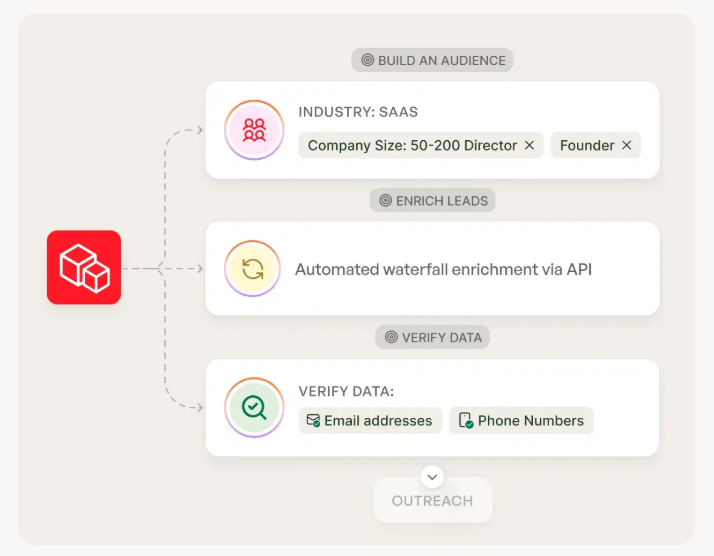
Switching CRMs is the perfect time to clean house. Prospeo enriches your existing contacts with 50+ data points at a 92% match rate - fresh emails, verified mobiles, job titles - all refreshed every 7 days. Import cleaner data into whichever platform you choose.
Start your new CRM with data you can actually trust.
FAQ
Can I switch from HoneyBook to Bloom?
Yes, but there's no automated migration tool. You'll manually export contacts, recreate templates, and rebuild automations. Budget 2-4 hours for simple setups or a full day for complex workflows. Export your client list as CSV first.
Does Bloom have a mobile app?
Yes, Bloom offers iOS and Android apps, though they're less mature than HoneyBook's full-featured mobile experience. HoneyBook lets you manage projects, send invoices, and respond to leads without feeling like a stripped-down version. Bloom's app is functional but still catching up.
Is HoneyBook worth it after the 2026 pricing?
For creatives processing $50K+ annually who rely on automations, SMS reminders, and the mobile app daily, Essentials at $49/mo is justified by time savings alone. Solopreneurs under $30K revenue who mainly use invoicing and contracts get better value from Bloom Standard at $17/mo - saving roughly $900/year.
Does HoneyBook work outside the US?
No. HoneyBook is only available in the US and Canada as of 2026. Their homepage displays a geo-gate confirming this restriction, with a waitlist for international expansion. International creatives should evaluate Bloom or Dubsado instead.
How do I find new clients once my CRM is set up?
Neither Bloom nor HoneyBook helps with outbound prospecting - they manage existing relationships, not new ones. Tools like Prospeo let you find verified emails from any professional profile or company website, starting free with 75 emails/month, so you can fill your pipeline before your CRM even matters.