

Cold Email Reply Rate: Real 2026 Benchmarks and Fixes
Your reply rate just dropped below 3%, and now you're wondering whether that's normal. Every source gives you a different number - 3.43%, 5.8%, 8.5%, even 1-4%. They're all "right," and they're all misleading without context.
Here's what the cold email reply rate benchmarks actually mean, what's dragging them down, and the fixes that move the number.
The Quick Version
A realistic reply rate in 2026 is 3-6% for well-run sales campaigns. But the metric that actually matters is your positive reply rate - replies expressing genuine interest - which often lands around 60-70% of total replies. Your real conversion number is closer to 2-3%.
For most cold sales sequences, 4 emails total is a strong default. And the single highest-leverage fix? Get your bounce rate under 2% before you touch a subject line. Everything else is optimization on a broken foundation if your list is bad.
2026 Benchmarks: What the Data Says
Every benchmark measures something different. That's why the numbers conflict - and why asking "what's a good response rate?" without context is the wrong question.
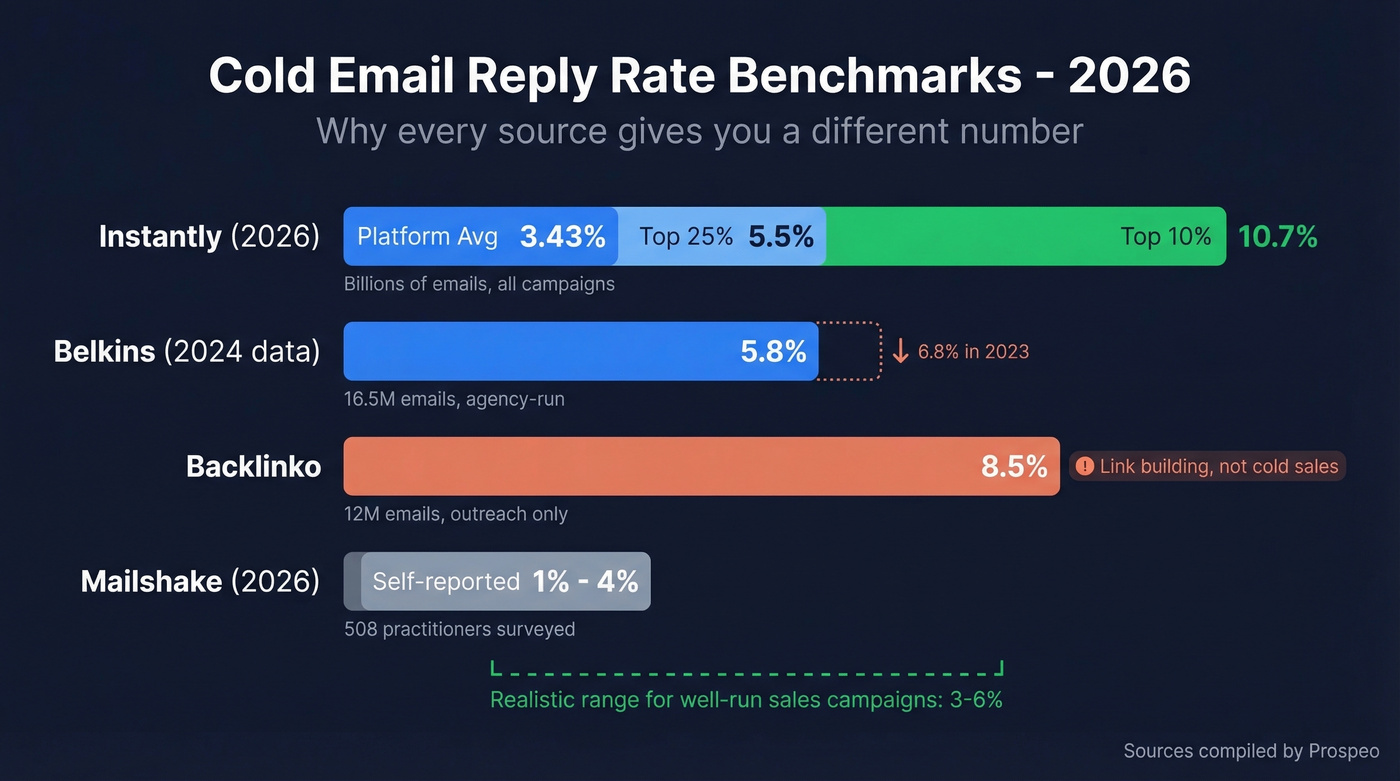
| Source | Reply Rate | Dataset | Context |
|---|---|---|---|
| Instantly (2026) | 3.43% avg / 5.5% top 25% / 10.7% top 10% | Billions of cold email interactions across thousands of active workspaces | Platform-wide, all campaigns |
| Belkins (2024 data) | 5.8% (down from 6.8% in 2023) | 16.5M emails, 93 business domains | Agency-run campaigns, Jan-Dec 2024 |
| Backlinko | 8.5% | 12M emails | Outreach/link-building, not cold sales |
| Mailshake (2026) | 1-4% | 508 professionals surveyed | Self-reported by practitioners |
Instantly's 3.43% is the most honest floor - it includes every workspace on the platform, bad campaigns and all. Belkins' 5.8% reflects agency-run campaigns, making it a more useful benchmark for teams with solid infrastructure. Backlinko's 8.5% gets cited constantly, but those are outreach and link-building emails, not cold sales. Mailshake's 1-4% comes from a practitioner survey where people self-report, which skews conservative.
If you've seen 2022 data floating around, note that response rates have compressed significantly since then. What counted as average then would be above-average now.
Two big datasets point in the same direction: response rates are getting harder to sustain at scale. Belkins shows 6.8% (2023) to 5.8% (2024), while Instantly's platform-wide benchmark sits at 3.43% in 2026. One Reddit practitioner noted that enterprise reply rates that used to hit 15-25% now feel like a win at 8-10%. The floor is dropping, and it's dropping faster for enterprise targets.
Industry matters too. SaaS campaigns see 10-12% at the top end, professional services 8-11%, and healthcare tech closer to 6-9%. If you're benchmarking against a single average figure, you're benchmarking against nothing.
Positive Reply Rate: The Metric That Matters
A 5% response rate sounds decent until you realize a third of those replies are "please remove me" and out-of-office autoreplies. One widely used benchmark framing implies roughly 67% of replies are positive, with the rest split between objections, unsubscribes, and OOO messages. An Outreach study of 100,000 emails found one template with a 6.1% reply rate had 20% of those replies as unsubscribes - so the "real" rate was closer to 4.9%.
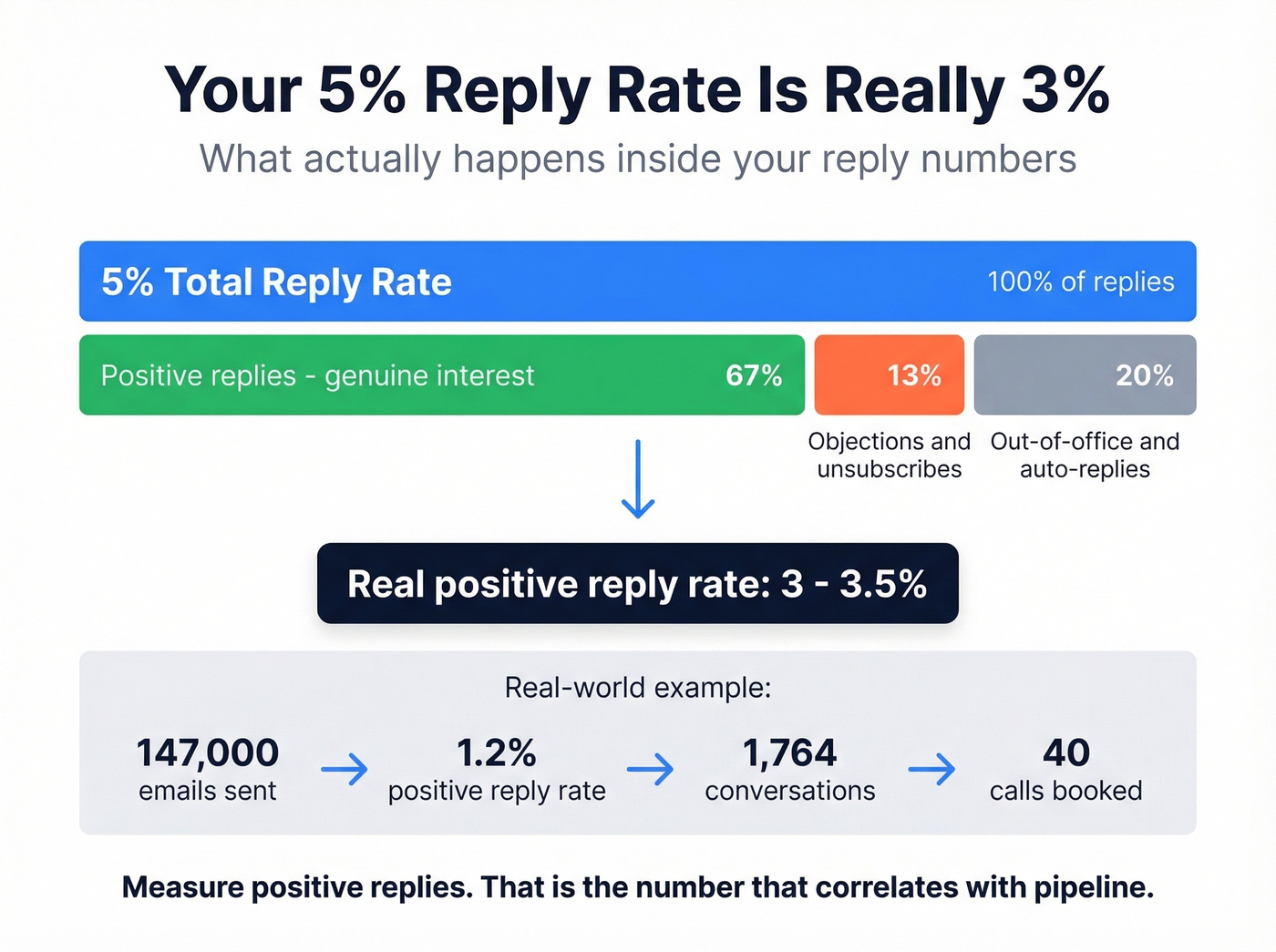
Here's the thing: one practitioner on Reddit documented 147,000 cold emails sent, a 1.2% positive reply rate, yielding 1,764 actual conversations and 40 calls. That's the math that matters. If your dashboard says 5%, your positive reply rate is probably 3-3.5%. Measure that number. It's the one that correlates with pipeline.
If you want to tie this to downstream revenue, map replies to your sales funnel stages and track drop-off by segment.

That 3-3.5% positive reply rate depends entirely on reaching real inboxes. Every bounce degrades your domain reputation and drags replies down further. Prospeo's 5-step email verification - with catch-all handling, spam-trap removal, and honeypot filtering - delivers 98% accuracy at $0.01 per email. Fix the foundation first.
Stop optimizing subject lines on a list that bounces at 5%.
Why Reply Rates Keep Declining
Gmail and Yahoo enforced bulk sender requirements in February 2024 - SPF, DKIM, DMARC, one-click unsubscribe. Microsoft followed on May 5, 2025, requiring the same authentication for anyone sending 5,000+ emails per day to Outlook and Hotmail domains. Non-compliant messages go straight to junk. Apple Mail Privacy Protection inflates open rates by pre-loading pixels, which makes reply rate the only reliable engagement metric left.
If you're troubleshooting the technical side, start with an email deliverability audit and then validate your DMARC alignment.
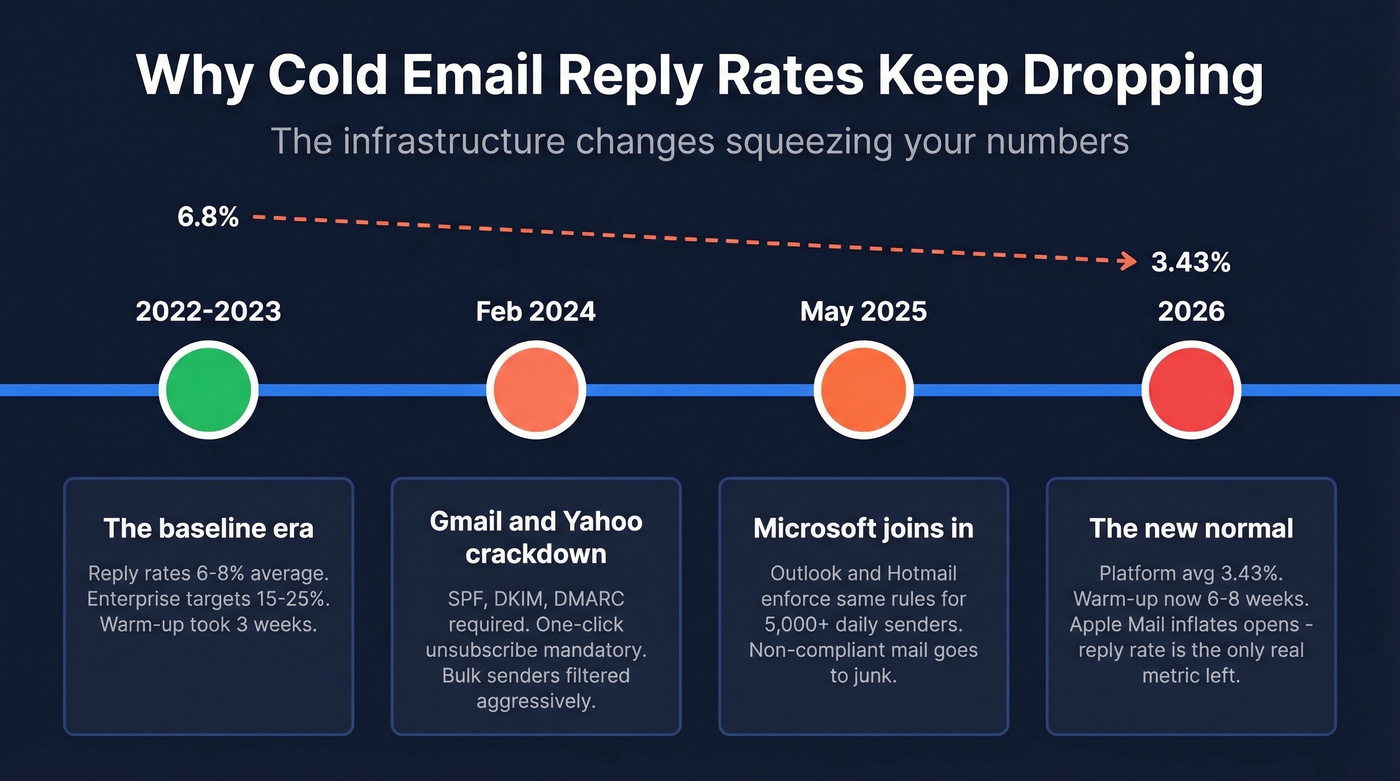
Warm-up timelines have stretched from 3 weeks to 6-8 weeks. Follow-up fatigue is real - spam complaints jump from 0.5% on the first email to 1.6% by the fourth send, while unsubscribes climb from 0.1% to 2%. We've watched this play out across dozens of campaigns: the teams that recover fastest fix infrastructure before copy. 2026 has only accelerated the downward pressure.
What Actually Moves the Number
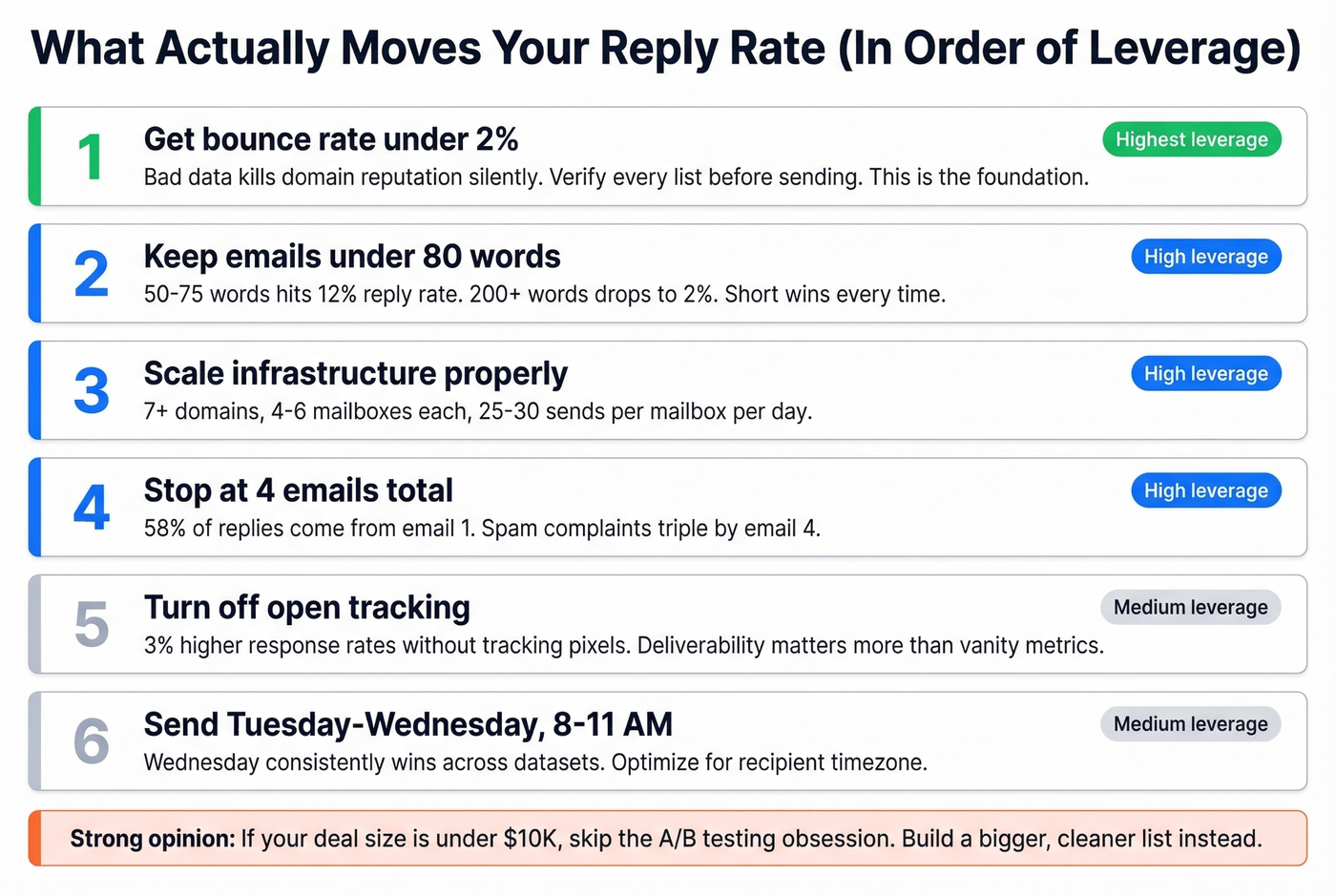
Let's be honest - we've seen teams obsess over subject lines while ignoring the fundamentals. Here's what matters, in order of leverage.
Get Bounce Rate Under 2%
Bad data is the #1 silent killer. Bounce rates above 2% degrade domain reputation, which tanks inbox placement, which tanks replies. This is where we'd point you toward Prospeo's email verification - 5-step process with catch-all handling, spam-trap removal, and honeypot filtering at 98% accuracy. Fix your list before you fix anything else.
If you need a deeper diagnostic, use this email bounce rate guide to interpret what you're seeing and what to fix first.
Keep Emails Under 80 Words
Instantly's benchmark shows best-performing campaigns keep emails under 80 words. BuiltForB2B's breakdown is more granular: 50-75 words hits a 12% reply rate, while 200+ words drops to 2%. Short wins.
If you're still iterating on hooks, pull from proven cold email subject line examples and test your preview text alongside the first line.
Infrastructure and Discipline
The remaining levers work as a checklist:
- 7+ domains, 4-6 mailboxes each, 25-30 sends per mailbox per day. This is standard scaling infrastructure in 2026. (If you're unsure about safe limits, see email velocity.)
- 4 emails maximum. 58% of replies come from the first email. Returns diminish sharply after the third, and spam complaints more than triple by the fourth send.
- Tuesday-Wednesday, 8-11 AM recipient time. Wednesday consistently wins across datasets. (More detail: best time to send cold emails.)
- Turn off open tracking. Belkins saw 3% higher response rates after removing tracking pixels. The deliverability hit isn't worth the vanity metric.
- Email multiple contacts per account. Reaching 2-3 people at the same company boosts response rates by 93%, though returns diminish past 5 contacts.
Adding a second channel lifts reply rates to 8-10% in BuiltForB2B's data. Some teams find that combining email with cold calling outperforms either alone. Only 5% of senders personalize every email, and they see 2-3x better results. Most teams under-invest in both.
A strong opinion: If your average deal size is under $10K, you probably don't need a 10% reply rate. You need a 3% reply rate on a clean, high-volume list with tight targeting. The teams chasing double-digit rates on 500-person lists are optimizing the wrong variable. Skip the obsessive A/B testing on subject lines and spend that time building a bigger, cleaner list instead.
A Real Rebuild: 3% to 6% in 62 Days
A practitioner on r/Entrepreneur documented their reply rate sliding from 8% to 3% over 18 months. Their rebuild took 62 days and hit 6%.
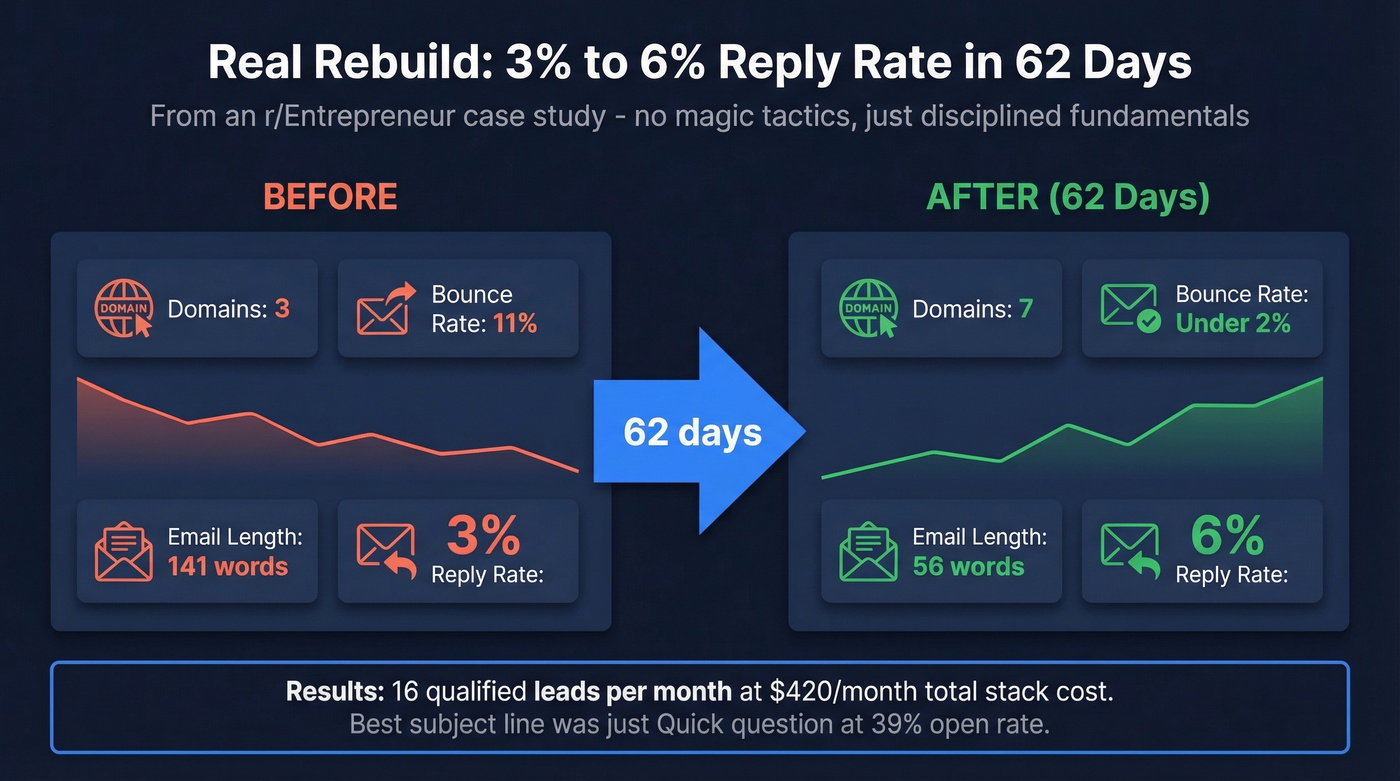
They expanded from 3 to 7 domains, capped sends at 26 per day, drove bounce rates from 11% to under 2% through manual verification, and cut email length from 141 words to under 56. Best subject line - "Quick question" - pulled 39% opens. Total stack cost: $420/month, generating 16 qualified leads.
None of those changes were revolutionary. They were disciplined execution of the fundamentals, stacked together over two months. A good cold email reply rate isn't about one magic tactic - it's about compounding small improvements across your entire sending infrastructure.
The article math is clear: 147K emails at 1.2% positive reply rate = 40 calls. Scale that with clean data and the numbers compound. Prospeo refreshes 300M+ profiles every 7 days - not the 6-week industry average - so your list doesn't decay between sends. Teams using Prospeo see bounce rates drop from 35% to under 4%.
Send 4x the volume without burning a single domain.
FAQ
What's a good reply rate for cold email in 2026?
3-6% total for well-run campaigns; top 10% of senders hit 10%+. Focus on positive replies - expect 60-70% of responses to show genuine interest, putting a realistic positive-reply benchmark at 2-4%. The platform-wide average across all senders is lower, around 3.4%, because that includes poorly targeted campaigns.
How many follow-ups should I send?
Four emails total - one initial plus three follow-ups. Spam complaints more than triple by the fourth send, and response rates drop 55% past that point. Each follow-up must add new value. "Just bumping this" is a reputation tax.
How do I know if my data is the problem?
Check your bounce rate first. Above 2% means your domain reputation is degrading with every send. Clean your list with a verification tool that catches invalid addresses, spam traps, and honeypots before launch - it's the single fastest way to recover deliverability and start getting replies again.
Does cold email or cold calling get better response rates?
Cold email delivers 3-6% total replies at scale; cold calls convert at 1-2% to a meeting but carry higher intent per conversation. The best-performing teams combine both channels - multichannel sequences consistently produce higher response rates than either alone, with some data showing 8-10% combined reply rates.