

The Cold Email Tech Stack That Actually Works in 2026
You launched your first campaign last month. By Day 3, half your emails were landing in spam, your bounce rate was north of 8%, and your shiny new domain was already flagged. The sending tool worked fine - everything around it didn't.
Here's the thing: 21% of B2B emails never reach inboxes because of poor domain and IP setup. Your $37/mo platform wasn't designed to fix that. With 86% of B2B companies running outbound, the teams winning aren't buying better subject-line tools. They're building a better cold email tech stack.
What Every Stack Needs
Six layers. Miss one and the whole thing breaks.
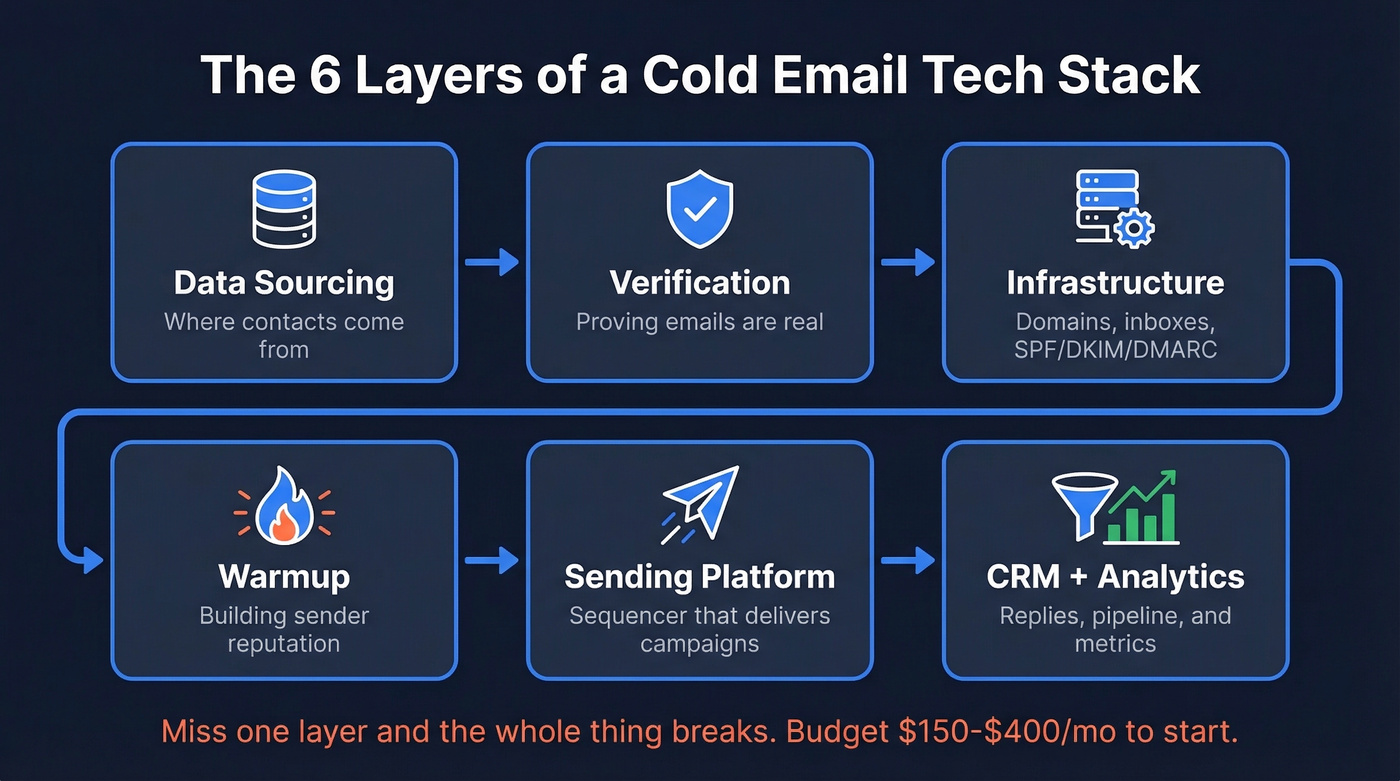
- Data sourcing - where your contacts come from
- Verification - proving those emails are real before you send
- Infrastructure - domains, inboxes, and authentication (SPF/DKIM/DMARC)
- Warmup - building sender reputation before going live
- Sending platform - the sequencer that delivers your campaigns
- CRM + analytics - where replies land and how you measure results
Most teams end up mixing and matching tools across these layers. Budget $150-$400/mo to start, $600-$1,500/mo at scale - not the $37/mo your sending tool advertises. Getting the stack right from the beginning saves you from rebuilding it six months later.
The 6 Layers, Explained
Data Sourcing
This is where most stacks quietly fail. B2B contact data decays roughly 2.1% per month - about a quarter of your list goes stale every year. Poor data quality costs companies $12.9M/year on average according to Gartner, and most of that starts with bad contact lists.
Prospeo delivers 98% email accuracy across 300M+ professional profiles on a 7-day refresh cycle, with built-in 5-step verification that eliminates the need for a separate verification tool. At roughly $0.01/email with a free tier, it's the cheapest way to start with data you can trust. Native integrations with Smartlead, Instantly, and Lemlist mean your contacts flow directly into your sending platform without CSV gymnastics.
Apollo covers 275M+ contacts and bundles sequencing, with paid plans starting around $59/user/mo. Users commonly see 70-80% email find rates. Clay connects to 100+ data sources and uses Waterfall Enrichment - powerful for technical RevOps teams, but at $700+/mo it's a different budget conversation entirely.
Email Verification
Even good data sources produce some bad addresses. Verification is your safety net.
ZeroBounce hits 99% accuracy and offers 100 free validations/month with pay-as-you-go credits that never expire. NeverBounce typically costs around $0.003-$0.01 per email at volume, making it solid for bulk verification on a budget. ZeroBounce handles catch-all domains, which matters more than most teams realize - catch-alls are the silent killer of deliverability.
If your data source already verifies in real time with catch-all handling, spam-trap removal, and honeypot filtering, you can skip this layer entirely and save $30-$100/mo.
Infrastructure
SPF, DKIM, and DMARC aren't optional. 45% of cold emails fail because of technical issues like missing authentication. This is the unsexy layer nobody wants to set up and everybody regrets skipping.
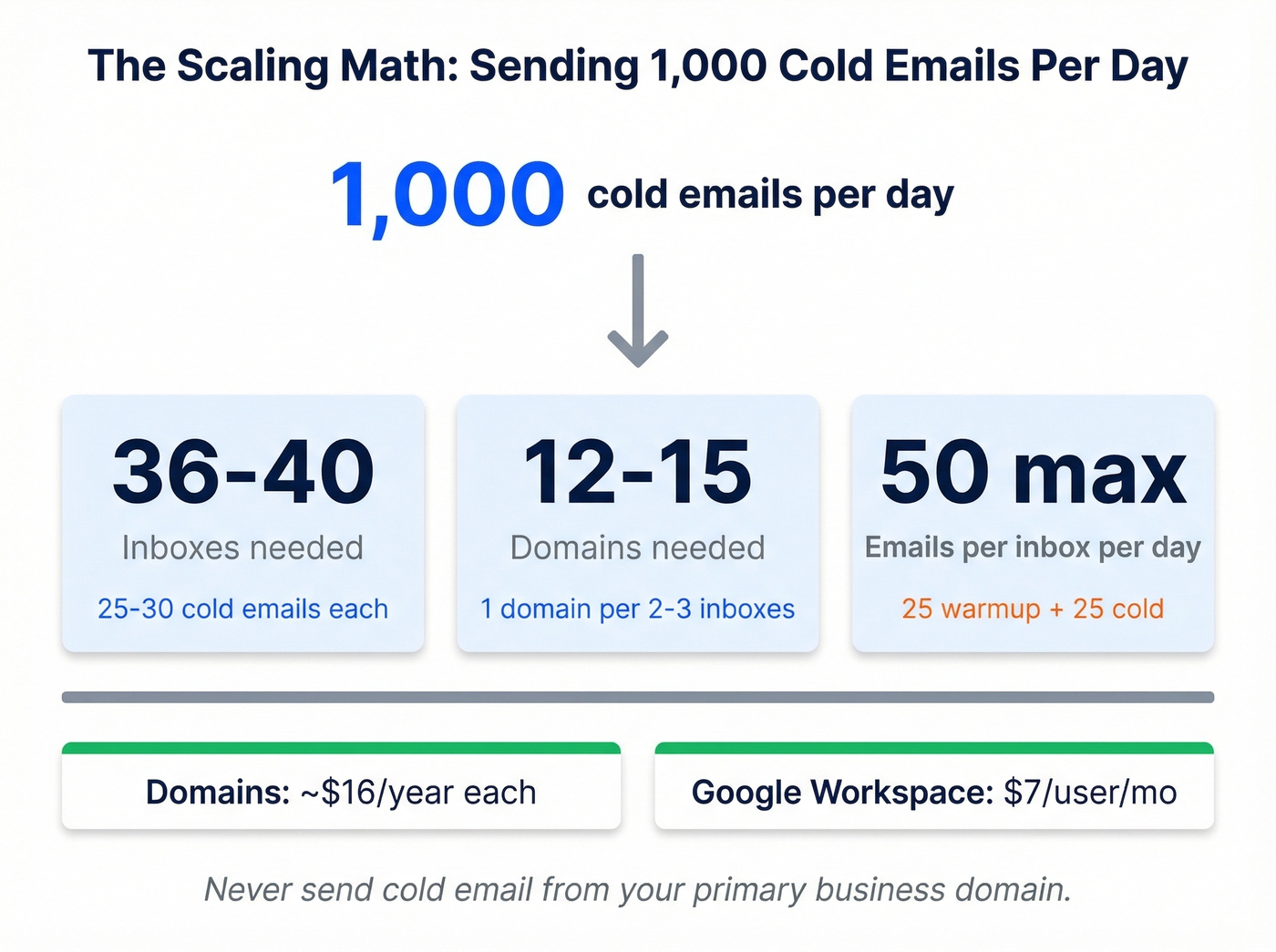
Google Workspace runs $7/user/mo on annual billing. Domains average about $16/year per .com. Plan one dedicated domain per 2-3 inboxes, and never send cold email from your primary business domain. Use inbox rotation across your sending accounts to distribute volume and protect individual inbox reputation.
The scaling math everyone asks about: to send roughly 1,000 cold emails/day, you typically need 36-40 inboxes sending 25-30 cold emails each, spread across 12-15 domains. That's your infrastructure floor before you even pick a sending platform.
Warmup
New inboxes have zero reputation. The ramp schedule that works: Week 1-2 at 5-10 emails/day, Week 3-4 at 15-20, Week 5-6 at 30-40, and Week 7+ maxing at 50/day per inbox. At peak, split 25 warmup and 25 cold. Never exceed 50 total from a single inbox.
Lemwarm runs $29/mo, Warmup Inbox $49/mo, and Folderly $120/mo. Smartlead starts at $39/mo; warmup is a $59/mo add-on - still cheaper than running a premium warmup tool at scale. If you're still dialing in volume limits, use an email velocity framework so you don't spike reputation.
Sending Platform
Everyone obsesses over this layer, and it's maybe 15% of what determines your results. The sequencer you pick matters far less than the infrastructure underneath it.
Instantly starts at $37/mo with unlimited email accounts, unlimited warmup, 1,000 uploaded contacts, and 5,000 emails/month. The $97/mo Hypergrowth tier pushes that to 100K emails. Great for pure volume, but watch for shared infrastructure risk on lower tiers - a concern that comes up repeatedly on r/coldemail.
In those same Reddit threads, a common recommendation is Smartreach paired with a lead database like Apollo and a verifier like ZeroBounce, though costs add up fast once you scale past 10 inboxes. Smartreach (~$29/mo entry) earns praise for time-zone sending and multichannel drips. Lemlist (~$55-79/mo) leads on image personalization and deliverability, though costs climb with add-ons. If you want a broader shortlist, compare options in our SDR tools roundup.
We've tested all three. If you're trialing, start with Smartreach, Instantly, and Lemlist - then choose based on time-zone sending needs, deliverability controls, and integration costs. Skip anything that locks you into annual contracts before you've validated your infrastructure.
CRM + Analytics
Your sending platform isn't your system of record. Replies, meetings, and pipeline need to flow into HubSpot, Salesforce, or whatever CRM your team lives in. Set up a master inbox that forwards all replies to one place - most sending platforms support this natively. If you need the plumbing, follow a connect outreach tool to CRM setup.
Monitor three numbers religiously: bounce rate under 2%, spam complaints under 0.1%, reply rate 5%+. If you can't hold those first two thresholds, you don't get to scale. (If you're missing the basics, start with an email deliverability guide and fix the root cause.)

The article breaks down 6 layers - Prospeo collapses the first two into one. With 98% email accuracy, 5-step verification including catch-all handling, and a 7-day refresh cycle, you skip the separate verification tool entirely. That's $30-$100/mo saved and one fewer integration to manage.
Cut your stack costs and start with data that doesn't bounce.
What It Actually Costs
That $37/mo sending tool is never $37/mo. The platform subscription is typically 10-25% of real cost - the other 75-90% is infrastructure, warmup, add-ons, and bad data. (If you're troubleshooting, start with email bounce rate benchmarks and fixes.)
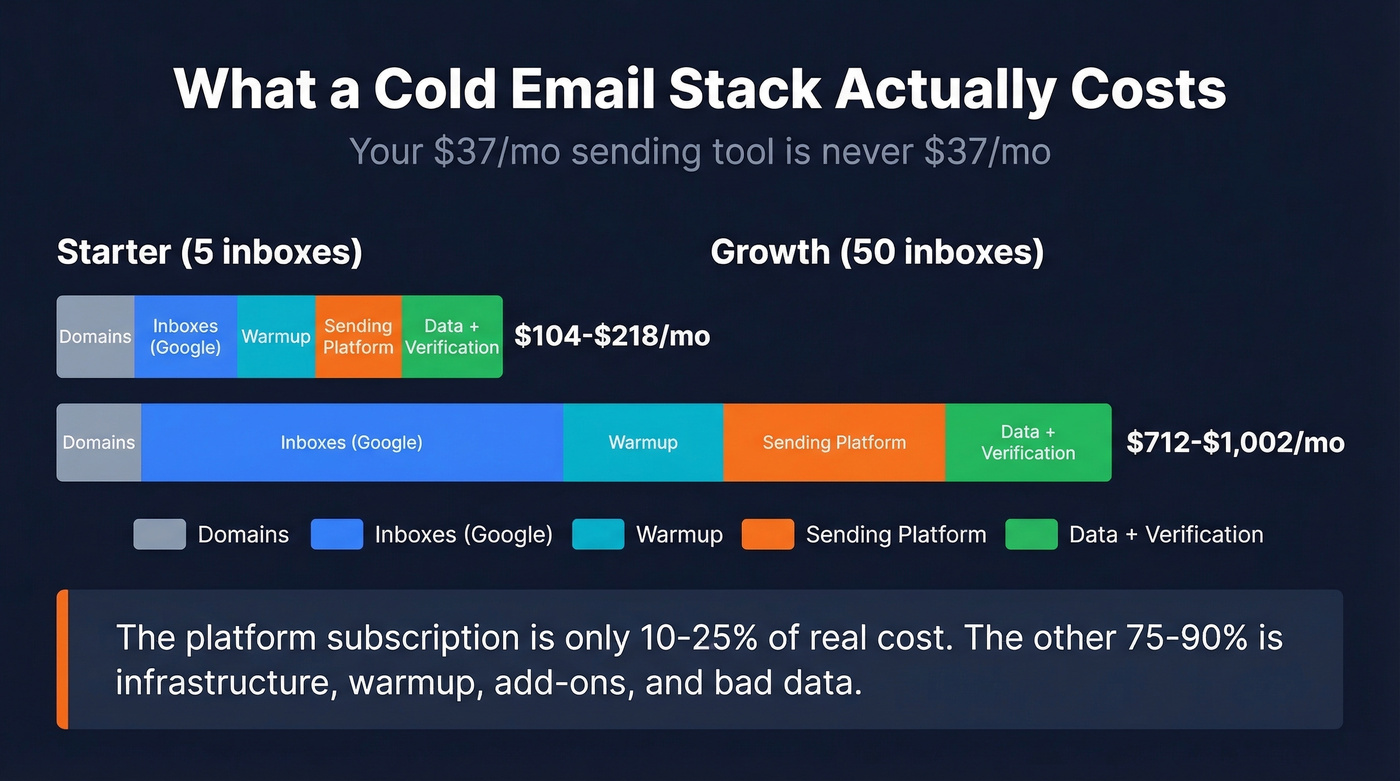
| Line Item | Starter (~5 inboxes) | Growth (~50 inboxes) |
|---|---|---|
| Domains | ~$3/mo | ~$69/mo |
| Inboxes (Google) | ~$35-42/mo | ~$350-420/mo |
| Warmup | $29-59/mo | ~$150/mo |
| Sending platform | $37-55/mo | $94-97/mo |
| Data + verification | $0-59/mo | $49-199/mo |
| Total | ~$104-$218/mo | ~$712-$1,002/mo |
A Lemlist user on the $79 plan with 15 senders and verification credits ends up paying roughly $257/mo for a single user. Multiply by a team of five and you're past $1,000/mo before you've bought a single contact. No platform advertises these real numbers on its pricing page.
Benchmarks That Prove It's Working
Average B2B cold email reply rates sit at 3-5.1%. Top performers hit 15-25%. The gap isn't luck - it's stack quality and targeting. If you need a baseline sequence structure, use a B2B cold email sequence playbook.
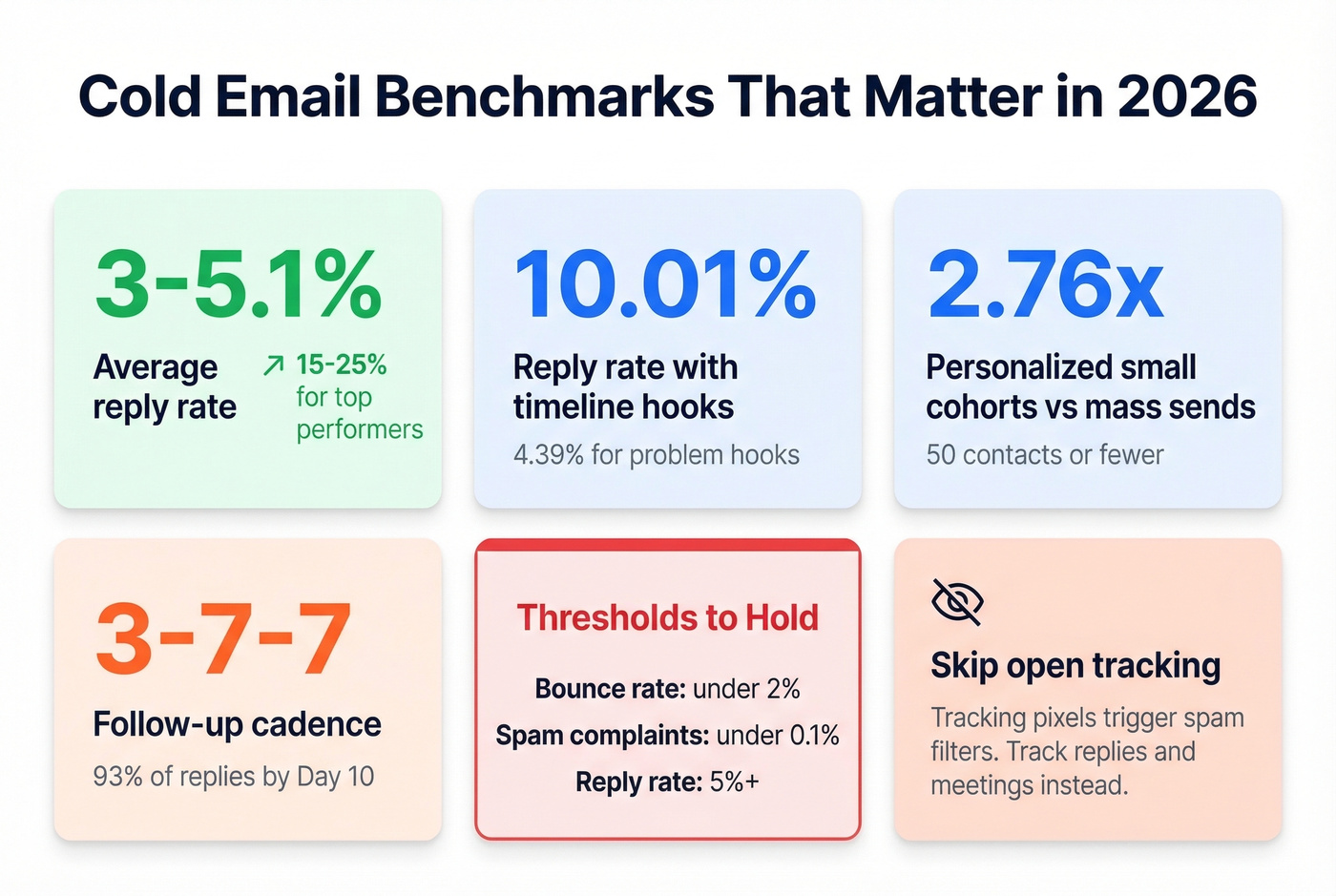
Timeline-based hooks average a 10.01% reply rate versus 4.39% for problem hooks, and meeting rates follow the same pattern at 2.34% vs 0.69%. Personalized emails to small cohorts of 50 contacts or fewer outperform mass sends by 2.76x. The 3-7-7 follow-up cadence captures 93% of replies by Day 10 - after that, you're chasing diminishing returns.
Let's be honest about open tracking: skip it entirely. Tracking pixels trigger spam filters and inflate vanity metrics. Track replies and meetings - those are the numbers that correlate with revenue.
Stack Optimize built a $1M agency on Prospeo data - zero domain flags, sub-3% bounce rates, 94%+ deliverability across every client. Native integrations with Smartlead, Instantly, and Lemlist mean your contacts flow straight into your sending platform. No CSV exports, no manual imports, no stale data.
Stop rebuilding your stack. Start with the data layer that actually holds.
Stop Overbuilding - Start Here
Stop buying 10 tools. The minimum viable cold email tech stack: one data source with built-in verification, 3-5 warmed inboxes, one sending platform, and your existing CRM. That's it.
The cheapest stack is the one that prevents burned domains. Every bounced email, every spam complaint, every flagged domain costs more than the tool that would've prevented it. Start lean, monitor your thresholds, and only scale infrastructure when reply rates justify the spend. We've seen teams at Stack Optimize build to $1M ARR with deliverability above 94% and bounce rates under 3% - all without a single domain flag. The stack doesn't need to be expensive. It needs to be right.
FAQ
How many domains do I need for cold email?
One domain per 2-3 inboxes. At 50 emails/day you need at least 2 sending inboxes sending 25 cold each, so start with 1-2 dedicated domains separate from your main business domain. Budget about $16/year per .com.
Should I track email opens?
No. Open-tracking pixels trigger spam filters and inflate vanity metrics. Track replies and meetings instead - if reply rates hold above 5% and meetings are booking, your campaigns are working.
What's the fastest way to build a verified prospect list?
Use a data platform with built-in real-time verification so you skip the separate verification step entirely. Prospeo's free tier includes 75 emails/month with 98% accuracy - enough for a first campaign of 50 personalized sends to test before committing.
How much does a complete cold email setup really cost?
Expect $104-$218/mo for a starter setup with 5 inboxes, covering domains, Google Workspace, warmup, a sending platform, and data. At 50 inboxes, realistic costs climb to $712-$1,002/mo. The sending tool alone is never the full price.