

Cold Emailing Strategies: The 2026 Playbook Backed by 16.5M Emails
Here's a failure mode we see constantly: a team runs a 10,000-email blast with a "proven" template and a purchased list. Bounce rate spikes into the double digits within days, and Gmail starts throttling the domain before week two. The emails aren't the real problem. The system underneath them is.
Belkins analyzed 16.5 million cold emails across 93 business domains and found the average reply rate dropped to 5.8% - down 15% from the year before. A now-classic CB Insights analysis dissected 147 cold sales emails and rated 93.9% of them "terrible." The teams still booking meetings aren't writing better subject lines. They're building better infrastructure, using cleaner data, and treating cold email as an engineering discipline rather than a copywriting exercise.
The Priority Stack
Cold email works as a system, not a hack. Here's the order:
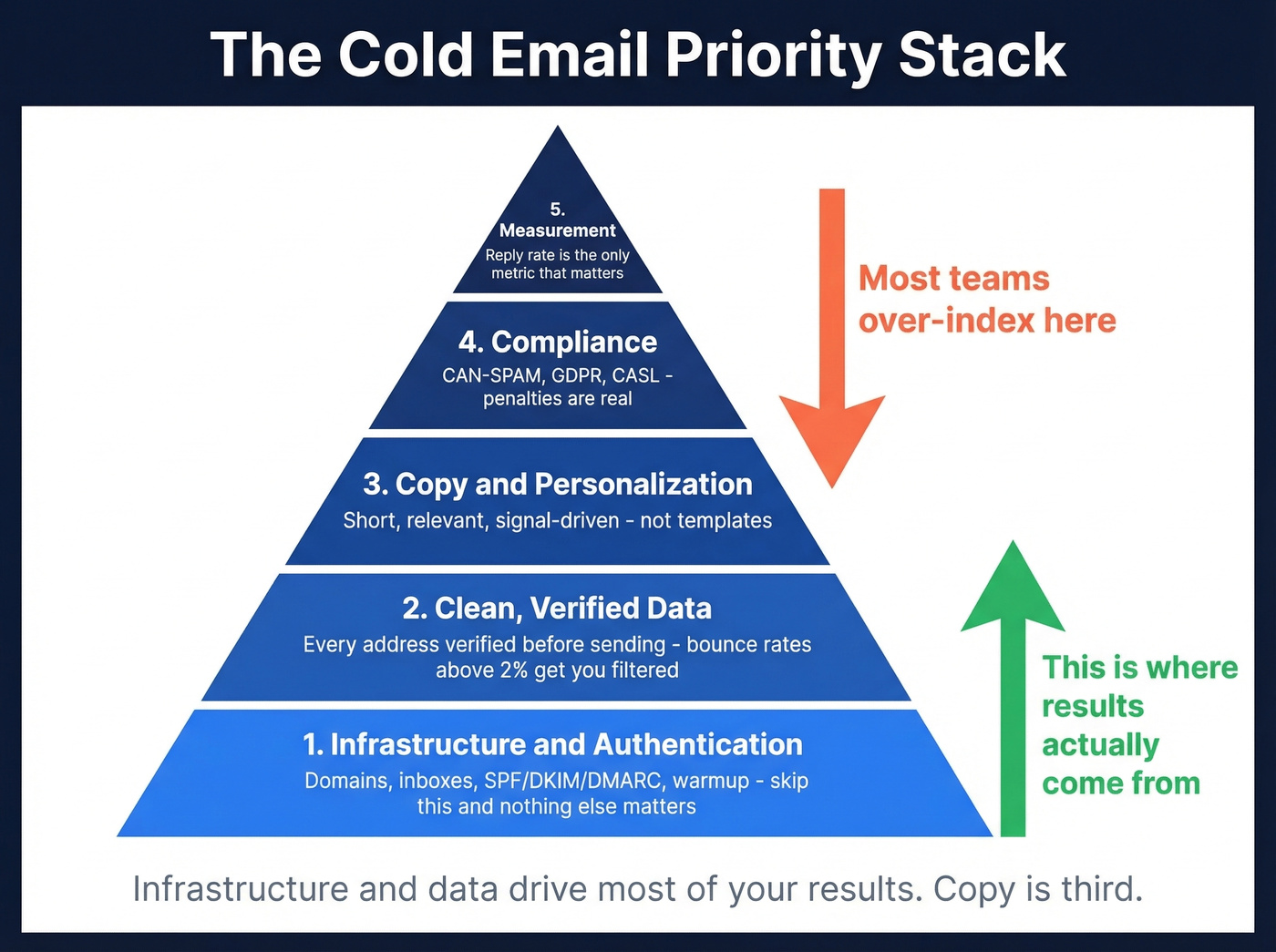
- Infrastructure and authentication - domains, inboxes, SPF/DKIM/DMARC, warmup. Skip it and nothing else matters.
- Clean, verified data - every address verified before sending. Bounce rates above 2% will get you filtered and throttled fast.
- Copy and personalization - short, relevant, signal-driven. Not templates. Not "Hi {{first_name}}."
- Compliance - CAN-SPAM, GDPR, CASL. The penalties are real.
- Measurement - reply rate is the only metric that matters. Open rates are dead.
Infrastructure and data drive most of your results. Most teams over-index on copy. That's backwards.
If your average deal size sits below ~$15k, a lean stack usually beats an overbuilt one. A few domains, clean verified data, and a basic sending tool will outperform a bloated tech stack with dirty lists every single time.
Deliverability Rules You Can't Ignore
Google, Yahoo, and Microsoft began enforcing bulk sender rules in 2025, and everything changed for outbound teams. If you're sending cold email without understanding these thresholds, you're operating blind.
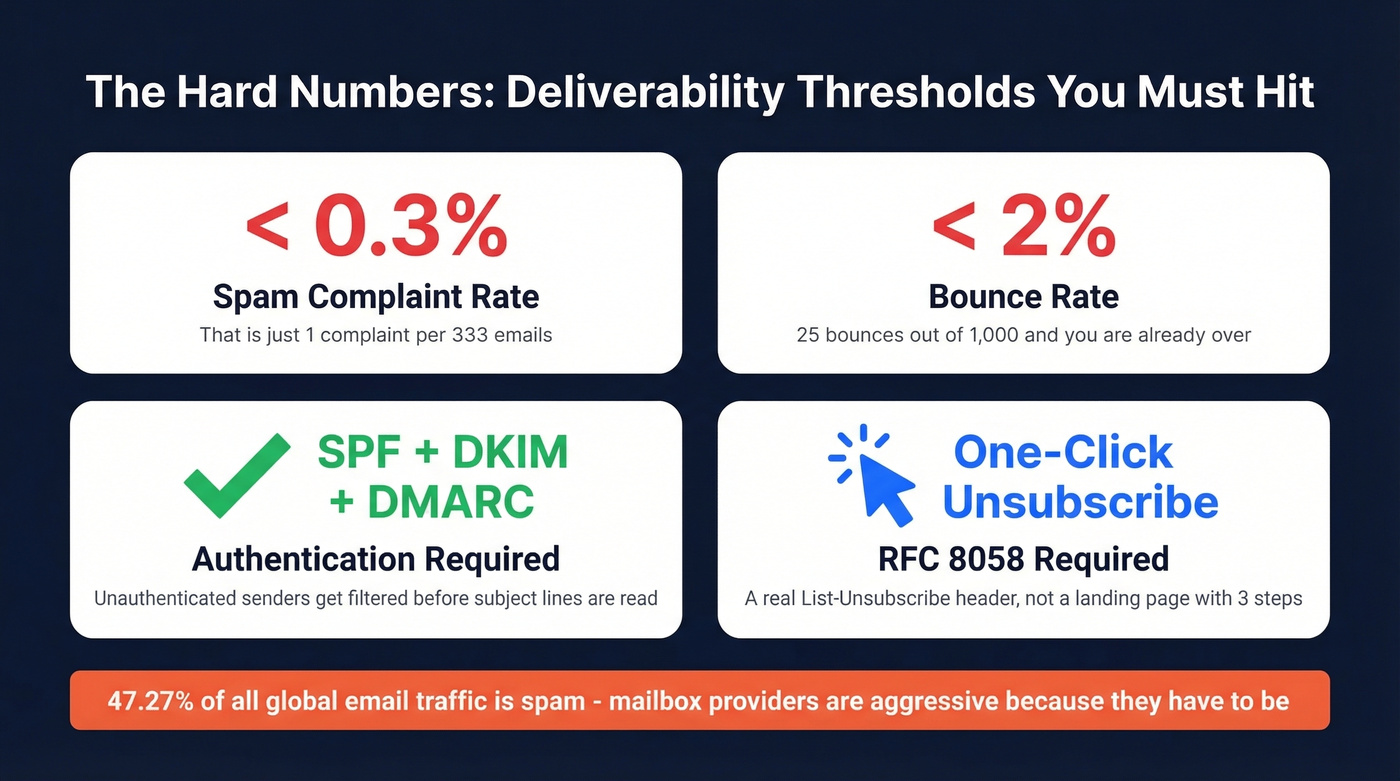
The hard numbers:
- Spam complaints must stay below 0.3%. One complaint per 333 emails. That's not much room.
- Bounce rates must stay below 2%. Send 1,000 emails with 25 bounces and you're already over.
- RFC 8058 one-click unsubscribe is now required - a List-Unsubscribe header that works with a single click, not a landing page with three confirmation steps.
- SPF, DKIM, and DMARC are table stakes. Unauthenticated senders get filtered before the subject line is even read.
47.27% of global email traffic is spam. Mailbox providers are aggressive about filtering because they have to be. Your cold emails compete against a tidal wave of garbage, and the only way through is proving you're legitimate at the infrastructure level. Even the most creative outreach won't land if your authentication is broken.
The consensus on r/coldemail is blunt: "lazy cold email is dead." Without proper infra, warmup, and authentication, you get blacklisted. Period.
Infrastructure and Deliverability Setup
This is the section most cold email guides skip or reduce to "set up SPF and DKIM." That's like telling someone to "just build a house" and handing them a hammer. Let's break it down properly.
Domain and Inbox Math
You can't send 1,000 emails a day from one domain without getting flagged. Here's how the scaling works:
| Daily target | Domains needed | Inboxes (3/domain) | Emails/inbox/day | Monthly infra cost |
|---|---|---|---|---|
| 500/day | 7 | 21 | ~24 | ~$100-150 |
| 1,000/day | 14 | 42 | ~24 | ~$200-300 |
| 2,000/day | 28 | 84 | ~24 | ~$400-600 |
The rule: 1 domain supports a maximum of 3 inboxes. Each inbox sends no more than 25 emails per day. Every new domain needs a minimum 2-week warmup before production sends.
For warmup, start at 5-10 emails/day, then increase gradually. Many teams aim for 10-20/day in week one, 20-40/day in week two, then 40-50/day if inbox placement stays healthy - with a full ramp often taking 4-6 weeks. Don't scale until you're hitting 80%+ inbox placement on seed tests.
Email Authentication
Implementation order matters. Don't jump straight to DMARC p=reject without inventorying all legitimate senders - you'll break things.
- SPF and DKIM first. Set up SPF records (watch the 10 DNS lookup limit, since stacking too many "include" mechanisms breaks SPF silently) and DKIM with 2048-bit keys.
- DMARC at p=none with reporting enabled. Monitor for 2-4 weeks to catch legitimate senders you forgot about.
- Tighten to quarantine, then eventually reject.
Only 18.2% of top domains have valid DMARC, and just 7.6% enforce quarantine or reject. Fully authenticated senders are up to 2.7x more likely to reach the inbox. That's a massive edge hiding in plain sight.
Deliverability Checklist
- 20 or fewer emails/day per email account (conservative, but safe)
- Custom tracking domain via CNAME - never use a shared tracking domain (see tracking domain)
- Turn off open tracking (Belkins found ~3% response improvement without it)
- Plain text preferred - avoid images and fancy HTML
- One link maximum in the email body
- Biweekly blacklist checks on all domains and associated IPs (use a proper email reputation tools stack)
- Spintax for message variation (identical emails get flagged after 500-600 sends)
- Inbox rotation - use batch A one month, batch B the next to let inboxes cool off
- Optimize your "From" line with a real name and title, not "Sales Team" or a generic alias
- Microsoft-heavy prospect lists require slower ramps and tighter daily limits; practitioners report significant deliverability drops when 70%+ of prospects are on Outlook
Building a Clean Prospect List
Your infrastructure can be perfect and your copy can be brilliant, but if 5% of your list bounces, none of it matters. The 2% bounce threshold isn't a suggestion - it's a hard line that mailbox providers enforce.
Belkins found that campaigns targeting 1-2 contacts per company averaged a 7.8% reply rate. Campaigns blasting 10+ contacts at the same company? 3.8%. Digital Bloom's data reinforces this: segmenting lists into cohorts of 50 or fewer contacts produced a 2.76x reply rate lift. Precision beats volume every time.
Verification before sending is non-negotiable - not "verify after the first bounce," but verify before the first send. We've been running our outbound through Prospeo's 5-step verification process, which covers 300M+ professional profiles at 98% email accuracy and refreshes records every 7 days compared to the 6-week industry average. That weekly refresh matters because people change jobs, companies shut down email aliases, and catch-all domains flip status constantly. The free tier gives you 75 verified emails per month, and at ~$0.01 per email, it's the cheapest insurance against bounces tanking your domain.
If you want a deeper breakdown of what to check (and what the codes mean), start with email bounce rate benchmarks and fixes.

The 2% bounce threshold is a hard line - this article proves it. Prospeo's 5-step verification delivers 98% email accuracy across 300M+ profiles, refreshed every 7 days. At ~$0.01 per email, it's cheaper than one bounced send destroying your domain.
Verify your entire list before you hit send. Start with 75 free emails.
Segmented lists of 50 contacts outperform 10,000-email blasts by 2.76x. Prospeo's 30+ filters - buyer intent, technographics, job changes, headcount growth - let you build surgical lists that actually convert. No contracts, no sales calls.
Build the precise prospect list this playbook demands. Free tier, no credit card.
Writing Copy That Gets Replies
Copy matters - it's just not the first thing that matters. Once your infrastructure is solid and your list is clean, here's how to write emails people actually respond to.
Subject Lines and Length
In practitioner testing, 2-word lowercase subject lines often win. Think "quick question" or "growth idea" - not "Exclusive Opportunity to Transform Your Revenue Operations in Q2."
Belkins' data on body length is clear: 6-8 sentences performed best with 42.67% open rates and 6.9% reply rates, and emails under 200 words outperformed longer ones. CB Insights also found that 88% of cold emails used mail merge or copy-paste, and 77% of those had formatting errors - broken merge tags, wrong names, mismatched company references. If you're using templates, QA them like your domain depends on it. Because it does.
If you need more options to test, pull from a curated bank of cold email subject line examples and iterate from there.
Hook Types That Work
This is where the data gets interesting, and where most teams leave the biggest gains on the table.
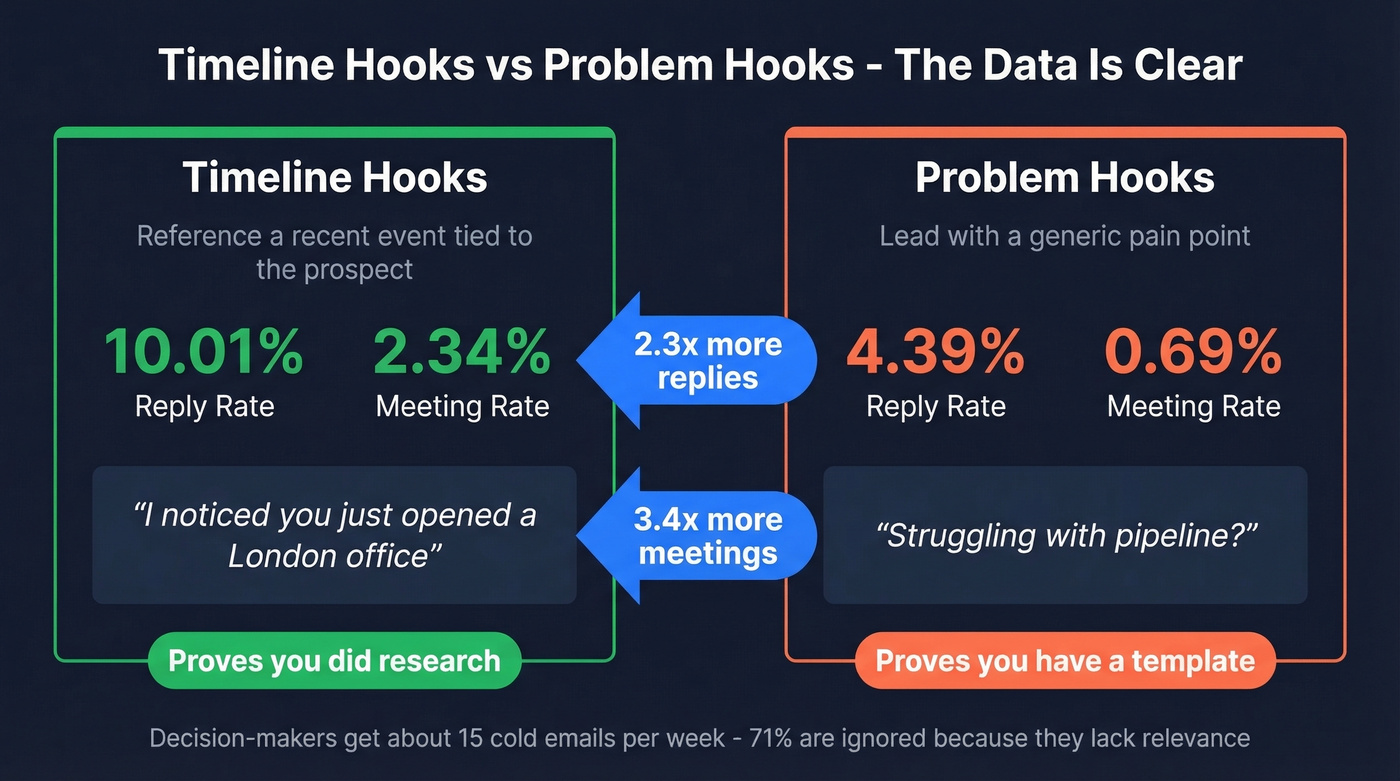
Timeline-based hooks - referencing a recent event tied to the prospect - crush problem-based hooks by a wide margin. Timeline hooks ("I noticed you just opened a London office") average a 10.01% reply rate and 2.34% meeting rate. Problem hooks ("Struggling with pipeline?") average 4.39% reply and 0.69% meeting rate. That's a 2.3x gap on replies and 3.4x on meetings.
The reason is simple. Timeline hooks prove you did research. Problem hooks prove you have a template. Decision-makers receive roughly 15 cold emails per week, and 71% are ignored because they lack relevance. A timeline hook is relevance in its purest form.
Annotated Templates
Initial outreach (under 75 words):
Subject: emea expansion
Hi {{first_name}},
Saw {{company}} just expanded into EMEA - congrats. When [similar company] made that move, they needed 40% more pipeline in 90 days to hit new-market targets. We helped them build that.
Worth a quick look at how?
Why this works: Timeline hook, one-sentence case study with a specific number, soft CTA that doesn't ask for 30 minutes.
Follow-up (Day 3):
Subject: re: emea expansion
{{first_name}} - figured the first one might've gotten buried. The short version: [similar company] added $2.1M in EMEA pipeline in their first quarter using our approach.
Happy to share the playbook if it's relevant.
Acknowledges the silence without guilt-tripping. Adds a new data point. Still under 50 words.
Breakup (Day 10):
Subject: closing the loop
{{first_name}}, I'll keep this short - if the timing isn't right, no worries at all. But if EMEA pipeline is on your radar this quarter, I'd love 15 minutes.
Either way, good luck with the expansion.
Gives the prospect an easy out. The "good luck" line is genuine, not passive-aggressive.
If you want more variations, use these cold email follow-up templates as a starting point.
Follow-Up Strategy and Cadence
The data on follow-ups is genuinely contradictory, and it's worth being honest about that.
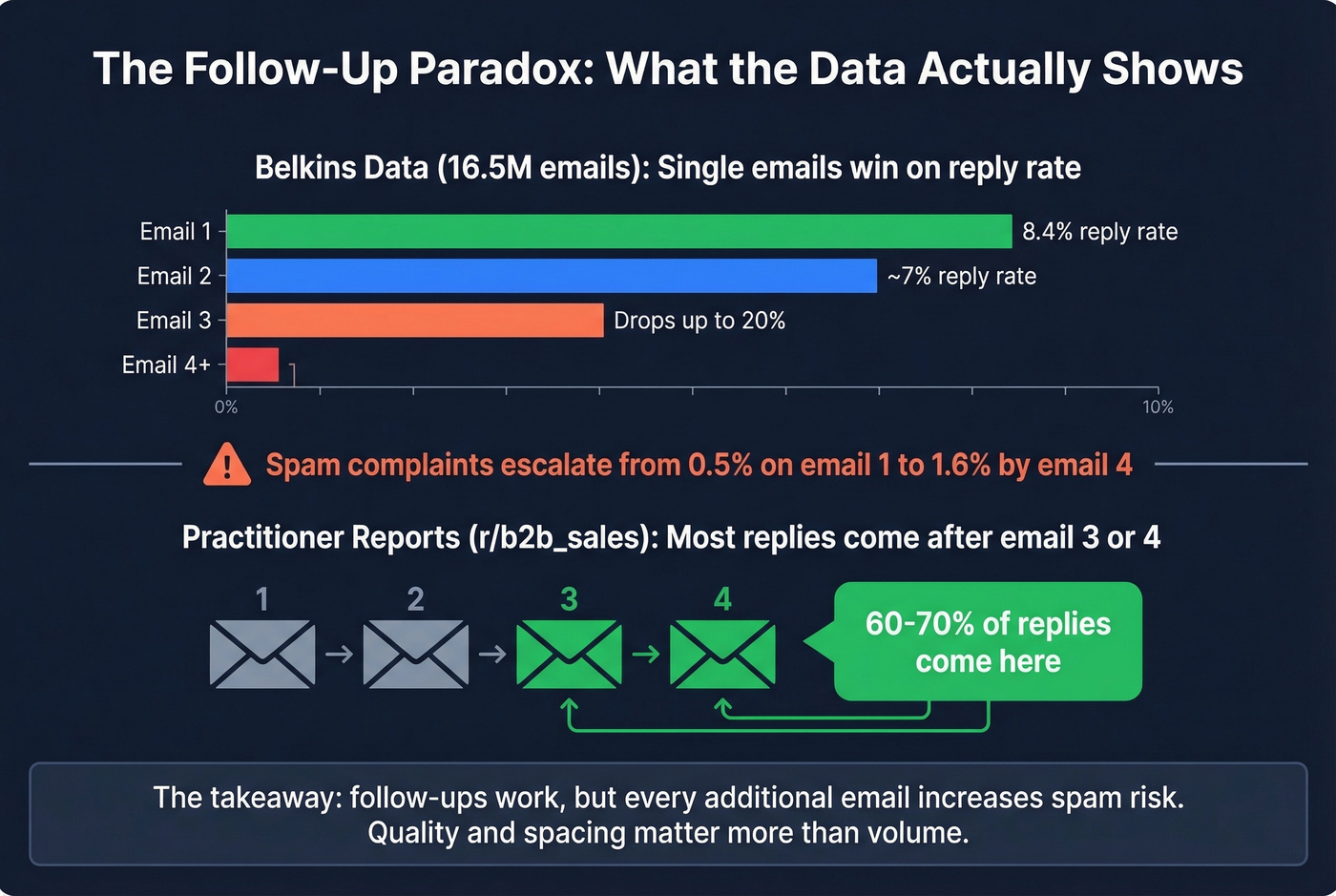
Belkins' 16.5M-email dataset shows that a single email has the highest reply rate at 8.4%, and adding a third email drops rates by up to 20%. Spam complaints escalate from 0.5% on the first email to 1.6% by the fourth.
Practitioners on r/b2b_sales consistently report the opposite - that 60-70% of their replies come after email three or four. Here's the thing: the Belkins data measures averages across all campaigns, including bad ones. The practitioner data comes from people who've already optimized their infrastructure and copy. If your system is dialed in, follow-ups work. If it's not, follow-ups just accelerate the damage.
The safest cadence we've seen work: 3-7-7 - send on Day 0, follow up Day 3, follow up Day 10, optional breakup Day 17. This captures 93% of replies by Day 10 while keeping spam complaints manageable. Three emails total is the sweet spot. Four is where risk starts outweighing reward.
Don't limit yourself to email alone. The best outreach strategies pair cold email with a LinkedIn touch and one polite phone call, which practitioners report can triple reply rates. Cold email opens the door; multichannel nudges push it open.
To systematize this, build a repeatable B2B cold email sequence and track outcomes by step.
AI-Powered Personalization at Scale
"AI personalization" in cold email ranges from useless - inserting a first name - to genuinely powerful - referencing a prospect's recent funding round in a custom first line. The difference is signal quality.
Here's the workflow that's actually working for teams in 2026:
- Monitor signals - funding announcements, leadership changes, expansion news, hiring surges. Layer intent data tracking buyer-research topics on top of firmographic triggers (see identifying buying signals).
- Scrape prospect activity - recent posts, company announcements, press mentions. Store these in CRM fields.
- Generate custom first lines - feed the signal data into GPT-4o mini with a prompt that outputs a one-sentence hook. Escalate to a stronger model for high-value prospects.
- Export and merge - CSV export with a {{custom_message}} variable, imported into your sending tool.
Teams running this workflow report response rates roughly 3x higher than their old template-based approach. AI that references a funding round is personalization. AI that inserts a first name is automation pretending to be personalization.
Skip this approach if you're sending fewer than 200 emails a month - the setup time won't justify the lift at that volume. For everyone else, this is where signal-driven outreach is heading: messages that feel handwritten but scale to thousands per week.
If you want to go deeper on tooling and workflows, compare approaches in AI cold email outreach.
Compliance by Jurisdiction
Cold B2B email is legal in the US, and permitted in the EU/UK under legitimate-interest frameworks when done correctly. But "legal" comes with specific requirements, and the penalties for getting it wrong are steep.
| US (CAN-SPAM) | EU (GDPR) | UK (PECR + UK GDPR) | Canada (CASL) | |
|---|---|---|---|---|
| Legal basis | Opt-out model | Art. 6(1)(f) legit interest | Consent or legit interest | Express/implied consent |
| Key requirement | Physical address, ID as ad | Document LIA, easy opt-out | Similar to GDPR | Implied = 24-mo window |
| Opt-out window | 10 business days | Without undue delay | Without undue delay | 10 business days |
| Max penalty | $51,744-$53,088 per message | EUR 20M or 4% revenue | GBP 17.5M or 4% revenue | $10M CAD/violation |
| Record keeping | Maintain suppression list | Document processing basis | Document processing basis | 3 years opt-out records |
For GDPR, Article 6(1)(f) legitimate interest is your lawful basis for B2B cold email - but you need a documented Legitimate Interest Assessment covering purpose, necessity, and balancing tests. "We thought it was fine" isn't documentation.
Canada's CASL is the strictest. Implied consent covers existing business relationships within the past 24 months or conspicuously published addresses relevant to the person's role. Express consent is always safer.
Measuring What Matters
Open rates are a vanity metric. Apple Mail Privacy Protection pre-loads tracking pixels, inflating open rates to meaningless levels. Belkins saw open rates swing from 46% to 31-32% within months before they stopped tracking mid-year. Don't optimize for a number that doesn't reflect reality.
Reply rate is the only metric worth tracking:
- Average reply rate: 5.8% across 16.5M emails
- Strong performance: anything above 7%
- System problem signal: below 3% - usually data quality or deliverability, not copy
- Best day: Thursday at 6.87% reply rate
- Best time: 8-11 PM at 6.52% (counterintuitive, but the data is consistent)
Practitioner expectations are more conservative: 1-2% reply rate, 15-20% of replies positive, roughly 1 qualified meeting per 2,000-3,000 emails. Elite campaigns can push past 10%, but that's top-decile performance, not a realistic baseline.
Below 3% reply rate? Don't rewrite your emails. Check your bounce rate, run a deliverability audit, and verify your list. The problem is almost always upstream of the copy. Once your system is stable, A/B test relentlessly - subject lines, hook types, CTAs, send times. Small gains compound fast when you're sending thousands of emails a month.
For a more technical diagnostic flow, use an email deliverability guide and work from infrastructure down to copy.
FAQ
Is cold emailing legal in 2026?
Yes. CAN-SPAM allows unsolicited B2B email with proper identification and a working unsubscribe. GDPR permits it under Article 6(1)(f) legitimate interest with documentation. Canada's CASL requires implied or express consent. None of these laws ban cold email - they regulate how you do it.
What's a good cold email reply rate?
The average across 16.5 million emails was 5.8%. Above 7% is strong. Below 3% signals a system-level problem - usually data quality or deliverability, not weak copy. Elite campaigns with verified data and signal-driven personalization push past 10%.
How many follow-ups should I send?
Three emails total is the sweet spot. Spam complaints triple by the fourth email, and reply rates drop ~20% after the third touch. A 3-7-7 cadence (Day 0, Day 3, Day 10) captures 93% of replies while keeping complaint rates manageable.
How do I verify my prospect list before sending?
Use a verification platform that runs multi-step checks with catch-all handling and spam-trap removal. Upload your CSV, remove invalid addresses, and keep bounce rates under 2% before any email hits a mailbox. Prospeo's free tier includes 75 verified emails monthly to get started.
Does cold email still work with AI spam filters?
Yes - with proper infrastructure. Authenticated domains, verified contact data, and signal-driven personalization still reach inboxes consistently. The teams failing are the ones skipping authentication and blasting generic templates to unverified lists.