

Cold Reply: What It Means and How to Handle It in 2026
You sent a thoughtful message. They replied "K." Or worse - your SDR team blasted 2,000 prospects last week and got back fourteen replies, eleven of which were some version of "please remove me from your list."
That sting has a name: the cold reply. And in 90% of cases, the problem isn't your message - it's your infrastructure.
Whether you're dealing with icy texts from a friend or frosty brush-offs from prospects, the fix starts with understanding what's actually happening on the other side of that screen.
Quick Version
A cold reply means different things depending on context. In texting, it's a short, emotionless response that kills the conversation. In sales outreach, it's a prospect replying with disinterest, a one-word brush-off, or a flat objection. Both feel terrible. If you're here because your cold emails are getting icy responses (or no responses at all), skip to the sales sections where we break down 2026 benchmarks, reply-handling templates, and the infrastructure fixes that actually move the needle.
What Does "Cold Reply" Mean?
At its simplest, a cold reply is a response that carries no warmth, engagement, or emotional investment. The phrase shows up in two very different worlds, and the meaning shifts depending on which one you're in.
In personal texting, a cold reply signals emotional distance. One-word answers, delayed responses, messages stripped of any personality. Calling someone's replies "cold" means they sound emotionless, distant, or even rude - lacking empathy or caring.
In B2B sales outreach, it's what happens when a prospect response comes back dripping with disinterest. It ranges from a curt "not interested" to a longer objection that still shuts the door. The common thread: the person replying has given you the minimum possible engagement. They responded, technically. They didn't connect.
Cold Replies in Texting
You sent a paragraph. They replied "Cool." You asked how their weekend was. They said "Fine."
That's a cold reply in its natural habitat.
Here's the thing: short texts don't always mean what you think they mean. Without tone of voice, facial expressions, or body language, text messages are notoriously easy to misread. Before you spiral, consider these interpretations:
- Low engagement - they're busy, distracted, or multitasking and genuinely aren't giving the conversation full attention
- Annoyance - something you said or how often you're texting is bothering them, and brevity is their passive signal
- Intentional brevity - some people just text short. Not personal. Just their style.
- Social signaling - they're trying to wind down the conversation without saying "I don't want to talk right now"
- Misinterpretation risk - what reads as cold to you might be neutral to them
Don't spiral. If someone consistently replies with one-word answers across multiple conversations, that's a pattern worth addressing directly. A single "K" after a long day isn't a diagnosis.
Cold Replies in Sales Outreach
Now let's talk about the version that costs you money.
Your SDR sends 500 emails. Open rate looks decent at 42%. But the reply rate? 2.1%. And of those replies, most are "not interested" or "please unsubscribe." Meanwhile, your bounce rate is sitting at 9%, quietly torching your sender reputation in the background.

Cold email responses aren't random. They're driven by predictable psychology. Prospects push back because of fear of change, suspicion of new vendors, and past bad experiences with salespeople who wasted their time. These map to five classic obstacles: no need, no money, no hurry, no desire, no trust. Most frosty responses trace back to at least one.
The mistake most teams make is treating every dismissive reply the same. A "not interested" from a VP who's mid-contract with a competitor is fundamentally different from a "not interested" from someone who's never heard of your category. The response strategy changes completely depending on which obstacle you're actually facing.

Your reply rate is a data quality problem. When 9% of emails bounce, sender reputation tanks and even good prospects go cold. Prospeo's 5-step verification delivers 98% email accuracy with a 7-day refresh cycle - so every message lands in a real inbox.
Stop burning your domain on bad data. Start reaching real buyers.
2026 Cold Email Reply Rate Benchmarks
Before you can fix cold replies, you need to know what "normal" looks like.
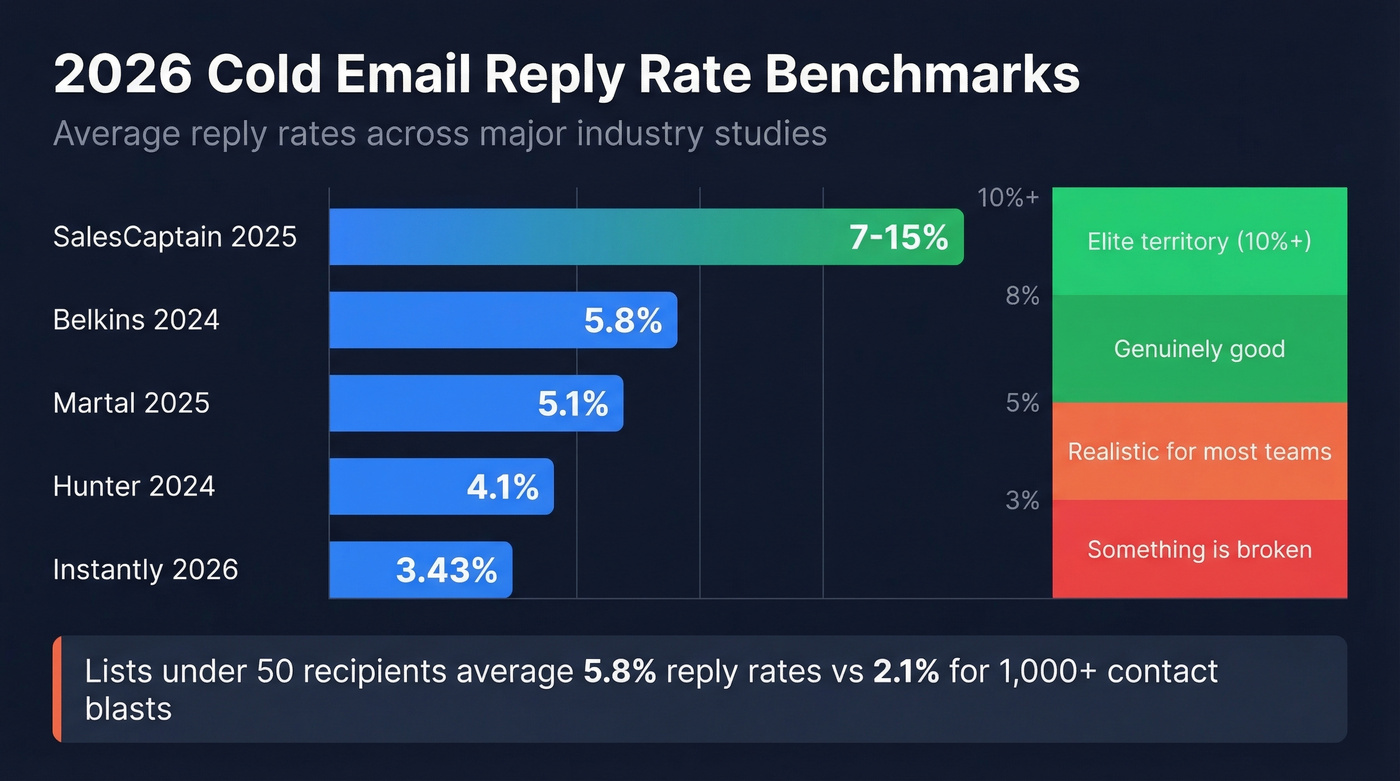
| Source | Dataset | Avg Reply Rate | Top Performers |
|---|---|---|---|
| Instantly (2026) | Benchmark report | 3.43% | 10%+ |
| Belkins (2024) | 16.5M emails | 5.8% | 8.4% (one-touch) |
| Hunter (2024) | 11M emails | 4.1% | 5.8% (<50 recipients) |
| Martal (2025) | Industry aggregate | 5.1% | - |
| SalesCaptain (2025) | Industry aggregate | 7-15% | 25%+ (personalized) |
The ranges tell a clear story. Below 3% means something's broken - your data, your deliverability, or your offer. Between 3-5% is realistic for most teams. 5-8% is genuinely good. 10%+ puts you in elite territory.
One number that doesn't get enough attention: list size matters enormously. Campaigns targeting 50 or fewer recipients average 5.8% reply rates, while campaigns blasting 1,000+ contacts drop to 2.1%. Smaller, verified lists consistently outperform large unverified blasts.
58% of replies come from step 1 of a sequence, with follow-ups contributing the remaining 42%. Your first email carries the most weight.
Handling Different Cold Email Responses
Not all replies deserve the same response. Here are the four scenarios you'll actually encounter.
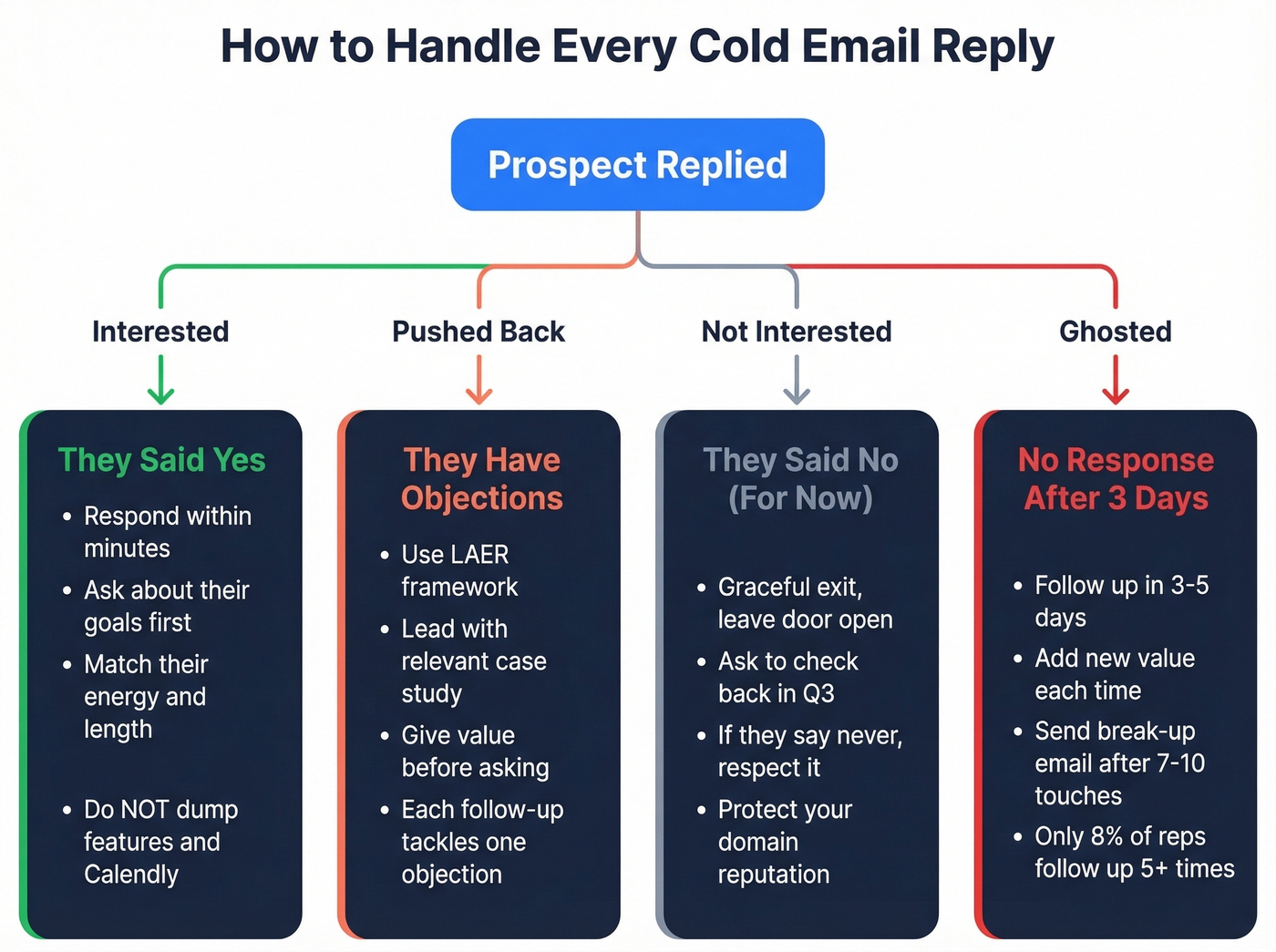
When They Say "Interested"
This is the reply you want - don't blow it.
Respond within minutes. Speed creates a live, human-to-human conversation feel. Keep it about them: ask about their goals and current workflow before pitching features. Match their energy - if they wrote two sentences, don't reply with a novel.
What kills these conversations fast is dumping your full feature list, attachments, and a Calendly link in one message. "Interested" means "willing to listen." It doesn't mean "ready to buy."
When They Push Back
LAER: Listen, Acknowledge, Explore, Respond. That framework works even in async email. In practice, your follow-up sequence should treat each email as a preemptive strike against a specific objection rather than a generic "just checking in."
If the common pushback in your market is "we already have a solution," your second follow-up should lead with a case study showing a customer who switched from that exact competitor. Use reciprocity - give something valuable before asking - and social proof to chip away at resistance. Each touchpoint should have a job.
When They Say "Not Interested"
"Not interested" usually means "not interested right now." The distinction matters.
A graceful exit that leaves the door open outperforms a hard push every time: "Totally get it - timing is everything. Mind if I check back in Q3 when [specific trigger event] might be on your radar?" This uses the commitment principle - a small "yes" to future contact is easier than a big "yes" to a meeting today.
If they say "not interested ever," respect it and move on. Your domain reputation isn't worth one more follow-up.
When They Ghost
90% of buyers respond within two days of their most recent message. If three days pass with nothing, they've made a decision by not deciding.
Follow up 3-5 days after the last touchpoint. Keep each follow-up short and add new value - a relevant stat, a case study, a different angle on the problem. After 7-10 touchpoints over 2-3 weeks, send a break-up email. Only 8% of reps follow up more than five times, so persistence alone puts you ahead of most of your competition.
Writing Emails That Get Warm Replies
The consensus across Reddit's outreach communities - r/sales, r/Entrepreneur, r/coldemail - is brutally clear: shorter wins. The cold email that actually gets responses in 2026 is 40-60 words, offer-led, and ends with a soft CTA.
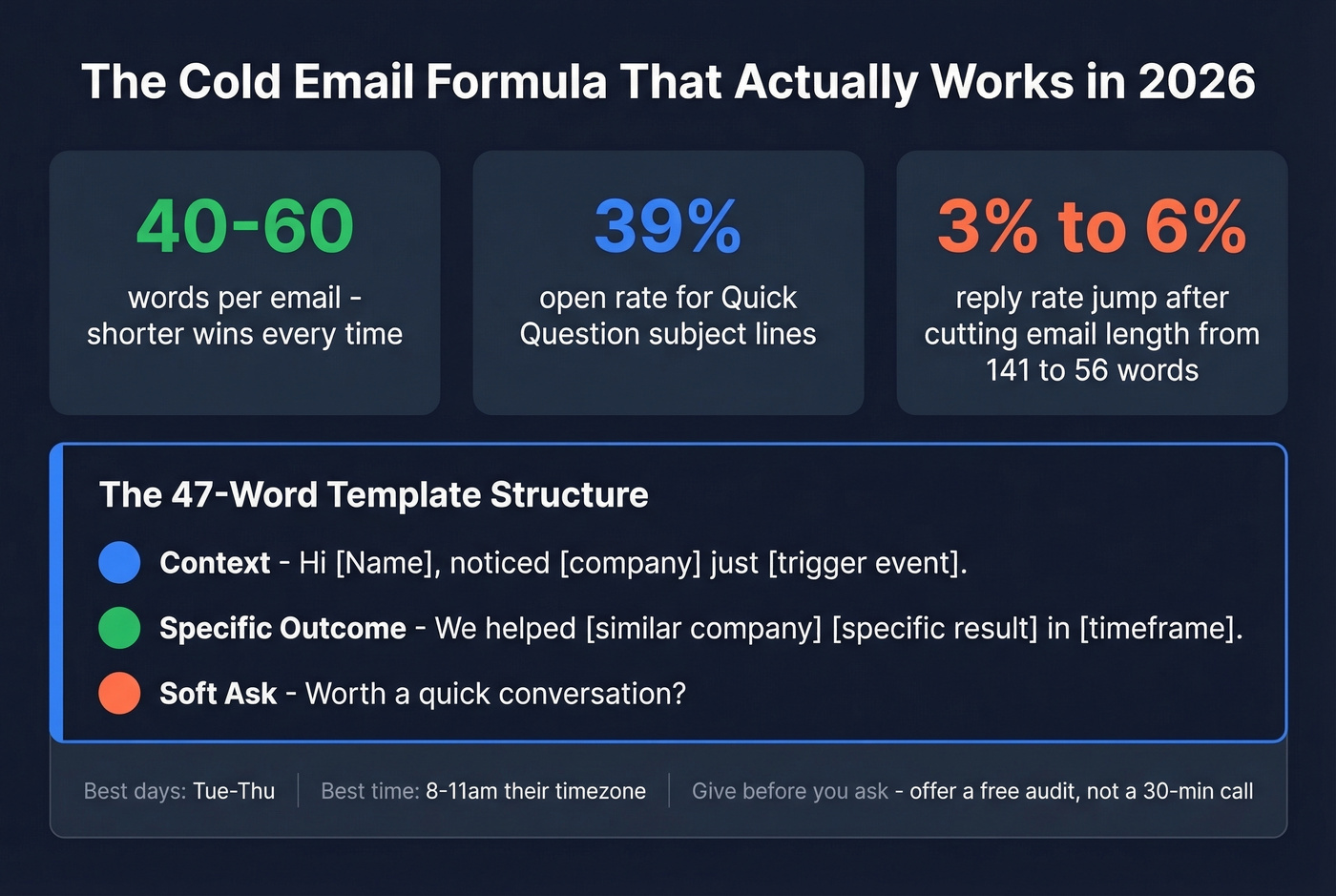
The data backs this up. Instantly's 2026 benchmarks show campaigns with sub-80-word emails consistently outperform longer ones. A detailed case study on r/Entrepreneur tracked a team that cut email length from 141 words to under 56 words as part of a broader overhaul - their reply rate went from 3% to 6% over 62 days. As the poster put it, "what worked last year is dead now."
That same case study revealed telling subject line data: "Quick question" pulled 39% opens, company name references hit 33%, and "Partnership opportunity" cratered below 19%. We've tested dozens of subject line formats across client campaigns - curiosity consistently beats formality.
Here's the winning template structure - context, specific outcome, soft ask, all in roughly 47 words:
"Hi [Name], noticed [company] just [trigger event]. We helped [similar company] [specific result] in [timeframe]. Worth a quick conversation?"
The offer matters more than the personalization. "I read your blog post" is table stakes - everyone says that now. A low-friction offer like "I'll audit your top 3 landing pages and send you a Loom with fixes" dramatically outperforms "let's hop on a 30-minute call." Give before you ask.
Best send window? Tuesday through Thursday, 8-11am in the recipient's timezone. That same Reddit team saw a 16% open rate improvement just from tightening their send schedule. If you want the data-backed breakdown, see our guide on the best time to send cold emails.
The Infrastructure Behind Your Reply Rate
Most cold email guides obsess over the message. The message is maybe 20% of the equation. The other 80% is whether your email even arrives.
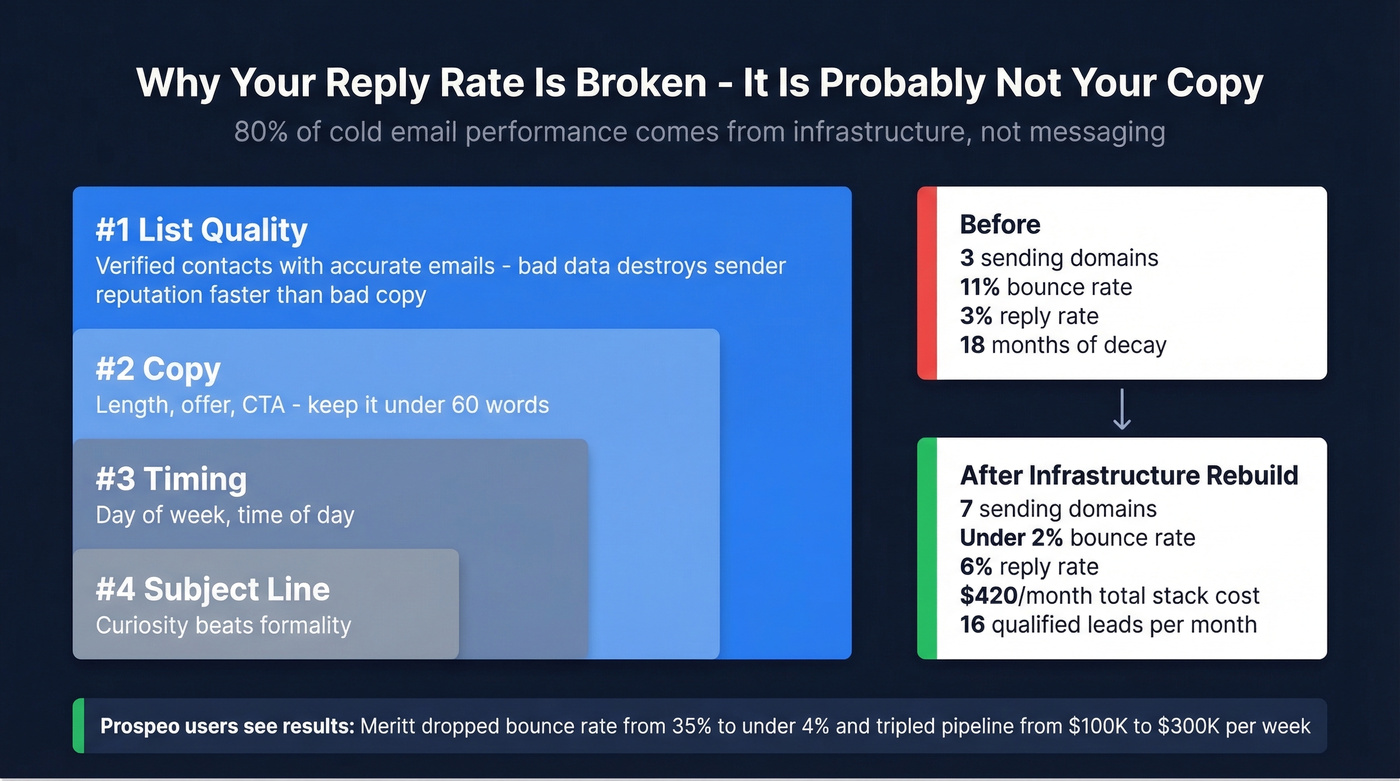
That Reddit case study? Their reply rate had decayed from 8% to 3% over 18 months. The rebuild that got them back to 6% was mostly infrastructure, not copywriting. They expanded from 3 sending domains to 7, capped each at 26 emails per day, and watched their bounce rate drop from 11% to under 2%. Total stack cost: roughly $420/month for 16 qualified leads per month.
Let's be honest - if your deal sizes sit below five figures, you probably don't need a $30k/year data platform. But you absolutely need clean data. The lever ranking we've seen play out repeatedly:
- List quality - verified contacts with accurate emails. Bad data destroys sender reputation faster than bad copy ever will. (If you're diagnosing issues, start with email bounce rate benchmarks and causes.)
- Copy - length, offer, CTA (Use an email call to action that’s low-friction.)
- Timing - day of week, time of day
- Subject line - curiosity beats formality (Steal from these cold email subject line examples.)
Before you rewrite a single subject line, verify your list. Prospeo's 5-step verification process - catch-all handling, spam-trap removal, honeypot filtering - delivers 98% email accuracy, and the 7-day data refresh cycle means you're not emailing contacts who changed jobs six weeks ago. If you want the full technical checklist, use our email deliverability guide and how to improve sender reputation.
The proof is in the results: Meritt saw their bounce rate drop from 35% to under 4% after switching, tripling their pipeline from $100K to $300K per week. Stack Optimize built their agency to $1M ARR while maintaining deliverability above 94% with zero domain flags across all clients.
The math is straightforward: high bounce rates damage sender reputation, emails land in spam, and replies drop to zero. In our experience, teams that fix their data foundation before touching copy see 2-3x the improvement. Fix the foundation first.
Smaller, verified lists hit 5.8% reply rates while unverified blasts drop to 2.1%. Prospeo gives you 30+ filters - buyer intent, job changes, tech stack - to build tight lists of in-market prospects at $0.01 per verified email. No contracts, no sales calls.
Build the list that turns cold replies into booked meetings.
Cold Replies Across Channels
Email isn't the only channel where cold replies happen.
| Channel | Avg Reply Rate | Scalability | Best For |
|---|---|---|---|
| Cold email | 3.43% | High | Volume outreach |
| LinkedIn DM | 7-15% | Low (connection limits) | Targeted outreach |
| Phone | Varies | Medium | Warm follow-up |
LinkedIn's higher reply rates come with a catch: connection limits and inbox mechanics that work against you. Connection requests with notes land in the "Other" inbox. InMail hits "Focused." Triggers that bury your messages include templated phrasing, no prior engagement, links in the first message, and identical bulk sends.
Email scales better. LinkedIn converts better per touch. The smart play is using both - email for volume, LinkedIn for high-value targets, and phone as the third channel for warm follow-up after someone's engaged with your content or profile. We've watched teams double their positive prospect responses when all three channels reinforce each other rather than operating in silos. To systematize this, borrow from these sales prospecting techniques and build a repeatable cold email sequence.
FAQ
What does "cold reply" mean in texting?
A cold reply is a short, emotionless response - "K," "Cool," or "Fine" - signaling disinterest or emotional distance. Context matters: some people just text short without meaning anything negative. Look for patterns across multiple conversations before drawing conclusions.
What's a good cold email reply rate in 2026?
The average sits at 3.43%. Between 5-8% is good, and 10%+ is elite. Below 3% consistently points to data quality or deliverability problems rather than copy issues.
How many follow-ups should I send after a cold reply?
Send 4-7 touchpoints over 2-3 weeks. Beyond 7, you hit diminishing returns and risk your domain reputation. Each follow-up should add new value - never a generic "just checking in."
Why are my cold emails not getting replies?
The most common culprits: high bounce rates from unverified lists, emails landing in spam, messages over 80 words, and weak offers. Fix deliverability first - verified data with 98% accuracy and weekly refresh cycles eliminates the data issues that silently kill most campaigns.
Does email verification actually improve reply rates?
Yes. Verified lists keep bounce rates under 2%, protecting sender reputation and ensuring emails reach real inboxes. That single fix often produces a bigger lift than any subject line or copy test.