

The Columbo Close: How "Just One More Thing" Surfaces Hidden Objections
You crushed the demo. The prospect was nodding, asking smart questions, even laughing at your jokes. Then they said "looks great, we'll circle back next week" - and disappeared. More than 36% of salespeople say closing is the hardest part of their job, and it's not because they can't pitch. It's because they never surface the real objection.
We've watched reps nail every part of a call and still lose the deal because they never asked the question that actually mattered. The Columbo close fixes that - and a Reddit post once called it "the single most effective sales technique ever documented."
The Short Version
- The technique: A disarming question asked after the prospect thinks the conversation is over, designed to surface hidden objections when their guard is down.
- The script: "Oh, just one more thing..." deployed as you're wrapping up, reaching for the door, or hovering over the end-call button.
- The rule: Prepare 2-3 "one more things" before every call. Never improvise this moment. It looks casual, but it's the most deliberate move you'll make.
What Is the Columbo Close?
The name comes from Peter Falk's iconic TV detective, Lt. Frank Columbo. His signature move was turning to leave - trench coat rumpled, cigar in hand - then pausing at the door with "Oh, just one more thing..." That throwaway question always cracked the case.
In sales, the mechanism is identical. You ask a disarming question after the prospect believes the conversation is ending. You'll also hear it called the doorknob close (because you literally have your hand on the doorknob) or the reverse close. The names differ, but the core idea doesn't: the most honest answers come when people think the pressure is off. It works in retail too. The "second effort" when a customer is walking out the door uses the same psychology to re-engage someone who's already mentally checked out.
Why This Technique Works
Christyne Berzenyi introduced a useful term in her 2021 book Columbo: A Rhetoric of Inquiry With Resistant Responders: antipotency. It's the deliberate projection of harmlessness - a facade of cluelessness that keeps the other person talking instead of defending. When you signal that the conversation is over, you're performing antipotency. You're no longer a salesperson pushing for a close. You're just someone with a stray thought on the way out.
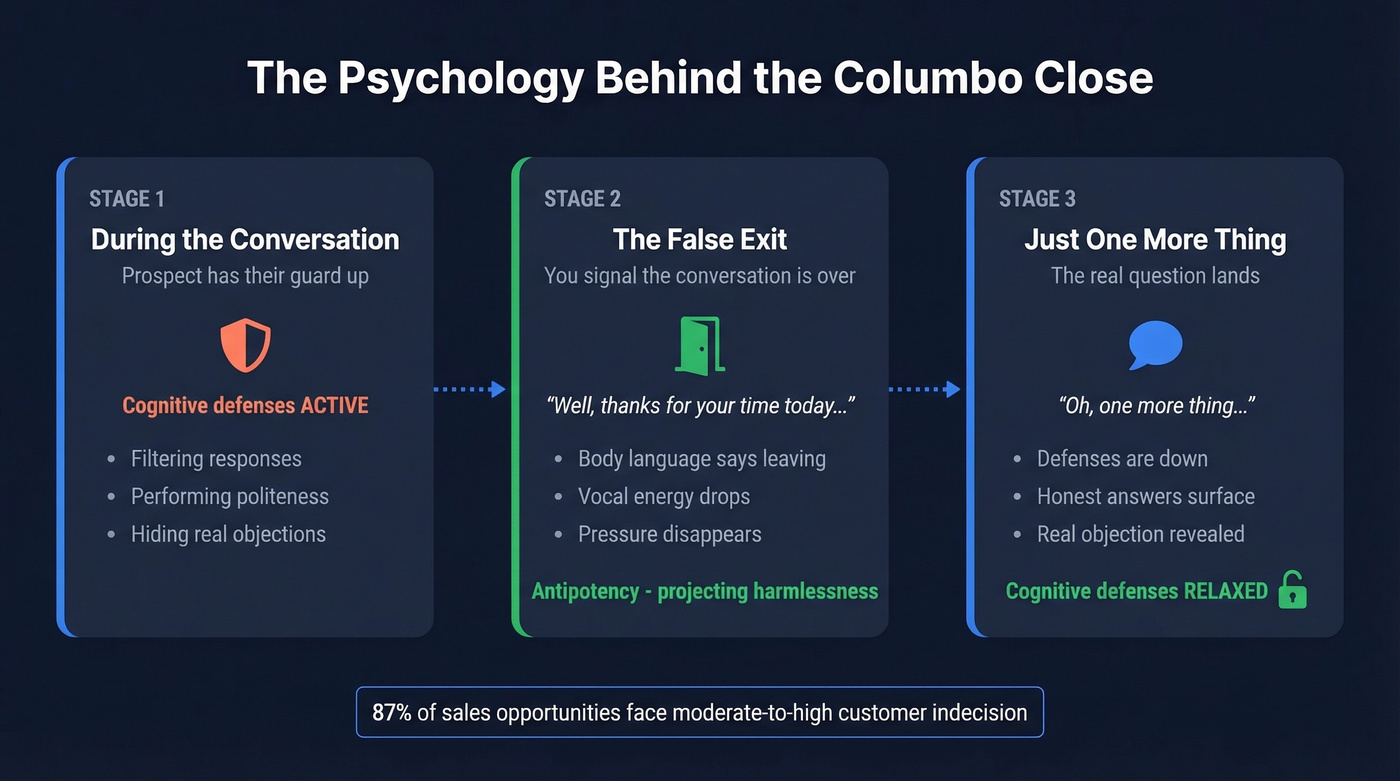
Psychology Today's analysis of Columbo's method highlights "false exits" as the key wrongfooting tactic. The prospect's cognitive defenses relax the moment they believe the interaction is ending. That's when the real objection slips out - not because you tricked them, but because they stopped performing too. The approach mirrors motivational interviewing; forensic psychologist Ray Bull described UK investigative interviews as "a lot like the old Columbo show," and the American Bar Association Journal once advised investigators to "Think Columbo."
This isn't academic trivia. When 87% of sales opportunities face moderate-to-high customer indecision and nearly 60% of stalled B2B deals die from overwhelming choice or unclear next steps, a well-timed false exit becomes essential. It creates the low-pressure window where the prospect finally tells you what's actually wrong.

The Columbo close only works if you're talking to the right person. Prospeo gives you 98% accurate emails and 125M+ verified mobile numbers so your 'just one more thing' lands with actual decision-makers - not gatekeepers.
Stop perfecting your close on prospects you can't reach.
Scripts for Every Scenario
You don't need 16 closing techniques. You need one great one and the discipline to prepare for it.
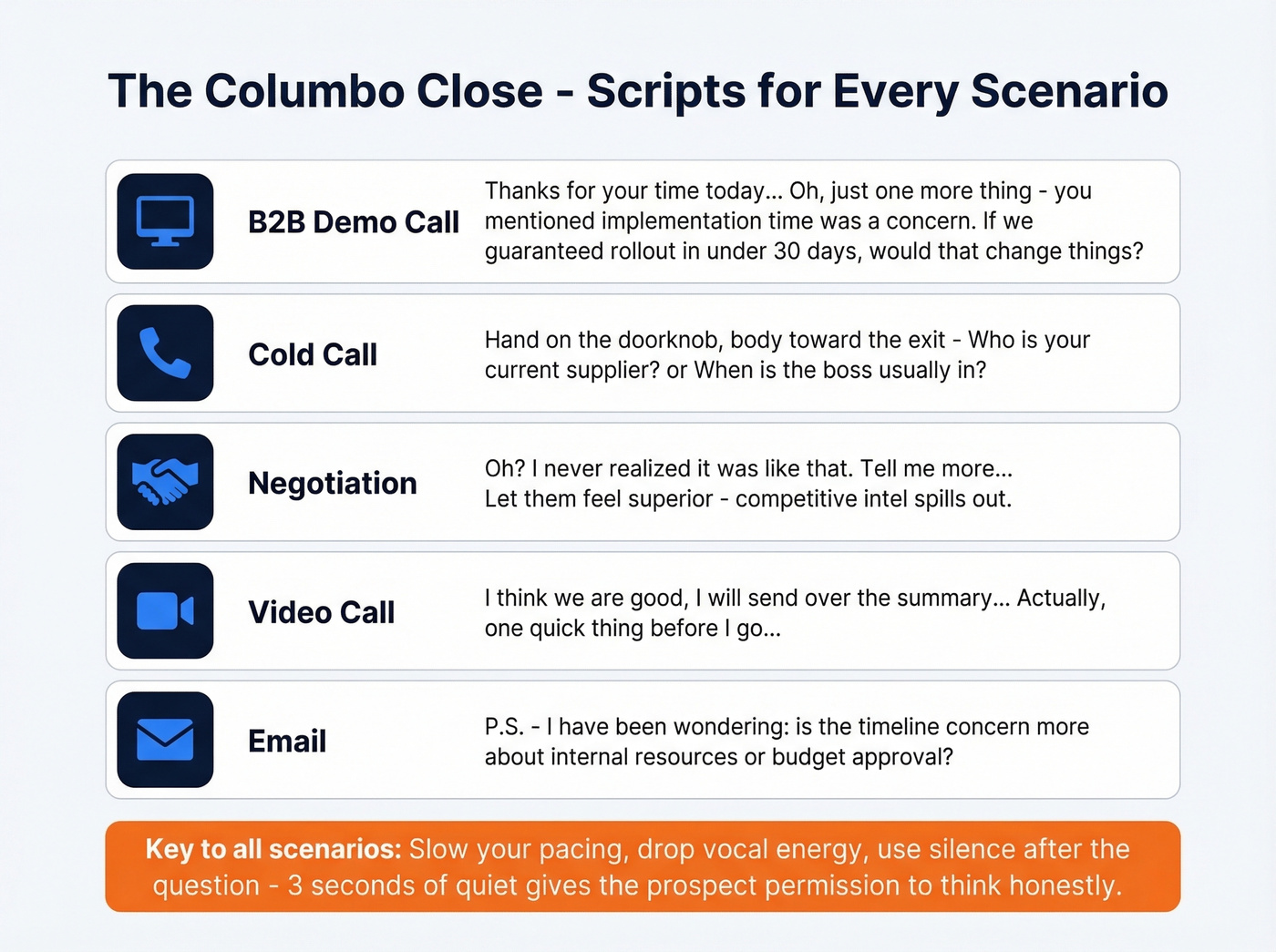
B2B Demo Calls
This is where the Columbo close shines brightest. The structure looks like this: "Well, thanks for your time today... Oh, just one more thing - earlier you mentioned that implementation time was a major concern. If we could guarantee a full rollout in under 30 days, would that make a difference in your decision?" The key is referencing something specific they said earlier. It proves you were listening, and it targets the unsaid objection directly.
A subtler variation works well when you have a strong case study: "Before we wrap up, I just want to share one quick case study from a business that's very similar to yours..." This reframes the false exit as generosity rather than interrogation - you're giving, not asking. Both approaches read the room and adapt timing, but the doorknob technique goes further than just reading the room. It resets it entirely.
If you want a tighter structure for your demo flow, pair this with a simple product demo checklist so your "one more thing" lands at the right moment.
Cold Calls and In-Person
Dan Galante described using the doorknob technique while selling dental office supplies. Hand on the doorknob, body turned toward the exit, he'd ask one last question - "Who's your current supplier?" or "When's the boss usually in?" The prospect answered because they thought he was leaving. He developed some of his best customers this way, turning throwaway answers into trial orders. That's the beauty of it: the question feels so low-stakes that people answer honestly without even thinking about it.
If you're building a repeatable outbound motion, this fits neatly into a broader cold calling system.
Negotiations
On the procurement side, negotiations.ninja frames this as "acting confused" to draw out information. Sales to procurement: "Oh?!? I never realized it was like that. Tell me more..." Procurement to sales: "Interesting... maybe you could walk me through that?" People can't resist feeling superior. They over-explain, and competitive intelligence spills out.
For more on how to use leverage without escalating tension, see anchor in negotiation.
Video Calls and Email
Nobody covers these, but they're where most selling happens now.
On video, create the false exit verbally - "I think we're good, I'll send over the summary" - then pause before clicking Leave Meeting. "Actually, one quick thing before I go..." The pause is everything. In email, the P.S. line is the written version of this technique. Your email body wraps up neatly, then: "P.S. - I've been wondering: is the timeline concern more about internal resources or budget approval?" The P.S. gets read precisely because it feels like an afterthought.
If you need follow-up language that keeps the same low-pressure tone, borrow from these sales follow-up templates.
Selling the False Exit
Slow your pacing. Drop your vocal energy slightly. Use silence after the question - don't fill it. On video, lean back. In person, physically orient toward the door. The whole point is that your body says "I'm leaving" while your mouth asks the real question.
In our experience, the silence after the question matters more than the question itself. Three seconds of quiet feels like an eternity to you, but it gives the prospect permission to think honestly.
When to Use It (and When Not To)
| Use the Columbo close when... | Skip it when... |
|---|---|
| You suspect a hidden objection | Trust is fragile or new |
| A deal has stalled with no clear reason | It's the very first interaction |
| The prospect went cold after a strong demo | The process is already aggressive |
| Multi-touch B2B with complex buying committees | You've already used it recently with this person |
| You need to surface the real blocker | The prospect has been fully transparent |
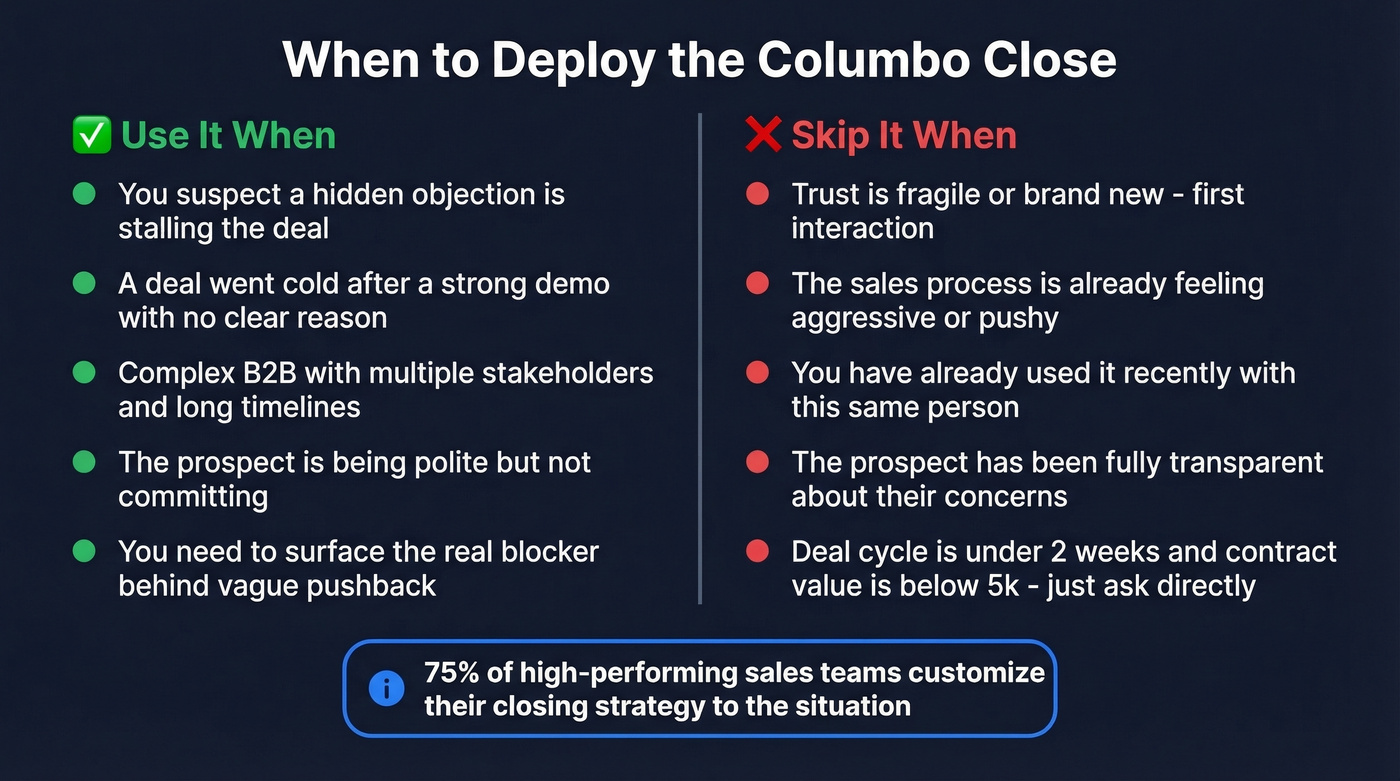
75% of high-performing sales teams customize their closing strategy to the situation. This isn't a universal hammer - it's a precision tool for moments when the truth is hiding behind politeness.
Here's the thing: if your average deal cycle is under two weeks and your contract value sits below $5k, you probably don't need this technique. Just ask directly. The Columbo close earns its keep on complex B2B deals where multiple stakeholders, long timelines, and organizational politics create layers of unspoken objections. That's where "just one more thing" pays for itself ten times over.
If you're looking for a broader framework beyond this one move, map it into the steps to close a sale.
Mistakes That Kill It
Being too rehearsed. If it sounds scripted, the "casual afterthought" illusion collapses. Practice the delivery, not just the words. It should feel like a genuine stray thought, not a trap.
Pushing after getting the honest answer. The whole point is to surface the real objection. If the prospect finally tells you "honestly, our CEO isn't bought in," don't immediately pivot to a hard close. Acknowledge it. Work with it. Pushing here destroys the trust you just earned.
Using it every single call. Pattern recognition is real. If the same prospect hears "oh, one more thing" three meetings in a row, you're not Columbo - you're predictable. Save it for the moments that matter.
Rushing the delivery. No pause before the question. No silence after it. If you blurt out "one more thing what's really holding you back" in one breath, you've killed the false exit. The pause is the technique. Preparing your questions before each call - and giving yourself permission to sit in silence afterward - is what separates a good rep from a great one.
If you want to reduce the number of stalls you have to rescue with a Columbo moment, focus on discovery questions earlier in the cycle.
How to Prepare Your Columbo Moments
The Columbo close looks spontaneous, but it's the most prepared move in your playbook. Before every call, build three "one more things" from these categories:
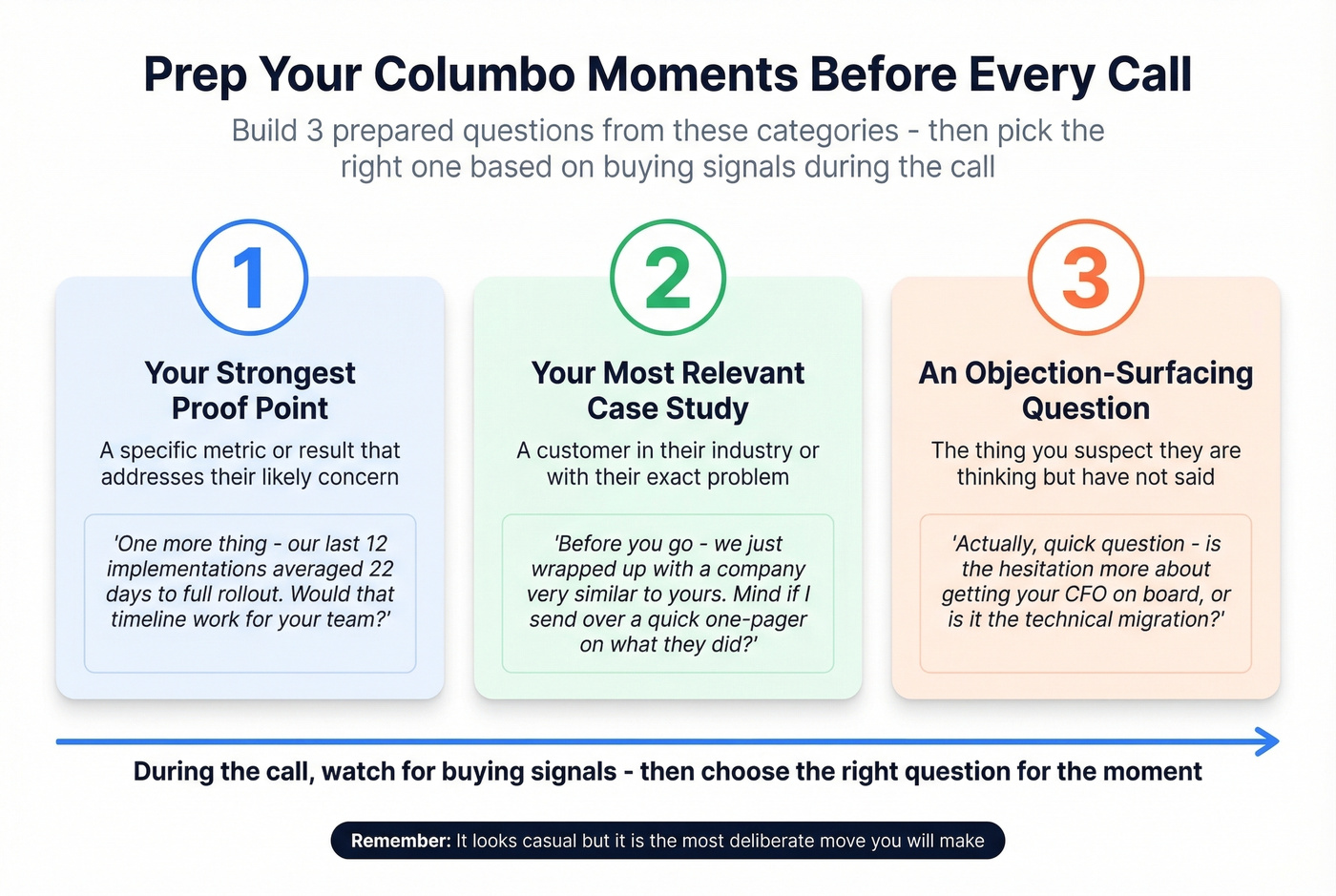
- Your strongest proof point - a specific metric or result that addresses their likely concern.
- Your most relevant case study - a customer in their industry or with their exact problem.
- An objection-surfacing question - the thing you suspect they're thinking but haven't said.
The "de-powering" concept matters here. Let the prospect feel in control throughout the conversation. The less threatening you seem, the more honest they'll be when you deploy your moment. Watch for buying signals throughout the call - the questions they ask, the features they linger on, the topics they avoid - and let those signals shape which of your three prepared questions you actually use.
If you want a more systematic way to spot those cues, use a simple rubric for identifying buying signals.

But none of this matters if you're calling a disconnected number or emailing someone who left the company six months ago. Step zero is verifying your contact data before the call. Tools like Prospeo can handle this with 98% email accuracy and a 7-day refresh cycle, so your carefully prepared Columbo close actually reaches the right person instead of bouncing into the void.
If you're comparing options for keeping lists clean, start with these data enrichment services and then narrow down to Bouncer alternatives if you specifically need verification.
You just learned the most deliberate move in sales. Now pair it with the most accurate data. Prospeo's 300M+ profiles with 30+ filters - including buyer intent and job changes - let you prep your Columbo questions with real context, not guesswork.
Prepare smarter 'one more things' with real buyer signals.
FAQ
What is the Columbo close in sales?
It's a technique where you ask a strategically prepared question after the prospect believes the conversation is ending. Named after TV detective Lt. Columbo's signature "just one more thing," it surfaces hidden objections by catching the prospect when their cognitive defenses are down.
Is the doorknob close the same thing?
Yes - same technique, different name. The doorknob close emphasizes the physical moment (hand on the doorknob, turning to leave), while the Columbo close references the TV origin. "Reverse close" is also used interchangeably.
Does this technique work on cold calls?
It does. Dan Galante's dental office supply story is the proof - he turned to leave, paused with one last question, and built some of his best customer relationships from those throwaway answers. The key is making the exit look genuine before you turn back.
Is the Columbo close manipulative?
It surfaces truth - it doesn't fabricate it. You're creating a low-pressure moment where the prospect can be honest about their real blockers. The ethical guardrail is simple: never push after getting the honest answer. The technique becomes manipulative only if you weaponize the honesty against them.
How do I make sure I'm reaching the right prospect?
Verified contact data is step zero. Even a perfectly delivered false exit is worthless if you're reaching the wrong person or a dead number. A platform with high email accuracy and frequent data refreshes - weekly, not monthly - keeps your outreach hitting live inboxes instead of bouncing.