

Company Sizes: The Complete Guide to Every Definition That Matters
Your VP of Sales says "focus on mid-market." Your CFO is reading an SBA report that defines "small" as up to 1,500 employees. Your European partner considers anything over 250 people a large company. Everyone's using the same words to mean completely different things, and it's creating real problems - from misaligned territories to botched government contract bids.
There's no single answer to "what counts as a small business." There are at least four major frameworks, and they disagree on almost everything.
Quick-Reference Table
| Category | US SBA (General) | EU SME | UK Companies Act | B2B Sales |
|---|---|---|---|---|
| Micro | No universal micro tier (NAICS-based) | <10 staff, ≤EUR2M rev | ≤10 staff, ≤GBP1M rev | <20 employees |
| Small | Often <500 employees (varies by NAICS) | <50 staff, ≤EUR10M rev | ≤50 staff, ≤GBP15M rev | <100 employees |
| Medium | Not a standard SBA tier (NAICS-based) | <250 staff, ≤EUR50M rev | ≤250 staff, ≤GBP54M rev | 500-2,000 employees |
| Large | Exceeds the NAICS "small" standard | 250+ staff | Exceeds medium | 2,000+ employees |
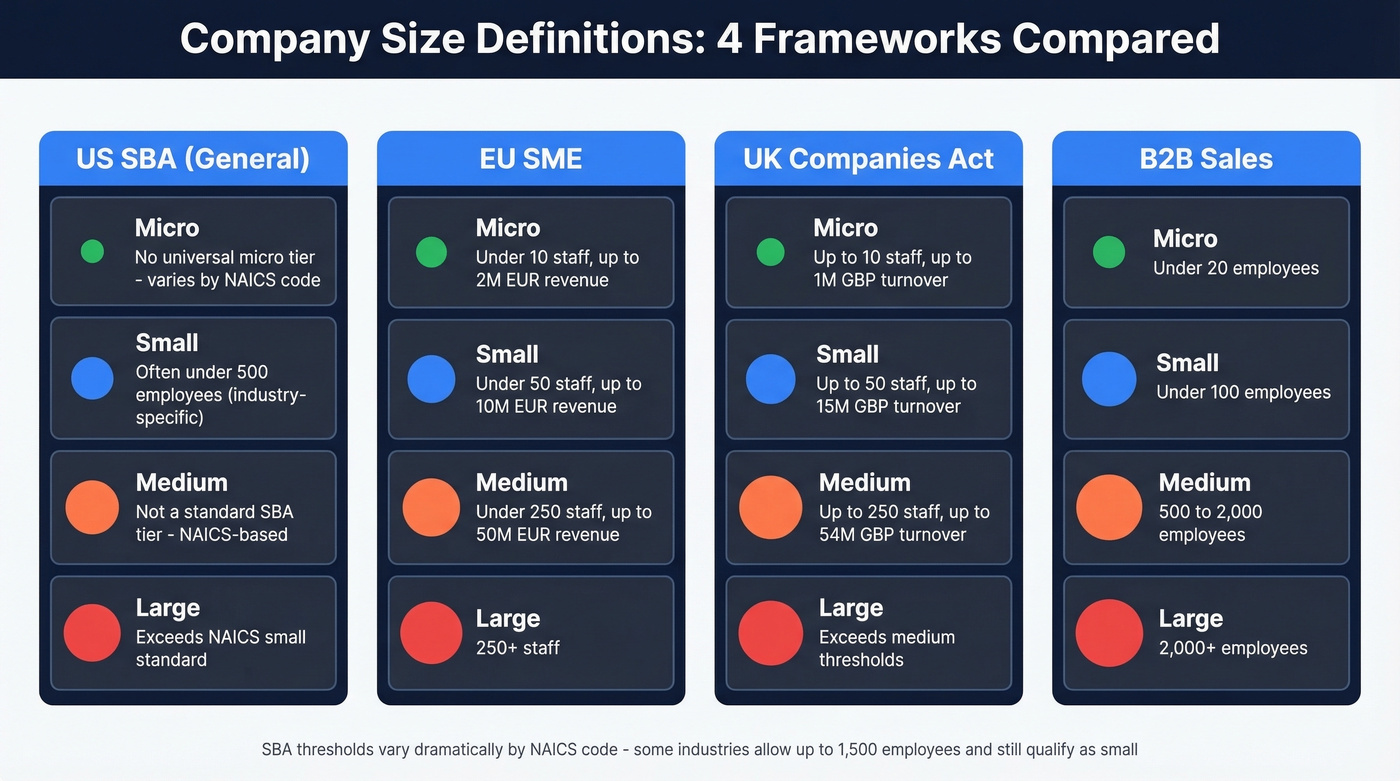
SBA thresholds vary dramatically by NAICS code - some industries allow up to ~1,500 employees or much higher receipts and still qualify as "small."
US SBA Size Standards
How the SBA Defines "Small"
The SBA doesn't use a single cutoff. Standards vary by industry, identified through NAICS codes, and they're based on either employee count or annual receipts - never both simultaneously.
For receipts-based industries, the SBA calculates total income plus cost of goods sold, averaged over the latest five complete fiscal years. For employee-based industries, it's the average number of people employed across each pay period over the latest 24 calendar months, including anyone on payroll regardless of hours or temporary status - part-time workers, temps, seasonal staff, all of them.
A 400-person engineering firm and a 400-person restaurant chain can have completely different SBA classifications, even at identical headcount.
Affiliates and Common Mistakes
Look, this is where companies get tripped up. Affiliates must be included in your employee and receipts calculations. Ownership of 50% or more is a common trigger for affiliation, but the SBA can also find affiliation through control even below that threshold.
Two misconceptions come up constantly. First, people assume revenue earned under one NAICS code only counts toward that classification. Wrong. Second, companies bidding on government contracts think only their government-contract revenue matters. Also wrong. The SBA's language is explicit: "all revenue in whatever form received or accrued from whatever source" counts toward your size determination. A company doing $20M in commercial work and $5M in government contracts has $25M in receipts for SBA purposes. We've watched companies lose contract eligibility over this exact mistake - it's not theoretical.
The 2025 SBA Threshold Proposal
On August 22, 2025, the SBA published a notice of proposed rulemaking to increase revenue-based size standards for 263 industries. If finalized, this would reclassify over 11,000 firms as "small" - opening up federal contracting opportunities they were previously locked out of. The comment period closed October 2025, and the final rule is expected sometime in 2026.
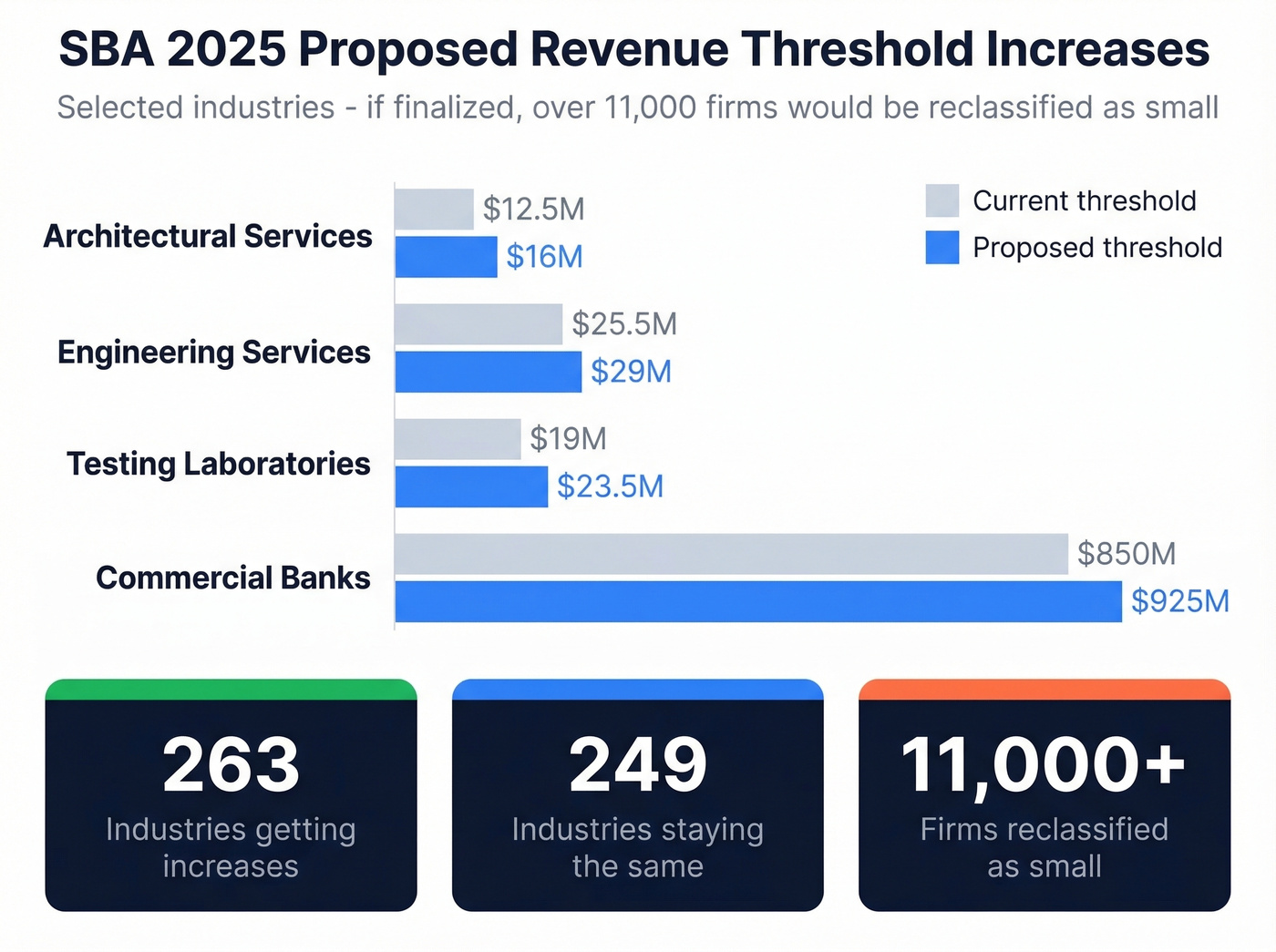
Some proposed changes: architectural services jumps from $12.5M to $16M, engineering services from $25.5M to $29.0M, testing laboratories from $19M to $23.5M, and commercial banks from $850M to $925M.
The methodology uses a "disparity ratio" test adopted in late 2024. When an industry's ratio falls below 0.8, the SBA considers small firms underrepresented and raises the ceiling. Out of 513 revenue-based standards reviewed, 263 get increases, 249 stay the same, and one exception gets removed.
EU SME Definitions
Thresholds: Micro, Small, Medium
The EU framework, based on Recommendation 2003/361, is the cleanest system of the four. Three tiers, two financial metrics, one headcount metric - no industry-by-industry lookup required.
| Category | Staff Headcount | Annual Turnover | Balance Sheet |
|---|---|---|---|
| Micro | <10 | ≤EUR2M | ≤EUR2M |
| Small | <50 | ≤EUR10M | ≤EUR10M |
| Medium | <250 | ≤EUR50M | ≤EUR43M |
Companies need to meet the headcount threshold and at least one of the two financial thresholds.
How It Works in Practice
The EU system has a built-in stability mechanism: a classification only changes when it meets or fails the criteria for two consecutive financial years. You don't flip from "small" to "medium" because of one strong quarter.
Where it gets complicated is ownership. Partner enterprises with 25% or more ownership of your company require proportional aggregation - if a partner owns 40% of your firm, you add 40% of their headcount and financials to yours. Affiliates with over 50% ownership get added at 100%. We've seen companies miscalculate this and lose their SME status retroactively, which is a painful surprise when grant funding is on the line.
The EU is also developing a new "Small Mid-cap" category for companies between roughly 250 and 3,000 employees - a recognition that the jump from SME to "large" has always been too abrupt.

Knowing the right company size framework is step one. Actually filtering your prospect list by headcount, revenue, department size, and growth rate is where deals happen. Prospeo's 30+ search filters let you segment 300M+ profiles by exact employee ranges, funding stage, and headcount growth - so your SMB, mid-market, and enterprise lists are built on real data, not guesswork.
Build size-segmented prospect lists in minutes, not hours.
UK Classifications Under the Companies Act
The UK Companies Act uses four categories - micro, small, medium, and large - with a pragmatic qualifying rule: a company meets a size threshold if it satisfies any two of three criteria across turnover, balance sheet total, and employees.
In April 2025, the UK significantly raised its monetary thresholds for accounting periods commencing on or after 6 April 2025:
| Category | Turnover (Old to New) | Balance Sheet (Old to New) | Employees |
|---|---|---|---|
| Micro | GBP632k to GBP1M | GBP316k to GBP500k | ≤10 |
| Small | GBP10.2M to GBP15M | GBP5.1M to GBP7.5M | ≤50 |
| Medium | GBP36M to GBP54M | GBP18M to GBP27M | ≤250 |
Small company turnover jumped nearly 50%, and medium company turnover went up by exactly 50%. The employee thresholds didn't change. The UK is essentially acknowledging inflation in revenue without assuming proportional headcount growth.
The UK also applies a two-year rule for moving between categories: you generally don't lose your status until you've failed the criteria for two consecutive years, and there are transitional provisions around applying the new thresholds after April 2025.
Business Sizes in B2B Sales
SMB vs Mid-Market vs Enterprise
Here's the thing: if you're in B2B sales, the government definitions above are mostly irrelevant to how you segment your pipeline. Sales teams use their own taxonomy, and while it's less precise, it's more operationally useful.
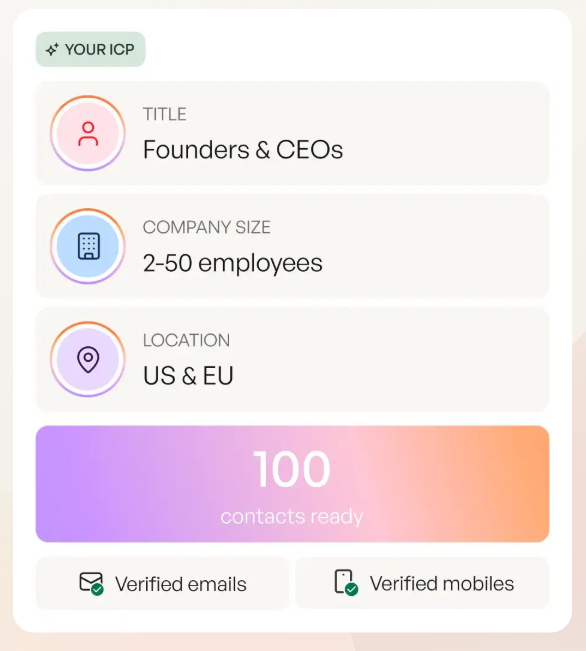
SMB is often treated as under 500 employees, though many orgs draw the line at 100 or even 50. Gartner defines midsize enterprises as $50M-$1B in annual revenue or 100-1,000 employees. In practice, most sales teams use 500-2,000 employees for mid-market. Enterprise starts at 2,000+.
If you want a deeper breakdown of how teams draw these lines, see SMB vs Mid-Market vs Enterprise.
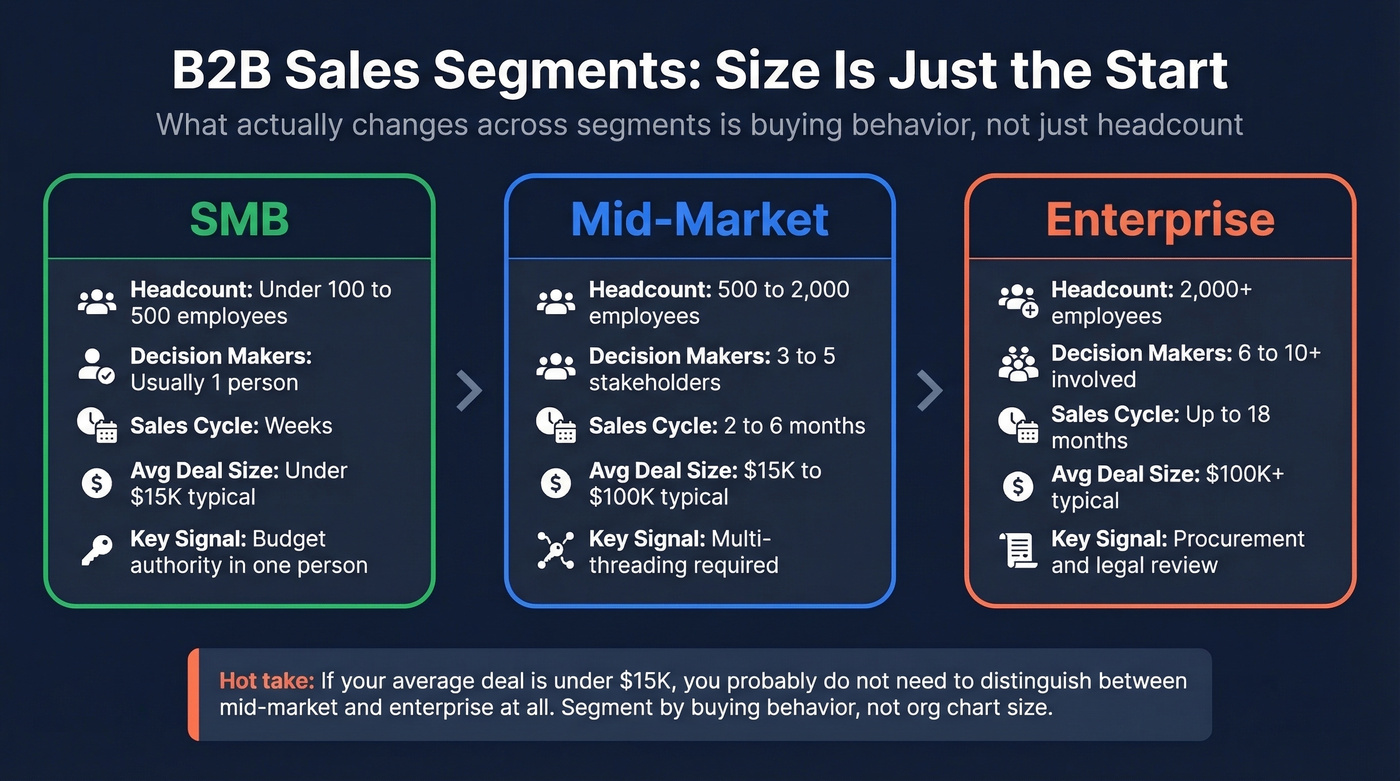
The real difference isn't headcount - it's buying behavior. Enterprise deals often involve 6-10 decision makers and sales cycles stretching to 18 months. Mid-market deals move faster but still require multi-threading across 3-5 stakeholders. SMB deals often close with a single decision maker in weeks. Your segmentation should reflect how you sell, not how the government classifies businesses.
Hot take: If your average deal is under $15k, you probably don't need to distinguish between mid-market and enterprise at all. Segment by buying behavior and budget authority, not org chart size.
Turning Definitions Into Prospect Lists
Understanding these classifications is step one. Step two is figuring out the actual size of a company you're targeting - and that's where most teams hit a wall. Half your CRM records probably don't have headcount data, and the ones that do are often stale.
Prospeo's B2B database lets you filter 300M+ profiles by headcount, headcount growth, department headcount, revenue, and funding stage - along with 30+ total search filters. If you've defined "mid-market" as 500-2,000 employees with $50M+ revenue, you can build that exact list in minutes and export verified contacts into tools like Smartlead or HubSpot.
If you're trying to fill in missing firmographics in your CRM, data enrichment tools can help keep headcount and revenue fields current.

How Many US Businesses Are Actually Small?
The vast majority of American businesses are micro or small by any definition. Census Bureau data makes this stark.
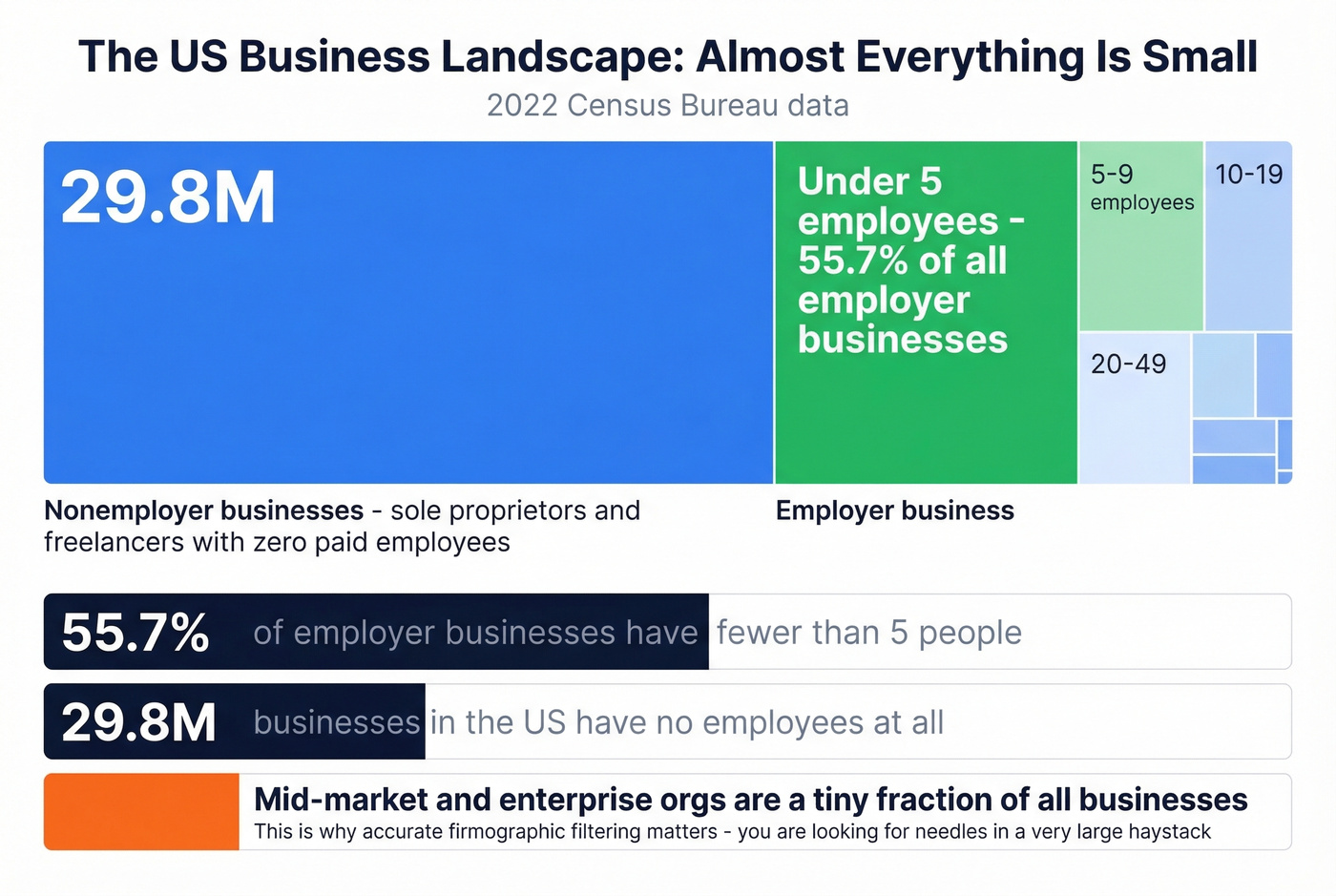
In 2022, there were 29.8 million nonemployer businesses in the US - sole proprietors and freelancers with no paid employees. Among businesses that do have employees, 55.7% of establishments had fewer than 5 people. That's not a typo. More than half of all employer businesses in America have a headcount you can fit in a minivan.
When politicians talk about "small business," they're describing the overwhelming majority of the economy. The mid-market and enterprise organizations that B2B sales teams obsess over represent a tiny fraction of all businesses - which is exactly why accurate firmographic filtering matters. You're looking for needles in a very large haystack.
If you're building segments for outbound, it helps to start from your ideal customer profile and then map size bands to your motion.
Beyond Headcount and Revenue
If you're still segmenting prospects purely by headcount and revenue in 2026, you're leaving money on the table. A 50-person AI company processing billions of data points daily is a fundamentally different animal from a 50-person accounting firm. Headcount tells you almost nothing about how they buy, what they need, or what they can afford.
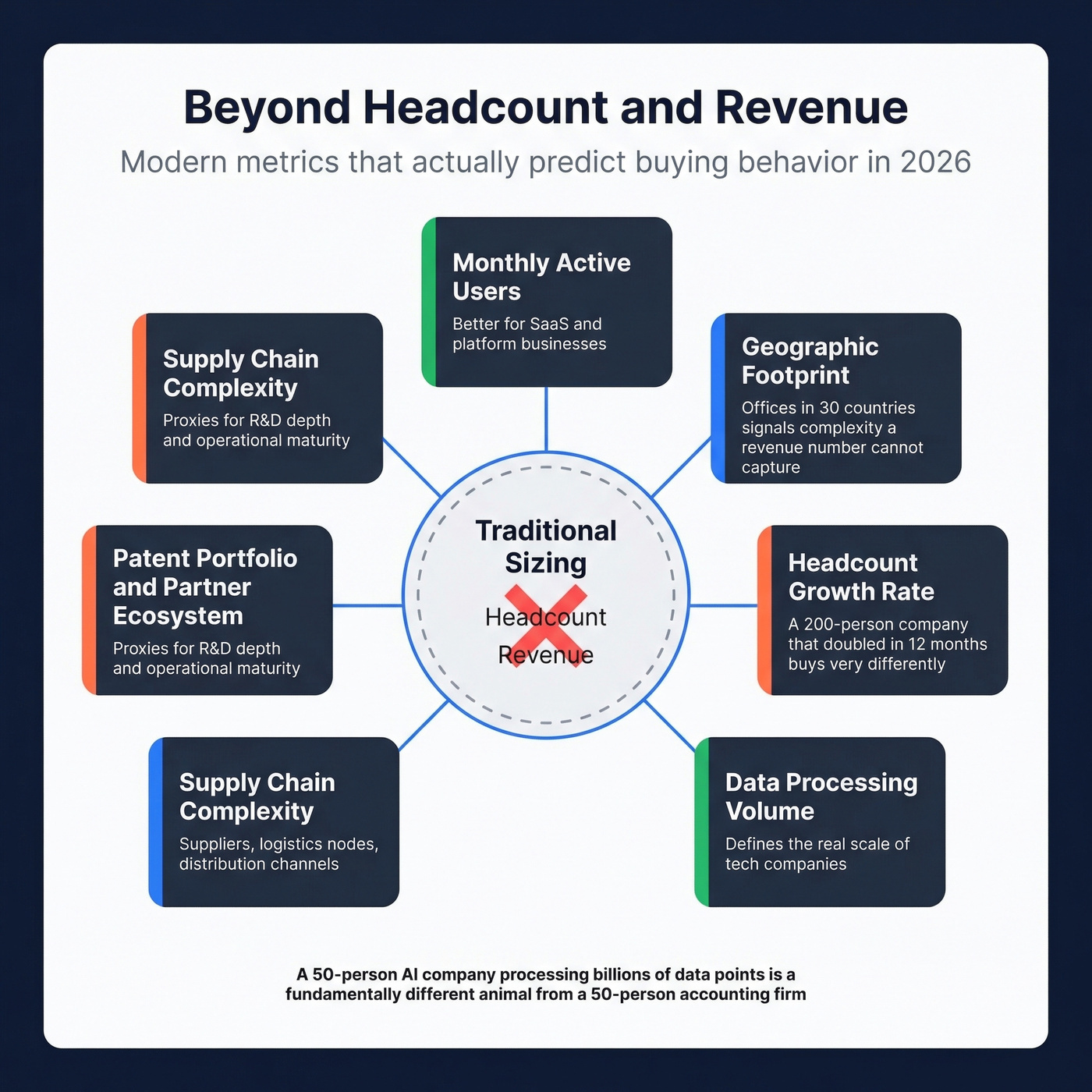
For platform and SaaS businesses, monthly active users or subscriber count often matters more than headcount. Geographic footprint - offices in 30 countries - signals complexity that a single revenue number can't capture. Patent portfolios proxy for R&D depth, and partner ecosystem size reveals operational maturity.
Other proxies worth tracking:
- Data processing volume - increasingly relevant for tech companies where infrastructure scale defines the business
- Supply chain complexity - number of suppliers, logistics nodes, and distribution channels
- Headcount growth rate - a 200-person company that doubled in 12 months behaves nothing like one that's been flat for five years
In our experience, the best B2B teams layer three or four of these signals on top of traditional size classifications to build segments that actually predict buying behavior. Let's be honest - if you're only filtering by employee count, you're working with a blunt instrument.
To operationalize these signals, many teams add technographics and intent layers on top of firmographics, then run it through B2B prospecting strategies that match their segment.
You just learned that company size definitions vary wildly across frameworks. Your outbound shouldn't suffer from the same ambiguity. Prospeo lets you filter by precise headcount ranges, department headcount, revenue bands, and even growth signals - then delivers 98% accurate emails and verified direct dials for every contact. At $0.01 per email, segmenting by company size finally matches the precision your sales motion needs.
Turn firmographic precision into pipeline with data that actually connects.
FAQ
How many employees is a small business?
The US SBA often uses up to 500 employees - and in some industries, up to around 1,500. The EU caps "small" at 49 staff. In B2B sales, "small" typically means under 100. Always clarify which framework applies to your context.
What's the difference between SMB and mid-market?
SMB generally means under 500 employees, though many teams cap it at 100. Mid-market is commonly 500-2,000 employees, and Gartner's "midsize" definition is $50M-$1B in revenue or 100-1,000 employees. The real distinction is buying complexity - committee decisions and longer cycles - not a specific headcount number.
Do SBA size standards change?
Yes. In August 2025, the SBA proposed raising revenue thresholds for 263 industries, which would reclassify over 11,000 firms as "small." The final rule is expected in 2026.
How do I find the SBA size standard for my industry?
Look up your six-digit NAICS code in the SBA's Table of Size Standards. Include affiliate revenue and employees in your calculation - not just your standalone entity. The SBA counts all revenue from all sources.
How can I filter prospects by company size?
Use a B2B data platform with firmographic filters. Prospeo lets you filter by headcount, revenue, headcount growth, department headcount, and 30+ attributes - so you can build prospect lists matching your exact ICP in minutes.