

SMB vs Mid-Market vs Enterprise: What Actually Separates Them
Your CRO just announced you're "moving upmarket." Pipeline targets doubled overnight, cycle times tripled, and nobody adjusted quota or headcount. Sound familiar? It's the most common GTM strategy mistake, and it starts with a fundamental misunderstanding of what separates SMB, mid-market, and enterprise selling.
Here's the thing: there's no universal definition for any of these segments. Segmentation isn't an objective truth - it's a GTM design choice. The companies that treat it that way outperform the ones chasing a bigger logo just because the ACV looks attractive.
Quick Comparison Table
SMB is a speed game. You're closing deals in 38-57 days, talking to one or two decision-makers, and winning on volume.
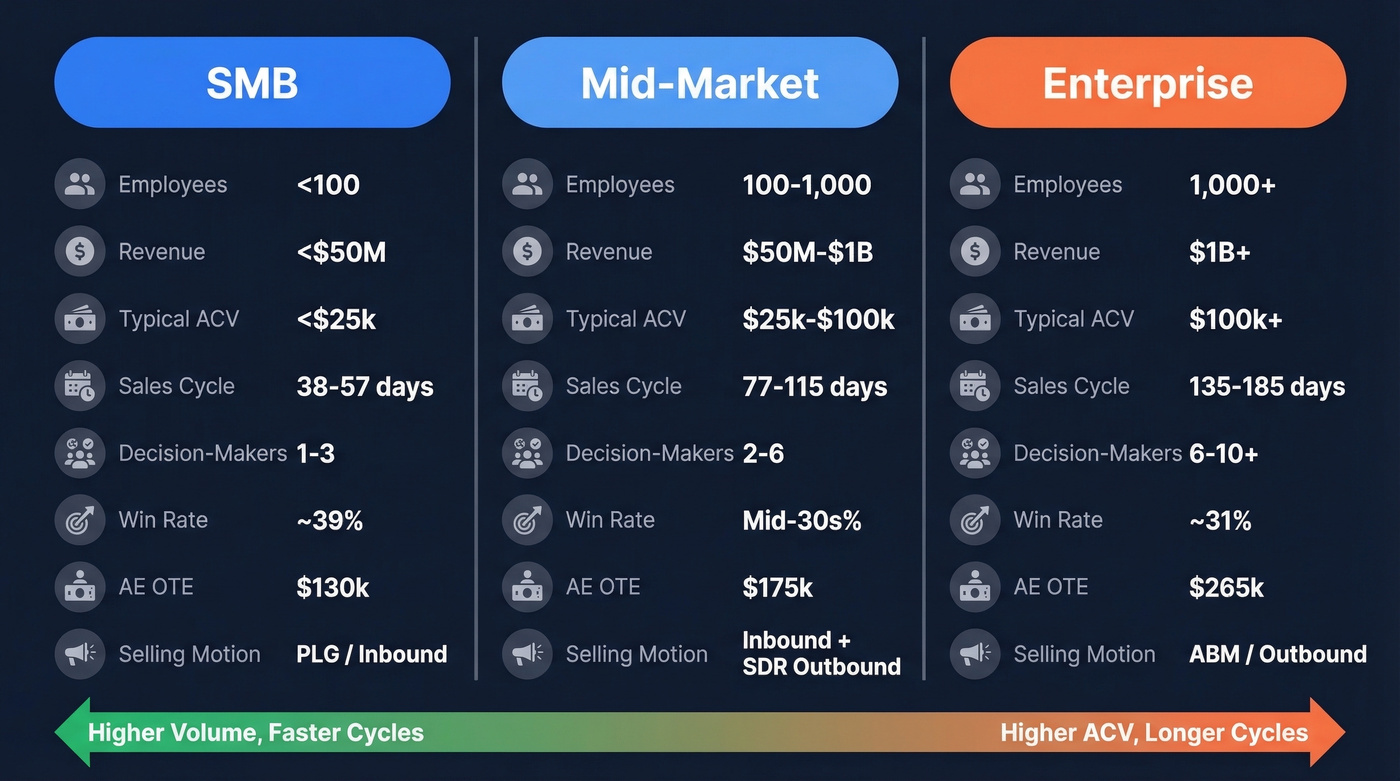
Mid-market is the segment most people underestimate - it carries enterprise-like complexity on SMB-like budgets, with 2-6 stakeholders and cycles that often stretch into the 3-6 month range depending on deal size and process. Enterprise is the long game: 135-185 day cycles, 6-10+ stakeholders, procurement gauntlets, and opportunity-to-close rates that drop to 31% or lower.
Don't start with employee count when picking a segment. Start with buying complexity - how many people touch the deal, how long the legal review takes, and whether procurement has its own approval workflow. That single lens tells you more than any headcount threshold ever will.
Revenue thresholds vary widely: GTMnow uses a $10M mid-market floor while Gartner uses $50M. The table below uses the more common Gartner-aligned ranges.
| Dimension | SMB | Mid-Market | Enterprise |
|---|---|---|---|
| Employees | <100 | 100-1,000 | 1,000+ |
| Revenue | <$50M | $50M-$1B | $1B+ |
| Typical ACV | <$25k | $25k-$100k | $100k+ |
| Sales Cycle | 38-57 days | 77-115 days | 135-185 days |
| Decision-Makers | 1-3 | 2-6 | 6-10+ |
| Opportunity-to-Close | ~39% | Mid-30s | ~31% |
| AE OTE (Median) | $130k | $175k | $265k |
| Quota Attainment | 44.8% | 43.9% | 40.9% |
| Selling Motion | PLG / inbound | Inbound + SDR outbound | ABM / outbound |
| Methodology | BANT | MEDDIC | MEDDICC/MEDDPICC |
| Churn Profile | High logo, low impact | Moderate logo, mixed impact | Low logo, high impact |
Why Nobody Agrees on Definitions
Ask five sales leaders to define "enterprise" and you'll get six answers. One seller on r/sales shared a perfect example: at their previous company (niche ERP software), enterprise meant 200+ employees. At their current company (HR software), SMB includes companies up to 1,000 employees, and "enterprise" doesn't start until 3,500+. Same seller, completely different thresholds.
The SBA's official size standards define "small" differently for every NAICS code - sometimes by employee count, sometimes by annual receipts averaged over five fiscal years. They even require you to include affiliates when calculating size, so a 50-person subsidiary of a 5,000-person parent doesn't count as small.
For practical GTM purposes, GTMnow's rule-of-thumb ranges are more useful: SMB under 100 employees and $5-10M revenue, mid-market at 101-500 employees and $10M-$1B revenue, large enterprise at 1,000+ employees and $1B+ revenue. They estimate nearly 200,000 mid-market companies in the U.S. alone, with roughly 350,000 enterprise companies worldwide. Some companies add a fourth tier below SMB - solopreneurs or "prosumers" - served entirely through self-service PLG motions.
One nuance we see constantly: many companies weight revenue more heavily than employee count, which creates edge cases where a 75-person fintech generating $200M in revenue looks mid-market by revenue but SMB by headcount. This is exactly why employee count is a lazy proxy.
The Three Segments Explained
SMB - Speed Wins
Use this if: You want fast feedback loops, high volume, and a motion where individual reps own the full cycle. SMB deals close in 38-57 days for companies with 1-50 employees. You're typically talking to one to three decision-makers - often the founder or a department head who can say yes without a committee. Opportunity-to-close rates hover around 39%, the highest of any segment.
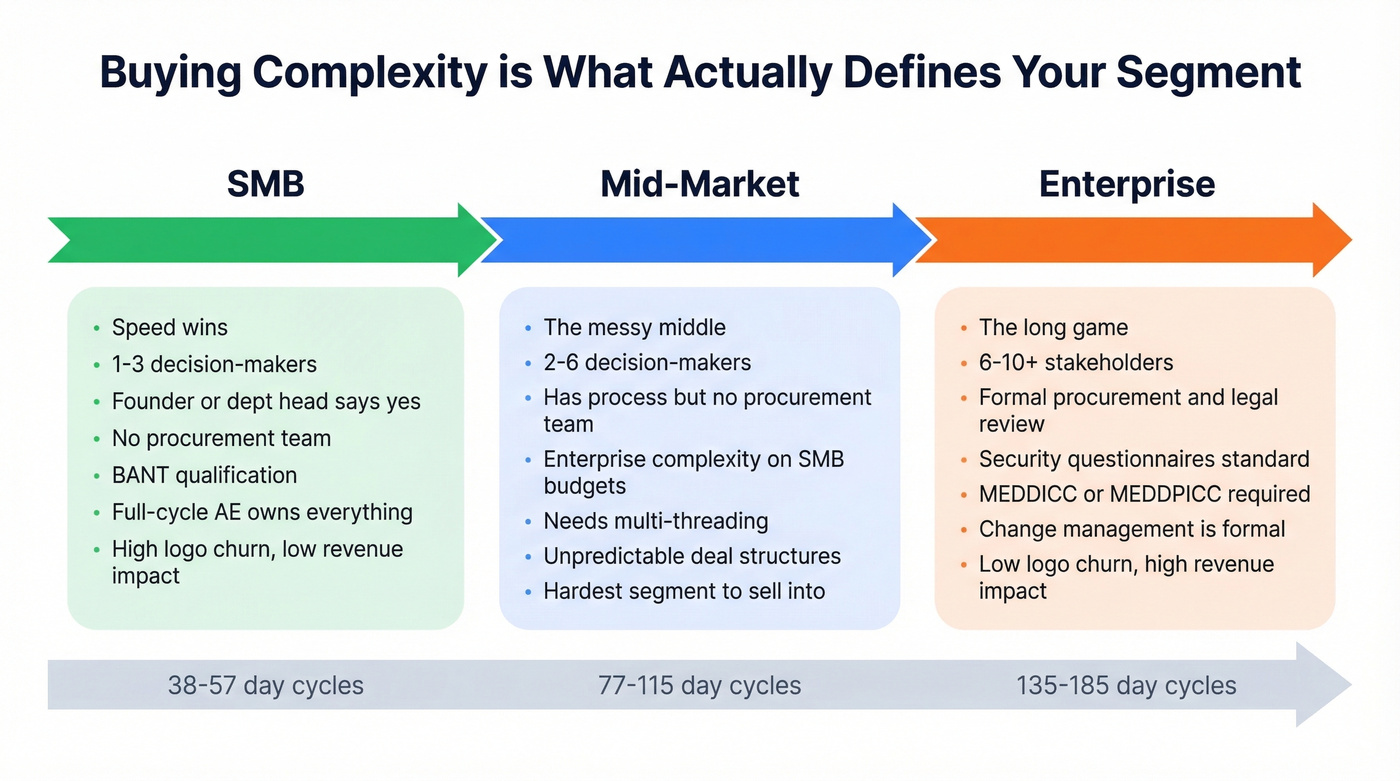
The ACV sits under $25k, which means you need volume to hit meaningful revenue targets. PLG and inbound-led motions dominate. Comp plans are simple - 20-30% commission rates, minimal accelerators, straightforward quota structures. Logo churn runs higher than other segments, but that's offset by a diversified customer base. Losing one SMB account doesn't crater your quarter.
Skip this if: You hate repetition. SMB selling is a numbers game - you're running the same discovery call fifteen times a week. If you need intellectual complexity in every deal, you'll burn out fast.
Mid-Market - The Messy Middle
Mid-market is the hardest segment to sell into. Not enterprise - mid-market. We'll die on this hill.
Mid-market deals carry enterprise-like complexity on SMB-like budgets. You're dealing with 2-6 decision-makers, sales cycles averaging 4-6 months, and ACV in the $25k-$100k range. That's long enough to require multi-threading and champion-building, but the deal size doesn't justify the dedicated SE, legal liaison, and CSM that enterprise deals get. You're doing enterprise work with SMB resources. The motions look similar on the surface, but the economics are completely different.
RevOps challenges are unique too. Mid-market systems need to prioritize velocity - lead routing, data hygiene, conversion reporting - while also supporting enough process to manage multi-stakeholder deals. Most CRMs aren't configured for this without heavy customization. If you're rebuilding your process, it helps to start from a clear Ideal Customer Profile and keep an eye on pipeline health as you add complexity.
Companies with 51-1,000 employees show cycle times of 77-115 days. The real defining characteristic isn't size - it's that these companies are big enough to have process but not big enough to have dedicated procurement teams. Every deal feels slightly different, and that unpredictability is what makes mid-market so demanding.
Enterprise - The Long Game
Enterprise selling is a different sport entirely. Cycles run 135-185 days for companies with 1,000-10,000+ employees. Harvard Business Review research puts the average buying group at about 7 people, and in practice it's often more - you're navigating champions, economic buyers, technical evaluators, procurement, legal, and sometimes a security review board.
The opportunity-to-close rate drops to around 31%. For deals above $100k ACV, win rates fell from roughly 26% to roughly 17% in late 2022/early 2023, and recovery has been slow. That means you need ~6x pipeline coverage just to have a reasonable shot at hitting quota.
A thread on r/sysadmin captures the cultural dimension well: in enterprise environments, "nothing belongs to you." Process, ownership boundaries, and specialization define everything. Change management is formal. Decisions move through committees. This isn't dysfunction - it's how 10,000-person organizations manage risk. But it means security questionnaires, legal redlines, and procurement workflows can add weeks or months to any deal you thought was close.
MEDDICC and MEDDPICC aren't optional here - they're survival tools. Multi-threading is mandatory. If your champion leaves and you haven't built relationships across the buying committee, the deal dies. If you want a deeper playbook, see our guide to enterprise B2B sales and how to map the economic buyer early.
Cycle Length and Win Rate Benchmarks
Here are cycle lengths broken down by prospect company size, drawn from Focus Digital's benchmark data:
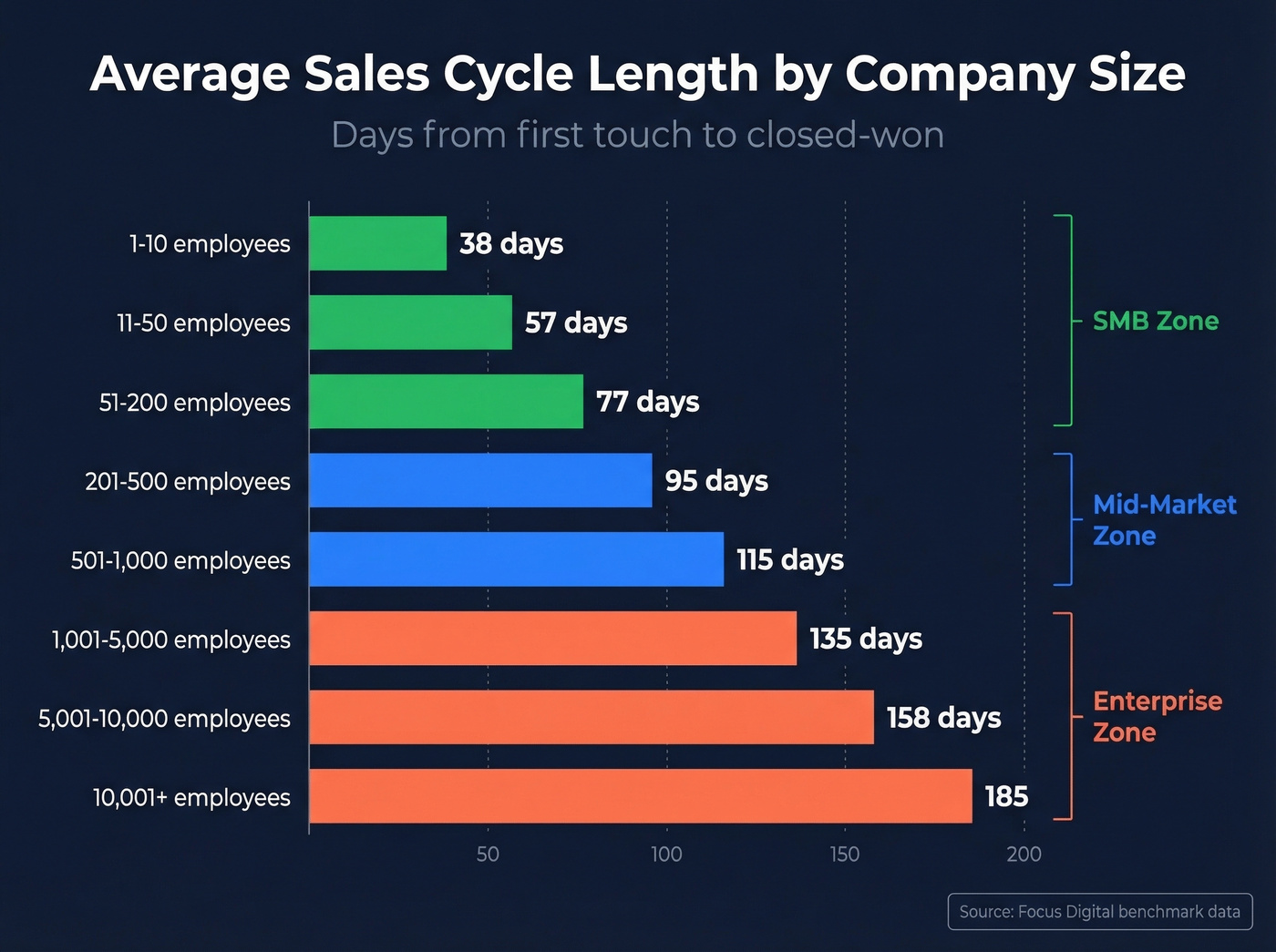
| Employee Count | Avg. Cycle (Days) |
|---|---|
| 1-10 | 38 |
| 11-50 | 57 |
| 51-200 | 77 |
| 201-500 | 95 |
| 501-1,000 | 115 |
| 1,001-5,000 | 135 |
| 5,001-10,000 | 158 |
| 10,001+ | 185 |
And by ACV:
| ACV Range | Avg. Cycle (Days) |
|---|---|
| <$1k | 25 |
| $1k-$5k | 40 |
| $5k-$10k | 55 |
| $10k-$50k | 75 |
| $50k-$100k | 120 |
| $100k-$250k | 170 |
| $250k-$500k | 220 |
| >$500k | 270 |
The overall B2B win rate sits around 21%. SMB opportunity-to-close rates run about 39%, while enterprise drops to 31%. For $100k+ ACV deals specifically, win rates fell to roughly 17% - more than four out of five enterprise opportunities die in the pipeline. The median private SaaS deal size is $26,265, which tells you most of the market is still mid-market and below.
The pipeline coverage implication is massive. If you're closing 39% of SMB deals, 3x coverage gets you there. At a 17% enterprise win rate, you need ~6x coverage - and each opportunity takes three to five times longer to generate. If you're trying to diagnose why coverage isn't translating into revenue, these sales pipeline challenges show up constantly in upmarket moves.

Mid-market deals fail when reps can't multi-thread past a single champion. Prospeo gives you 300M+ profiles with verified emails (98% accuracy) and 125M+ direct dials - so you reach every stakeholder in the buying committee, not just the one who replied first.
Stop single-threading deals that need five contacts to close.
How Your Segment Changes Org Design
The Bridge Group benchmarks show SaaS companies average 1 SDR per 2.6 AEs, but that ratio shifts dramatically by segment.
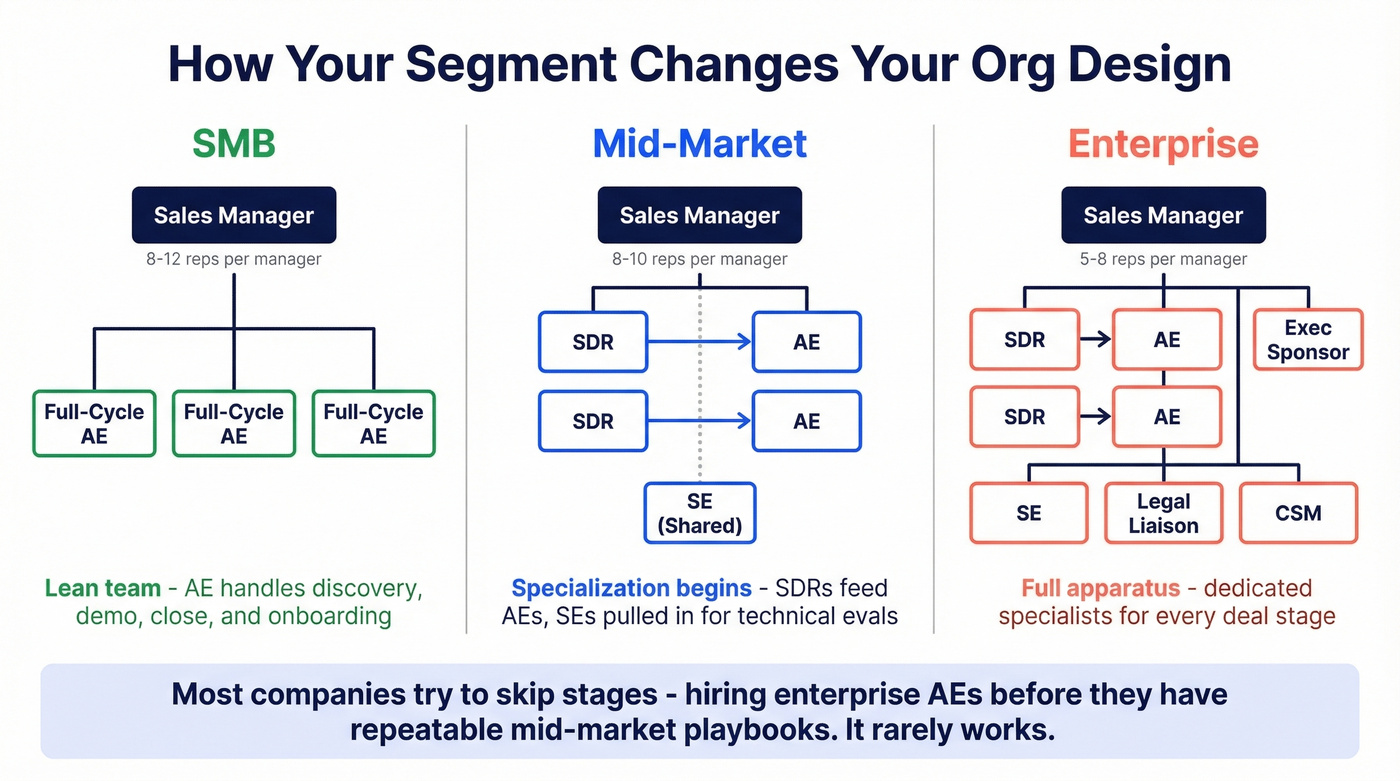
Manager span-of-control tells the story. Alexander Group data shows inside sales teams running 8-12 reps per manager, field sales in mid-market running 8-10, complex enterprise teams dropping to 5-8, and SDR teams at 10-12. The tighter enterprise ratio reflects the coaching intensity these deals demand - you can't manage ten reps who each have three six-month deals in flight without dropping balls.
SMB orgs are lean. One AE handles the full cycle - discovery, demo, close, maybe even some onboarding. Mid-market starts requiring specialization: dedicated SDRs feeding AEs, with SEs pulled in for technical evaluations. Enterprise demands the full apparatus - dedicated SEs, legal liaisons, CSMs, and often executive sponsors for strategic accounts. The difference between commercial and enterprise sales isn't just deal size. It's an entirely different operating model with different hiring profiles, different enablement needs, and different management cadences. If you're formalizing this, it helps to define sales operations metrics and align on sales execution so process doesn't become theater.
Most companies try to skip stages - hiring enterprise AEs before they have repeatable mid-market playbooks. It rarely works.
Compensation by Segment
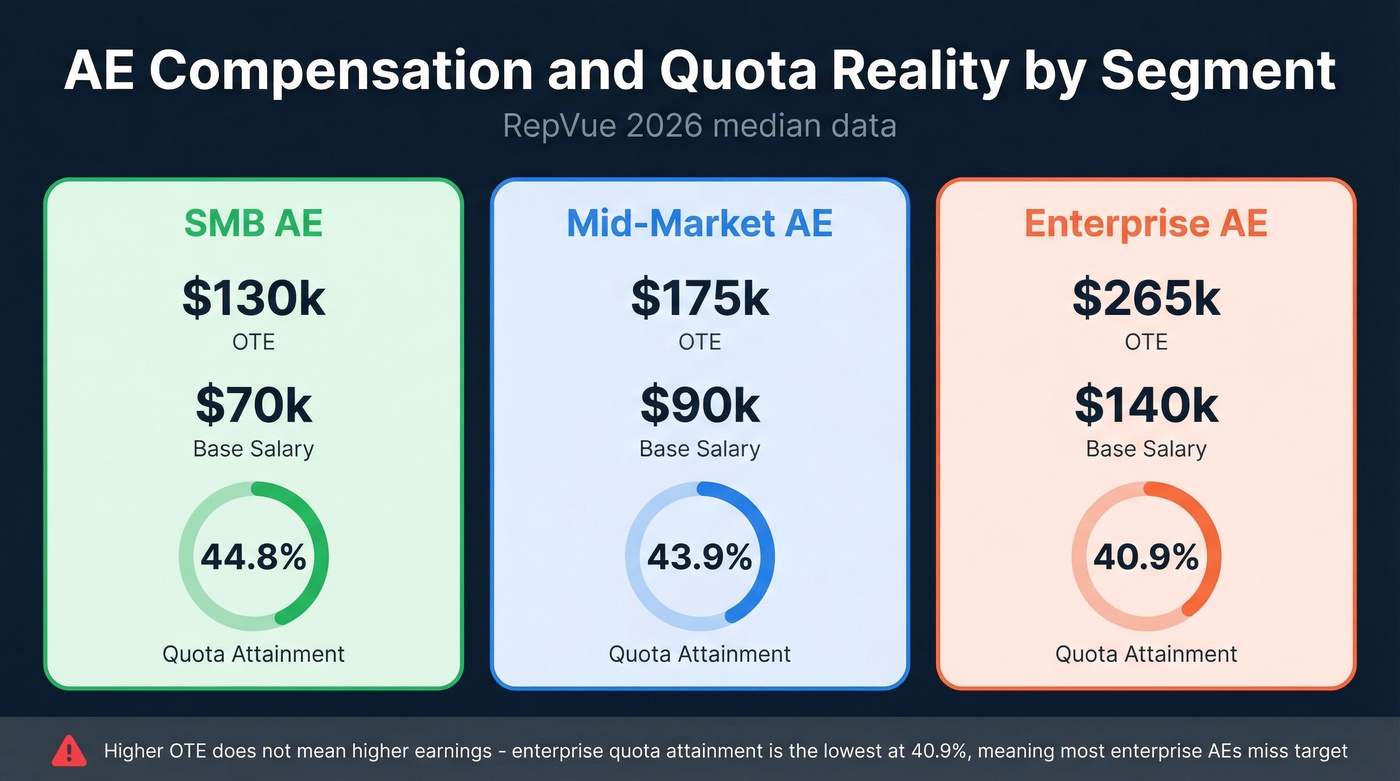
RepVue's 2026 data gives us real medians:
| Role | Base | OTE | Quota Attainment |
|---|---|---|---|
| SMB AE | $70k | $130k | 44.8% |
| Mid-Market AE | $90k | $175k | 43.9% |
| Enterprise AE | $135k | $265k | 40.9% |
| SDR | $60k | $85k | 57.3% |
Sybill's ranges corroborate: SMB AE OTE at $110k-$150k, mid-market at $140k-$200k, enterprise at $220k-$320k, and strategic accounts pushing $260k-$380k+. Many B2B companies follow a "10/10 model" where base and variable each represent roughly 10% of the rep's total quota. (If you need the math and terminology, here's a clean breakdown of OTE in sales.)
Enterprise OTE looks great on paper. Now run the math. Only 40.9% of enterprise reps hit quota. Ramp time is 6-9 months. You might carry a $0 pipeline for two quarters before you close anything. Meanwhile, 77% of sellers miss quota across the board - and that number skews worse at the enterprise level where comp plans layer in accelerators, MBOs, and multi-year deal structures that add complexity without adding certainty.
Let's be honest: mid-market is the sweet spot for most AEs. The OTE-to-attainment ratio is more favorable, ramp times are shorter, and you get enough deal complexity to build real skills without the 9-month drought cycles that enterprise brings. For SDRs eyeing the AE promotion, mid-market gives you the best blend of learning and earning.
Should You Move Upmarket?
Most companies move upmarket too early. A founder on r/SaaS shared a cautionary tale: sales cycles went from a few weeks to several months, every deal required multiple stakeholders, security questionnaires, and legal reviews, and the opportunity cost was brutal - the effort spent on one six-month enterprise deal could've closed dozens of SMB accounts. Worse, one enterprise customer became a huge revenue share. When they consolidated vendors, the impact was severe.
Here's a simple readiness test. Score yourself on these four criteria - one point each:
- Win rates justify longer cycles. Your current-segment close rate is above 35%, giving you a stable base to fund longer enterprise experiments.
- Product maturity supports enterprise requirements. You have SSO, audit logs, SLAs, and at least SOC 2 in progress.
- Team structure absorbs 4-6 month cycles. You have enough pipeline at your current segment that pulling reps into longer deals won't starve revenue.
- Repeatable playbooks exist at your current segment. You've documented what works, not just gotten lucky with a few deals.
Score 3 or higher? You're ready to test upmarket. Below 3? Shore up your foundation first. A $200k deal that takes 9 months and a 17% win rate isn't automatically better than twenty $10k deals that close in 6 weeks at a 39% clip.
Data Quality Across Segments
Your data requirements shift fundamentally across segments. SMB motions are volume plays - you're sending hundreds of emails per day, and bad data burns your domain reputation fast. We've seen teams wreck their deliverability for months after a single week of high bounce rates. Enterprise motions are precision plays - fewer contacts, but every bounced email to a C-suite buyer is a burned impression you can't get back.
Mid-market needs both: enough velocity to fill the pipeline and enough accuracy to protect your sender reputation. In our experience, this is where most teams struggle because they're toggling between three different tools just to build a clean list. If you're tightening this up, start with the basics of email deliverability and track your email bounce rate before scaling volume.
Prospeo handles both ends of this spectrum. At 98% email accuracy with a 7-day refresh cycle, you're not sending to stale data regardless of volume. The 30+ search filters - including buyer intent, technographics, and headcount growth - let you build segment-specific lists without the tool-juggling problem. If you're comparing vendors, these data enrichment services and sales prospecting databases roundups can help frame tradeoffs.

Enterprise pipeline needs 6x coverage, and bad data burns cycles you can't afford on 135-day deals. Prospeo's 7-day data refresh and 5-step verification keep your contacts current - at $0.01/email instead of $1 with ZoomInfo.
Enterprise data quality without the enterprise contract.
FAQ
What's the difference between mid-market and enterprise?
Mid-market companies typically have 100-1,000 employees and $50M-$1B in revenue, while enterprise starts above 1,000 employees and $1B+ revenue. The real difference is buying complexity - mid-market deals involve 2-6 decision-makers with 77-115 day cycles, while enterprise requires navigating 6-10+ stakeholders, formal procurement, and legal reviews stretching 135-185+ days.
How long is the average enterprise sales cycle?
Enterprise sales cycles range from 135 to 185+ days depending on company size. For deals above $100k ACV, expect 170-270 days. SMB cycles average 38-57 days - roughly a quarter of the enterprise timeline - which is why pipeline coverage requirements jump from 3x to 6x.
Do enterprise reps actually earn more?
Enterprise AEs earn a median OTE of $265k versus $130k for SMB AEs. But only 40.9% of enterprise reps hit quota compared to 44.8% in SMB. Factor in 6-9 month ramp times and the higher ceiling narrows significantly on a risk-adjusted basis. Mid-market ($175k OTE, 43.9% attainment) often delivers the best earnings-to-effort ratio.
What's the biggest mistake when moving upmarket?
Moving before you've built repeatable playbooks at your current segment. Enterprise deals demand specialized resources - dedicated SEs, legal support, 6-9 month ramp times - and if your current motion isn't generating predictable revenue, you won't survive enterprise cycles with 17% win rates. Score yourself on the four-point readiness test above before committing resources.