

Competitive Marketing Intelligence: The Practitioner's Guide for 2026
A RevOps lead we know ran a three-tool CI bake-off last quarter. The platform that "monitored everything" generated 400 Slack alerts a week - and nobody read them. The team that won more deals? They tracked three competitors, kept battlecards updated monthly, and made sure reps could actually reach decision-makers at competitive accounts. That's the gap between having competitive marketing intelligence and using it.
68% of B2B sales deals involve at least one direct competitor. Yet the average sales team rates its own competitive preparedness a 3.8 out of 10. The problem isn't a lack of data - it's a lack of structure, prioritization, and last-mile execution.
What You Need (Quick Version)
You don't need a $40K platform to start. Here's what works at each budget tier:
- Free stack: Meta Ad Library + Google Ads Transparency Center + Google Alerts + Feedly + a spreadsheet. Cost: $0. This covers ad monitoring, news tracking, and basic content analysis.
- SMB stack (under 50 people): Semrush ($139/mo) for digital competitive analysis + Prospeo for verified contact data on competitive accounts + Feedly ($6/mo) for news monitoring. Total: ~$150/mo.
- Enterprise stack: Crayon (~$15K-$100K+/yr; median ~$28,750/yr) or Klue (~$20K-$40K/yr) for a dedicated CI platform + Semrush + Sprout Social ($199/user/mo) for social listening + your enrichment tool of choice for accounts your program flags.
Starting lean is better than buying shelfware. Pick the tier that matches your team size and move.
What Is CMI, Exactly?
Competitive marketing intelligence is the systematic collection and analysis of publicly available information about competitors' marketing activities - their ad spend, messaging, content strategy, pricing moves, and positioning shifts. It's a subset of the broader competitive intelligence discipline, focused specifically on what competitors are doing to win customers.
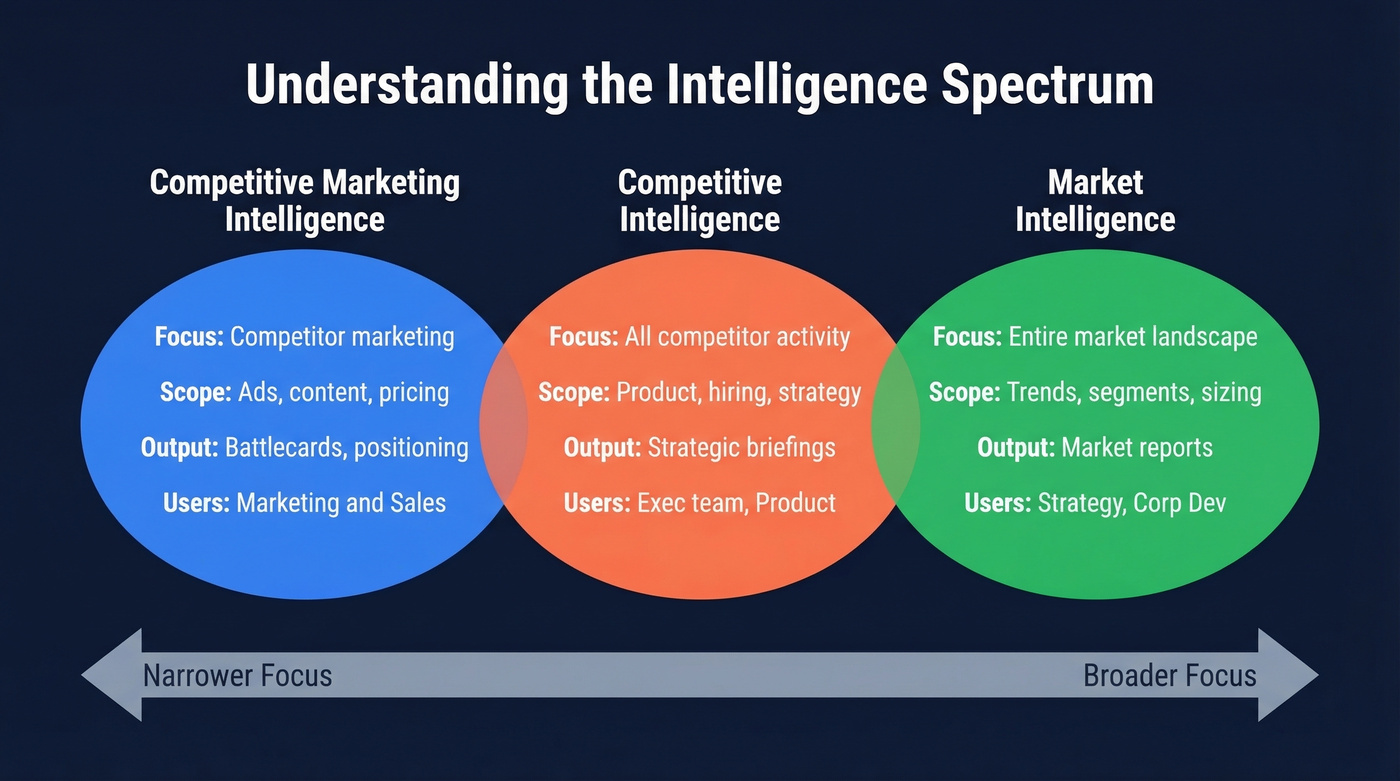
People confuse it with three related concepts:
| CMI | Competitive Intelligence | Market Intelligence | |
|---|---|---|---|
| Focus | Competitor marketing | All competitor activity | Entire market landscape |
| Scope | Ads, content, pricing | Product, hiring, strategy | Trends, segments, sizing |
| Output | Battlecards, positioning | Strategic briefings | Market reports |
| Users | Marketing, sales | Exec team, product | Strategy, corp dev |
Here's a contrarian take that'll save you months of wasted effort: track three competitors, not ten. Most programs collapse under their own ambition. You don't need a dossier on every company in your space - just deep, actionable intelligence on the two or three competitors your reps encounter most often in deals, plus one emerging threat.
Why CMI Matters in 2026
74% of technology and service providers identified competitive and market intelligence as a top priority within the next 12 months, per a Gartner Tech Marketer Role Survey. That's not a nice-to-have. It's a board-level priority.
The competitive intelligence tools market is projected to reach $1.46B by 2030. By 2026, 40% of technology and service providers are expected to use commercial CI tools, up from roughly 10% just a few years ago. Teams without a structured intelligence practice are already falling behind in competitive deals.
How to Build a CMI Program
Six steps. None require a $30K platform to start.
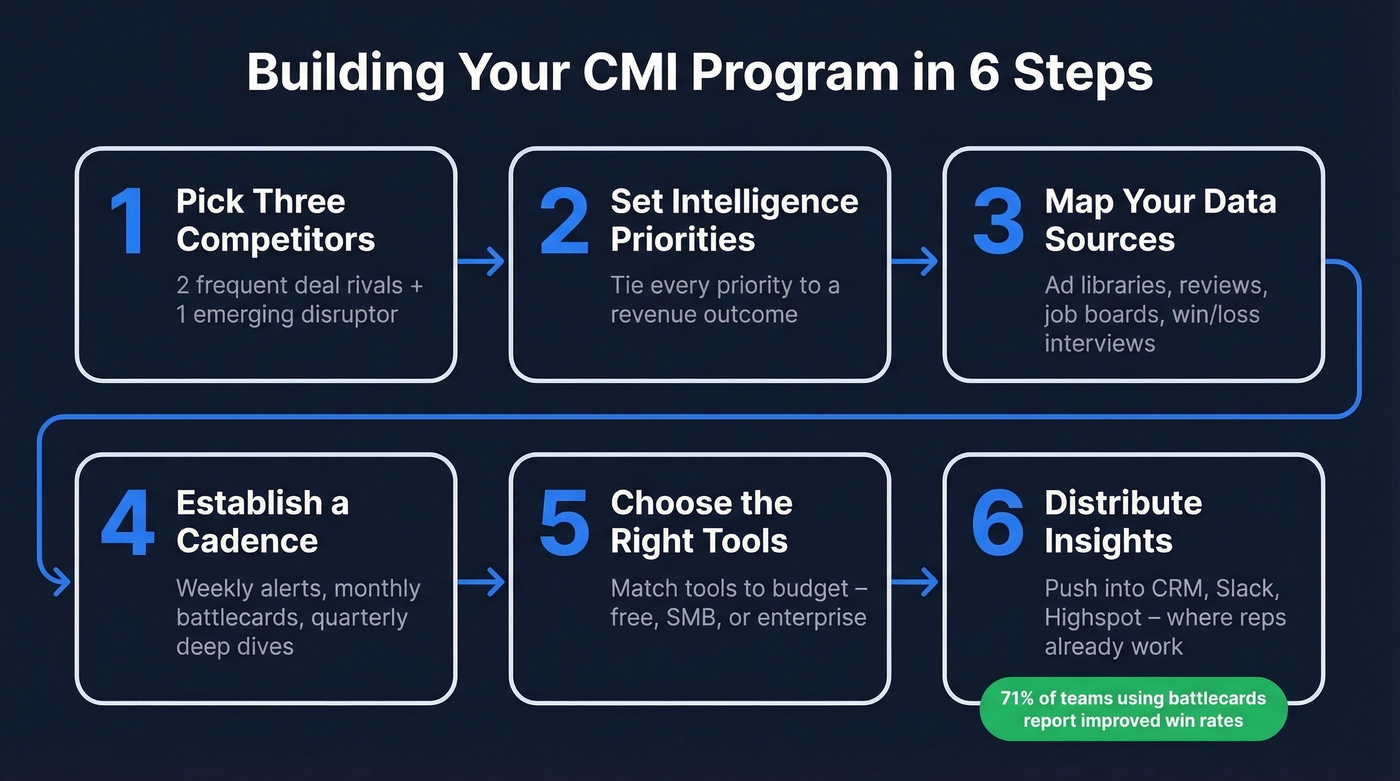
Pick Three Competitors
Identify the two competitors your sales team encounters most frequently in deals, plus one emerging disruptor. Resist the urge to track everyone. Depth beats breadth - you want to know their messaging cold, not have surface-level awareness of a dozen players.
Set Intelligence Priorities
What do you actually need to know? Pricing changes, new feature launches, ad spend shifts, hiring patterns, and positioning pivots are the usual starting points. Align these with your sales team's biggest objection-handling gaps. If reps keep losing on price, pricing intelligence is priority one - everything else can wait. (If price comes up constantly, build a repeatable system for overcoming the price objection.)
Map Your Data Sources
Competitor websites, ad libraries (Meta, Google), job boards, G2 and Capterra reviews, public filings, press releases, social media, and technographic data showing what tools your competitors' customers use. Job postings are underrated - a competitor hiring five "enterprise AEs" tells you more about their strategy than any press release ever will.
Win/loss interviews are one of the richest CI sources. They reveal competitor positioning, pricing objections, and messaging gaps all at once. If you do nothing else, do these.
Establish a Cadence
Weekly monitoring for alerts and ad changes. Monthly battlecard refreshes. Quarterly deep-dive win/loss analysis and strategic reviews.
Without a cadence, CI becomes a fire drill - someone asks "what's [competitor] doing?" and you scramble for two days. A rhythm prevents that.
Choose the Right Tools
Match tools to your budget tier from the quick-version section above, or see the full tools breakdown below. The intelligence is only valuable if you can act on it, so make sure your stack includes a way to actually reach decision-makers at the accounts you flag. (If you're rationalizing tool sprawl, start with a lean RevOps tech stack.)
Distribute Insights
Intelligence that lives in a Google Doc nobody opens is worthless. Push battlecards into Salesforce, Slack, or Highspot - wherever reps already work. 71% of companies using battlecards report improved win rates. The distribution mechanism matters as much as the intelligence itself.

Competitive intelligence only matters if you can act on it. Prospeo turns every account your CI program flags into a reachable contact list - 300M+ profiles, 98% email accuracy, 125M+ verified mobiles. At $0.01/email, your entire competitive account strategy costs less than one Crayon alert.
Stop monitoring competitors you can't actually reach.
Why Most CMI Programs Fail
Look, a Klue survey of 300+ revenue leaders found that nearly half of reps don't know who they're competing with until they're in negotiation. 13% don't know even after the deal closes. That's staggering.
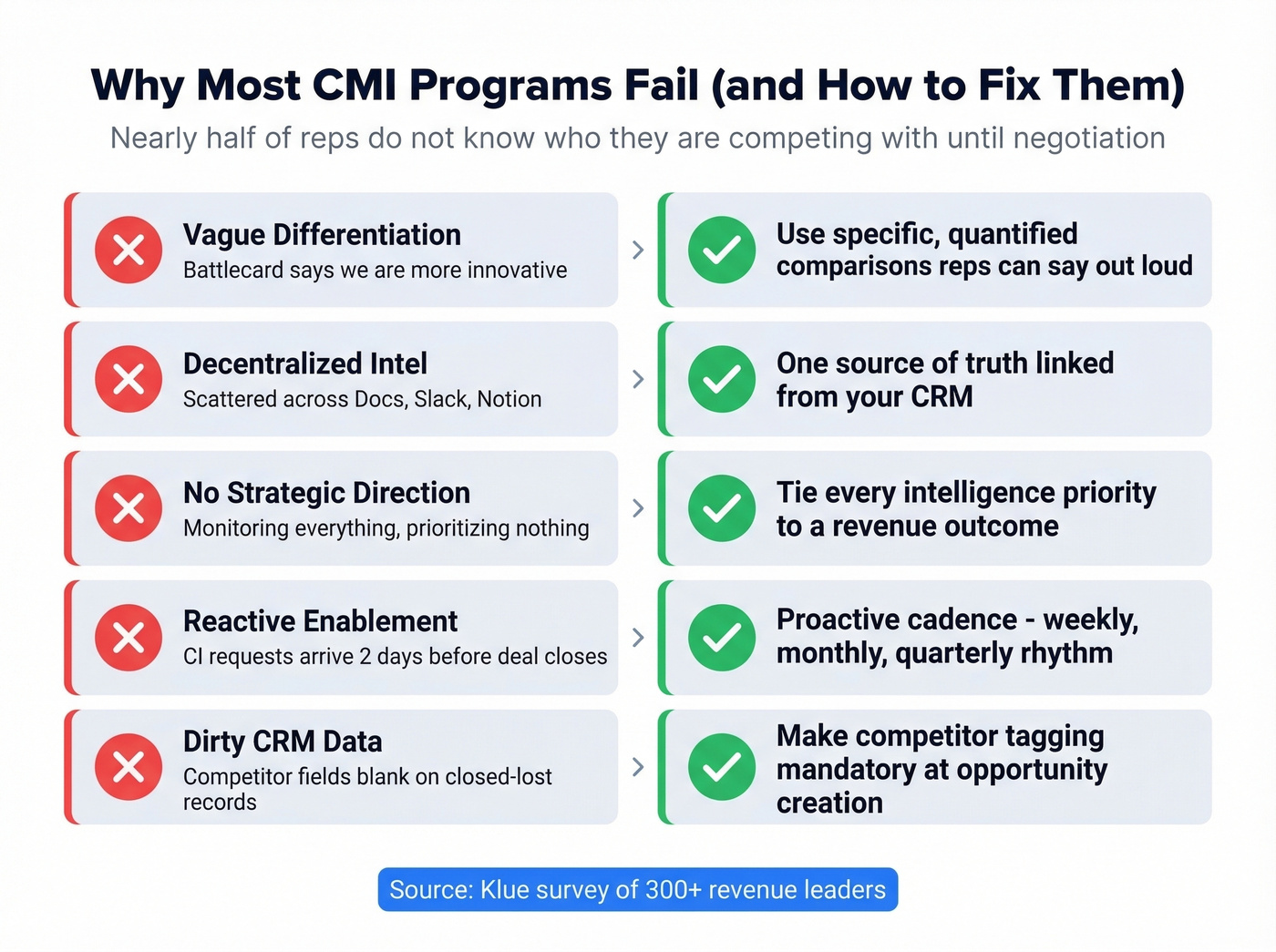
Five failure modes we see most often:
- Vague differentiation. Your battlecard says "we're more innovative." That helps nobody. Fix: use specific, quantified comparisons reps can say out loud.
- Decentralized intel. Battlecards scattered across Google Docs, Slack threads, and someone's Notion. Fix: one source of truth, linked from your CRM.
- No strategic direction. You're monitoring everything and prioritizing nothing. Fix: tie every intelligence priority to a revenue outcome.
- Reactive enablement. CI requests arrive two days before a deal closes. Fix: the cadence system from step four - proactive beats reactive every time.
- Dirty CRM data. You can't do win/loss analysis if competitor fields are blank across a big chunk of closed-lost records. Fix: make competitor tagging mandatory at opportunity creation, not close. (If your process is messy, CRM automation software can enforce the rules.)
Tools and What They Cost
| Tool | Best For | Starting Price |
|---|---|---|
| Crayon | Real-time CI + battlecards | ~$15K-$100K+/yr |
| Klue | Sales competitive enablement | ~$20K-$40K/yr |
| Semrush | SEO + digital CI | $139/mo |
| Prospeo | Verified contact data | Free; ~$0.01/email |
| SpyFu | PPC competitor research | $39/mo |
| Feedly | News + content monitoring | $6/mo |
| Sprout Social | Social competitive analysis | $199/user/mo |
| Kompyte | Budget CI platform | $300/yr |
| Visualping | Website change detection | Free + paid plans |
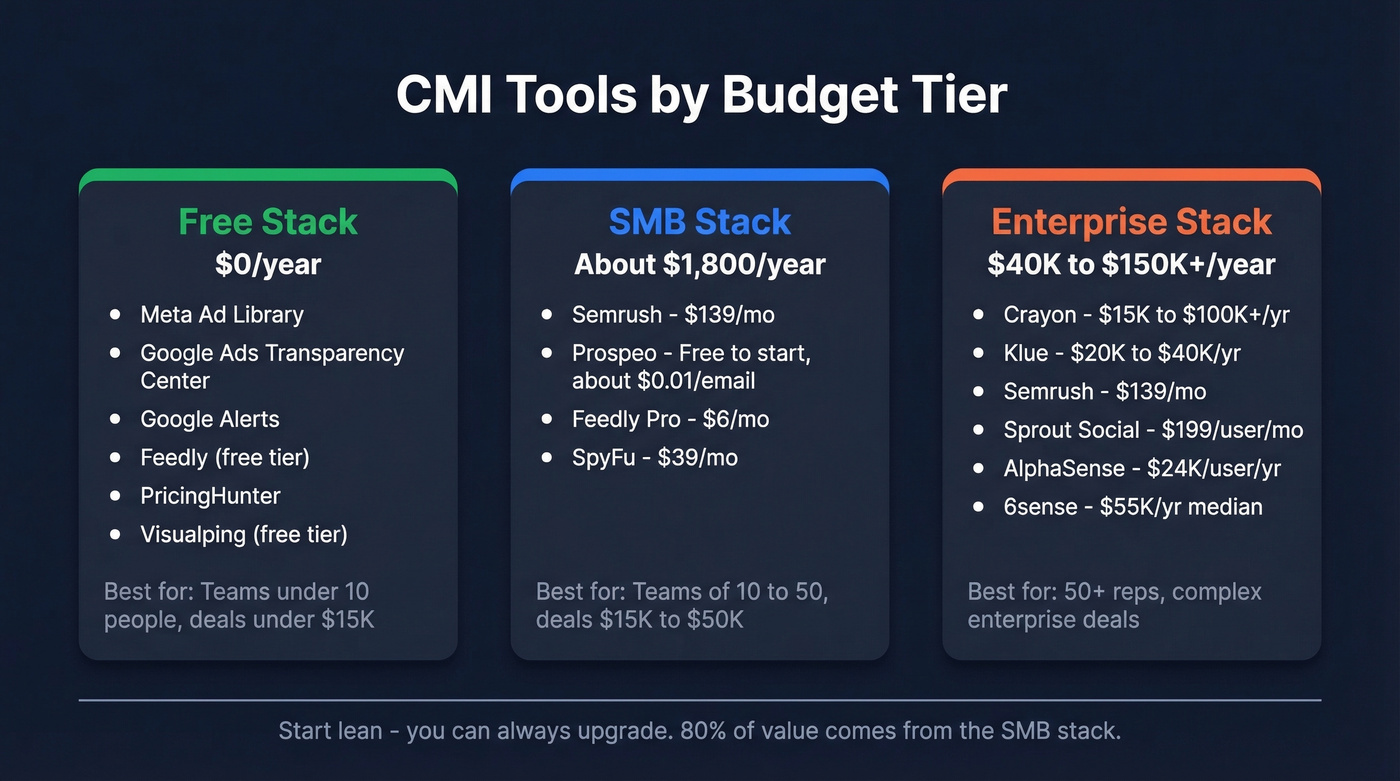
Enterprise teams sometimes layer in AlphaSense (~$24K/user/yr) for deep market research or 6sense (~$55K/yr median) for intent-driven competitive targeting. These are worth evaluating if your average deal size justifies the spend.
Dedicated CI Platforms
Crayon is a leading platform for real-time competitor monitoring. It tracks website changes, messaging shifts, and product updates, then surfaces them with importance scoring. The battlecard creation workflow is genuinely good - templates, Salesforce/Slack/Highspot distribution, and engagement analytics so you know if reps actually read them.
The median contract runs $28,750/year based on 90 purchases tracked by Vendr, with enterprise deployments pushing past $100K. Capterra reviews flag internal adoption as a common hurdle - getting field teams to contribute intel back into the system. Budget for change management, not just the license.

Klue occupies similar territory with stronger emphasis on sales enablement workflows. Pricing runs ~$20K-$40K/yr. If your primary use case is arming reps with competitive talking points rather than broad market monitoring, Klue edges ahead. (If you're formalizing enablement, use a real sales enablement planning process.)
Digital and SEO Analysis
Semrush is the workhorse for digital competitive analysis - organic rankings, paid ad spend estimates, content gap analysis, and backlink profiles. At $139/mo, it's the best value in the digital CI category. We've used it to reverse-engineer competitors' content strategies in a single afternoon.
SpyFu focuses specifically on PPC competitor research. At $39/mo, it's a no-brainer add-on if paid search is a major channel for your competitors.
News and Social Monitoring
Feedly at $6/mo is absurdly good for the price. Set up feeds for competitor blogs, press mentions, and industry publications. It won't replace a dedicated CI platform, but it covers 80% of the "what are they publishing?" question.
Sprout Social ($199/user/mo) with Listening adds social monitoring - competitor mention tracking, sentiment analysis, and share-of-voice metrics across social channels. It's expensive for what it does, but nothing else combines social CI with publishing tools this cleanly.
Free Tools Worth Using
Meta Ad Library lets you see every ad a competitor currently runs on Facebook and Instagram - creative, copy, start date, and links. Google Ads Transparency Center does the same for Google. Google Alerts is crude but effective for monitoring competitor mentions and press coverage. PricingHunter tracks competitor pricing changes on product pages. Combined, these cover a surprising amount of ground at zero cost.
Let's be honest: if your average deal is under $15K, you probably don't need Crayon or Klue. The free stack plus Semrush will get you 80% of the way there. Save the $20K-$40K/yr for headcount or ad spend. Dedicated CI platforms earn their keep when you have 50+ reps who need consistent, always-current battlecards - not when you have a team of eight.

How to Build a CMI Report
A useful CI report follows a consistent structure. Start with an executive summary - two to three sentences on the biggest competitive shifts this period, nothing more. Follow it with one-page competitor profiles covering current positioning, recent moves, strengths, and vulnerabilities.
Include a tight SWOT per competitor with four bullets per quadrant max, a section on messaging and positioning shifts captured from website copy, ad creative, or sales deck language, and any public pricing moves or discounting patterns from win/loss data. Close with specific recommendations for sales, marketing, and product based on the intelligence.
Monthly refreshes keep battlecards current. Quarterly deep-dives give leadership the strategic view. Anything less frequent and the intelligence goes stale before anyone acts on it.
Ethics and Legal Boundaries
Competitive intelligence has a clear ethical framework. The SCIP Code of Ethics lays out the principles:
Do:
- Comply with all applicable laws, domestic and international
- Accurately disclose your identity and organization before interviews
- Avoid conflicts of interest
- Use only publicly available or voluntarily shared information
Don't:
- Post fake job listings to bait competitor employees into sharing information
- Apply to competitor jobs with no intention of accepting
- Misrepresent yourself to gain access to proprietary information
- Pressure ex-competitor employees for confidential details - explicitly tell them you don't want protected information from their prior employer
The line between CI and industrial espionage is simple: CI uses openly available data. Espionage involves obtaining protected confidential information through illegal means. If you're ever unsure whether a tactic crosses the line, it probably does. (For sales-side guardrails, align with your B2B compliance checklist.)
AI and the Future of CMI
AI adoption within CI teams jumped 76% year-over-year, with 60% of CI professionals now using AI tools daily. CI team sizes grew 24% YoY - this discipline is getting more investment, not less.
The biggest shift is conversational interfaces replacing static dashboards. Instead of digging through a Crayon dashboard, you'll ask "what did [competitor] change on their pricing page this month?" and get a synthesized answer. Roughly 90% of competitive data is unstructured - press releases, social posts, job listings, review sites - and AI is finally good enough to make sense of it at scale.
As go-to-market intelligence matures, expect these AI layers to connect CI insights directly to outbound workflows - flagging accounts, enriching contacts, and triggering sequences without manual handoffs. The teams that win won't just know more about their competitors; they'll act on that knowledge faster. (If you're building this motion, start with a clean sales outreach strategy.)
Your battlecards are updated. Your win/loss analysis is done. But if reps can't reach decision-makers at competitive accounts, none of it matters. Prospeo gives you verified emails and direct dials on the accounts your CI program surfaces - refreshed every 7 days, not 6 weeks.
Close the last mile between intelligence and pipeline.
FAQ
What's the difference between competitive intelligence and competitive marketing intelligence?
Competitive intelligence covers all business functions - product roadmaps, hiring, financials, M&A. Competitive marketing intelligence focuses specifically on marketing activities: ad spend, messaging, content strategy, pricing, and positioning. CMI is a subset of CI, tailored for marketing and sales teams who need to win against specific competitors.
What are the best free tools for competitor monitoring?
Meta Ad Library, Google Ads Transparency Center, Google Alerts, and Feedly's free tier cover ad monitoring, news tracking, and content analysis at zero cost. Add Visualping for website change detection and you've got a solid foundation before spending a dollar.
How often should you update battlecards?
Weekly for monitoring alerts and ad changes. Monthly for battlecard refreshes and messaging analysis. Quarterly for deep-dive win/loss reviews. Skip the cadence and intelligence goes stale - 71% of companies using regularly updated battlecards report improved win rates.
How do you measure ROI on a CMI program?
Track competitive win rate, time-to-close on competitive deals, battlecard adoption, and influenced revenue. Crayon highlights outcomes like a 22% increase in competitive win rate and $6M+ in influenced revenue in under a year. Even a 10-15% win-rate lift pays for most CI tools many times over.
How does CMI translate into outbound pipeline?
Identify accounts using a competitor's product or showing buying intent through your CI monitoring, then enrich those accounts with verified emails and direct dials. Layer competitive signals with in-market buyer behavior using intent data so intelligence connects directly to outbound sequences instead of sitting in a report nobody reads.