

Competitive Selling Strategies: The Field-Ready Playbook
You send pricing on a Thursday. The buyer goes silent for ten days. Then you spot the competitor's demo still on their calendar. 68% of sales opportunities are competitive, the average B2B win rate sits around ~21%, and only 43.5% of reps hit quota. Without deliberate competitive selling strategies, you're leaving pipeline on the table.
Most competitive selling advice teaches mindset. This playbook gives you the moves - a battlecard template, talk tracks, and a win/loss loop that feeds itself.
What You Need This Week
- One-screen battlecard for your top 2-3 competitors. If it doesn't fit on one screen, reps won't use it.
- The ARR talk track (Address, Reframe, Redirect) plus 3 landmine questions per competitor.
- Win/loss segmentation by competitor, deal size, and persona - a pattern-finding habit, not a spreadsheet dump.
Competitive Deals Are Won Before the Call
The reps who win head-to-head deals aren't improvising when a competitor gets name-dropped. They've already rehearsed the pivot. That preparation lives in a battlecard - but not the 10-page wiki nobody reads.
Crayon's ABC rule nails the design principle: Accuracy, Brevity, Consistency. If a battlecard isn't actionable in under 10 seconds, reps won't touch it. We've watched teams significantly improve competitive win rates just by switching from bloated wikis to the one-screen format below.
The One-Screen Battlecard
Every card needs four blocks:
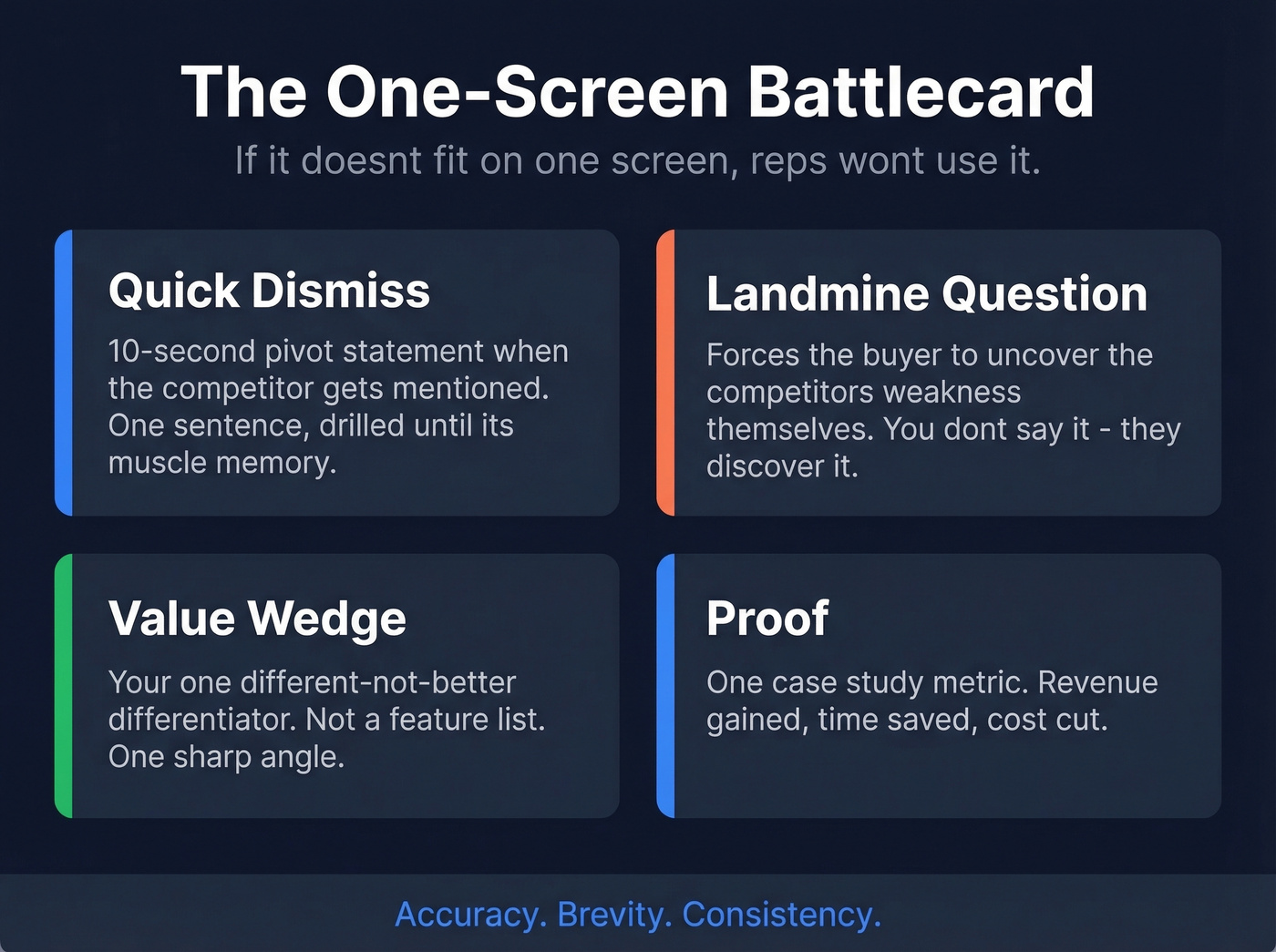
- Quick Dismiss - A 10-second pivot statement when the competitor gets mentioned. One sentence, drilled until it's muscle memory.
- Landmine Question - Forces the buyer to uncover the competitor's weakness themselves. You don't say it; they discover it.
- Value Wedge - Your one "different, not better" differentiator. Not a feature list. One sharp angle.
- Proof - One case study metric. Revenue gained, time saved, cost cut.
Selling Against Competitors on Live Calls
ARR Framework (Address, Reframe, Redirect)
ARR Framework (Address, Reframe, Redirect) gives you a repeatable structure, but the response depends on the claim type:
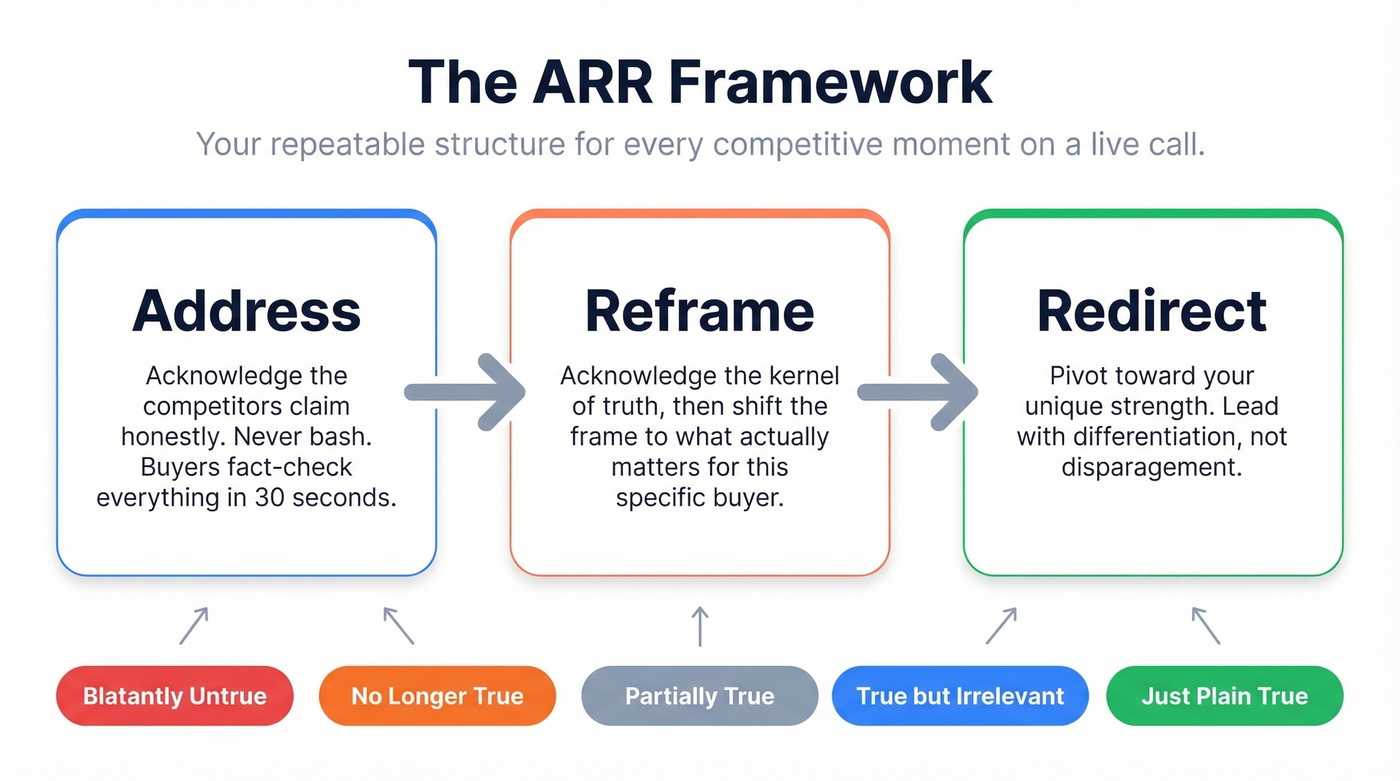
| Claim Type | Response Strategy |
|---|---|
| Blatantly untrue | Address directly with third-party proof |
| No longer true | Address; use it to show competitor's outdated info |
| Partially true | Reframe - acknowledge the kernel, redirect to your edge |
| True but irrelevant | Reframe back to what actually matters for this buyer |
| Just plain true | Redirect toward your strengths; don't dwell |
Here's the thing about trust: buyers can fact-check everything in 30 seconds. Never bash. If a competitor is genuinely strong somewhere, say so - then pivot. A pro move is asking the buyer's permission before you compare. "Would it be helpful if I walked through how we differ from [competitor]?" That single question reduces perceived aggressiveness and builds credibility fast.
Talk Tracks You Can Use Today
Competitor Displacement (Validate, Isolate, Reframe): "[Competitor] is a solid tool for [X]. The reason customers have moved to us is [switching trigger - usually a gap]. How are you currently handling [that gap]?"
This follows a Validate, Isolate, Reframe sequence: validate the buyer's current choice, isolate the gap that triggers switching, then reframe the conversation around your strength. Selling against competitors this way feels consultative rather than combative.
Price Isolator: "If price wasn't a factor at all, is this the solution you'd choose to solve [specific problem]?"
If they say yes, you've got a negotiation. If they hesitate, price isn't the real objection. (If you need a tighter negotiation baseline, set an anchor before you talk discounts.)
Timing Reframe: "What's going to change between now and next quarter that makes this a better time?" Follow with the cost-of-waiting calculation: monthly pipeline leaked x average deal size x close rate = what inaction costs per month. A common theme in r/sales threads is that buyers ghost after pricing when reps don't anchor value first - and that tracks with what we've seen across dozens of deal reviews.
Champion Enablement: When your champion needs to sell internally, co-create a one-page summary they can bring to the leadership meeting. Don't make them reconstruct your pitch from memory. Arm them with the exact language and metrics that close.
If you want more ready-to-steal scripts, keep a swipe file of talk tracks and update it after every competitive loss.

Your battlecard is only as good as the data behind it. Prospeo gives you 98% verified emails, 125M+ direct dials, and buyer intent signals across 15,000 topics - so you reach decision-makers before competitors even know they're in-market.
Stop losing competitive deals to bad data. Start winning them with Prospeo.
Discovery That Wins Competitive Deals
If your competitive strategy starts when the buyer mentions a competitor, you've already lost.
Let's be honest: "do nothing" and "build it in-house" kill more deals than any named vendor. Your discovery needs to surface whether the real competition is another product or organizational inertia. I've watched reps obsess over a competitor's feature matrix while the deal quietly dies to a VP who decides the status quo is fine. Beating the competition often means beating apathy first.
Three landmine questions worth stealing:
- "How does [competitor] handle [known weakness area] at your scale?"
- "What happens to your workflow when [competitor's limitation] kicks in?"
- "Why did the team decide to evaluate alternatives now?"
Open-ended how/what/why questions are your weapon. Closed yes/no questions give the buyer an easy exit. (If you want a deeper bank of prompts, use a structured set of discovery questions.)
Win/Loss Analysis Is the Strategy
"Pricing" is the most overused excuse for losing a deal. Seller and buyer reasons for a loss match only 30-50% of the time. That gap is where your competitive selling strategies actually improve.
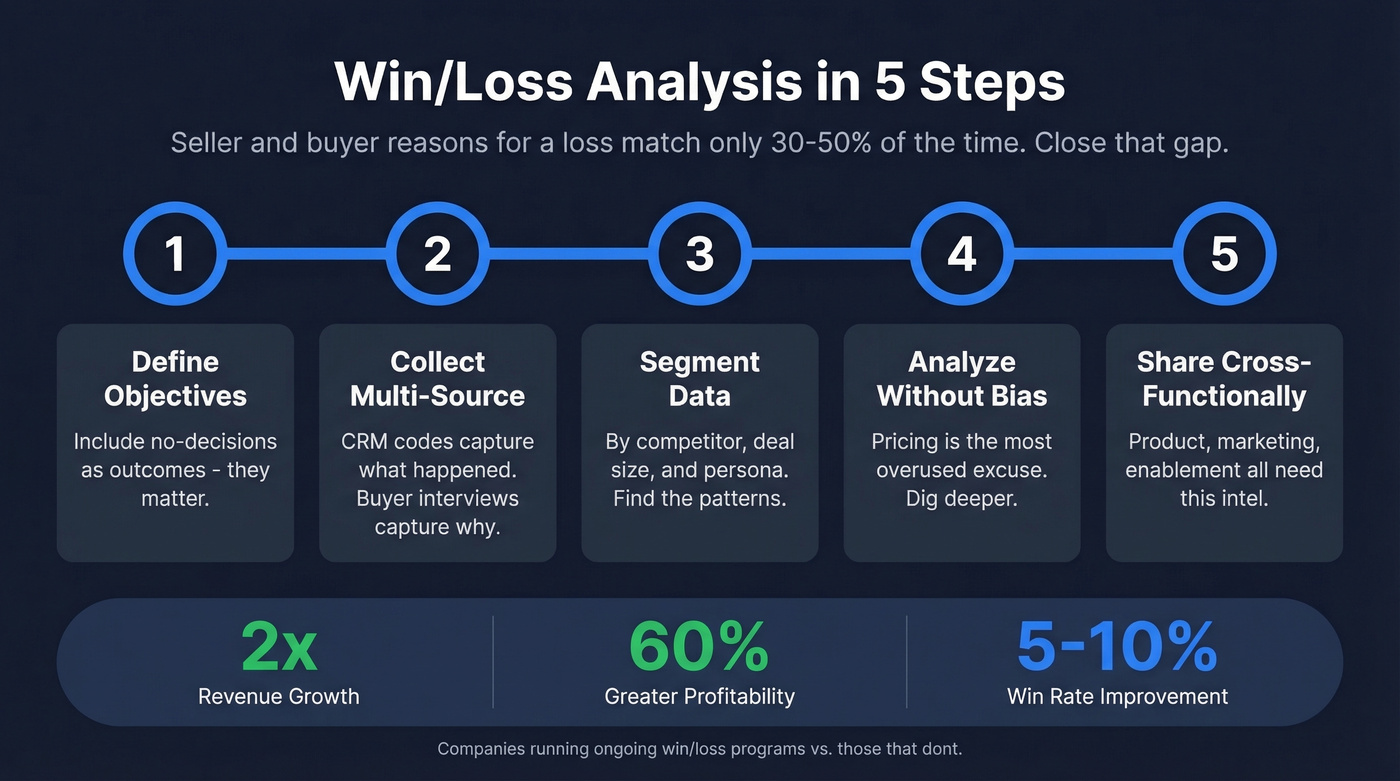
The win/loss process in five steps: define objectives (no-decisions count), collect from multiple sources (CRM codes capture what, buyer interviews capture why), segment by competitor and deal size, analyze without bias, and share cross-functionally with product, marketing, and enablement. Skip any of those steps and you'll end up with a spreadsheet that nobody trusts and nobody uses.
Two definitions most teams confuse: win rate = wins / total opportunities. Win-loss ratio = wins / losses, excluding no-decisions. The second isolates head-to-head performance and is far more useful for competitive analysis. For enterprise deals above $100k ACV, model 15-20% win rates; mid-market teams closing $50-100k deals can target 20-25% after refinement.
Companies running ongoing win/loss programs see 2x revenue growth and 60% greater profitability. A mature program often drives a 5-10% win-rate improvement - that's pipeline you already have, converting at a higher clip. (To operationalize this, treat it like data-driven selling, not a quarterly post-mortem.)
Mistakes That Kill Competitive Deals
In our experience, the same five errors show up in nearly every post-mortem:
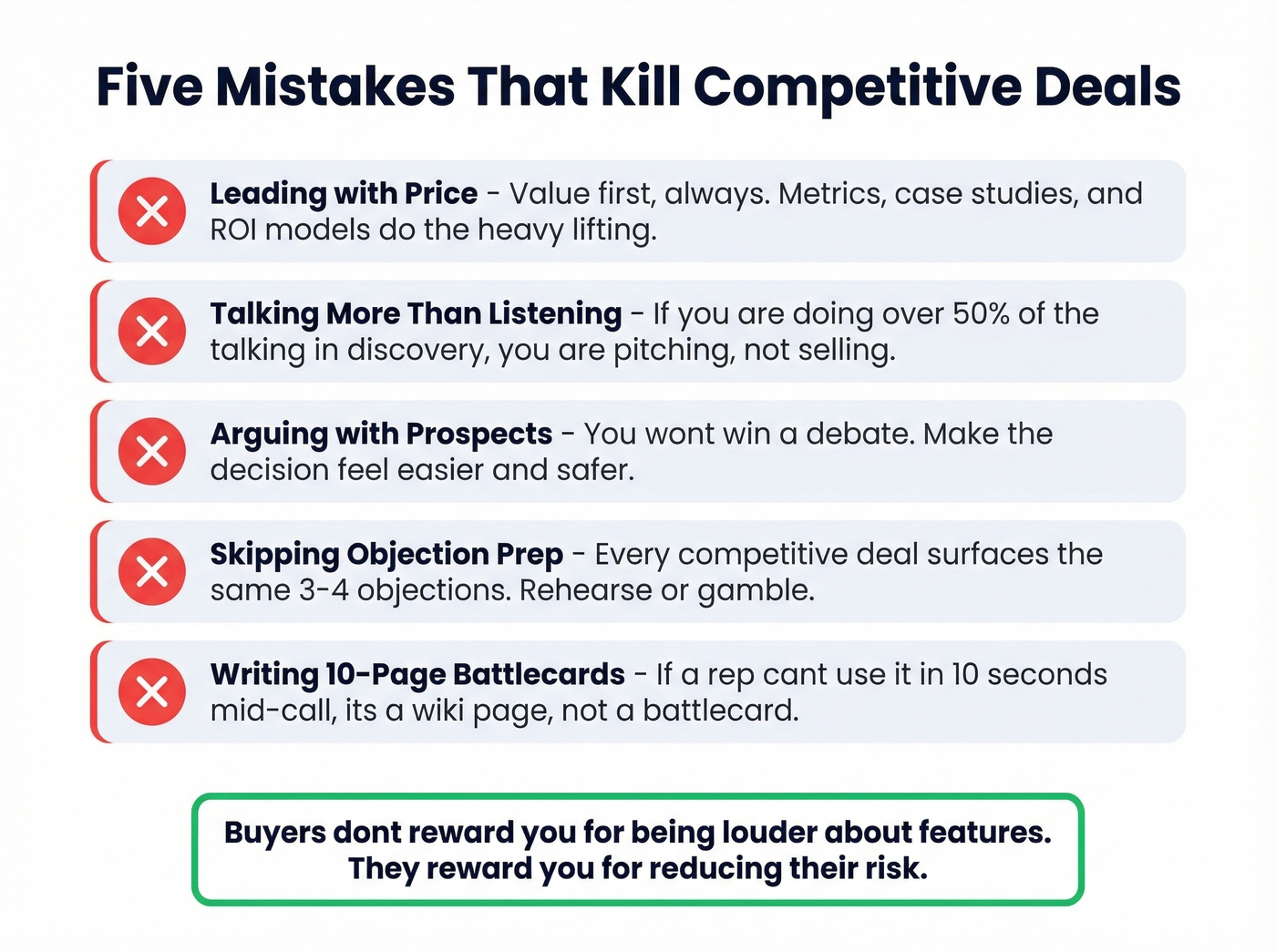
Leading with price. Value-first, always. Metrics, case studies, and ROI models do the heavy lifting - not discounts.
Talking more than listening. If you're doing over 50% of the talking in discovery, you're pitching, not selling. (Tighten your sales communication habits and the gap closes fast.)
Arguing with prospects. You won't win a debate. You'll win a deal by making the decision feel easier and safer.
Skipping objection prep. Every competitive deal surfaces the same 3-4 objections. If you haven't rehearsed responses, you're gambling with quota. (Build a repeatable sales execution cadence so prep actually happens.)
Writing 10-page battlecards. If a rep can't use it in 10 seconds mid-call, it's a wiki page, not a battlecard. Kill the bloat.
Buyers don't reward you for being louder about features. They reward you for reducing their risk. The reps who consistently win against rivals understand this instinctively - they lead with clarity, not volume.
Win/loss analysis reveals the pattern - but acting on it requires reaching the right buyers first. Prospeo's 7-day data refresh means you're never working stale contacts while competitors send to bounced emails. At $0.01 per lead, you outpace rivals without outspending them.
Close more head-to-head deals with data your competitors can't match.
FAQ
What's the difference between competitive selling and regular selling?
Every deal has competition - even "do nothing." Competitive selling means you've built specific plays (battlecards, landmine questions, talk tracks) for each named competitor instead of relying on generic pitches. The discipline turns reactive firefighting into a repeatable system.
How often should battlecards be updated?
Monthly at minimum - stale battlecards erode rep trust fast. Every lost deal against a competitor should trigger a battlecard review. Pair updates with fresh win/loss interview data so the cards reflect real buyer objections, not marketing guesses.
What tools help with competitive deal execution?
CI platforms like Klue or Crayon handle battlecard management. Conversation intelligence tools like Gong analyze what's actually said on calls. For the data layer, Prospeo ensures you're reaching the right buyers with verified contact data and intent signals before competitors do - its 7-day data refresh means your lists stay current while rivals work off stale records.
How do I sell against competitors without badmouthing them?
Use the ARR framework: acknowledge a competitor's strengths honestly, then redirect toward the specific gap your solution fills. Buyers trust reps who are transparent about the landscape - not ones who tear down every alternative. Lead with differentiation, not disparagement.