

Concept Selling: The 2026 Practitioner's Guide
Most B2B teams treat discovery calls like product demos with a question or two sprinkled in. The result? Average win rates stuck at 21% and sales cycles that have stretched 32% since 2021. Concept selling flips that dynamic - you stop pitching features and start mapping what success looks like in the buyer's mind.
The short version: Plan every meeting with a Green Sheet. Ask five types of questions. Secure a concrete next step - an "Advance" - not a vague follow-up. This works best for complex B2B deals with multiple stakeholders and $50K+ deal sizes. If your deals are transactional and under $25K, use BANT and save yourself the overhead.
What Is Concept Selling?
The conceptual selling methodology was created by Robert Miller and Stephen Heiman, launched in 1987 to support complex, high-stakes B2B sales deals. The core principle: buyers don't buy products. They buy the concept of what a solution will do for them - the outcome they envision, the problem they need solved, the future state they're trying to reach.
That distinction changes everything about how you run a sales conversation. Instead of walking through a feature list hoping something resonates, you uncover each stakeholder's individual concept of success, then map your solution to those concepts. If there's no fit, you walk away. Miller and Heiman framed this as "win-win" selling - not as a platitude, but as a structural requirement. A deal where the buyer's concept doesn't align with your product's reality isn't a win. It's a churn event waiting to happen.
The methodology sits within the broader Miller Heiman toolkit alongside Strategic Selling for deal strategy and Large Account Management for key accounts. Conceptual selling specifically governs how you plan and execute individual sales meetings - it's also often taught in a "no-sell selling" style, where the best sales conversations don't feel like selling at all. When you're genuinely exploring a buyer's concept of success, you're consulting, not pitching.
Quick disambiguation: A "selling concept" in marketing refers to demand-generation strategy - pushing what the company produces through aggressive sales techniques. That's a completely different idea. When we say concept selling here, we mean the Miller Heiman methodology for structuring B2B discovery conversations around buyer outcomes.
Why It Matters in 2026
The B2B selling environment has gotten harder on every axis that matters. Sales cycles have lengthened 32% since 2021, with enterprise cycles stretching even further at +36%. Only 21% of opportunities convert to closed-won. And 64% of sellers missed their most recent quota.
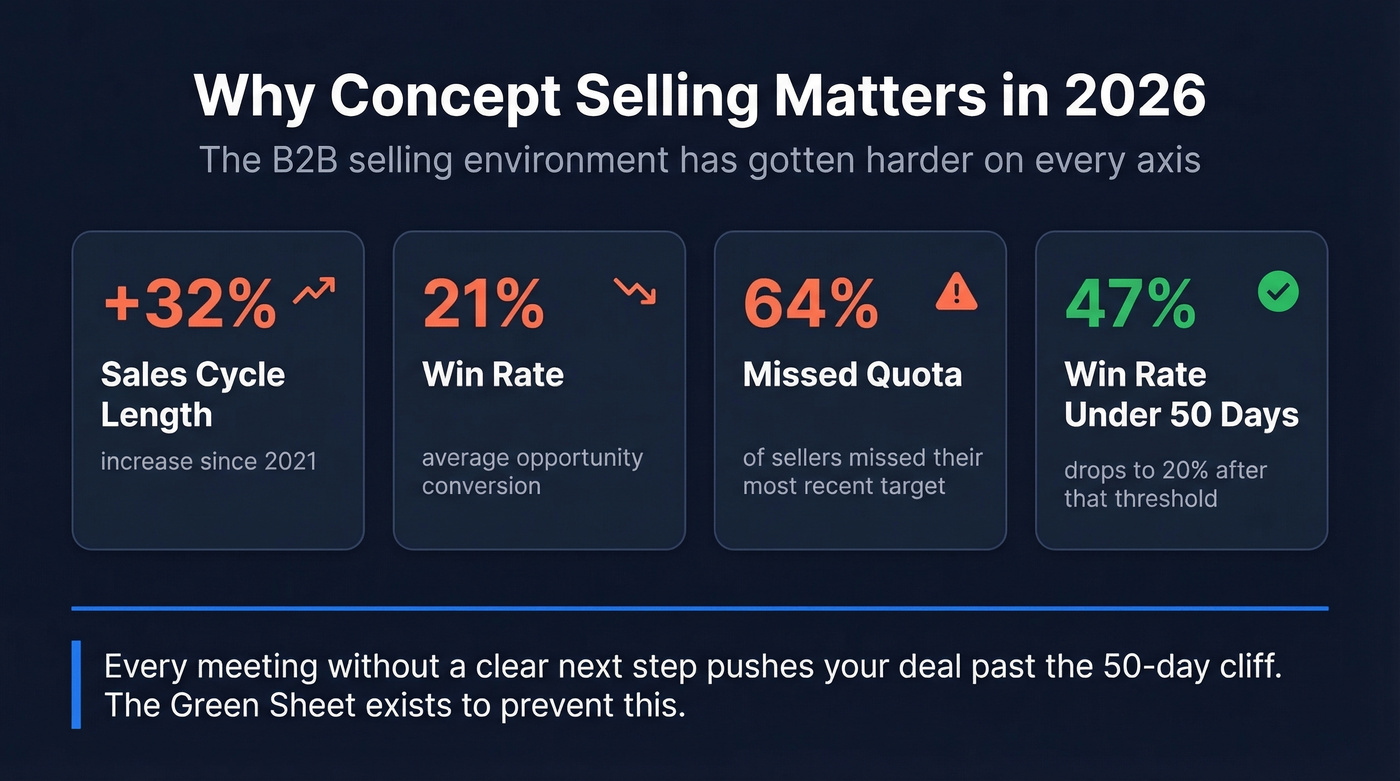
Here's the number that should reshape how you think about meeting prep: deals closed within 50 days carry a 47% win rate. After that threshold, win rates crater to 20% or lower. Every meeting that ends without a clear next step pushes your deal past that cliff. The entire architecture of this methodology - the Green Sheet, the Advance, the structured question flow - exists to compress cycles by making every interaction count.
The Five Golden Rules
These aren't suggestions. They're the structural guardrails that separate a deliberate discovery framework from generic "ask good questions" advice.
1. Never Make a Premature Presentation
You just sat through a 45-minute demo where your AE talked for 38 minutes, showed 14 features, and the prospect said "interesting" exactly once. That's a premature presentation. Until you understand the buyer's concept of success, you have nothing to present.
2. Focus on Perception, Not Reality
Your product might objectively be the best solution. Doesn't matter. What matters is how each stakeholder perceives their problem and your fit. Two VPs at the same company can have completely different concepts of success. You need to understand both.
3. Always Ask for the Customer's Opinion
This isn't politeness - it's intelligence gathering. When you ask "How do you see this fitting into your current workflow?" you're surfacing objections, priorities, and alignment gaps before they become deal-killers.
4. Ensure Every Interaction Adds Value
If the buyer leaves a meeting without learning something new or gaining a useful perspective, you've wasted their time. They won't give you more of it. (If you want a practical breakdown, see how to add value in sales.)
5. Obtain a Clear Commitment
Not "let's circle back next week." A specific, calendar-bound next step with defined participants and purpose. This is the Advance - the single most important element in the methodology.
The Green Sheet: Your Meeting Strategy
The Green Sheet is the methodology's meeting planning tool. If Strategic Selling's Blue Sheet maps your overall deal strategy across stakeholders, the Green Sheet zooms in on one thing: how to make your next meeting productive.
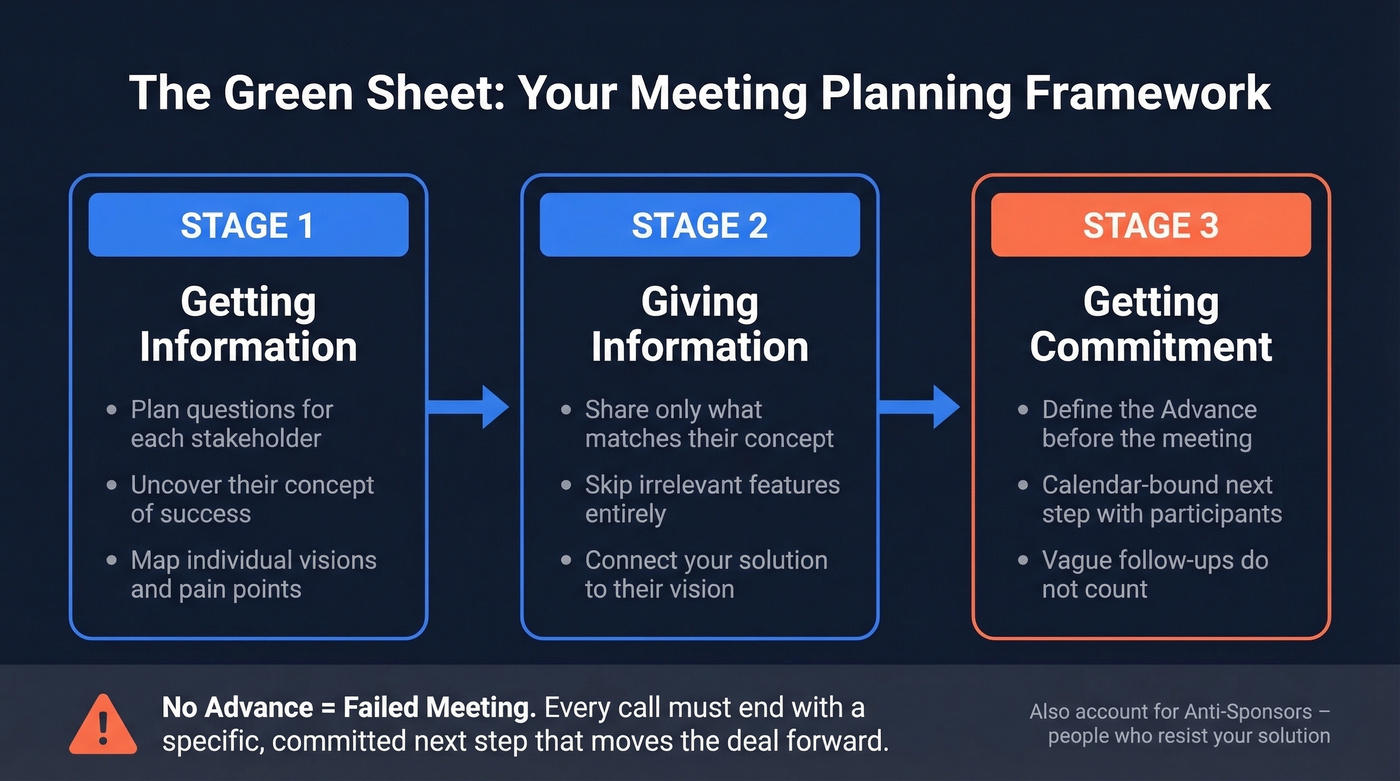
It follows three stages. Getting Information - plan which discovery questions to ask each stakeholder to uncover their concept of success. Giving Information - share only what's relevant to the concepts you've uncovered, not your full feature set. Getting Commitment - define the Advance you want before you walk into the room.
The Advance deserves emphasis. It's a commitment to a specific next step that moves the deal forward - a technical evaluation, a meeting with the economic buyer, a pilot agreement. Vague outcomes like "we'll think about it" don't count. If you leave a meeting without an Advance, the meeting failed.
Complex deals are team sports. Every Green Sheet should account for multiple stakeholders, including potential Anti-Sponsors - people who actively resist your solution. Ignoring them doesn't make them disappear. It makes them dangerous.
The Green Sheet is the single most underrated artifact in B2B sales. In our experience, teams that skip it end up running discovery calls that meander for 30 minutes and produce zero deal progression. We've seen teams that adopt structured meeting planning cut their average cycle by two to three weeks - not because the methodology is magic, but because it forces you to define what "success" looks like before you dial in. Top sellers spend roughly six hours per week researching prospects, and that time should go toward understanding each stakeholder's concept of success, not hunting for contact data.

Concept selling only works when you reach the right stakeholders. Prospeo gives you 98% accurate emails and 125M+ verified mobile numbers so your Green Sheet prep goes toward understanding buyer concepts - not chasing bad contact data.
Spend those six hours on strategy, not data hunting.
The Five Question Types
The methodology organizes discovery into five question categories, each mapped to a specific purpose. Gong research shows top reps ask 11-14 questions per call and maintain a talk-to-listen ratio around 46:54 - the buyer talks more than you do.
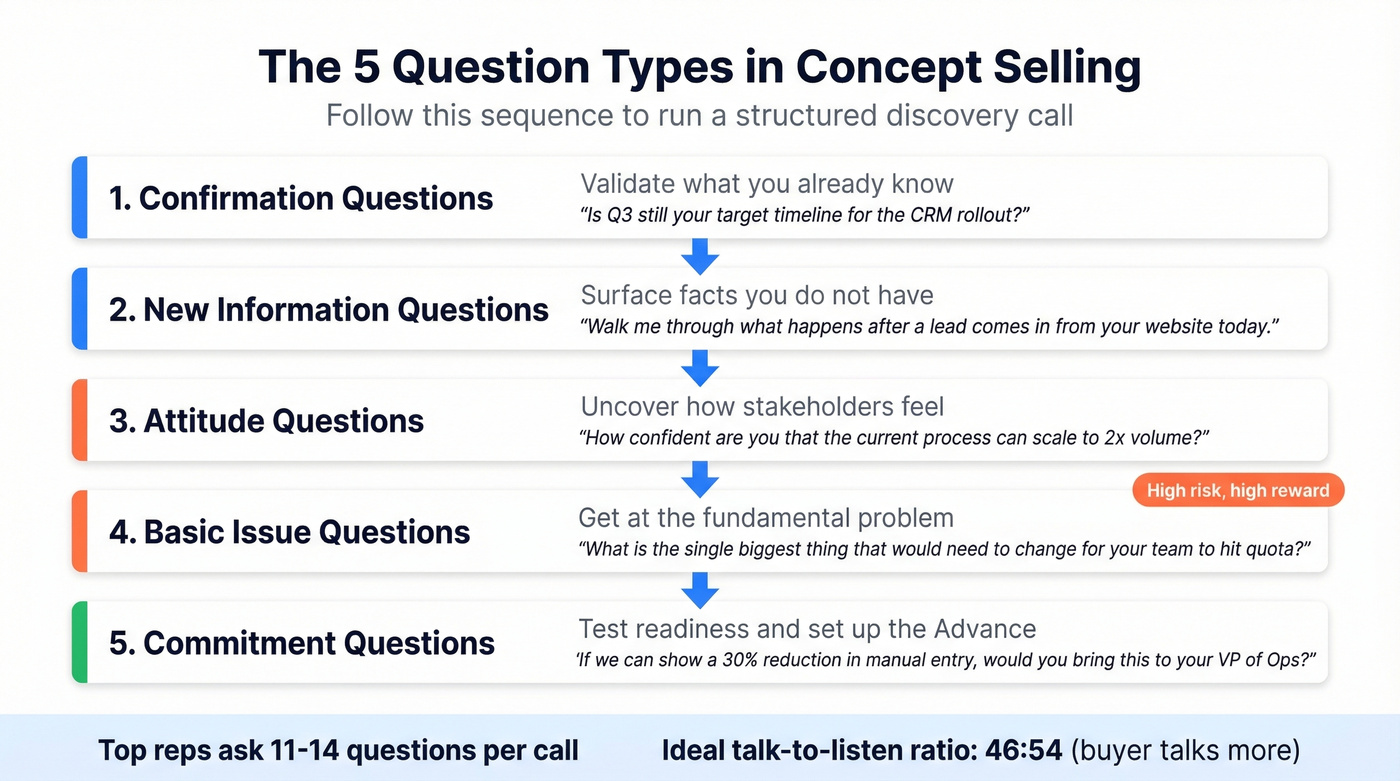
Confirmation Questions validate what you think you already know. "Last time we spoke, you mentioned Q3 was your target for rolling out a new CRM. Is that still the timeline?" These prevent you from building on outdated assumptions.
New Information Questions surface facts you don't have. "Walk me through what happens after a lead comes in from your website today." These are your primary discovery engine.
Attitude Questions uncover how stakeholders feel about the situation. "How confident are you that the current process can scale to 2x volume?" Feelings drive decisions - ignore them at your peril.
Commitment Questions test readiness to move forward. "If we can demonstrate a 30% reduction in manual data entry, would you be comfortable bringing this to your VP of Ops?" These set up your Advance.
Basic Issue Questions get at the fundamental problem. "What's the single biggest thing that would need to change for your team to hit quota consistently?" High-risk, high-reward - ask them too early and you seem presumptuous, ask them at the right moment and you unlock the real conversation.
Start with Confirmation to establish common ground, move through New Information and Attitude to build understanding, then use Basic Issue and Commitment questions to drive toward your Advance. Mastering this question flow is what separates teams running a deliberate discovery strategy from those winging it with generic scripts.
Concept Selling vs. Product Selling
Same prospect, same product, two completely different conversations.
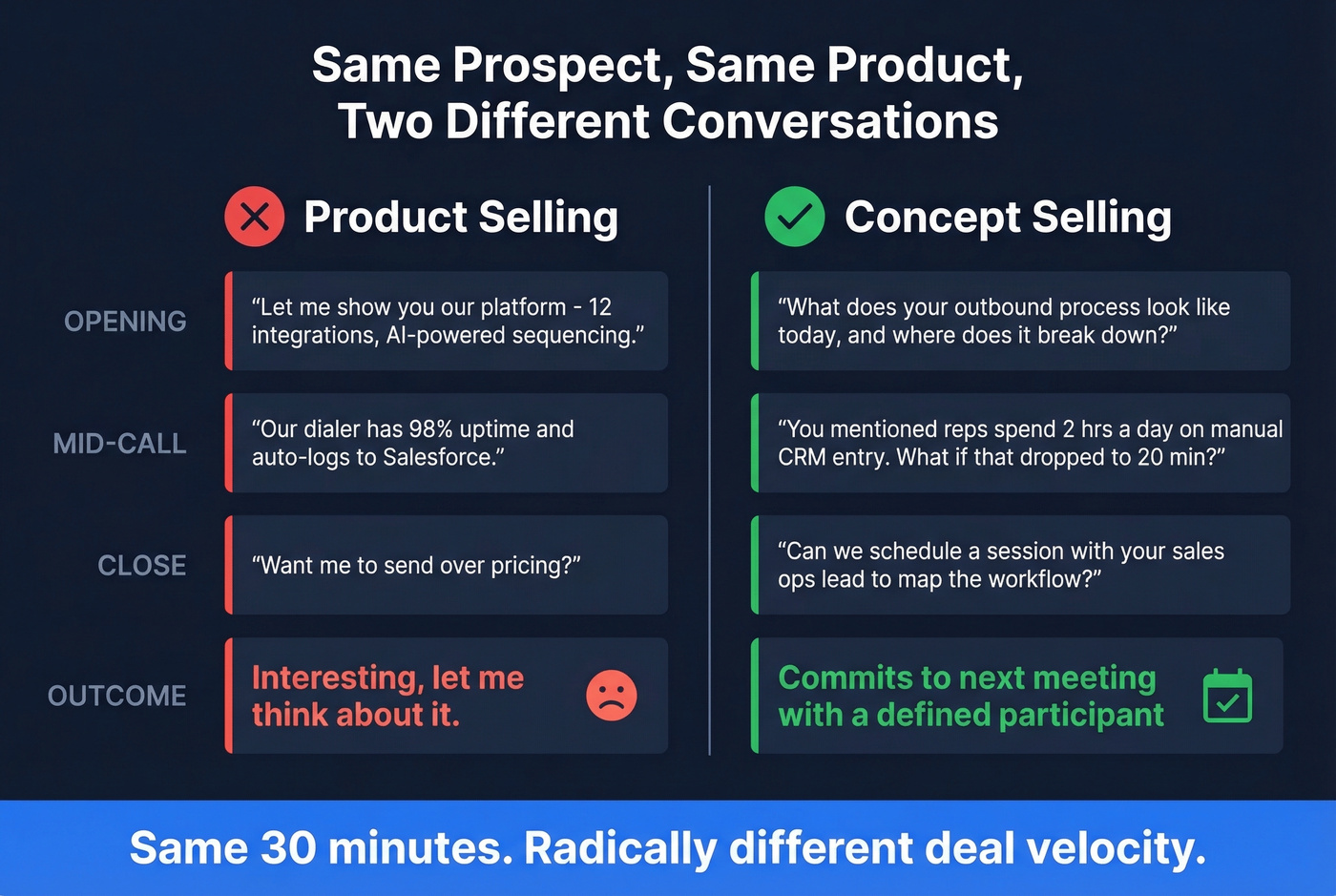
| Product Selling | Concept Selling | |
|---|---|---|
| Opening | "Let me show you our platform - 12 integrations, AI-powered sequencing." | "What does your outbound process look like today, and where does it break down?" |
| Mid-call | "Our dialer has 98% uptime and auto-logs to Salesforce." | "You mentioned reps spend 2 hrs/day on manual CRM entry. What if that dropped to 20 min?" |
| Close | "Want me to send over pricing?" | "Can we schedule a session with your sales ops lead to map the workflow?" |
| Outcome | "Interesting, let me think about it." | Commits to a next meeting with a defined participant. |
The product seller talked about features. The concept seller uncovered a vision of success - rep productivity - validated it, and secured an Advance. Same 30 minutes, radically different deal velocity.
How It Compares to SPIN, Challenger, MEDDIC
No single methodology covers everything. Let's break this down.
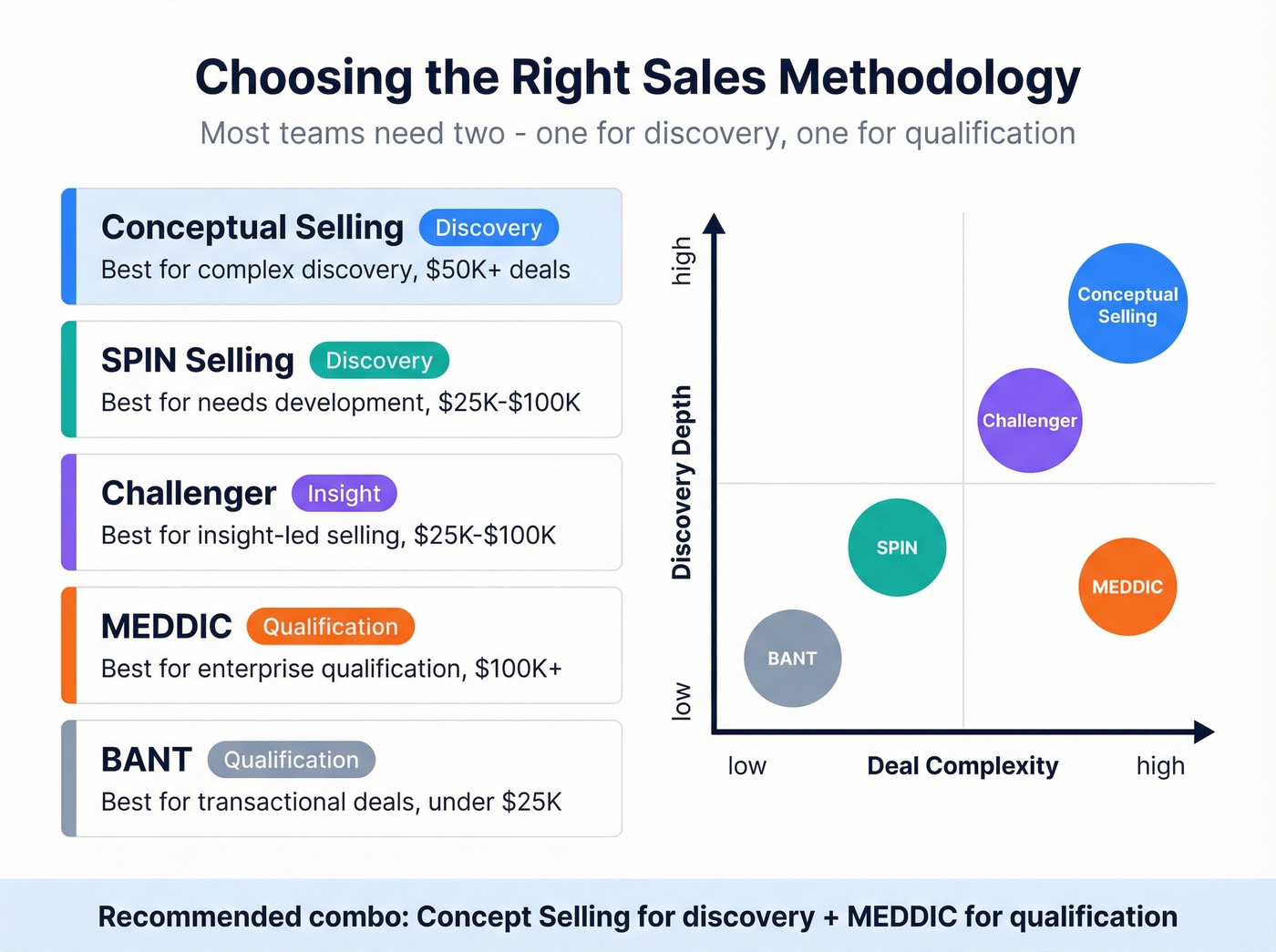
| Methodology | Best For | Research Base | Deal Size | Core Mechanic |
|---|---|---|---|---|
| Conceptual Selling | Complex discovery | Miller Heiman (1987) | $50K+ | Map buyer's concept of success |
| SPIN | Needs development | 35K calls, 12yr, 20+ countries | $25K-$100K | Situation - Problem - Implication - Need-payoff |
| Challenger | Insight-led selling | 6,000+ reps, CEB/Gartner | $25K-$100K | Teach / Tailor / Take Control |
| MEDDIC | Enterprise qualification | PTC (1990s) | $100K+ | Metrics, Economic Buyer, Decision Criteria, Champion |
| BANT | Transactional qualification | IBM (1960s) | Under $25K | Budget, Authority, Need, Timeline |
SPIN's research showed that a structured questioning strategy can improve closure rates by roughly 20%. Challenger's insight is that the best reps don't just respond to needs - they reshape how buyers think about their problems.
Here's the thing: most teams need two methodologies, not one. One for discovery - conceptual selling or SPIN - and one for qualification like MEDDIC. Challenger gets more hype in sales Twitter threads, but I'd argue concept selling is the better starting point for teams that haven't yet mastered basic discovery. You can't teach a buyer something new about their business if you haven't first understood how they see it.
When NOT to Use It
Skip this framework for transactional deals under $25K with a single decision-maker and a two-week cycle. If you're selling a $99/month SaaS tool to individual contributors, Green Sheet planning for every call will slow you down. Use BANT and move on.
There's also a real risk that doesn't get enough attention: a compelling concept can set expectations the product can't meet. If you spend 45 minutes building a vision of the buyer's ideal future state and your product only delivers 60% of it, you've created a gap that will haunt you through implementation. The concept has to be grounded in what you can actually deliver.
Tools That Support the Framework
The right tools eliminate friction so reps can focus on discovery instead of admin work. Here's what we've found works well.
CRM: HubSpot's free tier works for small teams; Salesforce plans start around $25/user/month and scale up by edition. Document stakeholder concepts, Green Sheet notes, and Advance commitments directly in your deal records. (If you're evaluating options, start with these examples of a CRM.)
Conversation intelligence: Gong is typically sold on annual contracts and varies by package; many teams budget a few thousand dollars per user per year. Record and analyze calls so you can audit talk-to-listen ratios and whether reps are running real discovery or defaulting to feature dumps.
Training: Formal Conceptual Selling programs typically run $3,000-$6,000 per seat for workshops, or $25,000-$100,000+ for enterprise team engagements.
Prospect data and enrichment: Before you can ask the right questions, you need to reach the right people. Tools like Prospeo let you layer intent data across 15,000 topics to identify which accounts are actively researching solutions, so your Green Sheet planning starts with signal, not guesswork. That means your six hours of weekly research goes toward understanding stakeholder concepts instead of chasing down email addresses. (Related: how data enrichment services fit into modern outbound.)

Every deal that stalls past 50 days sees win rates crater to 20%. Map all your stakeholders - including Anti-Sponsors - with 300M+ profiles, 30+ filters, and intent data across 15,000 topics. At $0.01 per email, bad data never kills your Advance again.
Compress your sales cycle with contacts that actually connect.
FAQ
What's the difference between conceptual selling and consultative selling?
Consultative selling is a broad philosophy - ask questions, listen, advise. Conceptual selling is a specific methodology with named tools like the Green Sheet, five defined question types, and a structured meeting framework created by Miller and Heiman. Think of consultative selling as the category and conceptual selling as one proven implementation of it.
Is This Methodology Still Relevant in 2026?
More than ever. With sales cycles 32% longer than 2021 and only 21% average win rates, structured discovery frameworks directly address the complexity dragging modern B2B deals past the 50-day win-rate cliff. The emphasis on stakeholder alignment and securing concrete next steps is exactly what today's multi-threaded deals require.
How Do I Prepare for a Discovery Call?
Fill out a Green Sheet: identify each stakeholder's likely concept of success, plan your five question types, and define the Advance you want before you walk in. Spend your research time on strategy - understanding the account's priorities, recent news, and org structure - rather than manually tracking down contact details.