

Best Consensus Alternatives for Demo Automation in 2026
Your Consensus renewal just landed and it's 25% higher than last year. The CFO wants to know why you're paying $1,250/mo for a video demo tool when half the sales team still shares screen recordings in Loom. You're not alone - and you don't need to evaluate 15 alternatives to find something better. Three or four will do.
Quick note: This article covers Consensus the demo automation platform (goconsensus.com), not Consensus the AI-powered academic research tool (consensus.app). If you're looking for literature review alternatives, you're in the wrong place.
Our Top Picks (TL;DR)
| Scenario | Pick |
|---|---|
| Most versatile mid-market alternative | Storylane |
| Best free plan to test first | Navattic |
| Cheapest per-creator cost | Supademo |
| Enterprise sandbox environments | Reprise |
| Tightest budget (under $50/mo) | Arcade |
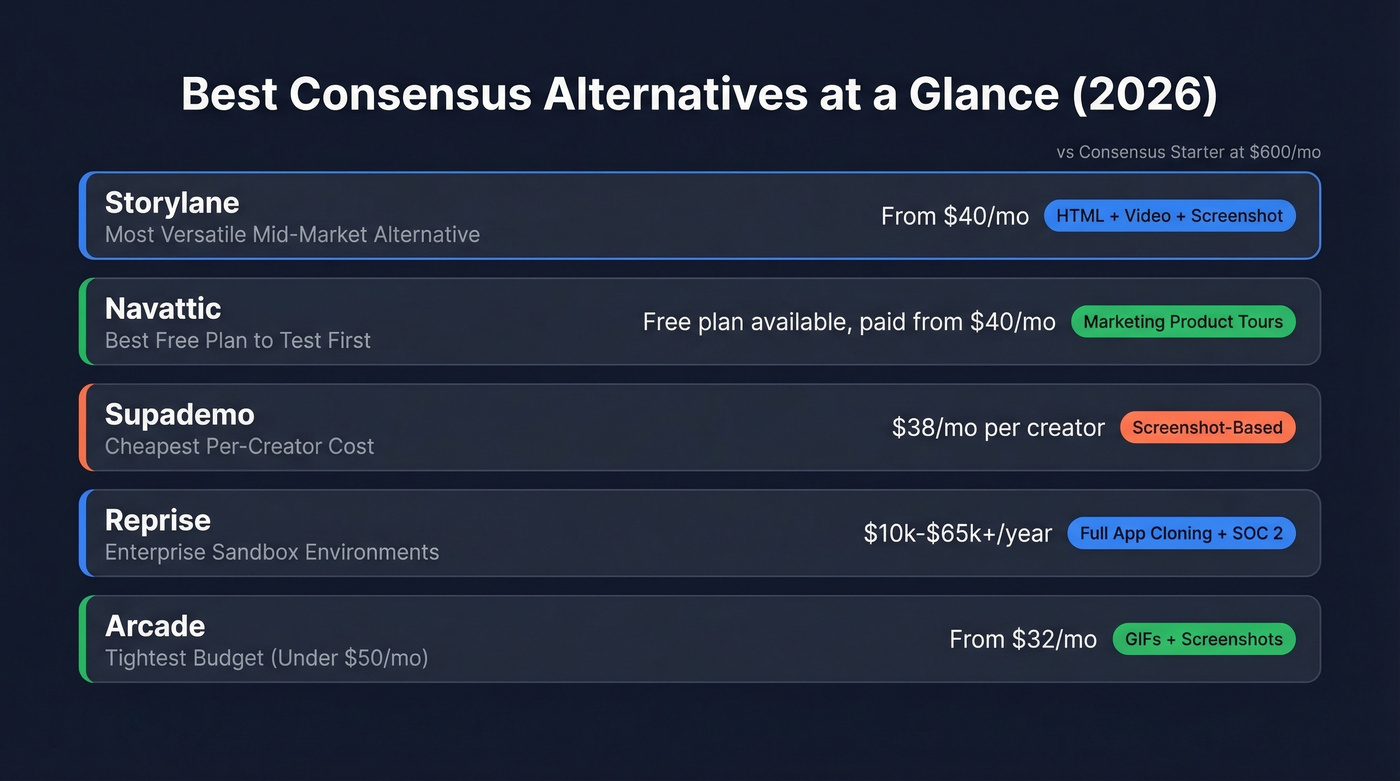
Run a two-week pilot with real content and you'll have your answer.
Why Teams Leave Consensus
Consensus holds a solid 4.7/5 on G2 across 1,647 reviews. It's not a bad product. But three patterns keep pushing teams toward competitors.
Demo Boards Take Too Long
The most consistent complaint: building and organizing demo boards eats hours. One reviewer called the process "time-consuming," noting the client-facing interface gets confusing when you're juggling multiple themes and sections. For presales teams already stretched thin, that friction compounds fast.
Video-First Format Mismatch
Consensus built its reputation on video demos - personalized, trackable, shareable. That's powerful for enterprise presales, and the company claims outcomes like 50% larger deal sizes and 30% shorter sales cycles at scale. But marketing teams want embeddable product tours on their website. PLG companies want interactive walkthroughs inside their app. Video doesn't fit either use case well.
Consensus has expanded beyond video with Product Tours and Simulations, and it picked up screenshot demos through the ReachSuite acquisition - but the platform's DNA is still video-first. If your primary use case is website-embedded HTML demos, you're fighting the tool's center of gravity.
Price-to-Value Tension
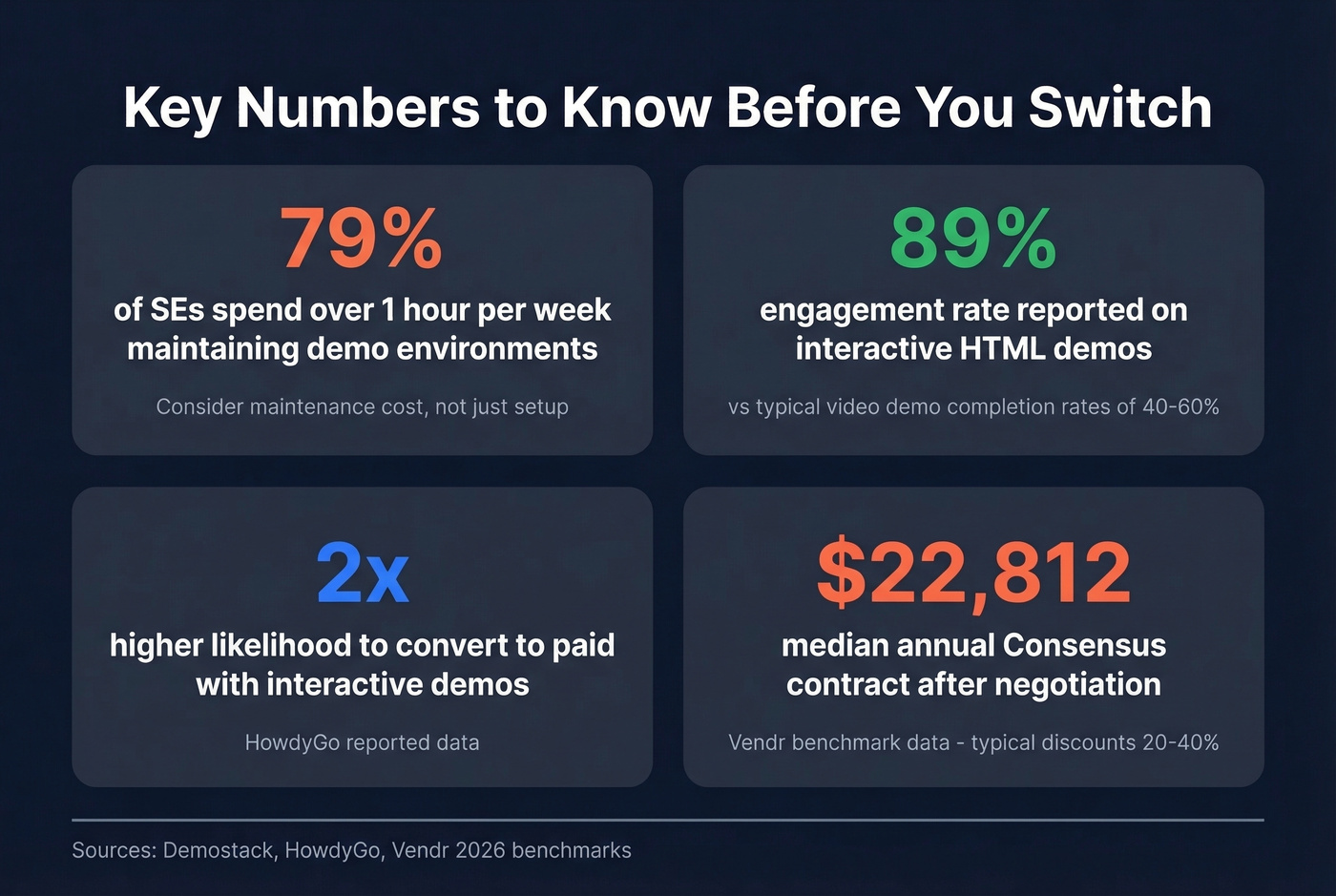
Consensus Starter runs $600/mo for 5 users. Pro jumps to $1,250/mo for 10 users. Enterprise is custom. According to Vendr's contract benchmarks, the median buyer pays $22,812/year - but that's after negotiation. Typical discounts run 20-30% on Business tier and 25-40% on Enterprise, with multi-year commits shaving another 15-30%.
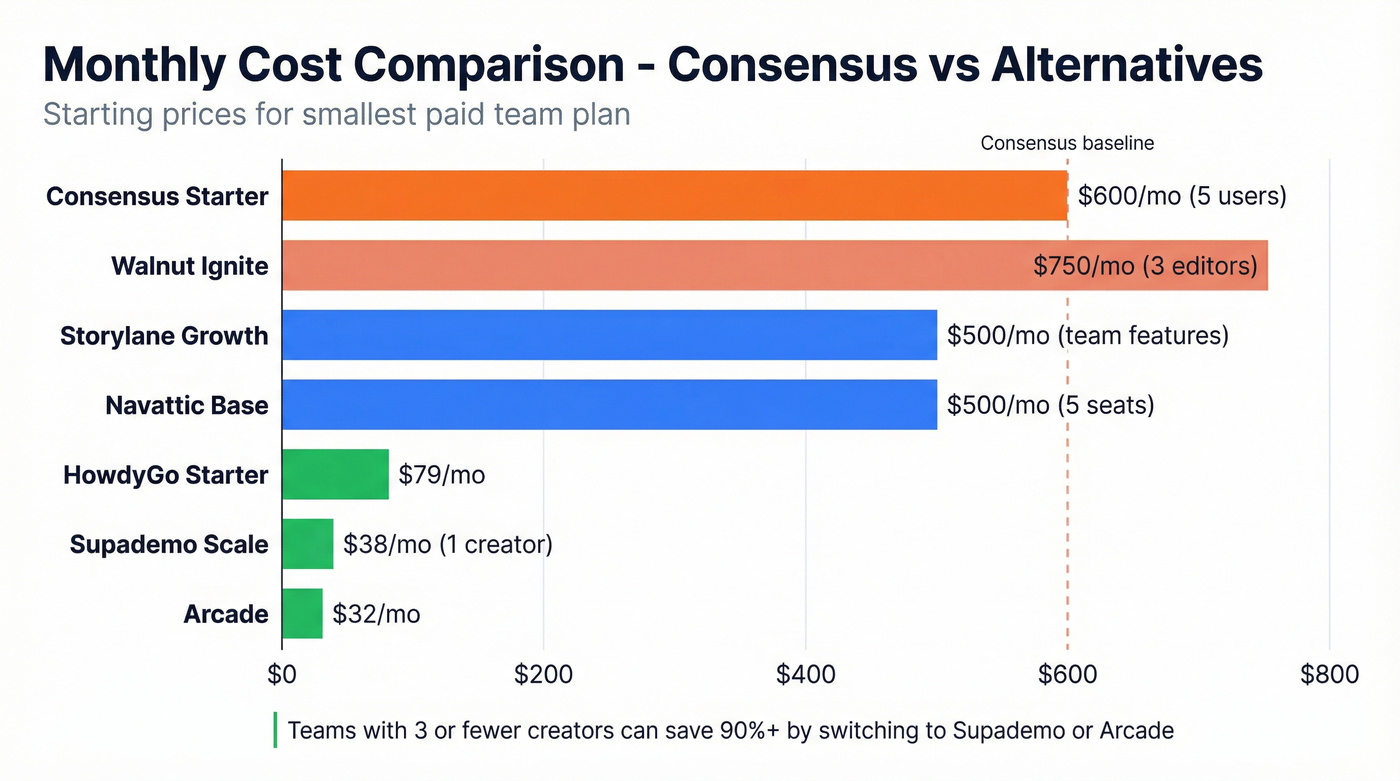
Negotiation tip: If you're renewing, lead with the multi-year discount first, then stack the tier discount on top. Vendr data shows the most aggressive savings come from combining both levers. (If you want a framework for setting your floor, see walk away point and anchor tactics.)
Here's the thing: if you're a 3-person marketing team that just wants product tours on your website, $600/mo is a hard sell internally no matter how you slice it.
Demo Format Primer
Before picking an alternative, understand what format you actually need. This matters more than feature lists.
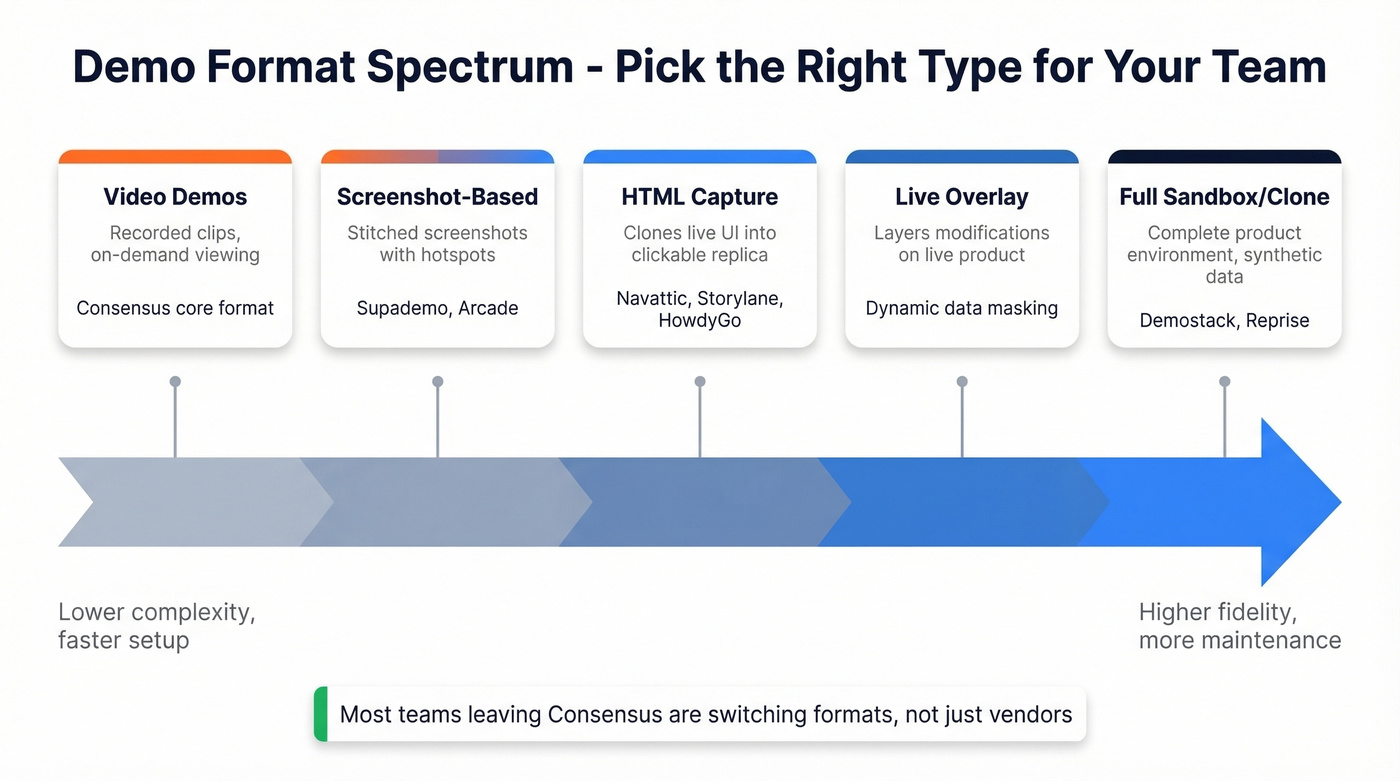
- Video demos - recorded, personalized clips viewers watch on-demand. Consensus's core format.
- HTML capture - clones your live product UI into an interactive, clickable replica. Navattic, Storylane, and HowdyGo all use this approach.
- Screenshot-based - stitched screenshots with hotspots and annotations. Supademo and Arcade live here.
- Live overlay - layers modifications on top of your live product for demos, useful for dynamic data masking.
- Full sandbox/clone - spins up a complete product environment with synthetic data. Demostack and Reprise own this space.
Interactive HTML demos can outperform video on engagement - HowdyGo reports 89% engagement rates and 2x higher likelihood to convert to paid. That tracks with what we've seen across teams making the switch. Most teams leaving Consensus are actually switching formats, not just vendors. Pick the format your buyers engage with, then find the tool that does it best.

A better demo platform gets prospects to engage. But you still need verified contact data to follow up. Prospeo gives you 98% accurate emails and 125M+ direct dials so every demo viewer becomes a reachable opportunity - not a dead end in your CRM.
Don't optimize your demos then lose deals to bad contact data.
The Best Consensus Alternatives Compared
Storylane
Storylane is the tool G2 calls the "best overall Consensus alternative", and after testing it against several competitors, we'd agree for most mid-market teams. It handles HTML capture demos, screenshot-based guides, and video - so you're not locked into one format.
Use this if: You want a single platform that covers marketing product tours and sales leave-behinds. The free plan lets you build unlimited demos with Storylane branding, so you can validate the workflow before spending anything. Paid plans start at $40/mo (Starter), jump to $500/mo (Growth) for team features, and $1,200/mo (Premium) for enterprise needs.
Skip this if: You need full sandbox environments with synthetic data. Storylane captures and recreates the UI - it doesn't clone your entire product. For complex enterprise demos where prospects need to click through real workflows with their own data, look at Demostack or Reprise instead.
Reviewers consistently say Storylane is "easier to set up, easier to admin, and more usable" than Consensus. It carries a 4.8/5 on G2, and Gartner Peer Insights gives it 4.8 as well. The setup speed is the real differentiator - most teams go from signup to published demo in under a day.

Navattic
Navattic is the pick for marketing teams that want product tours embedded on their website - the kind of interactive walkthrough that replaces a "request a demo" form with an instant, self-serve experience.
The free Starter plan gives you 1 seat, 1 demo, and unlimited views with basic analytics. That's enough to test whether interactive demos actually convert on your site before committing budget. Paid tiers scale from Starter Plus at $40/mo, to Base at $500/mo for 5 seats, to Growth at $1,000/mo for 10 seats with A/B testing, advanced analytics, and personalization.
Navattic holds a 4.7/5 on G2 with 852 reviews - the largest review base of any alternative on this list. Reviewers say it's "easier to admin" and offers "better support" than Consensus. Gartner Peer Insights rates it lower at 3.6/5, but that's based on just 5 ratings and isn't worth weighting heavily. One thing budget-sensitive teams should know: a G2 reviewer noted the price is "steep" with little room to negotiate, so factor that into your planning.
Who should skip it: Presales teams that need to personalize demos per deal. Navattic is built for marketing-led, one-to-many product tours. It's less suited for the tailored, stakeholder-specific demo experiences that Consensus and Walnut focus on.
If you're building a self-serve motion, it also helps to tighten the rest of your funnel metrics (see funnel metrics and pipeline health).

Supademo
I watched a three-person startup team evaluate Storylane, Navattic, and Supademo last quarter. They picked Supademo in two days. The reason wasn't features - it was that a single creator could go from zero to published demo in under 30 minutes, and the cost was $38/mo. For teams where budget discipline matters more than enterprise bells and whistles, Supademo is the obvious choice.
The free plan gives one creator unlimited demos forever. Scale runs $38/mo per creator. Growth is $350/mo for 5 creators. Reviewers say it's "easier to set up" and "more usable" than Consensus - and at roughly 1/15th the price of Consensus Starter, the value math isn't close.
Best for: Solo creators, small marketing teams, or startups that need screenshot-based product walkthroughs without a procurement process. Not ideal for: Teams that need HTML capture or enterprise-grade analytics with CRM integration. It's a lightweight tool by design.
Walnut
Walnut is the enterprise sales team's demo tool. Personalized, no-code demo environments with deep analytics and deal rooms.
The Ignite plan starts at $750/mo for 3 editor seats. Accelerate jumps to $1,550/mo with sandbox demos, prospect personalization, and advanced Salesforce integration. Scale adds translation into 243 languages - genuinely useful for global presales teams. Walnut also offers standalone Interactive Deal Rooms at $70/user/month, or $35/user/month bundled with a demo plan. A 14-day free trial lets you test before committing.
The 4.5/5 rating on G2 across 151 reviews is solid but a step below Storylane and Navattic on usability scores. The $750/mo floor prices out most SMBs, so this is really a tool for teams with 10+ AEs running complex deal cycles. (If deal rooms are a core requirement, compare approaches in our digital sales room guide.)
Demostack
Here's a stat that should make every presales leader wince: 79% of SEs spend over an hour per week maintaining demo environments. Demostack creates those environments - full product clones with synthetic data - and the maintenance burden is the honest trade-off for that power.
Demostack spins up complete sandbox environments, which is great for complex enterprise software demos where prospects need to interact with realistic data. One reviewer noted that product updates can require "recreating all existing clones from scratch," so factor ongoing maintenance into your evaluation, not just setup time.
The price reflects the enterprise positioning: $50k-$55k/year for 10 users on the Standard tier. Third-party pricing analyses peg negotiated deals around $32,000. There's no free trial. If you're under 50 employees or don't have dedicated SE resources, this isn't your tool.
Reprise
If your security team has veto power over tool purchases - and at enterprise scale, they always do - Reprise is the demo platform that clears compliance review fastest. SOC 2 Type II and ISO 27001 certification come standard, along with SSO/RBAC and full application cloning.
Gartner Peer Insights gives Reprise 4.7/5 across 25 ratings, the highest-rated enterprise option on that platform. The trade-off is transparency: Reprise uses an annual platform fee plus per-user licenses, all quote-only. Typical contracts run $10,000-$65,000+/year. Reviewers comparing Reprise to Consensus flag it as "more expensive" and "slower to reach ROI" - but for regulated industries, the compliance certifications alone can save months of procurement friction.
HowdyGo
HowdyGo is a lightweight HTML capture tool that starts at $79/mo (Starter) and $319/mo (Pro), with a 14-day free trial. Their reported 89% engagement rates on interactive demos are worth testing if your current video demos aren't getting watched.
Arcade
Arcade is the budget pick for teams that just need quick product GIFs and screenshot-based walkthroughs. Free plan available, paid plans run $32-$42/mo. Think of it as a step up from Loom, not a step down from Consensus. It isn't a full demo automation platform, but for product marketing teams that need embeddable walkthroughs on a docs site or blog, it does the job at a fraction of the cost.
Pricing Comparison
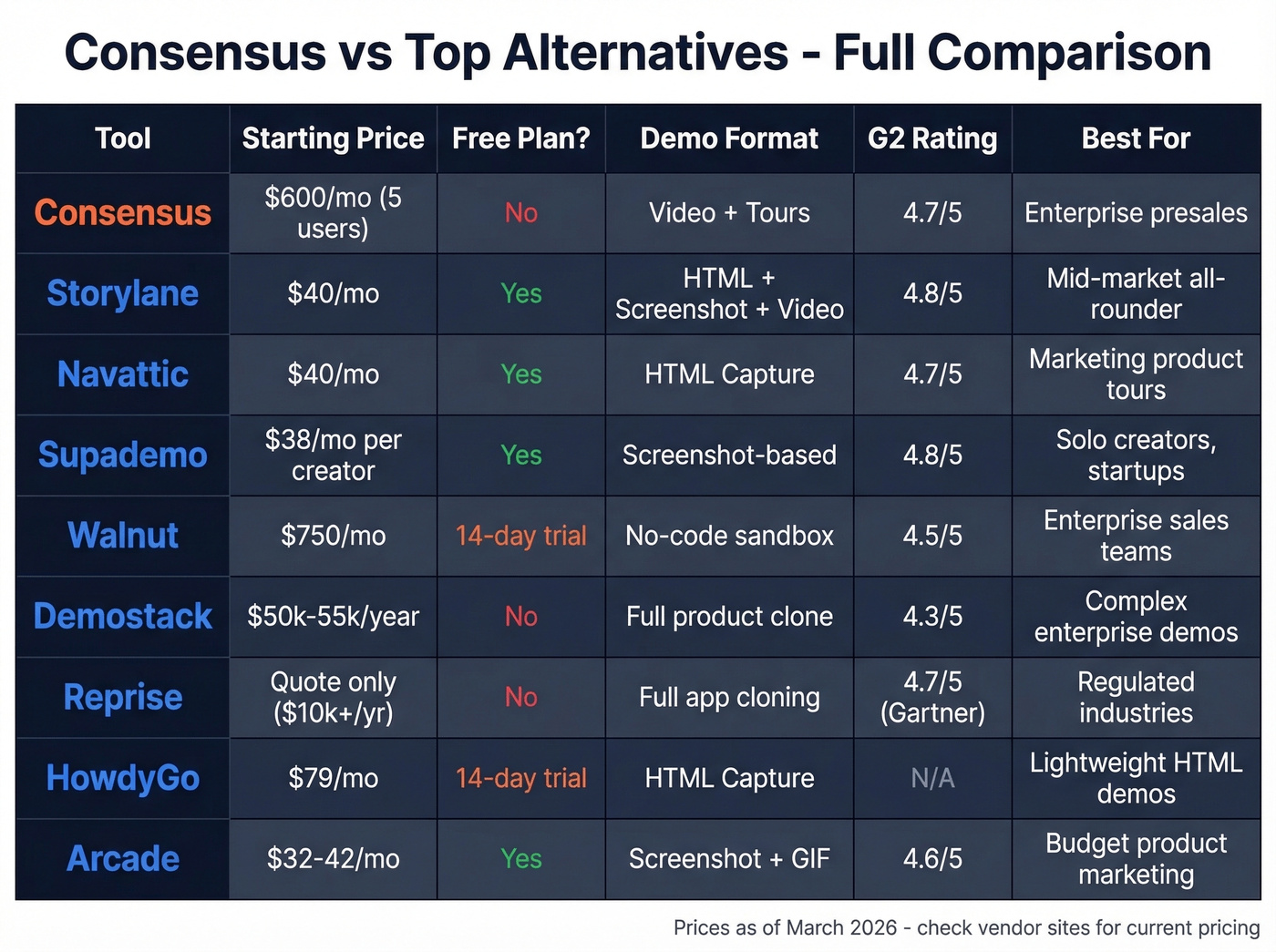
Half these vendors won't show you a number until you sit through a discovery call. Here's what you'll actually pay:
| Tool | Starting Price | Free Plan/Trial | G2 Rating | Best For |
|---|---|---|---|---|
| Consensus | $600/mo | No public self-serve trial | 4.7/5 (1,647) | Enterprise video demos |
| Storylane | Free / $40/mo | Free plan | 4.8/5 | Mid-market versatility |
| Navattic | Free / $40/mo | Free Starter | 4.7/5 (852) | Marketing product tours |
| Supademo | Free / $38/mo | Free forever | 4.7/5 | Budget-conscious teams |
| Walnut | $750/mo | 14-day trial | 4.5/5 (151) | Enterprise personalization |
| Demostack | ~$50k-$55k/yr | None | 4.6 (Gartner) | Full sandbox clones |
| Reprise | ~$10k-$65k+/yr | None | 4.7 (Gartner) | Compliance-heavy enterprise |
| HowdyGo | $79/mo | 14-day trial | - | Lightweight HTML capture |
| Arcade | Free / $32/mo | Free plan | - | Quick walkthroughs |
How to Choose the Right Tool
Let's be honest: most teams overthink this decision. If your average deal size is under $25k, you almost certainly don't need Consensus-level tooling. A $40/mo Storylane or Supademo plan will cover 90% of your use cases, and the money you save can go toward actually reaching the right prospects.
| Your Problem | Best Fit | Why |
|---|---|---|
| Consensus is too expensive | Supademo or Arcade | Both under $50/mo with free tiers |
| We need website tours, not video | Navattic or Storylane | HTML capture for website embeds |
| Demo boards take too long | Storylane or Supademo | Fastest time to published demo |
| We need full sandbox environments | Demostack or Reprise | Full product clones + synthetic data |
| One tool for marketing + presales | Storylane | Tours, guides, and leave-behinds |
| Compliance is non-negotiable | Reprise | SOC 2 + ISO 27001 certified |
For teams moving from video-first to interactive HTML demos, that's a fundamentally different buyer experience. Test the format with a free plan before committing budget to a paid tier.
The Step Most Teams Skip
You've picked your demo tool. You've built beautiful interactive walkthroughs. Now you're sending them to prospects - and 30% of your outbound list has dead emails. You're automating demos to ghosts.
Demo automation ROI depends entirely on whether the right people actually see your demos. We've watched teams pour weeks into demo content only to realize their prospect data was stale. Prospeo handles the step before the demo tool: 300M+ professional profiles, 98% email accuracy, and a 7-day data refresh cycle that keeps your lists current. The free tier gives you 75 verified emails per month - enough to test whether cleaner data actually moves your demo engagement metrics. (If you're auditing your stack, start with data enrichment services and a clean sales prospecting database.)
You're saving $600-$1,250/mo switching from Consensus. Reinvest a fraction into contact data that actually converts. Prospeo delivers verified emails at $0.01 each - 90% cheaper than ZoomInfo - so your new demo tool feeds a pipeline you can actually reach.
Pair your new demo tool with data that books 26% more meetings.
FAQ
Is Consensus worth the price in 2026?
For enterprise presales teams running video-first demo programs at scale, yes - the tracking and stakeholder analytics justify the spend. For smaller teams or marketing-led use cases, Storylane or Supademo deliver comparable value at 1/10th the cost. The median Consensus buyer pays $22,812/year, which is hard to justify for product tours alone.
What's the cheapest alternative to Consensus?
Supademo at $38/mo per creator and Arcade starting at $32/mo are the most affordable options. Both offer permanent free plans. Navattic also has a free Starter tier with 1 seat and 1 demo - enough to validate the format before paying anything.
Can I use multiple demo tools together?
Yes, and many teams do. A common pairing: a marketing product tour tool like Navattic or Storylane for website embeds alongside a presales sandbox tool like Reprise or Demostack for deal-specific demos. Two $500/mo tools still cost less than Consensus Pro.
Does Consensus offer a free trial?
Consensus doesn't list a self-serve free trial on its pricing page. You'll need to book a demo with their sales team to get access. Navattic, Supademo, and Arcade offer permanent free plans, while Walnut and HowdyGo provide 14-day trials - no sales call required.
How do I make sure prospects actually watch my demos?
The best demo tool is useless if your outbound emails bounce. Clean contact data is the prerequisite for demo engagement - tools like Prospeo offer 98% email accuracy across 300M+ profiles with a 7-day refresh cycle, plus a free tier of 75 verified emails per month to get started.