

Consultative Selling Techniques That Actually Work in 2026
A company paid $15,000 for a consultant to run a six-hour consultative selling workshop. The next day, a rep opened a discovery call with "What's keeping you up at night regarding your current solution?" The prospect said, "Are you reading from a script?" - and hung up. That's the paradox of consultative selling techniques in 2026: they work, but the moment they sound like techniques, they fail.
The Short Version
- Consultative selling works when it's framework-driven, not script-driven. Start with SPIN for discovery, layer in Challenger once you've built industry expertise.
- Aim for 11-14 targeted questions per discovery call, structured around the buyer's current state, goals, stakeholders, and urgency.
- The single highest-ROI habit: spend 10 minutes researching the prospect before every call so your questions are specific, not generic.
Why It Matters Now
Here's the thing. 61% of B2B buyers prefer a rep-free buying experience, according to a 2024 Gartner survey of 632 buyers. And 73% actively avoid suppliers who send irrelevant outreach. Buyers don't want to talk to you - unless you make it worth their time.
86% of business buyers are more likely to purchase when a seller understands their goals, yet 59% say most reps don't even try. On top of that, 69% of buyers report inconsistencies between what they find on a supplier's website and what the seller tells them - eroding trust before the conversation starts. That's not a market that hates salespeople. It's a market that hates lazy salespeople. Consultative selling - real consultative selling, not the scripted version - is how you land on the right side of that gap.
What It Is (and Isn't)
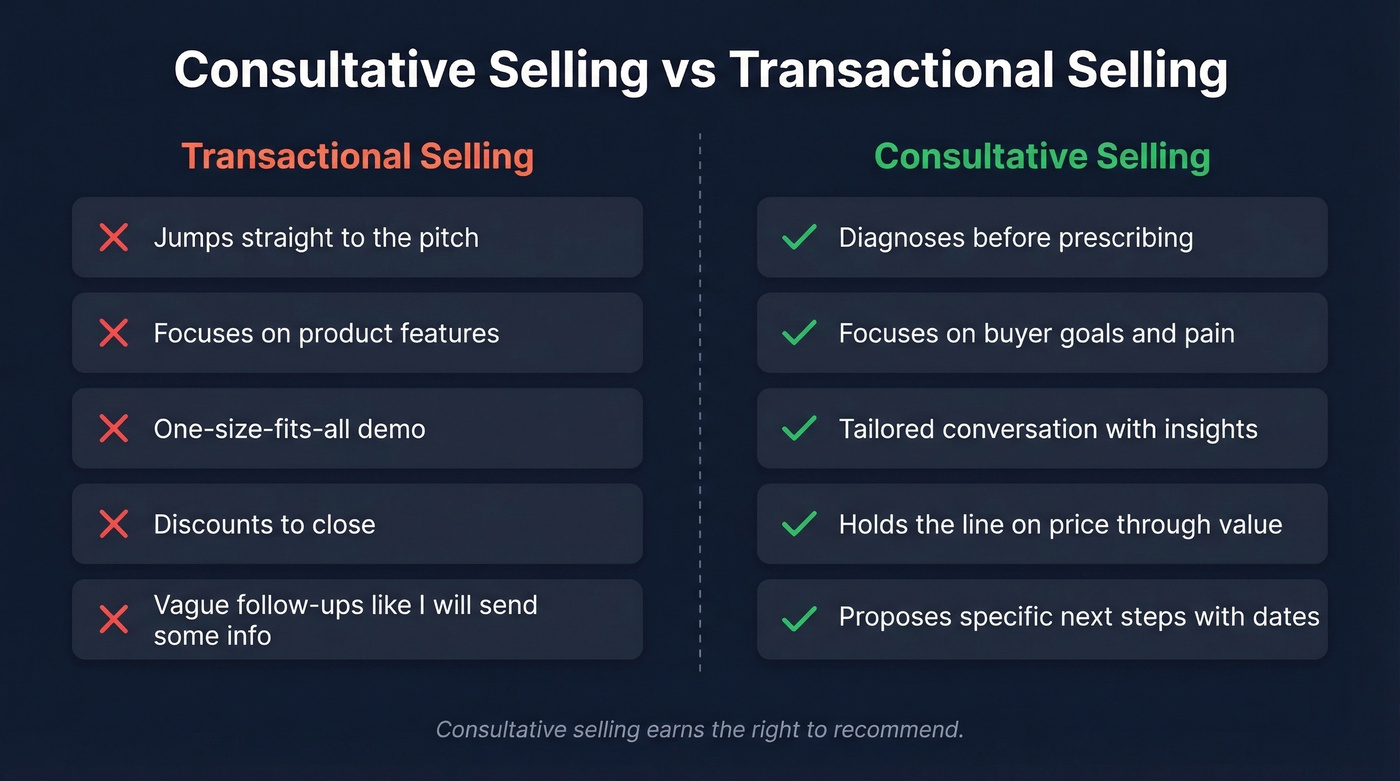
Consultative selling means diagnosing before prescribing. You lead with discovery, listen for what the buyer actually needs, and guide them toward a decision - even if that decision isn't your product. Sometimes the most consultative thing you can do is tell a prospect they're not a fit and refer them elsewhere. That builds more trust than any closed deal.
Let's kill three misconceptions:
- It's not passive. Consultative sellers challenge assumptions, push back on fuzzy thinking, and propose next steps. This isn't order-taking.
- It's not subservient. Done right, it helps you hold the line on price because you've built enough value that discounting feels unnecessary.
- It's not "just ask questions." You also need to teach. The best mental model is One-Up/One-Down: you're One-Up on your market expertise (you've seen this problem a hundred times), and One-Down on the buyer's specific business (they know their org better than you ever will).
Transactional selling skips the diagnosis. Consultative selling earns the right to recommend.

Consultative selling fails without pre-call research. Prospeo gives you technographics, buyer intent across 15,000 topics, headcount growth, and funding data - refreshed every 7 days. Walk into every discovery call One-Up.
Stop winging discovery calls. Start every conversation informed.
Techniques That Work
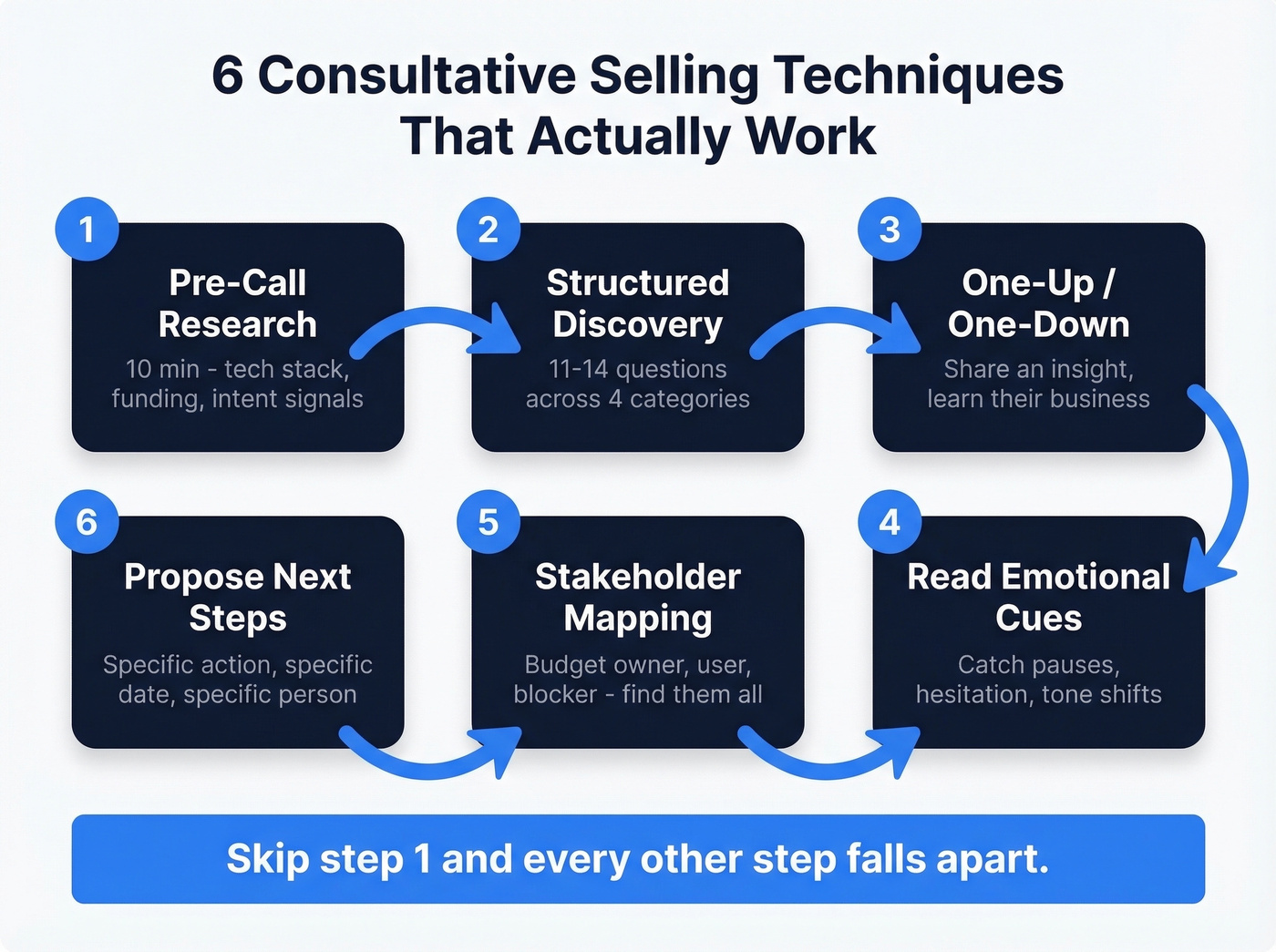
Pre-call research (10 minutes)
This is the single biggest differentiator between reps who sound consultative and reps who sound scripted. In our experience, the reps who spend 10 minutes before every call pulling the prospect's tech stack, recent funding, job changes, headcount growth, and intent signals close at noticeably higher rates than those who wing it. Skip this step and you're gambling with every conversation.
Prospeo's B2B database makes this fast - 300M+ professional profiles, 143M+ verified emails, technographics, and buyer intent signals across 15,000 topics. With a 7-day data refresh cycle, your homework reflects current reality, not stale CRM records from six months ago.
Structured discovery (not scripted)
A useful benchmark is the 11-14 question range. Fewer and you miss context. More and you're interrogating.
Structure your questions around categories - current state, goals, stakeholders, urgency - but never read them in order. Let the conversation guide which category you pull from next. A simple way to keep it natural: write your categories at the top of your notes, not the questions. Then you're listening for "which bucket are we in?" instead of "what line do I say next?"
One-Up/One-Down mindset
Walk into every call knowing something the buyer doesn't - a trend, a benchmark, a pattern you've seen across similar companies. That's your One-Up. Then genuinely learn what you don't know about their business. That's your One-Down. The interplay between the two is what makes a conversation feel consultative instead of transactional.
Reading emotional cues
This one can't be taught from a list. It has to be practiced.
Rep: "How's the current handoff between marketing and sales working?" Prospect: (long pause) "It's... fine." Rep: "That pause tells me it might not be fine. What's actually happening?" Prospect: "Honestly? We're losing 40% of MQLs in the handoff."
That pause was the signal. The best sellers notice these moments and lean in instead of plowing through to the next question. We've listened to hundreds of call recordings, and the reps who catch these micro-signals consistently outperform the ones running through their question list on autopilot.
Stakeholder mapping
Mid-market deals typically involve 6-10 stakeholders. Enterprise deals can hit 11+. Ask early: "Who else should weigh in on this decision?" Then map the budget owner, the day-to-day user, and the potential blocker. We've seen deals stall for months because a rep never identified the quiet VP who had veto power.
Proposing the next conversation
Here's the difference between a deal that moves and one that dies:
| Vague follow-up | Consultative next step |
|---|---|
| "I'll send over some info." | "Let's schedule 30 minutes next Tuesday to walk through the business case with your CFO." |
| "Let me know if you have questions." | "I'll draft a one-page ROI summary and send it by Thursday. Can we review it together Friday at 2?" |
| "I'll check back in a few weeks." | "Based on your Q3 deadline, we should loop in procurement by the 15th. Does that work?" |
Stalled deals don't stall because the buyer lost interest. They stall because the seller failed to propose a clear next step. If you need a repeatable system for this, keep a few sales follow-up templates ready so you can send the recap fast.
Frameworks Compared
| Framework | Research Basis | Core Approach | Best For | Limitation |
|---|---|---|---|---|
| SPIN | 35K calls, 20+ countries, 12 yrs | Question sequence (S-P-I-N) | Relationship-driven complex sales | Time-intensive, skill-dependent |
| Challenger | 6,000+ reps (CEB) | Teach, Tailor, Take Control | Buyers stuck in status quo | Requires deep market knowledge |
| MEDDIC | Practitioner-developed | Qualification checklist | Deal qualification | Not a discovery framework |
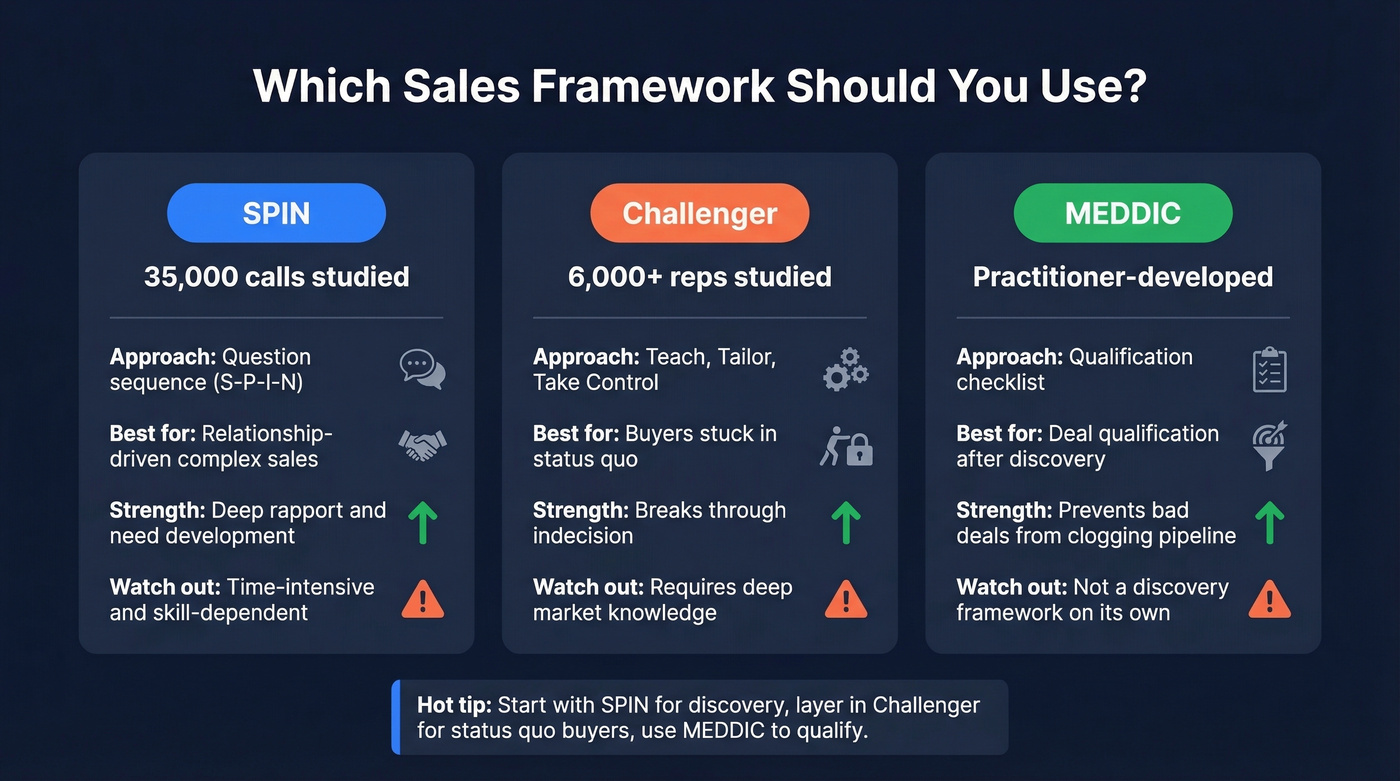
Companies with a defined sales process are 33% more likely to hit high-performance benchmarks. Xerox reported a 17% increase in sales and $65M in contract value after implementing Challenger - proof that picking a framework and committing to it pays off. Use SPIN when you're selling into relationship-driven, complex environments. Layer in Challenger when buyers are entrenched in the status quo and need to be pushed. Use MEDDIC for qualification after discovery, not as a substitute for it.
Hot take: If your average contract value is in the low four figures, you probably don't need a formal framework at all. Just do the pre-call research, ask good questions, and propose clear next steps. Frameworks shine in complex, multi-stakeholder deals where the cost of a bad discovery call is measured in months of wasted pipeline.
Discovery Questions You Can Steal
A good discovery call runs 15-30 minutes and covers 11-14 questions. Here's a bank organized by purpose - not a script to read aloud.
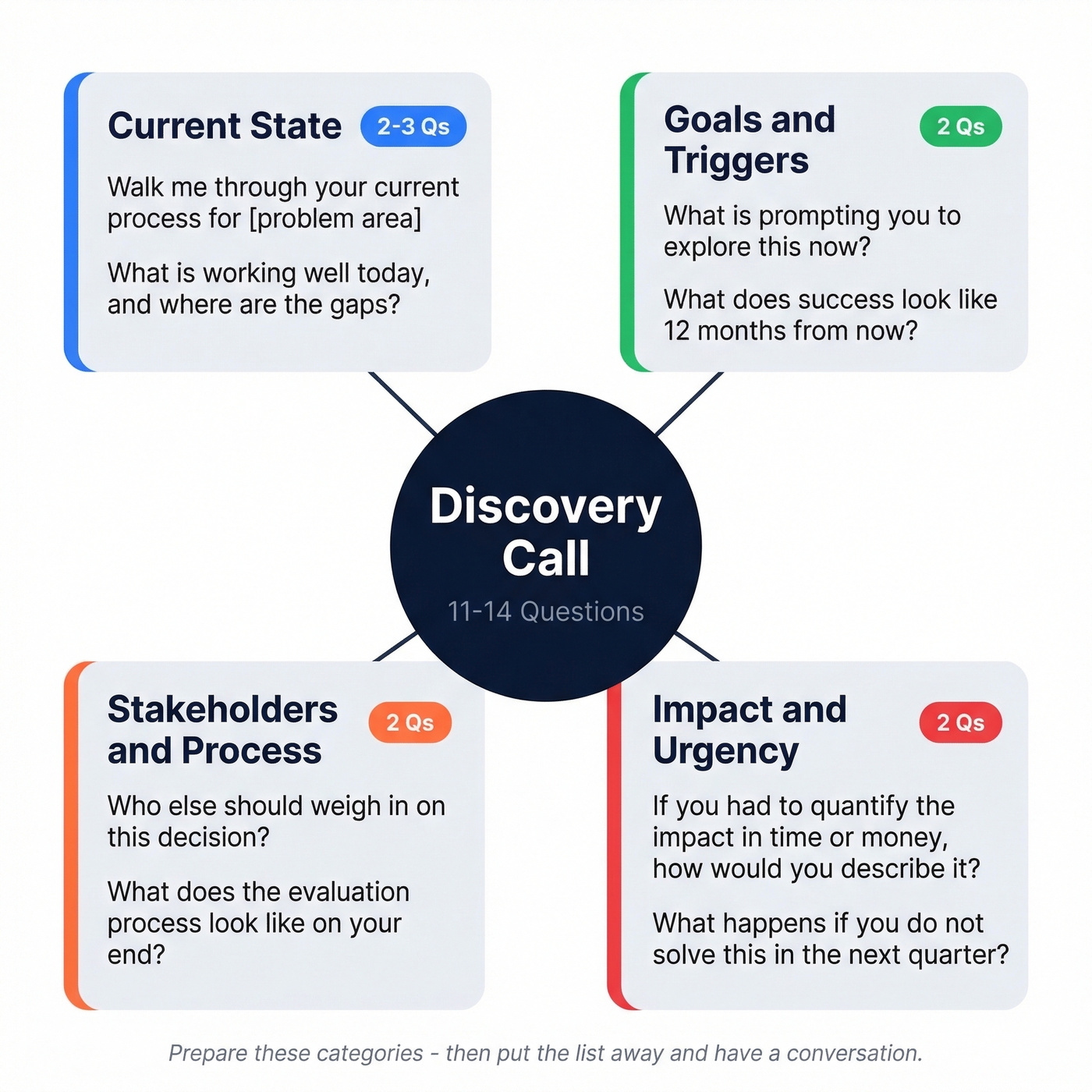
Current State (2-3 questions):
- "Walk me through your current process for [problem area]."
- "What's working well today, and where are the gaps?"
- "Beyond budget, how does your team evaluate solutions like ours?"
Goals & Triggers (2 questions):
- "What's prompting you to explore this now - has anything changed recently?"
- "What does success look like 12 months from now?"
Stakeholders & Process (2 questions):
- "Who else should weigh in on this decision?"
- "What does the evaluation process typically look like on your end?"
Impact & Urgency (2 questions):
- "If you had to quantify the impact in time or money, how would you describe it?"
- "What happens if you don't solve this in the next quarter?"
These are starting points. The moment you read them verbatim, you become the rep from the $15K training who got hung up on. Use them to prepare. Then put the list away and have a conversation.
Building the Skill Over Time
CSO Insights data shows it takes over 10 months for a rep to fully adopt a new sales methodology. This isn't a one-workshop transformation. It's a daily practice. Organizations investing in full sales enablement see ~49% higher win rates on forecasted deals.
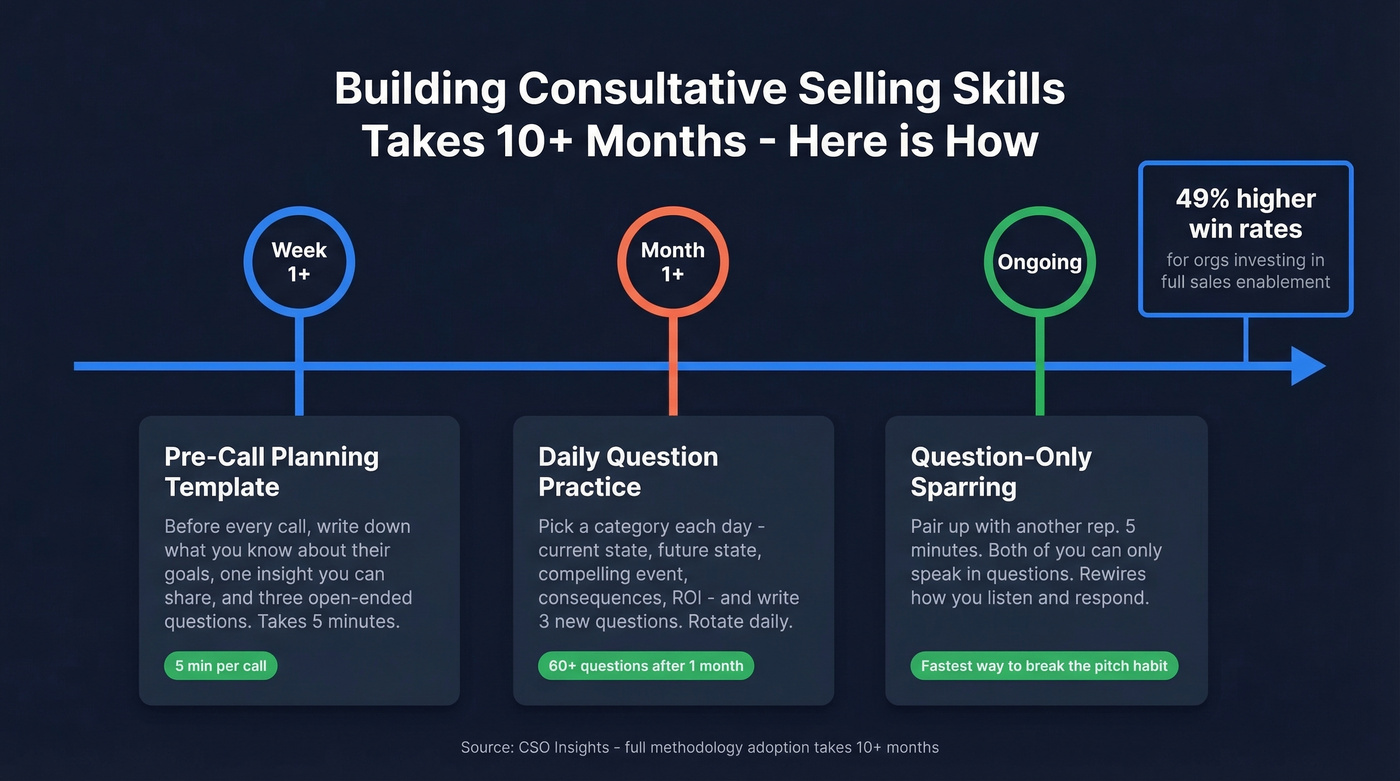
Three exercises that actually move the needle:
Pre-call planning template. Before every call, write down what you know about their goals and challenges, one insight you can share, and three open-ended questions. Takes five minutes. Changes everything.
Daily question practice. Pick a category each day - current state, desired future state, compelling event, consequences, ROI - and write three new questions. Rotate categories across the week. It sounds tedious, but after a month you'll have a mental library of 60+ questions you can pull from without thinking.
Question-only sparring. Pair up with another rep and have a five-minute conversation where both of you can only speak in questions. It sounds silly. It rewires how you listen and respond, and it's the fastest way to break the habit of jumping to your pitch.
By the time prospects talk to sales, 50-90% of the buying journey is already complete. Your discovery call isn't the beginning of their process - it's the middle. Show up prepared or don't show up. If you're building a broader outbound motion around this, start with proven sales prospecting techniques and tighten your lead scoring so the right accounts reach discovery.
Stakeholder mapping requires accurate contact data. Prospeo's 300M+ profiles with 98% email accuracy and 125M+ verified mobiles mean you reach the quiet VP with veto power - not a dead inbox. At $0.01 per email, bad data is no longer an excuse for stalled deals.
Map every stakeholder. Reach every decision-maker. Close faster.
FAQ
What's the difference between consultative selling and solution selling?
Consultative selling diagnoses the problem through discovery before recommending anything, while solution selling starts with a presumed need and fits a product to it. In practice, consultative works best for multi-stakeholder deals because it clarifies impact, decision criteria, and urgency before you ever demo.
How many questions should I ask on a discovery call?
Aim for 11-14 questions in a 15-30 minute call. That's enough context without turning it into an interrogation. If you're under 10, you'll miss stakeholders or urgency; over 15 and you're usually compensating for weak pre-call research.
How long does it take to learn consultative selling?
CSO Insights data says 10+ months for full methodology adoption, but you can see improvement in 2-4 weeks by practicing one behavior daily. Start with 10 minutes of pre-call research, then add stakeholder mapping and a "specific next step" close on every call.
What's a good tool for pre-call research?
For outbound teams, Prospeo is a strong pick - it combines 300M+ professional profiles with 98% verified email accuracy, 125M+ verified mobile numbers, and intent data across 15,000 topics. The free tier includes 75 emails plus 100 Chrome extension credits per month, enough to test it in real workflows before committing.
Quick summary for 2026
Stop trying to "sound consultative" and start showing up prepared. Do 10 minutes of research, run structured discovery without reading from a script, map stakeholders early, and always propose a concrete next conversation. That's how you earn trust with buyers who'd rather not talk to sales at all.