

Consultative Selling vs Traditional Selling: What to Actually Do Differently
Your manager just pulled you aside and said you're "too transactional." You nodded, walked back to your desk, and immediately searched what that actually means. You're not alone - this is one of the most common pieces of feedback on r/sales, and it's almost always vague.
The consultative selling vs traditional selling debate isn't new, but efficiency matters more than ever: the median B2B SaaS company spends $2 to acquire $1 of new ARR. The selling motion you choose is the difference between efficient growth and lighting money on fire.
The Short Version
- Traditional selling = pitch-first, close-fast, seller-driven. Works for lower price-point, simple purchases.
- Consultative selling = discover-first, advise-second, buyer-driven. Works for complex B2B, multi-stakeholder deals.
- Most teams need both. The skill is knowing when to shift.
- If your deal size is small and your product has a free trial, a six-call discovery process is overkill.
What Is Traditional Selling?
Traditional selling is transactional and product-focused. The rep owns the conversation, leads with features, and drives toward a close. It's not inherently bad - it's built for a specific type of sale.
The hallmarks:
- Scripted pitches with a standard talk track (see talk track examples)
- Persuasion and urgency as primary levers ("this pricing expires Friday")
- One-size-fits-all messaging regardless of the buyer's situation
- Seller-driven cadence where the rep controls the timeline
Think of it as product-push selling: the rep focuses on winning that one sale and moving to the next. It works when the buyer already knows what they need and just wants speed.
What Is Consultative Selling?
Consultative selling flips the dynamic. Instead of leading with your product, you lead with the buyer's problem. The rep acts as a trusted advisor - asking questions, listening actively, and tailoring the recommendation to what actually fits.
- Open-ended discovery questions before any pitch (use a discovery questions bank)
- Active listening and follow-up probes
- Trusted-advisor positioning over vendor positioning
- Collaborative problem-solving where the buyer shapes the solution
This isn't feel-good theory. 87% of buyers expect salespeople to act as trusted advisors, per Salesforce research. The bar has moved. Buyers know the difference between someone who's genuinely diagnosing their problem and someone reading a script, and they'll ghost the script-reader every time.
Side-by-Side Comparison
| Dimension | Traditional | Consultative |
|---|---|---|
| Focus | Product features | Buyer's problem |
| Sales cycle | Shorter | Longer |
| Typical deal size | Lower | Higher |
| Relationship depth | Transactional | Partnership |
| Best for | Office supplies, DTC, HVAC | SaaS, service businesses, real estate |
| Primary risk | Churn, low trust | Over-investing in bad fits |
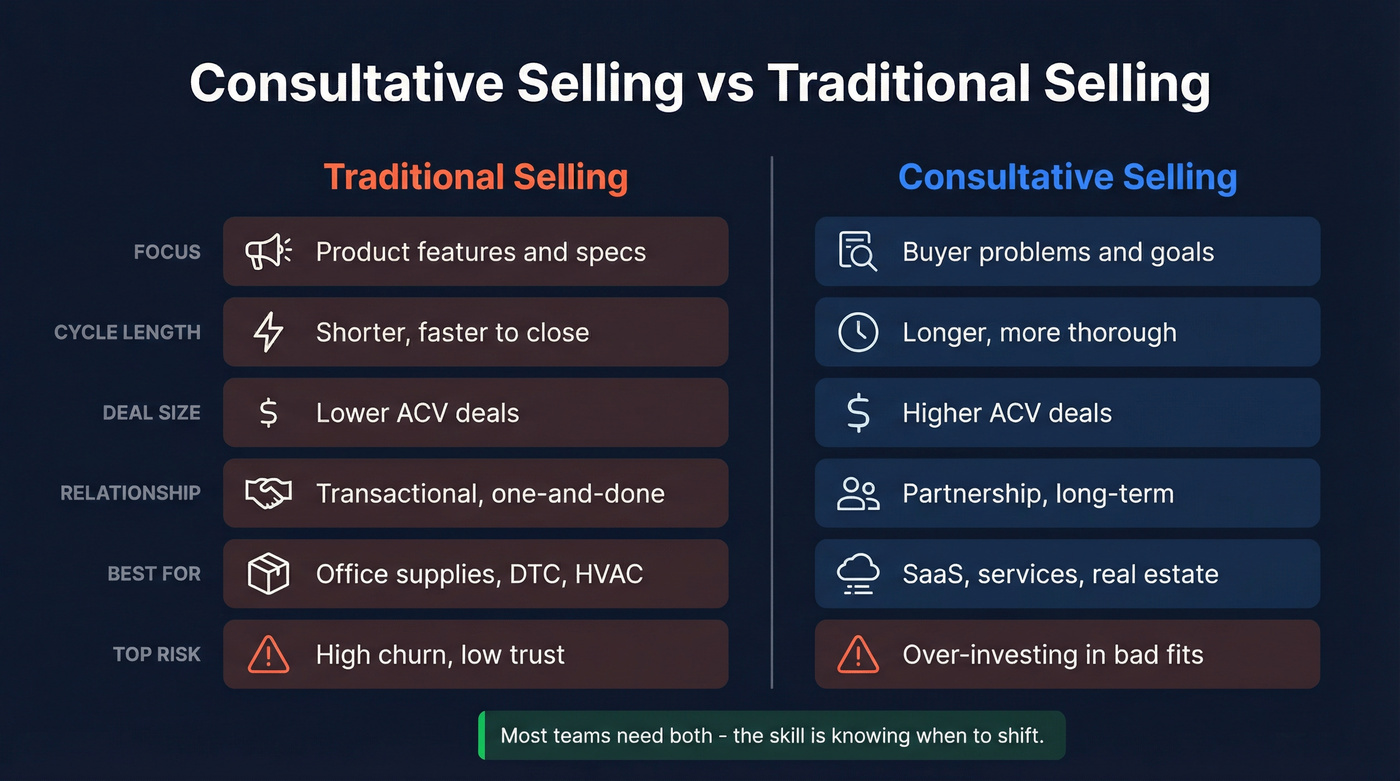
Neither column is universally better. A rep selling office supplies consultatively is wasting everyone's time. A rep selling enterprise SaaS transactionally is leaving money and retention on the table.
The best teams run a hybrid motion: transactional qualification and PLG entry on the front end, then consultative expansion once the deal crosses a complexity or ACV threshold.

Whether you run a transactional or consultative motion, both fail if your contact data bounces. Prospeo's 98% verified emails and 125M+ direct dials mean your reps actually reach decision-makers - so discovery calls happen instead of getting ghosted by dead inboxes.
Stop prepping SPIN questions for prospects you'll never reach.
When Traditional Wins
Here's the contrarian take most guides won't give you: the traditional sales approach isn't dead. It's misapplied.
Traditional works when four conditions are true: the deal size is low, the buyer already knows what they need, the purchase is simple, and pricing is public. That describes a huge chunk of the market. 39% of Series A startups now enable PLG/self-serve from a dataset of 474 companies, and in DevTools the number hits 50%. These companies aren't running six-call discovery sequences - they're removing friction so buyers can close themselves.
Hot take: if your ACV is under $5K and your buyer is the end user, you probably don't need a consultative approach at all. Forcing it onto a PLG/self-serve funnel is like bringing a sommelier to a beer garden.
When Consultative Wins
Consultative selling earns its overhead when the stakes are high enough to justify it. Multi-stakeholder deals, long implementation timelines, high switching costs, compliance requirements - these are the conditions where discovery isn't optional. It's the whole game.
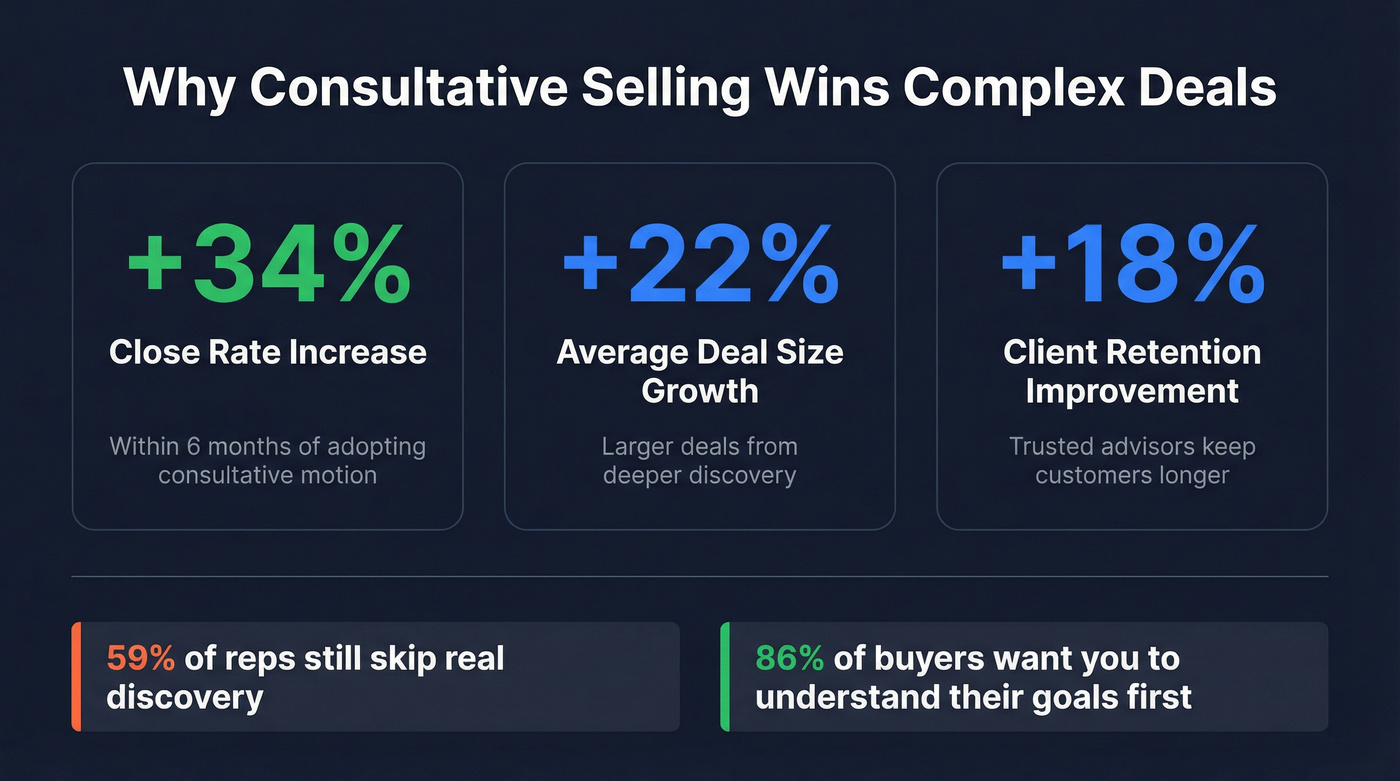
The data backs this up: 86% of business buyers are more likely to buy when a company understands their goals, yet 59% say most reps don't bother. That gap is where advisory-style sellers win. Teams that shift to a consultative motion see close rates jump 34%, average deal size grow 22%, and client retention improve 18% within six months - numbers that are hard to argue with when you're defending a longer sales cycle to your VP.
If your deal involves more than two stakeholders and a switching cost, you can't afford to skip discovery.
A Steal-able SPIN Question Bank
Knowing you should "ask better questions" is useless without a framework. SPIN Selling - built from 35,000+ sales calls across 20+ countries - gives you one. Here's a question bank organized by SPIN category that we've seen work well in our own outbound conversations.
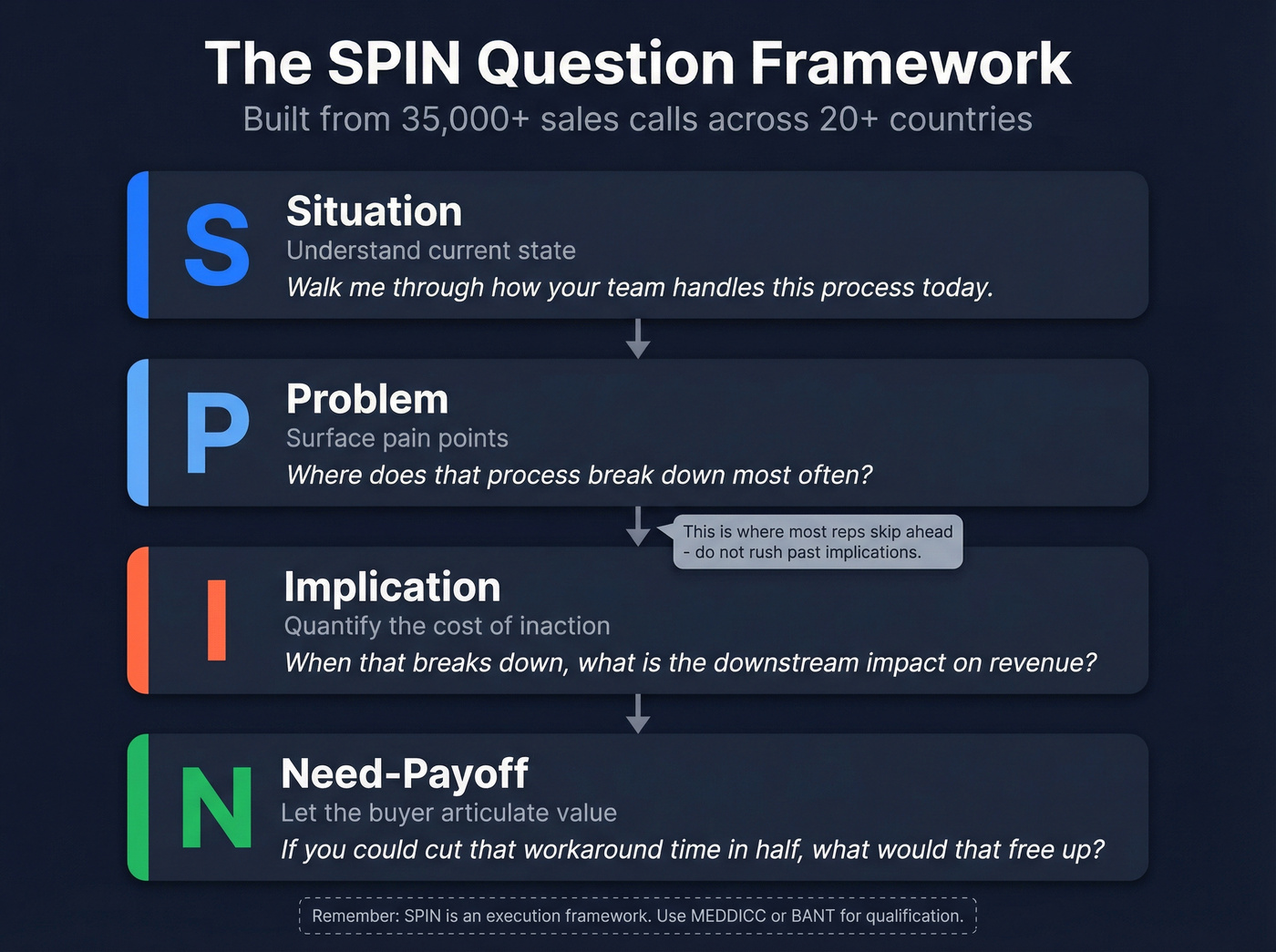
Situation (Understand Current State)
- "Walk me through how your team handles [process] today."
- "What tools are you currently using for [function]?" (tie it back to your ideal customer profile)
Problem (Surface Pain)
- "Where does that process break down most often?"
- "What's the biggest frustration your team has with the current setup?"
Implication (Quantify the Cost)
- "When that breaks down, what's the downstream impact on [revenue/timeline/team]?"
- "How much time does your team spend working around that issue each week?"
Need-Payoff (Let the Buyer Articulate Value)
- "If you could cut that workaround time in half, what would that free up?"
- "What would solving this mean for your Q3 targets?"
One thing to keep straight: SPIN and Challenger are execution frameworks - they guide how you run conversations. BANT and MEDDICC are qualification frameworks - they help you decide if an opportunity is real. You qualify with MEDDIC, then execute with SPIN. Mixing them up is a common mistake, and it leads to reps asking qualification questions when they should be building urgency.

The Pivot Problem
Let's be honest about the most common objection to consultative selling: it's not that it doesn't work. It's that being too consultative feels fake. Buyers know you're selling. Spending 40 minutes asking questions without ever showing your hand doesn't build trust. It builds suspicion.
The consensus on r/sales threads about this is pretty clear - buyers respect reps who are upfront about why they're calling and then earn the right to go deeper. Nobody wants to feel like they're being therapist-ed into a purchase.
Match your depth of discovery to the buyer's depth of uncertainty. If they're already educated, compress - give them the demo in five minutes (use a product demo checklist). If they're still figuring out the problem, expand. The framework serves you; you don't serve the framework.
And none of this matters if your first touchpoint never lands. Consultative selling starts before the call - with research and a clean contact list. If your emails bounce or you're calling dead numbers, your discovery call never happens. That's why we built Prospeo with a 7-day data refresh cycle and 98% email accuracy: so the consultative process can actually begin (and your email bounce rate stays under control).
Choosing Your Motion, Deal by Deal
Choosing between consultative selling vs traditional selling isn't a permanent identity. It's a situational decision you make deal by deal, sometimes call by call. The best closers we've worked with read the room and flex accordingly - transactional speed for the buyer who already has budget approved and just needs a quote, deep discovery for the VP who's still building the business case internally (see enterprise B2B sales).
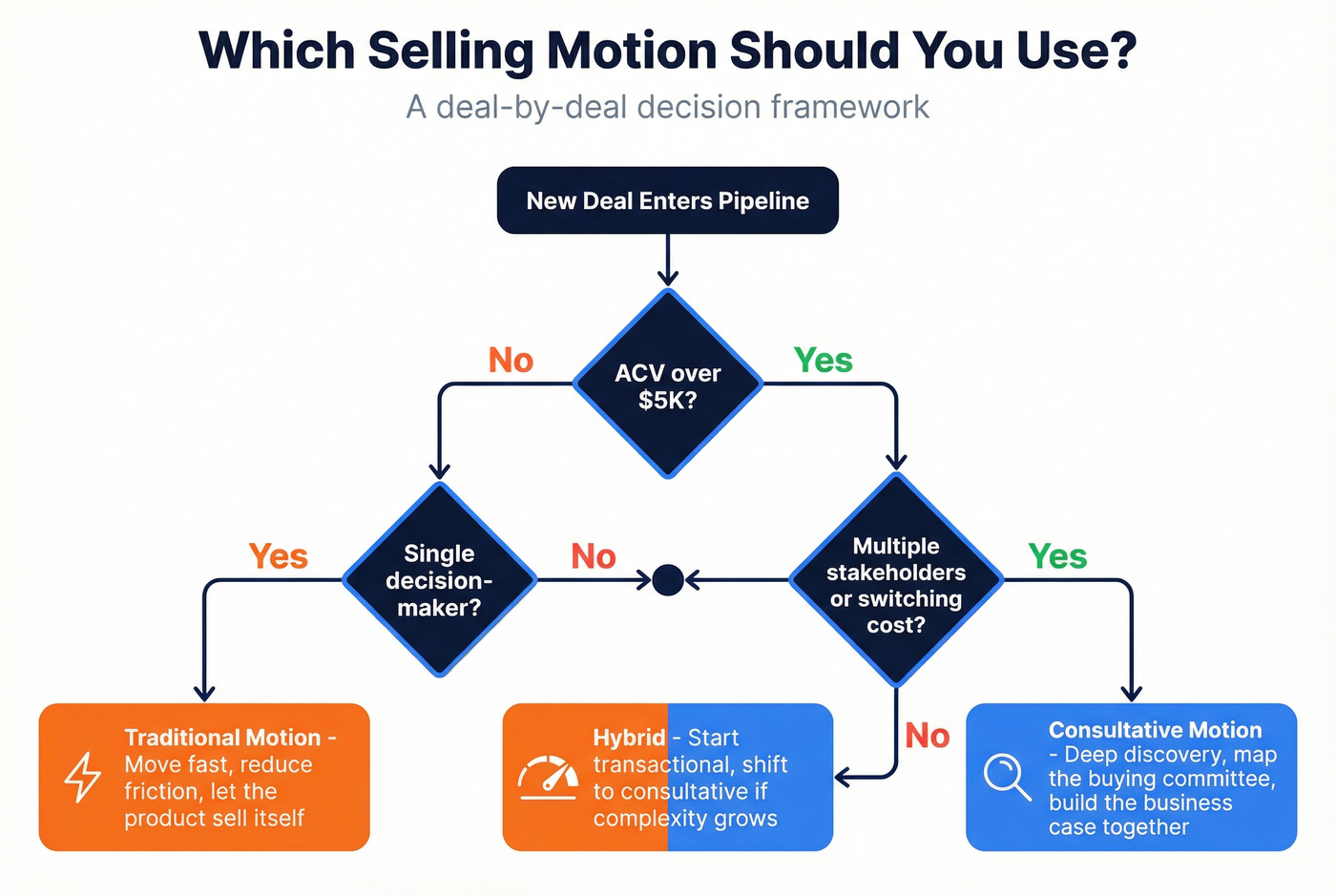
Skip the consultative playbook if your buyer is a single decision-maker spending under $5K on a product with public pricing and a free trial. Go deep on discovery when there are multiple stakeholders, a switching cost, or a contract value that justifies the extra investment in understanding their world.
Multi-stakeholder deals need multi-threaded outreach. Prospeo gives you 30+ filters - buyer intent, department headcount, job changes - so you can map the entire buying committee before your first discovery call. At $0.01 per email, consultative selling finally scales.
Build your buying committee list in minutes, not days.
FAQ
Is consultative selling the same as solution selling?
They overlap but aren't identical. Solution selling starts with a predefined solution and works backward to fit the buyer's needs. Consultative selling starts with the buyer's problem and may recommend walking away if the fit isn't there. That willingness to disqualify is what separates the two.
How do I train my team to shift from traditional to consultative?
Start with SPIN question practice in recorded role plays, then measure discovery-to-demo ratio and questions asked per call - not just close rate. Teams that track these leading indicators typically see improvement within one quarter. The biggest hurdle isn't skill; it's getting reps comfortable with silence after asking an open-ended question.
Can you combine both approaches?
Yes, and most high-performing teams do. Use a transactional motion for deals under $10K with a single buyer, then shift to consultative discovery once deal complexity, stakeholder count, or contract value crosses a threshold worth the extra investment. The line between the two isn't a wall - it's a dial you adjust.