

Conversation Intelligence: What It Is, What It Costs, and Which Tools Actually Deliver
Your VP of Sales wants to know why reps are losing winnable deals. The CRM says the pipeline is healthy. The forecast looks fine. But somewhere between the first call and the closed-lost email, something's going wrong - and nobody can tell you what.
That's the exact problem conversation intelligence was built to solve, and in 2026 it's a $27.4 billion market growing at 8.2% CAGR. The tooling has matured. The question isn't whether CI works - it's which flavor you actually need and how much you should pay for it.
What You Need (Quick Version)
- Enterprise (50+ reps): Gong is the most common enterprise default. Budget ~$50K platform fee plus $1,600/user/year. Pair it with clean upstream data or you're analyzing garbage.
- Mid-market (10-50 reps): Outreach Kaia or HubSpot Sales Hub CI. If you're already paying for the platform, use the CI that's bundled in.
- SMBs and startups (under 10 reps): Fathom at $19/mo or Fireflies at $10/mo. Don't overspend. You need transcription, summaries, and basic coaching - not a six-figure analytics suite.
- Already on a CRM with CI built in? Use what you have. HubSpot and Outreach ship CI features inside their core platforms, and Salesforce has native conversation insights in its ecosystem. Standalone tools like Gong offer deeper analytics, but bundled CI covers 80% of use cases.
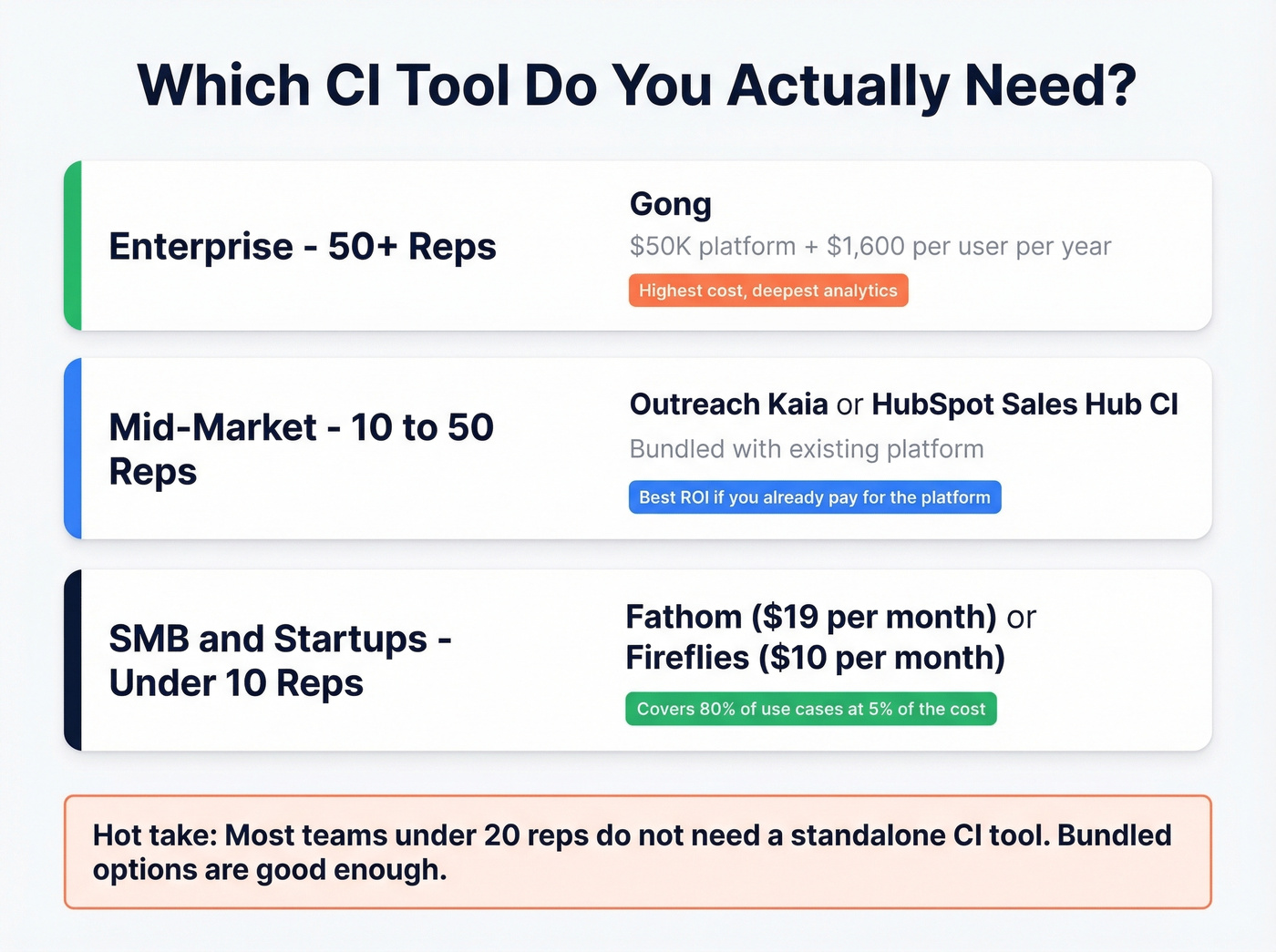
Here's the contrarian take most articles won't give you: most teams don't need a standalone CI tool anymore. The bundled options have gotten good enough that paying separately for CI is a luxury reserved for orgs with 50+ reps and dedicated enablement staff. If your average deal size is under $15K and your team is under 20 reps, a standalone CI platform will almost certainly be your worst ROI line item.
What Is Conversation Intelligence?
Conversation intelligence is AI-powered analysis of business conversations - calls, video meetings, and (in some tools) emails - that turns unstructured dialogue into structured, actionable data. Instead of relying on reps to self-report what happened on a call, CI tools record, transcribe, and analyze every interaction automatically. At its core, conversational intelligence gives revenue teams visibility into the interactions that drive pipeline without relying on subjective call notes.
Under the hood, these platforms combine natural language processing and machine learning models. They layer on sentiment analysis, speaker diarization (labeling who said what), and keyword detection to produce coaching insights, deal risk signals, and pipeline forecasting data that would take a human manager hundreds of hours to extract manually.
One distinction worth nailing down: CI and conversational AI aren't the same thing. Conversational AI participates in interactions - chatbots, virtual assistants, IVR systems. Conversation intelligence listens and learns. One talks; the other analyzes. They're complementary, but if you're shopping for CI, you're shopping for the listening side.
While this guide focuses on sales applications, CI use cases extend well beyond the sales floor. Contact centers use it for QA and agent coaching, customer success teams track sentiment trends across renewal calls, and healthcare organizations analyze patient interactions for compliance. The deepest tooling and the biggest budgets, though, live in B2B sales - and that's where we'll spend our time.
The practical output varies by tool, but at minimum you're getting call transcripts, talk-time ratios, topic tracking, and some form of deal health scoring. The better tools layer on coaching scorecards, competitive mention alerts, and CRM-synced next steps that actually reduce admin work for reps.
How CI Software Works
The CI workflow breaks into four stages. Understanding how the technology works helps you evaluate which tools are doing real work versus just slapping "AI-powered" on a transcription service.
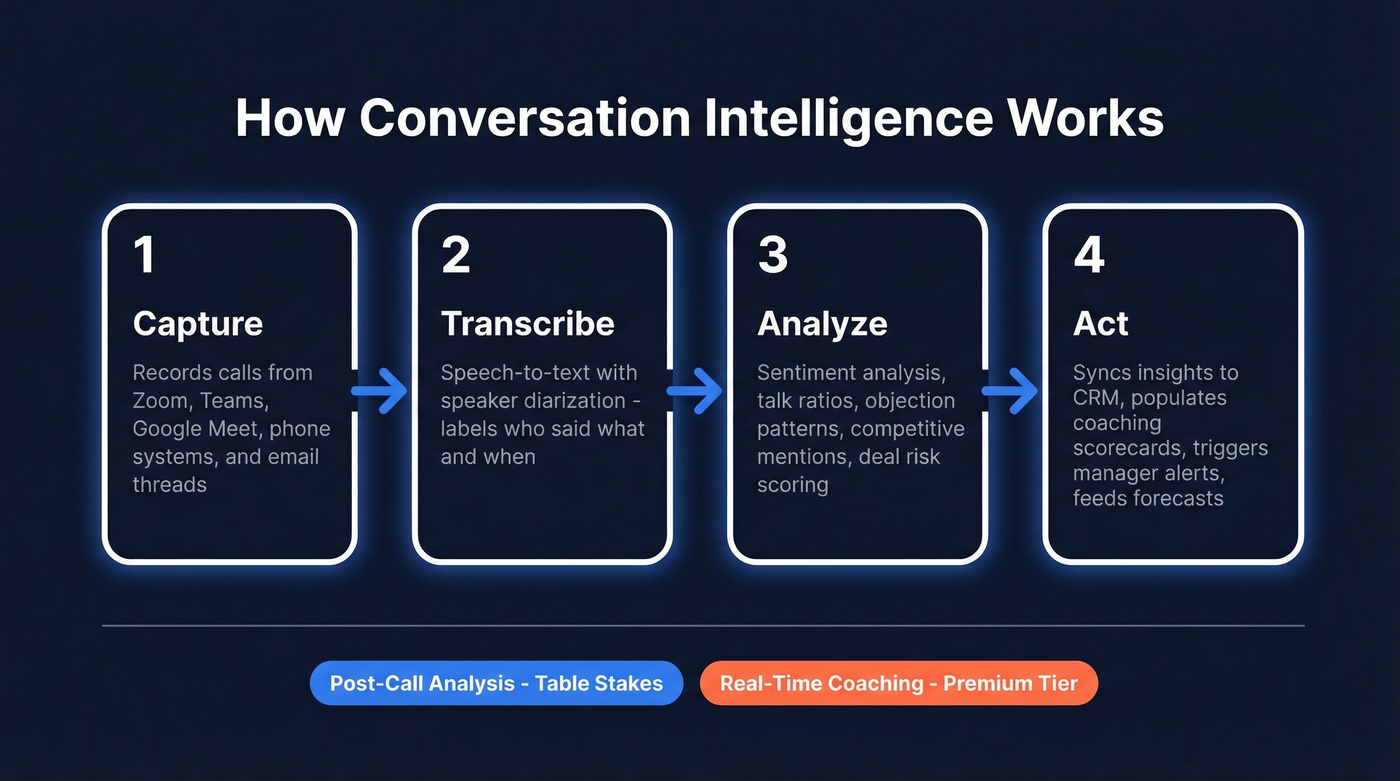
Stage 1: Capture. The tool records conversations from wherever your team works - Zoom, Teams, Google Meet, phone systems, and in some platforms, even email threads. Some tools join meetings as a visible bot, which creates friction with prospects. Grain uses a desktop app to capture without a bot presence.
Stage 2: Transcribe. Speech-to-text engines convert audio to text with speaker diarization. Transcription quality varies wildly across tools, especially with accents, background noise, and multi-speaker crosstalk. This is where cheap tools fall apart.
Stage 3: Analyze. This is where AI earns its keep. The platform runs sentiment analysis, calculates talk ratios, flags competitive mentions, identifies objection patterns, and scores deal risk based on conversation signals. The best tools analyze patterns across hundreds or thousands of calls - not just individual meetings. That's the difference between a transcription tool and actual intelligence.
Stage 4: Act. Insights sync back to your CRM, populate coaching scorecards, trigger manager alerts, and feed pipeline forecasting models. Some platforms offer real-time guidance during live calls - surfacing battlecards, objection responses, and pricing guidance while the rep is still talking.
The real-time versus post-call distinction matters. Post-call analysis is table stakes now. Real-time coaching is where the category is heading, and it's the feature that justifies premium pricing for teams with newer reps who need in-the-moment support.
Benefits for Sales Teams in 2026
U.S. sales teams using CI report win-rate improvements of 10-18%. That's not a marginal gain. On a team closing $5M/year, even the low end of that range represents $500K in additional revenue.
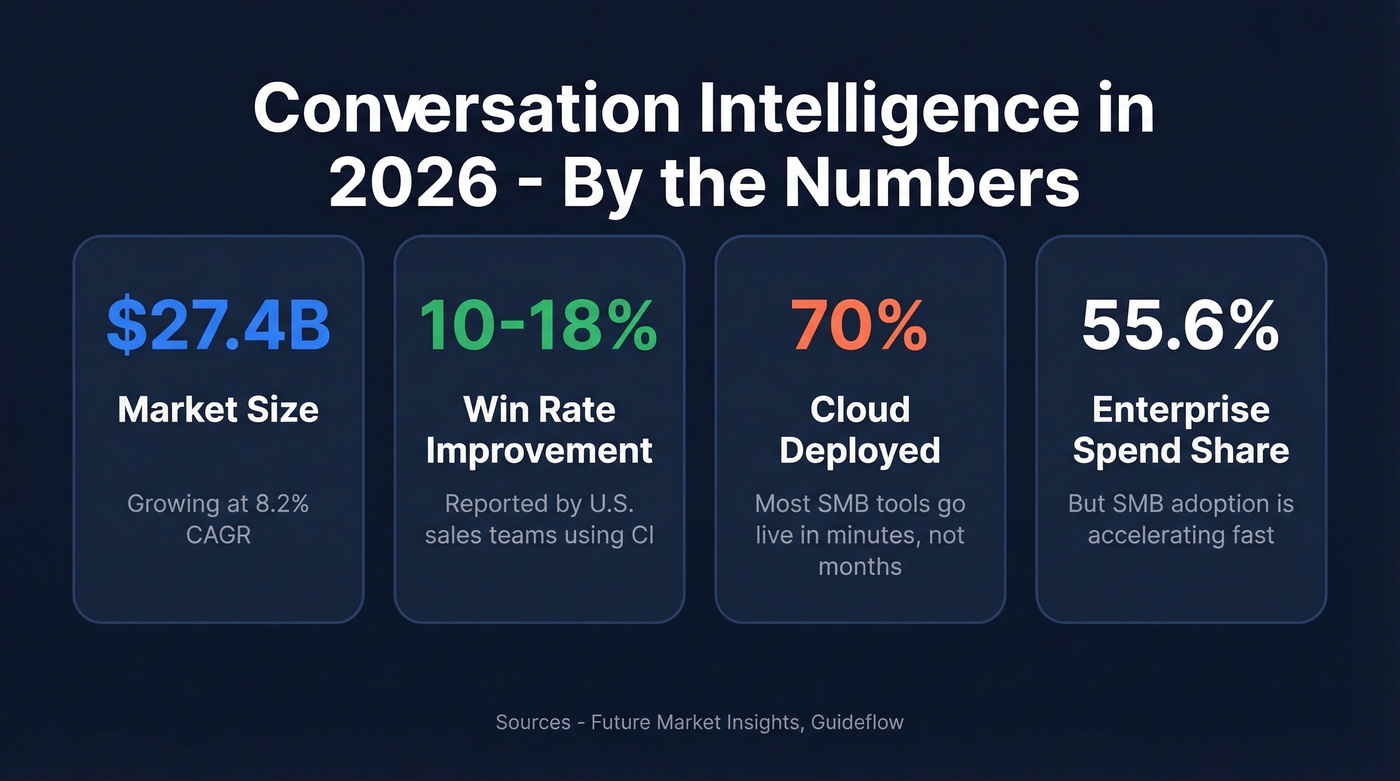
Cloud deployment now accounts for 70% of the CI market, which means implementation timelines have collapsed. You're not running a six-month on-prem deployment anymore - most SMB tools are live in minutes. Large enterprises still represent 55.6% of end-user spend, but SMB adoption is accelerating fast as tools like Fathom and Fireflies drop entry prices below $20/mo.
The bigger trend reshaping the category is bundling. HubSpot, Salesforce, and Outreach increasingly include conversation insights inside broader sales platforms. Reddit threads in r/hubspot consistently show users asking for affordable CI that integrates with their existing CRM - and the answer increasingly is "you already have it."
Standalone CI tools are becoming a luxury, not a necessity. Gong still offers some of the deepest analytics in the market, but for teams that just need transcription, coaching highlights, and CRM sync, the bundled options are good enough. We've seen mid-market teams move off $30K+ Gong contracts and switch to native CI inside their existing stack without missing a beat.

CI tools analyze conversations - but only if your reps are talking to real decision-makers. Prospeo's 300M+ verified profiles and 125M+ direct dials mean your team spends less time chasing bad numbers and more time having the calls that CI platforms actually learn from.
Better conversations start with better data. At $0.01 per verified email.
Recording Consent and Compliance
Before you record a single call, you need to understand consent laws. Getting this wrong isn't a slap on the wrist - it's a potential felony in some states.
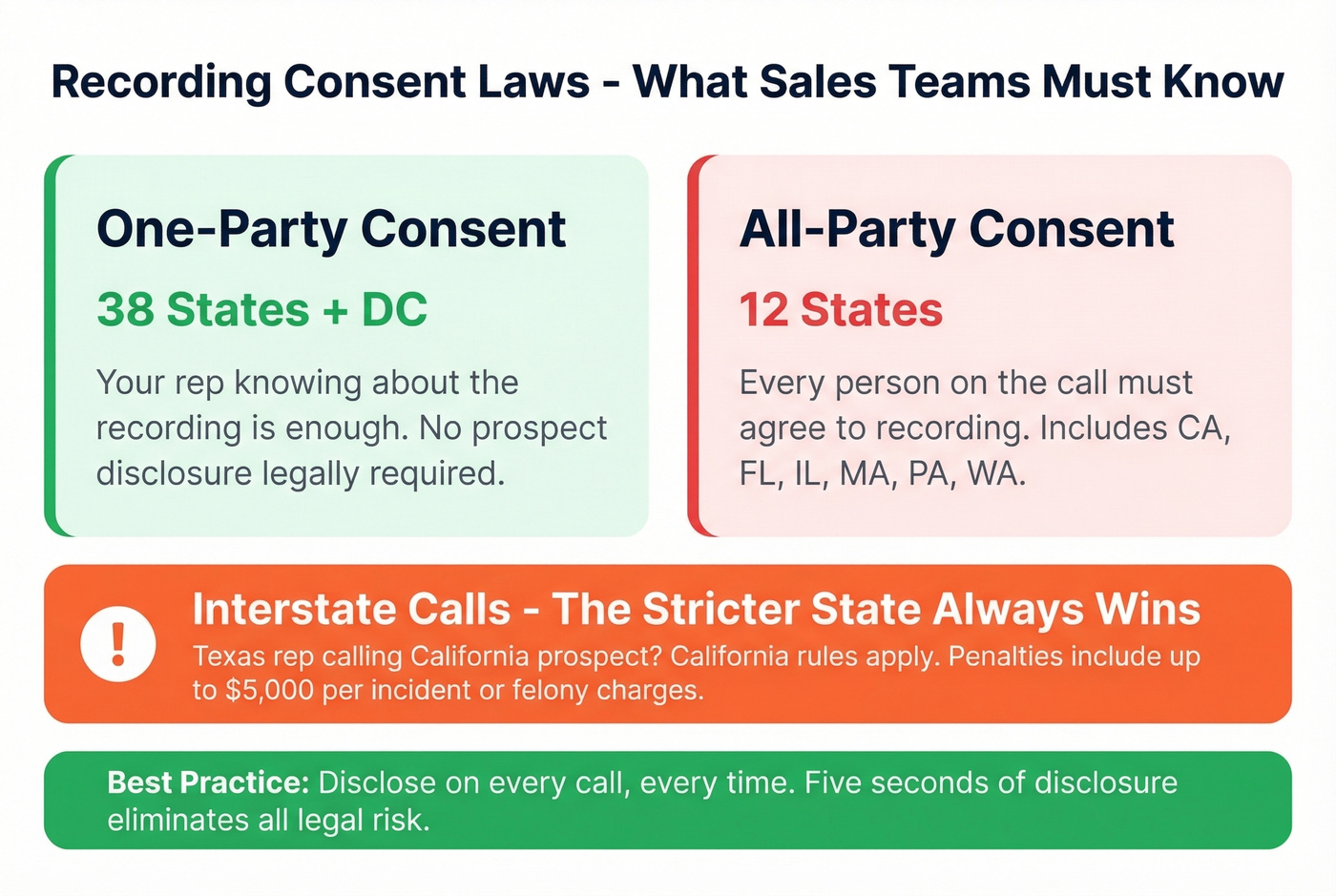
The federal baseline under ECPA permits one-party consent, meaning one person on the call (your rep) can consent to recording. But states can be stricter, and 12 of them are.
One-party consent: 38 states plus DC. Your rep's knowledge of the recording is sufficient.
All-party consent: 12 states require every participant to agree - California, Florida, Illinois, Massachusetts, Pennsylvania, and Washington among them.
For interstate calls - which is most B2B sales - the stricter law applies. If your rep is in Texas (one-party) calling a prospect in California (all-party), California's rules govern.
| Consent Type | States | Key Rule |
|---|---|---|
| One-party | 38 states + DC | One participant's consent is enough |
| All-party | 12 states (CA, FL, IL, MA, PA, WA, etc.) | Every party must consent |
| Interstate | N/A | Stricter state's law applies |
The penalties are real. California violations carry up to $5,000 per incident or triple actual damages. Florida classifies violations as third-degree felonies - up to five years in prison. California's AB 2905, in effect since January 2025, adds a $500 fine per undisclosed AI-assisted call.
Best practice is universal disclosure. Every call, every time, regardless of state. "This call is being recorded for quality and training purposes" takes five seconds and eliminates the legal risk entirely. Every major CI tool supports automated disclosure prompts - use them.
How to Evaluate CI Platforms
Not all CI tools are created equal. Here's what actually matters when you're running an evaluation:
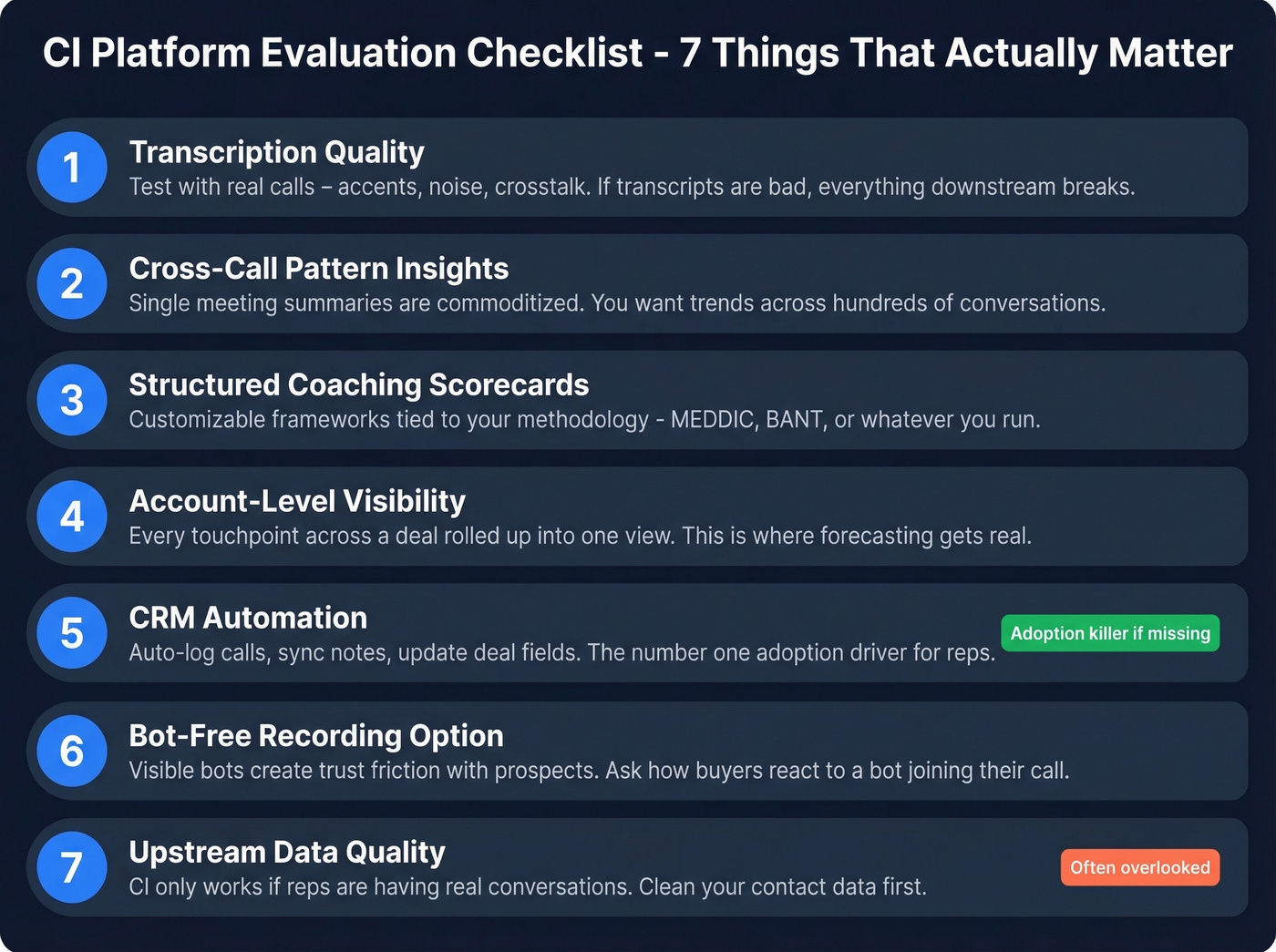
Transcription quality. Test with real calls - accented speakers, noisy backgrounds, multi-person meetings. If the transcript is garbage, everything downstream breaks.
Pattern insights across calls. Single-meeting summaries are commoditized. You want tools that analyze trends across hundreds of conversations - which objections are killing deals, which talk tracks correlate with wins.
Structured coaching scorecards. Managers need a framework, not a wall of transcripts. Look for customizable scorecards tied to your methodology (MEDDIC, BANT, whatever you run). If you're standardizing coaching, it helps to align on B2B sales best practices so scorecards match how your team actually sells.
Account-level visibility. Meeting-level insights are useful. Account-level rollups showing every touchpoint across a deal are where forecasting gets real.
CRM automation. The #1 adoption driver is reducing admin work. If the tool auto-logs calls, syncs notes, and updates deal fields, reps will actually use it. If it doesn't, they won't - no matter how good the analytics are. (If you're tightening workflows, compare options in CRM automation.)
Bot-free vs. bot-based recording. Some tools join meetings as a visible bot participant, which creates trust friction with prospects. Grain's desktop-app approach avoids this entirely. Ask yourself how your buyers will react to "Gong Bot has joined the meeting."
Upstream data quality. CI can only analyze conversations that happen. If your reps are calling disconnected numbers or emailing invalid addresses, you're paying for a tool that has nothing to analyze. Clean your contact data first - then invest in analyzing the conversations that follow. (If you're auditing sources, start with a verified contact database and a short list of the best B2B database options.)
Best Conversation Intelligence Tools
| Tool | Best For | Pricing | G2 Rating | Key Differentiator |
|---|---|---|---|---|
| Gong | Enterprise (50+ reps) | ~$50K platform + $1,600/user/yr | 4.7/5 | Deep analytics + deal intelligence |
| Fathom | SMBs & solopreneurs | From $19/user/mo (free tier) | 4.8/5 | Fast setup, strong summaries |
| Fireflies.ai | Budget teams | From $10/user/mo (free tier) | 4.5/5 | Cheapest paid plan |
| Outreach Kaia | Mid-market on Outreach | Bundled w/ Outreach | 4.3/5 | Real-time in-call guidance |
| Avoma | Small sales teams | From $19/user/mo | 4.6/5 | Meeting lifecycle mgmt |
| HubSpot Sales Hub | HubSpot CRM users | From $45/mo | N/A | Native CRM integration |
| Chorus (ZoomInfo) | ZoomInfo customers | ~$8K/yr (3 seats) | 4.5/5 | Strong if you're already in ZoomInfo |
| Grain | Teams wanting bot-free recording | $19-$39/user/mo | 4.6/5 | Bot-free recording |
| Apollo | All-in-one prospecting | From $49/user/mo | N/A | CI bundled with sequencing |
| CallRail | Call-tracking teams | From ~$45/mo | N/A | Call tracking + conversation analytics |
| Salesforce Einstein | Salesforce orgs | Included in Salesforce ecosystem | N/A | Native to Salesforce |
Gong
Use this if: You have 50+ reps, a dedicated enablement team, and the budget to match. Gong's analytics are among the deepest in the category - models trained on billions of sales interactions, 99% interaction capture, and account-level deal intelligence that goes well beyond what bundled CI tools offer. It remains the benchmark for enterprise-tier CI, and for good reason: the cross-call pattern analysis, competitive intelligence tracking, and forecasting models are genuinely a tier above everything else on this list.
Skip this if: You're a small team. Gong's pricing is a three-part model: ~$50,000/year platform fee plus $1,600/user/year, plus $7,500-$28,500 in onboarding and professional services. Add-ons like Forecast ($700/user/year) and Engage ($800/user/year) push costs higher. Multi-year contracts are standard, and typical renewals include 5-7% annual increases. Negotiated rates can drop per-user costs to $1,000-$1,349, but you need leverage.

Here's the thing: Gong is priced for enterprise and it knows it. One Reddit user reported being disqualified from even getting a demo because their team was too small. If you're under ~20 reps, look elsewhere - you'll get 80% of the value from tools at 10% of the cost.
Fathom
Fathom is one of the highest-rated tools in the category at 4.8/5 on G2. Setup is instant - no IT involvement, no multi-week rollout, no onboarding fee. You sign up, connect your calendar, and start getting AI-generated summaries after your next meeting.
Pricing starts at $19/user/month with a functional free tier. The transcription quality is solid, the summaries are actionable, and the coaching highlights cover the basics without overwhelming you with dashboards you'll never open. Where Fathom falls short is cross-call pattern analysis and account-level deal intelligence - it's built for speed and simplicity, not for 200-person sales orgs with complex forecasting needs. For teams under 10 reps, it's the best value in the category.
Fireflies.ai
Imagine this: you're a five-person startup, you just closed your seed round, and your co-founder asks what CI tool to buy. Fireflies at $10/user/month on annual billing. That's $600/year for your whole team - less than a single month of Gong's platform fee.
There's a free tier for testing, implementation takes minutes, and it connects to major meeting platforms and many CRMs. The trade-off is sophistication. Fireflies is a transcription-and-insights tool first, a coaching platform second. You won't get real-time in-call guidance or deep cross-call analytics. But for the price, that's a fair trade. G2 rating sits at 4.5/5, and the sweet spot is teams of 3-15 reps who need meeting intelligence without a line item that requires CFO approval.
Outreach Kaia
Outreach Kaia is the play for mid-market teams already running Outreach as their sequencing platform. It's bundled - no separate contract - and delivers real-time in-call guidance that surfaces battlecards, content cues, and objection responses while reps are live with prospects. Outreach reports 19% shorter sales cycles and 36% higher follow-up booking rates with Kaia enabled. If you're not on Outreach, this isn't relevant. If you are, turn it on.
Avoma
Avoma positions itself as meeting lifecycle management - covering everything from scheduling and agenda templates through transcription, analysis, and follow-up. At $19/user/month with a G2 rating of 4.6/5, it's a strong option for small sales teams that want more than transcription but aren't ready for Gong's complexity or price tag. Think of it as the middle ground between Fathom's simplicity and Gong's depth.
HubSpot Sales Hub
If you're already in HubSpot's ecosystem, the CI features baked into Sales Hub (from $45/mo) are the path of least resistance. Native CRM integration means call recordings, transcripts, and coaching insights live right alongside deal records - no syncing, no middleware. The r/hubspot community consistently asks for affordable CI options, and the answer is increasingly "you already have it." It won't match Gong's analytics depth, but for most HubSpot shops, it's more than enough.
Chorus (ZoomInfo)
Chorus runs ~$8K/year for three seats with additional seats at ~$1,200 each. The value proposition is straightforward: if you're already paying for ZoomInfo's data platform, Chorus is an easy way to add CI without another vendor relationship. G2 rating is 4.5/5. The analytics are solid but not Gong-tier. The real question is whether you want to deepen your ZoomInfo dependency or diversify your stack.
Apollo, Grain, CallRail, Salesforce Einstein
Apollo (from $49/user/month) has quietly built a better-than-expected bundled meeting recording experience. Reddit users praise its ability to seamlessly record Teams and Zoom calls with accurate transcription. If you're already using Apollo for prospecting and sequencing, the meeting recording is a strong bonus that reinforces the bundling trend reshaping this category. If you're building more top-of-funnel volume to feed those calls, pull ideas from pipeline generation ideas.
Grain ($19-$39/user/month, G2 4.6/5) differentiates with bot-free recording via a desktop app - no "Grain Bot has joined" awkwardness. Strong choice for teams where prospect trust matters more than feature depth.
CallRail (from ~$45/month) layers conversation analytics on top of call tracking and attribution. Best for marketing-heavy orgs that already use CallRail for inbound call analytics and want conversation insights without a separate tool.
Salesforce Einstein lives inside Salesforce's ecosystem. If you're a Salesforce-native org, it's a natural place to look first. The analytics won't blow you away, but the zero-friction integration with your existing CRM data model is the point.
What CI Can't Fix
Let's be honest about something we've seen too many times: a team paying $40K/year for Gong while their SDR team is still calling wrong numbers and emailing addresses that bounce. The CI tool is sitting there, ready to analyze conversations - but there aren't enough quality conversations to analyze.
Conversation intelligence is only as good as the data feeding your pipeline. If your contact database is stale - emails bouncing, phone numbers disconnected, prospects mismatched to accounts - your reps have fewer conversations, and your CI investment is underperforming. We've watched teams agonize over which CI platform to buy while ignoring a contact database with a 15% bounce rate. Fix the data first. (If you're diagnosing deliverability, start with check bounce and then look at data enrichment to keep records current.)

You're investing in conversation intelligence to improve win rates. But garbage pipeline in means garbage insights out. Prospeo refreshes every record every 7 days - so the contacts feeding your CI tool are current, verified, and actually picking up the phone.
Stop analyzing calls to wrong numbers. Start with 98% accurate data.
Getting Started by Team Size
| Team Size | Recommended Tool | Setup Time | First Step |
|---|---|---|---|
| SMB (< 10 reps) | Fathom or Fireflies | Days | Enable universal disclosure, start recording |
| Mid-market (10-50) | Bundled CI (HubSpot, Outreach) | 2-8 weeks | Evaluate existing platform's CI, train managers on coaching |
| Enterprise (50+) | Gong or platform-native CI | 2-6 months | CRM integration, security review, legal sign-off, dedicated admin |
For SMBs, the move is simple: pick Fathom or Fireflies, set up universal recording disclosure, and start capturing calls this week. You'll have actionable insights within days.
Mid-market teams should audit what CI capabilities already exist in their current stack before buying anything new. If you're on HubSpot or Outreach, you likely have 80% of what you need. Spend the implementation time training managers on coaching workflows - the tool is only as good as the humans reviewing the insights. If you need a baseline for rep execution, use these sales activities examples to standardize what “good” looks like.
Enterprise deployments are a different animal entirely. Expect 2-6 months for full rollout with CRM integration, security reviews, legal compliance sign-off, and a dedicated admin to manage scorecards and reporting. The ROI is there, but so is the implementation cost - and the organizational change management that nobody budgets for but everyone needs.
FAQ
What is conversation intelligence and how does it differ from conversational AI?
Conversation intelligence analyzes recorded interactions to extract coaching insights, deal signals, and pipeline data. Conversational AI actively participates in interactions - chatbots, virtual assistants, IVR systems. One listens and learns; the other talks back.
How much does CI software cost in 2026?
Free tiers exist from Fathom and Fireflies for basic transcription. Most mid-market teams spend $19-$45/user/month. Gong's enterprise platform starts at ~$50K/year plus $1,600/user, making it 50-100x pricier than SMB alternatives.
Do I need consent to record sales calls?
Yes - always. Thirty-eight U.S. states allow one-party consent, but 12 (including California, Florida, and Illinois) require all-party consent. For interstate calls, the stricter state's law applies. Use universal disclosure on every call to eliminate risk.
Can my CRM replace a standalone CI tool?
For most teams under 50 reps, yes. HubSpot Sales Hub, Salesforce Einstein, and Outreach Kaia all include transcription, summaries, and basic coaching. Standalone tools like Gong offer deeper cross-call analytics, but bundled CI covers 80% of use cases at no extra cost.
Does contact data quality affect CI ROI?
Directly. CI can only analyze conversations that actually happen. If 15% of your emails bounce and half your dials hit disconnected numbers, your CI tool sits idle. Cleaning up upstream data with tools like Prospeo - 98% email accuracy, 30% mobile pickup rate - means reps generate enough conversations for CI to deliver meaningful insights.