

How to Write a Courtesy Follow-Up Email (Without Being Annoying)
You had a great networking conversation last week. You nailed the interview. You sent a proposal that felt right. Now it's been three days of silence, and you're staring at your inbox wondering if following up makes you helpful or insufferable.
Here's the thing: you don't need 15 templates and a 12-step framework. You need a few principles, the right timing, and enough self-awareness to know when to stop. This piece covers how to write a courtesy follow-up email that actually gets replies - without torching the relationship.
What a Courtesy Follow-Up Actually Is
A courtesy follow-up isn't a sales cadence or a drip sequence. It's a single, intentional message designed to preserve a relationship - not push a conversion.
The distinction matters more than most people realize. Sales follow-ups optimize for replies and pipeline. A courtesy follow-up optimizes for respect. You're saying "I valued our interaction and I'm not going to let it evaporate," not "please buy my thing." Four principles separate a genuine polite follow-up from noise:
- The recipient opted into the relationship.
- You're using their preferred channel.
- You're adding something they didn't already have.
- You say it once.
In our experience, the follow-ups that actually get replies give the recipient a reason to respond - not just a reminder that they haven't. One reminder can be courteous. Repeated reminders become a nuisance. If you've followed up once and heard nothing, that silence is its own answer.
How Many Follow-Ups Are Too Many?
Fewer than you think.
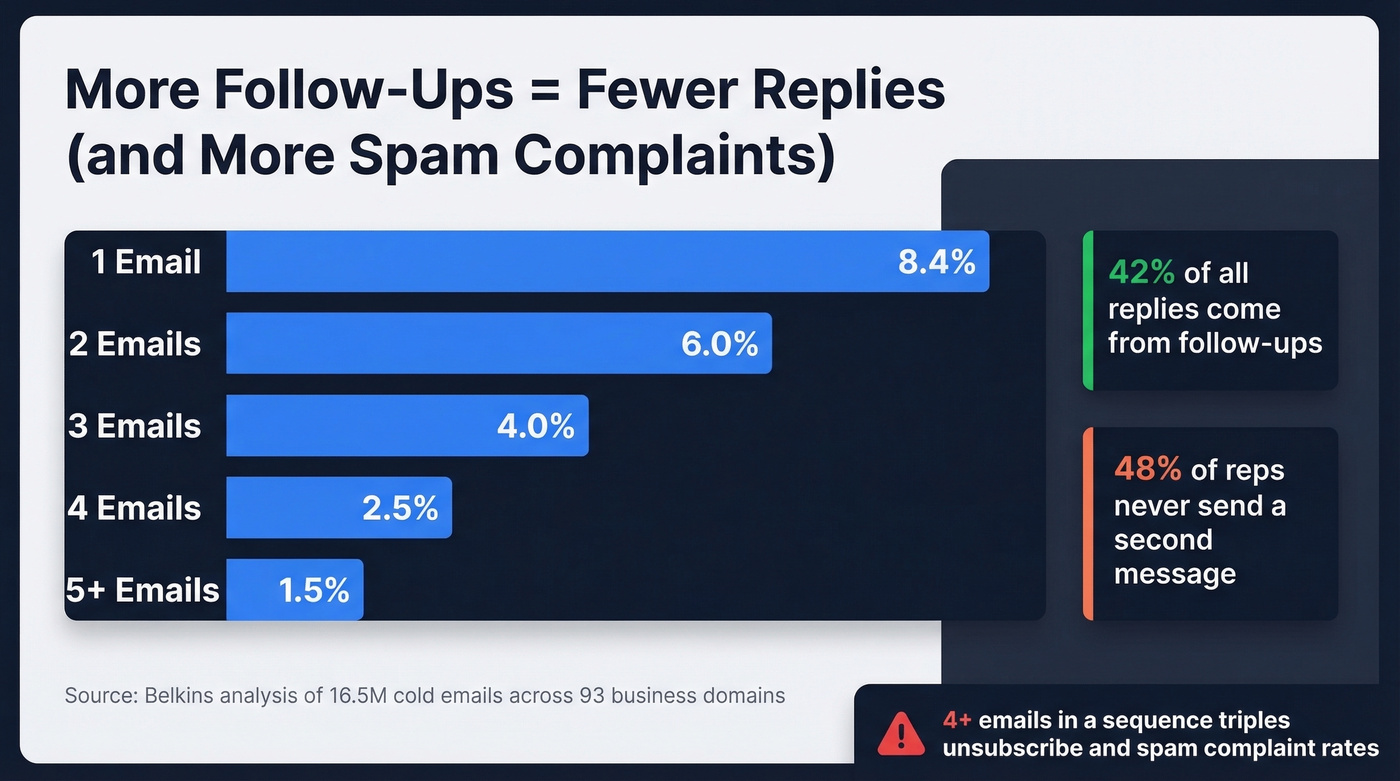
Belkins' analysis of 16.5M cold emails across 93 business domains found the highest reply rate - 8.4% - came from a single email. Each additional follow-up delivered diminishing returns, and sending four or more emails in a sequence tripled unsubscribe rates and more than tripled spam complaint risk. Enterprise contacts at companies with 1,000+ employees tend to ghost quickly and have even lower tolerance for persistence.
And yet 42% of all campaign replies come from follow-ups, while 48% of reps never send a second message. The sweet spot is clear: follow up, but don't overdo it. For courtesy contexts - networking, interviews, internal requests - one follow-up is standard. Two is the ceiling. Beyond that, you're not being persistent. You're being ignored.
If you need a more sales-oriented version of this logic, see our sales follow-up templates and the data behind follow-up email reply rate.
When to Send Your Follow-Up
Timing depends entirely on context. A post-interview thank-you sent three days later looks lazy. A proposal follow-up sent three hours later looks desperate.
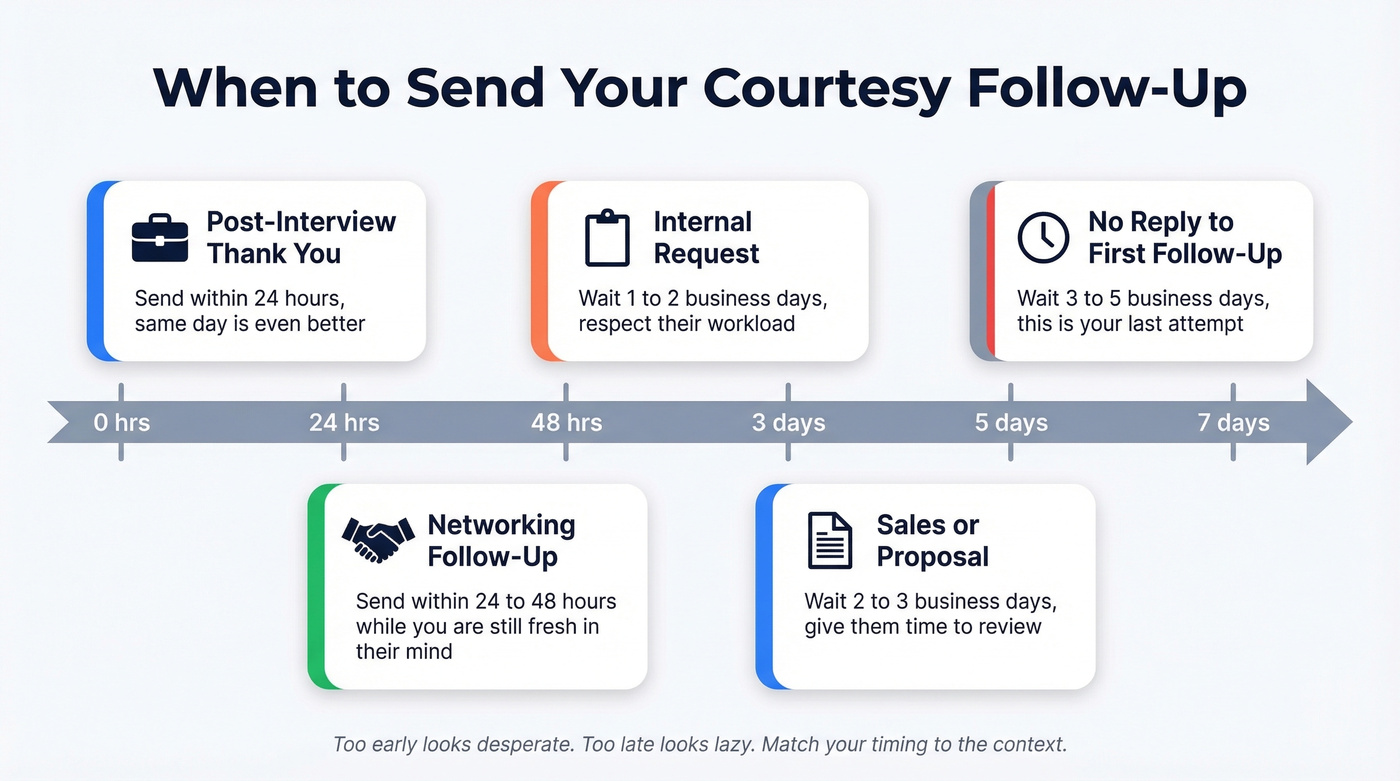
| Scenario | Wait time | Notes |
|---|---|---|
| Post-interview | 24 hours | Same day works too |
| Networking | 24-48 hours | While you're still fresh |
| Internal request | 1-2 business days | Respect workload |
| Sales / proposal | 2-3 business days | Give them time to review |
| No reply to first follow-up | 3-5 business days | Last attempt |
We've seen proposals sit for a week before getting a response - that's normal, not a red flag. If you're unsure, this guide on when to follow up on an email breaks down timing by scenario.

A perfectly worded follow-up means nothing if it bounces. Prospeo's 98% email accuracy and 7-day data refresh ensure your courtesy follow-up reaches the right inbox - not a dead address. At $0.01 per email, one verified contact costs less than the opportunity you'd lose to bad data.
Write the perfect follow-up. Send it to a verified email.
Phrasing: Say This, Not That
The words you choose matter more than the timing. A few common phrases actively undermine your message.
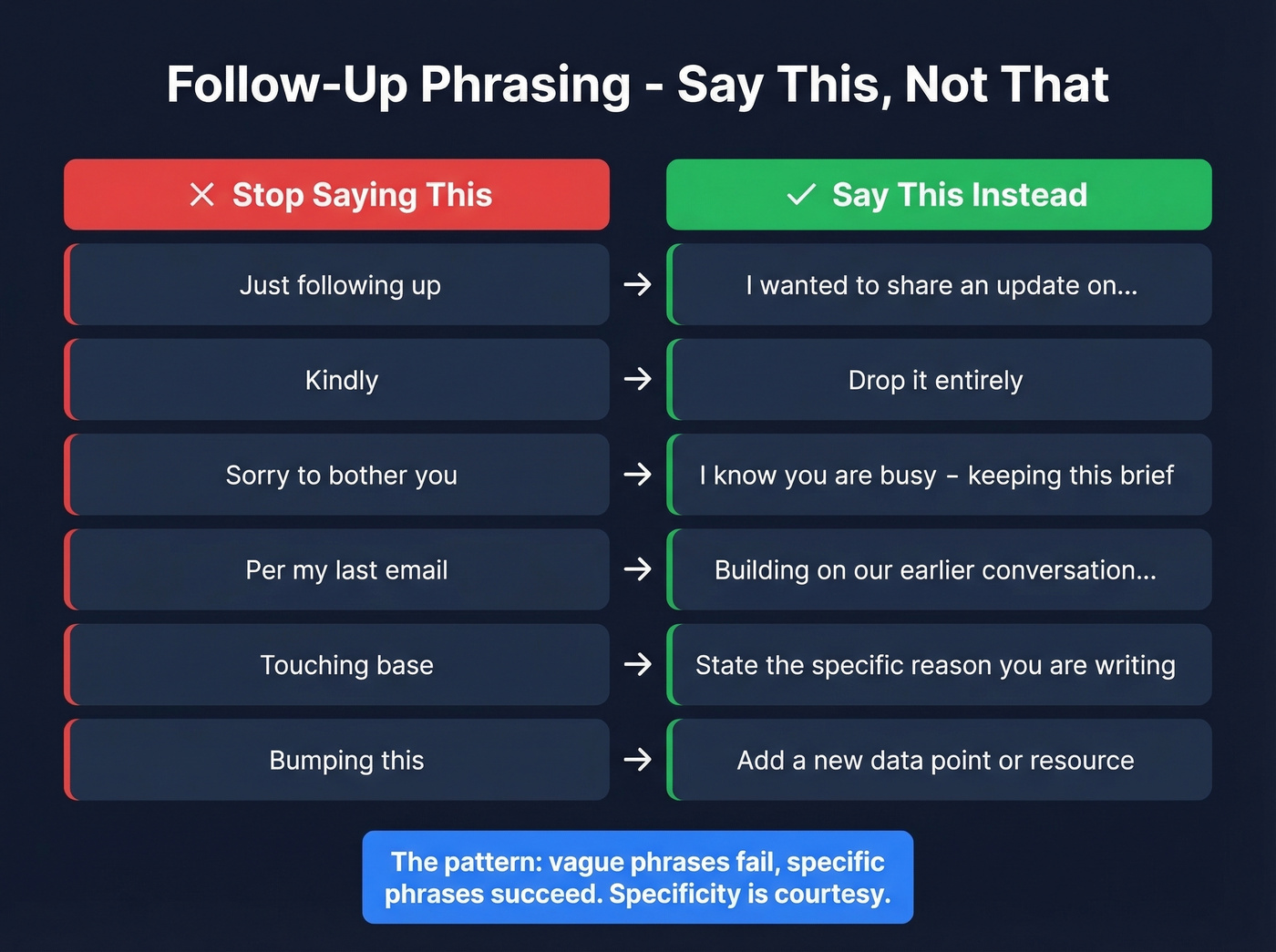
CNBC's guidance on the word "just" nails it: writing "just following up" subtly tells the recipient your message isn't important. "Sorry to bother you" frames your email as a burden before they've even read it. And "kindly" - especially in a phrase like "I just wanted to kindly follow up" - can read as condescending, particularly in cross-cultural communication where non-native speakers don't realize it sounds like an instruction rather than politeness.
If you catch yourself defaulting to "checking in," this guide on how to say just checking in professionally gives better options.
| Don't say | Say instead |
|---|---|
| "Just following up" | "I wanted to share an update on..." |
| "Kindly" | Drop it entirely |
| "Sorry to bother you" | "I know you're busy - keeping this brief" |
| "Per my last email" | "Building on our earlier conversation..." |
| "Touching base" | State the specific reason you're writing |
| "Bumping this" | Add a new data point or resource |
The pattern is simple: every phrase in the left column is vague. Every phrase on the right is specific. Specificity is courtesy.
Templates That Work
After a Networking Conversation
The Harvard career advising approach works because it proves you were actually listening. Reference something specific they said, then show you acted on it.
Hi [Name], it was great meeting you at [event] on [day]. You mentioned [specific advice] - I actually followed up on that and [brief result or action]. Would love to keep you posted as things develop. Thanks again for the conversation.
Post-Interview Thank-You
Hi [Name], thank you for taking the time to meet today. Our conversation about [specific topic from interview] reinforced my excitement about the role. I'm looking forward to next steps - please don't hesitate to reach out if you need anything from my end.
One Reddit poster reported receiving a job offer 20 minutes after sending their follow-up. That timing wasn't a coincidence - interviewers notice when you follow up promptly and specifically.
Internal Project Check-In
This one needs an exit ramp. Nobody wants to feel like they're being tracked, so give them an easy out that signals you respect their workload.
Hi [Name], circling back on [project] - wanted to check if you've had a chance to review [specific deliverable]. If you could take a look by [date], that would help me keep [downstream task] on track. If this isn't a priority right now, no worries - just let me know and I'll adjust the timeline.
If you're writing to someone who’s overloaded, our follow-up email to a busy person examples can help you keep the tone respectful.
After Sending a Proposal
The key here is new information - a case study, a reframed question, a specific next step. If you don't have something new to add, you don't have a reason to follow up.
Hi [Name], following up on the proposal I sent [date]. I came across [relevant case study / data point / article] that speaks to [specific challenge they mentioned] - thought it might be useful as you're evaluating. Happy to walk through any questions, or if a 15-minute call next week works better, I'm flexible.
Each template follows the same structure: context, new value, clear next step. Adapt the format to your situation, but don't skip any of those three elements.
Mistakes That Kill Your Follow-Up
Let's be honest: most bad follow-ups aren't rude - they're lazy. The sender copies the same message, changes the date, and expects a different result. That's not persistence. That's spam with a polite subject line.
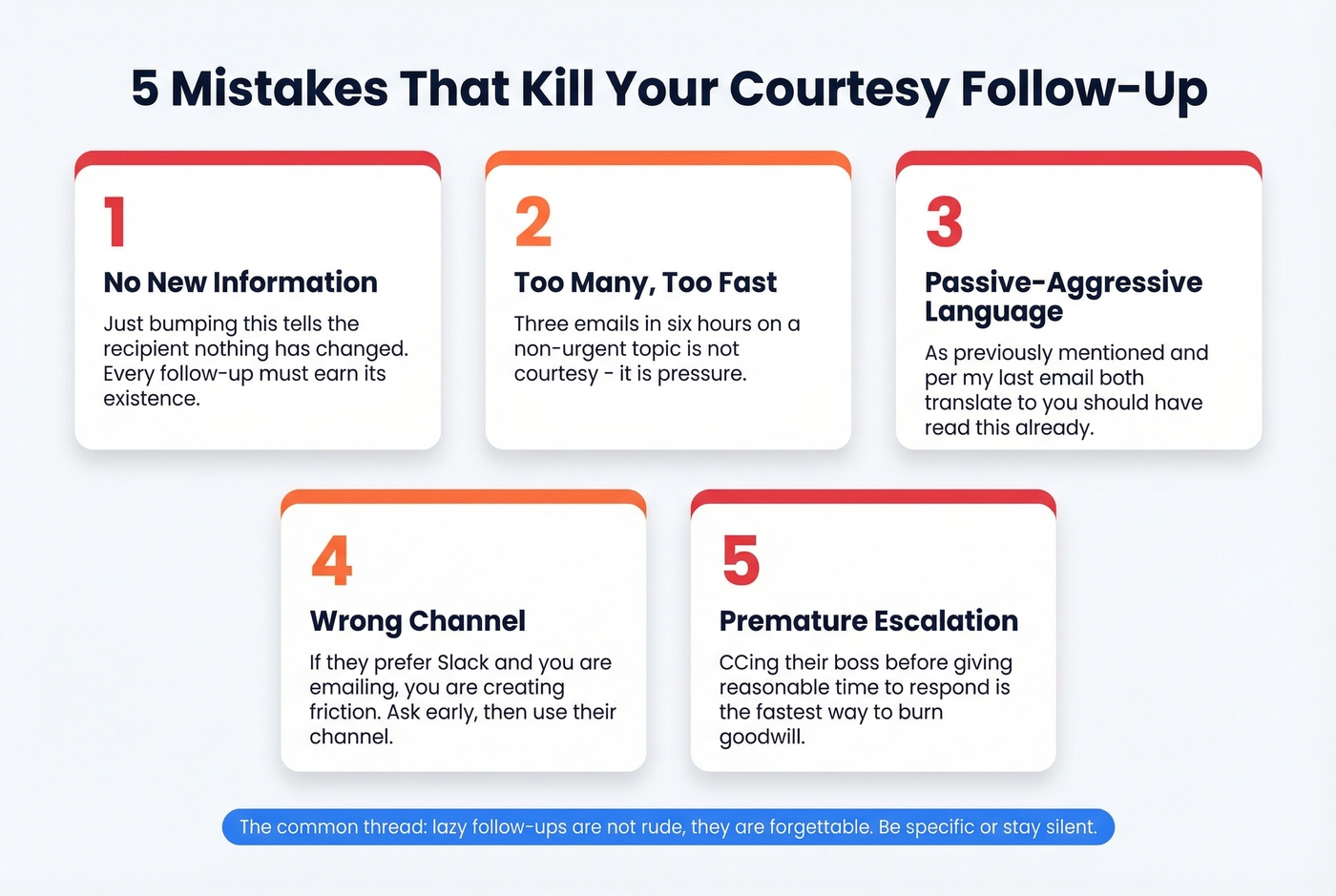
Here are the five fastest ways to ruin a courtesy follow-up:
No new information. "Just bumping this to the top of your inbox" tells the recipient nothing has changed - so why would their response? Every follow-up needs to earn its existence with something the first email didn't include.
Too many, too fast. One Reddit thread described someone receiving three emails in six to eight hours on a non-urgent topic. That's not a courteous message. That's pressure disguised as politeness.
Passive-aggressive language. "As previously mentioned" and "per my last email" both translate to "you should have read this already." Even if that's true, saying it out loud torches the relationship.
Wrong channel. If someone prefers Slack and you're emailing, you're creating friction. Ask for their preferred channel early and use it.
Premature escalation. CC'ing someone's boss before giving them reasonable time to respond is the fastest way to burn professional goodwill. The same Reddit thread described exactly this move, and the recipient's reaction was predictable: fury, not compliance. One more to watch: putting "follow-up" in the subject line itself can feel accusatory. Lead with the topic, not the reminder.
If you want to tighten the structure and clarity of your message, these emails that get responses principles apply well to courtesy follow-ups too.
Make Sure It Actually Lands
The most courteous follow-up in the world is useless if it bounces. People change jobs, companies restructure, and email addresses go stale faster than you'd expect - especially in industries with high turnover.
Before you send that carefully crafted message, verify the address is still valid. Prospeo's email finder checks emails in real time with 98% accuracy on a 7-day data refresh cycle, and the free tier covers 75 email verifications per month - more than enough for courtesy follow-ups. A bounced email doesn't just waste your effort; it can flag your domain for every future message you send.
If deliverability is a recurring issue, start with an email deliverability guide and keep an eye on your email bounce rate.

Skip this step if you're emailing someone you spoke with yesterday at their current company. But for contacts from a conference three months ago, or a hiring manager you found through a referral? Verify first. It takes five seconds and saves you from looking like you didn't do your homework.
When your follow-up gets no reply, the problem might not be your copy - it might be the contact data. Prospeo gives you 300M+ verified professional profiles with direct emails and mobile numbers, so you can follow up on the right channel with confidence.
Stop following up into the void. Start with data that connects.
FAQ
How long should a courtesy follow-up email be?
Aim for 50-125 words. State your purpose in the first sentence, add one new piece of value, and close with a clear ask or next step. If your follow-up requires scrolling on a phone screen, it's too long.
Is it okay to follow up more than once?
One is standard, two is the ceiling. Research on millions of outbound emails consistently shows each additional message delivers diminishing returns while increasing spam complaint risk. If two messages get silence, respect the signal.
What's the best day and time to send a follow-up?
Tuesday through Thursday mornings tend to get the highest open rates across most industries, according to Mailchimp's send-time data. That said, a courtesy follow-up isn't a marketing blast - send it when the timing makes sense for the relationship, not when an algorithm tells you to.
What makes a courtesy follow-up get a reply?
Three things: reference a shared context so the recipient remembers you, include one piece of new value they didn't have before, and end with a specific, low-effort ask. The templates above give you the exact structure - adapt them to your scenario rather than sending a generic "checking in" message.