

The CPQ Process: What Works, What Breaks, and What It Actually Costs
Your VP of Sales just forwarded a quote that took four days to build. Three of the seven line items have wrong pricing. The customer's already talking to a competitor. This is the moment most companies start Googling "CPQ."
CPQ - Configure, Price, Quote - is the process of automating how businesses build product configurations, apply pricing rules, and generate professional quotes. In complex sales, a well-built CPQ process can take quoting from days to minutes. It works best when most of your quoting is standardizable. If your team quotes from spreadsheets and errors cost you deals, CPQ is triage, not a luxury.
This guide isn't selling you a platform. It's telling you what actually works.
Why CPQ Matters in 2026
The CPQ software market was valued at $3.46 billion in 2025 and is projected to reach $10.89 billion by 2033, growing at a 15.6% CAGR. North America accounts for 36.7% of that revenue. Research and Markets projects $5.46 billion in incremental growth through 2030 at a 20.9% CAGR, confirming the trajectory from a second independent source. These aren't vanity numbers - they reflect a real shift in how companies handle quoting complexity.
Consider bdtronic, a precision manufacturing company with 1,400+ components and compatibility rules documented across a 60-page internal manual. Before CPQ, one in eight quotes contained a configuration error. That's not a rounding error. That's lost revenue and damaged credibility at scale.
Industry research quantifies the gap: CPQ users generate quotes 10x faster and cut approval times by up to 95%. When your product catalog runs into the thousands of possible configurations - NetSuite cites one example with 110,592 - spreadsheet-based quoting isn't just slow. It's structurally broken.
The 6-Stage CPQ Process Flow
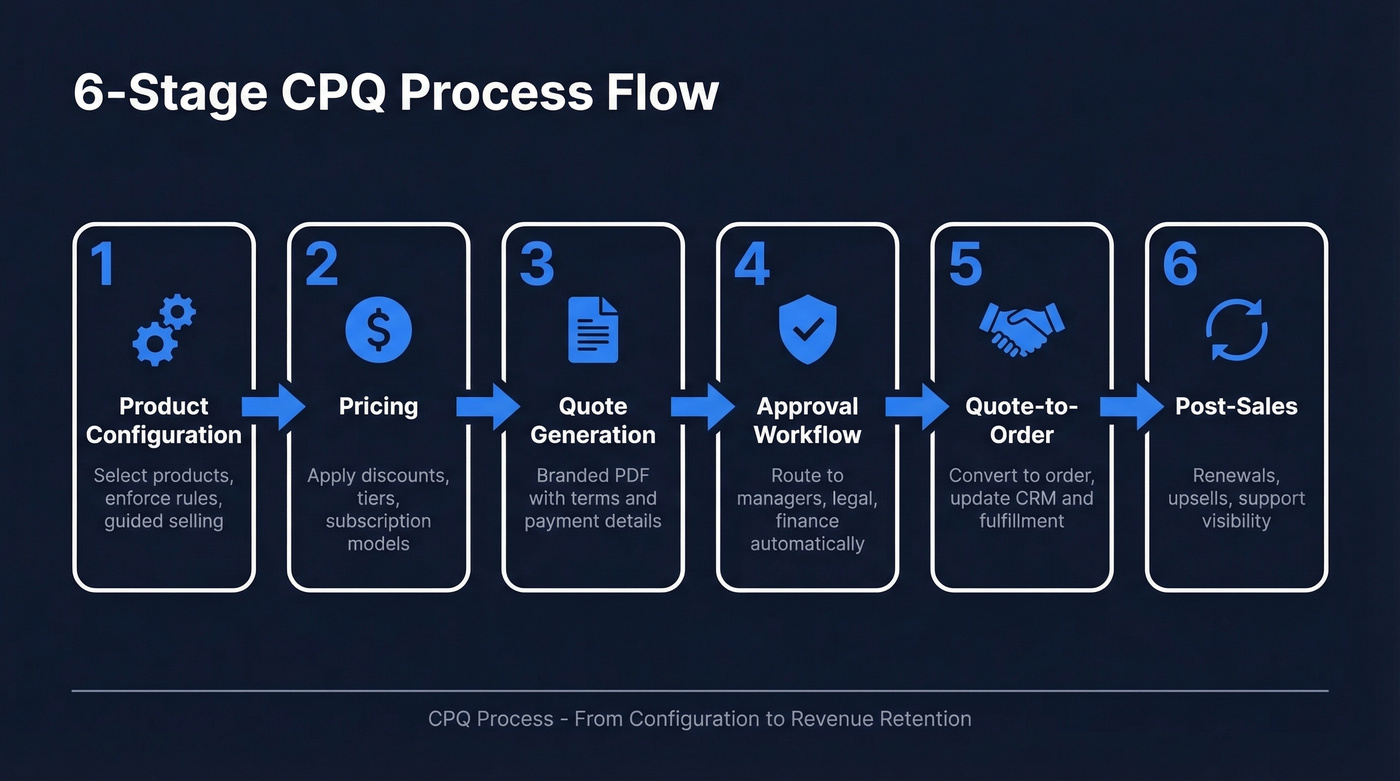
Here are the six stages that make up a configure-price-quote workflow. Each one has a clear function, a set of stakeholders, and a specific way it tends to break.
1. Product Configuration
This is where a rep - or increasingly, a buyer on a self-service portal - selects products, features, and options within a guided interface. The system enforces rules, constraints, and dependencies so you can't pair an incompatible module with a base product, or select a feature that requires a prerequisite the customer hasn't chosen.
Guided selling is the key capability here. Instead of memorizing bdtronic's 60-page compatibility document, reps answer a series of questions and the system builds the configuration. The trap is getting rule strictness wrong. Too rigid and reps get locked out of legitimate edge cases. Too loose and bad configurations slip through. Most teams overcorrect toward rigidity on the first pass and spend six months loosening things up.
2. Pricing
Once the configuration is set, the CPQ engine applies pricing rules - list prices, volume discounts, tiered pricing, subscription models, promotional rates, and customer-specific agreements. Discount guardrails prevent reps from giving away margin without approval.
This stage is where CPQ earns its keep for finance teams. Before CPQ, discount consistency across a 50-person sales team is basically fiction. After CPQ, every discount follows a rule or triggers an approval.
But over-engineering is the silent killer. If every pricing change requires a consultant to update the rules engine, you've traded one bottleneck for another.
3. Quote Generation
The system assembles the configured products and applied pricing into a formatted, branded document - typically a PDF with terms and conditions, payment schedules, and scope details. Good CPQ tools let you template these so reps aren't manually formatting proposals.
We've seen this stage fail in a specific, predictable way: templates designed for the average deal. A quote for a 3-product deal looks great. A quote for a 47-line-item enterprise deal with custom T&Cs overflows the template and looks unprofessional. Build your templates for the largest deal you'll realistically quote, not the median one.
4. Approval Workflow
Quotes that exceed discount thresholds, involve non-standard terms, or hit certain deal sizes route automatically to the right approver - sales management, legal, finance, or some combination. The system maintains an audit trail of who approved what and when.
Here's the thing: we've seen teams where a 15% discount requires four approvals across three time zones. The quote sits in limbo for two days, and the speed advantage evaporates. If your approval chain has more than two levels for standard discounts, you've built a bureaucracy, not a workflow.
5. Quote-to-Order
Once approved and accepted by the customer, the quote converts to an order. The CRM updates, finance gets notified, and fulfillment receives the bill of materials.
The handoff to fulfillment depends heavily on accurate contact data in your CRM. If the decision-maker's email bounces, your perfectly automated quote dies in a dead inbox. Tools like Prospeo keep CRM records current with a 98% email accuracy rate and a 7-day refresh cycle, so the quote actually reaches someone who can sign it.
6. Post-Sales
CPQ doesn't end at the signature. The system tracks renewal dates, surfaces upsell opportunities based on the original configuration, and gives support teams access to what the customer actually bought. This is where CPQ connects to revenue retention, not just revenue generation.
Most teams underinvest here. If you're not using CPQ data to drive expansion revenue, you're leaving the easiest money on the table.
Before and After: CPQ Results
Numbers tell the story better than theory.
| Company | Before | After | Key Metric |
|---|---|---|---|
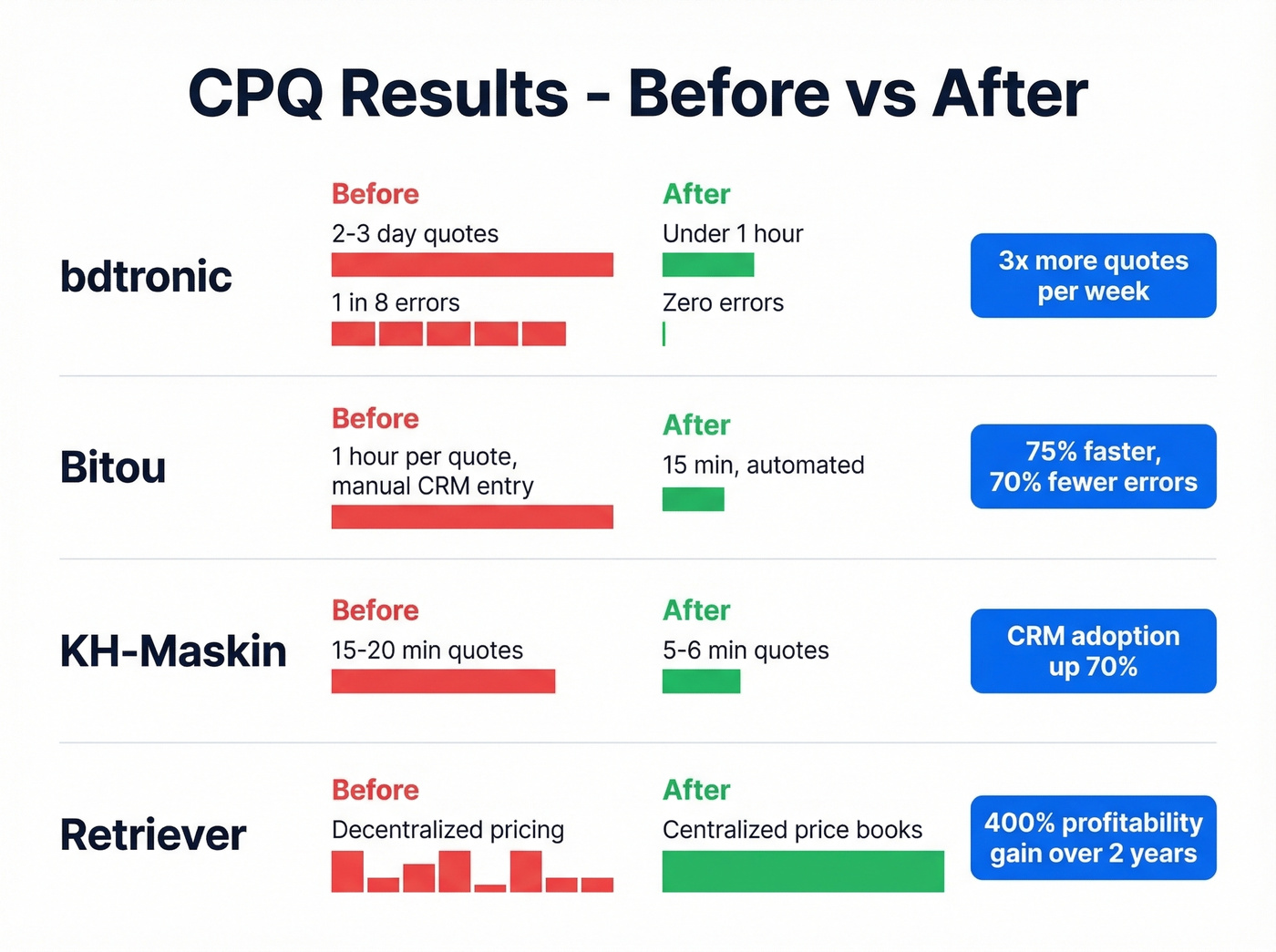
| bdtronic | 2-3 day quotes, 1-in-8 errors | Under 1 hour, zero errors | 3x more quotes/week |
| Bitou | 1 hr/quote, manual CRM entry | 15 min, automated | 75% faster, 70% fewer errors |
| KH-Maskin | 15-20 min quotes | 5-6 min quotes | CRM adoption up 70% |
| Retriever | Decentralized pricing | Centralized price books | ~400% profitability gain over 2 yrs |
bdtronic implemented SAP CPQ in two weeks for 1,400+ components, built guided selling workflows, structured product attributes, and added tiered discount approvals. Senior reps who'd been spending 30% of their time reviewing other people's configurations got that time back entirely.
Beans in Cup tells a similar story on the SMB end: CRM usage jumped from 40% to 100%, and pricing errors dropped from 5% to 1%. The pattern is consistent - CPQ doesn't just speed up quoting, it forces process discipline that ripples across the org.
When CPQ Fits (and When It Doesn't)
CPQ is a fit when:
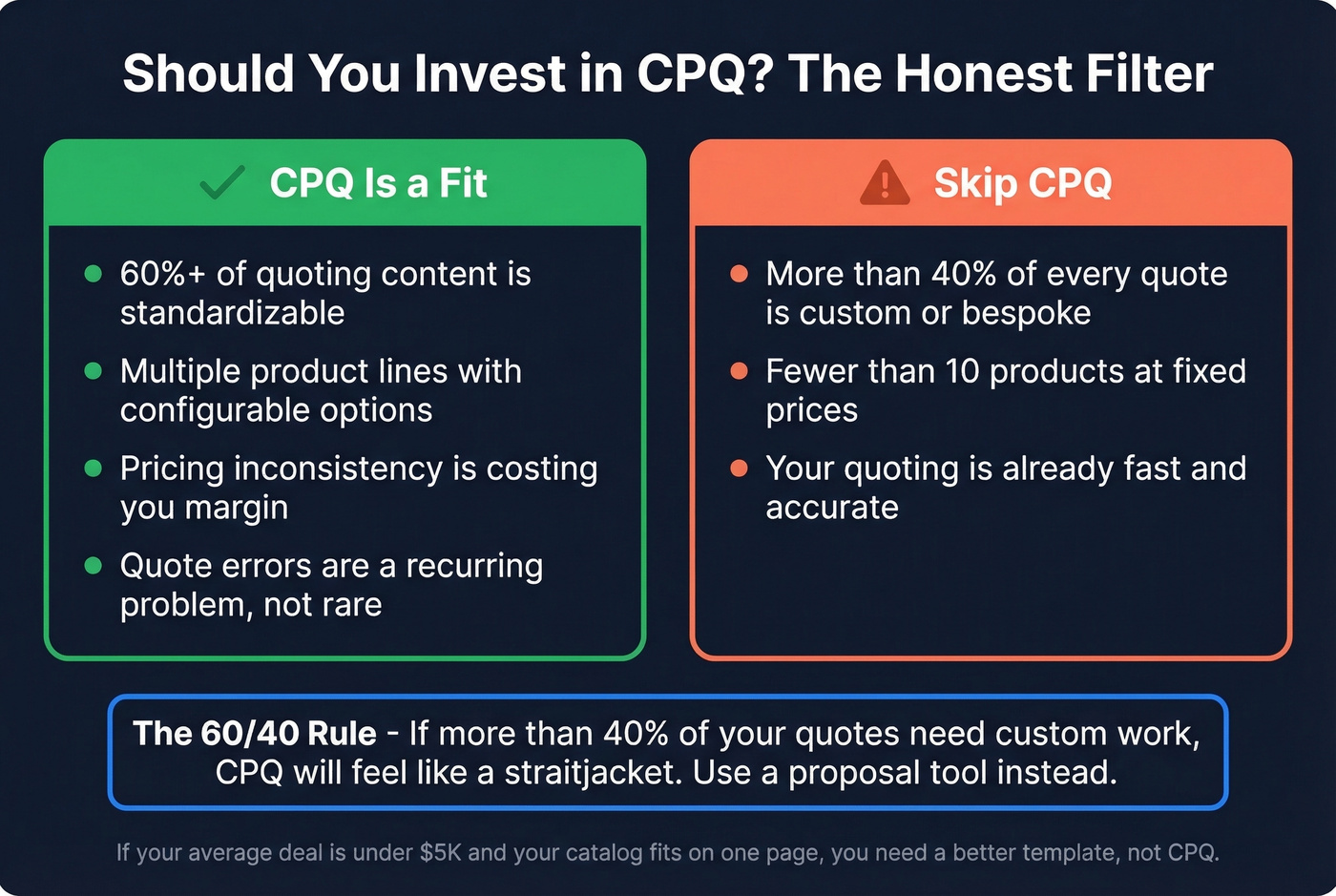
- Most of your quoting content is standardizable - products, pricing rules, terms. A practitioner on r/SalesOperations framed this as the 60/40 threshold, and it's a useful rule of thumb.
- You have multiple product lines with configurable options, tiered or subscription pricing, and multi-stakeholder approvals.
- Pricing inconsistency across reps is costing you margin or credibility.
- Quote errors are a recurring problem, not a rare exception.
Skip CPQ if:
- More than 40% of every quote is custom - unique scope, bespoke pricing, one-off terms. CPQ feels like a straitjacket when the exceptions outnumber the rules.
- You sell fewer than 10 products at fixed prices. A proposal tool like PandaDoc handles this without CPQ complexity.
- Your quoting is already fast and accurate. Adding CPQ to a process that isn't broken adds complexity you don't need.
Let's be honest: if your average deal size is under $5K and your product catalog fits on one page, you don't need CPQ. You need a better proposal template and a pricing spreadsheet with locked cells. CPQ's ROI kicks in when configuration complexity creates real error risk. Below that threshold, you're buying a forklift to move a couch.
The vendors won't tell you this. Every CPQ demo makes your use case look perfect. The 60/40 test is the honest filter.

Your CPQ process generates perfect quotes in minutes - but they die in dead inboxes. Prospeo enriches your CRM with 98% accurate emails on a 7-day refresh cycle, so every quote reaches the decision-maker who can actually sign it.
Stop losing deals to bounced emails after the quote is already perfect.
Why Implementations Fail
"No one is happy after implementing CPQ - except the consulting company and the CPQ vendor." That's a real quote from r/salesforce, and it captures a pattern we've seen repeatedly. CPQ has real ROI, but the implementation path is littered with avoidable mistakes.
For most teams, the root cause is sales process optimization done too late: you try to automate a workflow you haven't actually agreed on.
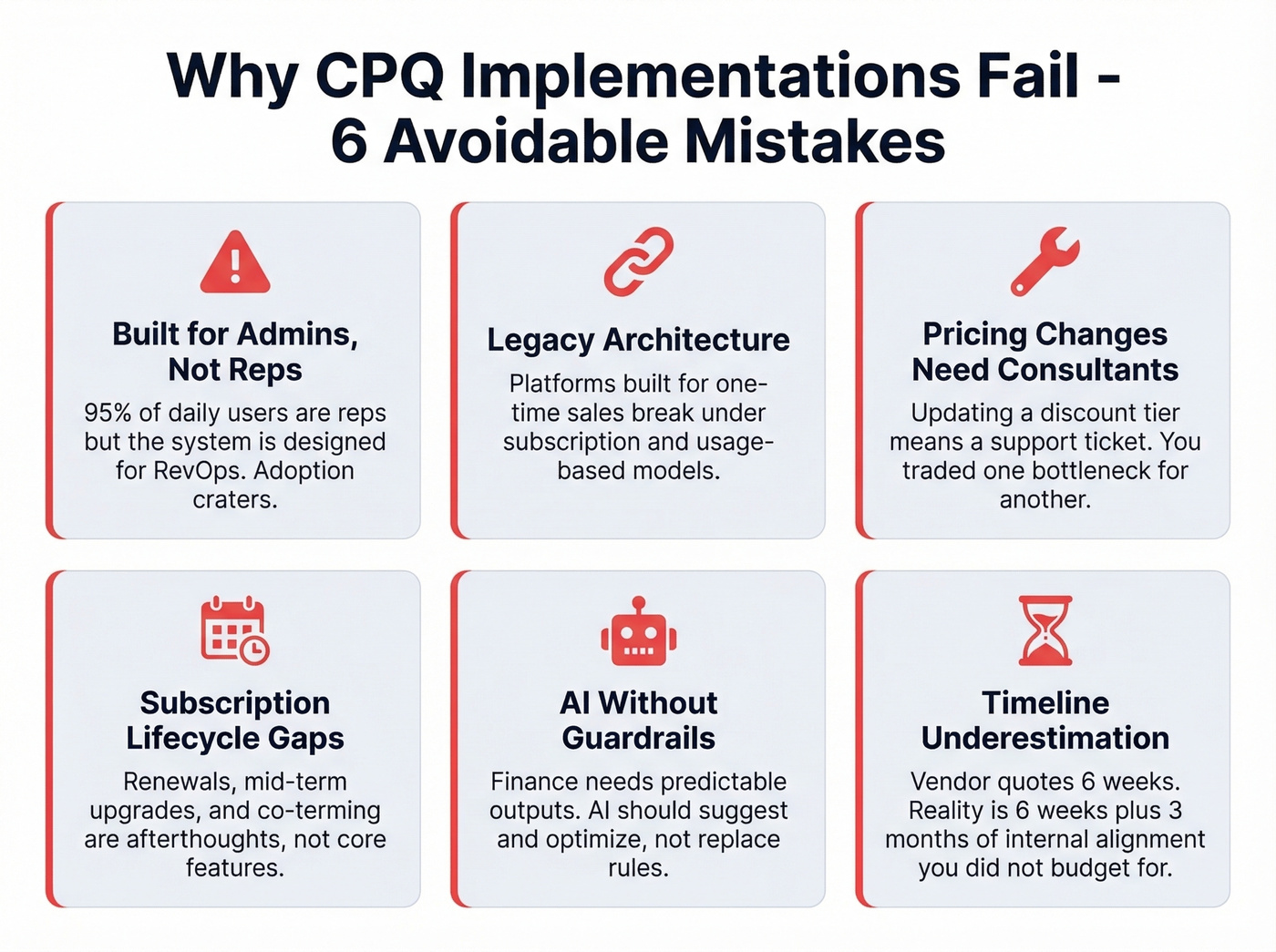
Six failure modes, drawn from Vendori's analysis and our own observations:
Optimized for admins, not reps. CPQ is designed and sold to RevOps, but 95% of daily usage is sales reps. If the rep experience is clunky, adoption craters.
Legacy rigidity for modern pricing models. Many platforms were built for one-time product sales. Subscription, usage-based, and hybrid models expose architectural limitations that no amount of configuration can fix.
Pricing changes require consultants. If updating a discount tier means opening a support ticket with your implementation partner, you've created a new dependency instead of eliminating one.
Subscription lifecycle not handled natively. Renewals, mid-term upgrades, co-terming - these workflows are afterthoughts in most platforms, not core capabilities.
AI layered without deterministic guardrails. Finance systems need predictable outputs. AI should sit above rules to suggest and optimize, not replace the rules engine entirely.
Timelines ignore internal pricing ambiguity. The vendor quotes 6 weeks. But your team hasn't agreed on discount policies, approval chains, or product bundling rules. The real timeline is 6 weeks of implementation plus 3 months of internal alignment you didn't budget for.

Beyond these structural issues, tactical mistakes compound: poor requirements gathering, overcomplicated configuration rules, inadequate data cleanup, and no training plan. Before implementation, run your CRM through an enrichment tool. Dirty contact data - bounced emails, wrong titles, departed contacts - undermines CPQ output from day one.
Even perfect data can't fix a rollout where reps never learned how to use the system. Budget serious time for sales training and reinforcement after go-live.
AI in CPQ - Hype Check
AI in CPQ is about 80% marketing and 20% reality right now.
What works today: pricing optimization engines that analyze historical deal data and recommend discount levels. Companies adopting these engines report 30-50% accuracy improvement versus traditional rule-based systems. Guided selling recommendations that surface relevant upsells based on configuration patterns deliver real value too - manufacturing companies use AI to optimize bundle recommendations, telecom providers automate plan pricing based on usage patterns, and SaaS companies predict renewal likelihood from configuration data.
What doesn't work yet: fully autonomous quoting agents. A Salesforce leader on Reddit described the challenge bluntly - with 180 products and 20,000 rate cards, they had low confidence an AI agent could "accurately and properly quote" even with strong consultants supporting the build. That skepticism is warranted.
Industry analysts predict that by 2028, quoting will be "largely automated, predictive, and conversational." That's aspirational, not current reality. The guardrails point is the right framework: finance systems need deterministic outputs. Let AI optimize pricing suggestions, flag anomalies, and draft proposals. Don't let it replace the rules engine that ensures your quotes are actually correct.
How CPQ Strengthens Deal Control
One of the most underappreciated benefits of a mature CPQ process is the deal control it gives sales leadership. When every quote follows enforced pricing rules and discount thresholds, managers gain real-time visibility into what reps are offering and at what margin. Instead of discovering a rogue 40% discount after the contract is signed, the approval workflow surfaces it before the quote leaves the building.
This level of deal control also shortens sales cycles. Reps spend less time negotiating internally for approvals and more time closing, because the guardrails are already built into the system.
CPQ Vendor Landscape (2026)
Here's the current Gartner Peer Insights snapshot - the closest thing to a neutral vendor comparison:
| Vendor | Rating | Reviews | Best For | Approx. Pricing |
|---|---|---|---|---|
| Conga CPQ | 4.7 | 267 | Highest-rated overall | ~$1,500-5,000/mo |
| PandaDoc | 4.6 | 190 | SMBs / quick start | From $19/mo |
| DealHub CPQ | 4.5 | 115 | Mid-market sweet spot | ~$1,000-3,000/mo |
| Salesforce CPQ | 4.3 | 271 | Salesforce shops | ~$75-150/user/mo |
| SAP CPQ | 4.3 | 107 | SAP ERP users | ~$30-100K+/yr |
| Oracle CPQ | 4.2 | 148 | Oracle ecosystem | ~$30-100K+/yr |
For teams evaluating for the first time, start with three demos: Conga (highest-rated, Gartner Peer Insights Customers' Choice), DealHub (mid-market sweet spot), and PandaDoc (lowest barrier to entry).
The pricing opacity in this market is genuinely frustrating. You're committing to a tool that touches every deal, and most vendors won't tell you what it costs until you've sat through two demos and a "discovery call." Negotiate hard - especially on implementation services, which often exceed the software cost.
If you want a sanity check on downstream impact, tie CPQ changes back to pipeline health and cycle time, not just quote speed.
CPQ fixes your quoting. But if 12% of your contact records are stale - the industry average - you're automating quotes to nowhere. Prospeo's CRM enrichment returns 50+ data points per contact at 92% match rate, for roughly $0.01 per email.
Clean data is the last mile of your quote-to-order process.
FAQ
What is the CPQ process?
The CPQ process covers six stages: configuring products, applying pricing rules, generating quotes, routing approvals, converting quotes to orders, and managing post-sales renewals. CPQ software replaces spreadsheet-based quoting with guided workflows that enforce pricing accuracy and cut quote turnaround from days to minutes.
How long does implementation take?
bdtronic implemented SAP CPQ in two weeks for 1,400 components. Enterprise deployments with heavy CRM/ERP integration typically take 3-6 months. Budget beyond the vendor's initial estimate - internal alignment on discount policies and approval chains adds 2-3 months most teams don't plan for.
Is CPQ worth it for small businesses?
Only if your quoting involves configurable products, tiered pricing, or multi-step approvals. If you sell five products at fixed prices, PandaDoc (from $19/mo) handles quoting without CPQ complexity. CPQ pays off when configuration errors and pricing inconsistencies cost you real revenue.
How does CRM data quality affect quoting accuracy?
CPQ pulls contact and account data from your CRM to populate quotes. Outdated emails, wrong titles, or departed contacts mean quotes reach nobody. Running your CRM through an enrichment workflow before CPQ implementation - and keeping it clean on an ongoing basis - is the single highest-ROI prep step most teams skip.