

CRM Sales Process Steps: 7 Stages (With Exit Criteria, Benchmarks, and What Actually Goes Wrong)
You pull the pipeline report on Monday morning. Half the deals haven't moved in six weeks. Three "committed" opportunities have no next step logged. Your forecast is fiction - and everyone in the room knows it.
The problem isn't your CRM. It's that nobody defined what it means for a deal to move from one stage to the next.
That's why CRM sales process steps matter: they turn vibes-based forecasting into a pipeline where every stage has proof, not hope. Companies with a formal sales process generate more revenue - Jason Jordan and Robert Kelly made that case in HBR, and the data still holds. But that uplift only materializes when reps follow a process with teeth. Here's how to build one.
The Quick Version
Seven stages. Each one needs exit criteria and at least one required CRM field.
- Stages: Prospecting → Qualification → Discovery → Proposal → Negotiation → Close → Post-Sale
- Median B2B SaaS cycle: 84 days (optimal: 46-75)
- Typical win rate: 20-30%
- Pipeline coverage: 3x-5x quota
Hot take: five stages with clear exit criteria beat nine stages with none. Stop obsessing over the number of stages. Start obsessing over what moves a deal forward.
CRM Sales Process Steps (All 7 Stages)
1. Prospecting & Lead Generation
This is where pipeline quality gets set. Reps identify buyers through outbound research, inbound leads, or database searches. Get it wrong here and every downstream metric suffers.
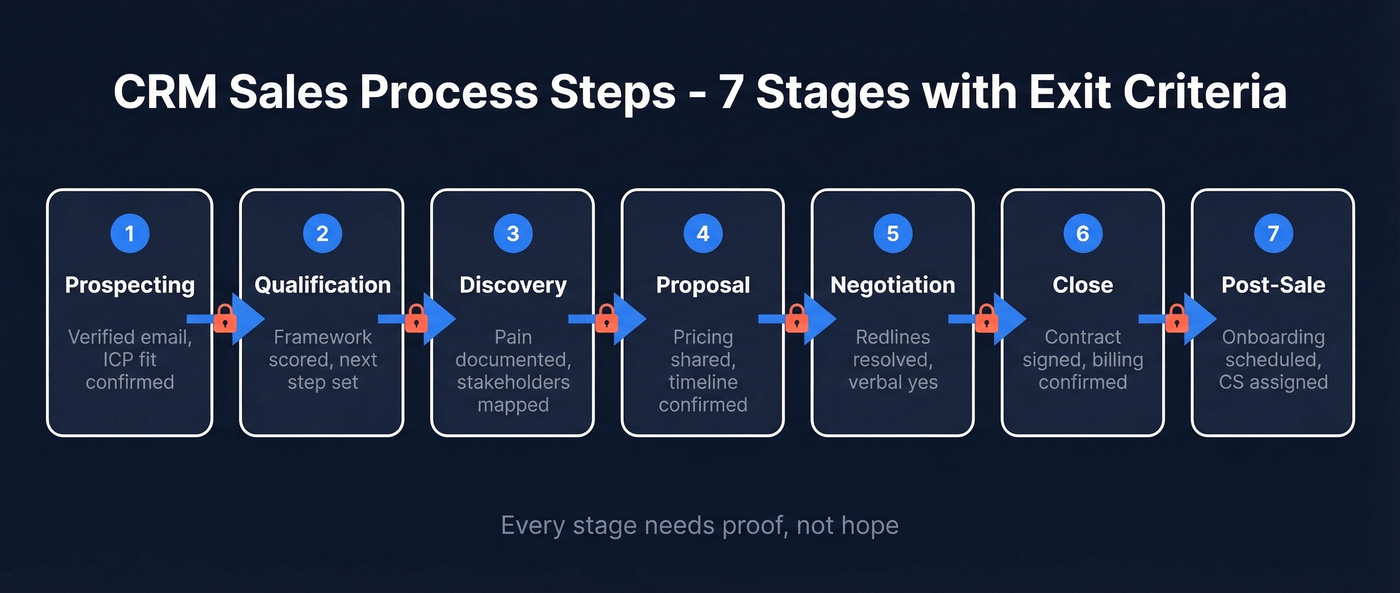
Exit criteria: Contact record created with verified email, company name, ICP fit confirmed. Required CRM fields: Lead source, email (verified), company, ICP match (yes/no). Activity example: Build a list of 50 target accounts, verify contacts, push to a sequence.
If your bounce rate is high, the problem isn't your messaging - it's your data. Prospeo verifies emails in real time with 98% accuracy and refreshes records every 7 days, so reps aren't sequencing dead addresses. One customer, Snyk, saw bounce rates drop from 35-40% to under 5% after switching their prospecting data source.

Lead-to-MQL conversion runs about 39% in B2B SaaS. Well below that? Audit list quality before blaming your copy.
2. Lead Qualification
Does this person have budget, authority, and a real problem you solve? Separate signal from noise here, or you'll waste every hour downstream.
Exit criteria: Qualification framework completed, lead scored, accepted by sales, next step scheduled. Required CRM fields: Budget range, decision-maker flag, timeline, qualification score.
MQL-to-SQL conversion is the biggest bottleneck in most funnels - 15-21% is typical. If yours is lower, you're qualifying too loosely at the top or too strictly in the middle. We've found that the fix is almost always tighter ICP definitions, not more volume.
3. Discovery & Needs Analysis
Ask any RevOps manager what separates reps who close from reps who don't. The answer is always the same: discovery discipline. This is where you earn the right to propose.
Run a 30-minute discovery call using SPIN questions. Document the buyer's pain, map stakeholders, and schedule the next meeting before you hang up. If you leave discovery without a confirmed next step, the deal is already dying - no matter what the rep tells you in standup.
Exit criteria: Pain documented, stakeholder map started, next meeting scheduled. Required CRM fields: Primary pain, stakeholders (names/roles), success criteria, next meeting date.
4. Proposal / Pitch
Present a solution mapped to the problems uncovered in discovery. Generic decks die here.
Exit criteria: Proposal delivered, pricing shared, decision timeline confirmed. Required CRM fields: Proposal sent date, deal amount, expected close date.
When deals stall at "Proposal Sent," the problem almost always traces back to a weak discovery stage. Enforcing required fields at each prior stage is one of the fastest ways to reduce stale opportunities - because it forces reps to actually do the work before advancing.
5. Negotiation & Objection Handling
Terms, pricing, legal, procurement. This is where deals slow down or die quietly.
Address pricing objections with ROI case studies and send revised terms within 48 hours. Momentum matters more than perfection here. Get mutual agreement on terms, resolve redlines, and secure a verbal commitment before advancing.
Exit criteria: Redlines resolved, final pricing approved, verbal yes captured, signature process started. Required CRM fields: Discount %, competitor mentioned, objection category, legal/procurement status.
Log every discount, competitor mention, and objection in the CRM. Your future self will thank you at QBR time.
6. Close
Signature collected. Deal marked Closed Won - or Closed Lost with a reason code.
That reason code matters more than most teams realize: it's one of the best inputs for improving your qualification criteria next quarter. Update the CRM within 24 hours of signature, no exceptions.
Exit criteria: Contract executed, billing confirmed, handoff created. Required CRM fields: Close date (actual), close reason, contract value, payment terms.
7. Post-Sale & Retention
The deal isn't done at signature. Trigger the handoff to CS, schedule onboarding, and set a 90-day check-in.
Exit criteria: Onboarding kickoff scheduled, success plan created, renewal owner assigned. Required CRM fields: CS owner, onboarding status, renewal date.
Remember that Monday morning pipeline report? With exit criteria enforced at every stage, you'd know exactly which deals are real - and your post-sale handoffs would stop falling through the cracks.
Benchmarks by Stage
Sales cycles are 21% longer than in 2020, and win rates are falling alongside them.
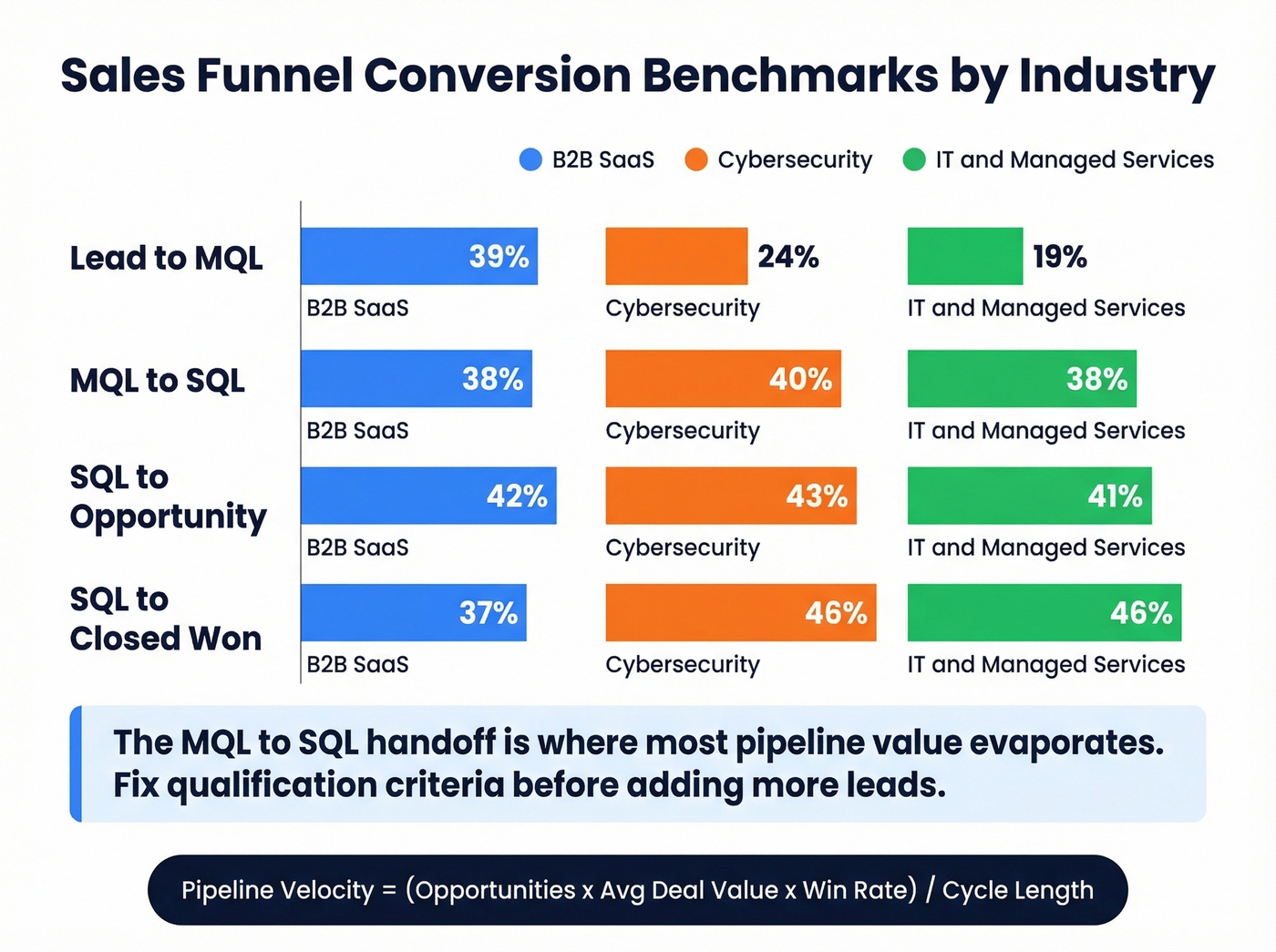
| Stage | B2B SaaS | Cybersecurity | IT & Managed Svcs |
|---|---|---|---|
| Lead→MQL | 39% | 24% | 19% |
| MQL→SQL | 38% | 40% | 38% |
| SQL→Opportunity | 42% | 43% | 41% |
| SQL→Closed Won | 37% | 46% | 46% |
Enterprise funnels convert slower at every stage - expect MQL-to-SQL around 31% vs. 39% for SMB. The MQL-to-SQL handoff is where most pipeline value evaporates. In our experience, the fix is almost always tighter qualification criteria, not more leads.
Track this monthly: Pipeline velocity = (Opportunities x Avg Deal Value x Win Rate) / Cycle Length.
Pick a Qualification Framework
| Framework | Best For | Complexity | Key Stat |
|---|---|---|---|
| BANT | Transactional, <60-day cycles | Low | Created by IBM; 1-3 decision-makers |
| MEDDIC | Enterprise, >$100k ARR | High | 18% higher win rate, 24% larger deals |
| SPIN | Complex discovery-heavy sales | Medium | 57% higher prospect talk time |
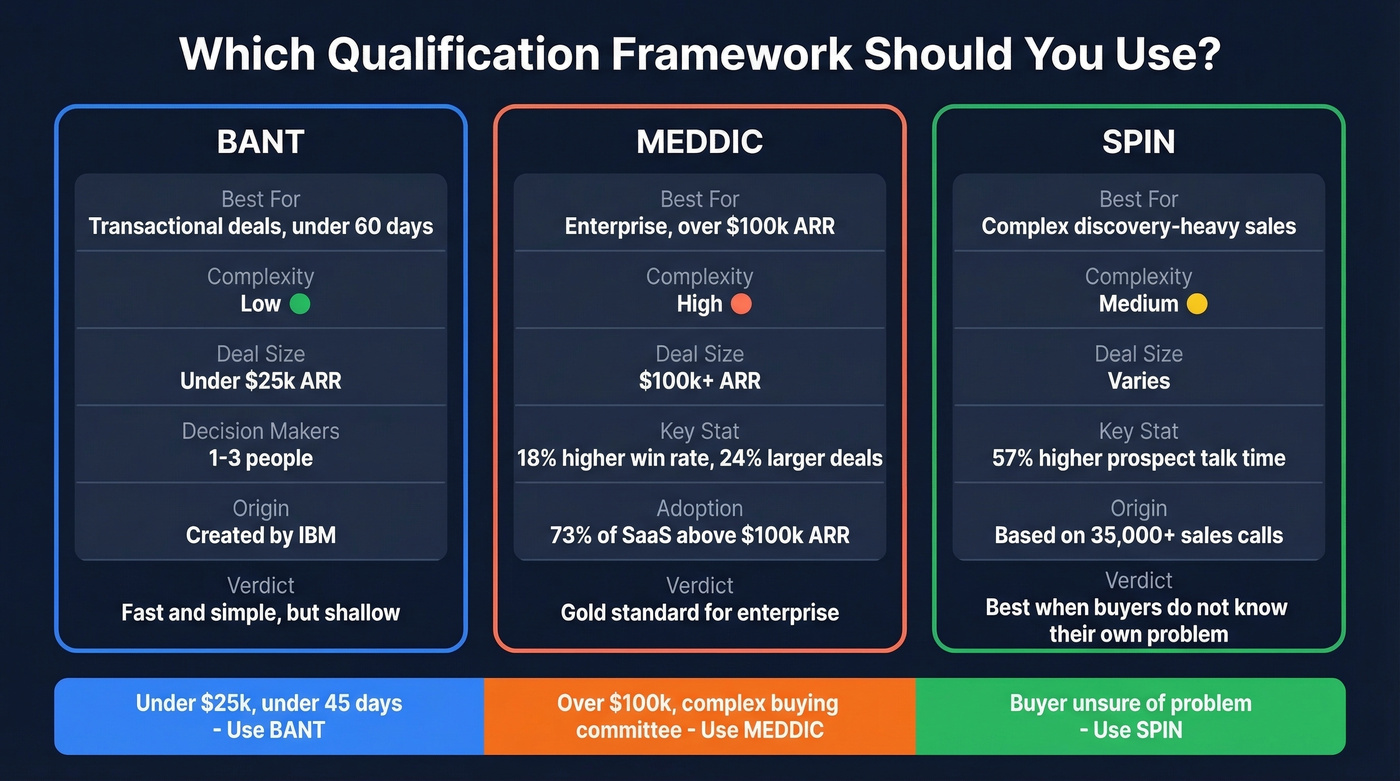
BANT is fine for transactional deals under 60 days. If you're selling six-figure contracts and still using BANT, you're leaving money on the table - 73% of SaaS companies above $100k ARR use some version of MEDDIC, and there's a reason for that. SPIN works best when the buyer doesn't fully understand their own problem yet; it was developed from analysis of 35,000+ sales calls.
Skip MEDDIC if your average deal size is under $25k and your cycle is under 45 days. You'll drown reps in process overhead for deals that should close on a handshake and a demo.

Stage 1 sets the ceiling for every metric downstream. Prospeo feeds your CRM with 98% accurate emails, refreshed every 7 days - so reps sequence real buyers, not dead addresses. Snyk dropped bounce rates from 35-40% to under 5% and added 200+ new opportunities per month.
Stop filling your pipeline with garbage data. Start with verified contacts.
5 Mistakes That Break Your Pipeline
Here's the thing: most CRM implementations fail not because of the software, but because of the process design.
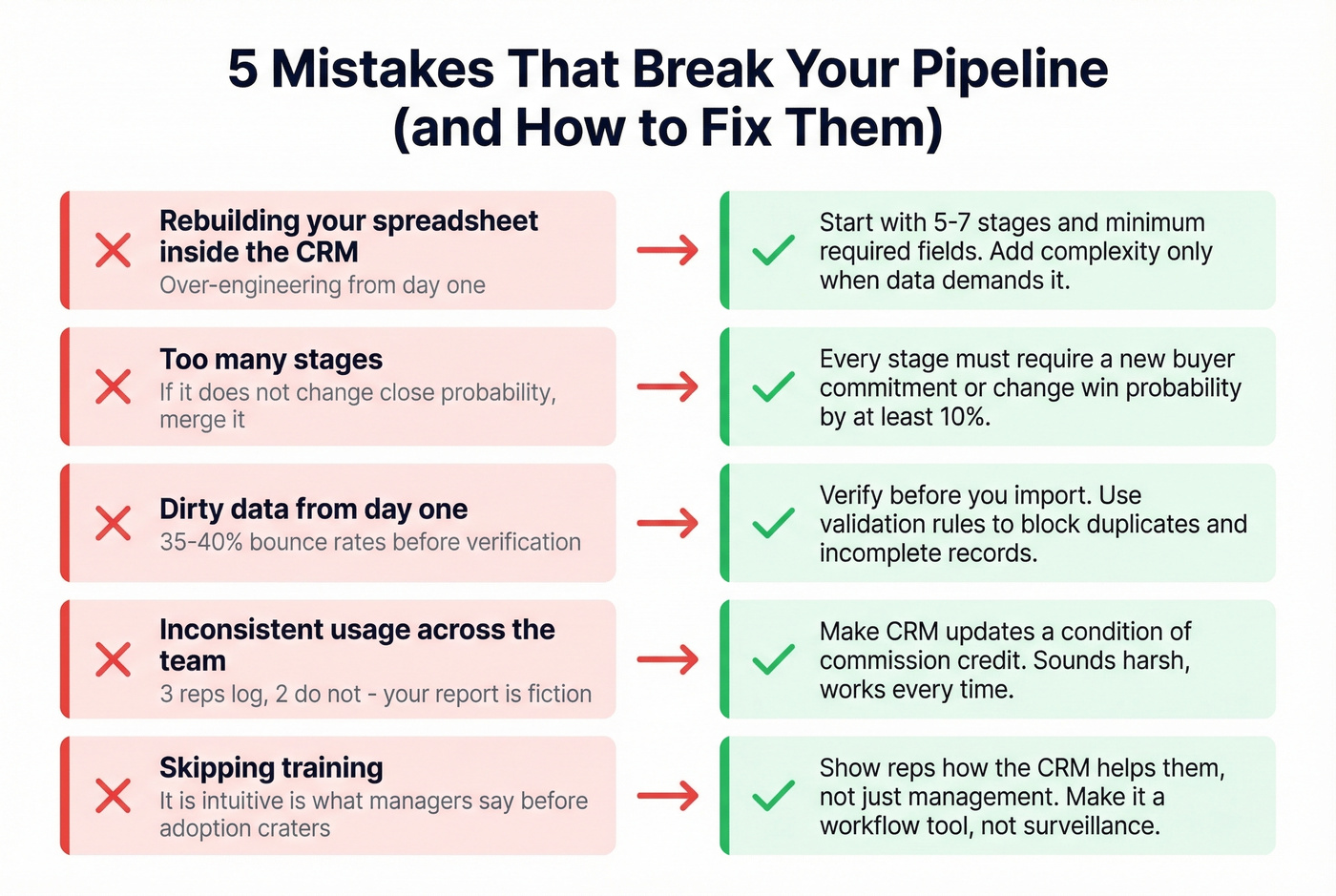
1. Rebuilding your spreadsheet inside the CRM. Start with 5-7 stages and minimum required fields. Add complexity only when data shows you need it.
2. Too many stages. If a stage doesn't change the probability of closing, merge it with another. Twelve stages with sub-stages guarantees reps abandon it within a month.
3. Dirty data from day one. We've seen bounce rates at 35-40% before verification - Snyk's team was dealing with exactly this before they implemented real-time verification and dropped to under 5%. Verify before you import, and use validation rules to prevent duplicates and incomplete records.
4. Inconsistent usage. Three reps log religiously, two don't - your pipeline report is now useless. Make CRM updates a condition of commission credit. Sounds harsh. Works every time.
5. Skipping training. "It's intuitive" is what managers say before adoption craters. Show reps how the CRM helps them, not just management. The consensus on r/sales is that reps hate CRMs because they feel like surveillance tools, not workflow tools - and that's a training problem, not a software problem.
Which CRM to Use
HubSpot - Free tier is genuinely usable. Easiest onboarding for teams under 10 reps. Paid plans start around $20-$50/user/month depending on tier.
Pipedrive - Best pipeline visualization on the market. Typically ~$15-$30/user/month.
Zoho CRM - Best overall value per PCMag. Strong customization at higher tiers.
Salesforce - Most powerful, most complex. Usually makes sense once you have a dedicated admin. Starter plans run around $25-$50/user/month, but real implementations cost far more.
Let's be honest: the CRM you pick matters less than the process you put inside it. A $15/month Pipedrive with enforced exit criteria will outperform a $150/month Salesforce instance where reps drag deals across stages based on gut feel.
If you're evaluating tools, it helps to compare a few examples of a CRM and map them to your process.
CRM Sales Process Steps: FAQ
How many stages should a CRM sales pipeline have?
Five to seven is the sweet spot for most teams because adoption stays high while exit criteria stay clear. If you're above seven, merge any stage that doesn't change close probability by at least ~10% or doesn't require a new buyer commitment.
What's a good win rate for B2B sales?
A 20-30% win rate is typical for B2B teams with decent qualification and a real ICP. If you're under 15% for two straight quarters, tighten qualification and require a documented pain plus a next step before a deal can advance past discovery.
How do I keep CRM data clean at the prospecting stage?
Use verified contact data, enforce deduplication, and require 3-5 fields at lead creation: source, ICP match, email status, company, and next step. Real-time email verification and a short data refresh cycle reduce bounces and stale records before they poison the pipeline.
Exit criteria mean nothing if your contact data decays between pipeline reviews. Prospeo refreshes 300M+ profiles every 7 days - 6x faster than the industry average - so the emails and phones in your CRM actually connect. At $0.01 per email, keeping your pipeline clean costs less than one stale deal.
Your forecast deserves data that's less than a week old.
Make the Steps Real
CRM sales process steps aren't stages you picked from a dropdown. They're a set of commitments with exit criteria, required fields, and consequences when reps skip them. Keep the stages simple, enforce the fields that prove progress, and fix data quality at the top - because everything downstream inherits it.
If you want to pressure-test your top-of-funnel inputs, start with sales prospecting techniques and a tighter ideal customer profile.