


10 Best Crunchbase Alternatives in 2026
Your SDR just bounced 30% of a Crunchbase export list. The VP of Sales is asking why you're paying $99/month for contacts that don't work. And you're searching for Crunchbase alternatives at 9 PM on a Tuesday.
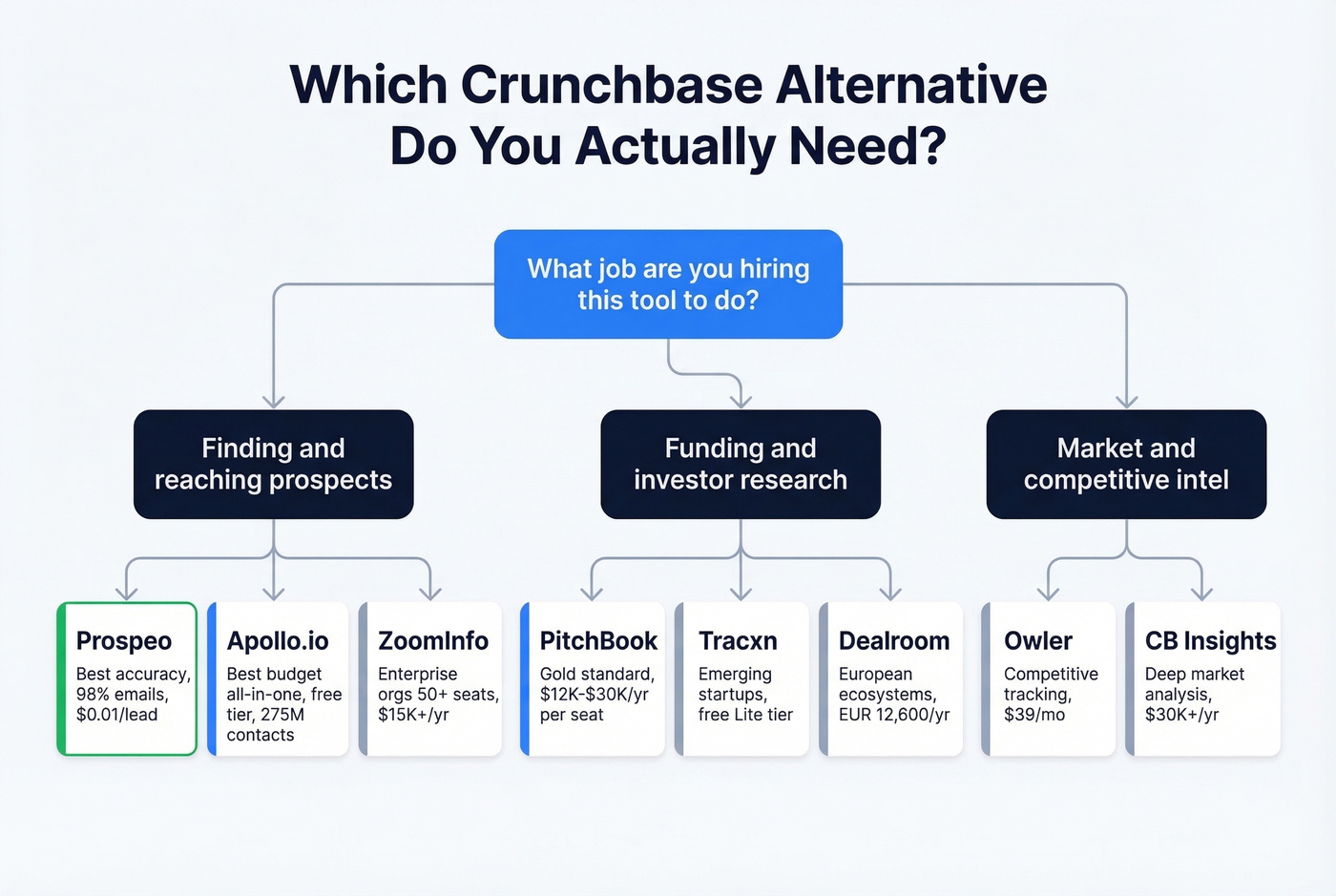
Here's the thing: lining up PitchBook next to Owler as if they solve the same problem is useless. The real question isn't "what replaces Crunchbase?" - it's what job were you hiring Crunchbase to do? Company research? Contact information for outbound? Each of those jobs has a different best tool, and most of them aren't Crunchbase.
Ten alternatives below, grouped by what they actually do, with real pricing so you don't waste a week on demos.
Our Picks (TL;DR)
Best for verified contact data: Prospeo - 98% email accuracy, 7-day data refresh, free tier with 75 verified emails/month. If your Crunchbase problem is reaching people, start here. (If you’re also evaluating verification vendors, see email accuracy.)
Best all-in-one for sales teams on a budget: Apollo.io - generous free tier, 275M contacts, and built-in outreach tools including sequencing. The obvious starting point for SMB teams. If you want more options in this category, compare sales prospecting databases.
Best for investor/VC research: PitchBook - the gold standard for funding and deal data. Typical pricing runs $12K-$30K/year per seat, and many teams land $20K+ depending on package, so it's priced for institutional teams, not founders.
Why People Leave Crunchbase
Credit where it's due. Crunchbase has built a solid company research platform - 4M+ private companies, market activity data from 80M+ users, and a clean interface that makes basic company discovery easy. Its G2 rating sits at 4.4/5 from 400 reviews, which is genuinely good.
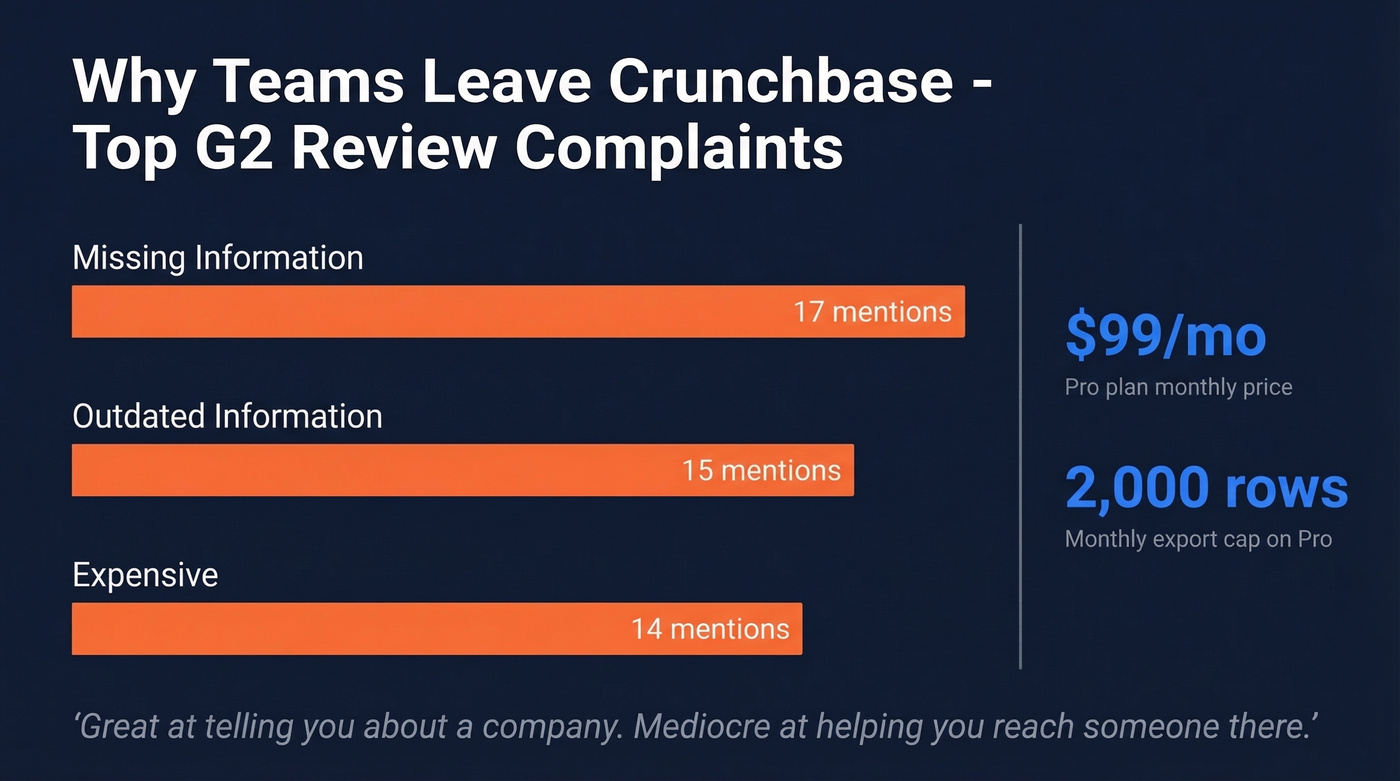
But the complaints tell a consistent story. Across those G2 reviews, "missing information" shows up 17 times, "outdated information" 15 times, and "expensive" 14 times. That's not a random distribution - it's a pattern. Users love the search and list-building. They hate what happens when they try to actually use the data for outbound. One r/sales commenter summed up the frustration bluntly: they "haven't been too impressed" with the contact data from Crunchbase or similar tools. (If this is your issue, start with email bounce rate fundamentals.)
Then there are the export limits. Pro caps you at 2,000 rows/month. Business gives you 5,000. If you're running any kind of volume outbound, you'll hit those walls fast. Pricing isn't trivial either - Pro runs $99/month, or $49/month billed annually, while Business jumps to $199/month on an annual contract.
The fundamental tension: Crunchbase is great at telling you about a company. It's mediocre at helping you reach someone at that company. We've seen this play out with our own customers - most teams hit that exact wall within the first quarter of using Crunchbase for outbound. If you’re rebuilding your outbound motion, use these sales prospecting techniques to avoid “spray and pray.”
Pricing Comparison
These tools span a staggering range - from $0 to $80,000+/year. Part of the confusion is that pricing models vary wildly across the category. Some charge per seat, others burn through credits, and a few lock you into flat annual contracts with opaque "talk to sales" gates.
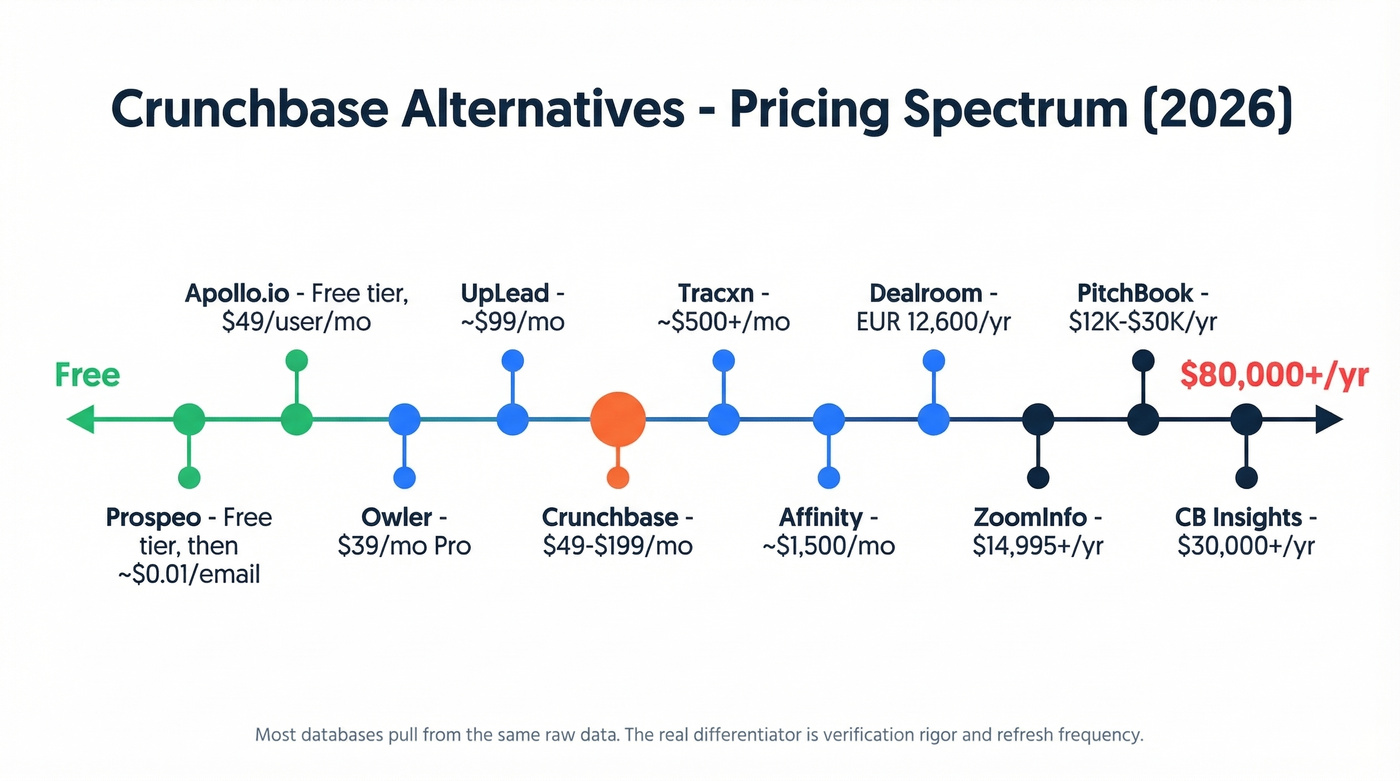
One thing worth knowing: most of these databases pull from the same raw materials - SEC Form D filings, web scraping, and user-contributed data in a give-to-get flywheel. The real differentiator is verification rigor and refresh frequency. That's why a $49/month tool can sometimes outperform a $15,000/year platform on contact accuracy. (Related: what “enrichment” actually means in practice - data enrichment services.)
| Tool | Best For | Starting Price | Free Tier? | Key Limitation |
|---|---|---|---|---|
| Prospeo | Verified emails & mobiles | ~$0.01/email | Yes (75 emails/mo) | Company/funding data isn't its focus |
| Apollo.io | Budget all-in-one | $49/user/mo | Yes | ~79% email accuracy; credits expire monthly |
| ZoomInfo | Enterprise sales intel | ~$14,995/yr | Yes (10 credits/mo) | $10K+ minimum; long sales cycle |
| PitchBook | Investor/VC research | ~$12K/seat/yr (often $20K+) | No | Expensive for non-institutional teams |
| Tracxn | Startup discovery | Free (Lite) | Yes (limited) | Premium pricing not public |
| Dealroom | European ecosystems | EUR 12,600/yr | 3-day trial | 3-seat minimum |
| Owler | Competitive intel | $39/mo (Pro) | Yes | Shallow company data |
| CB Insights | Market intelligence | ~$30,000+/yr | No | Enterprise-only pricing |
| Affinity | Relationship intel | ~$1,500/mo | No | Niche (VCs/deal teams) |
| UpLead | Budget contact data | ~$99/mo | Limited | Smaller database |

Bouncing 30% of your Crunchbase exports? Prospeo's 98% email accuracy and 7-day data refresh exist to solve exactly that. 143M+ verified emails, 125M+ verified mobiles, 30+ filters including intent data - starting free with 75 emails/month.
Stop paying for contacts that bounce. Start reaching real buyers.
Top Crunchbase Alternatives for Sales Prospecting
Prospeo - Best for Verified Contact Data

Use Prospeo if you've found the companies you want to target and need verified contact data to actually reach people there. The database covers 300M+ professional profiles with 143M+ verified emails and 125M+ verified mobile numbers. Email accuracy runs 98% - compare that to 87% at ZoomInfo and 79% at Apollo. The 7-day data refresh cycle is genuinely unusual; the industry average is six weeks.
Search filters go beyond basic firmographics: buyer intent powered by Bombora across 15,000 topics, technographics, job change signals, funding data, and headcount growth - 30+ filters total. And the proprietary email-finding infrastructure means it doesn't rely on third-party email providers, which is a big part of why accuracy stays high. If you’re building a full outbound stack, see our roundup of SDR tools.
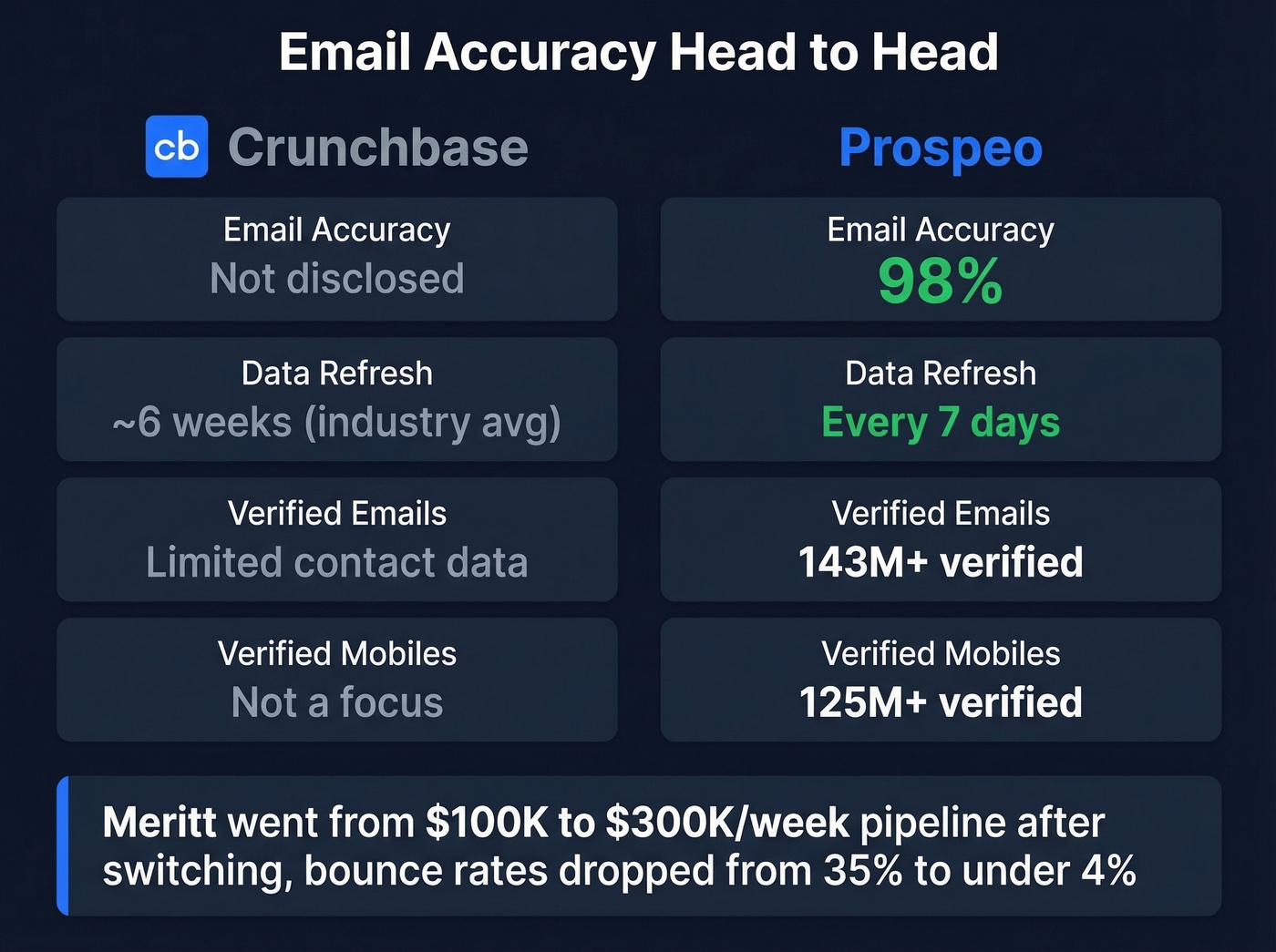
The proof point that matters: Meritt tripled their pipeline from $100K to $300K/week after switching, with bounce rates dropping from 35% to under 4%.
Prospeo focuses on the contact layer, not the company intelligence layer. Pair it with Crunchbase or Tracxn for funding histories and investor mapping, then use Prospeo to actually reach the people you've identified. Pricing starts free with 75 emails and 100 Chrome credits per month. Paid plans run about $0.01 per lead. No contracts, no sales calls required. (If you’re comparing vendors directly, see LeadMine vs Prospeo.)
Apollo.io - Best Budget All-in-One
Pros:
- Generous free tier that's actually usable for small teams
- 275M contacts with built-in outreach tools including sequencing - no need for a separate platform
- Paid plans start at $49/month for Basic, $79/month for Professional, and $119/month for Organization (minimum 3 seats)
Cons:
- Email accuracy sits around 79%, so roughly 1 in 5 emails bounce - that'll hurt your domain reputation over time (here’s how to improve sender reputation)
- Credits don't roll over between billing cycles, so you lose what you don't use
- The hybrid pricing model of seat fees plus credits gets confusing fast; you think you're paying $49/month, then realize mobile reveals and enrichment eat credits at a different rate
Apollo is the tool most teams try first when leaving Crunchbase for sales prospecting. It's a solid starting point. Just don't trust the contact data blindly - smart teams run Apollo exports through a secondary verification tool before sending.
ZoomInfo - Enterprise Sales Intelligence
Use ZoomInfo if you're a 50+ person sales org that needs a full GTM platform - intent data, workflow automation, website visitor tracking, and a massive US database. ZoomInfo's dataset includes 500M+ contacts and 100M+ companies. Nothing else matches its breadth for North American B2B data. G2 names ZoomInfo Sales as the best overall Crunchbase competitor, but that ranking reflects enterprise feature depth, not value for money.
Skip ZoomInfo if you're a 5-person startup. It's overkill, and the pricing reflects that. Plans start at $14,995/year for Professional+, climbing to $35,995/year for Elite+. Discounts of 30-65% are common with negotiation, but you're still looking at five figures minimum. Email accuracy runs about 87% - solid but not best-in-class.
There's a free tier called ZoomInfo Lite with 10 monthly credits. Enough to test the interface; most teams will need a paid plan to run campaigns at scale.
Let's be honest: ZoomInfo is still the most complete all-in-one sales platform on the market. But most teams don't need all-in-one. They need accurate emails and direct dials - and they can get those for 90% less elsewhere.
UpLead - Budget Contact Data
Use UpLead if you're on a tight budget and need basic contact data without a long-term commitment. Skip it if you need scale - the database is noticeably smaller than Apollo's or ZoomInfo's. Starting at around $99/month with email verification built in, UpLead is a decent entry point for solo founders or two-person sales teams who just need a few hundred verified contacts per month. It won't replace a full prospecting stack, but it fills a gap at a price point that won't make your CFO flinch.
Best Alternatives for Investor Research
PitchBook - Gold Standard for Funding Data
PitchBook is the tool every VC and PE firm either uses or wishes they could afford. The depth of funding data, deal comps, investor profiles, and market analysis is unmatched - if you need to know who led a Series C round, what the post-money valuation was, and which LPs are in the fund, PitchBook has it.
The catch is price. Reddit threads consistently flag sticker shock - one user balked at a "$20k subscription" for what amounted to a handful of searches. Typical pricing runs $12K-$30K/year per seat, and most teams land north of $20K once you add the modules you actually need. There's no free tier.
This is priced for institutional investors, not founders doing market research. For seed-stage startups trying to find investors, Crunchbase Pro at $49/month on an annual plan does 80% of the job at 2% of the cost. But if you're an analyst at a PE firm, PitchBook is non-negotiable.
Tracxn - Emerging Startup Discovery
Tracxn is quietly strong for discovering early-stage companies. The database covers 5.5M+ companies, 289K+ investors, and 1.2M+ funding rounds, with 3,000+ sector classifications that go deeper than most competitors. The free Lite tier lets you browse without a credit card, though exports and alerts are locked behind premium.
Where Tracxn shines is sector-level research - finding every AI-in-healthcare startup that raised a seed round in Southeast Asia, for example. Premium pricing isn't public, but expect roughly $500+/month for commercial use. The Lite tier is genuinely useful for initial exploration, making it one of the few tools where the free plan isn't just a teaser.
Dealroom - European Startup Ecosystem
Pros:
- The strongest database for European and MENA startup ecosystems - when you're sourcing deals outside the US, Dealroom often has data PitchBook misses
- Premium starts at EUR 12,600/yr with 10,000 export credits per user; Premium Plus at EUR 17,000/year adds CRM integration and 3,000 business email credits
- 3-day free trial with 50 export credits, no credit card required
Cons:
- Three-seat minimum on paid plans, so it's not ideal for solo users
- Heavily Europe-focused - US-primary deal flow will have gaps
- Export credit model means you're constantly watching your balance
Market & Competitive Intelligence
Owler - Free Competitive Intelligence
Use Owler if you want news alerts, competitive tracking, and basic company snapshots without paying anything. The Community plan is free and surprisingly useful as a complement to other tools. Pro at $39/month adds more alerts and features. (If you’re formalizing this function, see competitive intelligence strategy.)
Skip Owler if you need it to replace Crunchbase entirely. The company data is community-driven and shallow compared to dedicated databases. Think of Owler as a monitoring layer, not a research platform.
CB Insights - Market Intelligence at Scale
CB Insights is built for strategy teams and market analysts, not sales reps. The platform excels at trend analysis, industry research, and competitive mapping. Pricing runs $30K-$80K+/year - firmly enterprise territory. If you're doing board-level market analysis, it's excellent. If you're running deals under $15K, you almost certainly don't need it.
Affinity - Relationship Intelligence
Affinity maps relationship networks - who on your team knows whom, and how strong the connection is. Pricing runs roughly $1,500-$3,000/month. It's purpose-built for VCs and deal teams who source through warm intros rather than cold outbound. Niche, but very good at what it does. If your firm closes deals through relationships rather than volume outreach, Affinity pays for itself quickly. Everyone else can skip it.
How to Choose by Budget
$0/month: Start with Crunchbase's free search, Tracxn Lite for startup discovery, Owler Community for competitive news, and ZoomInfo Lite for 10 contact reveals. You can build a surprisingly functional stack for zero dollars.
Under $100/month: Apollo's Basic plan at $49/month gives you real prospecting power with built-in sequencing. Pair it with Crunchbase Pro at $49/month on an annual plan if you still need company research. UpLead at $99/month is another option for contact data on a budget.
$100-$500/month: This is where combining tools gets smart. Use Crunchbase or Tracxn for company discovery and funding research, then layer a dedicated contact data tool on top for verified emails and direct dials. The company intel tool finds the targets; the contact data tool finds the people. In our experience, the real differentiator between tools at this tier is verification quality and refresh speed, not the raw data itself. If you’re operationalizing this, start with a clean lead generation workflow.
$10K+/year: PitchBook for institutional investor research. ZoomInfo for enterprise sales intelligence. Dealroom for European ecosystems. At this budget, you're buying depth and workflow integration, not just data.
The smartest teams don't pick one tool to replace Crunchbase. They pick two - one for company intelligence, one for contact data - and spend less combined than a single enterprise platform would cost.
Most Crunchbase alternatives pull from the same stale sources. Prospeo refreshes every 7 days - not 6 weeks - using proprietary email infrastructure. Meritt cut bounce rates from 35% to under 4% and tripled their pipeline. No contracts, no sales calls, $0.01/email.
Replace stale Crunchbase exports with data that actually connects.
FAQ
Is Crunchbase still worth paying for in 2026?
Yes for casual company research and funding tracking - the interface is clean and the 4M+ company database covers most due diligence needs. No if you need accurate contact data, large exports, or fresh information. At $49/month billed annually, it's reasonable for research but limited for outbound at scale.
What's the best free alternative to Crunchbase?
Depends on the job. Apollo's free plan offers basic prospecting with sequencing. Owler's Community plan covers competitive news. Prospeo's free tier gives you 75 verified emails/month with 98% accuracy - the strongest option if your main need is reaching people, not just researching companies.
Crunchbase vs PitchBook - which should I pick?
PitchBook has dramatically deeper funding and deal data but costs $20K+/year for most teams. Crunchbase Pro at $49/month covers 80% of basic company research. Institutional investors need PitchBook. Founders doing market research are fine with Crunchbase.
Which tool has the most accurate contact data?
Prospeo leads with 98% email accuracy on a 7-day refresh cycle, plus 125M+ verified mobile numbers at a 30% pickup rate. ZoomInfo follows at 87%, and Apollo trails at roughly 79%. For teams whose primary pain is bounced emails, accuracy matters more than database size.
What about Clearbit or Lusha?
Both are solid contact enrichment tools, but they've narrowed their focus. Clearbit was acquired by HubSpot and is now deeply integrated into HubSpot's ecosystem - great if you're already a HubSpot customer, limiting if you're not. Lusha offers a clean interface and decent European data, with plans starting around $49/month. Neither replaces Crunchbase's company research layer.