

Customer Persona: How to Build One That Actually Works
A RevOps lead we know spent six weeks building four beautiful customer persona decks. Custom illustrations, detailed backstories, even Spotify playlists for each persona. Sales never opened the files. The personas described people who didn't match a single closed-won deal from the previous quarter.
That's the persona problem - most teams build fiction, not strategy.
The Short Version
- A customer persona is a research-based profile of your ideal buyer, not a demographic guess.
- Build your ICP first (which companies), then your persona (which people inside them).
- Interview 8-15 real buyers per segment. No interviews = fiction.
- Start with one primary persona. Add secondaries only when research demands it.
- The persona is useless if you don't operationalize it - embed it in campaigns, briefs, CRM workflows, and prospecting filters.
What Is a Customer Persona?
A customer persona is a semi-fictional, research-based profile that represents a segment of your target audience. It captures who your buyer is, what they're trying to accomplish, what frustrates them, and how they make decisions. The key word is research-based. A profile built from assumptions isn't a persona - it's a guess with a headshot.
You'll see the terms used interchangeably: buyer persona, marketing persona, audience persona. They're the same concept. Alan Cooper first developed the idea in 1983 while designing software, then formalized it in his 1999 book The Inmates Are Running the Asylum. His insight was simple: design for a specific person, not for "everyone." That principle applies to sales and marketing just as much as product design.
A strong persona goes beyond demographics. It includes goals, pain points, behavioral patterns, decision-making triggers, and objections. For B2B, it also includes firmographic context - company size, industry, tech stack, and budget authority. The profile should feel like someone your sales team would recognize from their last five discovery calls. Some teams build goal-based personas organized around desired outcomes, others build role-based personas organized around job function. The best B2B personas are hybrids: anchored in the buyer's role but structured around what they're trying to achieve.
Why Personas Drive Revenue
Companies that exceed revenue and lead goals are nearly twice as likely to have documented personas - 71% of overperformers have them, compared to 37% of companies that merely meet goals and 26% that miss them. Persona-driven email campaigns see 2x open rates and 5x click-through rates. One MarketingSherpa case study found persona-based campaigns drove a 900% increase in time-on-site.
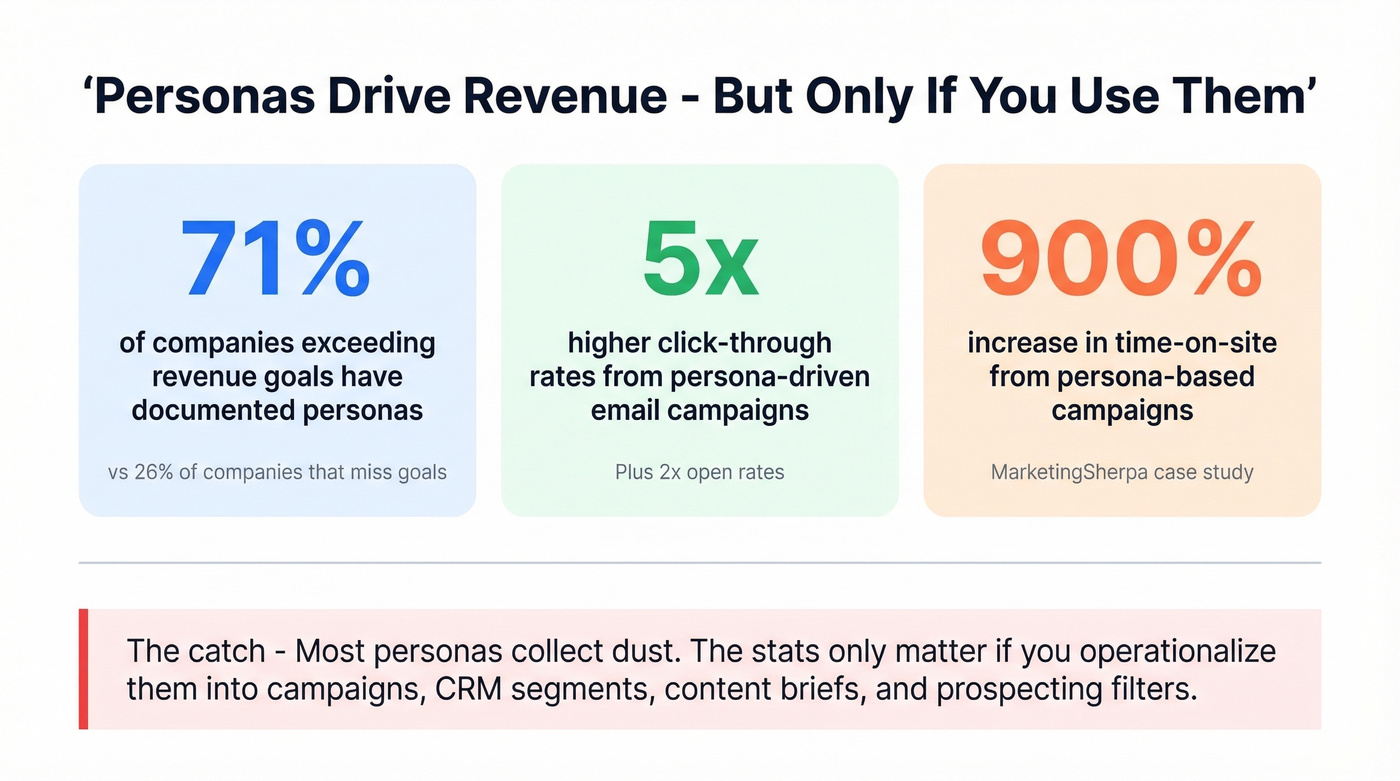
Those stats sound great in a slide deck. The reality is messier.
The consensus on r/b2bmarketing is that most personas "collect dust" - they get presented once, everyone nods, and then nobody references them again. We've seen this firsthand with clients who come to us with beautiful persona docs and zero pipeline to show for it. The stats only matter if you actually operationalize the persona into campaigns, content briefs, CRM segments, and prospecting filters. A persona that lives in a Google Doc nobody opens is worth exactly nothing.
The gap isn't in building personas. It's in using them.
Persona vs Buyer Persona vs ICP
These terms get tangled constantly. Here's the clean version.
| Definition | Key Attributes | Example | |
|---|---|---|---|
| Customer Persona | Profile of an individual buyer or user | Role, goals, pain points, behavior | VP Ops at mid-market SaaS |
| Buyer Persona | Same concept - the terms are interchangeable | Same | VP Ops at mid-market SaaS |
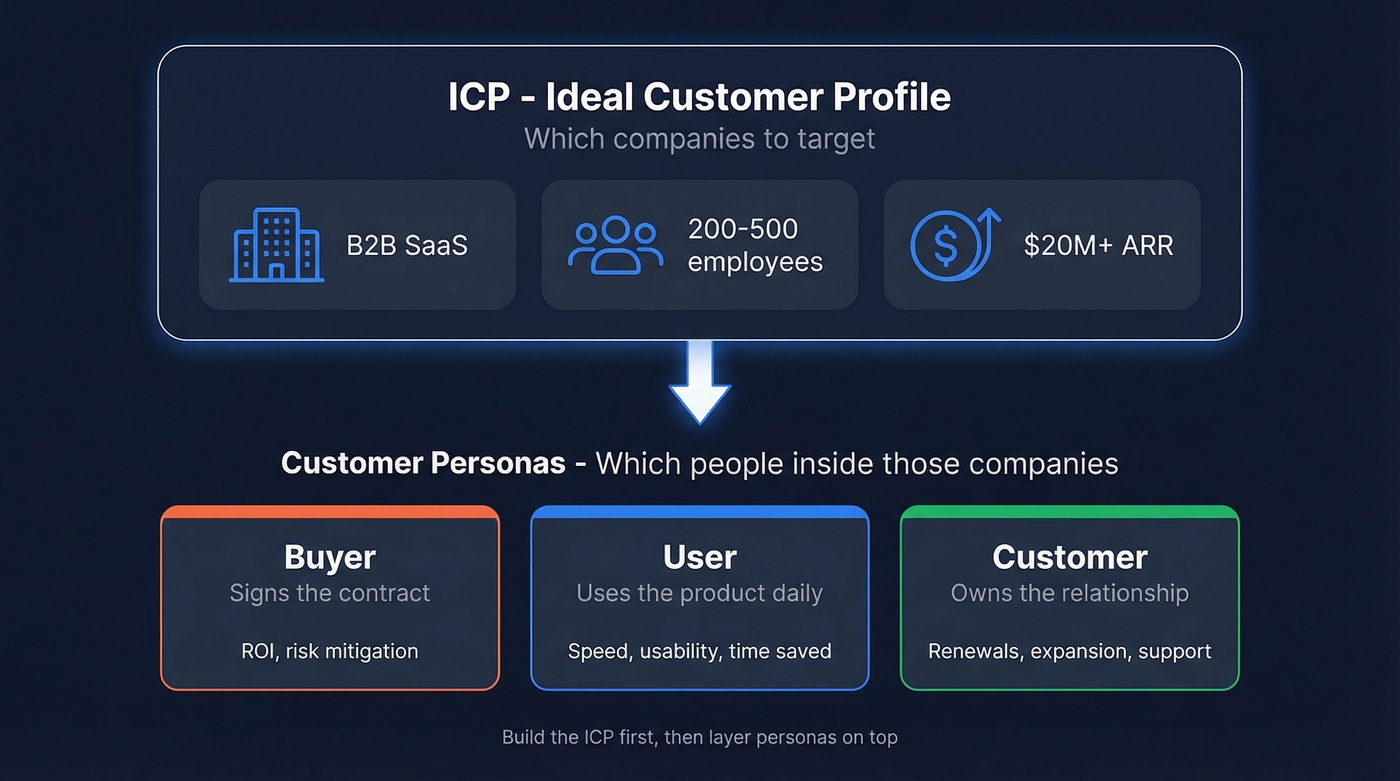
| ICP | Profile of the ideal company | Industry, size, revenue, tech stack | B2B SaaS, 200-500 employees, $20M+ ARR |
HubSpot frames it well: personas tell you who you're speaking to; ICPs tell you which companies are worth speaking to. Build the ICP first, then layer personas on top.
The classic failure mode is targeting the right person at the wrong company. Your persona might perfectly describe a VP of Operations who cares about workflow automation - but if they're at a 15-person startup with no budget, you've wasted everyone's time. ICP filters out the wrong companies. Personas filter out the wrong people within the right companies.
One more distinction worth mapping: within a single account, the buyer, the user, and the customer often have different goals entirely.
| Role | What They Do | Success Metric |
|---|---|---|
| Buyer | Signs the contract, owns the budget decision | ROI, risk mitigation |
| User | Uses the product daily | Usability, speed, time saved |
| Customer | Owns the ongoing relationship | Renewals, expansion, support quality |
Writing messaging that resonates with the buyer but alienates the user is one of the most common B2B mistakes. Map all three roles before you finalize your persona.
How to Create a Customer Persona
Define Your Segments
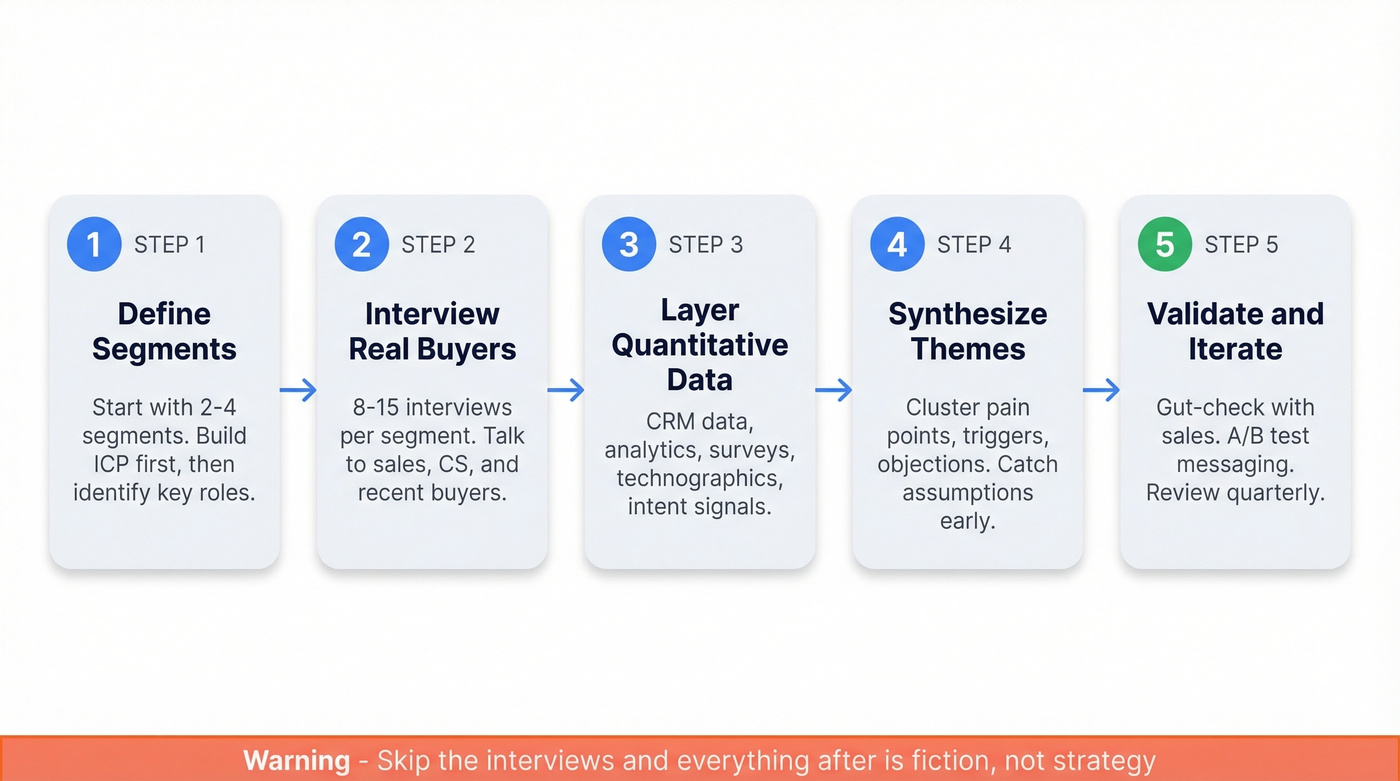
Start with 2-4 segments. Trying to cover every possible buyer type is how you end up with 12 personas and zero focus. For B2B, define your ICP first, then identify the key roles within those companies.
If you're a startup, start with one beachhead persona. Webflow's early success came from focusing obsessively on freelance designers, not "anyone who builds websites." That focus let them build specific messaging, features, and community that Wix and Squarespace couldn't match. You can always expand later. You can't un-dilute a scattered launch.
Research - Talk to Real Buyers
No amount of desk research replaces talking to actual buyers. Target 8-15 interviews per segment to reach pattern saturation. Fewer than that and you're working with anecdotes, not patterns.
Start internally. Your sales reps, customer success managers, and account managers talk to buyers every day. Ask them what questions come up most frequently on calls, what makes buyers happiest after they sign, what frustrates buyers enough to churn, and what objections kill deals most often. This costs nothing and takes an afternoon.
Then go external. The Buyer Persona Institute recommends interviewing buyers who recently made the decision you're trying to influence - not hypothetical future buyers, but people who just went through the evaluation process. Their methodology has driven results like doubled new buyer engagement and triple-digit pipeline growth for clients.
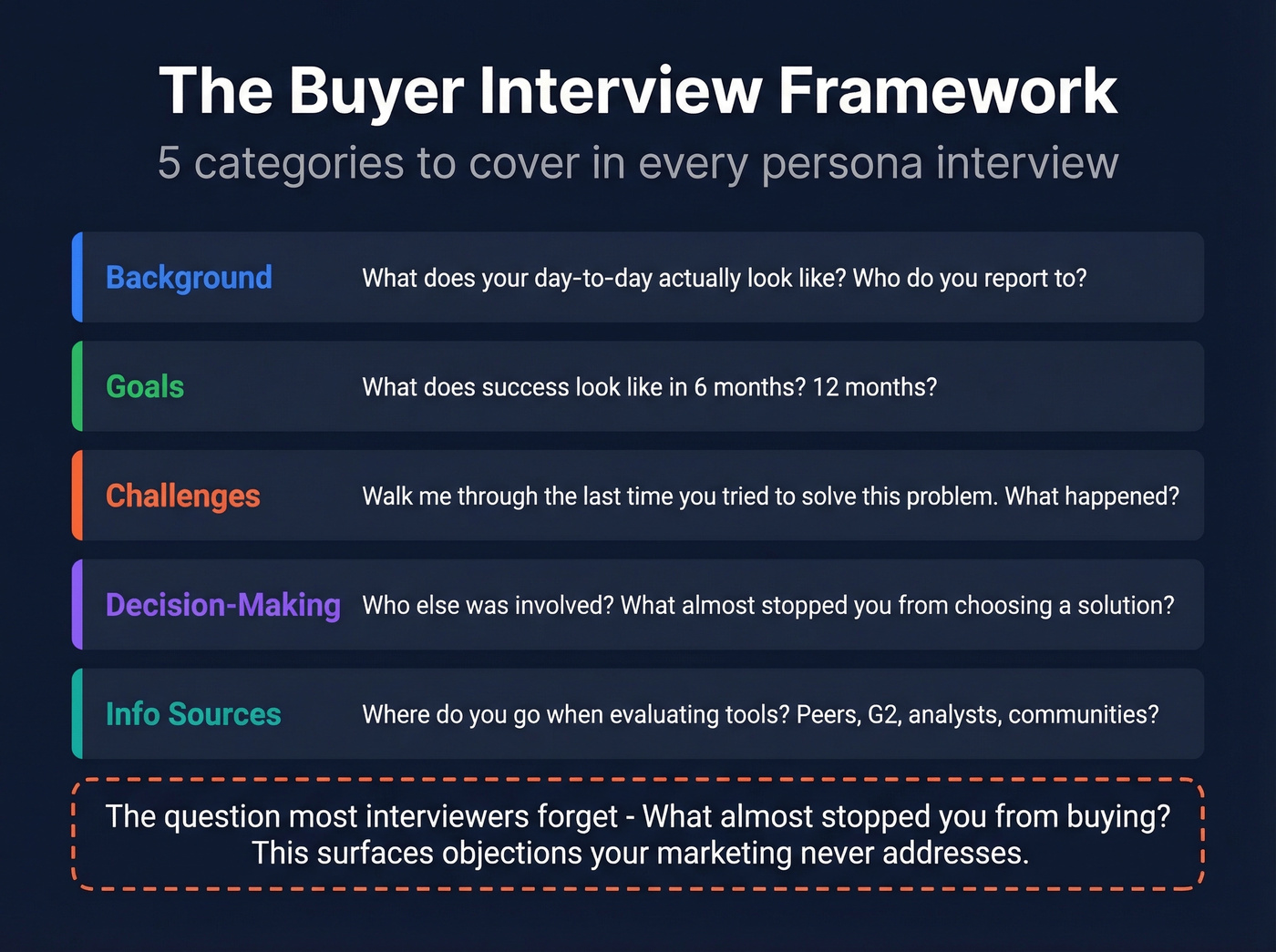
Structure your interviews around these categories:
- Background: Role, team size, reporting structure, daily responsibilities
- Goals: "What does success look like in 6 months? 12 months?"
- Challenges: "Walk me through the last time you tried to solve [problem]. What happened?"
- Decision-making: "Who else was involved in choosing a solution? What almost stopped you?"
- Information sources: "Where do you go when you're evaluating tools? Peers? G2? Analysts?"
Here's the thing: the best prompt for unlocking real insight is "What almost stopped you from choosing a solution?" That question surfaces the objections your marketing never addresses, and it's the one most interviewers forget to ask.
Layer in Quantitative Data
Interviews give you the "why." Quantitative data gives you the "how many" and "how often." Pull CRM data on activation rates, feature adoption, support ticket topics, and win/loss notes. Use Google Analytics to identify which pages prospects visit before converting and where they drop off. Validate interview themes at scale with structured surveys through SurveyMonkey or Typeform. Layer in modern signals too - technographic data showing what tools prospects use, intent data revealing what topics they're researching, and job change signals that add real-time context static demographics can't provide.
Synthesize Into Themes
Group your findings into clusters: pain points, jobs-to-be-done, buying triggers, common objections, and success metrics. Look for contradictions and trade-offs - those are often the most valuable insights.
Here's a litmus test we use internally: if your sales team calls 20 prospects matching the persona profile and half of them say "we don't have that problem," your persona was built from assumptions, not research. The "Marketing Mary" persona that looks great on paper but doesn't match reality is the most common failure mode. Synthesis is where you catch that before it costs you pipeline.
Draft the Document
Give it a name and a photo. This sounds trivial, but it makes the persona memorable and referable. "Let's check what Operations Olivia would think about this landing page" is a sentence people actually say in meetings. "Let's check what Segment 3B would think" is not.
Keep it to one page. If your persona document requires scrolling, it's too long for anyone to reference regularly. HubSpot's free Make My Persona tool can help format your findings into a shareable document - but the tool structures your research, it doesn't replace it.
Validate and Iterate
Share the draft with sales and CS for a gut-check. Do they recognize this person from their calls? If they squint and say "kind of," you need more research.
Treat each persona as a testable hypothesis, not a finished deliverable. If your persona says the buyer cares most about integration speed, run an A/B test on that messaging. Data confirms or kills the assumption. Use Likert-scale surveys - "On a scale of 1-5, how much does [pain point] affect your daily work?" - to validate interview themes across a larger sample before committing to a final profile.
Then test it live. Run a small campaign targeting the persona - a sequence, an ad set, a content piece - and measure response rates. If the persona is accurate, you should see above-average engagement. If it falls flat, something in the profile is off. Plan quarterly reviews. Markets shift, buyer behavior evolves, and your product changes. One CMO reported engaging 8,100 new buyers in a year versus 4,400 the prior year after refreshing their persona work - that's the kind of gap that makes the maintenance worth it.

Your persona says VP of Ops at mid-market SaaS. Prospeo's 30+ filters - buyer intent, technographics, headcount growth, funding - turn that persona into a live prospect list with 98% verified emails.
Stop describing your ideal buyer. Start reaching them.
Template and Examples
Persona Template
| Field | What to Include | Example Entry |
|---|---|---|
| Name & Photo | Memorable name, stock photo | "Operations Olivia" |
| Role & Seniority | Title, department, team size | VP Operations, 8-person team |
| Company Context | Size, industry, tech stack, revenue | B2B SaaS, 200-500 employees, $20M ARR |
| Goals | Short-term and long-term objectives | Reduce manual workflows by 40% this year |
| Pain Points | Challenges, frustrations, unmet needs | Data silos between tools, no single source of truth |
| Behavioral Patterns | Buying journey, info sources, decision process | Evaluates via G2 reviews and peer recommendations |
| Psychographics | Values, motivations, risk tolerance | Values efficiency over innovation; risk-averse on new vendors |
| Budget Authority | Can they sign? What's the approval process? | Owns budget up to $50K; above that needs CFO sign-off |
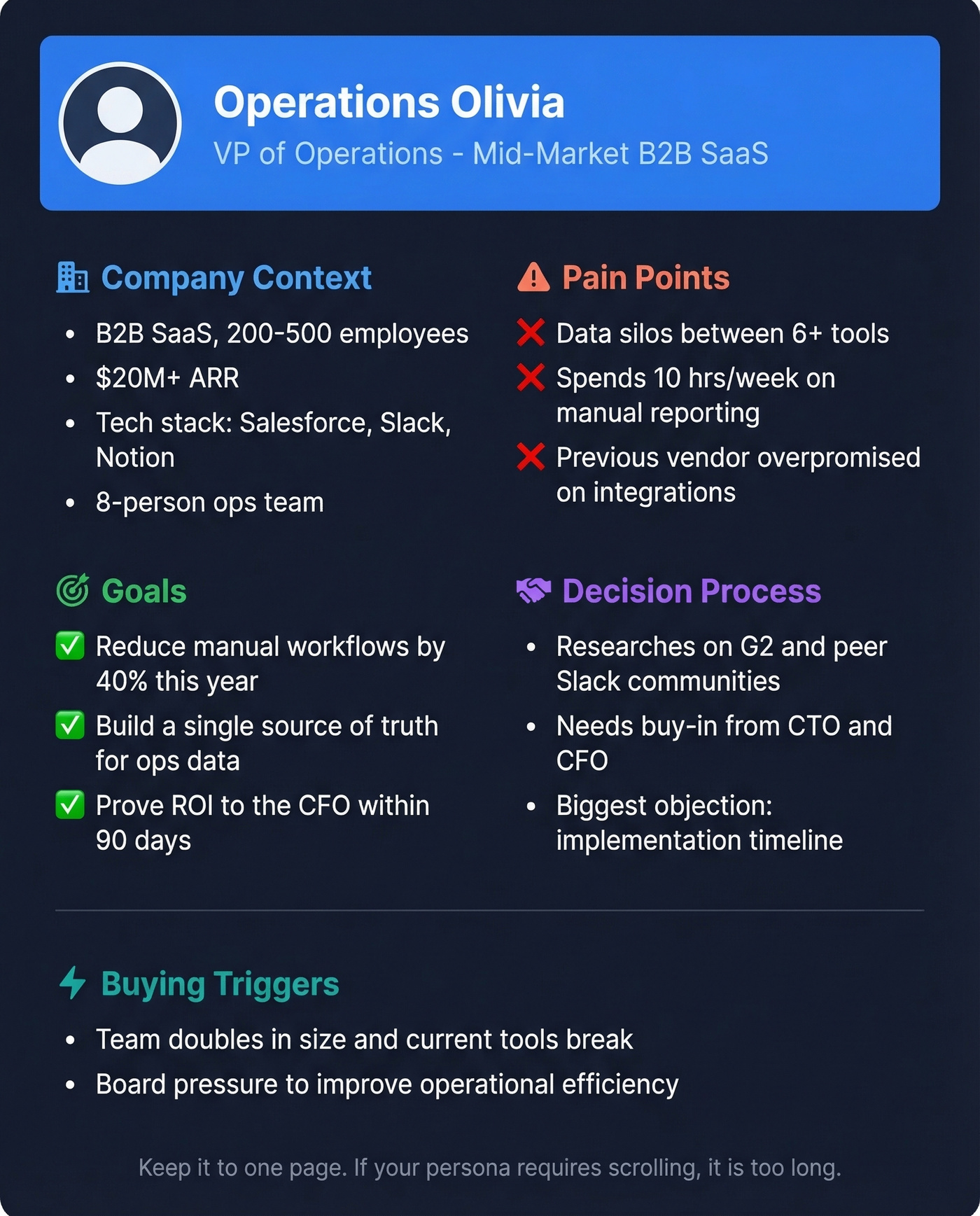
For B2B, skip the hobbies and coffee orders. Nobody's buying your software because they enjoy hiking.
Filled-In Example: B2B SaaS
"Operations Olivia"
| Field | Detail |
|---|---|
| Role | VP Operations at mid-market SaaS, 200-500 employees |
| Goals | Eliminate manual data entry; consolidate 4 tools into 2; reduce ops team overtime by 30% |
| Pain Points | Data silos across CRM, billing, and support; no visibility into cross-functional workflows; previous vendor implementations failed |
| Decision Process | Researches on G2 and asks peers in Slack communities; needs to build internal business case; CFO approves anything over $50K |
| Objections | "We tried something like this before and it didn't stick"; "My team doesn't have bandwidth for another migration" |
| Success Metric | Time saved per week on manual processes; reduction in data errors |
Notice how every field connects to a buying decision, not a lifestyle detail. Olivia's persona centers on buying committee dynamics and business outcomes. A B2C persona would shift emphasis toward lifestyle context and emotional motivations - same framework, different weight.
Common Mistakes
Building from assumptions, not research. This is the #1 killer. Marketers sit in a room, brainstorm who they think their buyer is, and produce what one r/b2bmarketing poster called "fairytale personas." The fix: no persona gets published until it's backed by at least 8 buyer interviews. Period.
Creating too many personas. If you have 12 personas, you have zero. Cooper's original insight came from designing the Palm V - he focused on one primary user, not a committee of archetypes. The Interaction Design Foundation recommends starting with one primary persona and adding secondaries only when research reveals meaningfully distinct groups. For most companies, 3-5 is the ceiling.
Leading with demographics in B2B. "Marketing Mary, 34, lives in Austin, enjoys podcasts" tells you nothing about how she buys software. B2B personas need firmographics, buying committee roles, jobs-to-be-done, and decision-making processes. Demographics are background noise, not the signal.
Using AI generators without research. AI can format a beautiful persona document in 30 seconds. It can't interview your buyers. An AI-generated persona without real research data is just your assumptions in a polished template. Use AI to synthesize and organize findings - not to fabricate them from scratch.
No operationalization plan. This is the mistake that wastes all the work. The persona deck gets presented at a team meeting, everyone agrees it's great, and then it never touches a campaign brief, CRM workflow, ad targeting setup, or prospecting filter. Before you finalize the persona, document exactly where it'll be embedded: which campaigns, which sequences, which content briefs, which CRM segments. If you can't name five places the persona will live, it's already dead.
Negative Personas - Who Not to Target
A negative persona is a profile you explicitly exclude. It's just as valuable as your target persona because it helps teams say no to poor-fit leads instead of wasting cycles on deals that'll never close.
Let's say you sell self-serve SaaS at $200/mo. Your negative persona might be "Enterprise Ed" - a CTO at a 5,000+ employee company who requires 12-month procurement cycles, on-prem deployment, and SOC 2 Type II before a first call. Enterprise Ed will consume enormous sales resources and never convert. Documenting that explicitly gives your SDRs permission to disqualify fast.
Skip this step if you're pre-product-market-fit and still figuring out who your best customers are. But the moment you have 20+ closed-won deals, you should also have a clear picture of who wastes your team's time.
From Persona to Prospecting
You've built the persona. Now you need to find 500 people who match it.
This is the gap every other persona guide ignores - the bridge from research document to actual outreach. The mapping is straightforward: persona attributes translate directly to prospecting filters. Job title becomes a role filter. Company size becomes a firmographic filter. Tech stack becomes a technographic filter. Buying signals become intent data.
I'll be blunt: if your average deal size is under $15K, you probably don't need a 12-field persona. You need three things - the right job title, the right company size, and a buying signal - and a database that lets you filter on all three. Overthinking persona details is how small teams burn a month on strategy and never send a single email.
Tools like Prospeo let you translate persona attributes into search filters across 300M+ profiles - role, seniority, company size, industry, tech stack, buyer intent signals tracking 15,000 topics, headcount growth, and job change alerts. The point is to find prospects who match your persona and are actively in-market, then export verified emails the same day instead of spending another week on list building.

Operationalizing personas means embedding them in your prospecting workflow. Prospeo lets you filter 300M+ profiles by role, company size, tech stack, and intent data across 15,000 topics - so your persona drives pipeline, not slide decks.
Turn persona research into booked meetings for $0.01 per email.
Data-Driven Personas in 2026
Static persona documents are giving way to dynamic, AI-powered segments. The shift is happening across four dimensions:
Static to dynamic. Personas update continuously based on live behavioral and transactional data, not annual research cycles. The quarterly review we recommended earlier is the minimum - leading teams are feeding CRM signals back into persona definitions in near-real-time.
Demographics to multi-dimensional. Behavioral, psychographic, technographic, and zero-party data layers replace surface-level demographics. A prospect's tech stack and recent content consumption tell you more about buying intent than their age or location ever will.
Manual to automated. Pattern recognition and predictive modeling surface segments humans miss. Academic researchers have pushed this with quantitative persona methods - using principal component analysis and latent semantic analysis to generate personas from large behavioral datasets rather than small interview samples. For most marketing teams, that's overkill. But the principle matters: the best personas blend qualitative depth from interviews with quantitative validation from data. Neither alone is enough.
Privacy-first by default. Zero-party data - information buyers voluntarily share - and first-party behavioral data are replacing third-party tracking. The teams winning in 2026 layer real-time signals like intent data and technographic shifts on top of foundational persona research. The persona document becomes a living filter, not a static artifact.
FAQ
How many personas should I create?
Three to five for most companies. Start with one primary persona based on your best-fit customers, then add secondaries only when research reveals meaningfully distinct buyer groups. Startups should focus on a single beachhead persona - one focused profile outperforms five vague ones every time.
What's the difference between a customer persona and an ICP?
An ICP defines which companies to target using firmographic criteria like industry, size, and revenue. A persona defines which people inside those companies to reach - their role, goals, pain points, and decision-making process. Build the ICP first, then layer personas on top.
How do I research a persona without a big budget?
Interview 8-15 recent buyers per segment. Start with your sales reps and CS managers, who talk to buyers daily for free. Layer in CRM behavioral data and Google Analytics. For structured surveys, tools like SurveyMonkey and Typeform have free tiers. For prospecting data to validate segments, Prospeo offers a free tier with 75 email credits and 100 Chrome extension credits monthly - enough to test whether your persona maps to real, reachable people.
Can AI build my persona?
AI can format and organize persona documents, but it can't replace buyer interviews. An AI-generated profile without real research data is your assumptions in a polished template. Use AI to synthesize interview transcripts and spot patterns across responses. Don't use it to fabricate profiles from scratch.
How do I find prospects who match my persona?
Map persona attributes to prospecting filters: job title becomes a role filter, company size becomes a firmographic filter, and buying signals become intent data criteria. Any solid B2B database will let you search by these dimensions, export verified contacts, and start outreach the same day. The persona only matters if it connects to real people you can actually reach.