

D7 Lead Finder vs Lead Carrot: Which Local Lead Scraper Is Worth Your Money?
Choosing between D7 Lead Finder and Lead Carrot comes down to what you actually need: raw volume or a tighter GoHighLevel workflow. You export a few thousand leads from D7, run them through a verifier, and a chunk bounce. Now you're wondering if Lead Carrot's data is any cleaner.
We've tested both. Let's get into it.
30-Second Verdict
- Running GoHighLevel? Lead Carrot. Its native GHL integration is the one thing it genuinely does better than D7.
- Need volume and speed? D7. Up to 30,000 leads/day on the Professional plan, with results in three minutes or less.
Side-by-Side Comparison
| D7 Lead Finder | Lead Carrot | |
|---|---|---|
| Price | $44.99-$120/mo | $47/mo flat |
| Daily leads | ~3,500-~30,000 | Not public |
| Email verification | Syntax/formatting checks only | None published |
| G2 / Capterra | 3.7/5 (5 reviews) | 3.8/5 (12 reviews) |
| GHL integration | No | Yes, native |
| Export formats | CSV, Excel, PDF | Not public |
| Data refresh | Not public | Not public |
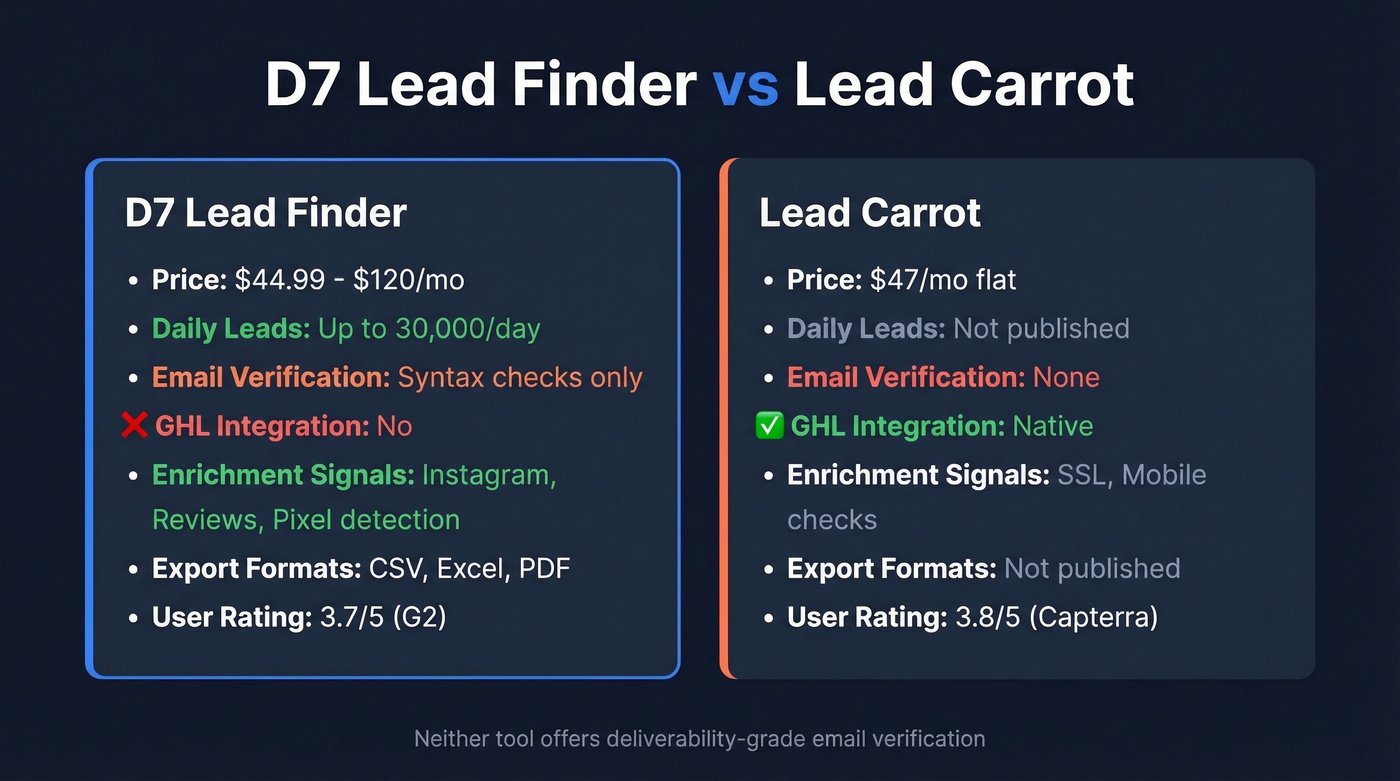
D7 Lead Finder Overview

Use D7 if you're scraping local business leads at scale across multiple countries. Three plan tiers give you flexibility: Starter at 10 daily searches and roughly 3,500 leads/day, Agency at 30 daily searches and around 10,000 leads/day, and Professional at 100 daily searches pushing up to 30,000 leads/day. Each search returns up to 1,200 results in three minutes or less, which is genuinely fast for this category.
The enrichment layer is surprisingly deep for a local scraper - Instagram data, review scores from Google, Facebook, and Yelp, plus tracking signals like Facebook Pixel detection and Google remarketing tags. If you're prospecting web design or marketing services to local businesses, those signals tell you a lot about how sophisticated a prospect's current marketing is.
Skip D7 if you need clean, verified emails out of the box. D7's built-in verification isn't deliverability-grade mailbox verification, so you'll still want an external verifier before any serious outreach (see our email deliverability guide). D7's G2 profile also shows an inactive vendor presence, which isn't a great sign for long-term product investment.
Lead Carrot Overview

Lead Carrot exists for one reason: pushing local leads straight into GoHighLevel without Zapier glue. That native GHL integration is the entire value proposition - and honestly, it's the main reason anyone picks it over D7.
At $47/mo flat, the pricing is dead simple. You get company name, email, phone, website/GMB URL, Google reviews, social URLs, plus checks like SSL status and mobile responsiveness.
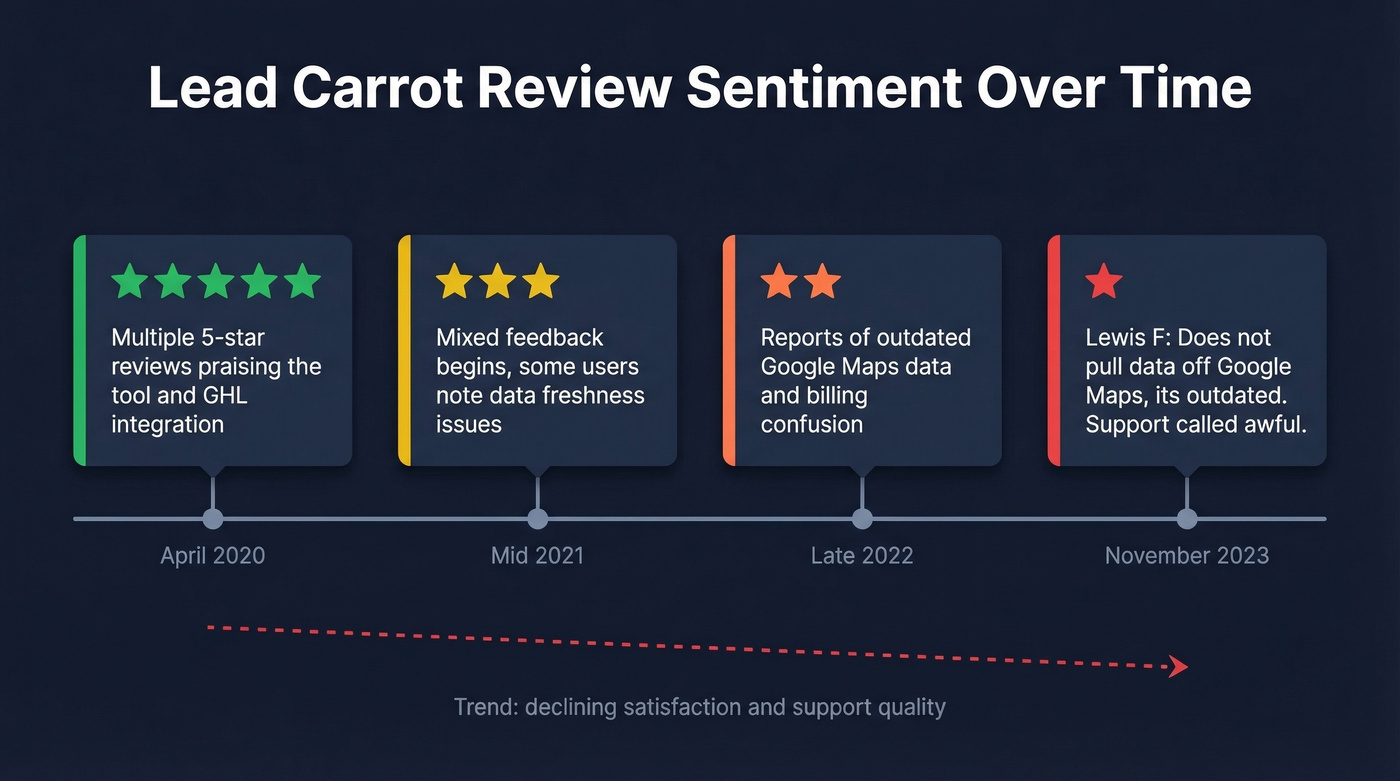
Here's the thing, though. The downsides are real. There's no free version, and at least one Capterra reviewer reported being charged despite expecting a free trial. The review timeline tells its own story: multiple 5-star reviews in April 2020 gave way to 1-star reviews by November 2023, with users citing outdated Google Maps data and poor support. There are also no published daily lead limits, which makes it hard to plan campaigns with any confidence.

D7 and Lead Carrot both force you to bolt on external email verification - adding $90-$150/mo to your real cost. Prospeo's 5-step verification is built in, delivering 98% email accuracy with a 7-day data refresh cycle. No duct-taping tools together.
Skip the scrape-then-verify stack. Get emails that actually land.
Where Each Tool Wins
D7: Speed and Volume
Three-minute results and up to 30,000 leads per day on the Professional plan make D7 the clear choice for agencies running high-volume local prospecting across multiple markets. The enrichment layer - Instagram data, review scores, ad/pixel signals - gives you extra filters that Lead Carrot simply doesn't offer (more on this in our guide to lead enrichment).
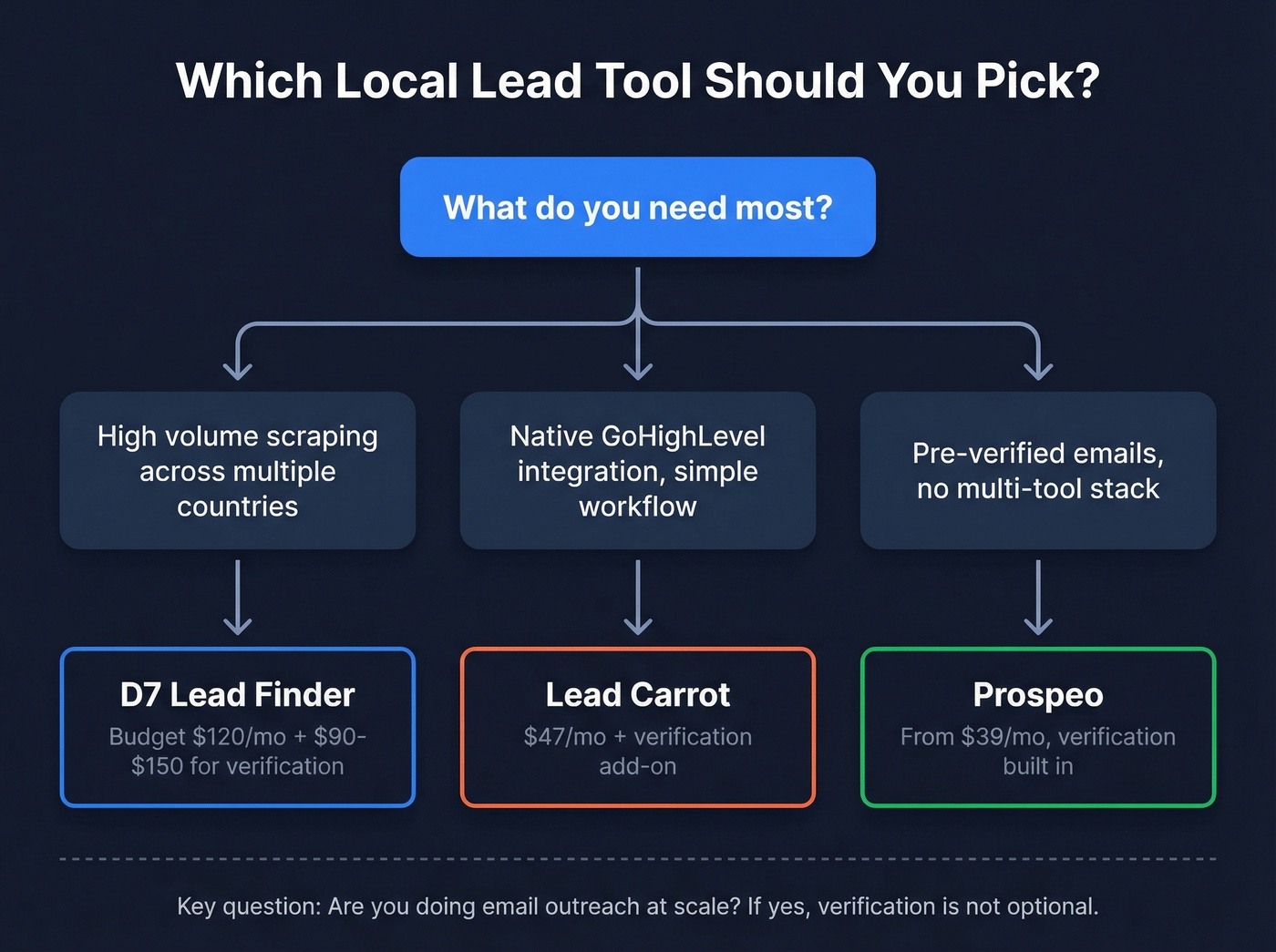
Lead Carrot: GHL Integration
One plan, one price, native push into GoHighLevel. If your entire agency workflow lives in GHL, Lead Carrot removes a step. That's the whole pitch.
Neither: Verified Emails or Fresh Data
Both tools leave you guessing on email deliverability, and neither publishes a data refresh cadence. We've seen this pattern repeatedly with local lead scrapers - they pull records fast but do nothing to keep them current, which means your bounce rates creep up the longer you wait to contact those leads (benchmarks in our email bounce rate guide).
True Cost Breakdown
Here's where the math gets uncomfortable.
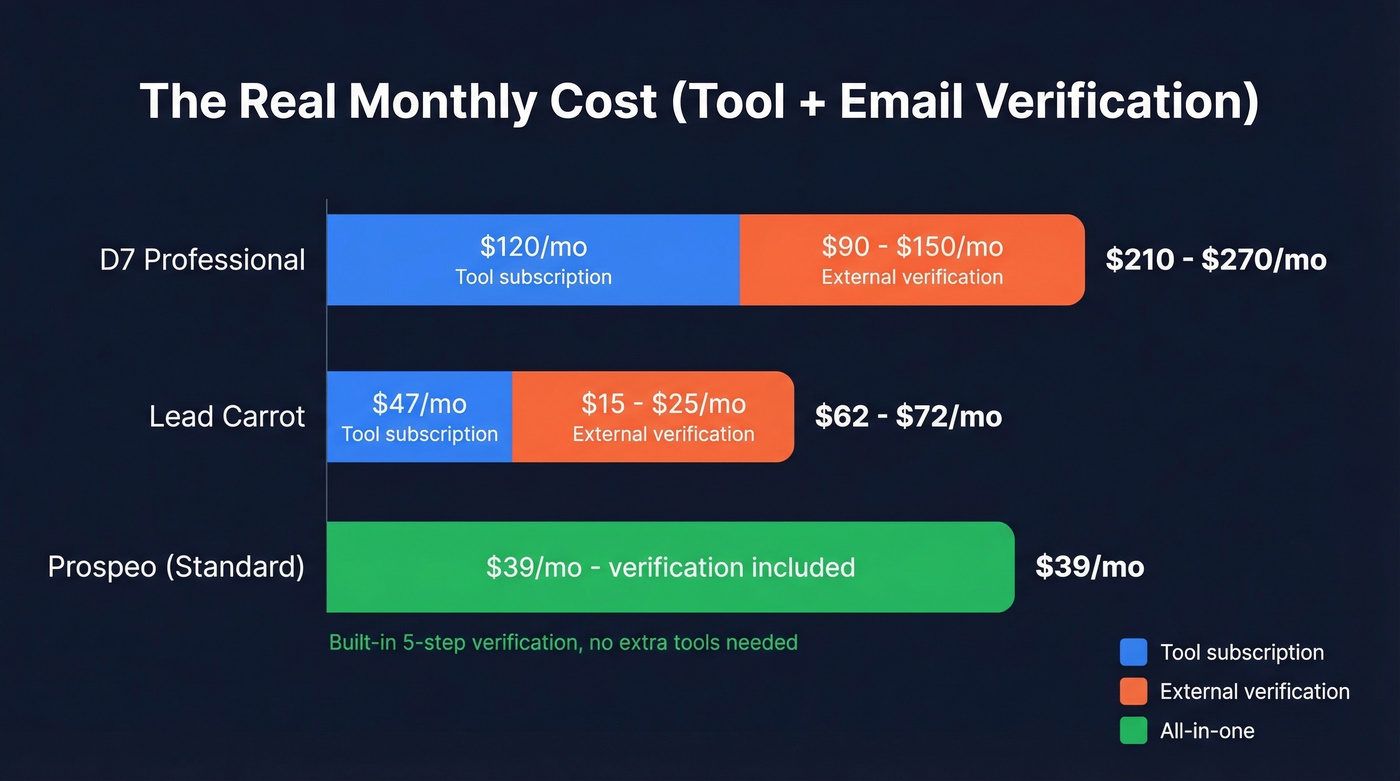
D7 Professional is commonly listed at $119.99/mo, but if you're doing email outreach, you'll almost always add external verification. Verification typically runs $0.003-$0.005 per email. Verify 30,000 emails per month and that's $90-$150/month on top of D7 - bringing a realistic "D7 Pro + verification" stack to $210-$270/month.
Lead Carrot at $47/mo looks cheaper, but you still don't get verified emails. Add $15-$25/mo for basic verification batches and you're at $62-$72/mo. More reasonable, but you're still duct-taping tools together.
Our take: if your average deal closes under a few hundred dollars, neither tool's verification gap matters enough to fix. Just call the leads. But the moment you're running email outreach at scale, the hidden verification cost makes both tools more expensive than they appear (see: bulk email threshold).
What Real Users Say
Lead Carrot's Capterra timeline is worth reading in full. Lewis F. wrote: "doesn't pull the data off Google maps, its out dated" and called support "awful." Another reviewer praised the GHL integration but reported being charged despite expecting a free trial, with support responding "too bad."
D7's signal is thin but mixed. A January 2026 G2 reviewer gave 4/5 stars, praising D7's simplicity but noting it lacks internal enrichment at scale. An earlier review titled "Zero Customer Support" recommended switching to LeadSwift as "much better." The consensus on Reddit's r/msp and r/DigitalMarketing threads leans the same way - D7 is fine for quick scrapes, but don't expect support when something breaks.
Verdict
- GHL agency needing native integration: Lead Carrot
- High-volume local scraping across multiple countries: D7 (budget for external verification)
- Need accurate, pre-verified data without a multi-tool stack: Neither. Keep reading.
Both tools are niche local scrapers built for a 2019 workflow. When weighing D7 Lead Finder vs Lead Carrot, the honest answer is that neither solves the verification problem on its own. Pick the one that fits your stack. But if you've outgrown scrape-then-verify, there's a cleaner path (see our breakdown of data enrichment services).
A Modern Alternative to Both

The free tier gives you 75 verified emails per month to test - no contracts, no credit card. Paid plans start at roughly $39/mo, with native integrations for Salesforce, HubSpot, Instantly, and Lemlist, plus Zapier and Make for workflow automation including GoHighLevel via Zapier.
If you're still comparing tools in this category, it also helps to zoom out and look at broader outbound lead generation tools and sales prospecting techniques so you don't over-optimize for scraping alone.
Neither local scraper publishes a data refresh cadence - Prospeo refreshes every 7 days, not whenever they get around to it. 300M+ profiles, 30+ filters, and verified emails at ~$0.01 each. Native HubSpot, Salesforce, and Instantly integrations included.
75 free verified emails per month. No credit card, no sales calls.
FAQ
Does D7 Lead Finder verify emails?
D7 includes basic syntax and formatting checks, but not deliverability-grade mailbox verification. Expect 15-30% bounces on raw exports. For outreach, add an external verifier like ZeroBounce or NeverBounce, or switch to a platform that verifies at the source.
Does Lead Carrot integrate with GoHighLevel?
Yes, natively. Leads push into GoHighLevel without Zapier or any middleware. Reviewers confirm the connection works for basic lead flow, though data freshness complaints suggest verifying records before outreach.
Is there a free alternative to both tools?
Prospeo offers a free tier with 75 verified emails per month and 100 Chrome extension credits. No credit card, no contract. It solves the core problem both D7 and Lead Carrot leave open: verified contact data out of the box, refreshed every 7 days.
Which tool is better for agency cold outreach?
Neither is ideal on its own. D7 gives you volume but requires external verification. Lead Carrot simplifies GHL workflows but lacks published lead limits. For cold email at scale, a platform with built-in deliverability-grade verification saves you from stacking multiple tools and burning your sender reputation in the process.